I really enjoyed the warmth and humour of this lovely tale about a country boy, finding that the 1960s isn’t the oasis of free love and hedonism promised in the media. Sam Ashby is finding that youth culture isn’t quite reaching the depths of Sussex. In order to find some excitement he takes the job of Assistant Manager at Meads Theatre in Eastbourne. This hormonally charged 19 year old is about to find his world changing in ways he never imagined. Breezing into Eastbourne is star of stage and screen Abigail Compton who is about to sweep Sam off his feet and out of his Levi 501s (shrink to fit). This is the final book in Masefield’s quintet of Sussex novels, but easily stands alone without the reader feeling they’ve missed half the story.
Sam is one of those hapless and inexperienced characters that it’s impossible not to fall in love with. There were anecdotes that made me laugh out loud – much to the annoyance of my other half who had dressed dropped off to sleep! Wanting to give off the more moody and sophisticated aura of James Dean, Sam buys a pair of shrink to fit Levi’s 501 jeans. Using his landlady’s bathroom he wedges himself into the jeans and awkwardly lowers himself into the lukewarm water. What follows in one of the funniest scenes I’ve read this year. Having grown up in the middle of rural Lincolnshire, I could identify with Sam’s frustration with his small town teenage years. There’s never enough access to fashion, the latest music or films, and it’s a case of grabbing excitement where you can. For Sam that means taking a job in his local theatre where he might have access to the bright lights and celebrities passing through. The author beautifully captures that yearning to experience something more than boring day to day family life – even when that family is much loved. We just get itchy feet at Sam’s age, to find out who we are and have our own adventures. He certainly meets some interesting characters who tread the boards; lovies and divas!
I liked the sense of place that the author creates. Even though Sam would like to be wandering beyond Eastbourne, there is a definite fondness for the area. The author writes so warmly about the beautiful countryside, it made me want to visit the area. He treads a fine line between depicting a town on the edge of decline, but the countryside being s picturesque. There’s also a great sense of the period, seen through the fashion and the actors Sam wants to emulate. The theatre itself is a wonderful backdrop to Sam’s first experiences of management. It turns out that ‘assistant manager’ is more of a ‘dogsbody’ role and as props go missing and the lighting malfunctions, Sam is simply fire-fighting all day long. Is this normal or is someone trying to sabotage the show? Given the clashing egos on the production, it wouldn’t be a surprise! Sam juggles all of this with varying degrees of success and many laughs along the way, but will the show go on and will the beautiful Miss Compton be able to grace Eastbourne with her dramatic skills? This is a lively, funny, and good-natured romp of a book. At the heart of it, Sam is a great character. Sometimes I found myself rolling my eyes at his stupidity, but I couldn’t help but like him. He’s naive, but charming, and the backdrop of old thespians sharing their ‘war stories’ only adds to this charm.
Meet The Author
Richard Masefield comes from a family of writers – John Masefield was his cousin – and with a love of animals and the outdoors he decided at a young age that he would farm and write, if necessary both at once. It took years of hard work before Richard could realise his dream, and in fact his first published novel was written while milking a herd of Friesian cows. He still lives on his farm in Sussex with his wife Lee and together they spend as much time as possible with their large family of children and grandchildren. Three Seasons of Sadie is part of a Sussex quintet including The White Cross, Brimstone, The Painted Lady and Chalkhill Blue. Each one is meant to be read as a stand-alone novel, they simply share a backdrop of the author’s beloved Sussex.
This is a deeply unsettling novel, set in a near future dystopia which reminded me somewhat of Westworld. It’s an opportunity that seven strangers can’t pass up when Timeo Technologies invites them to test out the very latest in leisure experiences. Our group of characters are promised a luxury getaway of their dreams, an adventure they’ll never forget. The last part is definitely true.
Amelia wonders why she’s been invited, especially when she meets the other guests who have more obvious benefits to Timeo – a social media influencer, a photographer, a games developer and a financier. They have nothing in common with Amelie who works for an NGO and prioritises helping others. Where do her skills fit in? However, as the trip develops it becomes clear that this seven have something else in common – each has a huge secret they wouldn’t want the world to know about. Every guest is fitted with a tracker that is symbiotic; it fastens into the skin behind the ear to tap into the body’s nervous system. Once activated it’s impossible to remove without causing damage, a sensation that made me feel really uneasy – I would be worried that it would give them control over me. Of course there is a downside. Instead of enhancing their island experience, or simply tracking where they are, this technology appears to harvest memories and then manifest the worst of them like a flickering projector film. Each person must relive a time when they behaved at their worst, knowing that every other guest can see it too. One character relives a time she attacked a girl with a glass in a nightclub. The guilt and shame is terrible and each person responds differently. As injuries and paranoia start to set in, Amelia begins to think that the only way to leave the game is to be the one left standing when the countdown ends. As each person makes their way to the big house, where a party is promised, true characters emerge and the group are split. Who will get there first and what will they have to do in order to get there?
I really enjoyed the opening chapters of the novel where we get to know the seven characters and they get to know each other. This was fascinating to read for a therapist like me, because we are only being introduced to everyone’s surface characteristics. The rest will slowly emerge. The author cleverly sets the scene with a sense of foreboding and although I wasn’t really invested in any particular character, I did start to worry about what was to come. I enjoyed the set-up of the technology, it felt believable within the context of real innovations mentioned in the narrative. This felt like the future, but not too distant. I did think the entire island was virtual for most of the narrative, because the setting felt strange. The island itself felt warmer and more tropical than an island off the south coast of the U.K. A couple of participants seem to have memories of the island and there were also moments that felt artificial, such as where Amelie noticed pixelation at the house. I wondered how far the device they were wearing created the environment and whether Amelie noticed differences because she was on an alternative type of tracker. It was more like a ‘Fitbit’ than the headset worn by the others and wasn’t quite as advanced.
To get the best reading experience I would definitely recommend reading in longer stretches. I had a lot going on when I started this and had to read in short bursts, so I did struggle to remember the characters and become fully immersed in the story. It was great to be able to read in long sections from then on and really lose myself in the story. I also think that in order to truly enjoy a story we need to engage with one of the characters, but I found that difficult to do in this novel. I really didn’t like anyone, even before their past was revealed. If anybody, I think Amelie was the one we were supposed to identify with, but for some reason this didn’t happen for me. This wasn’t just because these characters have done some terrible things, but because they felt as unreal to me as the island itself. These are not people I meet in everyday life, but then I live in a very rural part of the country and so my experience is possibly limited. Social media influencers and financiers are few and far between in Lincolnshire where you’re more likely to meet a farmer, gamekeeper or home carer. I really came away from it thinking this was a world far outside my social and economic experience.
This may say a lot about my character, but the most fascinating parts of the novel come when the characters are at odds with each other or under pressure. There’s a scene between Brenda, the banker, that’s almost Biblical! She is lured away to a quiet spot with a delicious looking picnic, but a nightmarish snake is lurking and starts to slowly wind itself around her leg. For someone with a snake phobia, this was a really vivid scene and hinted that perhaps the technology could root out each participants greatest fears. The following descriptions of Brenda’s leg, as the others try and get her to the big house before the poison takes hold, are horrific. In her pride she hasn’t wanted to tell them she was bitten, but her leg swells and changes colour dramatically and the tension created by the time scale on the injury really added urgency to the narrative.
I think the author had a brilliant premise. She has married our fear of modern technological advances with a good old-fashioned mystery in the style of Agatha Christie. You don’t know who is going to be picked off next. I did feel a bit side-swiped by the ending. It came suddenly and felt a little like the exposition of a Bond film with a villain hiding in his luxury home in an island, playing god with the guests lives. I think Susi Holliday is an incredibly talented writer. I struggled to fully engage with it though and it didn’t reach the heights of her last novel Violet which was one of my books of the year in 2019. However, if you like mysteries, morally questionable characters, and a bit of sci-fi thrown in then this might be the perfect book for you.
Meet The Author
.J.I. (Susi) Holliday grew up in East Lothian, Scotland. A life-long fan of crime and horror, her short stories have been published in various places, and she was shortlisted for the inaugural CWA Margery Allingham prize. She now lives in London (except when she is in Edinburgh) and loves to travel the world. She has written three crime novels set in the fictional Scottish town of Banktoun, which are a mix of police procedural and psychological thriller. They are: “Black Wood”, “Willow Walk” and “The Damselfly” – all featuring the much loved character, Sergeant Davie Gray.
Her serial killer thriller “The Deaths of December” (written as Susi Holliday), featuring Detective Sergeant Eddie Carmine and Detective Constable Becky Greene was a festive hit in 2017. Her spooky mystery “The Lingering” was released in September 2018, followed by “Violet” – a psychological thriller set on the Trans-Siberian Express – in September 2019. “Violet” has been optioned for film. Writing as Susi Holliday (again!) her next two releases, “The Last Resort” and “Substitute” are due out from Thomas & Mercer late 2020 and summer 2021 – both of these books are suspense thrillers with a technological element (a blend of Black Mirror, Tales of the Unexpected and The Twilight Zone).
I haven’t put the Christmas Tree up yet this year, but when I do there’s always a wonderfully quiet moment when I feel a sense of calm and well-being settle over me. Somehow, no matter how I’ve felt beforehand, that time when the tree lights are lit, the candles are on and I’ve got a glass of Bailey’s in hand is the moment when I settle into the Christmas season. There’s something about a cosy living room with a lit Christmas tree that brings a little bit of magic into the home. Our spirits lift and even the barest room looks that little bit more welcoming. My tree has so many different decorations on it and each one represents somewhere or someone that’s important to me. My woodland decorations represent my growing up in the country. My Liverpool skyline baubles represent my Mum’s home town. I have beautiful Polish glass baubles inherited from my Polish in-laws or bought for me by my late husband. Last year my stepdaughters each added a bit of their own personality to the tree, so we now have glamorous cheetahs wearing crowns and some very quirky llamas.
Of course you’ll want to know about my bookish baubles: they are white rabbits with playing cards, silver Moomin houses, and glass baubles with lines from Jane Eyre and Wuthering Heights inside, and finally clocks to represent The Night Circus. I know most of us bookish people like to give and receive bookish gifts and I know a lot of book bloggers do their Christmas round-ups or best books lists around now. I wanted to do something a little different and with my therapist head on I thought I’d create a list of books to support and promote wellbeing at this time of year. It’s been a hard year and we’re not quite out of the woods yet. For my part, due to my MS and other health difficulties, I have been mostly shielding at home and I haven’t really adjusted to the changes very well. We’ve had to cancel our wedding. Twice. Cancelled two holidays. Got through my Dad’s very scary Triple ‘A’ surgery. Now we’re going through a stressful house move that’s going to carry over into 2021, but needs to be complete before the stamp duty holiday ends! So how do we look after ourselves through this time? Especially bearing in mind that most of our time will be spent at home. I’ve put together a list of gift books that you might want to buy yourself, or someone special this Christmas.
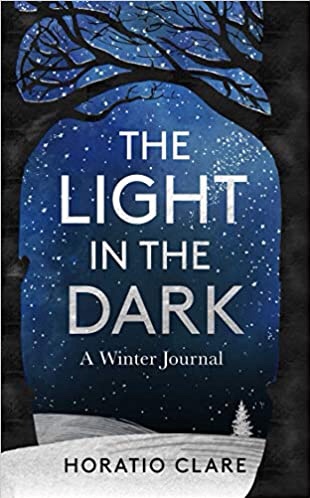
1. The Light in the Dark by Horatio Clare
Publisher: Elliot and Thompson ISBN: 978-1783964048
As November stubs out the glow of autumn and the days tighten into shorter hours, winter’s occupation begins. Preparing for winter has its own rhythms, as old as our exchanges with the land. Of all the seasons, it draws us together. But winter can be tough.
It is a time of introspection, of looking inwards. Seasonal sadness; winter blues; depression – such feelings are widespread in the darker months. But by looking outwards, by being in and observing nature, we can appreciate its rhythms and finds consolation. In this moving and lyrical evocation of a British winter and the feelings it inspires, Horatio Clare raises a torch against the darkness, illuminating the blackest corners of the season, and delving into memory and myth to explore the powerful hold that winter has on us. By learning to see, we can find the magic, the light that burns bright at the heart of winter: spring will come again.
2. Create Your Life Book by Tamara Laporte
Publisher: Quarry Books ISBN: 978-1631593536
This is a gorgeous book for any teenage girl or artist in your life.
Inspired by Tamara Laporte’s art classes, Create Your Life Bookpresents 18 step-by-step projects that help you explore and work through issues surrounding creative fulfillment. Based on much-loved mixed-media artist Tamara Laporte’s popular, multi-year series of online classes, Create Your Life Book offers mixed-media drawing and painting projects that can raise your awareness of and help youwork through personal challenges and other obstacles to creating art and achieving self-fulfillment. There are themed chapters that target issues hampering creativity, then an art project that helps you work through it. With a year like this I know a lot of people have struggled to create. I use a lot of mixed media projects when I’m doing mental health workshops and it’s amazing how much they unlock feelings and lift the spirits.
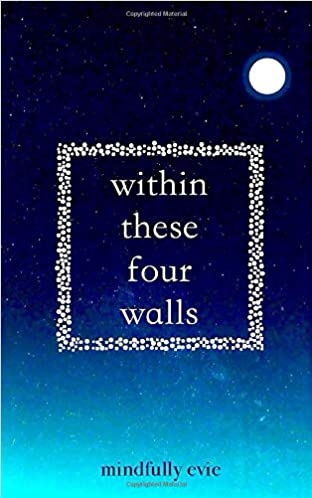
Mindfully Evie started as a blog, that grew from Evie’s experience with chronic illness (Lyme Disease and M.E). I work a lot with people who have chronic illness and disability, and this year has been especially difficult. Many are having to shelter due to being immune-compromised, and it can be really boring and lonely. I didn’t leave the house for four months earlier this year. People like me have a lot of skills and wisdom to share about how to cope with being at home, how to create happiness within imposed limitations and finding the joy in everyday life. Every word written in this book was written from within the confines of Evie’s home. Spanning over nearly three years this book is proof that despite being housebound, there is always happiness to be created, peace to be unearthed, and a life to be lived. Written within sections starting with the ‘The Storm’ this follows Evie’s journey when adjusting to her new circumstances. This is a great gift for anyone who has been struggling to be at home, or for the ‘spoonie’ in your life who is finding the pandemic harder than most.
4. The Christmas We Spent Apart by Toni McAree and Stephanie Hope.
This is a lovely gift for those you’re apart from this Christmas, perhaps instead of a Christmas card for those special friends and family. This is a pretty illustrated poem in scrapbook form, it allows you and your family to add personal details like photographs and handprints. It’s a great way to explain the differences this Christmas to your children as they do the activities, and leave as a gift basket or post out to loved ones.
I’ll still set up and reserve your normal space and imagine I’m sitting there seeing your face. Whenever it’s making me feel really sad, if it’s keeping you safe then I’ll choose to be glad. It’s made me realise that Christmas is not about things, but the joy of being around the ones you love brings. The biggest present would be holding you close, it can’t happen this year but it’s what I look forward to most.
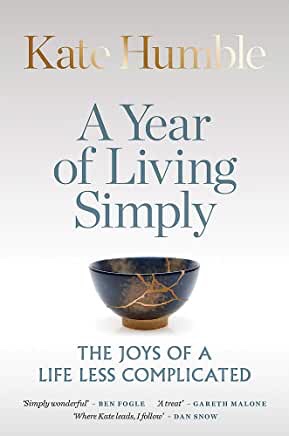
5. A Year of Living Simply by Kate Humble.
Publisher: Aster ISBN: 978-1783253425
From my chats with people over the last few months I realise that people are re-evaluating their lives. We’ve done it ourselves. After a year of living in the city with my partner and his daughters, most of it indoors, I realised how much I missed living in the country. My little barn wasn’t big enough for all of us, so I made the move, but I found the city too impersonal. I went days in lockdown not seeing anyone from 7am – 4pm. So we put the house on the market and in the new year we’ll be moving to a cottage in a small village with a shop, post office and pub. We have realised we’d like to live more within a community, to live more simply and do without things we don’t truly need.
If there is one thing that most of us aspire to, it is, simply, to be happy. But happiness has become anything but simple. Having stuff – The Latest, The Newest, The Best Yet – is peddled as the sure fire route to happiness. So why then, in our consumer-driven society, is depression, stress and anxiety ever more common, affecting every strata of society and every age, even, worryingly, the very young? Why is it, when we have so much, that many of us still feel we are missing something and the rush of pleasure when we buy something new turns so quickly into a feeling of emptiness, or purposelessness, or guilt? So what is the route to real, deep, long lasting happiness? Could it be that our lives have just become overly crowded, that we’ve lost sight of the things – the simple things – that give a sense of achievement, a feeling of joy or excitement? That make us happy. Kate Humble’s exploration of a stripped-back approach to life is uplifting, engaging and inspiring – and will help us all find balance and happiness every day.
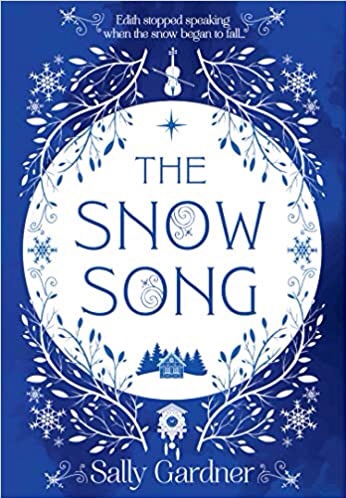
6. The Snow Song by Sally Gardner.
Publisher: HQ. ISBN: 978-0008217402
Sally Gardner’s beautiful book is the perfect gift this Christmas because, not only does it look gorgeous, but it is a story filled with love and magic. This Christmas, maybe more than most, we need to escape and this will take the reader into a spellbinding world. Gardner has imagined a world perched on a mountain, covered in ancient forests. Within this is a village, rife with secrets and cut off from the outside world. This village is run by the elders, men to whom tradition is all. Edith lives alone with her alcoholic father who is forcing her to marry the village butcher. But she is in love with a shepherd who promised to return to her. When the shepherd left the village, Edith’s father makes her promise that if he doesn’t return before the first snow, she will marry the butcher. When he doesn’t return, Edith’s hair turns white as snow and she loses her speech. Soon the village becomes isolated in a sea of snow and this enchantment that will have far-reaching consequences, not only for Edith but for the whole village. One by one the women of the village try to overcome their oppression and help Edith in her plight. Despite the terrible treatment from her father and her lack of voice, Edith has a silent strength which is inspiring to the other women and to me. Even though we see the worst of human greed and abuses of power, this book is beautiful and always has an underlying hope. Buy it for anyone who loves a fairytale, stunning artwork and needs to know there is always a light in the darkness.
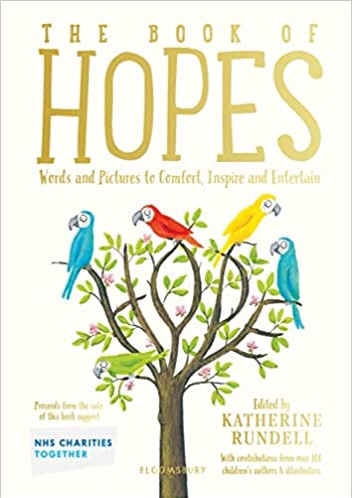
When life is hard what we need more than anything is hope: that things will be okay; that we will cope; that there is a way through to the other side of this slump. Children need this just as much as we do. This is a lovely gift book for the children in your life and every sale raises money for the NHS Charities Together. Editor and author Katherine Rundell emailed children’s authors and artists she liked best and asked them to contribute a short piece for the book, something that would raise curiosity, a sense of possibility or simply a snigger or smile. Within its pages you’ll find animal friends from insects to elephants, high-flying grandmas, a homesick sprite, the tooth fairy, and even extra-terrestrial life.
There are 133 contributions from authors and illustrators, including Anthony Horowitz, Axel Scheffler, Catherine Johnson, Jacqueline Wilson, Katherine Rundell, Lauren Child, Michael Morpurgo and Onjali Q. Raúf. Between them they have created a wonderful anthology that’s great to dip into when low, or just to pass the time on long days at home. It might even provide inspiration for your own family creations.
8. Away With The Penguins by Hazel Prior.
Publisher: Black Swan. ISBN: 978-1784164249
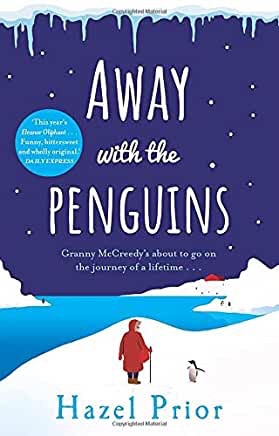
When I read my fellow bloggers reviews of this book, the word I kept seeing more than any other was ‘uplifting’. Veronica McCreedy lives in a mansion by the sea. She loves a nice cup of Darjeeling tea whilst watching a good wildlife documentary. And she’s never seen without her ruby-red lipstick.Although these days Veronica is rarely seen by anyone because, at 85, her days are spent mostly at home, alone. She can be found either collecting litter from the beach (‘people who litter the countryside should be shot’), trying to locate her glasses (‘someone must have moved them’) or shouting instructions to her assistant, Eileen (‘Eileen, door!’). Veronica doesn’t have family or friends nearby. Not that she knows about, anyway . . . And she has no idea where she’s going to leave her considerable wealth when she dies. Then a grandson is unearthed, but Veronica is underwhelmed by Patrick, whose life has fallen apart somewhat.
Inspired by her love of wildlife documentaries, she decides she wants to visit Locket Island and help out with the research team helping the Adelie Penguins. The team try to dissuade her but she won’t take no for an answer and offers them funding, but wants three weeks accommodation at the research station. Here she starts a blog on her adventures, making connections with new people and rescues a baby penguin, Pip. The experiences start to open her up and we start to learn about her wartime past. A diary she wrote about her experiences brings her and Patrick closer too, as he learns that she was once full of youth, vitality and dreams for her future. Then the death of her parents, the loss of a baby and finally marriage to a man who is forever unfaithful have gradually dulled her sparkle and trust in others. We start to see cracks in her harsh facade and learn that even people who seem set in their ways can change. Veronica will always be a force of nature, but in this quirky and uplifting book we realise she can learn to soften, and form new relationships. Simply gorgeous and unashamedly sentimental.
9. The Unwinding by Jackie Morris.
Publisher: Unbound. ISBN: 978-1784164249
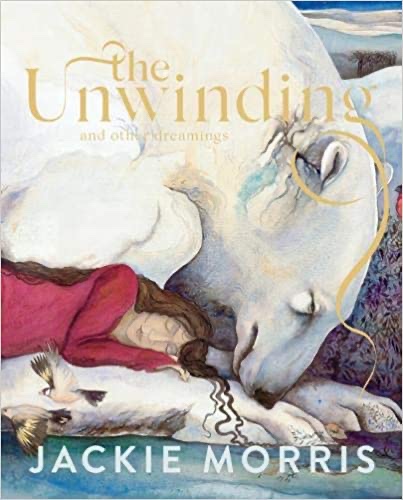
I absolutely love Jackie Morris’s artwork and her book The Lost Spells is one of this year’s Christmas picks with most booksellers. This is an earlier book, but I’ve chosen it because I think the illustrations are magical and it fulfils that need for quiet contemplation. When we are assailed by so much information, change and constant news updates our brain becomes completely overloaded. If we are introverted it can be very hard to cope with the sheer amount of noise the world produces. I’m sure I’m not the only one who has reduced their intake of news over the year, but I’ve also removed news alerts from our tablets and phones, kept my social media politics free where possible and turned off alarms and alerts for all my accounts. This may seem extreme, but it leaves me in control of when I dip my toe into reality and gives me space to be quiet, separate, happy and creative. I believe constant media alerts make us anxious and ramp up our sense that everything in the world is a disaster. However, if we keep updated here and there, but then focus on our own lives, families, friends and homes there is so much to be grateful for and happy about. Between its illustrations there are brief but lyrical words intended to make us curious, inspire us and create a space for our minds to wonder and unwind. Kept as a companion by the bedside, it’s a beautiful book to settle with at night, to flick through and quiet the mind. There is a companion book The Silent Unwinding that provides space for your own thoughts and feelings.
10. A Poem For Every Winter Day Edited by Allie Asiri
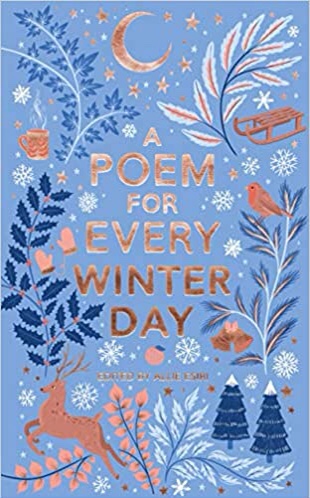
Sometimes, the only thing that will settle and relax me is poetry. There are times due to my MS and chronic pain that I find concentration difficult, so following a narrative or tackling a weighty novel just won’t work. I can always find consolation in a poem and their meaning unfurls beautifully when they’re read slowly. This volume of poetry takes us into winter, through Christmas and New Year all the way through to Valentine’s Day. It includes poems by Edgar Allen Poe, Thomas Hardy, Jackie Kay, Mary Oliver and Benjamin Zephaniah. Winter can feel endless, especially if you struggle with the lack of light and feel low at this time of year. This book highlights the parts of winter we can look forward to: the magic of frosty weather, the build-up to Christmas, the promise of a new year and the cosy warmth of our homes and families. It shows there are things to be grateful for and look forward to in this darker season. It’s great to dip in and out of and with its range of writers it should have someone for everyone.
I hope that’s given you some ideas to lift your own spirits this winter and gift inspiration for the people you love, especially this year when Christmas is going to be very different and we all need some support. There will be something here to fit anyone and I hope the suggestions help you support yourself and your loved ones this Christmas. 🎄🎉❄️
When I was first offered this book by the publisher I didn’t know what to expect. I hadn’t read the earlier books in the series and had never come across Rod Humphris or his hero Simon Ellice before. Having been assured I could enjoy this as a stand-alone novel I decided to have a go and read something out of my comfort zone. Simon retires from life in the city back to the Hampshire village he lived in when he was a child. He finds solace and comfort in the change of pace, and starts to work on a local farm where he finds some peace and tranquility. However, he seems to be the sort of character that trouble follows and it’s not long before he uncovers a mystery with its roots back in the London underworld he left behind. When old friends go missing he has to use his skills to investigate, finding murder, poison and pagan rituals threatening those closest to him. In what is billed as Ellice’s most challenging case, this is a fast paced novel with themes of sacrifice and objectification, that go to the very heart of our society.
This really was a novel of contrasts in settings, pace and structure. Simon, or Si to his friends, has been living mainly on his yacht – Polly, moored at a London dockside. In this novel we see quite a contrast between his previous life based in London and the new life he is trying to create in Hampshire. London is dark, murky and noisy in contrast to the peaceful pastoral scenes of the countryside. It pits something wholesome and gentle against a more aggressive and dangerous city where Si liked to party in nightclubs with beautiful women hanging on his arm and his every word. These two settings are in a way linked to Si’s character, especially as he is getting older. He has a darker, more cynical side that is used to dealing with the criminal underworld, but there is also a softer, more restful side that wants to calm down and this gentler side comes out more as he works on his friend’s farm. The London chapters are more punchy and fast moving, whereas the countryside sections have more flow and a much slower pace. The plot revolves around missing aristocratic women, who have developed drug habits before disappearing, then turning up dead. I don’t want to ruin the story with spoilers so that’s all I will divulge. but it is an exciting plot that really held my attention throughout.
There were elements of Si’s character and his adventures that reminded me of Bond, but Bond in a darker story with a dash of black humour thrown in too. I wasn’t sure if I liked him or not in parts, but there’s no arguing with how brilliant he is at his job. I love characters like this who are flawed, perhaps even difficult, but ruthlessly good at what they do. I wasn’t sure if I wanted him as a friend, but I would want him on my side if I was in trouble. I found it interesting that unlike other high octane thrillers, the women were just as strong as the men. In some cases they were just as crazy too. I also enjoyed the fact that Si now works for Whitehall, so could be seen as part of the establishment, but some of his more questionable methods could raise a few eyebrows. The author kept drip feeding just enough information to keep the reader interested, but never enough to work out what would happen. The ending left me thinking about it and still making connections in my mind. This was more of an action story than I would normally have chosen, but I did enjoy it enough to look for the author’s earlier novels. It was intelligent, exciting and at times darkly humorous. Definitely worth seeking out for those who enjoy crime thrillers and for those who want to try some thrilling action and escapism.
Meet The Author
In his office you will find Rod typing, flanked by two enormous dogs, and surrounded by the ephemera he has collected on his travels. “I always read. Since I can remember. First Asterix, then Willard Price, then Conan Doyle, then everything else. I’ve had a paperback jammed into my back pocket most days of my life. I remember wanting to write a book when I was about 12 and wanting to put everything into it” “I’ve read every kind of book, but the ones I love most are stories of adventure, so that’s what I write. I’ve put thousands of hours into learning to do it well. It’s taken me a long time, but I’ve developed my own voice and my own style. I spend so much time with Si, my main character, that he seems as real to me as anyone I know. In some cases, more so. I’m happiest and most productive when travelling about in my battered old truck with a canoe on top and a dog in the back.” Rod Humphris is the winner of N. N. Light Best Fiction Award 2016 @Rod_Humphris
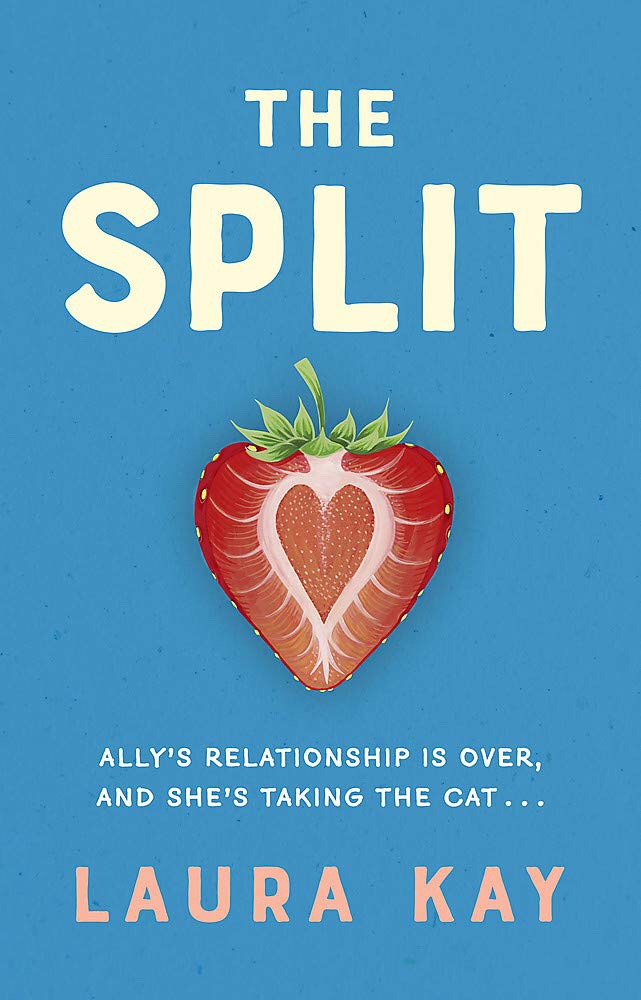
A brilliant, heart-warming and intensely funny story of love, heartache, friendship and family. Perfect for fans of Marian Keyes and Beth O’Leary.
Brutally dumped by her girlfriend, Ally is homeless, friendless and jobless… but at least she has Malcolm. Wounded and betrayed, Ally has made off with the one thing she thinks might soothe the pain: Emily’s cat.
After a long train journey she arrives home to her dad in Sheffield, ready to fold herself up in her duvet and remain on the sofa for the foreseeable. Her dad has other ideas. A phone call later, and Ally is reunited with her first ever beard and friend of old, Jeremy. He too is broken-hearted and living at home again.
In an inspired effort to hold each other up, the pair decide to sign up for the local half marathon in a bid to impress their exes with their commitment and athleticism.
Given neither of them can run, they enlist the support of athletic, not to mention beautiful, Jo. But will she have them running for the hills… or will their ridiculous plan pay off…?
I’m looking forward to this book so much. Even the proof cover is funny and gives you a good idea of the offbeat humour inside. I also loved that it’s a romantic, comic novel about a same sex relationship – this should just be a norm, but in my reading experience is quite rare. I was also drawn in by the promise of a long train journey with a cat to Sheffield. Sheffield is very local to me, and once on a journey back from Liverpool I was sat on the middle platform at Sheffield station, drinking a chai tea and people watching. On the next platform down was another bench where a young man was desperately trying to get a fighting cat back into a cardboard box. I stood up to help, just as he managed to get it in the box and close the flaps. On the final stretch of my journey I remember wondering what on earth had made the man take a train journey with a cat in a cardboard box? Even more, what had possessed him to take the cat out at a major railway station on the middle platform. I now know that books are borne out of such inspiration!!
Laura Kay wrote the book because she had been fed up of not seeing herself represented in romcoms, and placing a queer character as the heroine, rather than the token funny friend is refreshing. It had always been there in her head. She says she’d been writing the book in snippets and phrases for a long time, but was finally pushed into writing the book because she wanted to read it. She wanted to represent friendship between two queer characters in her depiction of Ally and Jeremy. Most importantly she wanted to write about cake, which is one of my favourite subjects. This book is heartfelt, warm and very funny, plus it addresses that terrible conflict of loving a horrible pet that simply cannot stand you. What more could you want for 2021? Look out for my full review on publication.
Meet The Author
Laura has an MA in American History from the University of Sheffield and works as a writer and editor. She lives in London with her wife and cat. This is her debut novel.
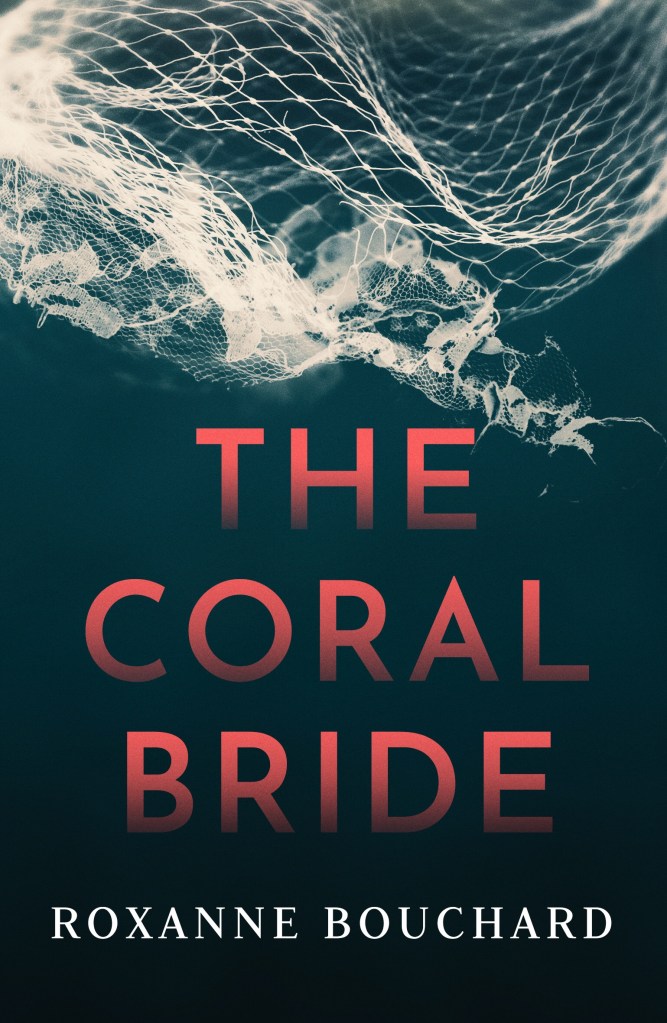
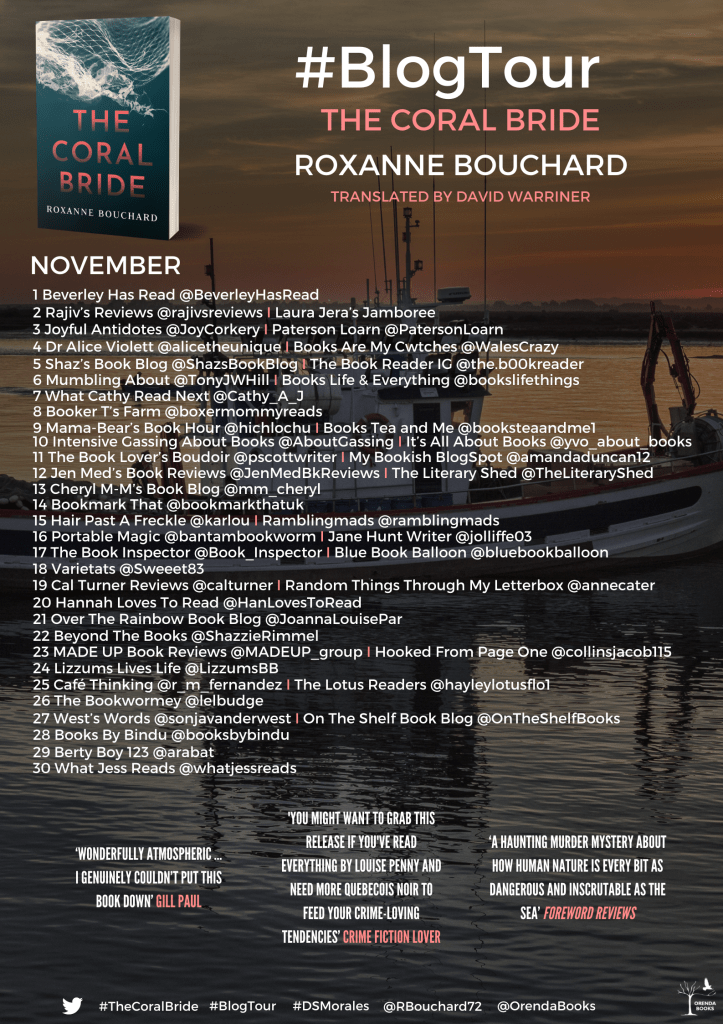
The Coral Bride is the second novel in Roxanne Bouchard’s D.S Morales series, the first being We Are The Salt Of The Sea. I think this easily read as a stand alone novel, but I enjoyed it so much that I’m going to read the first one. I’m not surprised, because I’ve never met an Orenda book I didn’t like!
The opening to the novel is haunting as a woman lies on the deck of a fishing boat. Somehow she has been rigged up so that she will eventually be dragged from the trawler and under the freezing cold water. She knows these are her final moments. As an opening it is very effective and sets up the main character in the novel: the sea. The sea is the life’s blood of people in this region – a small fishing village in Quebec. Angel Roberts is a very rare thing in this community, a woman with her own trawler who fishes for lobster. She’s named her boat Close Call II showing a good sense of humour too. The sea is her livelihood and there’s definitely an affinity with it. She is treated with suspicion by the rest of the trawlermen, because fishing here has always been a male dominated industry. However, the sea doesn’t just separate, it also brings people together, even Detective Morales and his son Sebastien.
Another recurring character is the moon, depicted as a silvery path reflecting off the water. Angel has always been told the moon is a liar and not to be trusted. However, it seems there may be another character in Angel’s life who isn’t what they seem. Morales finds out that every year Angel and her husband would dress up in their wedding finery and have a celebration on their anniversary. If her husband is to be believed he drove his wife home when she was tired and then returned to the bar. Then after 1am, it seems that Angel drove herself down to the harbour and took the boat out, still in her wedding dress? Detective Morales is a quiet and thoughtful man, who doesn’t jump to conclusions and I loved the way the author let the mystery breathe in the same way. You have chance to really think about peope’s stories alongside Morales, and I liked that the pace seemed to fit with the landscape and community. This is much more than a ‘whodunnit’. It explores the spirit of this community, and I especially enjoyed the loyalty and bravery of the fisherman. They really respect the sea and I respect them because it is such a tough way to earn a living. We get to explore the tribal aspects of this community, how relationships between people develop and change over the years. But as always, where there are old relationships there are old resentments.
Familial relationships are explored too as Morales’ son Sebastien has turned up unexpectedly with his car full of pots and pans. He’s a chef and he’s had a fall out with his girlfriend. I got a sense that Morales doesn’t really know his son, or Sebastien is acting out of character. Sebastien flirts with a female constable on his team; Morales has only seen her buttoned up, but ten minutes in Sebastien’s company and her hair is down and she’s doing salsa. There was sense that Sebastian will bring chaos to his life. Yet they have a shared experience, Morales is currently living alone and away from his wife. Maybe this is where father and son could understand each other better. These relationships gave the book depth and elevated it above the average thriller. I enjoyed the police team, the conflicts and allegiances. I loved the section where Morales was shown to his temporary office and it’s packed to the rafters with files stacked everywhere. It’s like this quiet, thoughtful, man has escaped to an out of the way place and people are challenging him on all sides. The space he has enjoyed is being encroached upon – Sebastien inviting him to salsa and let his hair down, the chaos of police files surrounding him, his son sleeping on his couch. It’s not long before, in his life and the investigation, he feels blocked in on all sides. I found this novel had a great sense of place and a thoughtful, intelligent hero. It was atmospheric, lyrical in parts and emotionally literate. The image of a woman being slowly pulled into the water, with her wedding dress glowing in the moonlight until she is swallowed up by the dark will stay with me for some time.
Meet the Author
Ten years or so ago, Roxanne Bouchard decided it was time she found her sea legs. So she learned to sail, first on the St Lawrence River, before taking to the open waters off the Gaspé Peninsula. The local fishermen soon invited her aboard to reel in their lobster nets, and Roxanne saw for herself that the sunrise over Bonaventure never lies. We Were the Salt of the Sea is her fifth novel, and her first to be translated into English. She lives in Quebec. Follow Roxanne on Twitter @RBouchard72 and on her website: roxannebouchard.com
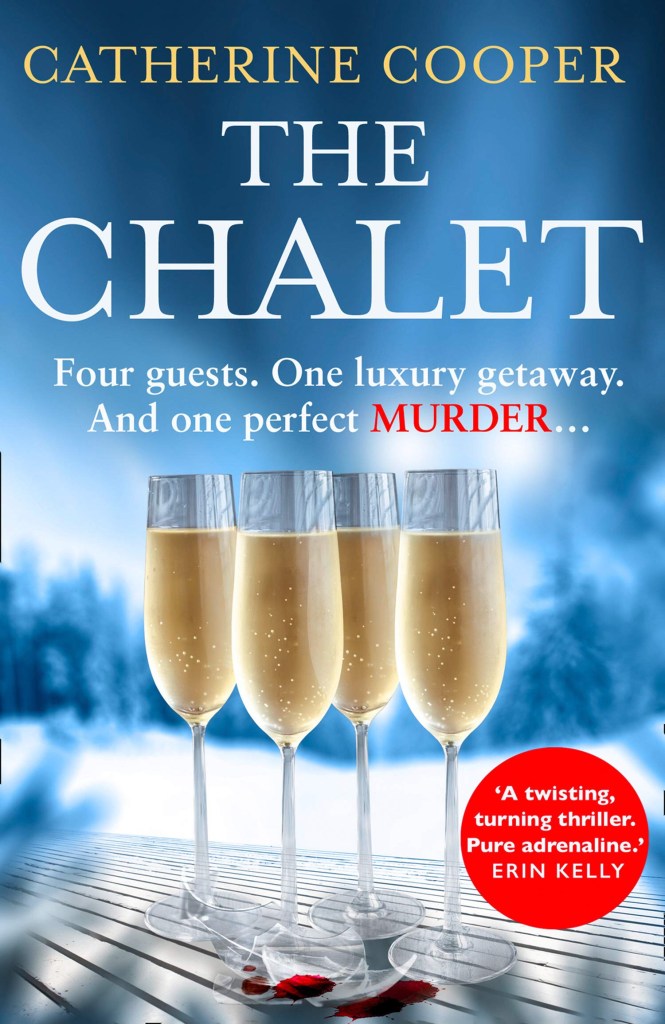
I have always felt that skiing was for a very different breed of people to me – people with money, balance and the ability to look stylish while dressed like the Michelin man. This book has confirmed my suspicions as well as leaving me addicted to the twists and turns of a dark thriller set in motion when two brothers go on a ski break in the 1990s. Adam and brother Will visit La Madiere in France with their girlfriends Nell and Louisa. Louisa and Will met at university, and she’s delighted to be asked to go on holiday but skiing isn’t something she’s done before. Will and Andy’s parents are middle class and the boys were on skis as soon as they could walk. They also have the sort of money that allows for quick ski breaks while at university whereas Louisa doesn’t. When Will says he will pay for it as her Christmas gift she starts to look forward to lazy mornings in fur covered beds, hot chocolate, plenty of sex and beautiful, romantic snowy views. What she gets is a more like a wooden dormitory with stodgy food and the boys bouncing out of bed at 7am in order to ski. Yet something terrible will happen on this holiday, that reverberates through the next twenty years.
The narrative zips back and forth between the 90s and the present day when a different group are on holiday in La Madiere. We meet Hugo, the slightly awkward owner of a travel company who has brought his wife Ria and friends to try out a luxury ski lodge, before adding them to his portfolio. In this narrative I was suspicious of everyone. Hugo’s wife Ria is more attractive than he is and knows it. She’s targeted him and accepted his marriage proposal on the basis that it’s better than living in poverty. She can think of worse men to be with and the lifestyle is exactly what she wants. We know that they’ve agreed to have children, but does she really want a family and what was she running from when they met? Their friends Simon and his wife have a small baby, but this first time Mum seems to be struggling and even disappears one morning. Hanging around are the staff from Powder Puff: Cameron the boss; Matt the lusty ski instructor and Millie the chalet girl with great cooking skills who caters to their every whim. There are simmering tensions between each couple, and possible diversions from both the skiing and their partners. I found myself unable to resist these chapters when I went back to them because I kept waiting for things to implode.
Finally, there is the interspersed narrative of a lonely little girl. She has been left alone by her Mum and is getting her own breakfast and holding tightly to her teddy for comfort. It’s clear that her mother isn’t coping, but this little girl’s distress is hard to read. I found myself wondering about what might have brought her mother so low. Even more addictive was trying to work out which character this little girl might be in the future. I jumped from one character to another and only fixed on one towards the end when a particularly big clue was dropped. I can honestly say I didn’t see every twist coming and I didn’t make every link from past to present. The author really did keep me guessing. The catalyst that brings past and future together is a huge storm, which closes the ski lifts and keeps everyone in their lodge, ratcheting up the tension. When the weather clears, a body is found. Disturbed by a fall of snow from a ledge, the body appears to be a man and has been buried under the snow for many years. This could possibly be the body of one of two brothers, missing since they were lost in a storm back in the 1990s. Past now meets up with the present as his brother is jetted in to identify the body. Who is going to recognise who? Finally, what of the ski guides employed to look after these brothers when they decided to ski off piste? Were they fired and if not, where are they now?
Cooper really does keep the tension throughout this complex narrative; handling several time frames and various narrative voices with ease. The luxury setting is lush, full of delicious descriptions of food, and lashings of alcohol that loosens tongues and possibly morals. The men are largely rich, arrogant and stupid. The woman more quietly manipulative, such as using a seemingly subservient position to assert power. There’s a lot of passive aggression here. I felt most for Louisa in the past narrative, she’s unsure, feels inferior in terms of money, status and looks. I also felt for Hugo who is a quiet man, ruled by his personal assistant Olivia and terribly awkward with customers. He has no idea that his wife engineered their meeting, or that she’s still taking her pill while he thinks they’re trying for a baby. He’s thoroughly decent and this book is about what happens when decent people come up against the unscrupulous and immoral, but in a thoroughly glamorous setting. Great, escapist reading.
Meet The Author
I am a freelance journalist living in the South of France with my husband and two teenage children. We moved from London in 2009 so that the children could grow up bilingual and we could all ski more, and to enjoy a more relaxed pace of life. I learned to ski on a school trip when I was 14 and have loved it ever since. I’m an avid thriller reader and have been since I discovered Agatha Christie as a child.
The Chalet is my first published full-length novel, though I have also written several (unpublished) thrillers for teens and a (what used to be called) chick lit novel set in TV production. Other than skiing and reading I love travel, rollercoaster, and I spend far too much time on social media. Some of my other favourite things include Alan Partridge, sparkly flip flops and salt and vinegar crisps.
You can follow me on Twitter @catherinecooper, Instagram @catherinecooperjournalist or Facebook @catherinecooperauthor
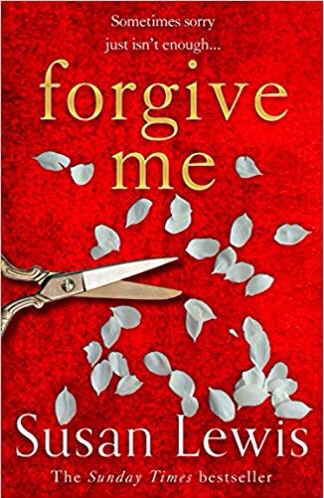
I’ve been reading this book for two days straight. Firstly because I had a fall a few nights ago so I’ve been recuperating from being very sore and bruised. Secondly, once the story started to unfold I found it hard to move away from. The concept of forgiveness is one that has always fascinated me and confused me in equal measure. As a child brought up in a religious household it was a requirement of Christianity, rather than a choice I could think about and there was no discussion about the understandable negative feelings surrounding it – anger, bitterness, hurt – because those were wrong too. As an adult I’ve had to talk myself out of this blanket approach to forgiveness and give myself permission not to forgive. I’ve also had to think about when holding onto that anger and bitterness might be more harmful to me than the other person – ‘holding onto anger is like holding a fiery coal’. I also had to learn that just because I forgive an action, doesn’t mean I have to keep that person in my life. Forgiveness does not always mean everything neatly slots back to the way it did before. This is something the characters in this book come to learn and it is Marcy who ends up with the most to forgive.
After her abusive husband is arrested and held on remand for dodgy business dealings, Rebecca decides to take her daughter, and her mother Marcy, and relocate somewhere totally new, leaving no trace. She goes as far as to change her name to Claudia and her daughter’s to Jasmine, dropping their Huxley-Browne surname. Marcus Huxley-Browne was a controlling bully, who had slowly sucked all of the confidence and joy out of Claudia over several years. He met her when she was a vulnerable widow and his kindness led her to trust him. Then once they were married all that sensitivity and care seemed to melt away. Then slowly he took a chisel to every part of her personality and chipped away until she started to doubt who she was. With a lot of help from Marcy, they take the opportunity of Marcus being remanded in prison to flee to the coast. There, in a flat by the sea, the three of them feel able to breathe again. Away from the constant criticism, Claudia finds she can make friends easily and even starts working again as an interior designer. She sees an incredible coach house for sale that would make a wonderful forever home for the family and she sets to work. The world seems to finally be opening up for Claudia and her family. However, will Marcus ever truly let go of them?
A terrible event does occur in the book that no one could have foreseen. It’s here where the theme of forgiveness, as a possible part of the restorative justice process, comes into the story and I found this part really interesting. Restorative justice is about victims and offenders communicating within a safe and mediated environment to talk about the harm that has been caused and finding a way to repair that harm. It gives the victim the chance to talk about the impact the crime has had on them directly to the offender. It gives the offender the chance to relate the crime they committed to an actual person and see how the victim has been affected. It also holds them accountable for their actions in a way that doesn’t always happen in the normal court process. Government research demonstrates that restorative justice provides an 85% victim satisfaction rate, and a 14% reduction in the frequency of reoffending. Here the author gives us both sides of the process by showing us in stark detail the effect of the crime on the victim, but also the background of the offender. Here and there through the narrative we read letters from the offender – how the restorative process begins- that detail his home life, the brutal hold of a family member on him and his mother, and a life of crime forced upon him from a young age. We know that this person is really the bottom of a long chain, a criminal subcontractor hired by someone powerful to do his dirty work. Essentially he is expendable, simply there to carry the can. Although in this case, the crime is much worse than was planned or expected.
This was a really engaging read. I quickly became invested in the family’s story and found myself very worried that their past would catch up with them, especially since a couple of their new friends started to work out who they really were. When there is a confrontation I found myself holding my breath, wondering what retribution would follow. I loved Marcy’s new romance with Henry and the fearless way she throws herself into the relationship. She was by far my favourite character and her story the most moving. I was imagining this funky, ballsy grandmother as Helen Mirren. It was a bit of a shock to hear one character to describe her as like Emma Thompson – I can’t imagine a world where Emma Thompson is old enough to have a 17 year old granddaughter! However, in terms of Marcy’s intelligence, beauty and grace it really made sense. Next to her, Claudia seems a lot quieter, cautious and sometimes invisible – something that’s not surprising given the experience she’s gone through with Marcus. It’s wonderful to see her come to life which tends to happen when she’s working on a project, especially The Coach House which is an incredible labour of love. I always feel on safe ground with Lewis. I know I’ll get a good read and I love that a lot of her heroines are women in middle life, dealing with their own problems, while supporting teenagers and parents who often need help. Far from being uninteresting and invisible, it’s women in mid-life who are often holding everything together while trying to hold down a job as well. But we’re also resilient, brave and ran out of damns to give a long time ago. I like that Lewis writes this mid-life characters and gives them strong, complex storylines like this one to get our teeth into.
Meet The Author
Susan Lewis has over thirty books to her name. She grew up in a council house on the edge of Bristol and was sent to boarding school after her mother died when she was 9. She has lived all over the world and started writing when she was advised by a boss at Thames Television to ‘go away and write something’. After time in the South of France and Hollywood she now lives in a barn in the Cotswolds with her husband and two dogs Coco and Lulabelle. Her website can be found at:
‘Over these things I could not see; These were the things that bounded me; And I could touch them with my hand, Almost, I thought, from where I stand’.
Renascence by Edna St Vincent Millay
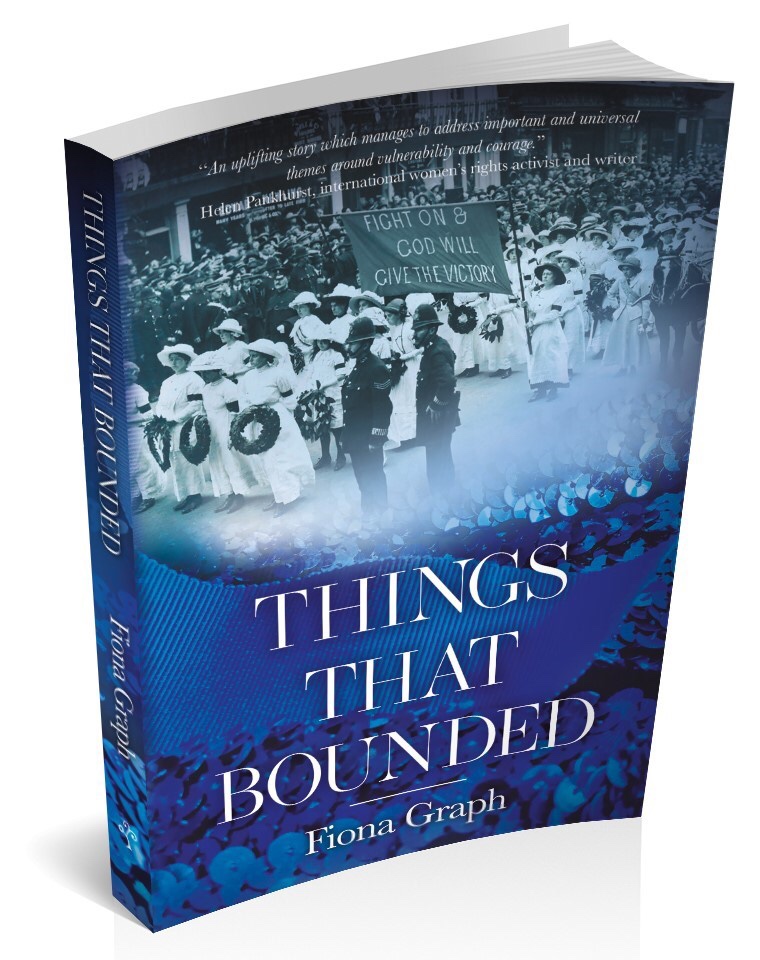
Fiona Graph’s novel is an interesting and well- researched piece of historical fiction, set in a period of history that I’m particularly interested in. Graph’s story writes back, both to a different time but also to a different element of society, one that hasn’t been well represented in fiction of the time. In the same way that Sarah Waters has written lesbian experience back into the Victorian period, here we visit a brother and sister post WWI who both describe themselves as ‘queer’. Freddie fought in the war, but now runs a women’s fashion boutique in London with his sister Ellen. Freddie is a designer, whereas Ellen tends to work with the passing customers selling off the peg clothes and accessories. Ellen is a woman who was somewhat emancipated through the war, due to working in jobs previously the preserve of men and from her activism in the suffragette movement. Brother and sister live together above the shop and are at a point where they’re both single. Freddie was in love with a fellow soldier who was lost in the war, and his most recent relationship with a young solicitor called Alec broke down. Ellen is seeing a woman called Myra, one of a string of married women that have allowed her to keep real love at a distance. Fate is now going to bring people into their lives that may challenge the lives they’ve built, that’s if all concerned can shrug off the ties that bind them to the past.
I fell in love with Freddie. He’s a lovely brother and incredibly talented, very keen to create clothes that are beautiful but that real women can wear. He needs to live quietly since his experiences in the war and has bravely been ‘out’ for years. It’s amazing that in such recent history he finds that people spit at his feet in the street. While he’s made a brave choice to live openly, his relationships are not easy. We learn that he pushed Alec away by behaving badly, in much the same way that Ellen has pushed real relationships away with secret liaisons with women who will never be free. It’s the reappearance of Ellen’s friend Kate that is the catalyst bringing these four people together. At a suffragette funeral, Ellen spies Kate who has been living in Paris. They had an easy going friendship before she left, even though their activism took different paths. Ellen supported peaceful protest, leafleting and was even known to throw the odd brick through a shop window. However, Kate had favoured more direct action such as Emily Davison’s jump in front of the King’s horse at the Grand National. Kate has been in self-imposed exile, after burning down a church. To her horror, in the aftermath a body was found in the wreckage. Kate had scrupulously checked all of the pews and the vestry, but it appeared in a newspaper that police had found the body of a man, possibly a rough sleeper. In fear, Kate fled the country and has lived the last few years in Paris. Will the women be able to pick up the friendship that was in its infancy back then? Even more importantly, will Kate ever be able to forgive herself for what happened. Ellen has always thought this newspaper account of Kate’s direct action, was a little bit fishy. There’s never been any other account that mentions this man, so Ellen suggests they investigate, enlisting the help of Freddie’s ex-boyfriend Alec. The investigation, and what they discover, could change the course of all their lives and break the ties that bind them to the past.
I remember reading Sarah Waters’ book The Paying Guests, set at a similar point in history to this novel and also depicting women trying to break free of social constraints and live their authentic lives. I remember being astonished by the bravery of characters trying to live as openly gay women in the early 20th Century. I felt the same when reading this, but what it confirms is how far certain lifestyles have been erased from history. As a disabled woman, I feel the same way about experiences of disability and I get so excited when a character has a disability. It shows me how much we need books that write these histories, it gives us context, broadens our understanding and represents the true diversity of a society and time. This novel did that for me, but also showed the struggle of people trying to live in the aftermath of such a turbulent time. Post WWI everything changed and the ordered Edwardian society of the turn of the century had been turned on its head. Instead of being largely in the home, women had experienced the freedoms that men had been enjoying for decades. More women had to take up jobs to make up the labour shortfall, bringing them out of the home for the first time. Many didn’t want to go back to the domestic sphere. The aristocracy were crumbling, many had lost the heads of their family, and their heirs too. With estates crippled by multiple death duties many sold up, or sent their sons to America to find a rich heiress to change their fortunes. Different loyalties had been formed across class boundaries, between men who had fought side by side. After the horror of war, the collective grief and upheaval, I can understand people wanting to live their truth and stop hiding. That’s what our characters are doing here, simply trying to live as who they are – something a lot of people take for granted. That was why I found both love stories very moving. I was rooting for both relationships. All they wanted was the ordinary things heterosexual couples would take for granted – to walk down the street together, to hold hands or hug in public, to eat dinner together and come home to each other.
I’ve read a lot about the suffragettes, and some of the treatment they were subjected to. I still found myself shocked by how Ellen responded to sexual assault. When she walks home at night from Kate’s flat, two men accost her and one gropes her breasts. Thanks to her activism she is trained in martial arts, so is able to overcome both of them and run back to Piccadilly where there are lights and people. When she relates the story back to her brother she doesn’t mention the sexual aspect of the assault at all. However, when we flash back to her suffragette days we remember that this was a daily occurrence, an actual police tactic. We see the police hatred of the movement when the group track down the police officer who found the body in the church after Kate’s arson. He’s now older, more frail, but his hatred of suffragettes and women in general is strong. I found this whole scene horrifying, but hilarious too. The fact that this man who considers himself so strong and dominant over women, is in fact defied and controlled by his own wife, really did make me laugh. However, it’s also a pivotal scene because here Kate may find the truth of what happened years ago and Ellen is hoping that this truth will set them both free and allow them to move forward. I think this shows us that often the ties that bind us, and hold us in place are of our own making. We are as free as we perceive ourselves to be. Here I’d like to return to the poem that inspires the title of the novel – Edna St Vincent Millay’s Renascence.
The world stands out on either side No wider than the heart is wide; Above the world is stretched the sky,— No higher than the soul is high. The heart can push the sea and land Farther away on either hand; The soul can split the sky in two, And let the face of God shine through. But East and West will pinch the heart That can not keep them pushed apart; And he whose soul is flat—the sky Will cave in on him by and by.
I love the final stanza of this poem, because it says exactly what I have taken away from the book. The world can be as wide as our heart is willing to accept. The sky is as endless as our soul allows it to be, in fact we can see beyond the physicality of our world to imagine a God and have a strong faith in some thing we can’t even see. All of this is achievable through the power of the mind. Yet if our heart is not open to experience our world becomes narrow and pinched, and if our soul cannot dream or believe then our opportunities and achievements come to nothing. We have the strength to break those ties that bind us, no matter how strong they may be, we can break beyond them and move into a better future.
Meet The Author
Fiona Graph was born in Sydney. Once she had obtained a degree in Psychology and Ancient History, she travelled before settling in north London. She worked variously as a psychologist, for an LGBT organisation and as a librarian, before ending up at the Foreign Office. Her youthful interest in writing came back strongly about five years ago. ‘Things That Bounded’ is her first novel to be published. A second novel will come out in 2021. You can find Fiona on Twitter at: @fiona_graph
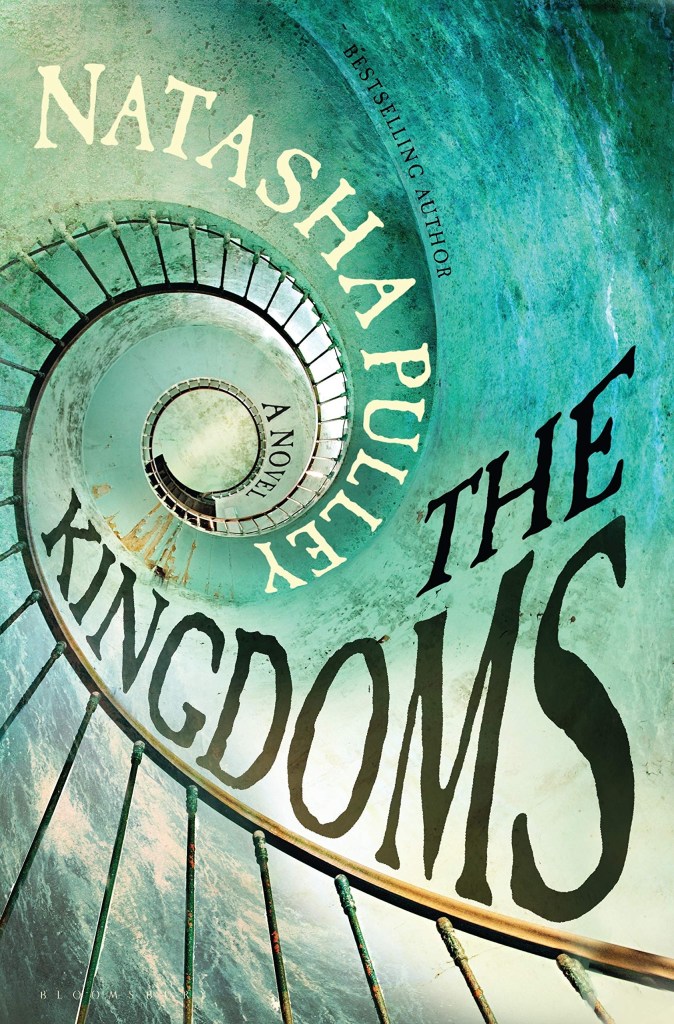
I fell in love with Natasha Pulley’s imagination as soon as I picked up her first novel The Watchmaker of Filigree Street – anybody who can create a character that’s a clockwork octopus is definitely on my team. So it’s with great anticipation that I await her next novel, The Kingdoms. I have been lucky enough to be granted an ARC copy through NetGalley, but with a lot of reading to get through it might not be read until Christmas. Maybe I should make it my Christmas present to myself.
The book’s main character is Joe Tournier. He’s one of numerous British slaves dotted throughout the French Empire. He has a wife and daughter and has lived his entire life in London. So how come he has memories of a different place to this, a place where English is spoken in England instead of French. He has flashes of a different life to this.
There is a postcard waiting in a sorting office for Joe Tournier. It has been waiting for 91 years and shows a lighthouse named Eilean Mor set on an island in the Hebrides. The postcard was written about a hundred years ago, but Eilean Mor has only been built for six months. It was written by a complete stranger, but a stranger who seems to know Joe very well.
Joe’s quest to find out more about the postcard and it’s writer takes him from French -occupied London to the islands of Scotland. Here Joe will slip through time to fight for his own life, but also for a different future.
Come home again, if you remember.
Meet the Author
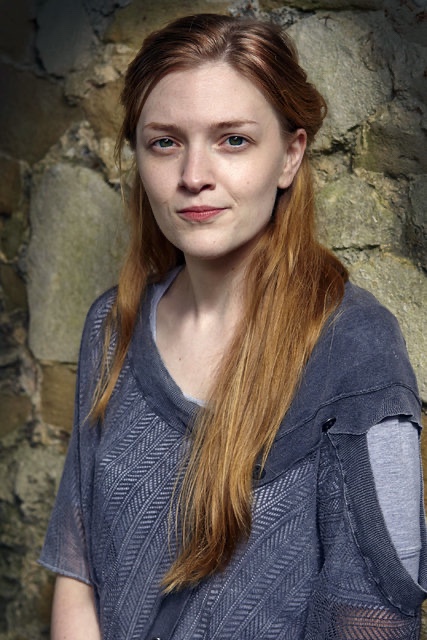
Natasha Pulley was born in Cambridge. She read English Literature at Oxford before doing an MA in Creative Writing at the University of East Anglia. In 2013 she went to Japan on a scholarship from the Daiwa Anglo Japanese Foundation. She lived in Tokyo for a year and a half, learning Japanese and researching her first book, ‘The Watchmaker of Filigree Street’. More recently she spent several months in Peru courtesy of a travel grant from the Society of Authors, chasing llamas and researching ‘The Bedlam Stacks’. She lives in Bath













 The Lotus Readers