Blog Feed

Posted in Netgalley, Publisher Proof

Profile K by Helen Fields 

I’m going to say up front that I’m a massive Helen Fields fan, with The Last Girl to Die being a particular favourite of mine. Her last novel introduced us to the unusual and complex psychologist and profiler Dr. Connie Woolwine at The Institution. Connie makes a cameo here, but the undoubted heroine of this tale is Midnight Jones. Midnight lives with her twin sister Dawn ( see what the parents did there) and is her main carer, since their parents chose to go travelling when Midnight finished university. Dawn was affected by lack of oxygen at birth leading to Cerebral Palsy. It’s effects are very individual to the patient, but it can cause both physical and intellectual disabilities. Dawn is profoundly affected, needing care 24/7 and that’s why Midnight is desperate to keep her job at Necto. She needs their higher than average pay packet to cover the costs of care. The company like to present themselves as an ethical firm, starting with their space age offices, filled with plants and trees that help create a better work environment. They have their fingers in many pies, but Midnight is a profiler and every day works through thousands of applications for universities, the military and other organisations, passing some applicants through to be interviewed and rejecting others based on assessment data alone.

Necto’s testing systems are so sophisticated, there’s nothing about the applicant they don’t know. In assessments, virtual reality head sets show images and the applicants every response is recorded from intelligence to levels of empathy. Then, dependent on the parameters for the particular institution they’re applying to, they are accepted or not. However, on this particular day Midnight finds a candidate who isn’t run of the mill, in fact he’s a one-off. In training, a candidate like this is jokingly dubbed a ‘Profile K’- for killer – Midnight finds a man who has recorded as showing zero empathy. When she watches the footage he was shown through her own headset, she is sickened by what she sees. This is way beyond the normal films shown to illicit empathy, it’s as if the machine couldn’t get a reading so has chosen more and more disturbing and violent images that should provoke empathy and disgust. Yet none comes. Unable to compute the response and also where such extreme footage could have come from, Midnight decides to take this further but her supervisor Richard Baxter isn’t interested. So she goes over his head, telling his boss that she’s found a Profile K. Surely they have a duty to report him, what if he’s dangerous? What if he kills? 

I’ve read three great thrillers this weekend in quick succession but this was by far the most inventive, with a hint of dystopia and a touch of social justice that was right up my street. I empathised with Midnight’s situation, determined not to let down her sister Dawn but struggling to pay for just enough care that Midnight can go to work. There is no room for a social life or romance. Their heads are just above water, but there’s no flexibility or empathy for her care role within her company, despite it’s apparent ethics. She takes a big risk taking her findings higher than Richard Baxter, because if she loses her job how will she afford the care Dawn needs? Yet she can’t ignore what she knows. Especially when the worst happens. A young woman is killed very close to where she and Dawn live and although Midnight doesn’t know this at first, the torture methods used are very close to a scene from the film shown during the Profile K’s application process. The victim was subjected to the death of a thousand cuts, which would have been both a painful and long drawn out way to die. Midnight is horrified to find that her boss would rather keep her discovery under wraps and she’s reminded of her non-disclosure agreement. What reason could they have that’s better than saving the lives of future victims? Midnight has read about the psychologist and profiler Dr Connie Woolwine and has a theory to run past someone with her expertise. Not expecting a response, she sends a message and is pleasantly surprised when the unusual doctor calls her late at night to talk it through. Midnight is scared of the consequences, but sure of her theory – could Necto have known about the Profile K? What if they showed the violent material on purpose to trigger a response? To turn someone with killer potential into a killer for real. 

I absolutely loved this belting thriller, because it was complex and intelligent but also full of human feeling. I guess this might sound strange when there’s quite graphic violence involved in some scenes, but they’re balanced by the pure depth of feeling Midnight has for her sister and later on for the elderly lady they begin a friendship with. I loved how authentic Midnight’s caring situation was, with a very clear struggle between wanting to provide the best help for someone she loves but feeling the fear of that sole responsibility. The anger she feels towards her parents is very real, because although she understands their need to follow their dreams, their freedom has curtailed her own. She can’t make any life decision without factoring Dawn in. How could she have a romantic relationship? What if she falls ill herself? Having been a carer I know how lonely and exhausting it can be. We can see the pull between home and work life, in that they both hinder and are dependent on each other. Parts of the book are genuinely terrifying. There is a scene that’s going to stay with me, like that episode of Luther where a woman gets undressed and climbs into bed followed by a ceiling shot where a man slowly slides out from underneath as if he’s been working under a car. It’s that combination of vulnerability and evil. We’ve all done that walk home where we get inside and lock the door, then take a deep breath and know we’re safe. To be attacked in that moment is heart-stoppingly scary! In the end, everything had to stop for those final chapters as I raced through to find out what happens. I was glued to these scenes, made all the more terrifying because the victim doesn’t have a clue how much danger she’s in. It’s one of those finales where I put the book down and realised every muscle in my body was tense! I needed some yoga stretches and a few episodes of Friday Night Dinner before bed to unwind. This is an absolute cracker of a read and I highly recommend it.

Published by Avon 25th April 2024

Meet the Author
A Sunday Times and million copy best-selling author, Helen is a former criminal and family law barrister. Every book in the Callanach series has claimed an Amazon #1 bestseller flag. ‘Perfect Kill’ was longlisted for the Crime Writers Association Ian Fleming Steel Dagger in 2020, and others have been longlisted for the McIlvanney Prize, Scottish crime novel of the year. Helen also writes as HS Chandler, and has released legal thriller ‘Degrees of Guilt’. In 2020 Perfect Remains was shortlisted for the Bronze Bat, Dutch debut crime novel of the year. In 2022, Helen was nominated for Best Crime Novel and Best Author in the Netherlands. Now translated into more than 20 languages, and also selling in the USA, Canada & Australasia, Helen’s books have won global recognition. She has written standalone novels, The Institution, The Last Girl To Die, These Lost & Broken Things and The Shadow Man. She regularly commutes between West Sussex, USA and Scotland. Helen can be found on X @Helen_Fields.

Posted in Throwback Thursday

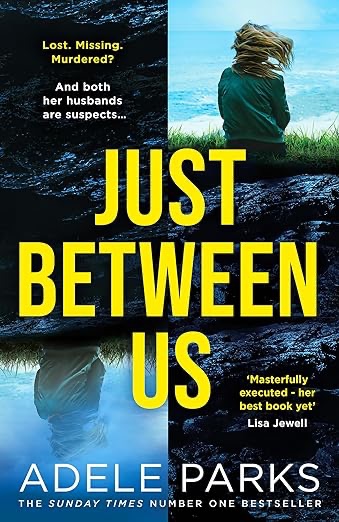
Just Between Us by Adele Parks

For some reason, I wasn’t fully engaged with Adele Parks’s last novel Both of You and I wasn’t expecting a sequel. I didn’t really like any of the characters involved. Kylie has two pseudonyms and two lives: half the time she’s Leigh, wife to Mark and stepmum to Oli and Seb; the rest of the time she’s Kai, wife to Dutch banker Daan Jaanssen and lives in an upmarket apartment with luxury clothes, cosmetics and holidays. The two seem to balance Kylie’s complicated needs, she’s equally at home having dinner in a Michelin starred restaurant as she is eating sand filled butties on a cold beach with the kids. Kylie’s other important relationship is Fiona, her friend of many years who has become part of the family and unofficial aunty to the boys. There isn’t a single person in Kylie’s world who knows about her double life, until one day she disappears. Now the whole world knows about Kylie’s bigamous marriages and the husbands and children are dragged into a police operation and a media frenzy. This sequel picks up after the first, when we’ve just found out who has been keeping Kylie prisoner. Just when we think it’s all over, we’re only halfway there.

I won’t ruin any of the twists and turns of either book, because this is one of those you need to start without any idea what’s going on. We have the original characters including the rather wise and interesting DCI and we have small chapters from every point of you. However, there are some newbies too and it was here where the book really took off for me. I was so eager to know what the hell was going on and where these people fit into the original story. We are in the depths of lockdown and Kenneth has been shielding alongside his grown-up daughter Stacie. Stacie is in the early stages of recovery from cancer treatment and she has fought hard to keep living. She deliberately doesn’t look at herself but knows she looks a little beaten up with her shorn hair and the scarring. Sadly, she has the added complication of amnesia after falling so dangerously ill so she doesn’t even remember treatment or anything before that. Thankfully she has Kenneth to fill in the blanks and he seems like such a caring and loving dad, luckily he’s also a retired GP so he’s perfectly placed to reassure Stacie and support her recovery. They have a quiet routine of daily dog walks, cooking and board games. They’re in the town of Lyme Regis and Stacie does feel like she knows the place and her dad has told her about her engagement to local lad Giles. She called the wedding off two weeks before the date and moved to Paris. Then something odd happens. Stacie is on the beach when she feels a sensation of being watched. Up on the promenade there is a woman staring at her with a fierce intent. She wonders if this is someone who knew her from before. So, she makes her way over, keeping a safe social distance and introduces herself, explaining that she might look a little different, because she’s had cancer. No, the woman says, you’re not Stacie. This is a moment where the hairs go up on the back of the neck, but we don’t know who the woman is or how well she knows Stacie and Kenneth. What possible reason could she have to confuse a woman who’s had cancer treatment and lost her memory?

I enjoyed having more input from the husbands and Kylie’s two stepsons this time around. The boys are incredibly loyal to her, despite being hurt by finding out about her second husband and let’s not forget, all of them are grieving. Daan Jaanssen also shows an incredible amount of loyalty and concern, especially considering he’s being charged with Kylie’s kidnap and murder. Does this mean he didn’t do it or is he putting up a smokescreen in the hope of walking free? Mark is angry and bitter, perhaps because he’s was her husband first. He is on the verge of making mistakes because of that anger. Seb and Ollie show maturity and enormous love beyond their years and put their own Dad to shame. The short, sharp chapters keep the momentum going and definitely have that ‘one more chapter’ addictive quality. Be prepared to set aside a day to finish it when you can’t put it down. This is definitely one of those sequels where you need to read the first novel, there’s a little bit of exposition about Kylie’s ordeal but not too much. The main question is what happened to her afterwards? Is she dead as the police think? This is a great thriller from Adele Parks and it made me feel back on track with loving her writing.

Meet the Author

Adele Parks MBE is the author of twenty-three bestselling novels including the recent Sunday Times hit Just Between Us and the audible Number One sensation One Last Secret. Over 5 million English editions of her work have been sold and she is translated into 31 different languages.

Her number one bestsellers Lies Lies Lies and Just My Luck were both shortlisted for the British Book Awards and have been optioned for development for film & TV.

41,000+ 5 star reviews have kindly been written by her fans on Amazon 🙂

She is an ambassador of the National Literacy Trust and the Reading Agency: two charities that promote literacy in the UK.

Adele was born in North Yorkshire and has lived in Botswana, Italy and London and is now settled in Guildford, Surrey.

In 2022 she was awarded an MBE by King Charles III for services to literature.

Connect with Adele Parks on Twitter @adeleparks, Instagram @adele_parks and Facebook @OfficialAdeleParks or visit her website for more information.

Posted in Netgalley, Publisher Proof

Nightwatching by Tracy Sierra

Yesterday upon the stair I met a man who wasn’t there,

He wasn’t there again today, oh how I wish he’d go away.

Antagonish by Hugo Mearns

My grandad taught me the first few lines of the poem above. I think it appealed to his sense of humour. I thought it was a riddle and I used to ask ‘but is he there or not?’ This is the very question this whole book revolves around from the first line – ‘there is someone in the house’. Our unnamed narrator wakes in the night as a strange noise breaks through her sleep. I was told by a book reviewer I respect enormously that this was brilliant and she was absolutely right. Although I drove my husband crazy by waking him up to ask if he remembered locking the door. He hadn’t always and I knew I wouldn’t sleep until one of us had crept downstairs and checked. Preferably not me. This is the situation all of us dread, waking to that unexpected noise in the night and finding there is an intruder. Our narrator is at her secluded home with her two small children in a blizzard. The sound she hears is a familiar one, a tread on the stairs to her room, but it’s unusually heavy and slow. She has a split second to make the decision – does she hide, try to run or stay and fight. Will all three of them get out alive and if they do will anyone believe her?

The first thing that hit me about this book was the unique voice this mother has. We see everything through her eyes and experience everything her body goes through – mainly fear. There’s the heart-stopping tension of that first night, the immediate threat rendering everything else unimportant. Yet there are other fears lurking underneath – will the police believe her, will it stir up questions about her husband’s absence, what will her father-in-law make of what has happened? She is waiting for people to doubt her and the reader doubts her too. Always on the lookout for unreliable narrators, I did wonder whether I should trust what she was experiencing. It’s just so incredibly odd. This tall intruder seems to have two voices: a raspy harsh voice when he’s angry then more of a soft, weedling voice. A voice you might use for children as he asks them to ‘come out little pigs, little pigs are more delicious’. As he does this right next door to their hiding place, it’s even more terrifying. Her little girl whispers to her mum that it’s the ‘Corner Man’ from her nightmares, he sits in the corner of her bedroom at night and whispers to her. My heart was in my throat at this point! Was he real or something supernatural? Could he possibly be real if this is true? I wondered if this overwrought mother is imagining this person, but that opens up a more frightening prospect – is she hallucinating and terrorising her own children with her delusions? The author plays with the reader beautifully. Just as I was starting to think the narrator is completely crazy, she addressed my concerns.

‘How nice it would be to be crazy instead of correct. For t all to be a psychotic break. To have her husband come down those stairs. She’d pop out of the hidden place relieved – rated – to meet his look of confusion’.

This is a woman who is used to being misunderstood and there’s no shortage of men around, happy to convince her that she’s strange, hysterical and marked as different in some way. There’s an awful moment, recalled while hiding, when her husband told his father he was not going to continue studying law. She hears his father’s fury down the phone:

‘You never behaved this way before you met that girl. Christ. She’s disfigured’.

Our narrator has vitiligo – a long term skin condition where areas of skin lose melanin and become paler, creating a patchy complexion. People stare and perhaps mistrust her, worried they may catch a skin disease or worse. Added to this, she’s a newish mum full of hormones, perhaps she’s a bit anxious and over-protective. She’s recently bereaved, having nursed her terminally ill mother-in-law. Maybe she’s not in the best frame of mind. All of this and the fact that she’s a woman, mean the police will be unsure or just plain rude about her. They keep explaining there’s no evidence: no footsteps in the snow; nothing of any value is stolen – in fact the items she does mention are probably lose or mislaid by the children. They don’t sound like the type of things someone would steal. They’ll turn up.

While hiding from one monster, we learn that she’s battling another in the shape of her father-in-law. Honestly, I have never wanted to climb into a book and punch someone more. He is a bully, but everyone else placates him. He is ashamed of his son, even more ashamed of his disfigured daughter-in-law. He hates the noise of his newborn grandson and his wife apologises! Even while his wife is dying, he sits with his feet up watching television and creates holy hell if he’s disturbed. His daughter-in-law does all the work and is rarely appreciated or thanked. He wants his grandson to man up and stop being a wuss. Worst of all he’s aggressive, violent even. Having him in charge of her children is the worst outcome of all. This mother is also fiercely protective. A passing incident where a stranger commented on her daughter and pulled the drooping strap of her sundress back onto her shoulder, really bothers the mother. You can feel her hackles rising in much the same way she reacts when her father-in-law criticises her son. She has very keen instincts and it’s fascinating to see how those instincts can be eroded, mainly by men who still consider women a hair’s breadth away from hysteria and the asylum. It shows that we’re not just gaslighted by individuals, it can be institutional, perpetuated by organisations like the police force or as I’ve found in my own life, the medical profession.

The whole setting is brilliantly eerie. A secluded mansion house with woods behind and five acres of open pasture between them and the next house. The house was built in 1722 with two staircases, higgledy-piggledy rooms and even it’s very own graveyard. She loves the house, even though it’s totally impractical and a nightmare to heat. She’s got to know each creak and bang, it’s night noises, but never imagined when she viewed the house that she’d be fleeing into the secret space next to the chimney, where the builders walled in the labyrinthine brick work. They never imagined being walled in. It’s a place where ghostly presences and hidden secrets would be easy to believe. Yet it’s not all scary. There are some wonderfully tender moments between the mother and her children and we can feel how torn she is when she has to be sharp with them, to keep them quiet and safe. I had no idea where this story might go and the author was one step ahead of me all the way. I might have finished this incredible thriller, but I’m still carefully locking the doors at night and when the cat decided she’d rattle our door to upstairs at 3am my heart did beat a little faster. I can’t believe how assured and psychologically complex it was for a debut! If you only buy one thriller this year, make it this one.

Out now from Viking

Meet the Author

Tracy Sierra was born and raised in the Colorado mountains. She currently lives in New England in an antique colonial-era home complete with its own secret room. When not writing, she works as an attorney and spends time with her husband, two children, and flock of chickens. Nightwatching is her debut novel.

Posted in Netgalley, Personal Purchase

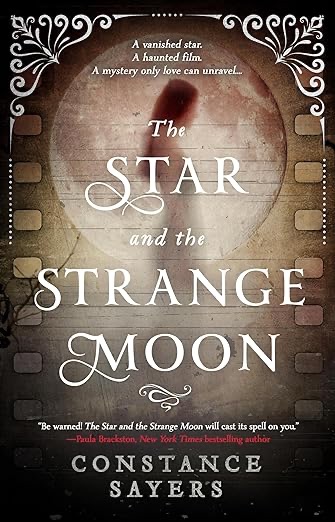
The Star and the Strange Moon by Constance Sayers.

Constance Sayer’s latest book has a lot of her literary trademarks: time slip narratives; a mystery to solve; magic realism and romance. She places her story in the world of Hollywood and film-making, with two main characters – the actress Gemma Turner and young film-maker Chris Kent. In 1968 Gemma is staying in London with her rock star lover Charlie Hicks when she is offered an unexpected film opportunity. Until now Gemma has been making a series of surfing films based in California, but she’s been longing to make something that has more critical acclaim. French director Thierry Valden is part of the nouvelle vague or new wave movement and has offered her the lead role in his next film L’Etrange Lune a vampire film set in 19th Century France. He seems open to changes and often works with improvisation so her long held skills as a writer might be needed too. However, when she gets to Thierry’s chateau the mood seems to have changed. She is greeted by Manon Valden, who warns Gemma off her husband immediately which isn’t very welcoming. Thierry doesn’t seem like the man she met before and when she reads the up to date script it still has the same stilted dialogue, despite the potential changes she had sent him. When she finally speaks to Thierry alone, he makes it clear that something has changed. He had envisioned more of a collaboration both on the script and possibly in the bedroom, but L’Etrange Lune will be his final film and he can’t afford to take risks. Gemma will have other opportunities for scriptwriting but he won’t. The next day as they’re filming in the nearby town of Amboise, Gemma has a scene where she runs down a darkened and cobbled alleyway, seconds after calling action the camera has suddenly lost her. Has she fallen on the cobbles? Are the dark shadows concealing her? Maybe she’s walked off in a huff. Yet it seems Gemma is genuinely gone and as they look back over the scene on film, frame by frame, she’s simply disappeared in front of their eyes.

Christopher Kent has had a strange fascination with the actress Gemma Turner since he was a child. Now at film school in 2007, his attachment to the actress stands out because she was never one of the greats – students aren’t usually hung up on obscure actresses from a handful of surf films. He remembers the day he first saw her, in a hotel where vintage black and white photos of actors were hung next to every door. In a very chaotic and traumatic childhood, this was one of those moments where he and his mum were without a roof over their heads. Chris could sense his mum was edgy and on the verge of a mood change, but as they approached their room and she saw the photo by the door she flew into a rage. She pulled the picture of Gemma Turner off the wall and smashed it, shouting personal insults and expletives. What was her link to the actress? Knowing Chris’s fascination with Gemma, his girlfriend and fellow student Ivy comes to him with a strange proposition. Every ten years Gemma’s final film, L’Etrange Lune, is shown to a select group of 65 guests at a randomly chosen cinema. Ivy’s father is one of the 65, but for this viewing he has offered Ivy his two place. They must wear a mask and cloak, but most importantly of all they must never approach or try to identify other members, nor can they talk about what they’ve seen. Chris doesn’t know what to make of the film. It seems to be a rather formulaic vampire movie, but there’s something odd about Gemma’s performance, almost haunting in fact. While in some places it’s fairly average, in other scenes there’s an incredible intensity to her acting. It’s almost as if she’s genuinely terrified.

I found the book a little slow at first, but once we reached Gemma’s disappearance I was hooked by this strange story. As we reach Gemma’s timeline in France and Chris starts investigating her disappearance several decades later, the pace of both timelines really picks up. There are suddenly enough strange and impossible happenings for the reader to start wondering what’s coming next. To be honest it felt like anything might happen! I loved the sense of evil created by the film – the strange melancholy that falls over those who see it, something that worsens if you keep going back every ten years. The rumours that the film changes in that decade are intriguing and suggest someone is still behind the lens. Could one of the 65 be playing tricks on the rest? Perhaps not letting on they have extra scenes that Thierry discarded, or that they have found an actress who is the double of Gemma Turner. Is something magical at work here? Despite all the warnings, I did understand Chris’s need to investigate, even when those he interviews start to feel the consequences of talking. This is such a clever concept and the author creates a real sense of mystery with wonderful period detail, especially in the 19th Century when there’s much discussion on the restriction and discomfort of women’s fashion especially in the summer. I also enjoyed 1960’s London where Gemma’s lover Charlie is part of a Fleetwood Mac-esque band where partners are swapped as readily as song lyrics. There’s even a very unexpected romance woven within this magical and unexpected series of times and worlds. What I wanted to see more than anything was for Chris to overcome the trauma of his childhood and fulfil his potential, wherever and whenever that might be.

Out in paperback from Piatkus 28th March 2024

Meet the Author

Constance Sayers is the author of A Witch in Time, The Ladies of the Secret Circus, and The Star and the Strange Moon from Hachette Book Group.

A finalist for Alternating Current’s Luminaire Award for Best Prose, her short fiction has been nominated for the Pushcart Prize and Best of the Net.

She received her master of arts in English from George Mason University and graduated magna cum laude with a bachelor of arts in writing from the University of Pittsburgh. She attended The Bread Loaf Writers Conference where she studied with Charles Baxter and Lauren Groff. A media executive, she’s twice been named one of the “Top 100 Media People in America” by Folio and included in their list of “Top Women in Media.”

She splits her time between Alexandria, Virginia and West Palm Beach, Florida.

Posted in Squad Pod Collective

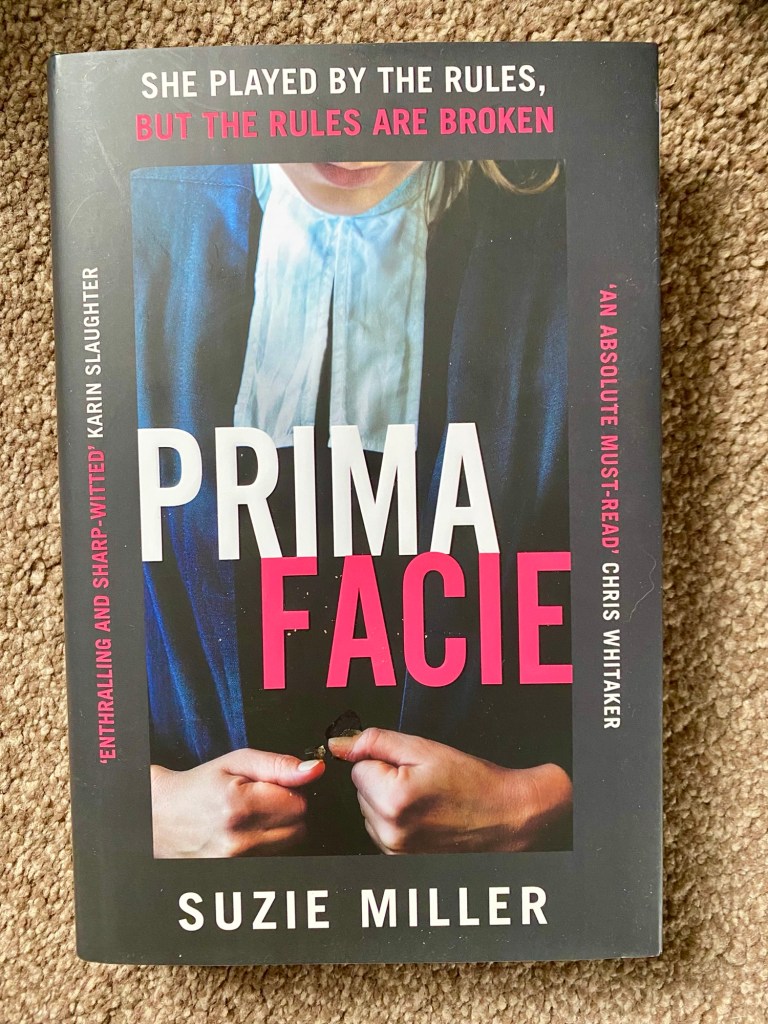
Prima Facie by Suzie Miller

I was only a few pages into this thriller, when I wished I’d seen Suzie Miller’s stage play of the same name running in the West End with an award-winning performance by Jodie Comer. I could see that Comer was the perfect choice for Tessa because I imagine she would understand this character perfectly. Tessa has brought herself from the council estates of Liverpool, via similar areas in Luton, through Cambridge University to one of the best barrister’s chambers in London. Tessa is a defence barrister, one of the best in the competitive area of criminal law. She thinks like a lawyer, her job isn’t about the truth. It isn’t about whether her client is innocent or guilty, in fact she doesn’t want to know. It’s about following the intricacies of the law. It’s about looking for the holes in the prosecution’s case and exploiting them, bringing them to the attention of the jury and creating doubt. All she has to do is create enough reasonable doubt in the minds of the jury that the law directs them to an acquittal. It’s almost a game. A very high stakes game for the defendant, but Tessa gets paid either way. For her it’s the enjoyment of winning and seeing the the system she believes in, applied correctly. However, when Tessa goes on a date with a fellow barrister from her chambers, something goes wrong. Then she realises that the law might not be in her favour after all. Perhaps justice is more equal for some than others.

I was immediately enthralled by Tessa’s narrative voice. She’s smart, a quick study of other people and how they present themselves to the world. She is a brilliant, intelligent and careful lawyer. The author presents law like a religion. Tessa believes in the British justice system, that although there are anomalies, by and large justice does get served. After making a huge jump from her estate and family to Cambridge, she’s become a quick study of class and tribes. As she arrives at her first university lecture she spies a group of staff in suits hanging around the entrance and wonders if she’s been found out – ‘maybe I fluked it and one of those suited people are going to barge in with a list and call out my name. Tessa Ensler? I’m sorry there’s been a terrible mistake’. The boy sat on her right has clearly come from public school. He has that assured way of being that comes from knowing he belongs here and that he will be among those who change the country. The dean tells them that 1 in 3 of them will fail. As she looks to her other side she sees a girl trying to look dishevelled but with clothes deliberately made that way, rather than being worn out. With her layers of necklaces and raggedy clothes she’s showing that she has the confidence to look bedraggled, whereas as Tessa looks down at her own new jumper and knows she doesn’t belong. They know she doesn’t belong. What if she is the 1 in 3?

Yet she adapts and educates herself in how to blend in and even as a fully-fledged barrister years later, she is still well-versed in the unwritten codes of both the court room and the women barrister’s robing room. She refers to her fellow barristers as thoroughbreds. It isn’t enough for her to be a barrister, she has to know how to look and seem like a barrister. She knows the uniform – grey or blue understated suit, low comfortable heels for standing in court, hair that can withstand the wig, not too much make-up. It’s acceptable to show individuality with some quirky earrings, unusual glasses or chunky heel ankle boots. These little details are the way women have learned to own their own space, to show they are serious about the law, but do it differently to the men. Some things are sacrosanct such as the right shoes – the same designer brand, low key and stylish, but very expensive for a shoe that’s so boring. Yet within her first year as a barrister Tess has the same brand on her feet. Her rebellion comes in tiny acts like wearing a collarless shirt, coloured tights or eye-catching earrings. Individual, but not so out there it would frighten the horses. She also doesn’t have a wig tin, choosing instead to keep her wig in a Tupperware box borrowed from her mum. This is deliberate, it reminds her of where she’s from and how to remain grounded. She resists anyone’s offer to buy a wig tin for her, especially when they refer to her choice as ‘slumming it’. She’s mainly played by the rules and thinks she’s become one of them.

I will mention that there are graphic depictions of sexual assault that are a hard read, but they are necessary. They show the ambiguity that can be brought into the legal arguments. Anyone who reads the account has no doubt what happened between Tessa and her colleague. Yet already I could see the ‘holes’ in her story, the things she does ‘wrong’ and how the difference she thought was invisible, being brought up to weaken her account. She can probably imagine the way a defence barrister will cross-examine her and which parts of her story he will exploit to create doubt in the jury’s mind. I found it so painful when she overhears other female barristers discussing the accused, Julian. Julian was always hoping to be a barrister, his father was before him and is now a judge. He is immediately accepted into this world without once having to work out how to be. As the women discuss going to his dinner party and how terrible this false accusation is for him it’s clear he’s one of them, they probably went to the same school and, like her pupil Phoebe, knew which shoes to buy before they even got here. One female barrister asks her outright why she would accuse Julian, when everyone knew she was into him. She must know it’s hurting her own reputation and her career, she’s alienating the ‘very people who will decide whether she gets silk’. In that moment Tessa wonders why it isn’t hurting Julian’s reputation? There are solicitors who will never instruct her again, people who will not share chambers with her and she will likely never progress with her career again. But he will. It brings home everything about her difference from that clique – the small world of London chambers – her disadvantages as a woman, as someone from the wrong school and the wrong type of estate.

I was fascinated with whether or not Tessa would realise that the law isn’t the same for everyone and that her belief in the system she has worked for is left crumbling at her feet? Added to everything else Tessa feels foolish for every time she has said that the law dispenses justice more or less, for everyone. Now she knows it doesn’t. Even before she’s in the court room she knows that it was her difference that made her a victim in the first place. This wouldn’t have happened to Alice or Phoebe because they are protected by their class:

‘I really had thought that I was now untouchable. That if I just did my job, didn’t stand out, won my cases, I’d be like everyone else in chambers. But I am not. I am disposable, I am rapeable. Just like when I was a kid on the estate. Nothing has changed, other than the class of man that can rape me.’

In being exposed to the way the world works for the right type of people, she has naively assumed that it now works that way for her too. We are so intimate with Tessa, her inner world is huge – full of contradictions and fierce intelligence with a veneer of upper middle-class lifestyle overlying strong working class roots. I was totally engrossed in her and recognised something of myself in that working class background rubbing roughly alongside years of middle class education and lifestyle. I’m conscious of a difference in the way I view the world from the rest of my family, but I’ve always wanted to keep them close. I know that if anything terrible happened they would be there for me, just as I hoped Tessa’s mum would be there for her. I’m aware of the difference in my accent honed by seven years of grammar school, a change that turned me into a vocal chameleon, picking up a trace of wherever I go, wanting to fit in. Tessa notices this with other barristers who have accents, there’s always a court voice that’s clear, concise and authoritative. There are so many points in the story where the author captures a current change in how the world has changed, particularly for women. Tessa recalls a sexual encounter in her teens which was only borderline consensual, but back then was chalked up to experience. I remember these days well: a push up against the wall followed by an unwanted kiss so hard it bruised my lip; a grab of the hips from a man as I reached over to answer a phone in a busy office; a teenage boy who thought that because my friend was snogging with his mate, I was up for it too. These seemed like minor incidents, but wouldn’t be accepted by young women today.

Tessa’s story brought up all those issues of consent that I find so interesting – does consenting to one sexual act mean you’ve consented for everything else? If we consent to sex once, does that mean we’ve consented for that whole night? Does it cover the next morning too? My husband was horrified that in law there was no such thing as marital rape until 1991. Consent was given by the woman through her marriage vows. Alarmingly there are still people who think as long as there is no violence, forced or coerced sexual intercourse within marriage does not constitute rape. The court scenes are electric, written with such tension and power. Watching the balance of that power shifting between defendants and prosecution witnesses and the barristers in their robes, posing the questions with scepticism, repeating them till you trip up and then diving in for the attack. I found myself dreading what would happen to Tessa if she didn’t get justice. Would she cope emotionally? Also, what would it mean for her professionally? Would she be trusted again? I would say ‘reading this….’ in my reviews normally, but I felt more like I was ‘experiencing this’ by Tessa’s side and sometimes in her head. She was as close as my own thoughts at times. I wondered whether it’s possible for someone to be as educated, honed and prepared for such an establishment career as the law, without becoming someone altogether different. Is there a way to separate the professional from the personal, to take on some of the female barrister’s characteristics and traditions but keep a little bit more of who you are? To take a bigger Tupperware box from home and seal even more of that professional persona inside along with the traditional wig. Her struggle between being the Tess she became at Cambridge and her chambers and the Tess who lived for a weekend house party with her friends from the estate is the struggle of every university graduate whose family earned a living in a manual job. A family who encouraged her to push herself, to reach grammar school, then be the first to go to university didn’t realise that with each step they’d lose her a little bit. A gap opens up, created by education, money, culture and lifestyle. I was strongly reminded of Tony Harrison’s poem ‘V’ that beautifully captures this dichotomy within a person, a Northerner that’s settled and makes both their name and their living in the south. Yet one line stood amongst all that anger and dislocation: ‘the ones we choose to love become our anchor’. He meant new friends but I hoped in Tessa’s case she would learn that she can be part of her family, while still being successful. To recognise them as her strength and support, rather than something you drift away from. This book is right up there, with the best I’ve read this year. Don’t miss it.

Published on 14th March by Hutchinson Heinemann. With thanks to the Squad Pod for having me in this month’s book club choice

Meet the Author

Suzie Miller is an international playwright, librettist and screenwriter. She has a background in law, and has won numerous awards, including the Australian Writers’ Guild, Kit Denton Fellowship for Writing with Courage and an Olivier Award. She lives in London and Sydney and is developing major theatre, film and television projects across the UK, USA and Australia.

Posted in Netgalley

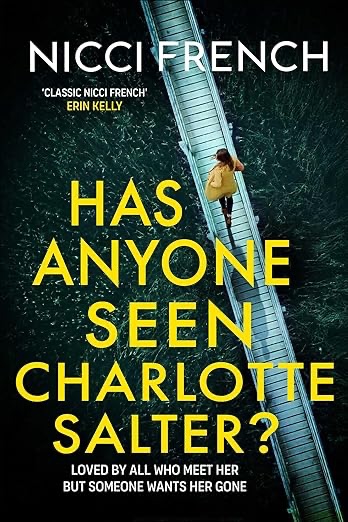
Has Anyone Seen Charlotte Salter? by Nicci French.

Charlotte and Alec Salter have four teenage children and live in the small village in East Anglia. We meet them on Alec’s 50th birthday where a big evening party is planned for most of the village as well as family. Yet at the beginning of the party there are no Salters present. Charlotte went for a walk and hasn’t returned. Alec did same, but they didn’t go together or in the same direction. Fourteen year old Etty is worried. The last of the Salters and yet to leave home she is starting to panic. She loves her mum, but if she is gone, for whatever reason, that means she has to spend two years at least in the company of her father. Just the two of them. Alone.

In the days that follow as the police investigate, there are rumours that Charlotte and family friend Duncan Ackerley were having an affair. Of course it was more widely known that Alec was seeing villager Mary Thorne, in fact his own daughter heard him on the phone to her from the other line the night of the party. When the Ackerleys invite the Salters for Christmas Day, only Lottie turns up at first, her brothers are late and Paul is probably giving it a swerve altogether. Yet Etty thinks it would be worse to sit at home, staring, worrying and jumping at every sound. As dinner time approaches, the Ackerley’s start to wonder where Duncan has got to. He’s been out for a walk, possibly down to the boat as there is a super high tide and he needs to move it. It’s Etty and Giles that start to look for him and he does try to shield her eyes as they come closer and see that Duncan is slumped in the water, dead. We move between the party night and the Christmas days that follow and twenty years later when all the Salters are once again in residence at the family home.

Everything about the house is dated and dilapidated, including their father Alec who is succumbing to dementia. Etty, ever the lawyer, is organising his move into a nursing home and the clearance of their parents possessions. For this job she has found a bright and organised woman called Bridget. She gathers the siblings and tells them that the easiest way is for them to put specific coloured post-its on their must have items, then she takes away the rest for sorting, selling and recycling. It’s emotional, especially since there are now only three of them. Their brother Paul never coped with life and the loss of their mother and sadly committed suicide on the anniversary of her disappearance. Meanwhile, now a TV personality, Morgan Ackerley is home to record a podcast on that Christmas, speculating on what happened to Charlotte and his father. This is going to stir up the village and make life difficult for both families. When a sudden event leads to yet another death, the police are called and a new detective looks at the old files as well as this new case. Are they linked in some way? Despite her boss seeming to warn against digging up what’s been long buried, this detective is determined to find out what happened to Charlotte Salter.

Seeing how much these families have changed over time is so interesting and I found myself wondering how different the Salters and Ackerleys might have been if this crime hadn’t happened. Etty melted my heart a little bit because she’s clearly so close to her mum and on the night of the party she’s the one who’s trying to raise the alarm because she knows something isn’t right. The boys are largely off doing their own thing and seem almost inured to the state of their parent’s marriage. The consensus is they’ve probably had a row, but Etty knows that despite a row, or their dad being on the phone to Mary Thorne at 2am the night before, there is no way that her mum wouldn’t turn up to his birthday party. She has always kept up appearances in that way. She even looks at her father and wonders whether he could have killed her. Her relationship with each parent couldn’t be more different, there’s a distance between Etty and her father both in the past and the present. In fact he doesn’t seem that invested in any of his children. Yet Etty can still imagine the smell of her mum’s perfume and what she would be wearing and I could imagine Charlotte hugging her daughter, her perfume just one of the many scents that signify home. With only the boys and her distant father left who will she go to for hugs? I could feel her panic as realises that after Christmas, the boys will go back to jobs and university and she will be left alone with their father for two years. I could also see the shadow of this huge loss in the adult Etty: an awkwardness about whether the family kiss to greet each other or not; keeping a lawyer’s professional manner at all times; doing all the organising and keeping busy so she can remain detached. She doesn’t cry, even when finding memories of their childhood. She holds herself stiffly, almost brittle and I wondered how much it would take for her to break.

There are many ghosts here. It’s not just Etty who was changed. They all feel the loss of their brother Paul deeply and he’s the empty chair at the table, even now. They tiptoe around each other, trying not to open old wounds but when a fire is started at Bridget’s home a new murder investigation is opened. Either the arsonist didn’t realise Bridget was at home, or didn’t care. Was their aim to kill the house clearer or was it to hide evidence that she’d unwittingly taken into her home alongside the Salter’s belongings? I found this mystery so intriguing that I couldn’t stop reading and I loved the psychological aspects of how these unsolved crimes had affected the families and the village as a whole. There were a couple of crucial points past and present where everyone I suspected seemed to be going for a walk alone – without even having a dog as an excuse! I was suspecting that Lottie’s husband wasn’t as advanced in dementia as she seemed, but couldn’t be sure. The reveals were satisfying, but it was the methods of concealment that really blew me away and I loved how thorough the investigating detective was. She wanted to be sure, whether or not it disturbed or upset some people and I loved that about her. Mainly I thought about how the author successfully showed the long term effects of a crime like this, even years on from the actual incident. These children were all changed forever and the villagers have lived under a fog of suspicion for years. Etty particularly left me thinking of all the events I’ve been able to enjoy with my mum over the last 50 years, that she and Charlotte had missed out on. Finding a balance between the real emotions that surround a crime and creating a page-turning mystery is difficult, but here I think the authors have really pulled it off.

Out 29th Feb in Hardback from Simon and Schuster

Meet the Author

Nicci French is the pseudonym of English husband-and-wife team Nicci Gerrard and Sean French, who write psychological thrillers together

Posted in Netgalley

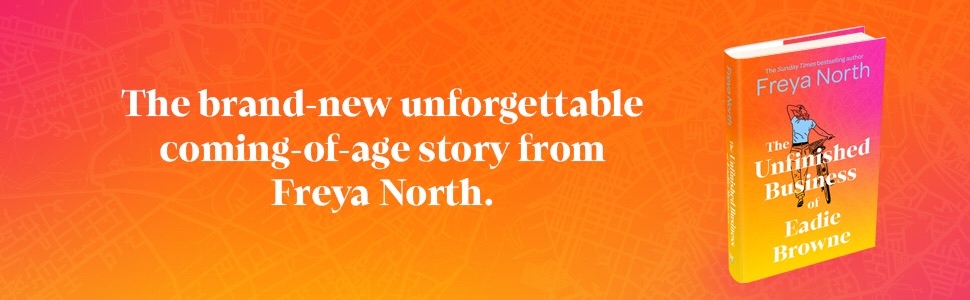
The Unfinished Business of Eadie Browne by Freya North

Eadie lives an unusual life in her garden city home, situated next to a cemetery. Far from being macabre and frightening, the dead are often this lonely little girl’s best friends. They provide her with somewhere to go and talk, without censorship or interruption. Her Mum and Dad work jobs outside the home, one in the day and one at night, but the rest of their time is spent at their desks in the family living room each completely engrossed in their writing work. She is an outsider at school, without friends and a target for kids like Patrick Semple. Patrick is relentless in his bullying of Eadie and it takes her a long time to find her little tribe. Her friend Josh lives with his grandfather who has a convenience shop, he’s also a concentration camp survivor. She also makes friends with Celeste, who’s lived in France and her mother, Sandrine, is an alcoholic. These are her first friends her own age, as up until now she’s mainly hung out with Michael, an elderly man who tidies the cemetery and Ross who plays the bagpipes at funerals. Eadie is feeling so settled with her life, but these three young friends are on the cusp of a huge change. All three will be going to different universities and while Eadie likes to think nothing will change, distance does have an effect on relationships and the whirlwind of Fresher’s Week will immerse them in their new lives. Will they still have time for each other? More importantly, will Eadie be able to leave the difficulties of her childhood behind her and make a life in Manchester?

Freya North beautifully inhabits the world of a young child and the fears and preoccupations that are their daily lives. It immediately swept me back to my own childhood and moments when I was afraid or felt like I didn’t belong. In my first year of primary school at age 5 we lived so rurally I had to get on a public service bus and remember when to get off and how much to pay the driver. It left me anxious about public transport ever since. I was also bullied, being poor but having a place at the local grammar school wasn’t easy and I never had the right clothes. My family also went to an evangelical church which made me different and restricted my social life. I really identified with Eadie, for feeling that her background was less than perfect. I felt Eadie’s pain. As children, if people tell us we’re odd or wrong in some way we internalise that feeling and assume they’re right. Eadie’s parents are not neglectful, but they are a very definite twosome, seemingly unaware that their only daughter is achingly lonely and suffering from immensely low self-esteem. As adults we can step back and see that her bully is probably suffering too, but children don’t realise this. As the group of friends grow towards leaving school, the changes are not easy for Eadie to cope with. What will happen to their trio as they all go their separate ways? While Josh and Celeste are excited about what’s coming, Eadie is anxious. What will Manchester hold? Will she be accepted?

I love the North West of England, my family are originally from Liverpool but my best friend is a Mancunian and we’ve spent an enormous amount of time there over the years, mainly seeing gigs from Manchester bands like Elbow. However, I grew up in the late 1980s and early 1990s and I was an indie kid. I started with The Smiths and Morrissey through to the Madchester scene and although I was too young for the halcyon days of the Hacienda I did love New Order with a passion and Bizarre Love Triangle is one of my favourite ever tracks. I felt immediately transported back to the reign of Tony Wilson, when New Order would be in residence and the club was heaving. North captures perfectly the heady days of the summer of love – the advent of Acid House and Ecstasy. Here, having made friends, Eadie finds her place of worship. She loves ‘the Hac’. She can be found on the dance floor in just a sports bra and shorts combo, able to dance all night with a raging thirst from E and a feeling of well-being to the whole world. This is before and the terrible deaths that occurred. Eadie and her friends rent a house on Hathersage Road, across the road from the amazing Baths with its art nouveau interiors. This is her home now. In fact she becomes so comfortable in her life here that she stops going home, she stops writing to friends and lives completely in the moment. It’s when things start to change that Eadie begins to struggle. Housemates have plans for their second year, placements abroad, moving back into halls and Eadie starts to fall apart. An unexpected face from the past comes back to haunt her too. After a warning from the barman at the local pub where she works, that the Hacienda is being run by drug gangs and that means violence. This leads to an unexpected blast from the past and is the catalyst for a breakdown. Eadie finds herself unable to complete work and even starts to question whether to stay at university. With her housemates making different plans for next year, Eadie can feel the foundations of her life shaking.

Freya North captures perfectly how secrets and traumatic experiences can follow us through life. If left unaddressed, our life is like a wall with a fault in it’s foundations. It can only be fixed by removing the upper layers until you reach and remedy the original fault. Eadie has covered her trauma over with many different layers: her friendships with the residents of the cemetery; alcohol and E; the Hacienda and acid house. I felt something with Eadie’s story, because of my own recent experiences with old friends. We can experience so much difficulty and pain in life that we feel far removed from those friends we’ve had in the past, but often they’re still there, just waiting for a sign that they can help or support us. I loved Eadie’s relationship with Kip, which isn’t perfect but the love is all the more real for those imperfections. His love is shown in actions rather than words and is stretched to it’s limits at times. Eadie is one of those people who takes a long time to work out who she is and what she wants to do in life, that is until she takes care of her unfinished business and then she flies.

Out now from Mountain Leopard Press

Meet the Author

I’m the author of 15 bestselling novels and am so excited to bring you my 16th novel: THE UNFINISHED BUSINESS OF EADIE BROWNE. I know you can read the blurb here – but I wanted to tell you how important and personal this book is to me… Much of it was drawn from my own memories of leaving home for Manchester Uni in the late 80s and remembering what that FELT like. Also, I live outside Welwyn Garden City in Hertfordshire – and I became interested in the visionary ethos of the Garden City movement. Because lockdown cancelled all the lovely centenary celebrations planned for Welwyn Garden City, this novel also serves as my tribute to the town and its Founder. I hope you’ll enjoy the novel – unlike Little Wing, my previous novel which flew out of me in 4 months flat, I really toiled over Eadie Browne; writing and rewriting and REWRITING until I was confident I’d written my best book yet… this much I owe to you, my lovely readers.

2021 marked the 25th anniversary of the publication of my first novel Sally! My 15th novel Little Wing was written during the first lockdown. Set partly in the Outer Hebrides and interweaving the secrets and lies of two families over two time frames – it was a joy to research and write and certainly kept me sane during the Pandemic. I’ve always been focussed on a sense of place being a key feature of my writing – settings being a leading character, not merely a backdrop. Previous locations have included North Norfolk, British Columbia, Derbyshire, Vermont, France, Scotland, Wales, Cornwall… I’m an avid reader too – and the novels of Barbara Trapido, Jane Gardam, Rose Tremain and Mary Wesley inspired me to write. I hope you enjoy my books – please keep in touch via my website, Facebook, Twitter and Insta! Happy Reading! Sign up for my newsletter (via my website)

Posted in Netgalley

Expiration Dates by Rebecca Searle

It’s been a while since a romantic novel has made me shed tears but I reached just over half way through Rebecca Searle’s new novel and I felt a lump forming in my throat. My reaction was possibly more emotional than the average, because I felt seen. Rebecca has this habit of taking what seems like a simple romance and adding an element that immediately elevates it to something more. Daphne lives in L.A. and works as an assistant to a film maker, outside of work she is a busy bee flitting between visiting her parents, spending time with her dog Murphy and roaming flea markets for quirky household items. However, her favourite weekend mornings are those she spend with her ex-boyfriend Hugo: he wakes her early, they get to an early farmer’s market for the best choices such as the sunflowers that are always gone by ten am. Her career hasn’t changed much over time and she has chosen to stay in the area to be close to her family. Daphne is single, at a point in life where people she knows are staying together, having babies and getting married. Daphne tends to have short term relationships, but she is starting to wonder about all these things. Are they something she’ll ever find? Her friends can’t understand it, she’s a great girl, and have started to offer to their friends and work colleagues as potential dates. What they don’t know is that Daphne keeps a box under her bed and in it are post-it notes, drinks coasters and theatre tickets all which have the name of a boyfriend and a length of time, an expiration date. From one night to several months these cards enter her life around the same time as a new man and Daphne knows the finite amount of time they have together. This bit of magic from the universe is amazing in some ways, but in other ways she’s starting to think they hold her back. Are they starting to become a self fulfilling prophecy? Then her friend Kendra sets her up with Jake and Daphne waits for her expiration date to arrive. This time though, it’s just a name; no date. Does this mean Jake is the one?

Aside from the magical expiration dates, I was beginning to wonder whether this was a straightforward romance. Much as I was enjoying Daphne’s life, I was missing that extra element that grabs me and makes me feel something. I shouldn’t have doubted the author, because when it did arrive the impact was huge. Having had a similar experience at the same age as Daphne made her story even more compelling because I ‘got’ it and completely understood her emotions and reasoning. There are momentous experiences in life that divide it into a very clear before and after and you can never return to who you once were. Yet on the outside, the change isn’t visible. There is always something there to be revealed, something that can be ‘outed’ and only you can choose when and if you reveal it. Jake’s open ended expiration date is ambiguous, but what it does is leave Daphne to make choices in a way she never has before. Previously, short expiration dates have meant she doesn’t have to make a choice. If it’s one night, the chance to know another person is limited. If it’s three months Daphne doesn’t have to invest too much emotionally. It’s both freeing and restricting at the same time. Daphne doesn’t have to change or make too much effort, because whatever she does or doesn’t do it changes nothing. However, her emotions are restricted. If she didn’t see the expiration date, might she have invested more, took a risk or perhaps even fallen in love?

That’s why being with Jake is so different, it’s the only open ended relationship she’s ever had. Don’t get me wrong, Jake couldn’t be more perfect. He’s attractive and intelligent. More importantly he’s kind and considerate. At first, Daphne isn’t sure but for once they have all the time in the world for her to explore and see where the relationship and her feelings go. Jake has emotional depth and a willingness to put those emotions on the line. Jake was married once and his wife died. Daphne marvels at his ability to be vulnerable when he has lost so much. It also worries her, because she holds a secret that has the ability to shatter this fragile and tentative relationship they’ve built. She has a perfect man who wants to live together, to marry and build a future. Everyone says he’s perfect, but is he perfect for Daphne? I couldn’t help but keep thinking back to Hugo, who seems like the one who got away. He knows everything about Daphne, the secret and the expiration dates, but he’s still here. Their official romantic relationship may have come to an end at their proscribed three month deadline, but he’s still here and to me he felt like the person who is closest to Daphne. If they’d had the chance of an open ended relationship, might they have been perfect for each other? There were things I didn’t like about Hugo, but to me he felt more vibrant and alive than Jake. I felt like Daphne glows when she’s with Hugo, whereas with Jake she is the epitome of the phrase ‘settled down’. For Daphne, falling in love has never been simple and I really related to that. I think a lot of other readers will too.

Out on 14th March from Quercus

Meet the Author

Rebecca Serle is the New York Times bestselling author of Expiration Dates, One Italian Summer, In Five Years, The Dinner List, and the young adult novels The Edge of Falling and When You Were Mine. Serle also developed the hit TV adaptation Famous in Love, based on her YA series of the same name. She is a graduate of USC and The New School and lives in Los Angeles with her husband.

Posted in Netgalley

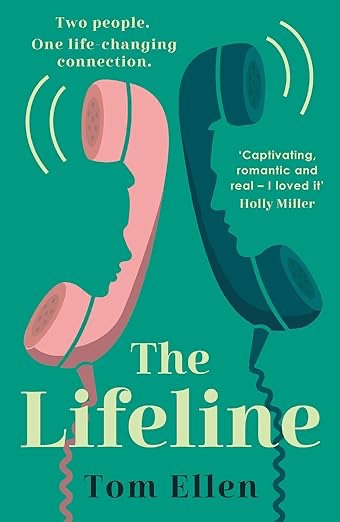
The Lifeline by Tom Ellen

If I learned one life lesson from Tom Ellen’s lovely romance novel, it’s that I’m not the only one who has a weird celebrity crush on Richard Ayoade. What a relief! Usually I get quizzical looks and awkward questions when I admit this, so I felt vindicated. I often say I don’t like romances, but I really did enjoy this story about Annie and Will. They met one day in Paris when Will’s band The Defectors were the next up and coming Indie band. Annie is sent out to interview them before a gig and hits it off with cute frontman Will Axford, who I was imagining as my Indie crush Damon Albarn. Annie finds his floppy hair, dimples and the gap between his front teeth very sexy. He seems to be clicking with her, but she’s still surprised when he catches up with her after the interview and suggests they spend the day together. Later as they watch the sunset from the Pont Alexandre III bridge, he asks if they can meet after his gig on the same spot. So, Annie is standing there at 11pm waiting for Will to arrive but when he still isn’t there at 11.30pm she gives herself a good talking to, fancy falling for the patter of a rock star. He’s probably with another girl already or tries this on every girl he meets. How stupid to think he would genuinely like her! As she pays for an extortionate last minute hotel room on her credit card, she’s already mentally writing up her interview full of anger and disappointment.

Fast forward five years and Annie works for an internet magazine, one of those that suck us into a blur of 1980’s celebrities and what they look like now or the best ever one hit wonders. It’s not what she wanted to do when she started out, with a pile of short stories and novel proposals, but it pays the bills and she loves her colleague Lexi. So, when she’s asked by her boss to write a new “Where Are They Now?’ series to go with some very lucrative advertising revenue, she jumps at the chance to do something more interesting. Then her boss asks her to track down The Defectors. Behind the scenes Annie is having a hard time. Her father died just over a year ago and her different approach to his cancer diagnosis has left her estranged from her mother and sister. Her live-in boyfriend Dom isn’t her dream man, they’re just muddling along while friends are making huge life changes like marriage and baby. The thought of losing Dom or her job scares her, but maybe a big change is exactly what she needs? As she tries to track down The Defectors she sees one of them has shared a phone number on a black background, which stands out in the usual technicolour of Instagram. It’s for a lifeline called Green Shoots, a listening ear for those who are bereaved, anxious and lonely. Annie needs someone to listen to everything that goes round in her mind, so decides to call using her middle name Pia. When Jack answers she finally feels she can open up.

Jack volunteers at the lifeline as often as he can but he doesn’t use his real name. Of course he has regulars and I fell in love with these callers, perhaps because they reminded me so much of my own work in mental health. Work I’m not well enough to do at the moment. I understood that fondness for certain callers, because it’s hard to avoid clicking with people, however we meet them. There’s Eric who calls and often makes hilarious commentary on whatever he’s watching. Some of these programmes, despite his advanced years, are things like Love Island and Made in Chelsea. I fell in love with him straight away and those times when he called feeling low I was heartbroken. Then there’s the breathing lady, who calls just to have someone to breathe with, until she feels calmer. Jack and Pia hit it off on the phone straight away, there’s energy between them. So when she says she’ll call back, he finds himself looking forward to her call. I really felt for Jack because working with people and their deepest emotions can forge strong connections, it’s hard to be detached from some callers. I loved that his friend and colleague Tanvi felt the same way too. He had been avoiding the get togethers and catch ups with other volunteers, mainly because he’s struggling with making friends and being social. Years before, there was a friend that Jack wished he could have been there for and he finds the guilt is crippling.

I felt for Annie too, especially her journey through grief and the struggle to cope when her father was diagnosed with terminal cancer. The author presents beautifully how even the closest people can grieve in their very different ways. There’s a need to give each other space and respect what they need to do in order to cope. It’s so hard when someone is terminally ill and perhaps their wishes don’t align with our own. It’s hard to let go of someone we love, even when we know they’re ready. I thought the author paced the story perfectly and the misunderstandings on the road to romance were believable, rather than formulaic ones that sometimes make me groan in romance novels. I really liked and understood these characters, so I was truly into their story and didn’t notice the romance tropes as much. Equally, I loved the revelations along the way, because as Annie found more dead ends in her search for Will Axford and his band, I began to wonder whatever did happen to him? This was a thoughtful, bittersweet novel about love and the people we lose along the way, and I read every word hoping our two main characters would find each other.

Out now from HQ

Meet the Author

Tom is an author and journalist from London, England. He is the co-writer of three critically acclaimed Young Adult novels: LOBSTERS (which was shortlisted for The Bookseller’s inaugural YA Book Prize), NEVER EVERS and FRESHERS. His solo adult debut novel is the romantic comedy ALL ABOUT US (HQ/HarperCollins, published October 2020). His books have been widely translated and are published in 20 countries. He is a regular contributor to Viz magazine, and has also written for Cosmopolitan, Empire, Evening Standard Magazine, The Daily Mash, Glamour, NME, ESPN, ShortList, Time Out London, Vice, Stylist and many more.

Posted in Random Things Tours

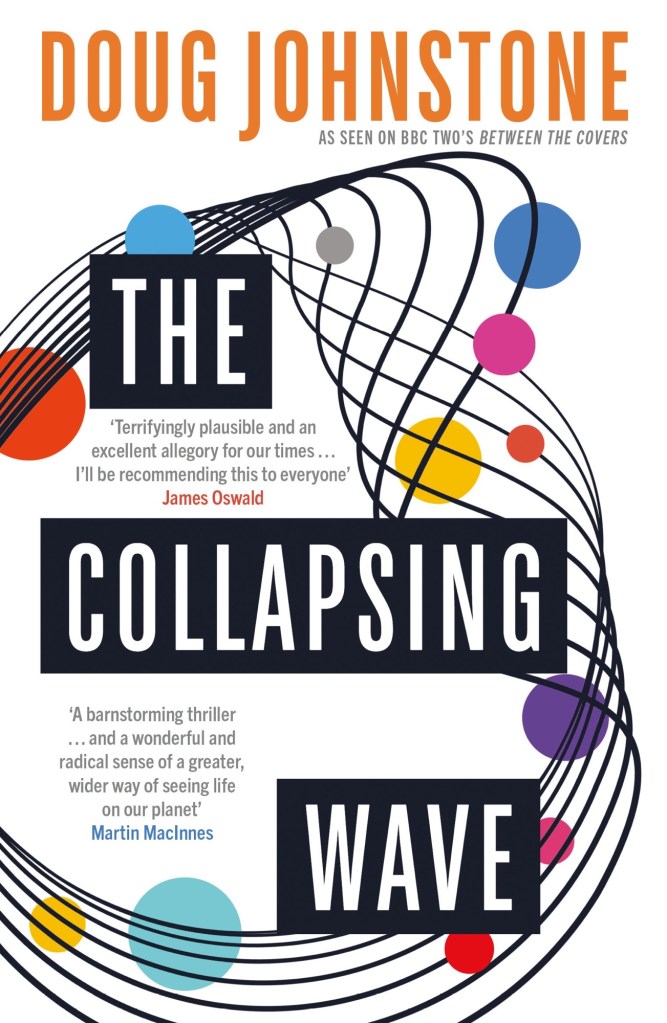
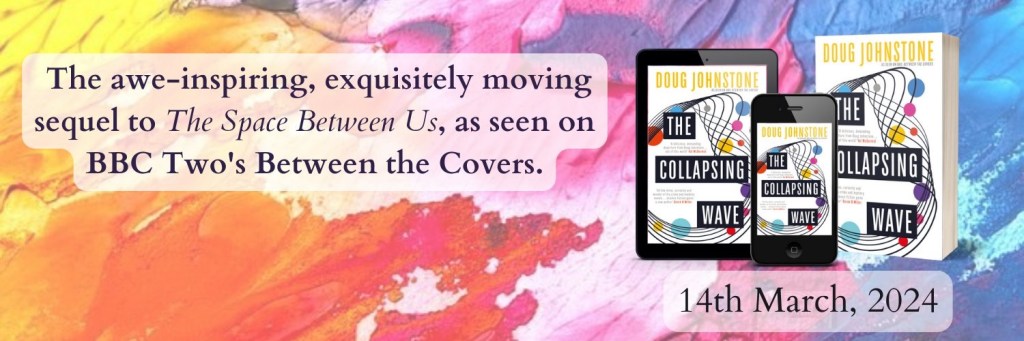
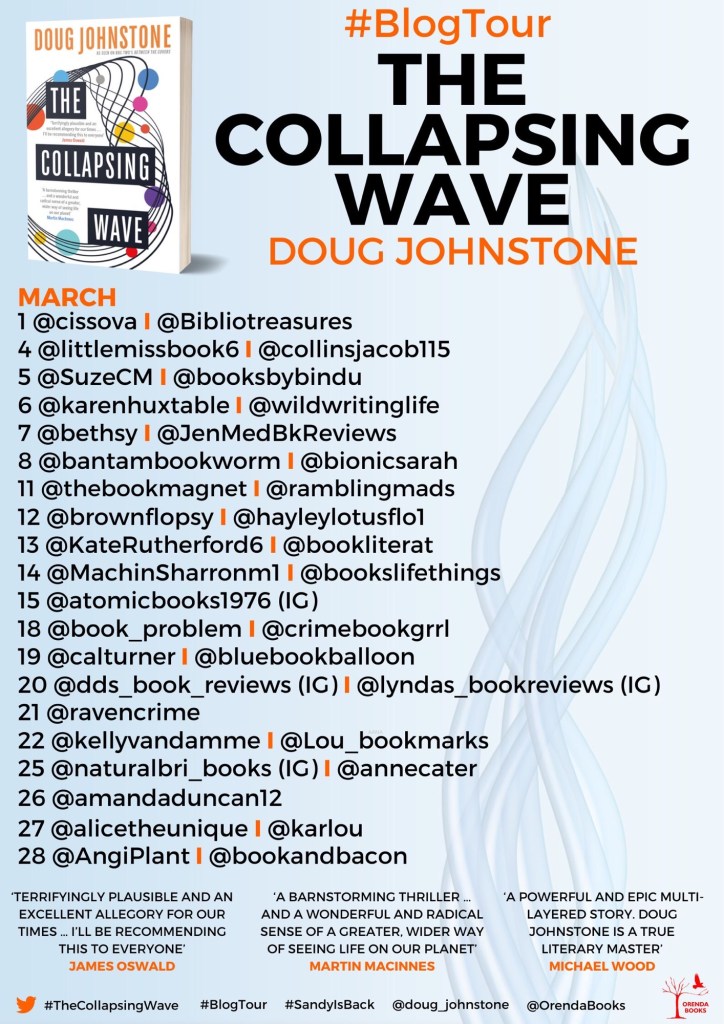
The Collapsing Wave by Doug Johnstone

When I first met the incredible being Sandy in The Space Between Us I had no idea that there would be a sequel, never mind a trilogy. I grew up at the time when home VCRs were becoming affordable and we rented the Star Wars films so many times that I’m sure if we added up the hire fees we probably bought them. Doug Johnstone’s second novel has something in common with the original trilogy in that this second outing is much like The Empire Strikes Back, it’s darker in tone and it looks like our heroes may be beaten. Heather, Ava and Lennox come up against the worst traits of human nature; fear, hate and paranoid self-preservation seem to be winning and it’s the military’s role to carry this ideology through.We start several months after the last book ended as Sandy was reunited with the rest of his species at Ullapool and disappeared into the sea loch. Our three heroes seemed set for different fates as the research scientists and police who’d been tracking their journey finally caught up with them. Ava is confronted by and wreaks revenge on her abusive husband who pushed her to the edge of suicide and now tries to take her baby Chloe away. At the beginning of this novel we find her in Edinburgh for the court case, watched by her sister who is now Chloe’s guardian. As she’s given a suspended sentence Ava’s elation turns to terror as she’s swept up outside the court room by military officers with guns. Lennox and Heather have been in a makeshift compound that’s now become the biggest American military base on British soil, named New Broom it sits at one end of Ullapool’s sea loch in the middle of nowhere, like Guantanamo Bay rebuilt in a beautiful Highland setting. Heather and Lennox are detained, seemingly with no legal basis, as MI7 Agent Oscar and the American military attempt to capture partial enceladons and understand the way they work. Oscar at least has an academic interest, whereas the military seem more fixated on how to exploit their alien powers to overpower and control the Earth. Nothing could be further from the alien’s minds, they are simply looking for somewhere to live now that their oceanic home has become colonised by another species. They are refugees.

I think the political climate and local circumstances had me reading the book on two levels: as a great science fiction story, but also as an allegory. For those who don’t know my closest city is Lincoln and we’re currently experiencing community divisions. The government’s decision to requisition the recently closed RAF base of Scampton, home of the Dam-Busters, and turn it into a centre for asylum seekers has met with uproar. It’s terrifying to hear the opinions of people who drink in the same pub, deliver the mail or wash the windows, in case it’s far removed from your own. There were sensible arguments against the plan: there was already a plan to turn the base into a museum and heritage centre, for which local people had fundraised hard; the government are not using the actual existing barrack blocks to house the men, but putting portacabins on the runway instead; it’s so far away from any services in the city. Yet, instead of being able to protest these points at a local level, a far right extremist group from Yorkshire has hijacked the cause and set up a protest camp at the base’s main gate with racist signage and ideology. They are protesting against any asylum seekers: ‘coming in illegally for the benefits; to commit crime; to be terrorists; to groom children; to take social housing’. They don’t even understand that in order to claim asylum someone must first arrive in their chosen country. Maybe because this is now part of my everyday life, the parallels between the enceladons and asylum seekers/ refugees were undeniable. Both have been forced from their own country for whatever reason and the majority seek to live somewhere peacefully and in harmony with the existing population, not realising that to some people, their very arrival itself is a threat.

New Broom’s research staff are carrying out experiments that wouldn’t have been out of place in concentration camps. They are building Faraday Cages to capture partial enceladons and prevent them communing with others through telepathy. This silence is enough to depress and eventually kill them, because they can’t live separately only as part of the whole. Lennox and Heather miss the sense of communion they get from their telepathic communication with Sandy. They can commune with each other though and do so whenever they can. Heavily guarded wherever they go, they have no idea that Ava and Chloe are on their way, or that a camp of ‘Outwithers’ has built up on the edge of the loch filled with travellers, believers, anti-government protestors and anyone who despises the idea of such a huge military base on Scottish soil or the capture and torture of enceladons. There’s only one American soldier who shows a trace of empathy, the others are simply unquestioning drones taught to believe they are acting in the interests of National Security and the defence of the Western way of life. The two main men in charge are clearly in the grip of obsession, whether it’s a selfish intellectual curiosity or the terrifying birth of a megalomaniac. While I felt Oscar could perhaps be redeemed, General Carson is itching to exert authority over both security and experimentation. The only character who has their freedom is Sandy, but how can they be truly free with their family being captured bit by bit and their peace threatened by a man determined to destroy them all. Make no mistake, this is not the soft humorous story we might have expected from the first novel. In parts it was hard to read and made me feel physically sick, especially when Ava is finally reunited with her friends at New Broom. As Carson separates Ava from her daughter and proceeds to torture Chloe I felt so angry I was tearful. It is horrific and has the reader rooting for the overthrow of the Americans, by whatever means necessary.

It’s the feelings that Doug Johnstone’s writing conjures in the reader, that make this such an immersive read. The moments of love, friendship and sacrifice between these characters are beautiful and are but a small part of the collaborative existence the enceladons share. The moments where Sandy takes a human into the ‘whole’ are euphoric and more than a little trippy! The way the enceladons harness and work with nature to fight back against the military base has a similar feeling. The way Heather decides to stop resisting the cancer invading her body and just enjoy the life she has left living within the collective. All of these are pointing to the same life philosophy. We must work with something, not against it. The enceladons want to exist alongside humans, to become friends and communicate with them. After years of Thatcherism and the message that autonomy is the route to success and freedom, working together actually is an alien concept. It isn’t just the communication between the three friends that proves to be powerful. It’s the mother – daughter bond between Ava and Chloe. It’s the ‘Outwithers’ who have come together to create their protest camp and two women; Jodie, a lifelong activist for connection and Vonnie, whose love connection with Lennox creates it’s own power. Communication with the Outwithers is what changes Oscar, although whether this actually redeems his character overall I don’t know. These are the people who understand that connection with the colony can strengthen society as a whole, rather than destroy it. There are also those who choose not to see, whether that’s by building a fence and only caring about what’s in your own backyard, or by choosing to believe the government and mainstream media narrative, which only exists to manipulate. It reinforced my belief that language is so incredibly important. If we choose the word integration instead of infiltration, opportunity rather than threat, to embrace something changing for the better rather than hankering after a nostalgic past that mustn’t be destroyed, if it ever existed. If we realise that connection is more important than individual attainment we learn to grow, adapt and embrace new things. It’s amazing that E.M. Forster’s quote ‘only connect’, although now it’s over a 100 years old, still has such huge resonance.

Published on 14th March by Orenda Books.

Meet the Author

Doug Johnstone is the author of twelve novels, most recently The Great Silence, the third in the Skelfs series, which has been optioned for TV. In 2021,The Big Chill, the second in the series, was longlisted for the Theakston’s Old Peculier Crime Novel of the Year. In 2020, A Dark Matter, the first in the series, was shortlisted for the McIlvanney Prize for Scottish Crime Novel of the Year and the Capital Crime Amazon Publishing Independent Voice Book of the Year award. Black Hearts (Book four), will be published in 2022. Several of his books have been best sellers and award winners, and his work has been praised by the likes of Val McDermid, Irvine Welsh and Ian Rankin. He’s taught creative writing and been writer in residence at various institutions, and has been an arts journalist for twenty years. Doug is a songwriter and musician with five albums and three EPs released, and he plays drums for the Fun Lovin’ Crime Writers, a band of crime writers. He’s also player-manager of the Scotland Writers Football Club. He lives in Edinburgh.