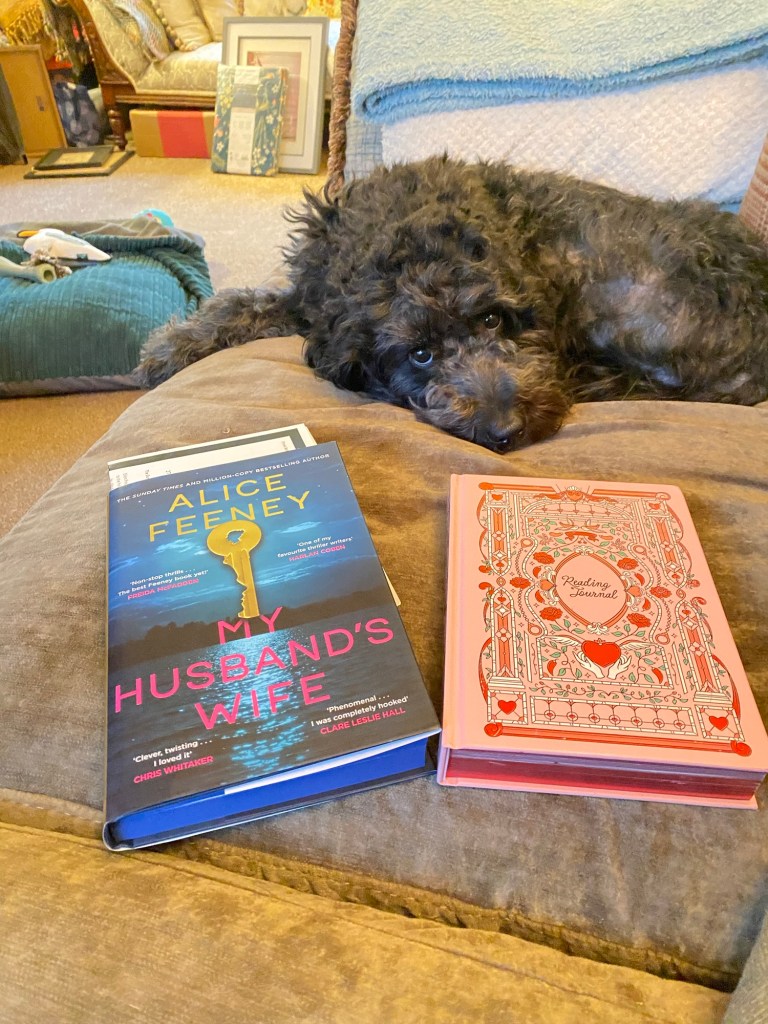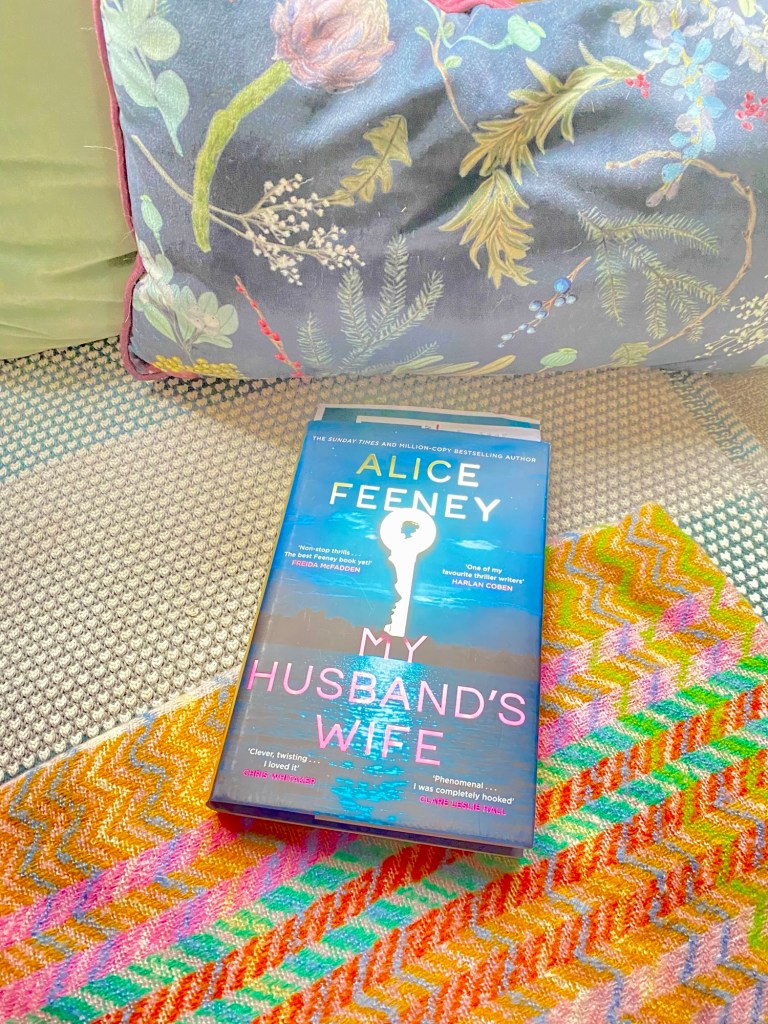
Eden Fox, an artist on the brink of her big break, sets off for a run before her first exhibition. When she returns to the home she recently moved into – Spyglass, an enchanting old house in the pretty seaside village of Hope Falls – nothing is as it should be. Her key doesn’t fit. A woman, eerily similar to her, answers the door. And her husband insists that this stranger is his wife.
One house. One husband. Two women. Someone is lying.
Six months earlier, a reclusive Londoner named Birdy, reeling from a life-changing diagnosis, inherits Spyglass. This unexpected gift from a long-lost grandmother brings her to Hope Falls. But then Birdy stumbles upon a shadowy London clinic that claims to be able to predict a person’s date of death, including her own. Secrets start to unravel and, as the line between truth and lies blurs, Birdy feels compelled to right some old wrongs.
My Husband’s Wife weaves a tangled web of deception, obsession and mystery that will keep you guessing until the last page. Prepare yourself for the ultimate mind-bending marriage thriller and step inside Spyglass – if you dare – to experience a story where nothing is as it seems.
My goodness this thriller messed with my head! From the very first time Eden Fox returns from her run, puts her key in the door and finds it doesn’t fit, I was utterly hooked. I couldn’t imagine how this had happened and what the hell was going on. Even her own art exhibition has been hijacked by a woman who looks exactly like her and as the village’s police officer Sergeant Carter is brought into the mystery, he’s also at a loss. He goes to meet Harrison Wolf at his home, a beautiful house called Spyglass set on the cliffs with a panoramic view of the sea. Harrison is Eden Fox’s husband and he insists that the woman at home with him is his wife. So who is the woman left at the police station? We’re then taken six months earlier and introduced to Birdy, a young woman living in an apartment above a bookshop in London. She receives a strange letter addressed to her recently deceased grandmother, it’s so strange Birdy is fascinated and wants to investigate further. It’s from a company called Thanatos who claim to be able to predict your death day. Birdy decides to become a client of the company, run by Harrison Wolf. Birdy is interested to see if they are as accurate as they suggest. She wants to know what the company told her grandmother, before she died. Her grandmother lived in a house looking out to sea, in a small village in Cornwall and Birdy has inherited it. How are all these people connected? I had so many questions I didn’t know where to begin, but the short chapters and their drip feed of information kept me reading. I just had to find out what was going on!
I loved Birdy as a character and was surprised by the part she played in the investigation around Eden Fox. Her dynamic with Sergeant Carter is comical and brings light relief to the complications of the plot. She is so very sure of who she is and has a specific look from her plaited hair to her brogues. She also loves reading with always endears a character to me and enjoyed her dog companion too. She’s very ballsy and soon has the measure of Carter who really doesn’t stand a chance against this intelligent and forthright older woman. Carter is our representative of this sleepy village in Cornwall and through his family we see the difficulties facing villagers as more and more housing is being turned into holiday accommodation. They have lost their home and livelihood at the Smuggler’s Inn. Young people have very little chance of settling where they’ve grown up which affects the passing down of traditions and social history. Our book is set around the time of All Soul’s Day and the village tradition is like a Day of the Dead parade with everyone dressed up as skeletons, or dead pirates and mermaids. This touch of folklore lets us know we’re somewhere unique, with a long history and old loyalties. Could this be an explanation for what’s going on here? Something magical or something more sinister and human?
I’m in awe of people who can write like this and keep track of all the threads. I imagine a room with one of those see through boards covered with pictures, lists and cross-referencing. Spyglass is a brilliant backdrop for all these odd goings on and reminded me a little of the home in the first Knives Out film that one detective refers to as a life size game of Cluedo. There’s something mesmeric about its view that inspires both Eden Fox and her stepdaughter Gabrielle who still paints nothing but the house and it’s surrounding despite living elsewhere, in a home for dependent young adults. Ever since an accident when she was a child Gabrielle hasn’t spoken and only communicates through her art, which sounds very eerie. Spyglass’s library sounds incredible and it’s no surprise to know that Birdy’s grandmother had a love of classic crime fiction. Like me, I’m sure other thriller readers will devour this addictive thriller that delivers great characters, a seemingly unsolvable mystery and twist after twist.
Out now from Pan MacMillan
Meet the Author
Alice Feeney is the New York Times and Sunday Times multi-million-copy bestselling author of novels including HIS & HERS, SOMETIMES I LIE, ROCK PAPER SCISSORS, DAISY DARKER, BEAUTIFUL UGLY and MY HUSBAND’S WIFE. Her books have been translated into forty languages, and have been optioned for major screen adaptations. HIS & HERS was an instant Global #1 Netflix show in 2026, starring Tessa Thompson and Jon Bernthal.
Alice was a BBC journalist for fifteen years before becoming an author. MY HUSBAND’S WIFE is her eighth novel.
You can follow Alice on Instagram or Facebook. To be the first to know about her tours, TV shows, and books, visit her website: alicefeeney dot com.
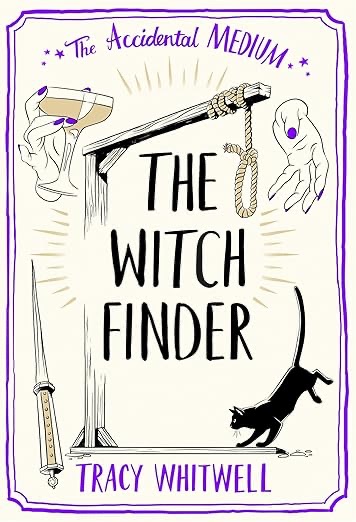
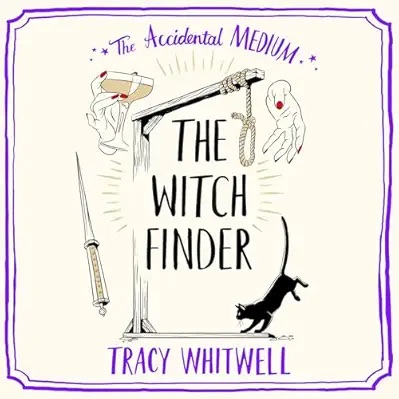
This is the fifth and final installment in the hilarious Accidental Medium series featuring Tanz, who with the help of the dead, has become an unwilling crime-solver.
When Tanz returns to her hometown in Newcastle, she comes face-to-face with dark, ancestral secrets lurking in its shadows. Haunted by chilling visions of the witch-trials, a voice from the past warns her, You’re the one. Burn it, chosen one. As a sinister figure threatens to ruin everything she’s built for herself, Tanz must embrace her connection to the dead to uncover her destiny.
With everything on the line, Tanz finds herself entangled in a web of folklore, mystery and imminent danger. Elements collide as the echoes of history demand intervention and new relationships entwine in her mystical journey. Tanz must wield courage against paranormal forces and listen to old and new allies in order to prevent ominous threats from consuming her world.
Will Tanz unravel the mysteries surrounding the witch pricker and her own lineage in time, or will she fall prey to the darkness that stalks her?
I love a good witch story and the Accidental Medium books have been a brilliant series from Tracy Whitwell. So much so that I’m really sad this is the last set of adventures for our titular accidental medium Tanzy. I love the combination of magical and ghostly goings on with our down to earth and sweary Geordie witch. This time the atmosphere is slightly different as we’re delving into the history of witches in Tanz’s home town of Newcastle. After returning from her exciting and romantic exploits in Iceland, she takes a worried call from her ‘little mam’ who has had strange and unsettling dreams about hangings. As usual Tanz tries not to alarm her mam because she isn’t comfortable with the family gift, but Tanz has also had similar dreams of feeling a bag over her head and a noose around her neck. She gets straight into the car and drives home and not a moment too soon since someone has thrown a dead hare over her parent’s garden wall warning them away, but from what? Newcastle is a lovely city and I enjoyed seeing Tanz in her own environment. She soon calls her friend Sheila to join her and tries to find out as much as she can about the city’s history with witches. As a contrast to the friendliness of people and the buzz of a lively city, Tanz starts to notice an atmosphere change heralding one of her visions. She notices storm clouds suddenly gathering and rain lashing down, especially when she’s confronted with the figure of the witchfinder, Matthew Hopkins. More disturbingly, he seems to be able to see Tanzy too and tries to attack her with his ‘pricker’ – the implement he uses to test whether marks on a witch’s skin bleed or not. In one terrifying scene he makes a swipe for the window of a tearoom leaving a scratch down the glass and down Tanzy’s cheek. As they research Hopkins in the library, Tanzy finds out that he identified several witches who were all hanged together on the common. She can hear Hopkins’s hatred of women and there were definite parallels with the current political situation around the Epstein files and Andrew Tate.
“All of them are witches, these sly cows with their lies and their ‘ways’. Once they’ve bred we should hang ‘em all. More peace for us”.
Tanzy feels more powerful than ever after her trip and her meeting with the Icelandic magical folk, there’s also the matter of Thor who it’s quite clear she’s fallen in love with. Her visions are so incredibly vivid and they seem to tire her more easily. In fact she collapses on the common at one point and ends up covered in mud. Tanz feels the emotions of the witches who’ve been imprisoned for a long time, broken down by lack of food and unsanitary conditions, not to mention the way they’ve been treated by the male guards. Hopkins was being paid ‘by the witch’ so it’s in his interest to find as many as possible. Tanz and Sheila soon realise that his pricker is false, with a needle that disappears inside the shaft when he uses it, leaving no marks on the woman and branded her a witch. In her usual frank language Tanz brands him ‘ a cunt and a shithouse’ which made me laugh out loud. When she’s not incensed, Tanzy is delightfully warm and open, making friends with a couple who own a small bar near the hotel and an Amazon woman called Lydia who definitely dresses like she enjoys taking up space! She is also connected to the mass hangings and has been researching her family tree and local witches at the library for years. There is also a new ghostly friend, a hooded lady called Mags who is an absolute mischief and brings some comic relief between the most serious scenes. In the bar, Mags terrorises a cocky young man who is manipulating his shy girlfriend by moving his drink and pulling his chair away. She proves very useful and doesn’t leave Tanz’s side until the spiritual warfare is over.
I did really worry for Tanz this time, especially when Sheila is laid low by a cold and can’t accompany her. Tanz knows she needs to be on her guard, but the plight of these women have left her feeling furious constantly. There will be a final showdown and with this being our last adventure I was on tenterhooks wondering whether Tanzy would come through okay. While I love all the characters in the book she is the magic spell of this series. Her earthiness and Northern wit balance out the more ‘woowoo’ aspects of her life and I wondered if it was time for her to return home? Somehow, despite nothing being resolved between them, Tanz also seems quite settled in her feelings for Thor and the more settled she is the more powerful she seems. As she’s offered a completely unexpected opportunity I really hoped she would take it. I recommend this whole series to anyone who enjoys a touch of the supernatural with a side order of history and realism. I’m going to miss Tanzy hugely but I’m excited for what this author might do next too.
Out now from Pan MacMillan
Meet the Author
Tracy Whitwell was born, brought up and educated in the north-east of England. She wrote plays and short stories
from an early age, then moved to London where she became a busy actress on stage and screen. After having her son, she wound down the acting to concentrate on writing full time. Many projects followed until she finally found the courage to write the first in her Accidental Medium series, a work of fiction based on a whole heap of crazy truth. Apart from the series, Tracy has written novels in several other genres and also writes mini self-help books as the Sweary Witch.
Tracy is nothing like her lead character Tanz in The Accidental Medium. (This is a lie.)
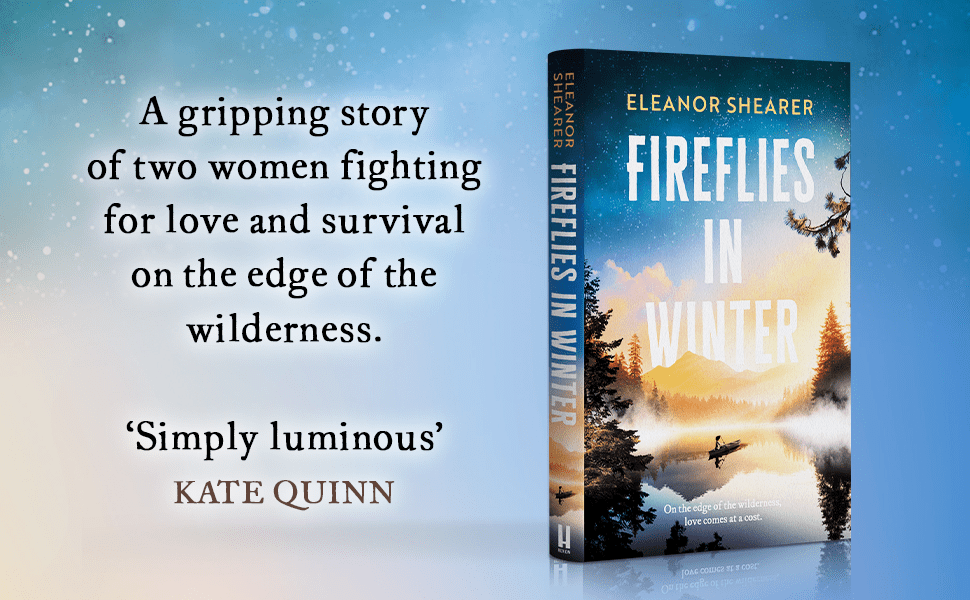
Nova Scotia 1796. Cora, an orphan newly arrived from Jamaica, has never felt cold like this. In the depths of winter, everyone in her community huddles together in their homes to keep warm. So when she sees a shadow slipping through the trees, Cora thinks her eyes are deceiving her. Until she creeps out into the moonlight and finds the tracks in the snow.
Agnes is in hiding. On the run from her former life, she has learned what it takes to survive alone in the wilderness. But she can afford mistakes. When she first spies the young woman in the woods, she is afraid. Yet Cora is fearless, and their paths are destined to cross.
Deep among the cedars, Cora and Agnes find a fragile place of safety. But when Agnes’s past closes in, they are confronted with the dangerous price of freedom – and of love…
Eleanor Shearer tells stories about fictional people in situations I didn’t even know existed and then makes me root for them so hard that I cry real tears. Cora is our central character and we see everything through her eyes, so it’s no surprise I felt close to her. Cora is so vulnerable and thoughtful. She cares for her unusual ‘family’ – Leah who has brought her up and been a substitute mother and Silas and young Ben who’s still a young boy. It’s makeshift but it’s the only family she has known, ever since Leah found her as a baby. They are ‘maroons’, escaped slaves from Jamaica who settled in Nova Scotia, Canada. Many maroons negotiated peace treaties with the British, but part of that treaty forced them to aid the British in capturing any new runaways. However, Agnes’s freedom is more precarious. She’s out in the forest alone, except for her dog Patience, and it’s a harsh existence with the added fear of discovery. I’m not sure Cora fully understands that her presence and connection to the Maroons settlement adds to that anxiety and doubles her chance of discovery. Cora isn’t hardened to winter in the forest and hasn’t had to hone her survival instincts in the way Agnes has. Something she shows by getting into scrapes in the snow, saved by the ever present Patience. There are different types of freedom in terms of gender and sexuality too. Cora knows that Silas has an expectation that they will be together one day and so far she has avoided this. However, it is there in every confrontation they have; the fear of his resentment and the threat of sexual violence is ever present. Cora doesn’t question her sexuality, she just knows she loves Agnes. Will they have the freedom to be together?
The environment is an incredibly strong part of this story and here the author excels in creating a Nova Scotia that’s harsh but exceptionally beautiful. I found the time Cora spends in the forest incredibly peaceful to read, the animals, the ice and the frosted trees have a romance, a poetry about them. Yet she doesn’t hide the raw reality of living in it. The girls must trap animals, although Cora frees a white hare unable to kill such a beautiful and mystical creature however hungry they may be. One of my favourite scenes is when Agnes takes Cora out on a boat to visit the whales who appear for them as if by magic. As they sit among these huge creatures one of them lifts their head and looks directly at Agnes and she feels seen for the first time in her life. Not as a woman, or a slave, or a Maroon. Just as Cora, another living being. There are also moments where Mother Nature shows its bite and when Cora falls through the ice I was holding my breath. The suspense of those moments are brilliantly pitched and show us that Agnes’s lifestyle may have magical moments, but it can be lethal.
I love that Eleanor writes people back into history, we can read the historical facts about settled slaves in Canada but she brings their experiences to life in a way that hits the emotions and helps us to understand. We’re also reminded by Cora that women have choices, sometimes marriage is just another form of slavery. It’s something she’s keen to avoid, even if the offer came from a more loving and kind man like her friend Thursday. She knows herself enough to know it is not for her and she’s not willing to sacrifice herself. Luckily, Thursday is a loyal friend and will help Cora without imposing conditions. When Cora finds out the truth about where she comes from, secrets that have been held for years come flooding out and threaten everything that Cora has known about herself. When Agnes faces a similar reckoning it threatens everything in their future. I was emotional about the little details the author puts into her book such as the braiding of Cora’s hair being the only moment where they’re both present and the ‘love can flow between them unimpeded’. Cora’s loss of her sister also hangs over her and I loved the nature metaphors she uses to express those emotions:
“Cora cannot stop thinking of her life like a tree, with the branches that split and split again until you reach the highest […] that there’s somewhere, the branches not taken – the world where she stayed with Elsy and Elsy would still be living.”
However, in everything that happens, one loss hit me the hardest and actually brought me to tears. I loved the still moments created, where Cora learned to be in nature. Where they are both present and entirely in the moment. The fireflies are a symbol for Agnes and Cora, in that they are glowing in the darkest and coldest circumstances. Cora and Agnes have a bond that flourishes where many things don’t survive, they are extraordinary like fireflies in winter.
Out from Headline Review on 10th February
Meet the Author
Eleanor Shearer is a mixed race writer from the UK. She splits her time between London and Ramsgate on the coast of Kent, so that she never has to go too long without seeing the sea.
As the granddaughter of Caribbean immigrants who came to the UK as part of the Windrush Generation, Eleanor has always been drawn to Caribbean history. Her first novel, RIVER SING ME HOME (Headline, UK & Berkley, USA) is inspired by the true stories of the brave woman who went looking for their stolen children after the abolition of slavery in 1834. The novel draws on her time spent in the Caribbean, visiting family in St Lucia and Barbados. It was also informed by her Master’s degree in Politics, where she focused on how slavery is remembered on the islands today.
Her second novel, FIREFLIES IN WINTER, is a love story set in the snow-covered wilderness of Nova Scotia in the 1790s. When Cora, an orphan newly arrived from Jamaica, glimpses a strange figure in the forest, she is increasingly drawn into the frozen woods. She meets Agnes, who is on the run from her former life. As the two women grow closer, they learn more about love, survival and the price of freedom.
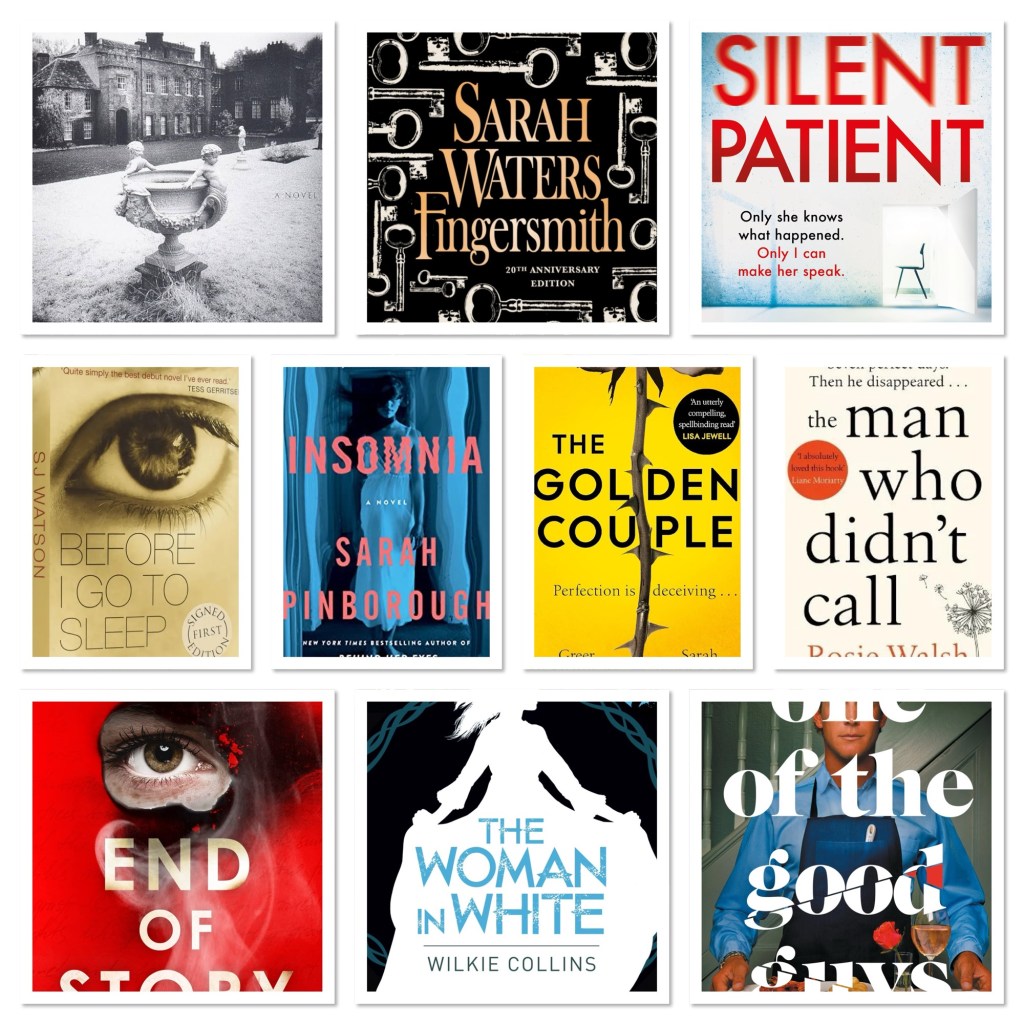
There are so many books billed as having killer twists these days that this should be an easy list to produce. What I wanted to do was focus on books that genuinely made me do a double take, where I went back a couple of pages to make sure I’d read it correctly. These are twists I absolutely didn’t see coming and made my jaw drop or conjured up huge emotions. They’re the sort of twists that have you recommending the book to everyone and it’s no surprise that quite a few have been adapted for film or television streaming services. As the ‘twist’ is usually reserved for crime fiction and thrillers I’ve added some that are historical fiction, love stories and sci-fi to mix things up a little. There are no spoilers here, just a synopsis and why you should read it if you haven’t already. Enjoy.
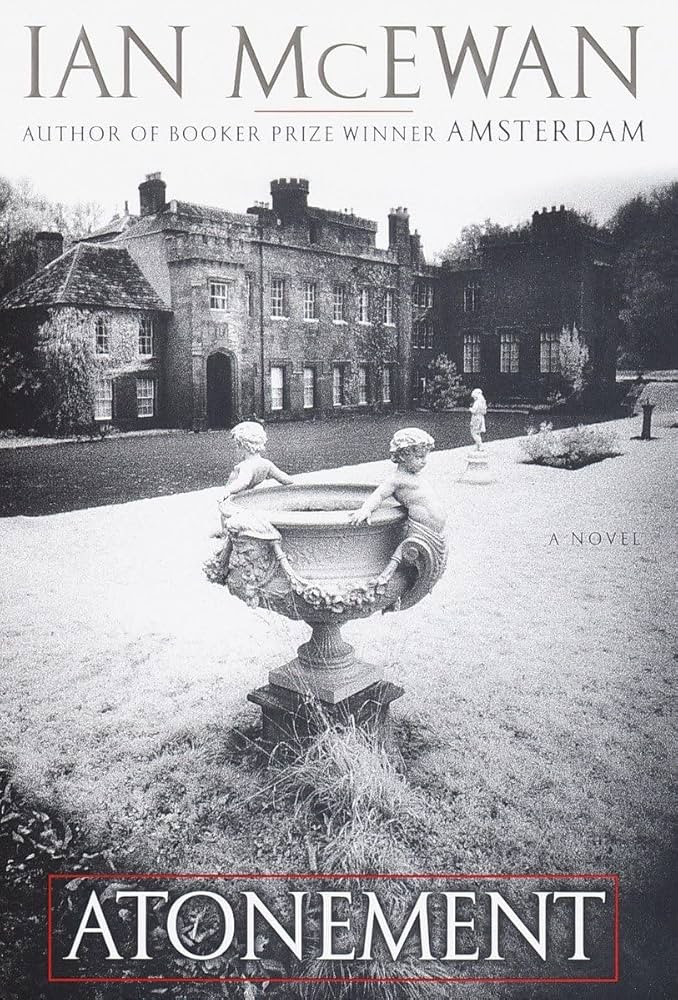
On the hottest day of the summer of 1934, thirteen-year-old Briony Tallis sees her sister Cecilia strip off her clothes and plunge into the fountain in the garden of their country house. Watching her is Robbie Turner, her childhood friend who, like Cecilia, has recently come down from Cambridge. By the end of that day, the lives of all three will have been changed for ever. Robbie and Cecilia will have crossed a boundary they had not even imagined at its start, and will have become victims of the younger girl’s imagination. Briony will have witnessed mysteries, and committed a crime for which she will spend the rest of her life trying to atone. I remember going to see this at the cinema and people standing up and clapping at the end. It’s a rare thing to see in the cinema but it was so spontaneous. Similarly, if you’ve read the book I don’t think you can be anything but devastated by the twist. I first read this at university as part of my post-modern literature course and I loved the characters as well as Briony’s innocent but life-altering mistake. It’s amazing how differently we interpret things as children, especially the complexities of human relationships. Robbie and Celia will have their lives turned upside down as Briony tells us about that day that altered the course of all their histories. We follow their lives and how the consequences continue to affect all of them. This twist is not of the usual kind, it is emotional and devastating.
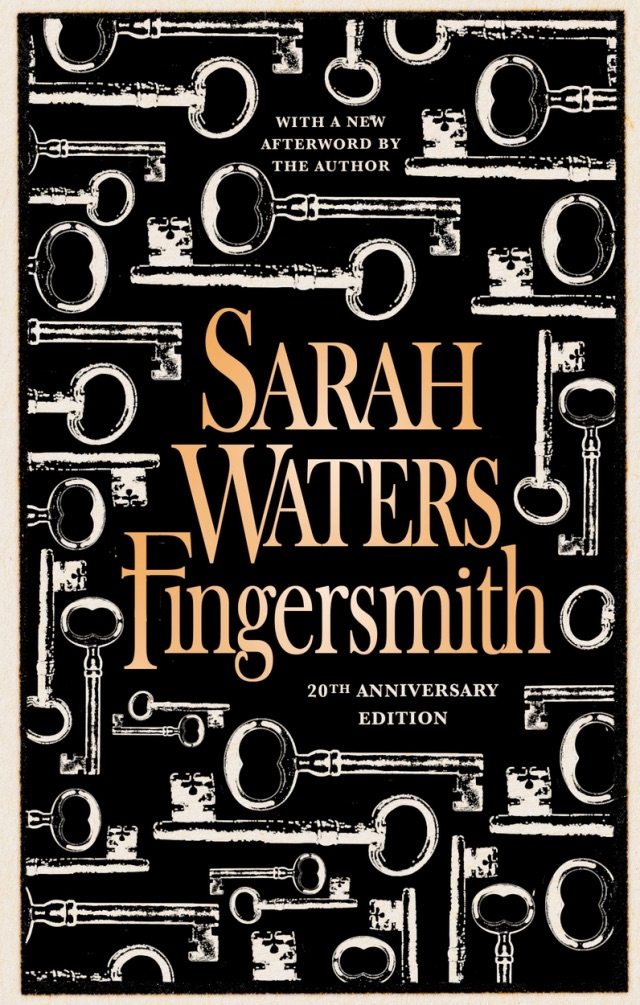
Sue has grown up among petty thieves in the dark underbelly of Victorian London, with her adopted mother, Mrs Sucksby, who is a “baby farmer”. One day they are visited by a confidence trickster known simply as “Gentleman” who has a devious plan for their consideration: he is trying to romance Maud Lily, a young naive lady who is heir to a fortune on the condition that she marries. She lives in a large house in the country and works as a secretary of sorts for her uncle. He is protective and keeps her close, so to be successful they must infiltrate the house. He proposes that Sue becomes Maud’s personal maid and once she is settled, gain the young woman’s trust. She must then convince Maud to take up an offer of marriage from a suitor named Richard Rivers, the ‘Gentleman.’ Once they have eloped he will declare Maud as mentally incompetent and commit her to an asylum taking charge of her inheritance. For her part in this plot, Gentleman promises Sue a reward.
At first their plans work well, but it isn’t long before Sue begins to have doubts. She is growing fond of Maud and realises she is not in love with Rivers at all. Actually Maud is terrified of him. Sue begins to fall in love with Maud herself, charmed by her innocence and lack of guile. It seems her feelings are returned, but as the girls consummate their relationship on the eve of Maud’s secret wedding, Sue doesn’t known how to stop the plan. The author splits the story between the two girls and there’s absolutely no warning of the huge twist that’s about to come. This is a brilliant novel from Sarah Waters with an audacious twist that’s one of the best in literary fiction.
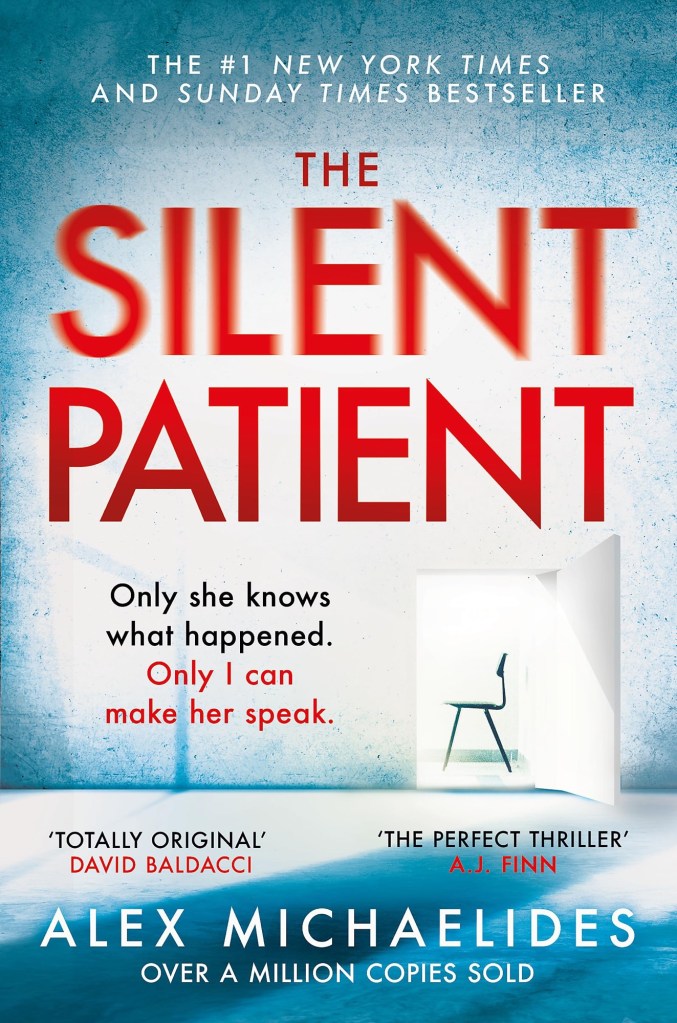
Alicia Berenson seems to lead a charmed life. She’s a famous painter and her husband is an in-demand fashion photographer. The couple live in a smart house overlooking the park in a desirable area of London. Yet, one evening, when her husband Gabriel returns home late from a fashion campaign, Alicia shoots him five times in the face. Since that day she has never spoken another word.
Alicia’s refusal or inability to talk turns this domestic tragedy into public property and casts Alicia into notoriety. Her art prices go through the roof, and she is known as the silent patient, hidden away from the tabloids at the Grove, a secure forensic unit. Theo Faber is a criminal psychotherapist and he has waited a long time for an opportunity to work with Alicia. He is determined to get her talking again and unravel the mystery of why she murdered her husband becomes an all consuming search for the truth…. I still love this book years on and I’m very excited to see the film when it comes out. This twist was so good I actually swore out loud! I know that a book has me in its grip when I respond out loud. The author plays on the readers’ expectations of the characters in a clever way. If you haven’t read this yet where have you been?
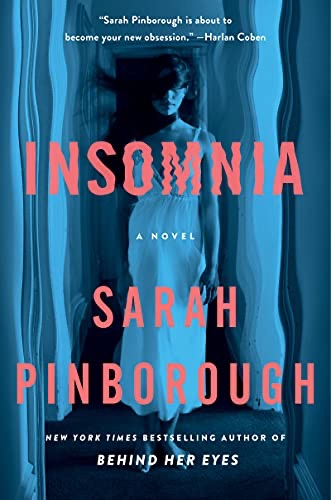
From the outside, Emma has the dream life – a loving husband, a beautiful house, two gorgeous children.
But something is keeping Emma awake.
Scratching at her sanity at 1am.
She’s tried so hard to bury the past, to protect her family. But witching hour loves a secret – and Emma’s is the stuff of nightmares …
This is such a great read and I remember shouting about it a lot. I wasn’t surprised when it was adapted for television. The way Emma disintegrates over the course of a few days is shocking, but believable. Until now Emma has prided herself on being a competent solicitor, very organised and together. I was desperate to find out what happened in their childhood and why her sister Phoebe popped up at this moment. I did feel there was an element of her not processing her childhood trauma. She’s locked it away in the back of her mind, but Phoebe’s appearance and advice that she should visit their mother seems like the trigger that unlocks these memories. What the author does, very cleverly, is muddy the waters; just as I was starting to think Emma was having a breakdown, other things start happening. Her young son keeps creating a strange macabre drawing of a terrible memory that haunts Emma. How could he know? Who has told him this happened? Her dictated letters have turned into a mumbled series of numbers when her secretary plays back the dictaphone. Added to these seemingly inexplicable events the author throws in a number of outside stresses At work she is trying to avoid the advances of a client, his ex-wife confronts Emma over losing custody of their boys. It becomes hard for the reader to see which events can be explained away, which are normal daily obstacles made worse by Emma’s severe sleep deprivation and which are incredibly strange. I was never fully sure what was real and what was imagined or who was to blame. This twist is so clever because the author uses our psychological knowledge and our expectations of thrillers to keep us looking elsewhere. Very clever indeed.
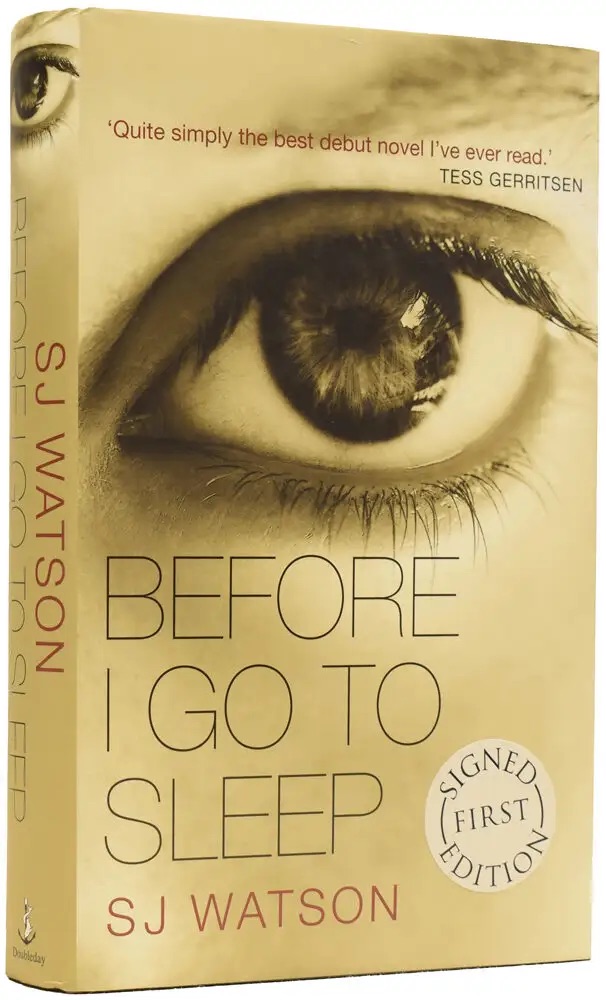
Memories define us.
So what if you lost yours every time you went to sleep? Your name, your identity, your past, even the people you love – all forgotten overnight. And the one person you trust may only be telling you half the story.
Welcome to Christine’s life.
I can’t believe this book is 12 years old this year! It was also S.J. Watson’s debut novel. Christine wakes up every morning with no memory of her life, helped by the notes her husband leaves for her to find she tries to navigate life where every day is finite and nothing is retained. One day a strange doctor visits with what he says is a private journal she has been writing while they work together. It is the first sign we have that not everything is at it seems and for Christine, the terrifying thought that she cannot trust the person she’s supposed to feel safe with. This is a very creepy and unsettling novel and the tension is stretched to breaking point because we know that as night draw in Christine will soon go back to sleep and lose everything she has learned. I felt like this was more of a slow release twist, but the horror definitely builds towards the end and I was completely engrossed. Again it was no surprise that this was picked up by a film company and the film is pretty good too.
Our narrator Fern Dostoy is a writer, one of the ‘big four’ novelists of the not too distant future. This is a future where the Anti-Fiction Movement’s campaign to have all fiction banned has been successful. It was Fern’s third novel, Technological Amazingness, that was cited as a dangerous fiction likely to mislead and possibly incite dissent in it’s readers. She had created a dystopian future where two major policies were being adopted as standard practice. To avoid poor surgical outcomes, only patients who are dead can have an operation. Secondly, every so often, families would be called upon to nominate one family member for euthanasia – leading to the deaths of thousands of elderly and disabled people. All fiction authors, including Fern, are banned from writing and the only books on sale are non-fiction. The message is that fiction is bad for you. It lies to the reader giving them misleading ideas about the world and how it’s run. Facts are safe, but of course that view is limited to those supplying the facts. AllBooks dominated the market for books until it became the only bookshop left, state sanctioned of course and only selling non-fiction. From time to time they hold a book amnesty where people can take their old, hidden novels to be pulped. Fern now cleans at a hospital and receives unannounced home visits from compliance officers who question her and search her house to ensure she’s not writing. Added to this dystopian nightmare are a door to door tea salesman, an underground bedtime story organisation, a mysterious appearing and disappearing blue and white trainer, re-education camps for non-compliant writers and a boy called Hunter. All the time I was reading about this terrible new world, I was taking in the details. and trying to imagine living in it. I also had an underlying sense that something wasn’t quite right with this story. When this twist comes it is astonishing, gut wrenching and reduced me to tears. An incredibly well written book about facts that is all about feelings.
Cole is the perfect husband: a romantic, supportive of his wife, Mel’s career, keen to be a hands-on dad, not a big drinker. A good guy.
So when Mel leaves him, he’s floored. She was lucky to be with a man like him.Craving solitude, he accepts a job on the coast and quickly settles into his new life where he meets reclusive artist Lennie.
Lennie has made the same move for similar reasons. She is living in a crumbling cottage on the edge of a nearby cliff. It’s an undeniably scary location, but sometimes you have to face your fears to get past them.
As their relationship develops, two young women go missing while on a walk protesting gendered violence, right by where Cole and Lennie live. Finding themselves at the heart of a police investigation and media frenzy, it soon becomes clear that they don’t know each other very well at all.
Wow! This blows your eyes wide open. I warn you not to start reading at night, unless like me you have a total disregard for the next morning. If I wasn’t reading this, I was thinking about it. I loved the way the author put her story together, using fragments from lots of different stories and different narrators. Just when we get used to one and start to see their point of view, the perspective shifts. I thought this added to the immediacy of the novel, but also reflected the constant bombardment of information and misinformation we sift through every day, with transcripts of radio shows and podcasts, Twitter threads and TV interviews. All give a perspective or commentary on the casual misogyny and violence against women that almost seems like the norm these days. It felt like a merry-go-ground of opinion, counter argument and trolling. Sometimes you’re left so twisted around you’re not sure what you think any more. I would believe one narrator, but then later revelations would blow what I thought right out of the water. It made me ask questions: about the nature of art and its ethics; about whether all men truly hate women; to what lengths do we go to protest; when is enough, enough? This controversial story was one of my reads of 2024 and I still think about it.
I didn’t expect a twist in a love story, but this is part love story and part mystery. Imagine you meet a man, spend seven glorious days together, and fall in love. And it’s mutual: you’ve never been so certain of anything. But after this whirlwind romance, he doesn’t call. You’ve been ghosted.
Your friends tell you to forget him, but you know they’re wrong – something must have happened, there must be a reason for his silence. What do you do when you finally discover you’re right?
Sarah met Eddie by chance on a country road while she was visiting her parents. She still thinks Eddie just might be the one. Could the Eddie she met really be a heartless playboy who never intended to call? Did Sarah do something wrong? Or has something terrible happened to him? Instead of listening to friends and writing this off as a one night stand, Sarah begins to obsess and is determined to find the answer. Every clue she has comes to a dead end and she is in danger of completely losing her dignity. As her time back home in the UK starts to run out, Sarah looks for clues to track Eddie down. What she hears is confusing her further. His friend doesn’t give the simple answer, that Eddie has moved on, but gives her a warning; if she knows what’s best for her, she needs to stop looking for Eddie. I never expected the twist in this story and all the time I was convinced of Sarah’s sense of ‘rightness’ to their meeting. As the months pass though, will she have to move on with her life? This novel is fully of emotion and the different ways life’s troubles affect us. It has everything you would expect from a romantic novel but with a healthy dose of realism and a smidgen of hope.
Marissa and Mathew Bishop seem like the golden couple – until Marissa cheats. She wants to repair things, both because she loves her husband and for the sake of their eight-year-old son. After a friend forwards an article about Avery, Marissa takes a chance on this maverick therapist who lost her licence due to her controversial methods.
If Avery Chambers can’t fix you in ten sessions, she won’t take you on as a client. She helps people overcome everything, from anxiety to domineering parents. Her successes almost help her absorb the emptiness she feels since her husband’s death.
When the Bishops glide through Avery’s door, all three are immediately set on a collision course. Because the biggest secrets in the room are still hidden, and it’s no longer simply a marriage that’s in danger.
The authors use alternate perspectives to drip feed details of this couple’s relationship and the events leading up to Marissa’s infidelity. It is compelling and really captures the intricacies of counselling a couple and the need to read body language and expression, not only of the person who’s speaking but their partner. I loved how therapy progressed the issues within the marriage, which are always somewhat different to the presenting issue. This was a clever thriller that showed just how complex we are psychologically.
If you feel like delving into a classic this could be for you. The Woman in White famously opens with Walter Hartright’s eerie encounter on a moonlit London road. He’s been engaged as a drawing master for the beautiful Laura Fairlie, Sir Percival Glyde’s new wife and they’re often accompanied by her sister Marian. Walter slowly becomes drawn into the sinister intrigues of Sir Percival and his ‘charming’ and rather eccentric friend Count Fosco, who keeps white mice in his waistcoat pocket and enjoys both vanilla bonbons and poison. The novel pursues questions of identity and insanity along the paths and corridors of English country houses and the madhouse, The Woman in White is the first and most influential of the Victorian genre that combined Gothic horror with psychological realism, known as sensation fiction. This book is the Victorian equivalent of our psychological thrillers, but could just as easily be described as crime or mystery fiction and even has a feminist slant. Be sure to take note of every small occurrence because the novel is plotted so precisely that everything has a meaning. Again we’re dealing with men’s attitudes and behaviour towards women, but Marian is more than a match for any man and is one of fiction’s first female detectives. I love a gothic novel and this has everything from ghostly encounters, to stately homes and damsels in distress. I believe this book is the inspiration for so many detective novels and its category of ‘sensation fiction’ is very apt because it employs a twist I’ve read variations on ever since.
Lincolnshire, 1914. As the First World War approaches, three women are living, trapped between the unforgiving marsh, the wide, relentless river, and the isolation of the fen.
Their lives are held fast by profound grief, haunted by the spectres of the past. Trapped by the looming presence and eerie stillness of a hospital that has never admitted a single patient.
Eleanor longs to escape. To make a life with the man she loves, leaving her sister, and all her ghosts behind. Clara’s marriage is crumbling and violent and she yearns for peace and security for both herself and her innocent children. Meanwhile, Lily, a formidable force of will, stands resolute against the relentless tide of change. She will stop at nothing, no matter the devastating cost, to ensure that life, and her family, remain frozen in an unyielding embrace of the past.
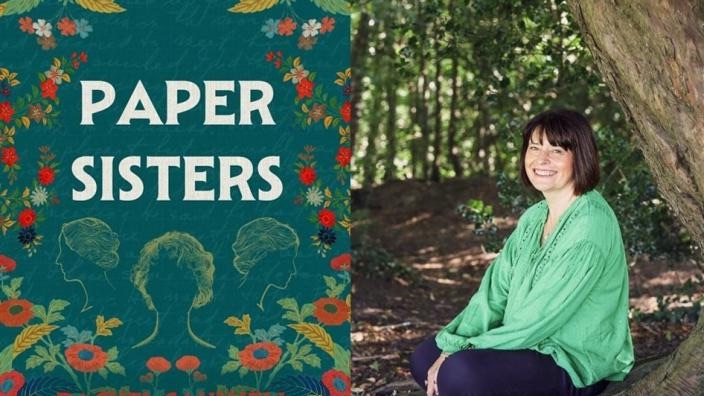
The author, Rachel Canwell, grew up with the story of this forgotten hospital. Isolated, stocked weekly and cleaned daily but never admitting a single patient. The hospital was real, tended by her family for over sixty years and set against the ethereal beauty and loneliness of the Fens, is the inspiration for her novel.
The atmosphere in this story perfectly captures the strange isolated feel of Lincolnshire’s fens. I’m Lincolnshire born and bred, further north than the fens but I know the area. It’s a flat, almost featureless place with dykes that drain the fields and the constant smell of vegetable crops in the air. The novel’s focus is on the area of Sutton Bridge, a village with a famous swing bridge built in 1897 across the River Nene. On one bank, an area of several acres is home to a building site where a port is being built and on the other is a hospital, built to service the workers of the port area. Alongside it is the home of the family who will run it. The author’s family waited for many years, ready to run their hospital, but this is not their story. The author opens with a strange and disorienting scene where a family are disturbed by noises at night and venture out in the pitch dark. As they stand on the bank, theres a loud rumble and the sound of heavy things hitting the water. The family can’t see anything, but in the light it’s clear that all their hopes for a future working alongside the port are gone. The bank on the far side has collapsed in the night, even worse one of their sons is missing, presumed drowned, while helping to look for workers. As we join them in 1910 only two sisters remain on the hospital side of the bank, Lily who has barely moved beyond the threshold since her twin drowned and Eleanor who tends to Lily, their garden and the hospital. Their other sibling, Frank, lives down in the village with his wife Clara and their children. It is the three women – Eleanor, Clara and Lily – who narrate our story.
I felt so strongly about these characters, especially Clara and Eleanor who have always been friends. It soon becomes clear that both are in a similar position. Eleanor is at the mercy of Lily’s health and her moods. She claims to be unable to leave her room and hates to be left alone in the house. Despite being so isolated Eleanor has met and fallen in love with a young man called John who has taken over the village’s smithy. How can she ever plan a future with him if she’s unable to leave the house? Similarly, Eleanor’s friend Clara is at the mercy of husband Frank’s moods and how much he’s had to drink. One of the book’s opening chapters follows the couple and their children on a train to the coast. However, the train hasn’t even left the station and Frank is already belligerent. The author writes this beautifully, with Clara’s hopes for one day of freedom as a family dwindling by the moment. The tension rises as Clara desperately tries to quiet the children, holding herself tightly, too terrified to move and incur his anger. Luckily, his behaviour draws young men from the next carriage and Clara leaves him to fight his own battles. The sudden freedom she and the children have is blissful, laughing as they run down to the sea, removing shoes and socks to jump in the waves. Clara knows her friend Eleanor is under equal pressure, because under a quiet and timid exterior Lily has a core of steel. While Eleanor feels sorry for Lily, trying to respect her grief and many physical symptoms, Clara lives with a bully and she sees beyond Lily’s quiet and apparent shyness, recognising them as control and emotional blackmail. Her interventions at the house, forcing Lily into activity, almost made me laugh. Clara isn’t emotionally attached to Lily so can’t be bullied. This dynamic brings enough tension but soon WW1 will cut a swathe through the men of the village bringing fear and loss in its wake.
Lily made me furious. Her sly nature is infuriating, always listening where she shouldn’t be and snooping in other people’s things. She seems to struggle with empathy, unable to see what her actions might do to others. Despite keeping her own artefacts of a time when the family were whole, she doesn’t recognise other people’s attachment to keepsakes. She’s quite happy to destroy things if she can’t have her way. John is unsure what to do in order to help Eleanor, if they’re to have a future things must change, but how to bring that about without making things worse? It may not be possible for Eleanor to sever her ties as her sister’s carer. Maybe he will have to come to them and get to know Lily. He doesn’t want Eleanor to think he doesn’t care about her sister, but equally he needs Lily to understand that he’s going to be in Eleanor’s life, whatever that takes. However, when pushed, Lily can be incredibly spiteful and destructive. It’s this selfish streak that sees her making reckless and desperate choices. The only times when we see the girl in Eleanor is when she’s with Clara and their shared history gives us all those elements of female friendship that mean so much – the shared jokes and memories, but also the support both physical and emotional. Eleanor may be in love but it’s Clara who fully knows her and will always hold her up when she can’t support herself. All of these women are trapped: Lily by her memories and fears, Clara by her marriage and Eleanor by Lily and the empty hospital she continues to maintain to her father’s standards. It’s almost a shrine to the dreams of those they’ve lost. Then there’s the isolation of the fen, trapped between salt marsh and the river.
War brings different experiences for Clara and Eleanor, especially when Frank joins up early. It’s like spring comes to Clara’s house because the children can play and make noise, she can run the house in a more relaxed way. She can pop over to sit with Lily giving John and Eleanor some freedom too. John’s is a reserved occupation so he doesn’t have to join up straight away. However, these golden times are short lived. It isn’t long before injury, shell shock and even death reach the village and it’s very hard for any of the women to understand their husband’s or brother’s experiences. Through the male characters we see every consequence of fighting for your country. Meanwhile the women are trying to produce food and help on the land. Even to this day, the fen area of the county still produces huge amounts of vegetable produce, as well as potatoes and flowers. To keep crops growing the farmers need labourers and one solution comes in the form of a prisoner of war camp, situated on the site of the old port, directly opposite Eleanor and Lily. The POWs are mainly German soldiers, who will bunk in cabins and work the fields. The author beautifully shows the tensions between prisoners and those men who’ve been fighting overseas. As a dreaded black edged letter arrives, grief now joins domestic violence, manipulation and alcohol issues. This family is set for an explosive reckoning. I became so attached to these women and their family’s tragic history that I read it so quickly. I already know I will go back and read it again though. Every element – character, setting, plot – is beautifully done and the historical background took me back to a time when my own grandparents would have been working the land and living next to the River Trent further north in the county. This is an excellent debut from Rachel Canwell that had me utterly absorbed and feeling every emotion alongside her characters.
Out now from Northodox Press
Meet the Author
For those close by Rachel will be appearing at Lindum Books on the Bailgate in Lincoln on Saturday 21st Feb from 10.30am
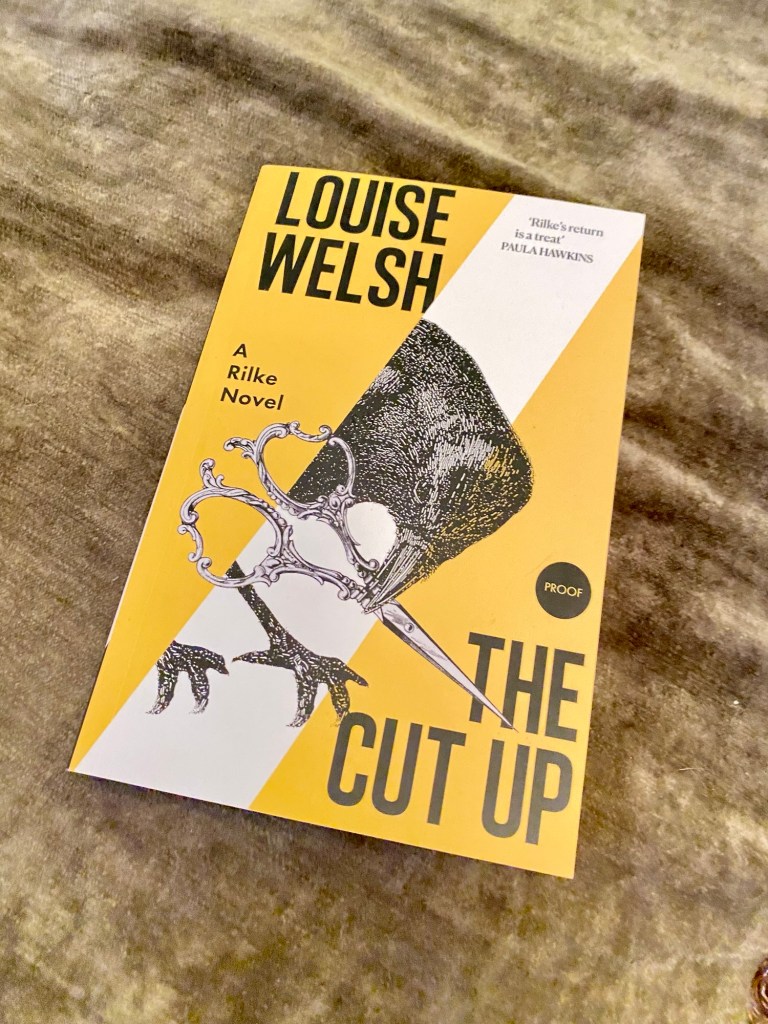
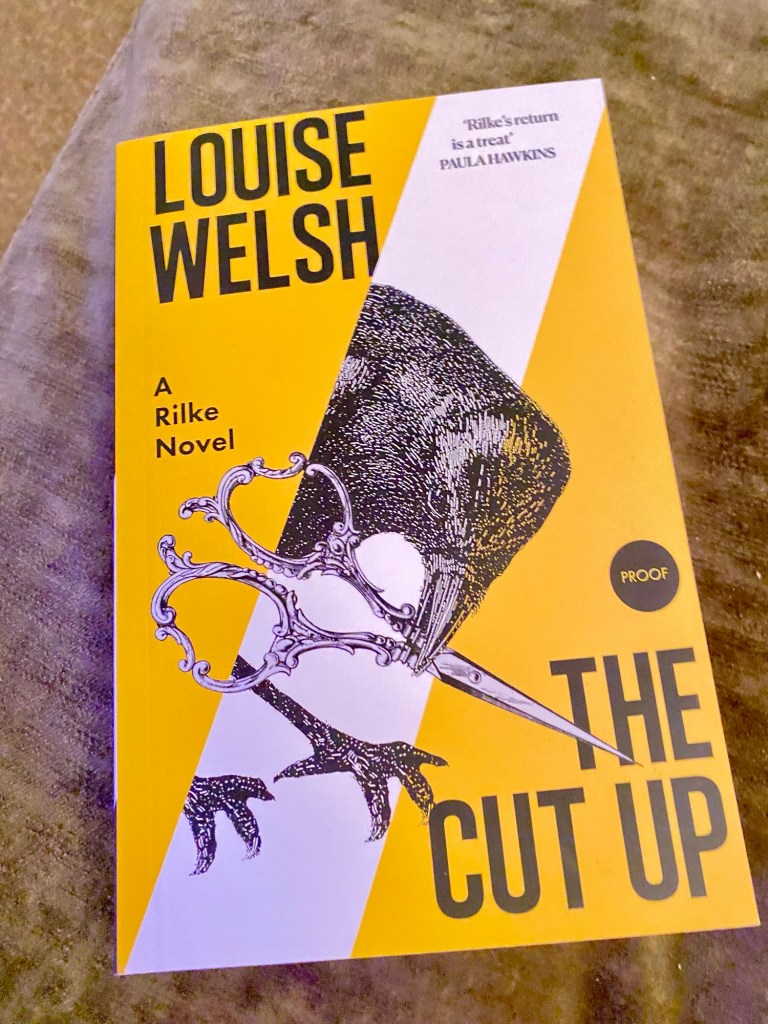
It’s hard to be good when living is expensive. And times are tough on the streets these days. Luckily for Rilke at Bowery Auctions the demand for no-questions-asked cash is at an all-time high, and business is booming.
When Rilke hears his old acquaintance Les is fresh out of prison, his inclination is to stay well out of his way. Letting sleeping dogs lie is one thing – but when one of Bowery’s customers winds up dead on their tarmac, Rilke needs a bit of help from his friends to tidy things up. If only his friends didn’t have such a habit of making things worse.
This is such a brief synopsis for a novel that’s full of character, atmosphere and set in one of the best cities I’ve ever spent time in. The novel is book-ended with someone coming out of prison and this is the world that valuer and auctioneer Rilke operates in. This is a world of second hand goods, murky dealers and eccentric characters who love collecting. Bowery Auctions is run by Rose Bowery and Rilke is part of the furniture. When one of their regulars, the creepy and questionable Manderson, is killed on the premises it’s only 24 hours till their next auction. In fact Manderson has been stabbed in the eye with one of the antique hat pins they had out for the viewing afternoon. An Edwardian amethyst pin would have had to make its way through a huge hat and into a woman’s long, piled up hair, to keep it secure. Now it’s made its way through Manderson’s eye into his brain and it’s going to take a lot of strength to remove it. Knowing the police will be involved and that Bowery’s will be implicated, perhaps it would be better if it wasn’t obvious that he’s been killed with one of their auction lots. Things get worse when a gangster turns up at Bowery Auctions with Rilke’s mate Les in tow. Ray has a way with a razor and he focuses Rilke with a swipe to Les’s face, he must now investigate who killed Manderson in just ten days or Les will pay the consequences. His investigations will take him to an old school where many ex-pupils have reported sexual abuse, to a brothel named after a questionable film and a girl called Chloe who may or may not be controlled by her boyfriend, Dickie Bird. Will he find the answers that will save Les? More to the point, are the answers to be found outside Glasgow or a lot closer to home?
The plot takes a few winding roads but we never forget that Rilke has a time scale for this investigation and he knows that a man like Ray isn’t joking. His best friend Les’s life is in his hands and the pressure and danger builds as we go along. I enjoyed the characters in this novel and I did grow to love them. I have to say thank you to the author here because one of my best friends was an antique dealer so I spent a lot of time visiting auctions and antique fairs with him. He also had an alcoholic cleaner and an ex-prisoner doing his garden. He died eight years ago and I’ve missed that part of my world. It is a world where any eccentric, misfit or miscreant can find a home and for the duration of the novel I was back there with Nigel, in his customary smoking jacket adorned with vintage brooches. So I wasn’t surprised to find characters like Manderson, Les and Rilke rubbing shoulders. Rilke’s vintage style was perfect and he struck me as a decent man who can’t get out of the circle he frequents. He’s also a deeply loyal man, especially to his newly released friend Les. I have to admit to falling in love with Les. I knew I’d love him as soon as he emerged from the Arlington Baths after a stretch in prison wearing ‘ a black kilt, tartan Doc Martens and a t-shirt bearing the slogan Get Your Rosaries Off My Ovaries.’ He’s an absolute imp, a mischief and so impulsive that he makes very bad choices. The author brings humour in with this character so when he’s in genuine danger from gangster Ray it hits even harder. It’s no surprise when Rilke immediately takes on Ray’s ultimatum in order to save him, but Rilke’s also thinking about getting the police out of Bowery Auctions and away from where Manderson was killed. The female crew aren’t remotely bothered that he’s met a sticky end, in fact one of the younger girls describes him as ‘handsy’ – an old man who wears trainers because he doesn’t want to be heard creeping up on them. So far, apart from Ray, nobody seems to missing him.
The city of Glasgow is the main character in the book and I loved seeing the underbelly of a place I’ve only visited as a tourist over several years. The author builds the history of the city beautifully, until we get a sense of it as a multi-layered place, where we only see the tip of the iceberg when it comes to it’s residents:
“The earliest sections of Glasgow’s West End, built on the site of old mines and quarries, for city merchants who had grown rich on the products of Caribbean plantations and compensation for freeing enslaved people who received no reward”.
It’s a city that doesn’t hide it’s darker corners and it is sobering to think that the beautiful Georgian buildings in the best parts of the city could only be so grand due to these inflated profits and the subjugation of African people. There are dark and forbidding areas, pubs where you watch your step and streets where the old mines underneath threaten to drag buildings back into the depths. However, the creepiest setting has to be found on an investigative trip outside Glasgow to the site of an isolated school. Rilke makes the journey with a journalist who has been investigating the history of the school and ex-pupils claims of sexual abuse. It’s abandoned, but with evidence left behind of its original purpose. It reminded me of those videos found online of urban explorers in abandoned hospitals. It’s clearly been a hell for these pupils at the mercy of sadistic staff, but what Rilke needs to know is whether it’s linked to what happened to Manderson. Here the author brings in modern concerns around women using Only Fans and other internet sex work to make ends meet. Can it ever be a feminist thing? There are also issues around coercive control and manipulation, but as Rilke learns it’s easy to get the wrong end of the stick. There’s a familiar jaded feeling around these issues and a knowledge that no matter what’s brought to light, some people will always get away with it.
The author absolutely captures the grubbiness of a sale room’s viewing day. Sale rooms are invariably freezing cold, filled with weird and wonderful items and often very dusty. I often came away from rifling through boxes with absolutely black hands. On sale day I’d wear thermals, a solid overcoat and gloves. There are people of every class too, from those who look like they’re homeless to fur coated women. I definitely felt that mix in the book and the little mentions of particular artists and makers made it authentic. Both Rilke and his boss Rose Bowery notice people’s interiors, often bringing humour into very dangerous situations. I loved Rose’s opinion of a particular setting and it’s purpose:
‘Rose looked […] then realisation dawned. The low lighting, the plush carpet, satin upholstery and Japanese prints. “Ah, I thought you just had ghastly taste”.
It’s also Rose who comments that everyone at Bowery’s is so familiar with employee Ina’s womb it should have its own Facebook page. Each character’s language is peppered with Scottish turns of phrase, such as ‘he was a sleekit wee liar as a laddie’. This just adds to all the other layers to convince me I was in a real world. I felt that if I took another trip to Glasgow I’d be able to walk in to Bowery auctions and see Rilke in his Crombie. Now, I can’t wait to read the others in the series.
Meet the Author
Louise Welsh is an award-winning author of ten novels. The Cutting Room, her debut novel, won the Crime Writers’ Association John Creasey (New Blood) Dagger Award and the Saltire First Book of The Year Award. In 2018, she was named the Most Inspiring Saltire First Book Award winner by public vote. She is Professor of Creative Writing at the University of Glasgow. In 2022 she published The Second Cut, which was shortlisted for the Bloody Scotland McIlvanney Prize for Crime Book of the Year and named by The Times as their Crime Book of the Year.
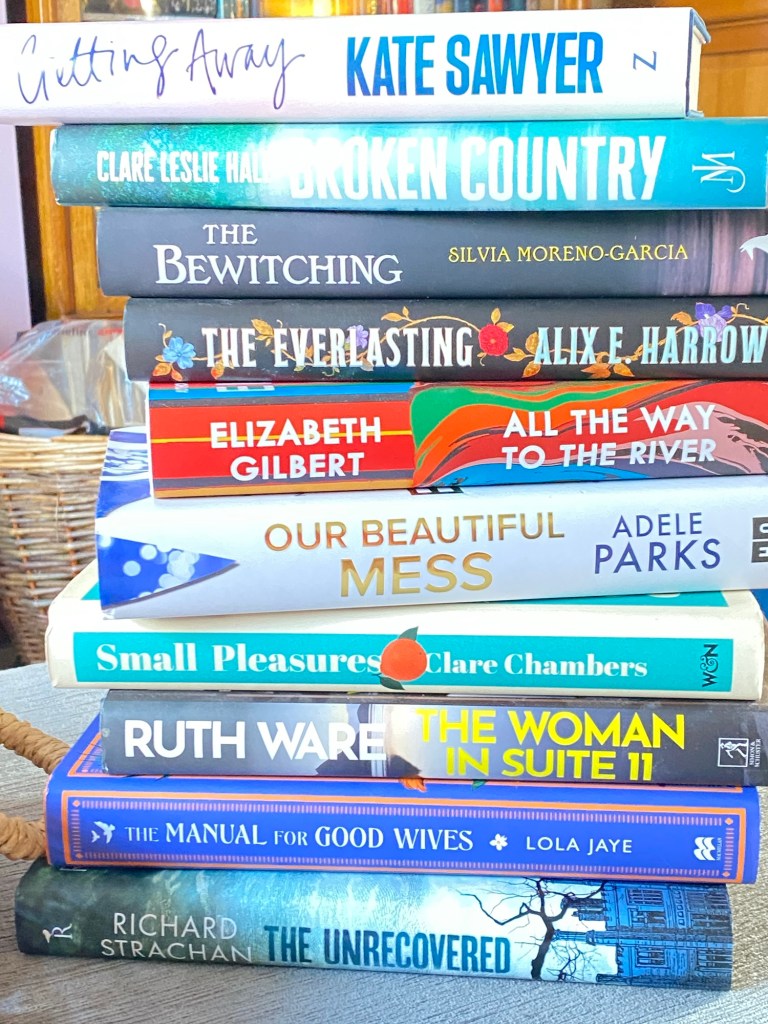
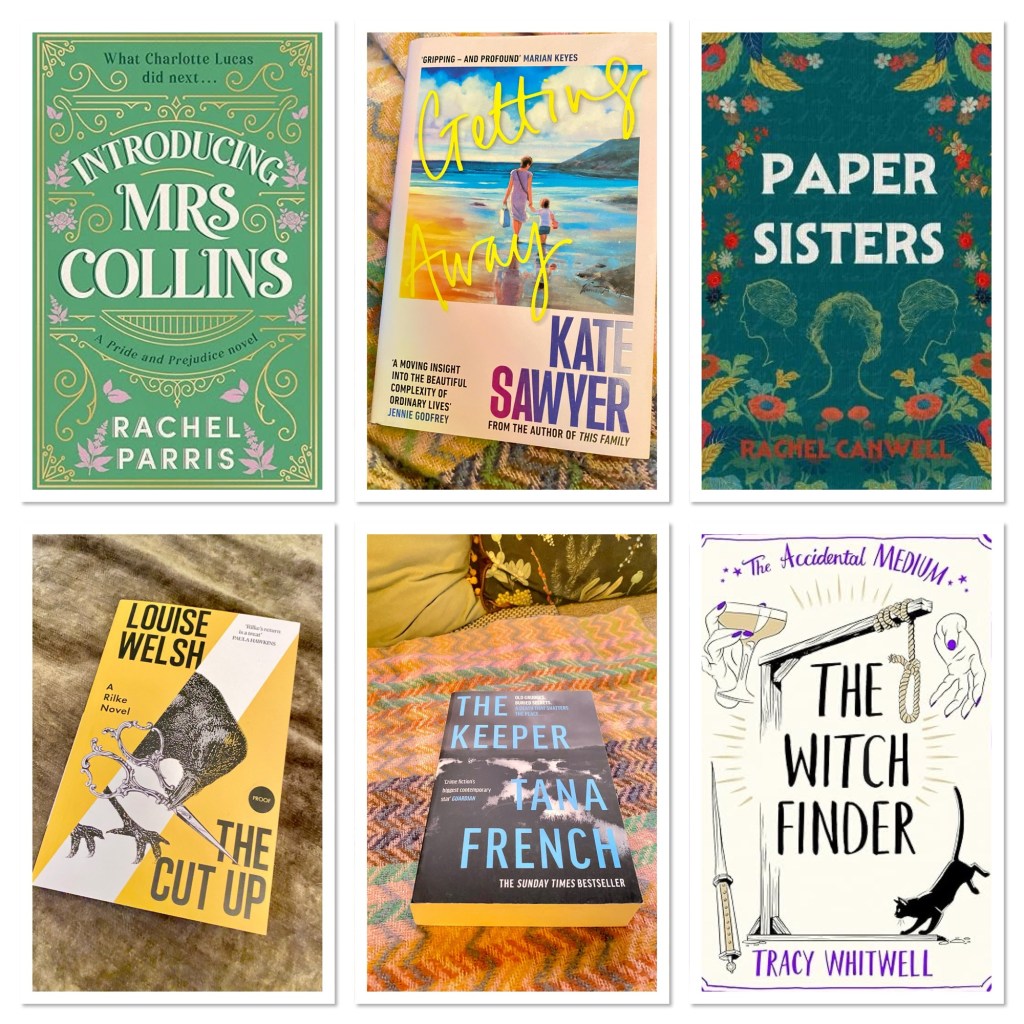
Every bookblogger works differently and most are probably a lot more organised than I am. I have books I’m looking forward to for a given year, from series or authors I follow religiously or books I’ve seen as debuts from publishers. Inevitably though there will always be others that creep in along the way, such as the blog tour you agree to as a favour, or a group read along or something that a publisher or PR offers you and sounds intriguing. Aside from all of these there are those books that just turn up, sent by publishers and authors in the hope I can fit them in. Any book that comes in goes on my TBR list in my reading journal and I tick them off as I go. The same goes for NetGalley reads, which often have to take a back seat for a while and then I have a quick blitz to get my reading percentage up a bit. Then there are the books I buy and sadly they often take last place. These books occupy a book shelf in the corner of the sitting room, totally separate from books I’ve been sent to review. This pile just doesn’t get priority, especially when there’s a really busy month. They languish on the shelf – and three piles on the floor if I’m being honest – and get read while I’m on holiday or taking a break from the blog. I often still review them, but usually they’re so behind they end up featuring on my Throwback Thursdays. Today I thought I’d share a flavour of what’s on my ‘bought books’ TBR. They come from many sources, independent bookshops, second hand bookshops, Bookshop.org and Amazon or even Vinted these days. I hope you enjoy a delve into my bookshelf.
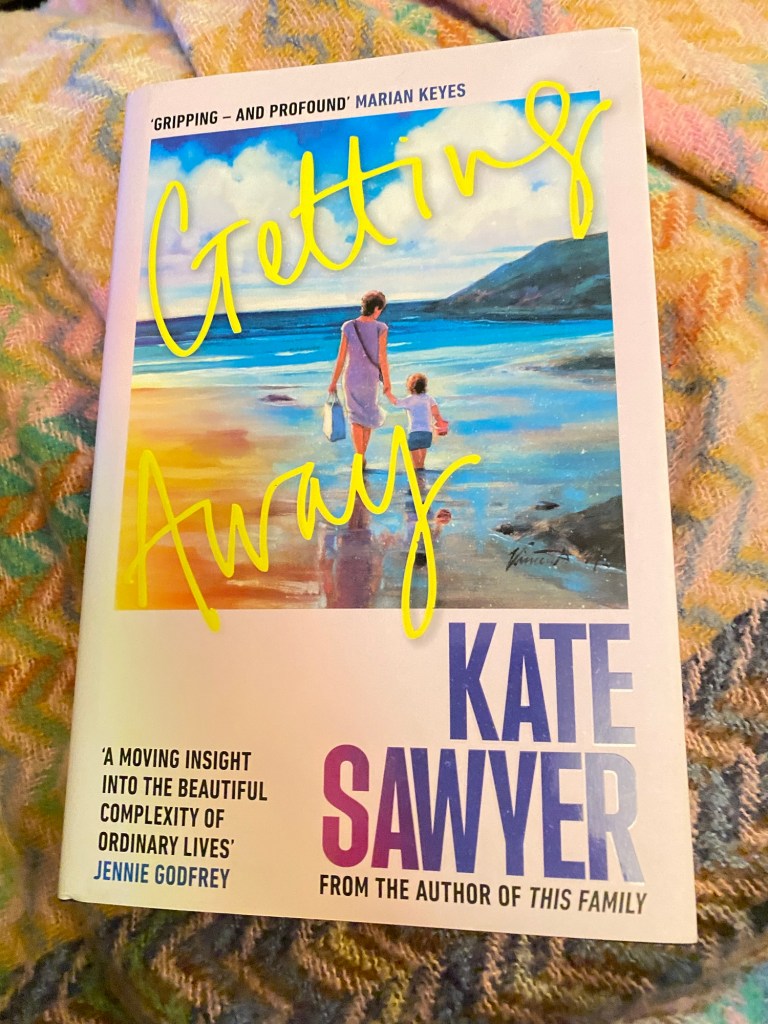
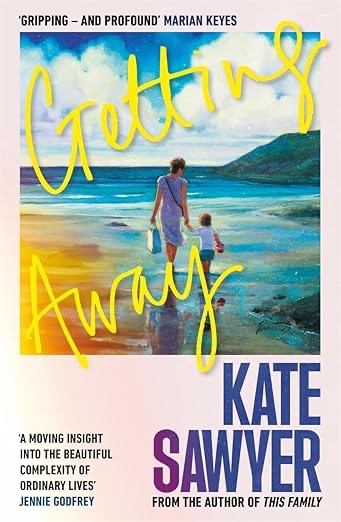
Getting Away by Kate Sawyer
Margaret Smith is at the beach.
It is a summer day unlike any other Margaret has ever known.
The Smith family have left the town where they live and work and go to school and come to a place where the sky is blue, the sand is white, and the sound of the sea surrounds them. An ordinary family discovering the joy of getting away for the first time.
Over the course of the coming decades, they will be transformed through their holiday experiences, each new destination a backdrop as the family grows and changes, love stories begin and end — and secrets are revealed. The author takes us through eight years of holidays from British beaches, to Spanish getaways and a trip to New York, but this more than a postcard. It charts the highs and lows of a family and there’s nothing like complex family dynamics for me. I love Kate’s writing so I must make time for this one.
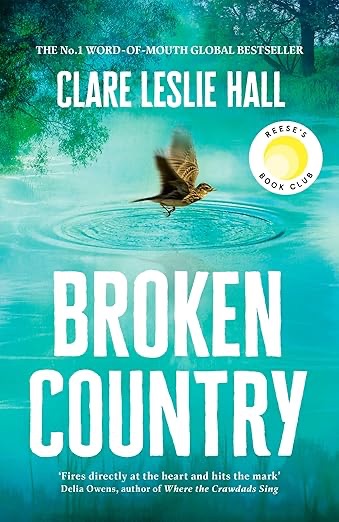
Broken Country by Clare Leslie Hall
This novel gets such a great write up online and the synopsis is incredible.
Everyone in the village said nothing good would come of Gabriel’s return. And as Beth looks at the man she loves on trial for murder, she can’t help thinking they were right.
Beth was seventeen when she first met Gabriel. Over that heady, intense summer, he made her think and feel and see differently. She thought it was the start of her great love story. When Gabriel left to become the person his mother expected him to be, she was broken.
It was Frank who picked up the pieces and together they built a home very different from the one she’d imagined with Gabriel. Watching her husband and son, she remembered feeling so sure that, after everything, this was the life she was supposed to be leading.
But when Gabriel comes back, all Beth’s certainty about who she is and what she wants crumbles. Even after ten years, their connection is instant. She knows it’s wrong and she knows people could get hurt. But how can she resist a second chance at first love?
A love story with the pulse of a thriller, Broken Country is a heart-pounding novel of impossible choices and devastating consequences.
Wow! That’s quite a summary. I am told by other bloggers I will be ‘broken’ or ‘ruined‘ by the end of this and yet I still want to read it.
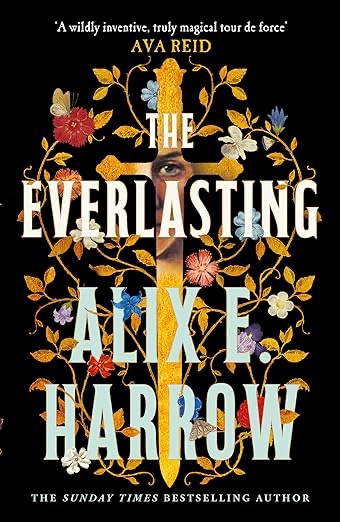
The Everlasting by Alix E. Harrow
A lady-knight whose legend built a nation meets a retiring historian in awe of her fame. He’s sent back through time to make sure she plays her part . . . even if it breaks his heart.
Sir Una Everlasting was Dominion’s greatest hero: the orphaned girl who became a knight, who died for queen and country. Her legend lives on in songs and stories, in children’s books and recruiting posters – but her life as it truly happened has been forgotten.
Centuries later, Owen Mallory – failed soldier, struggling scholar – falls in love with the tale of Una Everlasting. Her story takes him to war, to the archives, and then into the past itself. Una and Owen are tangled together in time, bound to retell the same story over and over again, no matter what it costs. But that story always ends the same way.
If they want to rewrite Una’s legend, and finally tell a different story, they’ll have to rewrite history itself – and change their lives in the process . . . So, this sounds a bit of an odd one for me. I’m always saying I don’t read a lot of fantasy and I don’t, but I love Alix Harrow’s writing, ever since her first novel Ten Thousand Doors of January. This would take me into the realms of romantasy for the first time (thanks Zoe for explaining it to me) but I’m here for it.
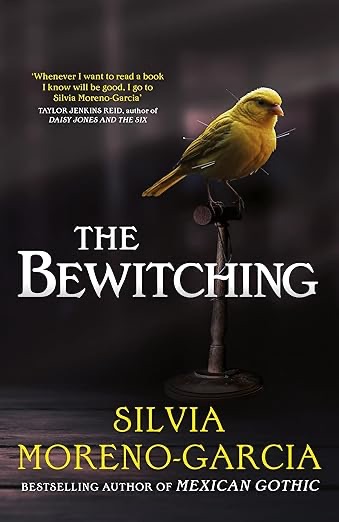
The Bewitching by Silvia Moreno-Garcia
Back then, when I was a young woman, there were still witches’: that was how Nana Alba always began the stories she told her great-granddaughter Minerva – stories that have stayed with Minerva all her life. Perhaps that’s why Minerva has become a graduate student focused on the history of horror literature and is researching the life of Beatrice Tremblay, an obscure author of macabre tales.
In the course of assembling her thesis, Minerva uncovers information that reveals that Tremblay’s most famous novel, The Vanishing, was inspired by a true story: decades earlier, during the Great Depression, Tremblay attended the same university where Minerva is now studying and became obsessed with her beautiful and otherworldly roommate, who then disappeared under mysterious circumstances.
As Minerva descends ever deeper into Tremblay’s manuscript, she begins to sense that the malign force that stalked Tremblay and the missing girl might still walk the halls of the campus. These disturbing events also echo the stories Nana Alba told about her girlhood in 1900s Mexico, where she had a terrifying encounter with a witch.
Minerva suspects that the same shadow that darkened the lives of her great-grandmother and Beatrice Tremblay is now threatening her own in 1990s Massachusetts. An academic career can be a punishing pursuit, but it might turn outright deadly when witchcraft is involved.
I LOVE a witch story. I blame Practical Magic. So I’m dying to read the author’s take on witching, especially if it has the same horror vibes as her other novels.
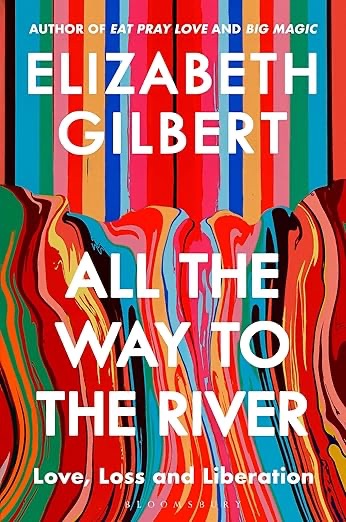
All the Way to the River by Elizabeth Gilbert
In 2000, Elizabeth Gilbert met Rayya. They became friends, then best friends, then inseparable. When tragedy entered their lives, the truth was finally laid bare: the two were in love. They were also a pair of addicts, on a collision course toward catastrophe.
What if your most beautiful love story turned into your biggest nightmare? What if the dear friend who taught you so much about your self-destructive tendencies became the unstable partner with whom you disastrously reenacted every one of them? And what if your most devastating heartbreak opened a pathway to your greatest awakening?
All the Way to the River is a landmark memoir that will resonate with anyone who has ever been captive to love – or to any other passion, substance or craving – and who yearns, at long last, for liberation.
I hear a lot of criticism of Elizabeth Gilbert but most of it tends to revolve around concerns that she’s mining her life for her writing. That’s what memoir is. I love complicated people and I don’t need to like a writer to enjoy their memoirs, especially if they have a lot of insight and clarity about their own struggles. I’m looking forward to seeing where Liz is now, after Eat, Pray, Love’s rather hopeful ending I know a lot has changed.
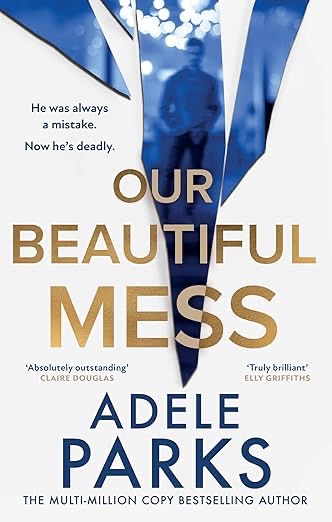
Our Beautiful Mess by Adele Parks
Connie can’t wait to have her daughters back home for the holidays. Fran is bringing a new boyfriend to stay, and the empty nest will once again be full of friends, family and young love.
Yet from the moment she sees Zac, Connie knows trouble is coming. Zac reminds her of the worst mistake she has ever made: a man whose charm and good looks nearly destroyed her marriage. She doesn’t want him in Fran’s world, but then Fran announces she’s pregnant.
Connie is terrified that her past is going to threaten her family’s future, but there’s a greater menace looming. She’s not the only one who has something to hide. Someone in the house has another devastating secret. A deception which will put everyone Connie loves in shocking danger, and one of them will pay the ultimate price.
I place Adele Parks in the same category as Louise Candlish and Lisa Jewell, in that I absolutely devour their books. Usually I can read them so quickly that they’re easy to fit between my other reads so I don’t know how this ended up in the unread pile. Now hopefully I’ll have time to read it.
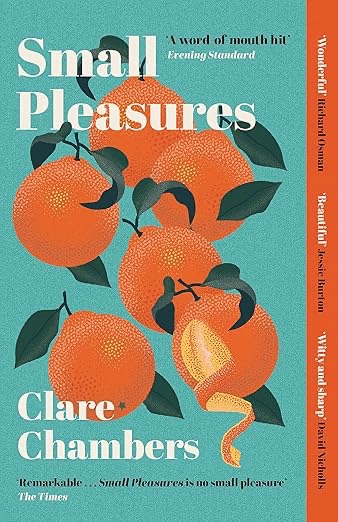
Small Pleasures by Clare Chambers
1957, the suburbs of south east London. Jean Swinney is a journalist on a local paper, trapped in a life of duty and disappointment from which there is no likelihood of escape. When a young woman, Gretchen Tilbury, contacts the paper to claim that her daughter is the result of a virgin birth, it is down to Jean to discover whether she is a miracle or a fraud. As the investigation turns her quiet life inside out, Jean is suddenly given an unexpected chance at friendship, love and – possibly – happiness.
I was first recommended this book about three years ago and I see it constantly on bloggers favourite lists so I’m determined to get it read this year. It sounds so unusual and hopeful and at the moment that’s just what I’m looking for.
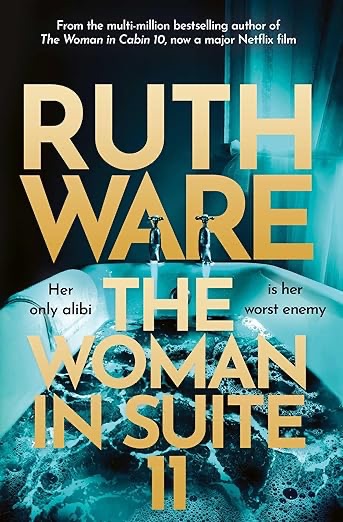
The Woman in Suite 11 by Ruth Ware
The stunning mountain views. The beautiful shore of Lake Geneva. The terrified woman held in the suite belonging to the hotel’s millionaire owner.
Lo Blacklock’s all-expenses paid trip to a luxury Swiss chateau should have been the ideal return to work. But as her past catches up with her, the millionaire’s mistress demanding that Lo help her escape, and a body turning up in the room next door, forces Lo to ask how far would she go to help someone she’s not even sure she can trust…
Having read Ruth Ware’s Woman in Cabin 10 I picked this up in a second hand bookshop in Scotland. I love the strange anonymity of hotels and the muffled quiet you get in luxury hotels. They can also be a little creepy. Again, I should be able to devour this so why haven’t I picked it up yet? Sometimes I frustrate myself!
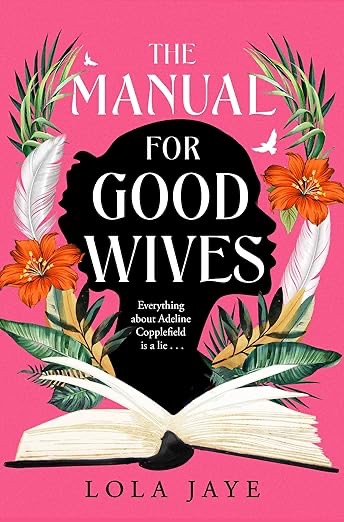
Everything about Adeline Copplefield is a lie . . .
To the world Mrs Copplefield is the epitome of Victorian propriety: an exemplary society lady who writes a weekly column advising young ladies on how to be better wives.
Only Adeline has never been a good wife or mother; she has no claim to the Copplefield name, nor is she an English lady . . .
Now a black woman, born in Africa, who dared to pretend to be something she was not, is on trial in the English courts with all of London society baying for her blood. And she is ready to tell her story . . .
I loved Lola’s book The Attic Child so this was a ‘must-buy’ for me, I love books that write people back into their history. This has that intrigue of a secret writer who is very different to the character they’re portraying. I love the idea of subverting The Angel in the House stereotype so this one is definitely going next to the bed.
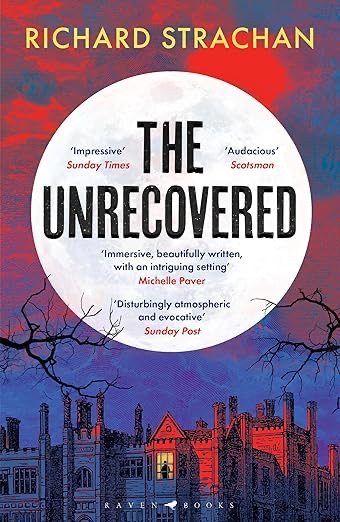
The Unrecovered by Richard Strachan
This book came out exactly one year ago this week and it has languished in the pile ever since. The money I could save!
At a Scottish manor house requisitioned as a temporary hospital during the First World War, Esther works as a volunteer nurse while dreaming of becoming a poet. With her husband and beloved father both dead, she knows that if the war ever ends she must build a very different life for herself.
Meanwhile, on the coast beyond her new home lies Gallondean Castle, a gloomy near-ruin that has been unhappily inherited by Jacob. Jacob is already haunted by his own demons but as he uncovers details of the castle’s past, the shadows only seem to be growing darker around him.
However it is Daniel, one of the soldiers who appears to have received only a minor, yet mysterious, injury, whose life will come to connect with both Esther and Jacob in horrifying and unexpected ways…
This was nominated for a Bloody Scotland prize and I do tend towards Scottish settings for both crime and gothic fiction. I have a feeling I’m going to love it.
So that’s ten from my personal TBR and I need to incorporate them into my reading list so they’re not languishing for another year! I’ll let you know how I get on.
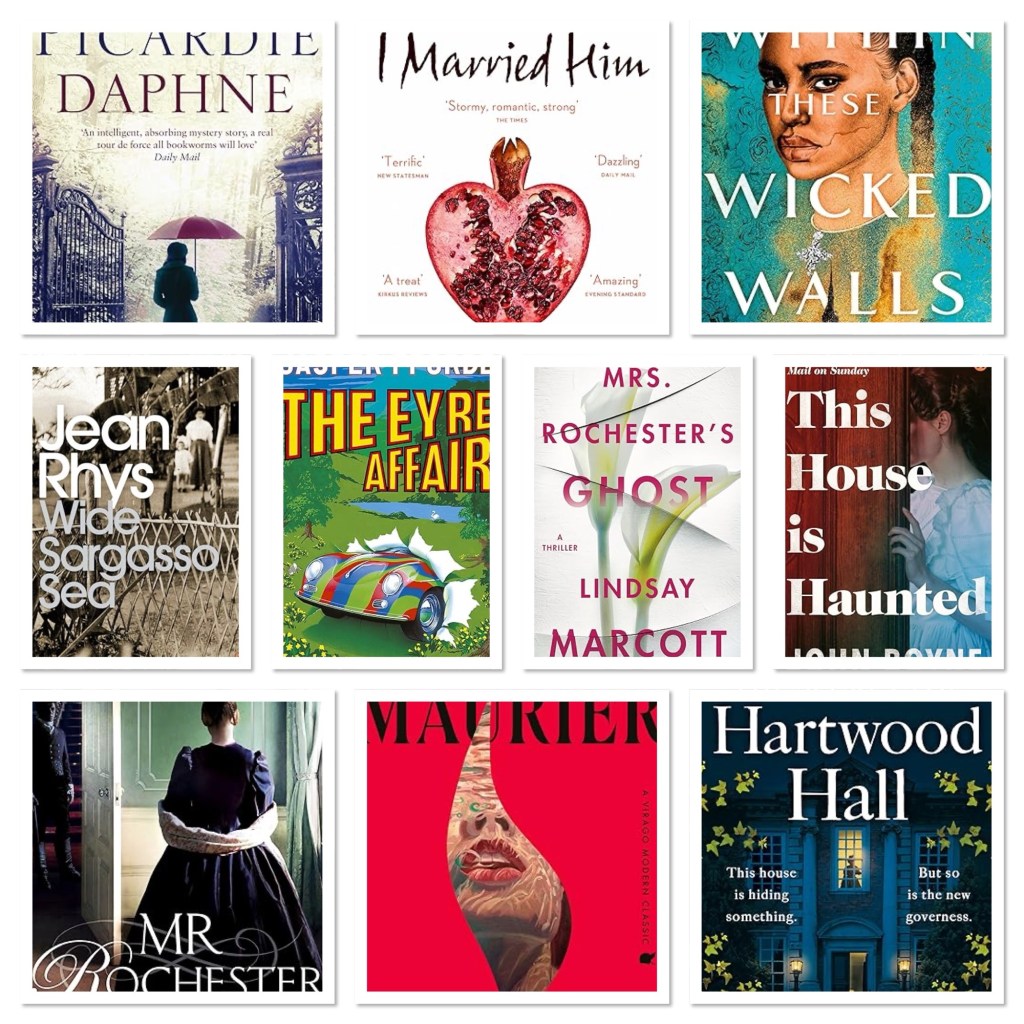
Like many English Literature students, Jane Eyre remains one of my favourite books and it has inspired writers ever since its publication in 1847. I first read it at ten years old and for me it was a romantic ghost story, read alongside the 1980s BBC series. As one of my first reads at university I could see how the novel contained aspects of everything I needed to learn on my 19th Century module: class, colonialism, morality, gender, work, women and much more. It also defies genre, with the potential to be classified as a mystery, romance, gothic fiction, Bildungsroman and historical fiction. I think this is what helps the novel endure. Its flexibility allows it to appeal to different generations for very different reasons. Each of this authors were inspired to use those multiple themes to shape a novel around Charlotte Brontẽ’s work.
My reading of the novel has definitely changed over the years. University opened up the novel for me as much more than the ghost story I’d enjoyed as a child. It brought colonialism into my mind for the first time, feminism and autonomy. It made me think more about the role of governess as a liminal figure in the household – she is an employee but doesn’t sleep or eat where the domestic staff do, she is unmarried and independent, earning her own money and making her own choices about it. I think it’s easy for a reader to identify with Jane, whether it’s the bullied and child trying to read behind the curtain or terrified by the Red Room. The girl scapegoated at school as ‘too passionate’ and a little bit defiant too. The young woman falling in love with an older man who isn’t what he seems, making decisions about whether to be in the role of mistress. All of these aspects are ripe for fictional updates and retellings. Bringing the book bang up to date there are aspects of manipulation and coercive control in Rochester’s use of Blanche Ingram and dressing up as a fortune teller to influence Jane’s thoughts. We can look at femininity through Bertha Mason, the madwoman in the attic and the comparison of Jane as everything she supposedly isn’t – modest, compliant, emotionally stable and moral. This is especially important in light of public figures like the Tate brothers who want to control how women behave and denigrate those who don’t fit their ideal. The nanny or governess has become a staple of modern thrillers because of their intimacy with the family they work for, often living in close quarters and becoming close emotionally. That is the book’s enduring appeal, that we can always look at it through the lens of today and find something new. One of my specific interests in the novel is mental health and who is in control of what constitutes instability. I’m also interested in the disability aspect of the novel and what it is about Rochester’s disabilities towards the end of the novel that brings some equality between him and Jane. Here I’ve gathered just a few of the novels that are inspired by the novel in very different ways.
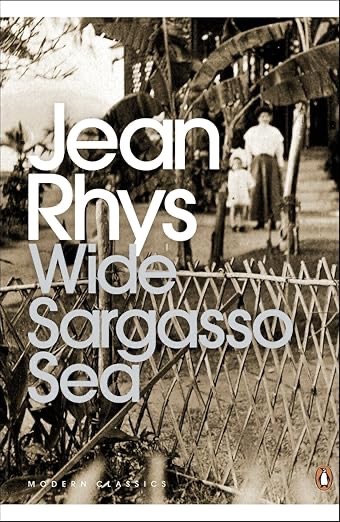
Born into the oppressive, colonialist society of 1930s Jamaica, white Creole heiress Antoinette Cosway meets a young Englishman who is drawn to her innocent beauty and sensuality. After their marriage, however, disturbing rumours begin to circulate which poison her husband against her. Caught between his demands and her own precarious sense of belonging, Antoinette is inexorably driven towards madness, and her husband into the arms of another novel’s heroine. Rhys shows us why Antoinette isn’t just the antithesis of the quiet and composed Jane Eyre. Her work evokes thoughts around female sexuality and whether sexual enjoyment or the woman’s initiation of sexual activity is what Rochester rejects in his wife. Is it really the history of madness in her family or is it the ‘Creole’ aspect of Antoinette’s heritage? Is she insane or furious about his rejection, withdrawal from and later imprisonment of her that aroused violent tendencies? This is a classic study of betrayal, a seminal work of postcolonial literature and is Jean Rhys’s brief, but beautiful masterpiece.
Jean Rhys (1894-1979) was born in Dominica. Coming to England aged 16, she drifted into various jobs before moving to Paris, where she began writing and was ‘discovered’ by Ford Madox Ford. Her novels, often portraying women as underdogs out to exploit their sexualities, were ahead of their time and only modestly successful. From 1939 (when Good Morning, Midnight was written) onwards she lived reclusively, and was largely forgotten when she made a sensational comeback with her account of Jane Eyre’s Bertha Rochester, Wide Sargasso Sea, in 1966.
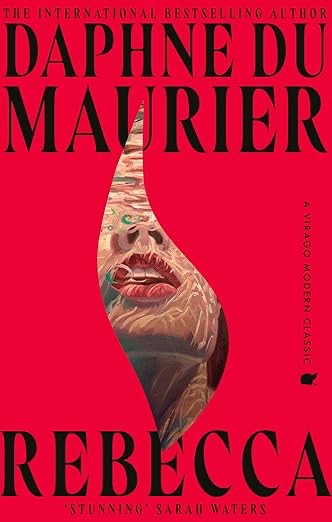
He did not belong to me at all, he belonged to Rebecca. . .
Everyone knows that Maxim de Winter was obsessed with his glamorous wife – and devastated by her tragic death. So when he proposes to a shy, anxious young woman after a whirlwind meeting in the South of France, no one is more surprised than the new bride herself. But when they reach Manderley, his beautiful, isolated Cornish mansion, the second Mrs de Winter begins to realise that every inch of her new home – and everyone in it – still belongs to Rebecca.
Daphne du Maurier’s thriller has Jane Eyre in it’s DNA, especially when it comes to it’s heroines: the dark and delicious vamp Rebecca who we never see and the quiet, awkward and compliant second wife who is never named. Here though, instead of a housekeeper, we get the gothic masterpiece that is Mrs Danvers, once Rebecca’s maid and now the housekeeper of Maxim de Winter’s stately home on the Cornish coast, Manderley. Maxim has chosen this new, much younger and adoring wife without any thought as to whether she has the knowledge or the qualities to run a great house. She doesn’t even have the confidence to ‘leave it all to Danny‘ as he tells her. He has the detachment of the upper classes who are so privileged they don’t care if they’re rude, ignorant or leave the staff to pick up after them. His new wife however can’t give orders and ends up trying to fit into the routine of her predecessor only to be reminded of her at every turn. Here, the madwoman is in the attic of the mind, ever present and even more intimidating in the imagination. There is also the creepy Mrs Danvers, slowly pressuring the new bride, showing her deficiencies as a mistress to Manderley and hinting at the sexual chemistry between Rebecca and Maxim. This is an incredible update of the classic, bringing in psychological aspects from the age of Freud and an addictive suspense that culminates in that bright glow of fire in the Cornish dawn.
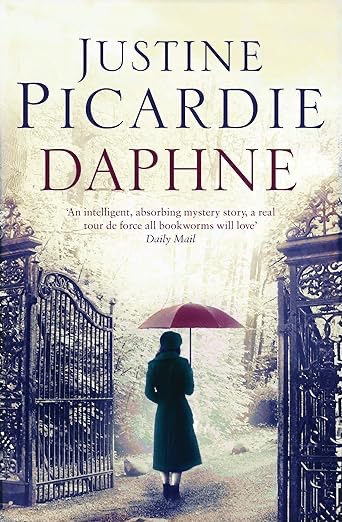
It is 1957. As Daphne du Maurier wanders alone through her remote mansion on the Cornish coast, she is haunted by thoughts of her failing marriage and the legendary heroine of her most famous novel, Rebecca, who now seems close at hand.Seeking distraction, she becomes fascinated by Branwell, the reprobate brother of the Brontë sisters, and begins a correspondence with the enigmatic scholar Alex Symington in which truth and fiction combine.
Meanwhile, in present day London, a lonely young woman struggles with her thesis on du Maurier and the Brontës and finds herself retreating from her distant husband into a fifty-year-old literary mystery. This is a subtle update of the themes of Jane Eyre in a time when a second wife isn’t an unusual and dealing with issues like blended families and the presence of ex-wives is an everyday occurrence. However, we have the clear Jane Eyre figure still in our PhD student, quiet and unassuming but psychologically dependent on her husband who still holds a fascination for the more colourful and bohemian poetess who was his first wife. It also delves beautifully into the psychology of Daphne Du Maurier, who sealed her journals for fifty years after her death. We now know she suffered mental abuse from her father, an actor whose fascination with younger actresses derailed his marriage and perhaps provides the blueprint for the older romantic figure of Max de Winter, an updated version of Edward Rochester. There is an incredible amount of research in this book that even goes back to the Brontë’s and the psychological genesis of their writing. The more you know about them and Daphne du Maurier, the more you will enjoy this one.
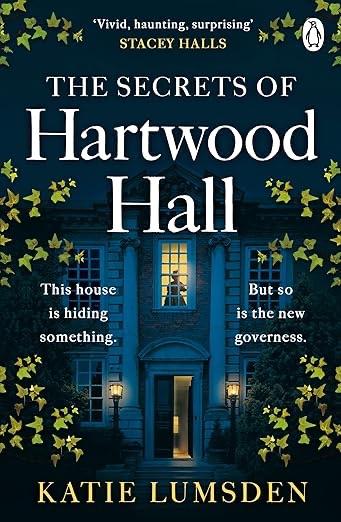
1852. When Margaret Lennox, a young widow, is offered a position as governess at Hartwood Hall, she quickly accepts, hoping this isolated country house will allow her to leave the past behind. But she soon feels there’s something odd about Hartwood: strange figures in the dark, tensions between servants and a wing of the house no one uses.
Why do the locals eye her employer, widowed Mrs Evesham, with suspicion? What is hidden in the abandoned East Wing? Who are the strangers coming and going under darkness? Hartwood Hall conceals mysteries, perhaps even danger. Margaret is certain that everyone here has something to hide, and as her own past threatens to catch up with her, she must learn to trust her instincts before it’s too late?
This is a brilliant example of the ‘gothic governess’ novel as I like to call them and brings an elements of modern preoccupations like gender and sexuality to the 19th Century novel. It begins with a du Maurier style opening of a winding drive and a forbidding house that local people like to avoid. When her charge is ill, Margaret is disturbed that locals won’t come near the hall and is more puzzled by the sudden presence of Miss Davis, a nurse who turns up at the house after hearing a child was unwell at the hall. After experiencing lights in a forbidden part of the house and seeing the unease Mrs Evesham has about people knowing their business, Margaret knows there’s a mystery here but is unsure exactly what it is. Because it’s a mystery I can’t say more, but I loved how this story unfolds and what it means for the women involved.
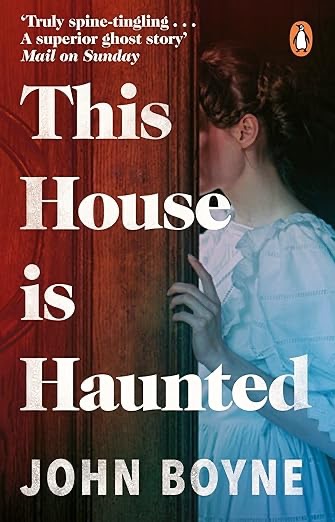
1867. On a dark and chilling night Eliza Caine arrives in Norfolk to take up her position as governess at Gaudlin Hall. As she makes her way across the station platform, a pair of invisible hands push her from behind into the path of an approaching train. She is only saved by the vigilance of a passing doctor.
It is the start of a journey into a world of abandoned children, unexplained occurrences and terrifying experiences which Eliza will have to overcome if she is to survive the secrets that lie within Gaudlin’s walls. This is such a gothic novel that it could almost be a parody but what saves it is Eliza herself, arguably a rather more modern governess than we would expect in 1867. curiosity, her determination and her rational analysis of her situation. Eliza is no hysterical heroine of a sensitive disposition, and her self-awareness is not just important to her handling of the mystery that surrounds Gaudlin, but also entertaining. Her independence, dry wit and forward-thinking views on certain social issues, if not necessarily likely for a woman living in the 1860s, elevate her above the average Victorian Gothic female protagonist, and her innate kindness is also an endearing counterpoint to her impressive courage. The children are also much more than the standard creepy kids of many a horror story, and the different ways in which they each deal with the challenges of their situation are fascinating and credible.
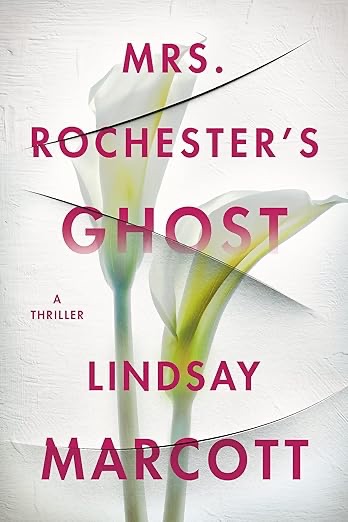
In a modern and twisty retelling of Jane Eyre, a young woman must question everything she thinks she knows about love, loyalty, and murder.
Jane has lost everything: job, mother, relationship, even her home. A friend calls to offer an unusual deal―a cottage above the crashing surf of Big Sur on the estate of his employer, Evan Rochester. In return, Jane will tutor his teenage daughter. She accepts.
But nothing is quite as it seems at the Rochester estate. Though he’s been accused of murdering his glamorous and troubled wife, Evan Rochester insists she drowned herself. Jane is skeptical, but she still finds herself falling for the brilliant and secretive entrepreneur and growing close to his daughter.
And yet her deepening feelings for Evan can’t disguise dark suspicions aroused when a ghostly presence repeatedly appears in the night’s mist and fog. Jane embarks on an intense search for answers and uncovers evidence that soon puts Evan’s innocence into question. She’s determined to discover what really happened that fateful night, but what will the truth cost her?
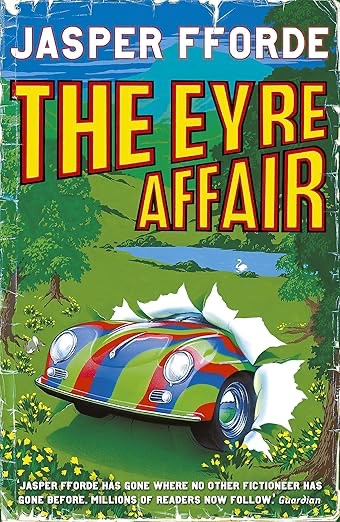
Meet Thursday Next, literary detective without equal, fear or boyfriend.
There is another 1985, where London’s criminal gangs have moved into the lucrative literary market, and Thursday Next is on the trail of the new crime wave’s MR Big. Acheron Hades has been kidnapping certain characters from works of fiction and holding them to ransom. Jane Eyre is gone. Missing.
Thursday sets out to find a way into the book to repair the damage. But solving crimes against literature isn’t easy when you also have to find time to halt the Crimean War, persuade the man you love to marry you, and figure out who really wrote Shakespeare’s plays. Perhaps today just isn’t going to be Thursday’s day. Join her on a truly breathtaking adventure, and find out for yourself. Fiction will never be the same again. This is such an inventive novel, part sci-fi and part detective novel with all the post-modern intertextuality you could want. Thursday is such an appealing heroine, with a detective’s flair and a keen nose for the bad guy – possibly due to her criminal father. We slip into various different worlds before finding ourselves back on that flaming roof at Thornfield Hall. Whimsical and utterly brilliant.
Uncover the secrets of Edward Fairfax Rochester, the beloved, enigmatic hero of Jane Eyre, as he tells his story for the first time in Mr Rochester, Sarah Shoemaker’s gorgeous retelling of one of the most romantic stories in literature.
On his eighth birthday, Edward is banished from his beloved Thornfield Hall to learn his place in life. His journey eventually takes him to Jamaica where, as a young man, he becomes entangled with an enticing heiress and makes a choice that will haunt him. It is only when he finally returns home and encounters one stubborn, plain, young governess, that Edward can see any chance of redemption – and love. Rich and vibrant, Edward’s evolution from tender-hearted child to Charlotte Bronte’s passionately tormented hero will completely, deliciously, and forever change how we read and remember Jane Eyre. Sarah Shoemaker takes us back to a world before Jane Eyre, using a 19th Century style in keeping with its source material. Most of the book is Edward Rochester’s early life, giving us a background that makes sense of the moody and changeable man we see in the original novel. His background is dogged by loss, including the death of his mother at an early age. We see with each loss how isolated he feels so that when he is betrayed by family into a marriage with the unknown Bertha Mason she becomes all he has, but everything he didn’t want. When Jane finally appears the stage is set for events at Thornfield but through his eyes. The tragedy is that the angel he sees before him is out of reach. Given access to his inner voice we can see how much he agonises over his feelings and whether to act, making sense of his odd hot and cold behaviour towards her. This book shines a new light on this story and is a definite must read for lovers of Jane Eyre.
What the heart desires, the house destroys…
Andromeda is a debtera – an exorcist hired to cleanse households of the Evil Eye. She would be hired, that is, if her mentor hadn’t thrown her out before she could earn her license. Now her only hope is to find a Patron – a rich, well-connected individual who will vouch for her abilities.
When a handsome heir named Magnus reaches out to hire her, she takes the job without question. Never mind that he’s rude and eccentric, that the contract comes with outlandish rules, and that the many previous debteras had quit before her. If Andromeda wants to earn a living, she has no choice. But this is a job like no other, and Magnus is hiding far more than she has been trained for. Death is the likely outcome if she stays, the reason every debtera before her quit. But leaving Magnus to live out his curse isn’t an option because, heaven help her, she’s fallen for him.
This is an unexpectedly romantic debut from Lauren Blackwood that has been both an Oprah Winfrey and Reese Witherspoon book club choice. It has beautiful imagery and its Ethiopian setting gave me background on a country mainly known for famine (especially for this child of the 1980s). The mythology is fascinating and brings an even spookier aspect to the story. This is a very loose retelling of Jane Eyre, with the emphasis on the gothic elements and reminding us what a Beauty and the Beast story this is. The romance develops a little too quickly for me, but there’s a great banter between the central characters that feels true to the original pair. It also sticks quite firmly to the premise that he is the one being rescued. An interesting addition for the Jane Eyre fan, but not a faithful retelling.
A collection of short stories celebrating Charlotte Brontë, published in the year of her bicentenary and stemming from the now immortal words from her great work Jane Eyre.
The twenty-one stories in Reader, I Married Him – one of the most celebrated lines in fiction – are inspired by Jane Eyre and shaped by its perennially fascinating themes of love, compromise and self-determination. A bohemian wedding party takes an unexpected turn for the bride and her daughter; a family trip to a Texan waterpark prompts a life-changing decision; Grace Poole defends Bertha Mason and calls the general opinion of Jane Eyre into question. Mr Rochester reveals a long-kept secret in “Reader, She Married Me”, and “The Mirror” boldly imagines Jane’s married life after the novel ends. A new mother encounters an old lover after her daily swim and inexplicably lies to him, and a fitness instructor teaches teenage boys how to handle a pit bull terrier by telling them Jane Eyre’s story.
Edited by the fantastic Tracy Chevalier, this collection brings together some of the finest and most creative voices in fiction today, to celebrate and salute the strength and lasting relevance of Charlotte Brontë’s game-changing novel and its beloved narrator.
A fantastic new novel from a writer who is now on my list of ‘must buy’ authors. She sets her novel in 18th Century Covent Garden, where bawdy houses are far from uncommon and while Mrs Macauley’s house isn’t a high class establishment, her girls are clean and she looks after them well. Our main character Sukey Maynard is a young black woman who has run from Mrs Macauley and finds a young man almost beaten to death in the street. He is also black and she fears he’s a runaway slave. So she finds a local doctor who is known to treat people in poverty and leaves him there, with Dr. Sharp promising to let her know how he gets on. Sadly, her altruistic act means Mrs Macauley’s security man Jakes catches up with her; in saving Jonathon’s life she has forfeited her own. As she’s dragged back to the house and a punishment in ‘the coffin’, it sets up a claustrophobic and scary atmosphere where the rules have to be obeyed. However, life at Mrs Macauley’s is more complicated than that. Sukey is anxious, having just had her first bleed. This means she is ready for work and has years of ‘debt’ owed for her keep so far. She and her equally young friend, Emmy are like family, having grown up together after the death of Sukey’s mother who was Mrs Macauley’s friend. They were prostitutes together in their younger years, along with a third woman Madame Vernier who is recently back on the London scene after years in France. After visiting Mrs Macauley, Madame Vernier learns that Sukey may be ready to work and that an auction will be held for her virginity. She promises to help, hopefully finding someone for the auction who has the means to ‘keep’ Sukey if he’s pleased with her. But why does Madame Vernier want to help? Is it in remembrance of her friend or does she have a different scheme in mind?
The plot is fascinating with disappearing prostitutes, competing houses and Sukey desperately trying to work out who has fled of their own accord and who might have been taken by the feared ‘Piper’. When Madame Vernier secures Sukey a regular client she feels her worries are solved, but as Mrs Macauley starts to apply pressure for more than a week to week retainer will he come through for her? She dreads being thrown downstairs into the parlour for the nightly competition with the other girls for whichever drunk falls through the door. When the most vocal and experienced resident Camille goes missing from one of Madame Vernier’s parties, Sukey is determined to find out what happened to her. Weirdly she’s also sure she saw another girl missing from their neighbourhood, but working the party under a different name. There’s a mystery here and Sukey is unsure who to trust. This mystery brings an element of suspense to the story and means Sukey must grow up fast if she’s to solve it. She’s a naive girl, only just a young teenager really. She’s been protected until now by Mrs Macauley and considers Emmy her sister, so it’s a huge jolt to suddenly be deemed a woman and expected to entertain men with no experience whatsoever. Even worse must be seeing the ledger with every moment of her childhood laid out in pounds and shillings – an amount she now has to pay back. It’s no surprise that Sukey’s hopes for a ‘keeper’ are paramount and when she thinks she’s safe it leaves the other girls thinking she feels superior.
I thoroughly enjoyed getting to know this house of working women and regular readers know my love for writing marginalised people back into history. Here it was great to read about women who are not the middle or upper class characters we often encountered in historical fiction. This is the turning upside down of 19th Century fiction norms, where we might expect the book’s focus to be one of rescuing our heroine. Yes, these women are in a tough situation and it may not be the way they’ve chosen to earn a living, but there are benefits compared to service or marriage. They are cooked for, sleep till late in the morning and they don’t have the drudgery of housework. They are also free from spending their lives obeying the man of the house. They earn more for less hours of work than a domestic servant. Their hours of leisure are their own, within reason and we see Sukey become more emancipated as she meets others who are black and live in her neighbourhood. I particularly loved the bookshop owner and his son who write the famous guide to London’s prostitutes and a profitable line in erotic literature. This is a great novel where no one is quite what you think they are and our intrepid heroine has a lot to learn, very fast. I learned a huge amount about the ethnicity of London in the 18th Century and I have to say I loved how the mystery unravelled. Sukey’s choices towards the end show a huge amount of growth and a deep longing for independence. I must also mention the title, bringing to mind a very different type of house and a sisterhood of nuns. This is another fantastic novel from Louise Hare with a complex and fascinating heroine.
Out on 12th February from HQ
Meet the Author
Louise Hare is a London-based writer and has an MA in Creative Writing from Birkbeck, University of London. Originally from Warrington, the capital is the inspiration for much of her work, including This Lovely City, which began life after a trip into the deep level shelter below Clapham Common. This Lovely City was featured on the inaugural BBC TWO TV book club show, Between the Covers, and has received multiple accolades, securing Louise’s place as an author to watch. This is her fourth novel.
We finally got here! The end of the twelve week month that is January and yes, I do still have mince pies in the freezer. I also had lots of books to read for January but gave myself a chance to read a few of those books that have sat on my shelves for a while and I’ll be reviewing those on my Throwback Thursdays. This month has taken me from a London hotel to Western Australia, via NYC, Nova Scotia and the South of France. What they do have in common are complex female characters with many secrets to uncover…
This book about a band taking a new direction was an unexpected pleasure and I read it with my Squad Pod pals. The Future Saints are Ripper on guitar, Kenny on drums and the explosive Hannah on guitar and vocals. Manifold Records manager Theo is sent to troubleshoot the band who’ve been struggling since the death of their old manager and Hannah’s sister Ginny. He has a remit, to get the band on track to produce at least one album and then let them go. However, when Theo walks into a bar to see them for the first time, he’s transfixed by Hannah and the new material she’s written. It’s emotional, dark and really connects with the audience. So when Hannah falls off stage mid-song and goes viral on TikTok it’s the perfect springboard for their new album. Theo is excited about this band, but just when he should be taking advantage of their viral moment he feels an instinct to protect Hannah who seems to be falling apart. You will root for this band because they’re such likeable characters and I felt their loss so strongly. There are funny moments but also a really deep psychological undertone to this novel that gives it heft. There’s also the growing chemistry between Hannah and Theo, at exactly the wrong time. This was a deeply emotional book, with the realities of the music business and the psychology of loss. A really entertaining read.
Cora is a ‘maroon’ one of a group of settled slaves from Jamaica who have signed an agreement with the English government to secure their freedom in Nova Scotia. She lives in her ‘found’ family – Leah who has been like a mother to Cora and her sister, Benjamin her niece and Silas. Cora has often felt watched when walking in the forest and comes across Agnes, a lone girl with a huge dog. Immediately they have a connection and slowly she trusts Cora enough to show her where she lives her bare and solitary existence. As the pair grow closer, Agnes shares their beautiful surroundings with Cora, showing her sights she never imagined. Can these two women build a life together with the obstacles of their sexuality, the complexities of freedom and the sheer struggle of surviving in the harsh winters of Canada? As Cora will find out, it’s easy to take one wrong step and lose your life in the wilderness. Also, one person can hide and escape more easily than two. There are secrets on both sides that will force both women to face their pasts and the truth of where they come from. This is beautifully pitched, with enough emotion, tension and a beautiful atmosphere to keep you reading. I found this moving, imaginative and historically interesting. My full review is coming in Feb with Random Things Tours.
This was a book I was catching up on over the New Year as I tried desperately to get my NetGalley backlog sorted. Of course I failed. However, I’m glad I finally had time to read this thriller from Katie Bishop whose debut novel ‘The Girls of Summer’ I enjoyed enormously. Our main character is Josie, recently released from prison and returning to her home town on the Côte d’Azure. She’s destined to stay with her brother and his girlfriend at the diving shop where they grew up. Years before Josie was jailed on the evidence of Nina Drayton, the youngest daughter of a local ‘summer’ family with a huge house on the cliffs overlooking the beach. Nina apparently told her mother that she’d seen Josie kill her older sister Tamara in the swimming pool. Coincidentally, the grown up Nina is at the family house with her husband and children trying to decide what to do with the place since her mother’s death. Haunted by that summer she has since become a psychotherapist, in the hopes of understanding her own memory. Did she see what she apparently disclosed to her mother and Blake, because she has no memory of it? As Josie tries to start anew she’s thrown of course by a True Crime channel on TikTok deciding to serialise Tamara’s death and blow it up all over again. How can she make a new start if everyone knows who she is? This is brilliantly told in two timelines and with both Nina, Josie and her friend Hannah as narrators. The tension grows as that summer is revealed slowly and the popularity as well as the sensationalism of the True Crime genre is questioned.
Kate and Vic have been married for a few years, after meeting when she was studying in Rome. After a normal morning rush at home Kate travels into London, on the pretext of doing an interview. However, she has a different destination in mind. This is an appointment she’s been keeping for several years like clockwork. Now she’s caught in the wrong place at the wrong time. She should be travelling home later this afternoon – picking up the kids from school and collecting the rabbit from the vets. Instead she’s trapped in room 706, in a luxury hotel that’s under siege by a terrorist group. How can she explain why she’s here? Even if her body is discovered in the aftermath everyone will wonder, what exactly is she doing here? She has always been very careful, leaving no trace. Now she wonders whether her husband Vic will understand why? As she tries to summon the words that convey just how much Vic and her children mean to her, Kate reflects on all the choices that brought her here. The author carefully lets the tension mount so slowly that while reminiscing over Kate’s life we almost forget where she is in the here and now. She’s a prisoner in this room and she has to be silent, so they can’t put the television on and they can’t flush a toilet. When the lights and electricity go they’re almost totally cut off from the outside world. It’s a quiet that is sometimes broken by heavy footsteps or other hotel guests meeting their fate. You’ll almost hold your breath at times. The forced intimacy means she asks questions of her lover that she’s never asked before. She knows nothing about his life, only that he’s married and has been sleeping with Kate in this way for several years. We know the terrorists are stalking the corridors, one floor at a time, but we don’t know whether they have a master key or a bomb. I realised that despite her family unit, Kate is lonely. What she wants is for someone to see and appreciate her as Kate the woman, not the mum, wife or journalist. You will be compelled to read this as I did, long into the night. It has the pitch perfect pacing and tension of a thriller, but so many psychological layers. Women will identify with Kate, at least some part of her. She very simply wants to be seen, desired and receive pleasure. As the terrorists come close enough to hear in the room next door, we know Room 706 will be next. Kate has had an opportunity to assess and understand her life, to possibly make changes and live more. You’ll have to read to the end to find out whether she gets that chance.
My final choice this month is an older read, a big chunky novel that’s been on my shelf for a long time! I’ve always picked up Kate Morton’s novels and I don’t really know why this one has sat on my shelves for so long. I made it one of the novels to catch up on in December, when I take a break from blog tours and read what I feel like. It’s a chunky novel and it took some time to get to grips with everyone and their timelines but there’s no mistaking the power of the central image as new mum Izzy and her children are found on their picnic blanket by the creek. The man who makes the discovery assumes they’re asleep, until he sees a line of ants crawling over Matilda’s wrist. It’s such a striking image that it inspires the title of journalist Daniel Miller’s book ‘As If They Were Asleep’. The only person missing is baby Thea and it’s assumed she’s been carried away by wild dogs. The conclusion is that Izzy has poisoned herself and her children, unable to leave them behind. Back at their home, Halcyon, Izzy’s heavily pregnant sister-in-law Nora is waiting for her brother’s family to return. Possibly due to the shock and in a powerful storm, Nora gives birth to her own daughter Polly. Once she leaves for her own home, no one will ever return to Halcyon. Nora’s brother stays in the USA seemingly unable to face what happened to the woman he loved and the children whose voices once filled the house he fell in love with as soon as he saw it. Now, with Nora seriously ill in hospital, her granddaughter Jessie will be drawn into the cold case through Nora’s rambling words and Daniel’s book. What follows is a not just a complex murder case but a tale of mothers and daughters and how intergenerational trauma has an impact, even when it’s a closely guarded secret. Morton keeps the twists and turns coming right up to the end of the novel, some expected and others a complete surprise. She never leaves even the tiniest loose end and that isn’t easy when we see just how far the ripples of this tragedy spread in the community. In the midst of that Christmas and all that comes after, Izzy really has an impact with her beauty and vitality. It is unthinkable that only hours later all that sparkle is simply snuffed out. If you love Kate Morton, this has all the aspects that make her novels so popular – the family saga, the big house and the secrets kept behind closed doors. However, this had the added element of an unsolved crime giving it an addictive quality. Added to that is the length of the book, allowing the story and characters to fully develop, showing fascinating and complex psychological dynamics between each mother and daughter. I can’t believe it took me so long to finally read it.