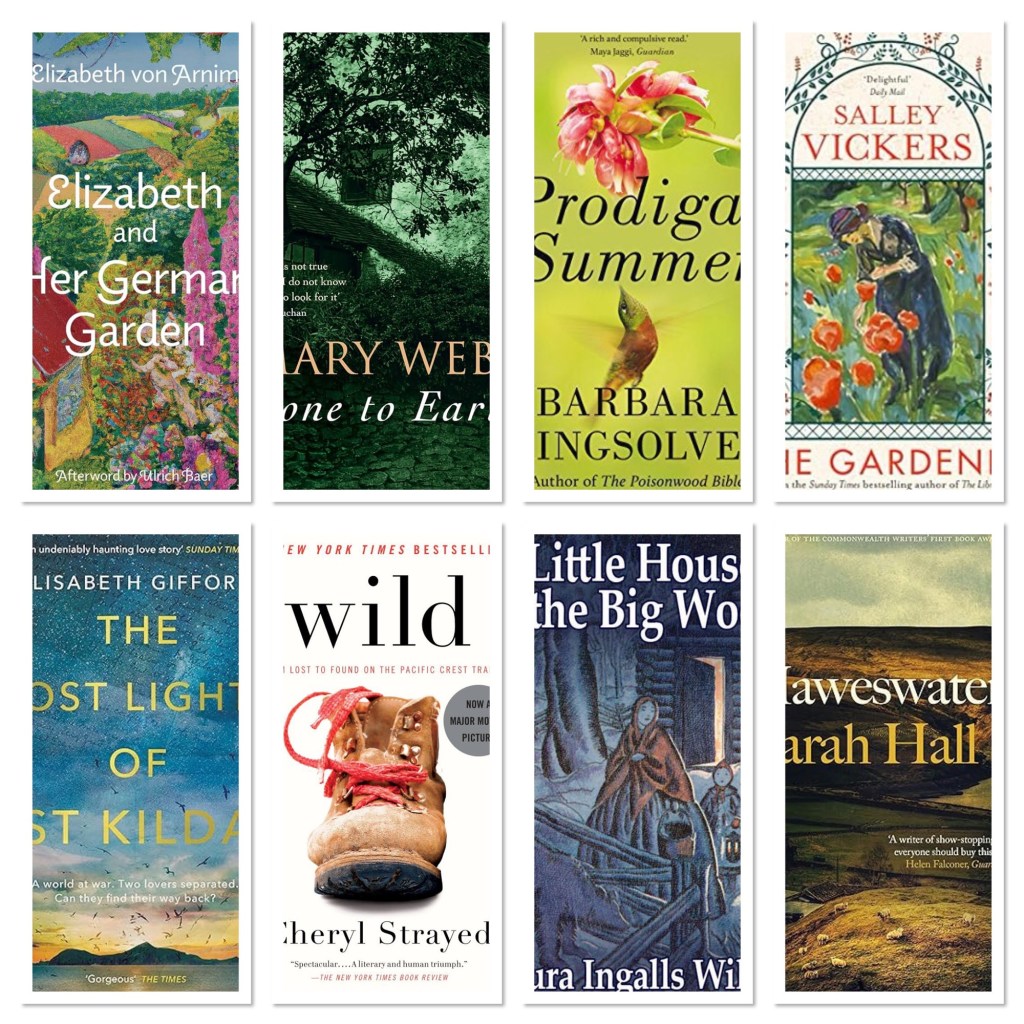
Last weekend was the first this year when I’ve sensed the merest whiff of spring, south easterly winds bringing a warmer feel when I ventured outside and a few bulbs sprouting in the sunshine. There’s still a little way to go though, so I thought I’d brighten up the dregs of winter with books that have a strong nature theme. Whether it’s a beautifully conjured sense of place, an outdoor challenge, the benefits of creating a garden or a correlation between nature and character, all of these have outdoor vibes. I was also inspired by my enjoyment of Eowyn Ivey’s new novel Black Woods, Blue Sky where our main characters inhabit the Alaskan wilderness.
On a personal front, I now know I have a narrowed spinal canal as well as arthritis throughout my spine. I’m a little stir crazy waiting for the next steps, so my longing for the outdoors is probably stronger than it’s been in a while. Thanks to my dad I now have a little custom made bench thats directly outside the kitchen door where I can sit with a brew in the morning and feel the sun. But I long to smell the forest, with pines swaying in the breeze and the sharp scent of their needles as I crunch them underfoot. Or the smell of the sea air and the salty spray on my cheeks. Each test and appointment gets me closer to a solution and hopefully, a long term one rather than a quick fix. If you too are longing for some outdoorsy book inspiration, look no further.
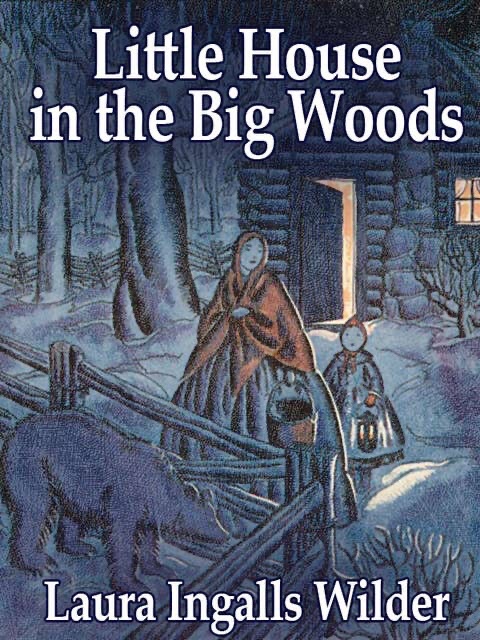
If I’m honest the Little House on the Prairie books are probably where I started to love reading about living in wild places. I think it’s also where I got my ability to make a home wherever I ended up. When we were small we moved wherever my Dad had work, so usually on farms or land drainage pumping stations – an absolute must in the flatlands of Lincolnshire! So every house was a ‘tied’ cottage and never belonged to us, although my Mum went out of her way to make every place a home. We both love these books, although of course we understand more about pioneer families now. Slowly moving further out to wilder areas, claiming land that until then had been Native American territory. Some of the language and attitudes towards Native Americans in later novels certainly reflect the attitudes of the time. This first book always stays with me, not necessarily because of the plot but because of the lengthy description of what life and nature was like. I remember a party when families came together to harvest maple syrup and the candy the girls would make out of syrup and snow.
I loved the harvesting, possibly because it was a part of our lives too, since we lived on a fruit farm for a few years so mum was always making pies, crumbles and jams. I must admit having my own pantry was a life goal, it had me gathering and freezing as well as making chutneys and plum brandy (absolutely lethal). There’s a huge satisfaction in growing your own and filling the pantry with enough preserves and chutneys to last till next harvest. The author captures how she felt and you always know that you’re experiencing life through the eyes of a small child. There are scary moments here – such as a big cat lurking overhead in the woods or bears stumbling into their homestead, but somehow the main feeling you come away with is how cozy and safe she was made to feel by her parents. I’m sure the reality for the adults was a lot harder. What I love is how their lives change through the seasons because they’re working with nature whether it’s the sharp cold of winter or the first warm spring day.

When I was about nine years old we spent some time living in Leicestershire and one of our regular family outings was to the Rutland Water reservoir. In 1975, the villages of Nether and Middle Hambleton were flooded to provide water for growing cities in the East Midlands. All that remains of the village is an old chapel that juts out into the water. We lived nearby in the late 1970’s to the early 1980’s so the reservoir was quite new with none of the facilities it now has, including a hotel, water sports centre and a nature reserve. I used to find it so eerie when I imagined a whole village underneath the water. This book gave me some insight into the experience as well as capturing the beauty and wildness of the Lake District. Set in 1936, the Lightburn family have always lived in a remote dale in the old, northern county of Westmorland. It’s a rural community where the family have been working in the harsh hill-farming tradition – largely unchanged by modern life. When a man from Manchester arrives, as spokesman for a vast industrial project, that will devastate the landscape and the local community. Mardale will be flooded, creating a new reservoir, supplying water to the Midlands’ growing cities. The waterworks’ representative is Jack Liggett who creates more problems by having an affair with local woman, Janet Lightburn. They each represent their respective viewpoints; Jack is all growth and progress, with man making his mark on the landscape, whereas Janet is more aligned with nature and her family’s way of life, now centuries behind. She takes a final, desperate and ultimately tragic attempt to restore the valley to what it has always been.
This book gave me an insight into how my grandparent’s lived, working on the land. The author creates an authentic sense of both time and place, in area that has been out of touch with progress for decades. It’s not just a destruction of a place, it’s a destruction of a whole community and tradition. It takes us away from the modern day touristy Lake District we all know, to when it was wilder and remote. When people wrestled their living from the landscape, working alongside nature and it’s changing seasons at a slower pace. The shock is seismic for those who now have to catch up with modern thinking and ways of earning a living. This is a beautifully written elegy for a time and place that no longer exists.

“Oh, my dear, relations are like drugs, – useful sometimes, and even pleasant, if taken in small quantities and seldom, but dreadfully pernicious on the whole, and the truly wise avoid them”.
This beautiful book cover always makes me smile. Most readers probably know this author’s other novel The Enchanted April, but this is such a gentle, witty and uplifting story. In a semi-autobiographical diary Elizabeth looks for respite from her husband, a Prussian aristocrat, and their children who she refers to by the month they were born. She came from a highly-educated and slightly bohemian family in England and married at the age of 25. Sadly they were mismatched, her husband was rather somber and dedicated to his duty of farming the estate and keeping it profitable. She comes across as bright and happy by nature, as well as sensitive. This was her first novel, written after seven years of marriage and it really is a literary poem to flowers, gardens, solitude and finding something that feeds your soul. I share her enthusiasm for all things that blossom, often dragging my other half into the garden because something has flowered. She has so much enthusiasm she sweeps you up and takes you with her. This was clearly the place she could relax and be herself. It was written in the late Victorian period so expect a bit of snobbery and a lack of self-awareness. If this doesn’t make you want to pick up a trowel or visit a garden I don’t know what will.
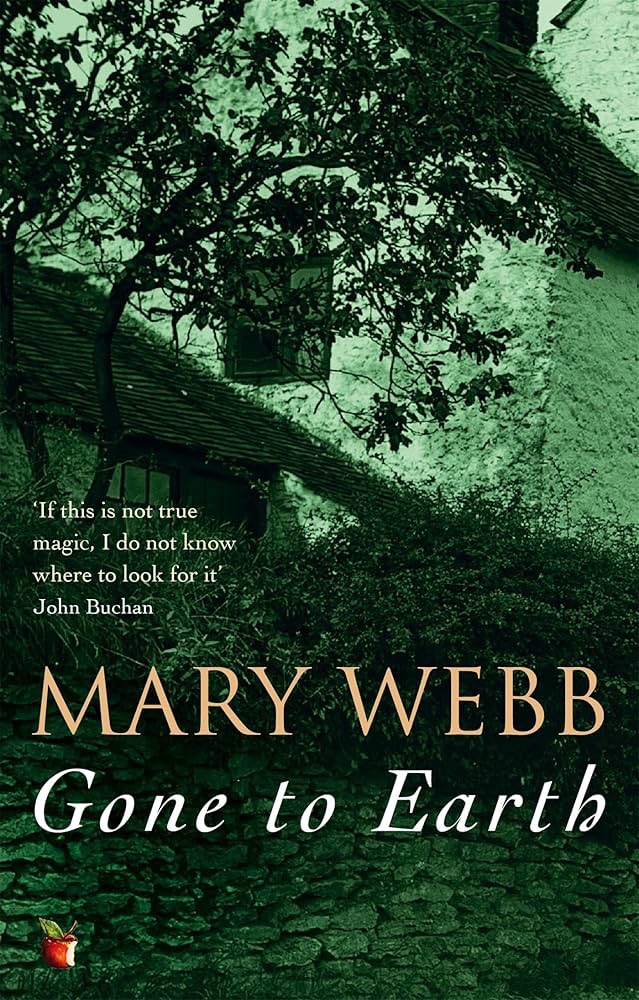
I love Mary Webb, with her novel Precious Bane being one of my all-time favourite books. They are rural based and immerse the reader into nature and a farming way of life, but Gone to Earth’s heroine is so bound to the landscape and particularly it’s wildlife.
Hazel has a pet fox and looks after other wounded or sick wild animals. She wants no more from life than this; to be herself, living in the remote Shropshire hills with her equally unnconventional father. Unfortunately for her, she is young and beautiful. Two men fall in love with Hazel – the good and honourable young church minister and a dissolute squire. She is driven to desperation by their competing claims on her and the pressures of conventional life. Hazel is no more equipped to be a squire’s wife than she is to marry a vicar. Both have very specific roles and duties, requiring her to be social and dressed appropriately. It would take her away from everything she loves and turn her into a caged bird or snared rabbit. She feels hounded, so much so that she’s forced to find a harrowing way of escape. This was Mary Webb’s second book, written in 1917 and set in the hills of Shropshire. It is a dark and difficult story that’s very intelligent and moving. It is Hazel’s connection to nature that’s so beautiful, it’s so clear that this is her place and purpose in life. Gone to Earth became a film in 1950, starring Jennifer Jones as Hazel.
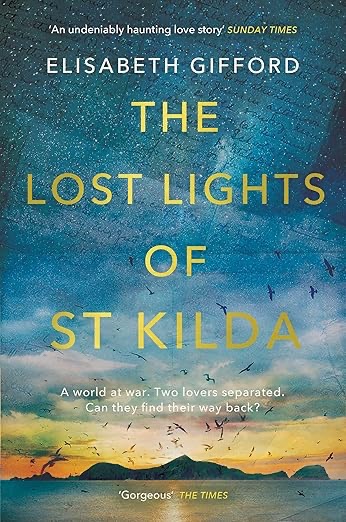
Chrissie Gillies comes from the last ever community to live on the beautiful, isolated Scottish island of St Kilda. Evacuated in 1930, she will never forget her life there, nor the man she loved and lost who visited one fateful summer a few years before. Fred Lawson has been captured, beaten and imprisoned in Nazi-controlled France. Making a desperate escape across occupied territory, one thought sustains him: find Chrissie, the woman he should never have left behind on that desolate, glorious isle. On the face of it, if you read the above blurb you might expect nothing more than a love story. However, even WW2 isn’t the main focus or even the part of the book I remember more than anything. It was the way the author wrote about the islands, these jagged and raw lumps of rock isolated in the ocean. They have no protection against the wind or the sheer power of the Atlantic. Then there are the birds that share the islands and provide the resident’s main source of food. Islanders must climb down the vertical cliff face to reach the birds and they don’t even taste good, considering their only diet is fish. It is bleak, so bleak that in real life the islanders eventually had to abandon the islands for the mainland. St Kilda is a World Heritage Site even now and is home to a tenth of Britain’s seabird population. I was totally immersed in this wild place and the people who scratched a living from it’s rocky and inhospitable outcrops.

Artist, Hassie Days, and her sister, Margot, buy a run down Jacobean house in Hope Wenlock on the Welsh Marches. While Margot continues her London life in high finance, Hassie is left alone to work the large, long-neglected garden. She is befriended by eccentric, sharp-tongued, Miss Foot, who recommends, Murat, an Albanian migrant, made to feel out of place among the locals, to help Hassie in the garden. As she works the garden in Murat’s peaceful company, Hassie ruminates on her past life: the sibling rivalry that tainted her childhood and the love affair that left her with painful, unanswered questions.
As she begins to explore the history of the house and the mysterious nearby wood, old hurts begin to fade as she experiences the healing power of nature and discovers other worlds. This is such a gentle read, it’s quiet and contemplative but ultimately joyful. This is for people who really understand how healing it is to be in the open air and being connected to the seasons.

At twenty-six, Cheryl Strayed thought she had lost everything. In the wake of her mother’s rapid death from cancer, her family disbanded and her marriage crumbled. With nothing to lose, she made the most impulsive decision of her life: to walk eleven-hundred miles of the west coast of America and to do it alone. She had no experience of long-distance hiking and the journey was nothing more than a line on a map. But it held a promise – a promise of piecing together a life that lay shattered at her feet… This read is a real journey that ultimately saves a life. It’s beautifully written, honest and raw. The author pits herself against the elements on the Pacific Coast Trail because she believes it will help her process everything that’s happened. She will be confronted with her self, every day, and forced to wrestle with her demons. She’s hoping that the walk will be a line, between her old ways of behaving and she will come out the other side with something to build from. She’s out in the open every day, whatever the weather and is reduced to her most essential self. I loved how she starts to notice the flora and fauna around her. It’s amazing to see how much the trail gets into her brain and ultimately changes her outlook.

It is summer in the Appalachian mountains and love, desire and attraction are in the air. Nature, too, it seems, is not immune. From her outpost in an isolated mountain cabin, Deanna Wolfe, a reclusive wildlife biologist, watches a den of coyotes that have recently migrated into the region. She is caught off guard by a young hunter who invades her most private spaces and interrupts her self-assured, solitary life. On a farm several miles down the mountain, Lusa Maluf Landowski, a bookish city girl turned farmer’s wife, finds herself marooned in a strange place where she must declare or lose her attachment to the land that has become her own. And a few more miles down the road, a pair of elderly feuding neighbours tend their respective farms and wrangle about God, pesticides, and the possibilities of a future neither of them expected. Over the course of one humid summer, these characters find their connections of love to one another and to the surrounding nature with which they share a place. I thought the author beautifully debates so many contentious issues around farming and nature: how much harm comes to wildlife when arable farming; the merits of vegetarianism and veganism, and whether we can be ethical meat eaters; the difficulties of cultivating crops and dealing with diseases in trees; studying animals without disturbing or changing them. It’s about how we humans interact with nature, the changing seasons and how fertile nature continues to be.

 The Lotus Readers