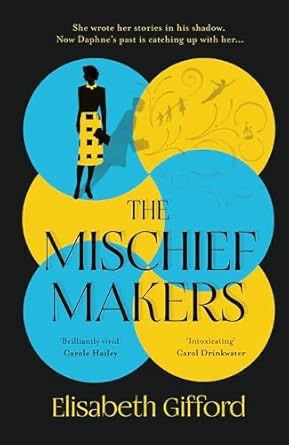
The Mischief Makers tells the story of author J.M Barrie’s relationship with the du Maurier family, including their daughter Daphne. I had a vague idea there was a connection between he two but hadn’t realised what the connection actually was. The film Finding Neverland always makes me cry, especially where the boy’s mother dies and makes her way into heaven/ Neverland. I knew that all the brothers were adopted by J.M.Barrie but I’d not realised that the boys were Daphne Du Maurier’s cousins. Their mother Sylvia was Gerald du Maurier’s sister, so my first thought was why weren’t the boys adopted by their own family? The author tells the story from Daphne’s perspective from her childhood all the way to middle-age. It’s a psychological study in a lot of ways, because Gifford really takes us into Daphne’s inner world as her life unfolds. Daphne herself filters the world through her psychological readings of Jung and Adler. We move back and forth in time as she examines incidents from her childhood with the benefit of experience and new discoveries she makes. We gain insight into her character and her process as an author, which was wonderful for me because I’m a huge fan of her work.
Daphne grows up in a very complicated situation where she has a very attentive father and a cold, distant mother. This is something she examines closely later o with her adult knowledge of what’s appropriate and her father’s philandering ways with young actresses he starred with in theatre productions. The boys and J.M. Barrie are constant presence too, particularly in the nursery where Daphne would be waiting for the writer to weave stories. She is an imaginative child and Barrie teaches her to use her imagination, conjuring her ‘shadow self’ very like his most famous creation, Peter Pan. Tomboy Daphne is his real life principle boy and their play gives her space to sword fight, climb and take to the high seas in a way that’s frowned upon for girls in her class. There’s a fluidity to Daphne, in terms of both her gender and sexuality. In adulthood her pirate side becomes the bold, beautiful and sexually adventurous Rebecca de Winter. This was a character I’d always associated with Jane Eyre’s Bertha Mason – the original madwoman in the attic. Similarly, the second Mrs de Winter also represents Daphne but the quiet side that’s rarely seen in London. This is the side that craves time alone in Cornwall where she dresses in men’s tweeds and romps through the countryside or goes out sailing from their home in Fowey. As I was reading about this side of her character I was reminded of the young Mrs de Winter’s tweed skirts and her new sister-in-law’s observation that she couldn’t give a fig what she looks like. Fowey is where she goes to be herself, o hunker down with her children and husband Tommy. It’s where she writes and is most at home.
I was very interested in the methods Barrie used to visualise the scenes from his books and plays. It also unlocks the imagination of his young charges, as the boys act out certain scenes such as hanging certain characters in the woods. With Daphne he has an almost hypnotic way of getting her to imagine an island rising from the lake. Could his techniques, which could be seen as hypnotism, have caused Daphne constant sense of being split. What effect did Uncle Jim’s imagination and techniques have on the boys in his care? Daphne remembers Michael being plagued by night terrors about drowning and a stubborn aversion to learning to swim. Are they all too imaginative? It’s clear that mental illness has run in the family, but is this an innate problem or unintentionally learned behaviour?
I loved how Daphne comes across as a very new type of woman, especially in her own society and class. She epitomises the ‘flapper spirit’ but her progression goes much further than the drinking and dancing of the Bright Young Things. She’s different from previous generations of women in her very own way. She wants to write, to live alone in Cornwall and earn her own money. She has never fancied the idea of a husband and children, and has chafed against all the rules of being a young lady set by a mother she refers to as ‘Edwardian’. We get what she means in one sentence – the generation gap is huge. There’s also her fluid sexuality , something that I’ve always suspected as an undercurrent in her most famous novel Rebecca. Mrs Danver’s obsession with her mistress, telling her new mistress about Rebecca’s lustrous hair and showing her the sheer lace of her nightdress. When Daphne visits New York for a plagiarism case about the novel she meets Ellen, the wife of her publisher. She is immediately struck by her hostess’s resemblance to the character both in looks and her ability to look after a guest and put them at their ease. Daphne is overwhelmed by feeling and interprets it as desire, but I could see the second Mrs de Winter gazing out at Rebecca wishing she could be like her. Wouldn’t life be easier if she was this smart, perfect hostess and Tommy’s trophy wife? Although, Tommy largely accepts his rather less organised and talented wife.
Elizabeth Gifford brought Daphne to life for me and having visited the du Maurier home at Ferryside and Menabilly, I could easily imagine her there. It was fascinating to take a trawl through her upbringing and how she ended up down in Cornwall writing. There is also this brilliant sinister edge to the story, with odd psychosexual tension and the questions around J.M. Barrie’s motives in adopting the du Maurier boys. Despite her mother’s wishes, her parents are generous enough to let her live down in Fowey as a young woman. Through her own journals we can see that she is troubled, constantly torn between the self she wants to be and the self she feels she should be. This is the gap between Rebecca and the second Mrs de Winter who is young, inexperienced and not equipped to run a great household in the same way as her predecessor. She questions herself constantly when the truth is that much like Maxim de Winter, her husband loves her for all the qualities she sees as faults. I thoroughly enjoyed this novel, that filled in the gaps in my knowledge about a brilliant writer and the psychological place her work came from.
Meet The Author

Elisabeth Gifford studied French literature and world religions at Leeds University. She has an MA in Creative Writing from Royal Holloway College. She is married with three adult children and lives in Kingston upon Thames.


I just bought this yesterday as it was on a Kindle deal. Looking forward to reading it – sometime!
LikeLiked by 1 person
It’s fascinating. I do love this author, her previous two novels were great too xx
LikeLiked by 1 person