Posted in Netgalley

Things Don’t Break On Their Own by Sarah Easter Collins.

It seems to be a year of incredible debuts and this one is definitely going to stay with me. We open at a dinner party. Robyn and her wife Cat are hosting an evening for their friends Willa and Jamie, Robyn’s brother Michael and his partner Liv, and Cat’s brother Nat and his new girlfriend Claudette. It’s the first time the group will meet Claudette and Robyn hopes to make it a chilled, relaxed evening. Robyn and Michael grew up in a rambling and ramshackle farm house in the south west of the UK. Their father Chris was a potter and it was a bohemian, relaxed place to grow up. Robyn had a scholarship for a private girl’s school and she ‘buddies’ with Willa who was a new sixth former. They shared a study bedroom and Robyn soon learns that Willa’s life is overshadowed by the disappearance of her sister Laika. Her boyfriend Jamie is a wine merchant who lived in South Africa and his confidence can become overbearing. Michael’s girlfriend Liv is a psychologist and she begins a discussion about implicit and explicit memories. Our explicit memories include times, dates and places and they tend to be formed by older children. Implicit memories are usually from unconscious emotional recollections and can be an amalgamation of several memories, as well as a few bits of what others have told us. These are memories created when we’re very small, usually pre-school age. Jamie isn’t convinced and Liv’s assertions seem to unsettle the party. As Jamie gets louder, Willa tells a memory of being tickled until she wets herself. She has always hated being tickled. However, someone in the party knows this isn’t actually Willa’s memory. It’s her sister Laika’s.

One of Willa’s other memories is that her sister called their dad’s personal assistant his ‘sexetary’ but doesn’t know why. This shows us that we only ever know part of the bigger picture. The author uses several narrators to show us that we can be present at the same event but see it totally differently. Laika had a memory of knocking over a tiered cake full of sugar flowers. In fact she’d stepped into the pantry to pick off the flowers and let them melt on her tongue. Then her dad and his secretary stepped into the cupboard and start to fool around. Laika is horrified and tries to get out, but then her dad notices her and is furious. He grabs her arm and yanks her out from under the shelf with so much force there’s an audible snap as he breaks her arm. Laika is screaming from pain but also because her dad is naked from the waist down. When her mother appears she’s confused by his explanation that her arm just broke; ‘things don’t break on their own’ she replies. Willa is a witness to her father’s abuse of Laika and her mother, but she is his ‘PP’, short for prized possession. I hated this sense of ownership. In her own narrative Laika talks about feeling rage and there were places where I really felt it. On one occasion, when Laika has tried to trim her own fringe, her father pins her down and hacks her hair off with the scissors. The sense of powerlessness that comes across in this scene made me feel physically sick. At a family gathering Laika finds a baby bird and takes it to her parents for advice, but her aunt snatches it from her and throws it into the waiting jaws of her dogs. Willa submits and doesn’t provoke her father, but Laika won’t and this makes his treatment of her even worse. Willa doesn’t even realise they’ve spent their childhood utterly controlled, because she’s never been anywhere else. She thinks all families are the same until she stays with Robyn’s parents in the school holidays. Their easy way of being, the gentle nurturing love and the emphasis on people not things is a revelation to Willa. By contrast her home is a sterile mausoleum to her father’s achievements with pictures of him with important people and shelves of prized Chinese ceramics without a speck of dust.

Another theme in the book is that of kintsugi, a Japanese practice of putting broken pottery back together with glue mixed with liquid gold. The broken pot becomes more beautiful because of it’s cracks. Robyn’s family is like this. They each show each other their broken parts and that familial love, acceptance and non-judgemental compassion is the glue that makes a person whole. By contrast, Willa’s father’s ceramics are distant and pristine, not to be handled. They have the same brittle beautiful exterior he expects from the women in his family, because their behaviour reflects on him. When we move into Laika’s narrative, we see another show of love and what it can do for someone who’s never had it. As she leaves home that morning she hides at a house she’s often seen in passing. It stands alone and is the home of an elderly lady who has many cats. She plans to sneak in and stay just one night to think about her next steps, but ends up staying for a while. The lady, Frieda, has nobody. There’s a carer who’s supposed to stay till lunchtime but only stays half an hour. Laika feeds Frieda properly, cares for her and she also listens. Frieda’s last living relatives are avaricious and only come round to see if they can find the family jewellery. Frieda knows what it is to powerless at the hands of a tyrant. As a German Jew she had to escape to the UK during WW2, but her sister didn’t make it. She knows that people only leave their friends and family if they’re desperate.

At school Willa needed the closeness of another person and enjoyed the physical comfort of sleeping next to Robyn. This blossomed into a relationship. For Robyn this was first love and their break-up just before exams was hard for her. She didn’t get the grades she’d wanted for medicine so instead she studied radiography. As an adult, Robyn has found Cat, a woman she knows she can build a life with and maybe become parents. Willa comes back into her life fifteen years later and has made a website about her sister Laika where people can post any sightings and Willa can write to her. When someone claims to have seen her she comes to Robyn for support and they fly to Thailand at a moment’s notice, much to Cat’s surprise. Cat wants a commitment and not to be second best. So she makes a choice to keep Willa as a friend, but to put Cat and their family first. When the couple visit Willa’s home it’s like an out of body experience. Crammed into a tiny flat in London, the couple are overwhelmed by the scale of the house. The wealth on display is slightly shocking, but the women, including Willa’s mother, have a great time. They read by the pool, visit local landmarks and cruise around in their convertible with George Michael on full blast. When her dad appears unexpectedly, Cat and Robyn look on open mouthed as Willa and her mother run to get changed into flowery dresses and start to wait on his every whim. They have become Stepford wives. We realise that Willa has always conformed, whereas Laika disrupted the picture perfect family. After her visit to Robyn, Willa tries to push her father a little but it takes Frank Zappa at full volume to really get under his skin. It’s clear at the dinner party that Jamie is Willa repeating a pattern. He’s so like her father and the pair get on well, with Willa’s weekends filled with visits home so they can play golf together. In fact Jamie spends more time with her father than he does with Willa. They share so many attributes and behaviours: the drinking and womanising, long trips abroad, strident right wing views, lack of empathy and he breaks things. In fact it’s his assertion ‘it just broke’ that wakes Willa up and makes her realise this is not normal.

The psychological dynamics of the dinner party are explained by the narratives from Robyn, Willa and Laika. This is a thriller, finding out what happened to Laika, complex in its psychology and often philosophical too within it’s twisty thriller structure. We each carry hidden histories within us, some aspects of which are subconscious. There are parts of that history that give us strength and resilience, others that give us an outlook of loving life, and others that help us fulfil our potential. Other parts of our history can unravel us. In counselling there’s a brick wall analogy. Something happens to us that we don’t process or resolve, so it sits there like a faulty brick. We continue to build our wall, but because of that dodgy brick the wall isn’t stable, it wobbles and might even collapse. In order to rebuild a strong wall, we must use the counselling process to slowly take away each brick until we reach the one that’s faulty. Then we remove it and replace it with a much healthier brick that comes from talking therapy, helping the client process trauma so their new wall stands the test of time. I loved the analogy of the natural pool where Robin’s parents take everyone to bathe. It’s a direct contrast to the sterile and man made pool at Willa’s home, that her mother turns into a rose garden. By contrast the natural pool at Robyn’s family home is filled with this self-made family that includes their friends too. Robyn and Michael’s family have so much love that it can easily take in others, old friends and new generations. Their love is like the natural spring that feeds the pool, constantly flowing and endlessly replaced.

‘I think about my duties and obligations […] as a decent human being. The things I have always known and understood , the things I’m prepared to stand up for, put my name to, hold myself accountable for. I think about my beautiful parents and how their love has helped me grow into the person I am.’

Meet the Author


Sarah Easter Collins grew up in Kent and studied at Exeter University before moving to Botswana and later Thailand and Malawi. A mother to a wonderful son, she now lives on Exmoor with her husband and two dogs. She is a graduate of the Curtis Brown Creative novel-writing course and holds a diploma in creative writing from Oxford University. When not writing, she works as an artist.

Posted in Netgalley

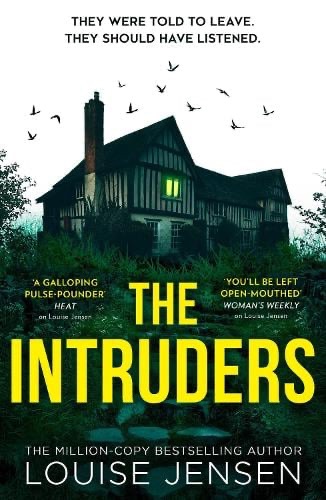
The Intruders by Louise Jensen

One night, at Newington House, the Madley family are disturbed by intruders. It’s the mother who first realises someone is outside and calls the police, but it’s a remote location and it will take them some time to arrive. Once the intruders are in the house they accost the mother downstairs and she sees them for the first time, in sheep masks and carrying knives. She tells them to take anything they want, jewellery and antiques, but they haven’t come for that. Now she’s sure she’s going to die. That night the only survivor in the family was the baby, placed in the priest’s hole by their sister waiting quietly for someone to find them. Written in blood on the wall is ‘tell me where it is’. Several years later, Cass is staying with her boyfriend James for the weekend when he suggests they go out for a drive. She’s surprised when he takes her to a hidden manor house on the edge of a village and tells her they’ve come to view it. An agent comes to meet them and shows them around and it’s weirdly still full of contents. The agent explains that it’s owned by a company who hope to turn it into a retreat, and while this is in the planning stage they need someone to caretake the house. They must live in it, as well as looking after and creating an inventory of it’s many contents. James wasn’t going to tell Cass straight away about the house’s sad history, but the agent does and at first Cass isn’t sure she could live somewhere such a violent act occurred. However, they certainly couldn’t afford anything like this normally. James assures her it will be fine and they agree to take on the contract, an easy thing to do in broad daylight on a lovely day, but Cass will be here alone while James is at work. Can a house hold trauma within it’s bricks and mortar or is Cass just being fanciful?

It doesn’t help that Cass’s father is very protective and isn’t sure about James or Newington House. James and Cass met in a club when she was standing in the shadows watching her friend enjoy her hen night and she is surprised when the attractive man she has just met, stands beside her and holds her hand. Yet it feels completely natural, like they’ve held hands before. Since then, her distance from James has been an issue as they can only see each other at weekends and Cass’s father worries about her travelling so far and being away from his watchful eye. It felt Iike there was something we didn’t know about her because her father’s concern seems out of all proportion. We start to learn that Cass has had issues with her mental health and there’s an allusion to her worrying that someone might be watching or stalking her. This really muddies the waters when it comes to knowing what is real and what is imagination as the couple move into Newington House. Cass is the one who has some strange experiences, perhaps because she’s home more than James or maybe because she’s susceptible to suggestion. Or is something more sinister going on and the house is singling her out? The house itself doesn’t feel creepy at first, but there’s always a sense that something more is going on than meets the eye, as if it’s traumatic past is still playing out within it’s walls. Like a faulty video recording that’s imprinted forever, leaving glimpses and feelings behind.

The previous family’s belonging don’t help, with Cass finding a long dark hair in the silver hairbrushes on her dressing table and the name Rose scribbled on a piece of paper that’s been left in the family suggestion box. The clock in the hall seems to keep stopping at 8.30pm, despite them winding it daily. It’s as if the house has PTSD and keeps experiencing flashbacks. The crime itself is terrifying, the strange addition of sheep’s masks feel so odd and out of place. In between Cass’s narrative we delve into the past with a young girl called Rose who is back at the village after a stint at private school. She doesn’t know many people of her own age in the village and while looking after the baby is fun, she doesn’t want to be a nanny all summer. She takes a walk into the village and meets two boys on the playing field, one of whom is really good looking. I found these sections so bittersweet, because she is a teenager with everything going for her, but we can sense how unsure she is about herself. She hasn’t had many interactions with boys and her innocence leaves her open to exploitation. She desperately wants to be liked, wants her feel that first kiss and know someone desires her. She’s sure to bow to peer pressure all too easily. I thought this character was written beautifully, really conjuring up those awkward teenage feelings. We know the name Rose has a resonance in the house, Cass can sometimes feel a sudden draft and the name comes to mind. Could Rose be the murdered girl at the manor and what is she trying to tell it’s new resident?

I was worried for Cass that perhaps an inexplicable evil lurks at the house, rather like the Overlook Hotel in The Shining where a terrible trauma seems to have infected the very walls of the building compelling residents to repeat history again and again. As the past and present narratives come together there is so much tension. We know the facts of what happened that fateful night but we don’t know the ‘who’ or the ‘why’ because it seems to have come from nowhere. I’m always desperate to know the reasons behind something, more than the whodunnit at times. This is where I felt a little bit lost, because I wanted to know if any of characters was the surviving child but the further we delved into the past the more characters seemed to be involved. My pet theory on why Cass was so vulnerable before meeting James was totally wrong! As we flipped back and forth in time I did have to go back and do some re-reading because I was genuinely confused. There were revelations I didn’t expect at all, adding more aspects to the case and the house than my brain could handle. It was like opening a set of Russian dolls to find that none of them matched the outside. However, the reveal of who was behind the masks was excellent and added an extra layer of danger to the ending. I think the moral of the story is that when you’re offered money to look after a mansion where murders have occurred, think twice. The old adage of ‘if something seems to good to be true it probably is’ really does apply here. I felt the best thing about the book was that sense of foreboding in the place where trauma has occurred, as if the violent acts of that night were imprinted on time like a photograph.

Out now from HQ

Meet the Author

Louise Jensen has sold over a million English language copies of her International No. 1 psychological thrillers ‘The Sister’, ‘The Gift’, ‘The Surrogate’, ‘The Date’, ‘The Family’, ‘The Stolen Sisters’, ‘All For You’ and ‘The Fall’. Her novels have also been translated into twenty-five languages, as well as featuring on the USA Today and Wall Street Journal Bestseller’s List. Her next thriller publishes in Spring 2024.

Louise has been nominated for multiple awards including Goodreads Debut Author Of The Year, The Guardians ‘Not The Booker Prize’, best polish thriller of 2018 and she has also been listed for two CWA Dagger awards. All of Louise’s thrillers are currently under option for TV & film. She has also written short stories for various publications including ‘My Weekly’, ‘Hello’, ‘Best’ and ‘The Sun’, as well as having stories featured in multiple anthologies.

Louise also has a penchant for exploring the intricacies of relationships through writing heart-breaking and uplifting stories under the pen name Amelia Henley. ‘The Life We Almost Had’ and ‘The Art of Loving You’ were international best sellers. ‘From Now On’ is her latest Amelia Henley release.

Louise lives with her husband, children, madcap dog and a rather naughty cat in Northamptonshire. She loves to hear from readers and writers.

Posted in Random Things Tours

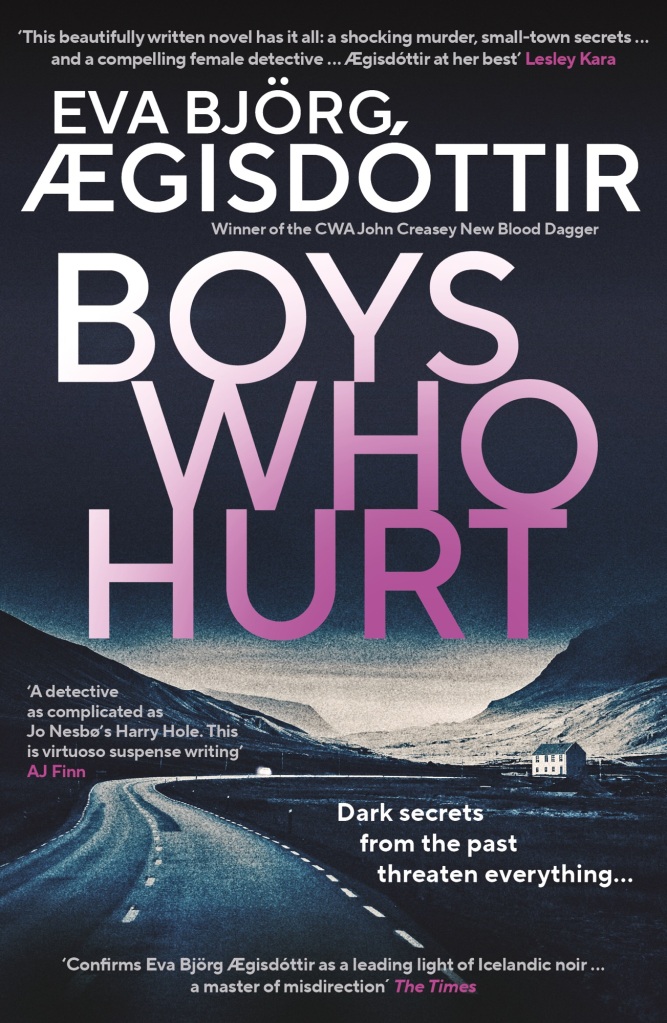
Boys Who Hurt by Eva Björg, Ægisdottir

Translated by Victoria Cribb

We’re back with Detective Elma in the fifth of the author’s Forbidden Iceland series and she is just returning to work from maternity leave when a body is found in a holiday cottage by a lakeside. The victim’s name is Thorgeir, he has grown up in Akranes and in a coincidence typical to small towns, his mother is Elma’s neighbour. The holiday cottage belongs to the family and the evidence suggests Thorgeir was not alone – there were two wine glasses and a lacy thong is found under the bed. He is found in the bed, with stab wounds and the line of a well known hymn written on the wall behind the bed, in blood. With Saever on paternity leave with their daughter Adda, Elma works alongside her boss Hörour to solve the murder. Several leads come to light. Thorgeir was working with his friend Matthías on an exercise and well-being app and had secured a large sum of money as an investment, but from an unexpected source. The hymn is well known, often sung at a popular Christian camp for teenagers and refers to the washing away of sin – had Thorgeir needed such forgiveness? Matthías and his wife Hafdis mentioned a young woman that Thorgeir had been seeing recently, but there is no sign of Andrea anywhere. The friends had often attended camps together as teenagers, but on one such occasion a young man had died out on the lake in the night, in similar circumstances to Thorgeir’s father’s death a few years before. It’s soon clear that many secrets are hidden in Akranes, some of them within Elma’s own home.

I love Elma’s character and what a refreshing change to read about a working woman whose partner is providing the childcare. There’s also none of the usual guilt or tension around her return to work, even as the case becomes more intense and late nights become the norm. She seems to have taken motherhood in her stride and she and Saever seem settled and happy. It’s sad that in the 21st Century this should stand out so much. Usually I read female characters caught between home and work, struggling from lack of sleep and feeling guilty. It’s great to see a woman who is a new mum, as well as a competent detective. The mothers in this novel and their relationships with their children were incredibly complex and psychologically fascinating. I was intrigued by Thorgeir’s elderly mother Kristjana, who happens to live next to Elma and Saever. She’s known as a drinker and is familiar to most people as the owner of a dry cleaners in town. She and Thorgeir didn’t seem close, but she had helped him financially. Was this out of love or guilt? There was something fishy about the business’s finances too, a thread that Höreur picked up and investigated. Kristjana’s home isn’t lavish and she doesn’t look like someone with the sort of money the accounts suggest. Saever finds her behaviour bizarre, even to the point of having to intervene one afternoon when he notices she’s dancing naked with the curtains open. She’s had tablets and alcohol, possibly due to grief and hinting at a troubled inner life but when questioned there’s a wall she puts up that’s metres and years thick. Hafdis is also a fascinating character, she asks for a divorce at the beginning of the book but where has she found the money to move on so quickly. Her relationship with Matthías is already over in her eyes, but I was shocked by her coldness towards her daughter Olof. The family have been having therapy, because Olof has been self-harming but Hafdis doesn’t even seem to have factored her daughter into her plans. Olof confides in her father about her mother, not that she gives her a hard time but that she looks at her daughter as if she’s nothing. What else might such a ruthless woman be capable of?

Saever is at home, but when he’s unpacking he comes across a box that doesn’t belong to them. In fact it belongs to previous residents, full of school exercise books and a holiday journal from the very year that the boy was killed on the lake. It belongs to Mani, one of the group staying in the same cabin as the dead boy, alongside Heioar, Hafdis, Thorgeir and Matthías. This draws him into the investigation and Elma isn’t surprised to find him at the station researching, while bouncing Adda on his knee. I loved the little Icelandic details on child care, such as wrapping the baby up warmly then popping them in the open air for a sleep. I didn’t expect to enjoy Elma working without Saever, but I really enjoyed Höreur being a part of the investigation and found myself amused by his grumpiness. His hip injury brings out a resistant and stoic side to his character, the pain making him increasingly snappish. The case has so many twists and turns that it’s hard to put down and little clues that seem to snag in your brain. I spent most of the book wondering about a second large bloodstain in Thorgeir’s family cottage, strategically covered with a rug. I was sure it was important and every time we got closer to the truth I kept thinking ‘but what about the bloodstain?’

Elma is perfect for the more complex investigative work because she occupies a liminal space in town, she’s both known and not known. Having been born in Akranes and having family that goes back generations in the town, there’s an element of belonging that gets her in the door. However, she’s spent her career so far in Reykjavik meaning she isn’t so involved that she can’t ask difficult questions. She doesn’t have the deference to the elders of the town that others might so she’s bold and doesn’t mind stirring things up a little. She definitely riles the old police chief Otto, so much so that he lets his true nature show. He is so angry that he verbally attacks Elma where it really hurts referring to her previous partner’s suicide and implying she should look closer to home for people who are keeping secrets. It sometimes feels like every home in Akranes holds an ocean of pain and unresolved trauma. There’s so much going on just under the surface, an intergenerational trauma that seems to come partly from religion and partly from rigid expectations. Elma is horrified when Heioar’s parents seem like good people, they adopted him and it seems to have been a good fit, but behind this surface is a very different family life and a total rejection of anything or anyone that doesn’t fit their ideals. I wondered how these women like Kristjana and Heioar’s mother were able to look the other way when their men are treating their children badly. Whether through religious conviction or control the fathers have ruled their homes quite literally with a rod of iron. One of the most complex relationships is between Thorgeir and his new girlfriend. I was fascinated with her narratives showing how attraction and repulsion can co-exist between two damaged people. Also, one terrible deed doesn’t define a person. This was a brilliant thriller, exposing a dark underside to Akranes and keeping me guessing to the very end.

Out from Orenda Books on June 20th 2024

Meet the Author

Eva is an Icelandic author of the bestselling Forbidden Iceland series and her books have been published all over the world. Her first book, The Creak on the Stairs, won the Crime Writers Association New Blood dagger, the Blackbird Award and was shortlisted for the Amazon Publishing Awards and the CrimeFest Specsavers Debut Awards.

In the series she writes about my hometown Akranes, a small town just forty minutes outside of Reykjavík with population of around 8000 people. She writes about dysfunctional families and relationships. She has a degree in Sociology and Criminology and is very much interested in human behaviour, which is perhaps evident in the books.

Eva grew up in Akranes and fell in love with reading at the age of 5. She moved to Norway in her twenties to study her Masters Degree and lived there for two years. When she moved back to Iceland she began writing her first novel, as she had always wanted to write a book. She has been a full time writer ever since it was published!

Posted in Netgalley

Cross Bones (The Accidental Medium 3) by Tracy Whitwell

There’s a queue at her door, and not all of them are living …

If you haven’t had the pleasure of meeting Tracy Whitwell’s character Tanz yet, you’ve been missing out. This bold, sweary Geordie actress and accidental medium is a delight and this is her third adventure in the series. Tanz is being torn in two directions as she reluctantly agrees to do a fringe play in London, but is also suddenly ‘activated’ as her spirit guide Frank explains. She is sent a new guide who she calls ‘Soft Voiced Lass’ and her flat is suddenly teeming with visions and apparitions, including a nurse who is on duty and walks through the wall into Tanz’s bedroom, which is quite a feat when you don’t have any legs! Luckily she has friend and fellow medium Sheila to rely on, but there’s a lot of sleeping with the light on too. As the play she’s been cast in becomes more dramatic off stage than on, Tanz has time on her hands and is guided down to Southwark and a cemetery known as Cross Bones. This is the burial place of the Winchester Geese, so called because they were prostitutes licensed by the Bishop of Winchester. After their deaths it was decided they could not be buried in consecrated ground and so this small burial ground became theirs and many of the poor in the same parish. Tanz is greeted by a horrific vision of the ground in the Victorian period, when overcrowded tenements spread diseases like wildfire and deaths from cholera, typhus and consumption were the daily norm. What Tanz sees isn’t an ordinary graveyard though. The smell hits her first; death, smoke and sewage creates a miasma that seems to cling to your clothes. In the yard Tanz can see a grave digger with a woman screaming at him, when she looks down she can see some fingers and a skull where he has been digging a body up to make room for more. She is overwhelmed and doesn’t really know what her purpose is here, just that it isn’t going to be easy.

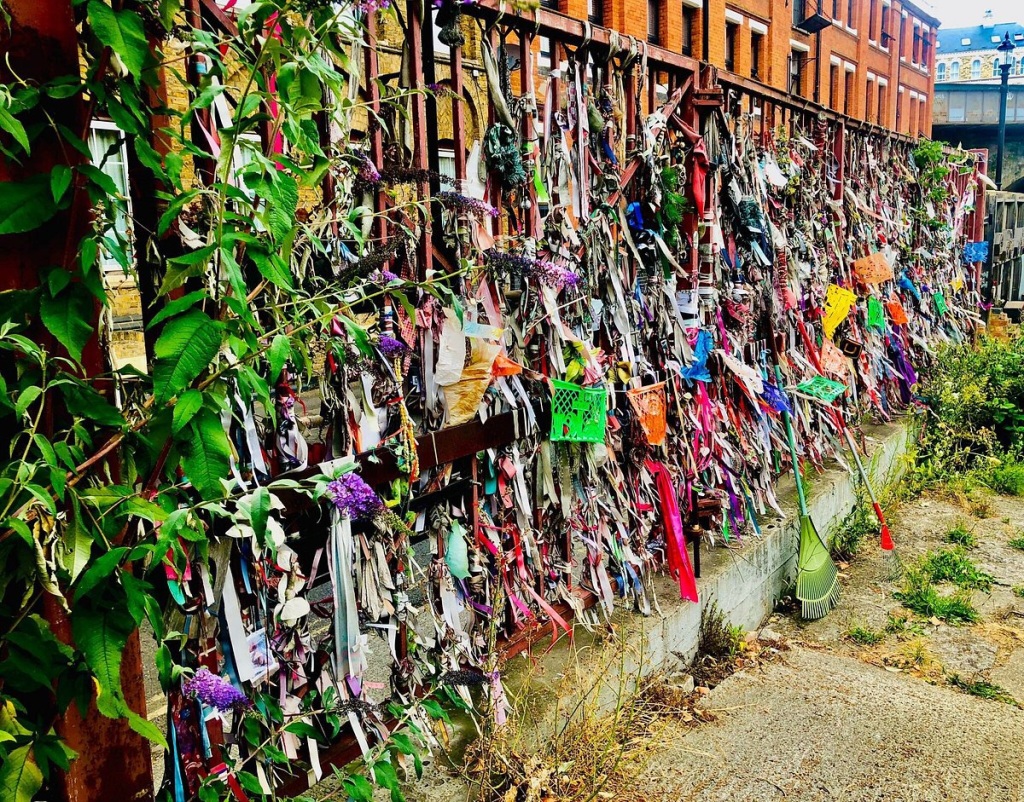
The gates at Crossbones Graveyard

I love Tanz because she’s one of the most real people I’ve ever met in a book, despite the spooky stuff that surrounds her. She’s very down to earth, independent and has a few vices. She’s also very compassionate with the living people she helps and the dead ones too even if they do scare her. She has a couple of solid friends, especially Sheila, but sometimes she gets lonely, especially as she gets older and sees friends pairing off and making new lives together. She’s in the same flat, still scraping by with no big break in sight. The play she’s rehearsing is comical and the small company has such vivid characters they leap off the page. Gerald is a particularly fun addition to her circle – an elderly actor with the old school manners of a man who was inspired to act by Olivier and Gielgud. Everyone except the playwright knows the play is rubbish and the sexual politics in the company are impossible to work with. At home different visions pop up, from an Irish family who look like they’re starving, to a woman at a sewing machine and very strangely, a ghost that lurks in the hallway with a blackened face. She knows all of this must make sense to someone and keeps visiting Southwark and doing her research into the area. The history behind the story is fascinating and had me searching and reading for information afterwards. Eventually the graveyard was used for all the poor in the area and with an influx of families from Ireland, escaping the dreadful famine ( to quote Sinead O’ Connor ‘there never really was one’) overcrowding was common. The place inside that should have been somewhere to view the dead, especially for Catholic families who prefer to have an open coffin, became a charnel house. There were rotting bodies everywhere from those they had no room to bury and those who’d been dug up to make room for more. It’s a vision of hell, made worse when the traumatised gravediggers, dulled by compassion fatigue and possible PTSD, started playing skittles with human skulls. No wonder the woman in Tanz’s vision is screaming.

No 2 in The Accidental Medium Series

Tanz thinks her visions relate to a single Irish family, the family she sees in a tenement room starving and looking completely shell-shocked by their circumstances and their losses. When Tanz sees a soldier called Robert, shot in the head and looking for his wife she starts to piece things together. Could this be several generations of the same family and could any of them still be alive? Between the spooky action there’s a huge injection of dark humour that I really appreciated. I love Tanz’s slightly prophetic phone calls from her ‘mam’ who strangely seems to always know when her daughter’s up to something while scolding Tanz for meddling in spooky situations. Thank God she doesn’t find out about the black faced woman, the homeless man and the knife! There’s also a side order of romance in this novel, with a younger police officer stirring up rather unexpected feelings for Tanz. Usually she wouldn’t consider a younger man, especially one of the good guys, but maybe now is the time for changing habits. It’s nice to see Tanz meet someone who likes and respects her for a change. Maybe Tanz has developed some boundaries and boosted her self-worth enough to accept that someone like this could like her. She’s also stopped the habit of always keeping her eye on the exit in her romantic affairs. She’s taking her gift seriously and maybe has to accept that it’s this type of work that she finds most fulfilling. Although, she also makes a radical move in her acting career too. It’s lovely to see Tanz in such a strong position in life, she’s ready to take on the world and I can’t wait for her next adventures.

Out on 17th July from MacMillan

The first novel in the series.

Meet the Author

Tracy Whitwell was born, brought up and educated in the north-east of England. She wrote plays and short stories

from an early age, then moved to London where she became a busy actress on stage and screen. After having her son, she wound down the acting to concentrate on writing full time. Many projects followed until she finally found the courage to write the first in her Accidental Medium series, a work of fiction based on a whole heap of crazy truth​. Apart from the series, Tracy has written novels in several other genres and also writes mini self-help books as the Sweary Witch.

Tracy is nothing like her lead character Tanz in The Accidental Medium. (This is a lie.)

If you’d like to know more about Crossbones Graveyard this is a great site to start with:

Posted in Netgalley

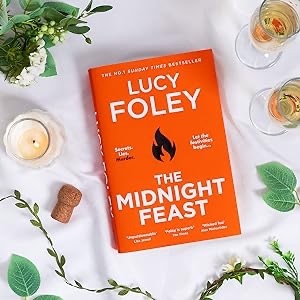
The Midnight Feast by Lucy Foley

I started this book in bed at night, which turned out to be a big mistake because I didn’t want to go to sleep once I’d started. There was a lot of yawning the next day. We’re introduced to the village of Tome (pronounced ‘tomb’ by the locals just to add a sense of foreboding) and the new wellness retreat created there by Francesca Woodland who inherited The Manor and it’s land from her grandfather. Her husband Owen is the architect on the project and has created woodland ‘hutches’ for guests, featuring outdoor showers and luxurious linens. The Manor itself is the central hub where there are classes in meditation and yoga, with a spa that has reiki alongside all the usual treatments. The opening weekend looms and while there’s a hint of anxiety around the late building of the tree houses, Fran is sure she has everything under control. On the final night of the stay she has planned a mini-festival with live music, a meal out in the woods and strange wooden sculptures. Every guest must wear a crown fashioned from twigs creating the look and feel of a pagan celebration. While the music is at it’s loudest she has given Owen the go ahead to start digging the foundations for the tree houses, in the hope the music drowns out the noise. However, that’s not the only problem on the horizon. In order to build the houses, they must take down some of the ancient trees and when Owen arrives the workmen are confused by the new symbols on their bark. They look like seagulls in flight. By the morning there’s a burned effigy and a body on the beach, a wrecked Aston Martin with blood inside and the manor hiss been rased to the ground by a ferocious fire. There’s also an elderly fisherman rambling on about seeing giant birds. It looks like the midnight feast was a rather Bacchanalian event, with discarded drink bottles, feathers and clothes littering the ground, but something went badly awry. Everyone in Tome knows the local saying- ‘Don’t disturb the birds’. Could Francesca’s dream be over when it had only just begun?

The book starts with the aftermath of the festivities, but there are two more timelines: fifteen-twenty years ago when Francesca was a teenager living at the manor with her grandparents and twin brothers and the beginning of the weekend leading up to the feast twenty-four hours later. This multi-layered effect is multiplied with several narrators – Bella who is befriended by a young Francesca and later becomes a mystery guest at The Manor’s opening weekend; Owen who is Francesca’s husband but also hides a secret past; a young man called Eddie who is the retreat’s kitchen help and Francesca, the founder. It seemed like a lot of perspectives and timelines at first but the author is very skilled at creating distinctive characters so I soon got to know them and I didn’t feel lost. Francesca radiates a sense of calm and purity. However, like many people who put up a facade like this, it’s only so long before they blow and I was waiting for that moment. Bella is very secretive, realising she isn’t The Manor’s target demographic she’s worried she might stand out. Owen is very successful architect, wealthy and absolutely in love with Francesca, but seems to know a lot about local folklore and knows his way to a secret beach. Eddie, who I was rather fond of, lives in the shadow of his older brother who went missing years ago after becoming an addict. He lives at home with his parents on the family farm and feels his father’s despair that the son who loved working the farm is gone. Eddie wants something different, but given his parent’s disapproval of the retreat, he hides his job there while hoping to work up the organisation. Finally there’s the DI on the case, who is trying to piece together the night before and recovering a body from the beach, while the only witness to the death is the elderly man who still blaming giant birds.

There’s a sinister ‘them and us’ feel to this novel, a distinction that’s in one way about class and in another way about belonging. Locals are different from tourists and even though Francesca is local because she comes from the big house she can’t be one of them. Bella’s mother scolds her for spending her summer up at the manor and wishes she would make more friends from the village. Those at the big house don’t understand the village ways. When Bella bumps into a good-looking surfer down on the secret beach there’s an instant attraction, but when she takes him to the manor Francesca and her brothers tease him as if he’s a yokel. Bella starts to wonder where she fits in at all. There are those who have transcended where they came from, but the transformation was painful and has left it’s scars. I could sense a lot of references, such as The Wicker Man and Midsommer where a seemingly pastoral and innocent celebration slowly builds towards violence. The note left for Francesca, the marked trees and the chicken nailed to her door could have been someone disgruntled with the retreat, but it felt more personal. Francesca struck me as a powder keg. When younger, she appears to have very little empathy, especially for those she views as beneath her. Her brothers have a similar outlook, convinced they can do whatever they like to the locals and it will be swept up by the family as if it never happened. Francesca was like a cat playing with a mouse and the pleasure she got from hurting others gave the impression of a psychopath in the making. Then at the opening weekend, the local kids make their protest felt by pelting the pool with stones and building fires on the section of the beach reserved for guests only. They have bigger plans too, but they’re saving them all for the night of the Midnight Feast. They want to make clear that Tome’s forest and it’s beaches are for the villagers and not to be fenced off for the use of rich visitors.

Bella wants her revenge to be more permanent than a simple one-off disturbance and she’s determined. With bleached, short hair she’s not easily recognisable as the girl she was and manages to be under the radar. When she first sees Eddie she’s taken aback, he looks so much like someone she used to know. Is she seeing ghosts everywhere? She is psychologically haunted by what happened all those years ago at another midnight feast and she’s appalled by Francesca’s decision to name the event after their final night as friends. Bella wants to make sure that the perfect, pious Sunday supplement Francesca is shown up for who she really is. By this time I was desperate for her to get her comeuppance to as we slowly see the consequences of that night long ago spreading into several local families. Each one has their own grudge: a father who’s been drinking ever since; a baby growing up without it’s mum; a young man with an addiction so strong he’s willing to lie and steal. Yet Francesca and her twin brothers are still rich, successful and as insufferable as ever. So it isn’t just our narrators who have reason to hate The Manor and some of them exact their revenge in amusing ways, while others want to end the retreat and Francesca for good. I loved the folk ritual element, reminiscent of Thomas Tryon’s Harvest Home mixed with a dose of Hitchcock’s killer birds. They are the size of a human, covered in black feathers and under their cloak is the huge beak. The villagers take them seriously, even the contractors who turn up to remove the trees don’t want to mess with those marked by the birds, they’d rather give the money back. Are the birds a simple folk tale that keeps Tome safe or are they real? As we countdown to what happened on the big night, two parties twenty years apart reveal their secrets and the birds will have their final say. The ending is terrifyingly final for some, while others will wake up hungover and wondering what exactly they witnessed. As for me, I devoured this book overnight and the final page reveal really made me smile.

Out now from Harper Collins

Meet the Author

Lucy is the No.1 New York Times and Sunday Times bestselling author of The Hunting Party, The Guest List and most recently The Midnight Feast. It’s set at a luxury new countryside resort built on old secrets beside an ancient wood. The opening weekend takes place during a heatwave (and with a big summer solstice celebration) and temperatures and tensions are rising, the local community is incensed by the influx of wealthy newcomers and some unexpected guests have come to stay. Then a body is found… 

Lucy always knew wanted to work with books somehow, so studied English at university before working in a bookshop, a literary agency and then as a fiction editor at a big publishing house, during which time she realised that every book starts off as a messy first draft full of plot holes and mistakes. She thought she’d have a go at writing herself — the result of which was her first historical fiction novel, The Book of Lost and Found. She wrote two more historicals, The Invitation and Last Letter to Istanbul, before turning to the dark side and writing her first crime thriller, The Hunting Party: her first Sunday Times and New York Times bestseller and Waterstones Book of the Month, set over New Year’s Eve at a remote, snowy spot in the Scottish Highlands. 

Next came The Guest List, a murder mystery set at a wedding on an island off the coast of Ireland, which was a Reese’s Book Club pick, a Goodreads Choice Awards winner, a Waterstones Book of the Month, and has sold over three million copies. Then came The Paris Apartment, which is a number one New York Times bestseller and Sunday Times bestseller. Her books have been translated into over 40 languages and all three murder mysteries are currently being adapted for TV and film. 

She’s also written a short story for the brand new Marple collection, a brand new series of short stories featuring Agatha Christie’s legendary detective Jane Marple, alongside writers such as Val McDermid, Kate Mosse, Alyssa Cole, Ruth Ware and Leigh Bardugo, out September 2022 to coincide with Christie’s birthday! 

If you enjoy her books or want to say hi, she’d love to hear from you: She’s @lucyfoleytweets on Twitter and @lucyfoleyauthor on Instagram, or you can check out her Facebook author page @lucyfoleyauthor

Posted in Netgalley

Sandwich by Catherine Newman

One week in Cape Cod. The perfect family holiday. What could possibly go wrong…?
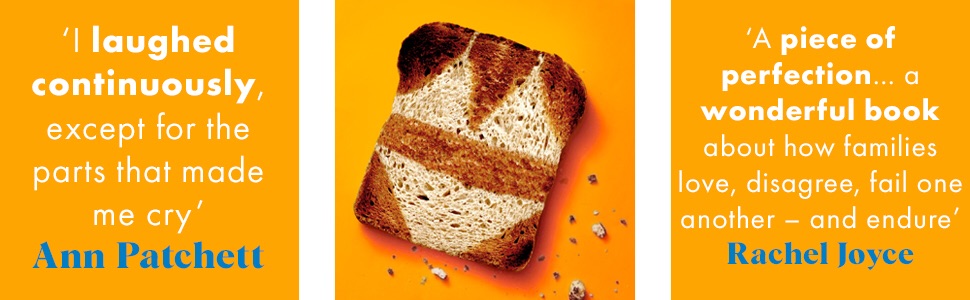
For the past two decades, Rocky has looked forward to her family’s yearly escape to Cape Cod. Their rustic beach-town rental has been the site of sweet memories, its quirky furniture and mismatched pots and pans greeted like old friends.

Now, sandwiched between her children who are adult enough to be fun but still young enough to need her, and her parents who are alive and healthy, Rocky wants to preserve this golden moment forever. This one precious week when everything is in balance; everything is in flux.

But every family has its secrets and hers is no exception.

With her body in open revolt and surprises invading her peaceful haven, the perfectly balanced seesaw of Rocky’s life is tipping towards change…

Rocky and her husband Nick have reached that middle point in life where adults seem to be at their most stretched. They’re coping with children who have left home or are living at university as well as increasingly elderly parents who need more help than they have before. This is the sandwich of the title. The emotions are conflicting, from the parental support a fledgling teenager still needs to the worry about their independence, as well as the feelings of loss that that come from empty nest syndrome. As for parents, it’s like a whole new stage in the relationship defined in the novel as ‘anticipatory grief’ because as they become increasingly frail there’s a constant reminder that the clock is ticking. This reminder of their mortality brings up feelings of loss and a sense of our own life being at their point where more is behind us than in front of us. I’m saying ‘we’ because I fall bang in the middle of this category. I have parents who have endless medical appointments, particularly Dad who seems to have surgery on a yearly basis like some sort of annuity. However, I also have one stepdaughter away at university, really stretching her wings as she ends her second year and moves in with her boyfriend. We’re only a quick call away though and we’ve gained a third child in the boyfriend. We miss her more than I can express. Then we have my other stepdaughter, one of the generation whose education has been massively affected by COVID. She has so many plans with friends that we now see her less so the loss is twofold. Then there’s the menopause, from sweating to vaginal atrophy it’s a veritable shitshow of symptoms that we’re just supposed to manage alongside everything else. To say I felt a kinship with our narrator Rocky, is an understatement. Again Catherine Newman has managed to put something on the page that’s raw, emotional and relatable. So much so that there were points in the book where I burst into tears.

Rocky is a great narrator in that I was immediately comfortable with her and believed in her world. This book was such an easy read and flowed so beautifully that I finished it in a day. A family trip to the Cape Cod holiday home they’ve rented since the children were small throws a family that’s scattered to the four winds, under one roof. Eldest child Tim is there with girlfriend Maya and student Willa has travelled from her college and meets them there. Later in the week grandma and grandad will join them for two days and of course there’s the ancient cat. They are rather piled in on tap of one another but they couldn’t come here to a different, bigger rental because so many of their memories have been made in this house. During the course of the week Rocky will learn and divulge some secrets, all of them filtered through her anxiety and what husband Nick calls a hint of narcissism. This family were so like my own that I deeply appreciated my upbringing, even though some of it wasn’t easy – we never had money, found a secret sibling then happily lost them again, mum and dad had their turbulent years. Yet I always felt loved and that’s what there’s a surfeit of in this family, everyone loves everyone else even when they disagree. Rocky is a passionate and emotionally intelligent mother, the sort of mum you might go to with a secret. She also happy to be schooled where she gets it wrong, especially where daughter Willa is concerned. She might use the wrong pronouns and need to check her privilege occasionally but largely she’s the sort of mum you want. She feels things almost too deeply and I understood that in her. She wants to breathe in her children when they’re little. She reminds me a little of something my mum and Mother, my great-grandmother, used to say when my brother and me were little: ‘ I could eat you on a butty without salt’.

I think Catherine Newman is brilliant when it comes to trauma and intergenerational family dynamics. There was a moment, as Rocky was reminiscing about a time when she miscarried that made me feel like she’d read my mind. I had recurrent miscarriages in my twenties and I’d never been desperate for children till I lost the first one. No one explained that grief can manifest in strange ways, in fact after my operation (which I’d had to consent to on a termination form) I was told when it would be physically possible to try again, but never that it might be a good idea to grieve first. To take time. As far as emotions went I was given a leaflet of phone numbers of women who’d had miscarriages – with the warning that in a lot of cases I might hear children in the background. I couldn’t bear to hear that so I didn’t call. What I do remember from that time was buying pregnancy tests in bulk and checking frequently whether I might be pregnant again, even if I’d already checked yesterday and knew I wasn’t. The author writes about Rocky staring at pregnancy tests, imagining she can see the second line in the window and trying again for the answer she really wants. I truly felt her pain in those moments and my own. I felt slightly less mad. To realise this was an understandable response to grief was so comforting. Every emotion I felt in those terrible couple of years was due to grief. I felt a failure, defective and terribly separate from people as if I was looking at life through a glass screen. Now thirty years later I’d like to thank Catherine for the way she handled this difficult story line because I finally felt less alone. I really admired the way she wrote about post-natal depression too. When my mum had my younger brother I was only four years old, but for years afterwards she had a morbid obsession that he was going to die. Every time something happened in his life she worried that this would be it. Now he would be taken away from her. I have to say that sometimes this felt very dismissive of me. Her explanation when I asked if she’d ever thought the same about me was that I could look after myself, despite me spending a long time in hospitals. This aspect of PND is something I’d never considered before and helped me to understand where she was coming from a little better.

I thought the author beautifully described how women are more aware of their bodies because we’re trained to be. In a medical world that’s often dismissive of things like period pain ( or anything that falls into the category of gynaecology and obstetrics) as a natural process, the author shows how these things truly feel physically and mentally. We have to ‘know’ as soon as we’ve got our period because the shame of being seen to bleed is fierce, especially as period shaming seems to be rife in secondary schools. Our minds and bodies are connected so we know if something is a normal pain or a pain that has a different feeling or intensity. As Rocky loses the idea of the baby she’s carrying, she’s also physically losing the baby. These moments are raw because the emotions are. There’s a desperation in physically losing a baby. The mind does gymnastics trying to find a way to keep them inside you where it’s safe. As Rocky reminisces about this time, the unresolved emotions are clear and perhaps stirred up by menopause symptoms and having her babies under one roof. I enjoyed Rocky and Nick’s marriage too. It’s not perfect and they haven’t really connected for a while, physically or mentally. When he stumbles on a long held secret it throws their dislocation into the spotlight and gives them the opportunity to talk. He still loves her, despite the fact she’s a bit of a narcissist. She recognises that throughout the holiday Nick has been cooking, organising, driving everyone and just quietly looking after everyone. They’ve been in their mum and dad roles for so long they’ve forgotten how to be Rocky and Nick. It’s something of a relief for Rocky to know that Nick still desires her, despite the expanding waistline and loss of libido. Also, as Nick points out, it’s hard to get close to someone when there’s a huge secret between them.

I connected with this novel so deeply and I raced through it in a day. I simply sat and read without music or any other distractions, that’s how engrossed I was in this family’s story. Each generation had it’s own issues to deal with. The grandparents are facing health issues and their eventual loss of each other, brought into sharp focus when grandma faints at the beach. Ricky’s son and his girlfriend are facing some huge life choices. Even great-grandparents cause a drama when Rocky’s dad lets slip that they were in a concentration camp, something Rocky’s never known. Rocky and Nick are the meat in this emotional sandwich. Catherine Newman has once again written a novel about family that is truthful, funny and life-affirming. I can easily see this being on my end of year list.

Published on 6th June by Doubleday

Meet the Author

Catherine Newman is the author of the kids’ how-to books How to Be a Person and What Can I Say?, the memoirs Catastrophic Happiness and Waiting for Birdy, the middle-grade novel One Mixed-Up Night, and the grown-up novels We All Want Impossible Things (Harper 2022) and Sandwich (Harper 2024). She edits the non-profit kids’ cooking magazine ChopChop and is a regular contributor to the New York Times, O, The Oprah Magazine, Cup of Jo, and many other publications. She lives in Amherst, Massachusetts, with her family.

Posted in Random Things Tours

The Garnett Girls by Georgina Moore

Regular readers will know how much I love stories of large families, their complicated dynamics and the psychological ins and outs of why they are, the way they are. This was the perfect read for me and I was immediately intrigued by the deep family secrets at the centre of the three sister’s relationships with their mother Margo. The three sisters are: eldest, Rachel married to Gabriel with two small girls and a career as a lawyer; Imogen, the playwright who is anticipating long term boyfriend William to conduct the perfect proposal while being unsure whether it’s what she wants. Then there’s Sasha, the fierce and rather wild youngest sister, who is struggling between her family and her coercive husband Phil while family friend Johnny watches on, wildly in love with her. The sisters live in the shadow of their mother Margo and father Richard’s tempestuous love affair and marriage which sadly ended in divorce. His drinking and their arguing lead to Richard walking out, to join his secret other family. None of the girls have ever seen their father since that day. Rachel remembers moving to their holiday home Sandycove from their house in London and Margo being unwell. She and Imogen, along with their Aunt Alice try to keep the house running, but Sasha is still a baby struggling to cope with Margo’s unavailability. In the present day, every one of the Garnett girls is carrying a secret, but Sasha’s secret has the potential to blow the family apart.

I loved the community on the island, where the family home has always stood. Rachel and Gabriel now live in Sandycove with their children. Rachel works in London during part of the week and Gabriel works as a counsellor but also looks after the home and the girls. Sandycove is still the official place where the Garnett family get together for special occasions and Margo is constantly popping in and out, helping with cooking and childcare. She now lives at at The Other Place, a bungalow up in the village. It’s here she conducts day to day life and her illicit love affairs, kept separate from her family, who often know a lot more than she realises. Because they’re together in the week, Gabriel and Margo often plan family get togethers and outings. This bothers Rachel who knows they’re only trying to take the burden from her, but she often feels like Sandycove isn’t their own, it belongs to everyone. In gaining the family legacy they’ve also lost something. Their close knit days of just the four of them are gone. Imi’s story starts in beautiful Venice where her perfect boyfriend William is set to propose. She knows this because Margo and Rachel are calling on a daily basis to hear what they’ve been up to. They’ve been a couple for a long time now and her family love William. They think he’s perfect too and Imi knows that if she vocalised her doubts to her mum or one of her sisters they’d think she’s lost her mind. On her return the read through of her play is set to begin and an up and coming Hollywood star has been cast in the lead role. Imi isn’t sure about Rowan and worries that it may be the worst kind of stunt casting, but from the moment she meets the actress, she can’t stop looking at her. Having always felt her relationship falls short of her parent’s great love, finally Imi knows what a coup de foudre feels like. Sasha has had a radical and fierce short haircut that she knows Margo will hate and will make her look very different from her sisters. Sasha is holding on to something else they’ll hate too, she is in contact with their father Richard and his family. Over the course of the novel, all the secrets hoarded by the sisters will come out. Can their close knit relationships survive?

Each of the three sisters are beautifully drawn by the author and became completely real to me very quickly. I loved their family dynamic too, even though I might find it a little bit suffocating if they were mine! Margo especially is a lot to take, with her daily phone calls and constant ‘pop-in’s’. There’s also the potential embarrassment of her sexual adventures, although I did enjoy her liberation and openness about having an active sex life as a grandmother. Sandycove has so many deep emotions buried in it’s walls. It almost runs like a stately home, with a list of annual events for family and friends that are a fixture in the village calendar. The family’s parties are incredible and I’d love to go to one! I thought the way the author used flashbacks was clever, because they helped me understand each of the women. So we see Sandycove as the home of 16 year old Margo who thinks she’s met the love of her life. Margo’s mother is unconvinced and is determined to keep this older man away from her daughter. Margo isn’t easily dissuaded from her love affair and ropes her sister Alice into helping her, eventually fleeing her childhood home with Richard in tow. Her self-awareness doesn’t stretch to realising that she’s now doing just the same with her own daughters – so sure that William is the one for Imi she’s planning the wedding before the proposal. We also go back to the moment when this family fell apart; this past event answered a lot of questions for me. I loved the moment of realisation for Rachel that her need for independence lies back there, in fact it was about survival. Yet she knows her independence made Margo feel unwanted and also masked a need to live up to her mother’s expectations and a fear of being unable to. She didn’t want to live somewhere that people came up to her in the street to tell her how like Margo she was. She wanted to live somewhere there was no Margo, maybe then there’d be enough space left for her to be Rachel. She knows that now these old feelings put a distance between her and Gabriel, in fact the whole family see strong, capable Rachel without thinking how exhausting it must be at times, how she can never be vulnerable.

Imi longs for someone to listen, so much so that on the day of her Venice proposal she drinks at the hotel bar with a young man just because he doesn’t talk over her, or assume what she wants in her life. When William proposes he uses the words ‘it’s what everyone wants’ before asking if it’s what she wants. It’s as if she’s ripe for rebellion, but doesn’t know how yet. Sasha’s rebellion is rather more visible, the short platinum blonde crop is a backlash against the long flowing hair that makes her a Garnett girl. Her identity is visible in the way she looks, with her slightly severe and spiky clothes and her red-soled high heels. She picks at Imi for accepting Margo’s bullying and interference, knowing straight away that Margo had bought Imi’s dress for the engagement party. Sasha can see that though she is beautiful she isn’t comfortable in it. In fact Imi wasn’t even comfortable with the party. Yet Sasha soon returns to Phil’s side, as he lurks in the doorway looking put out. He hates Garnett parties and prefers to have Sasha to himself; there are deep-seated reasons why Sasha has fallen into this possessive relationship, mistaking control for love. I thought these labyrinthine dynamics were brilliantly done, so real and perfectly in tune with coercive control and how intergenerational trauma works. I knew it was going to take the revelation of all the family secrets, probably in an explosive Garnett way, for these dynamics to change and for the girls and Margo to heal. I was so sucked into their world that I read the book in two sittings, desperate to see the girls speak their truth and start controlling their own lives. I also wanted healing for Margo too, because she’s been at war with an idea for the past twenty years. Her impression of the man who left her and the life he left her for is all in her head and it’s maybe time to face reality. The Garnett women can only move forward by being honest and real with each other and themselves. This was a wonderful read for people like me – the nosey and psychologically trained. It’s astute, beautifully written and full of strong women who are talented, ambitious and intelligent. It was a joy to read.

Published in paperback this month by HQ Stories.

Check out the rest of the blog tour

Meet the Author

Georgina Moore grew up in London and lives on a houseboat on the River Thames with her partner, two children and Bomber, the Border Terrier.   The Garnett Girls is her first novel and is set on the Isle of Wight, where Georgina and her family have a holiday houseboat called Sturdy. Georgina is working on her second novel, Walnut Tree Island, which will be published in 2025.

Posted in Netgalley, Publisher Proof

Nightwatching by Tracy Sierra

Yesterday upon the stair I met a man who wasn’t there,

He wasn’t there again today, oh how I wish he’d go away.

Antagonish by Hugo Mearns

My grandad taught me the first few lines of the poem above. I think it appealed to his sense of humour. I thought it was a riddle and I used to ask ‘but is he there or not?’ This is the very question this whole book revolves around from the first line – ‘there is someone in the house’. Our unnamed narrator wakes in the night as a strange noise breaks through her sleep. I was told by a book reviewer I respect enormously that this was brilliant and she was absolutely right. Although I drove my husband crazy by waking him up to ask if he remembered locking the door. He hadn’t always and I knew I wouldn’t sleep until one of us had crept downstairs and checked. Preferably not me. This is the situation all of us dread, waking to that unexpected noise in the night and finding there is an intruder. Our narrator is at her secluded home with her two small children in a blizzard. The sound she hears is a familiar one, a tread on the stairs to her room, but it’s unusually heavy and slow. She has a split second to make the decision – does she hide, try to run or stay and fight. Will all three of them get out alive and if they do will anyone believe her?

The first thing that hit me about this book was the unique voice this mother has. We see everything through her eyes and experience everything her body goes through – mainly fear. There’s the heart-stopping tension of that first night, the immediate threat rendering everything else unimportant. Yet there are other fears lurking underneath – will the police believe her, will it stir up questions about her husband’s absence, what will her father-in-law make of what has happened? She is waiting for people to doubt her and the reader doubts her too. Always on the lookout for unreliable narrators, I did wonder whether I should trust what she was experiencing. It’s just so incredibly odd. This tall intruder seems to have two voices: a raspy harsh voice when he’s angry then more of a soft, weedling voice. A voice you might use for children as he asks them to ‘come out little pigs, little pigs are more delicious’. As he does this right next door to their hiding place, it’s even more terrifying. Her little girl whispers to her mum that it’s the ‘Corner Man’ from her nightmares, he sits in the corner of her bedroom at night and whispers to her. My heart was in my throat at this point! Was he real or something supernatural? Could he possibly be real if this is true? I wondered if this overwrought mother is imagining this person, but that opens up a more frightening prospect – is she hallucinating and terrorising her own children with her delusions? The author plays with the reader beautifully. Just as I was starting to think the narrator is completely crazy, she addressed my concerns.

‘How nice it would be to be crazy instead of correct. For t all to be a psychotic break. To have her husband come down those stairs. She’d pop out of the hidden place relieved – rated – to meet his look of confusion’.

This is a woman who is used to being misunderstood and there’s no shortage of men around, happy to convince her that she’s strange, hysterical and marked as different in some way. There’s an awful moment, recalled while hiding, when her husband told his father he was not going to continue studying law. She hears his father’s fury down the phone:

‘You never behaved this way before you met that girl. Christ. She’s disfigured’.

Our narrator has vitiligo – a long term skin condition where areas of skin lose melanin and become paler, creating a patchy complexion. People stare and perhaps mistrust her, worried they may catch a skin disease or worse. Added to this, she’s a newish mum full of hormones, perhaps she’s a bit anxious and over-protective. She’s recently bereaved, having nursed her terminally ill mother-in-law. Maybe she’s not in the best frame of mind. All of this and the fact that she’s a woman, mean the police will be unsure or just plain rude about her. They keep explaining there’s no evidence: no footsteps in the snow; nothing of any value is stolen – in fact the items she does mention are probably lose or mislaid by the children. They don’t sound like the type of things someone would steal. They’ll turn up.

While hiding from one monster, we learn that she’s battling another in the shape of her father-in-law. Honestly, I have never wanted to climb into a book and punch someone more. He is a bully, but everyone else placates him. He is ashamed of his son, even more ashamed of his disfigured daughter-in-law. He hates the noise of his newborn grandson and his wife apologises! Even while his wife is dying, he sits with his feet up watching television and creates holy hell if he’s disturbed. His daughter-in-law does all the work and is rarely appreciated or thanked. He wants his grandson to man up and stop being a wuss. Worst of all he’s aggressive, violent even. Having him in charge of her children is the worst outcome of all. This mother is also fiercely protective. A passing incident where a stranger commented on her daughter and pulled the drooping strap of her sundress back onto her shoulder, really bothers the mother. You can feel her hackles rising in much the same way she reacts when her father-in-law criticises her son. She has very keen instincts and it’s fascinating to see how those instincts can be eroded, mainly by men who still consider women a hair’s breadth away from hysteria and the asylum. It shows that we’re not just gaslighted by individuals, it can be institutional, perpetuated by organisations like the police force or as I’ve found in my own life, the medical profession.

The whole setting is brilliantly eerie. A secluded mansion house with woods behind and five acres of open pasture between them and the next house. The house was built in 1722 with two staircases, higgledy-piggledy rooms and even it’s very own graveyard. She loves the house, even though it’s totally impractical and a nightmare to heat. She’s got to know each creak and bang, it’s night noises, but never imagined when she viewed the house that she’d be fleeing into the secret space next to the chimney, where the builders walled in the labyrinthine brick work. They never imagined being walled in. It’s a place where ghostly presences and hidden secrets would be easy to believe. Yet it’s not all scary. There are some wonderfully tender moments between the mother and her children and we can feel how torn she is when she has to be sharp with them, to keep them quiet and safe. I had no idea where this story might go and the author was one step ahead of me all the way. I might have finished this incredible thriller, but I’m still carefully locking the doors at night and when the cat decided she’d rattle our door to upstairs at 3am my heart did beat a little faster. I can’t believe how assured and psychologically complex it was for a debut! If you only buy one thriller this year, make it this one.

Out now from Viking

Meet the Author

Tracy Sierra was born and raised in the Colorado mountains. She currently lives in New England in an antique colonial-era home complete with its own secret room. When not writing, she works as an attorney and spends time with her husband, two children, and flock of chickens. Nightwatching is her debut novel.

Posted in Netgalley

Has Anyone Seen Charlotte Salter? by Nicci French.

Charlotte and Alec Salter have four teenage children and live in the small village in East Anglia. We meet them on Alec’s 50th birthday where a big evening party is planned for most of the village as well as family. Yet at the beginning of the party there are no Salters present. Charlotte went for a walk and hasn’t returned. Alec did same, but they didn’t go together or in the same direction. Fourteen year old Etty is worried. The last of the Salters and yet to leave home she is starting to panic. She loves her mum, but if she is gone, for whatever reason, that means she has to spend two years at least in the company of her father. Just the two of them. Alone.

In the days that follow as the police investigate, there are rumours that Charlotte and family friend Duncan Ackerley were having an affair. Of course it was more widely known that Alec was seeing villager Mary Thorne, in fact his own daughter heard him on the phone to her from the other line the night of the party. When the Ackerleys invite the Salters for Christmas Day, only Lottie turns up at first, her brothers are late and Paul is probably giving it a swerve altogether. Yet Etty thinks it would be worse to sit at home, staring, worrying and jumping at every sound. As dinner time approaches, the Ackerley’s start to wonder where Duncan has got to. He’s been out for a walk, possibly down to the boat as there is a super high tide and he needs to move it. It’s Etty and Giles that start to look for him and he does try to shield her eyes as they come closer and see that Duncan is slumped in the water, dead. We move between the party night and the Christmas days that follow and twenty years later when all the Salters are once again in residence at the family home.

Everything about the house is dated and dilapidated, including their father Alec who is succumbing to dementia. Etty, ever the lawyer, is organising his move into a nursing home and the clearance of their parents possessions. For this job she has found a bright and organised woman called Bridget. She gathers the siblings and tells them that the easiest way is for them to put specific coloured post-its on their must have items, then she takes away the rest for sorting, selling and recycling. It’s emotional, especially since there are now only three of them. Their brother Paul never coped with life and the loss of their mother and sadly committed suicide on the anniversary of her disappearance. Meanwhile, now a TV personality, Morgan Ackerley is home to record a podcast on that Christmas, speculating on what happened to Charlotte and his father. This is going to stir up the village and make life difficult for both families. When a sudden event leads to yet another death, the police are called and a new detective looks at the old files as well as this new case. Are they linked in some way? Despite her boss seeming to warn against digging up what’s been long buried, this detective is determined to find out what happened to Charlotte Salter.

Seeing how much these families have changed over time is so interesting and I found myself wondering how different the Salters and Ackerleys might have been if this crime hadn’t happened. Etty melted my heart a little bit because she’s clearly so close to her mum and on the night of the party she’s the one who’s trying to raise the alarm because she knows something isn’t right. The boys are largely off doing their own thing and seem almost inured to the state of their parent’s marriage. The consensus is they’ve probably had a row, but Etty knows that despite a row, or their dad being on the phone to Mary Thorne at 2am the night before, there is no way that her mum wouldn’t turn up to his birthday party. She has always kept up appearances in that way. She even looks at her father and wonders whether he could have killed her. Her relationship with each parent couldn’t be more different, there’s a distance between Etty and her father both in the past and the present. In fact he doesn’t seem that invested in any of his children. Yet Etty can still imagine the smell of her mum’s perfume and what she would be wearing and I could imagine Charlotte hugging her daughter, her perfume just one of the many scents that signify home. With only the boys and her distant father left who will she go to for hugs? I could feel her panic as realises that after Christmas, the boys will go back to jobs and university and she will be left alone with their father for two years. I could also see the shadow of this huge loss in the adult Etty: an awkwardness about whether the family kiss to greet each other or not; keeping a lawyer’s professional manner at all times; doing all the organising and keeping busy so she can remain detached. She doesn’t cry, even when finding memories of their childhood. She holds herself stiffly, almost brittle and I wondered how much it would take for her to break.

There are many ghosts here. It’s not just Etty who was changed. They all feel the loss of their brother Paul deeply and he’s the empty chair at the table, even now. They tiptoe around each other, trying not to open old wounds but when a fire is started at Bridget’s home a new murder investigation is opened. Either the arsonist didn’t realise Bridget was at home, or didn’t care. Was their aim to kill the house clearer or was it to hide evidence that she’d unwittingly taken into her home alongside the Salter’s belongings? I found this mystery so intriguing that I couldn’t stop reading and I loved the psychological aspects of how these unsolved crimes had affected the families and the village as a whole. There were a couple of crucial points past and present where everyone I suspected seemed to be going for a walk alone – without even having a dog as an excuse! I was suspecting that Lottie’s husband wasn’t as advanced in dementia as she seemed, but couldn’t be sure. The reveals were satisfying, but it was the methods of concealment that really blew me away and I loved how thorough the investigating detective was. She wanted to be sure, whether or not it disturbed or upset some people and I loved that about her. Mainly I thought about how the author successfully showed the long term effects of a crime like this, even years on from the actual incident. These children were all changed forever and the villagers have lived under a fog of suspicion for years. Etty particularly left me thinking of all the events I’ve been able to enjoy with my mum over the last 50 years, that she and Charlotte had missed out on. Finding a balance between the real emotions that surround a crime and creating a page-turning mystery is difficult, but here I think the authors have really pulled it off.

Out 29th Feb in Hardback from Simon and Schuster

Meet the Author

Nicci French is the pseudonym of English husband-and-wife team Nicci Gerrard and Sean French, who write psychological thrillers together

Posted in Netgalley

The Women by Kristin Hannah

I was completely engrossed by this incredible piece of historical fiction, covering a period of history and viewpoint I’d never read about before. All the Vietnam stories I’ve encountered have fallen into two categories and were made for the big screen; combat movies like Platoon and Full Metal Jacket, or the more domestic based aftermath of war at it’s best in the excellent Coming Home with Jane Fonda and Jon Voigt. I’d never considered that there would be women in Vietnam, which seems crazy since I’d avidly watched MASH when it was rerun in the 1980’s. The series set in a field hospital showed women in the operating theatres, as members of the US Army Medical Corps. Yet, I’ve never encountered anything that showed them in Vietnam, so I was fascinated by Frankie’s story; her personal experiences as well as the politics and societal changes around her tours of duty. What struck me most was how this war ripped the generation gap wide open. Most people my age will remember the Paul Hardcastle single ‘19’ and for me the most stark line in it was ‘none of them received a hero’s welcome’. It struck me how different the government and public response was to these veterans, the majority of whom were no less brave or noble than the WW2 veterans their fathers had been. The author deals with all these themes in a story about the women that served in Vietnam, the women that America forgot.

Frances McGrath is your typical All American teenage girl, living with her family on Coronado Beach. She has memories of growing up on that beach, swimming and surfing with her brother Finley. She is from a good family and expectations are that she will have the ‘right’ marriage and become a mother. However, things change when Finley makes a huge decision. He’s enlisted for Vietnam. It’s no surprise that he might go into military service at some point. Frankie’s dad has a wall in his office called the ‘Hero’s Wall’ where every family member’s military service is celebrated with cuttings, photos and medals. All the men, anyway. Yet not many of their friends and family members have sons who’ve voluntarily enlisted for Vietnam. There are ways of avoiding the draft, depending on who you know. Yet Finley enlists of his own accord, possibly believing the American government’s assertions that they must fight communism in Vietnam, lest it become even more widespread. Within weeks there’s a knock at the door; Finley has been killed in action. In a whirlwind of grief Frankie starts looking into her options. She wants to honour her brother and become a hero worthy of her father’s wall. Both the Air Force and Navy need a nurse to complete a long period of training before they’re posted to work in the field. However, if she enlists in the US Army, they’ll post her out to Vietnam after basic nursing training. Much to her parent’s shock Frankie is soon on her way to Vietnam.

The author creates such an incredible sense of place, I was in Vietnam with Frankie. The all pervading humidity and dampness of everything actually made me feel grubby. There’s a red dust blowing everywhere, that sticks to the constant sheen of sweat on Frankie’s skin and gets into every wrinkle. Frankie’s kitbag and everything she owns takes on the smell of mildew and she never feels dry. At first the bursts of gunfire and explosions in the jungle are surprising and Frankie is anxious, but soon they just become the everyday backdrop to her work. The ‘whump- whump’ of the helicopters arriving with MASCALS (mass casualties) control when she eats, sleeps and relaxes. The first experience of a MASCAL is shocking and Frankie does freeze, but the surgeon she’s working with talks her through it, let’s her know that he trusts her and she can do it. Gradually it becomes easier, although their injuries and the emotions of triaging these men can stay with her. If someone is beyond saving they are left to die, while they operate those they can save. It isn’t just the soldiers though, the unit treats Vietnamese soldiers and locals caught in the crossfire. The use of napalm and the injuries it caused really has stayed with me, the jelly like substance sticking to the casualty’s skin and keeps burning. Frankie is soon a first class combat nurse, that’s not to say these experiences become easy, they just become the norm. When we tuck trauma away in a box without processing it, it sits until we’re ready to open the lid or until a new experience forces that lid open. Usually when we least expect it. Her new relationships keep her going, especially those with her friends and fellow nurses Ethel and Barb. They are the glue that hold each other together and while men may come and go, the bond these women build is lifelong and loyal. That’s not to say there aren’t men. Frankie falls in love with Jamie, the surgeon she works with and the war only intensifies those feelings. There’s also the constant fear of losing them. Later on, a face from the past reignites feelings of first love but brings with it so many complications.

Frankie’s return and adjustment to everyday life on her return from war becomes yet another battle. Now she’s completely safe it’s as if all the feelings she had in Vietnam are bubbling to the service, manifesting in physical and mental symptoms. Her parents are relieved she’s home in one piece, but they don’t seem proud of what she achieved and her accolades don’t make the hero’s wall. She doesn’t seem to fit anywhere. Here Barb and Ethel are worth their weight in gold, taking Frankie in when she needs to get out of California and spending time talking through their experiences. No one else will ever get her like these women. Their lives do move forward though and Frankie just seems stuck. I thought this part of the story was beautifully done and represents so much research and care on the author’s part. She is very aware that although Frankie isn’t real, women did live through these experiences and had to find ways to reconcile their memories of war and their hurtful return to an ungrateful homeland they’d put their lives on the line for. It was as if the world had shifted on it’s axis while they were in the jungle. I was longing for Frankie to have a happy ending, because I thought she deserved it and I thought she still had so much to offer. I learned so much about a conflict I’d only experienced through film and usually from a male perspective. I was completely immersed in Frankie’s world and didn’t want to let it go.

Out now from MacMillan

Meet the Author

Kristin Hannah is the award-winning and bestselling author of more than 20 novels. Her newest novel, The Women, about the nurses who served in the Vietnam war, will be released on February 6, 2024.

The Four Winds was published in February of 2021 and immediately hit #1 on the New York Times, Wall Street Journal, USA Today, and Indie bookstore’s bestseller lists. Additionally, it was selected as a book club pick by the both Today Show and The Book Of the Month club, which named it the best book of 2021.

In 2018, The Great Alone became an instant New York Times #1 bestseller and was named the Best Historical Novel of the Year by Goodreads.

In 2015, The Nightingale became an international blockbuster and was Goodreads Best Historical fiction novel for 2015 and won the coveted People’s Choice award for best fiction in the same year. It was named a Best Book of the Year by Amazon, iTunes, Buzzfeed, the Wall Street Journal, Paste, and The Week.

The Nightingale is currently in pre-production at Tri Star. Firefly Lane, her beloved novel about two best friends, was the #1 Netflix series around the world, in the week it came out. The popular tv show stars Katherine Heigl and Sarah Chalke.

A former attorney, Kristin lives in the Pacific Northwest.

http://www.kristinhannah.com