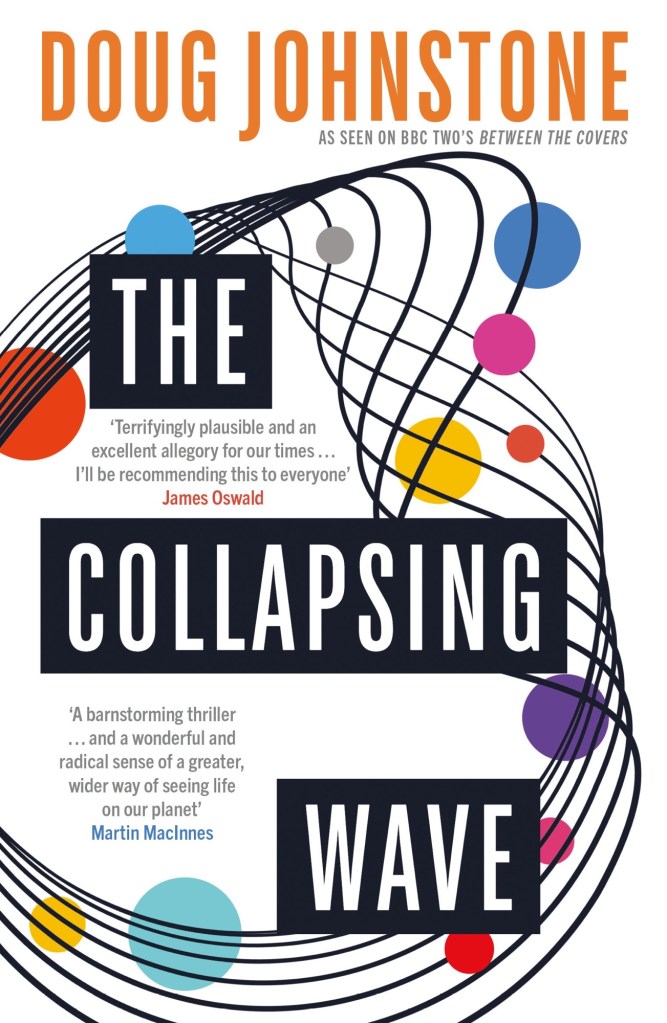
When I first met the incredible being Sandy in The Space Between Us I had no idea that there would be a sequel, never mind a trilogy. I grew up at the time when home VCRs were becoming affordable and we rented the Star Wars films so many times that I’m sure if we added up the hire fees we probably bought them. Doug Johnstone’s second novel has something in common with the original trilogy in that this second outing is much like The Empire Strikes Back, it’s darker in tone and it looks like our heroes may be beaten. Heather, Ava and Lennox come up against the worst traits of human nature; fear, hate and paranoid self-preservation seem to be winning and it’s the military’s role to carry this ideology through.We start several months after the last book ended as Sandy was reunited with the rest of his species at Ullapool and disappeared into the sea loch. Our three heroes seemed set for different fates as the research scientists and police who’d been tracking their journey finally caught up with them. Ava is confronted by and wreaks revenge on her abusive husband who pushed her to the edge of suicide and now tries to take her baby Chloe away. At the beginning of this novel we find her in Edinburgh for the court case, watched by her sister who is now Chloe’s guardian. As she’s given a suspended sentence Ava’s elation turns to terror as she’s swept up outside the court room by military officers with guns. Lennox and Heather have been in a makeshift compound that’s now become the biggest American military base on British soil, named New Broom it sits at one end of Ullapool’s sea loch in the middle of nowhere, like Guantanamo Bay rebuilt in a beautiful Highland setting. Heather and Lennox are detained, seemingly with no legal basis, as MI7 Agent Oscar and the American military attempt to capture partial enceladons and understand the way they work. Oscar at least has an academic interest, whereas the military seem more fixated on how to exploit their alien powers to overpower and control the Earth. Nothing could be further from the alien’s minds, they are simply looking for somewhere to live now that their oceanic home has become colonised by another species. They are refugees.
I think the political climate and local circumstances had me reading the book on two levels: as a great science fiction story, but also as an allegory. For those who don’t know my closest city is Lincoln and we’re currently experiencing community divisions. The government’s decision to requisition the recently closed RAF base of Scampton, home of the Dam-Busters, and turn it into a centre for asylum seekers has met with uproar. It’s terrifying to hear the opinions of people who drink in the same pub, deliver the mail or wash the windows, in case it’s far removed from your own. There were sensible arguments against the plan: there was already a plan to turn the base into a museum and heritage centre, for which local people had fundraised hard; the government are not using the actual existing barrack blocks to house the men, but putting portacabins on the runway instead; it’s so far away from any services in the city. Yet, instead of being able to protest these points at a local level, a far right extremist group from Yorkshire has hijacked the cause and set up a protest camp at the base’s main gate with racist signage and ideology. They are protesting against any asylum seekers: ‘coming in illegally for the benefits; to commit crime; to be terrorists; to groom children; to take social housing’. They don’t even understand that in order to claim asylum someone must first arrive in their chosen country. Maybe because this is now part of my everyday life, the parallels between the enceladons and asylum seekers/ refugees were undeniable. Both have been forced from their own country for whatever reason and the majority seek to live somewhere peacefully and in harmony with the existing population, not realising that to some people, their very arrival itself is a threat.
New Broom’s research staff are carrying out experiments that wouldn’t have been out of place in concentration camps. They are building Faraday Cages to capture partial enceladons and prevent them communing with others through telepathy. This silence is enough to depress and eventually kill them, because they can’t live separately only as part of the whole. Lennox and Heather miss the sense of communion they get from their telepathic communication with Sandy. They can commune with each other though and do so whenever they can. Heavily guarded wherever they go, they have no idea that Ava and Chloe are on their way, or that a camp of ‘Outwithers’ has built up on the edge of the loch filled with travellers, believers, anti-government protestors and anyone who despises the idea of such a huge military base on Scottish soil or the capture and torture of enceladons. There’s only one American soldier who shows a trace of empathy, the others are simply unquestioning drones taught to believe they are acting in the interests of National Security and the defence of the Western way of life. The two main men in charge are clearly in the grip of obsession, whether it’s a selfish intellectual curiosity or the terrifying birth of a megalomaniac. While I felt Oscar could perhaps be redeemed, General Carson is itching to exert authority over both security and experimentation. The only character who has their freedom is Sandy, but how can they be truly free with their family being captured bit by bit and their peace threatened by a man determined to destroy them all. Make no mistake, this is not the soft humorous story we might have expected from the first novel. In parts it was hard to read and made me feel physically sick, especially when Ava is finally reunited with her friends at New Broom. As Carson separates Ava from her daughter and proceeds to torture Chloe I felt so angry I was tearful. It is horrific and has the reader rooting for the overthrow of the Americans, by whatever means necessary.
It’s the feelings that Doug Johnstone’s writing conjures in the reader, that make this such an immersive read. The moments of love, friendship and sacrifice between these characters are beautiful and are but a small part of the collaborative existence the enceladons share. The moments where Sandy takes a human into the ‘whole’ are euphoric and more than a little trippy! The way the enceladons harness and work with nature to fight back against the military base has a similar feeling. The way Heather decides to stop resisting the cancer invading her body and just enjoy the life she has left living within the collective. All of these are pointing to the same life philosophy. We must work with something, not against it. The enceladons want to exist alongside humans, to become friends and communicate with them. After years of Thatcherism and the message that autonomy is the route to success and freedom, working together actually is an alien concept. It isn’t just the communication between the three friends that proves to be powerful. It’s the mother – daughter bond between Ava and Chloe. It’s the ‘Outwithers’ who have come together to create their protest camp and two women; Jodie, a lifelong activist for connection and Vonnie, whose love connection with Lennox creates it’s own power. Communication with the Outwithers is what changes Oscar, although whether this actually redeems his character overall I don’t know. These are the people who understand that connection with the colony can strengthen society as a whole, rather than destroy it. There are also those who choose not to see, whether that’s by building a fence and only caring about what’s in your own backyard, or by choosing to believe the government and mainstream media narrative, which only exists to manipulate. It reinforced my belief that language is so incredibly important. If we choose the word integration instead of infiltration, opportunity rather than threat, to embrace something changing for the better rather than hankering after a nostalgic past that mustn’t be destroyed, if it ever existed. If we realise that connection is more important than individual attainment we learn to grow, adapt and embrace new things. It’s amazing that E.M. Forster’s quote ‘only connect’, although now it’s over a 100 years old, still has such huge resonance.
Published on 14th March by Orenda Books.
Meet the Author
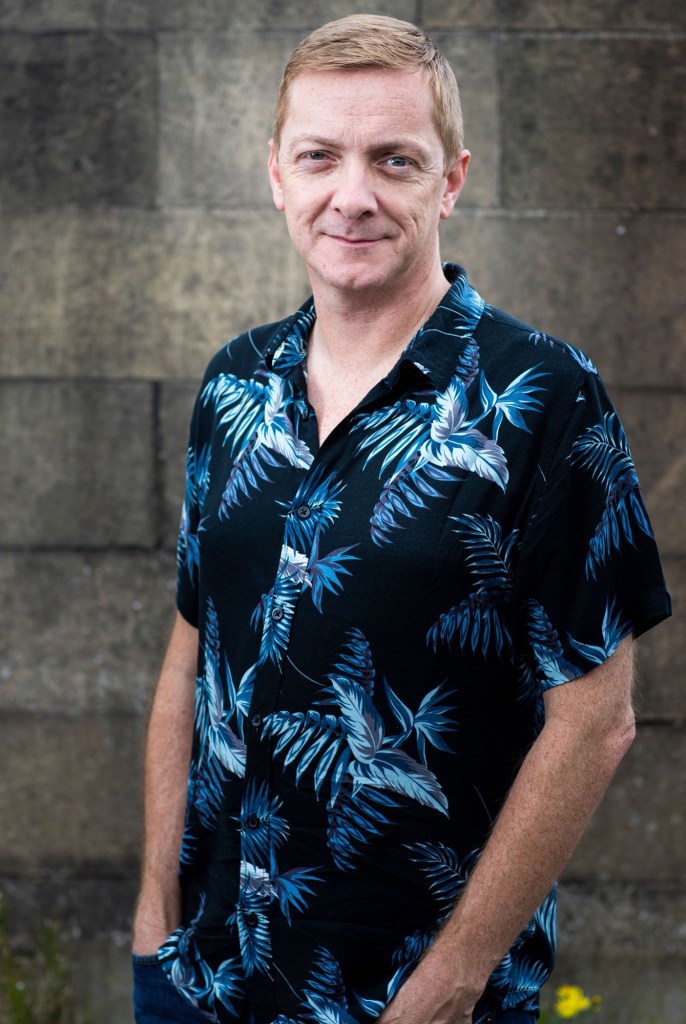
Doug Johnstone is the author of twelve novels, most recently The Great Silence, the third in the Skelfs series, which has been optioned for TV. In 2021,The Big Chill, the second in the series, was longlisted for the Theakston’s Old Peculier Crime Novel of the Year. In 2020, A Dark Matter, the first in the series, was shortlisted for the McIlvanney Prize for Scottish Crime Novel of the Year and the Capital Crime Amazon Publishing Independent Voice Book of the Year award. Black Hearts (Book four), will be published in 2022. Several of his books have been best sellers and award winners, and his work has been praised by the likes of Val McDermid, Irvine Welsh and Ian Rankin. He’s taught creative writing and been writer in residence at various institutions, and has been an arts journalist for twenty years. Doug is a songwriter and musician with five albums and three EPs released, and he plays drums for the Fun Lovin’ Crime Writers, a band of crime writers. He’s also player-manager of the Scotland Writers Football Club. He lives in Edinburgh.


 The Lotus Readers