Posted in Netgalley

The Princess by Wendy Holden 

It was all she ever wanted. Until her dreams came true…

The moving new novel about the young Diana.

Diana believes in love. Growing up amid the fallout of her parents’ bitter divorce, she takes refuge in romantic novels. She dreams of being rescued by a handsome prince.

Prince Charles loves his freedom. He’s in no rush to wed, but his family have other ideas. Charles must marry for the future of the Crown.

The right girl needs to be found, and fast. She must be young, aristocratic and free of past liaisons.

The teenage Diana Spencer is just about the only candidate. Her desperation to be loved dovetails with royal desperation for a bride.

But the route to the altar is full of hidden obstacles and people with their own agendas.

When she steps from the golden carriage on her wedding day, has Diana’s romantic dream come true?

Or is it already over?

Princess Diana hit the headlines when I was nine years old, perfect timing for me to buy into the fairytale and fall in love with her. I had my hair cut into Diana’s short style and I had one of her jumpers, well an Asda version, covered in sheep with one little black sheep in the bottom corner. When we look back at her life in retrospect, it could be that she was trying to tell us something. This book focuses on Diana’s earlier years, from her schooldays until that fairytale of a wedding which seemed to cement her into the consciousness of everyone, across the world. It was interesting to read more about her single life before dating Charles, a period that struck me as interesting when it was dramatised in The Crown. She had a busy, fun lifestyle sharing a flat with three friends and working in a nursery. Then as soon as the engagement was announced she was taken into apartments at Buckingham Palace, totally closed off from outside, but also from other members of the royal family. It was quiet, almost like a church, with no one reachable by phone and Charles on a tour abroad. His only thought in terms of company was to introduce her to Camilla Parker Bowles. 

The book did well when describing the dysfunctional way the Royals live. It’s an almost surreal existence with very specific rules to live by. When I read how much time each member spends alone I started to understand why they all have dogs. They don’t eat together daily, non-royals don’t come to the palace unless invited and each royal has their own quirks. For a 18-19 year old wandering round empty rooms and not being able to talk to friends must have been totally isolating. It was for her security of course, but it also meant she could be trained to fit the role she would play. She must have been so lonely. I’ve clearly read a lot of the same books as the author, because I knew about King Charles’s very odd boiled egg habits and the Queen Mother’s exploits in her home at Clarence House, but there were some things that were new to me. 

It was clear that Diana was a young girl full of life and romantic ideas about men and marriage. Wendy Holden tells the story through the eyes of Diana, her best friend at boarding school Sandy and Stephen Barry who was the Prince of Wales’s valet. The girls read paperback romances, the type of story written by Diana’s relative Barbara Cartland. When the girls imagine love at the age of 13, they imagine it being: ‘like a particularly delicious bath, deep and warm, with lots of bubbles.’ It conjures up a sense of comfort and pampering that I do actually feel sometimes with my other half, but a man who doesn’t know what love means isn’t equipped to love like that. The only people who pampered him were his servants, how can you provide what you’ve never had? I think Holden has captured the essence of a girl in adolescence, dreaming what her life might be. She’s a lively, bubbly girl who loves music and the company of others. She has a shy charm that’s so endearing, but her parents divorce has left a mark and I wondered whether it instilled in her a determination to get it right, which left me feeling a little sad for her.  

The second section of the novel definitely has a a melancholy feel, that shows us how well the author has brought the fun, young Diana to life. This is such a contrast. It also makes us realise how young she was to get married anyway, never mind becoming a future Queen of England. It is only six years since that journey with Sandy to boarding school. So, when she becomes engaged to the then Prince of Wales she was probably still expecting the comfort and care of a warm bath. She must have been disappointed at this moment. I always feel that Diana married the people on that day, rather than Charles. When she has some late doubts her sister Sarah warns her that her face is already on the tea towels. It’s too late. The pressure must have been immense. She has spent months hounded by the press and the famous moment where photographers captured her with a see through skirt is just one incidence of naivety on her part. She’s been getting thinner and her wedding dress needed taking in constantly. This isn’t the fairy tale love she’s dreamed about, more the matchmaking of two grandmothers living in the past and desperately trying to break off Charles’s adulterous relationship with Camilla.

I think the author attempted something very difficult here, to create a unique view of a story that’s a modern parable. Everyone knows a version of what happened. So, to create something that captures the voice of the most well known woman in the world, while bringing something new to her story, is near impossible. I think she partly succeeds. I didn’t learn anything new, but I did feel that I was listening to Diana in this story. It doesn’t have that compelling quality, because we already know about the divorce in 1996 and her death only a year later. I felt there was a bit of fire in this girl, despite her naivety. The rude awakening that she was simply a brood mare fuelled a fightback – the Andrew Morton book, the interview with Bashir and that last poignant summer are her pushing back against a system she felt used and abandoned by. A desperate need to be heard. I thought it was interesting to know she spent time with Princess Margaret, another young, royal woman who learned early on that her happiness came very low on the list of priorities. The royals never tried to be her family, missing that warmth and heart Diana was known for. I think this warmth, plus her fight and desire to buck the system is perhaps inherited by her son Harry. This was a well-researched book that really captured the spirit and personality of the most famous woman in the world. 

Out Now from Mountain Leopard Press

Posted in Publisher Proof, Random Things Tours

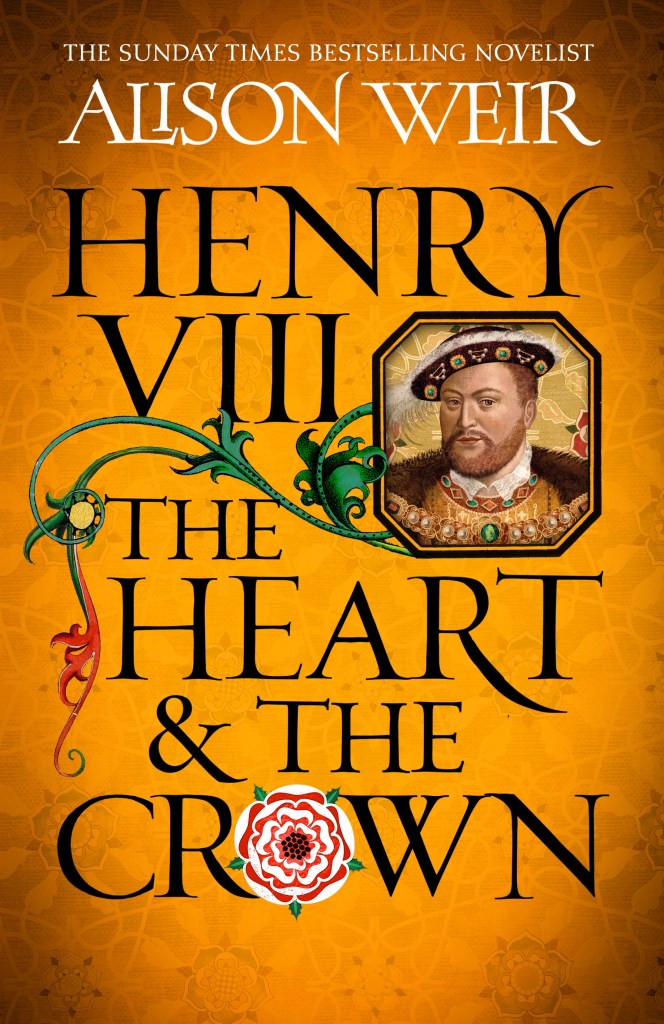
Henry VIII The Heart and the Crown by Alison Weir

I came to this book with quite a store of Henry knowledge – I promise not all of it comes from The Tudors, but this has been a great excuse to dig out the series again and enjoy Henry Cavill in leather trousers. In my previous home I had the alcoves each side of my fireplace turned into bookshelves and one side was all books on the Tudor period. A mix of novels and non-fiction it covered all the usual authors: David Starkey, Phillipa Gregory, Lucy Worsley, Alison Weir and many more. I have read each of Weir’s six wives series and her other novels on Elizabeth I and Lady Jane Grey. Her last novel was based on Elizabeth of York, Henry’s mother and daughter of Edward IV. All of them have been that brilliant mix of sound background research and an ability to get inside the characters and bring them to life. However, you don’t have to read any of her earlier work to enjoy this book, I’m just a Tudor Nerd! I wondered how Henry would fare, given that her previous books have shown great empathy for the position women found themselves in at the Tudor Court, especially where that ill treatment was at Henry’s hands. Interestingly, I read this alongside Prince Harry’s autobiography Spare, something that fascinated me given that Henry VIII’s story is largely influenced by that dynamic of ‘heir and spare.’ Henry is the man who was never intended to be king. Only the death of his brother Arthur, Prince of Wales, opened the way for a king who seemed almost meant to be. How could this well-built, ornately dressed and powerful man of the Holbein portrait not have been the King? It seems strange to think he was probably destined to be Duke of York and of much lesser importance than the huge presence he still is in our royal history. Did I see parallels between the man whose Twitter followers call Good King Harry and this similarly red-haired Tudor spare? Only a few!

I thought what Weir did really well was put Henry’s controversial and bloody reign into context. It’s easy to forget where Henry comes from and how violent and treacherous the route to the Crown was prior to his birth. As Weir explains, Henry’s maternal grandfather was Edward IV, a man who took the crown in the years of fighting between the York and Lancaster royal houses, known as the Wars of the Roses after the county emblems of the white and the red rose. However, it was also known as the Cousin’s Wars and to put that in a modern context it’s as if Princes Harry and William fought for the crown against Princesses Beatrice and Eugenie. It took a concerted effort by Henry’s grandmothers Margaret Beaufort and her rival Elizabeth Woodville to bring both houses together with a royal marriage and the new emblem of the Tudor Rose. Margaret was Henry VII’s mother and fought hard for her son to claim his crown, which he eventually did on the battlefield against Richard III. Elizabeth was Edward IV wife and despite losing both her sons, the rightful heirs to the throne who are believed to have been murdered in the Tower of London, she encouraged her daughter Elizabeth of York to make a political marriage to Henry Tudor, the new King. The emblem of their arranged marriage was a red rose for Lancaster with a white centre for York. These became known as the Tudor Rose and can be seen in many Tudor palaces and churches like York Minster. The country had endured years of in-fighting, from huge battles to hidden murders such as Edward IV and Richard, then Duke of York, allegedly murdering their brother by drowning him in a barrel of malmsey. Henry’s parents brought some stability to the country, despite Henry VII’s constant paranoia about usurpers and the lost Princes from the tower reappearing. If we imagine all of this followed by the death of Henry’s elder brother Arthur who died without heirs, it’s possible to see some of pressure upon the young king’s shoulders. Considering the paranoia he witnessed in his own father and his grandmother Margaret who drilled it into Henry that the only way to keep the crown secure was to have heirs, we can see the seeds of Henry’s own obsessions, paranoia and hatred of betrayal.

Often we only see the later King Henry on television and in fiction, because those latter years of his reign from meeting Anne Boleyn onwards are so dramatic. It’s easy to forget that Henry ruled and lived happily with his first wife and Arthur’s widow Catherine of Aragon from 1509 until he met Anne Boleyn in 1525, although he remained married to Catherine until 1533. There are only fourteen years between his marriage to Anne until his own death in 1547, in which he married, divorced or beheaded four more wives. I loved how Weir captures the earlier and often ignored years of Henry’s reign because we see something of the great prince that all of Europe were talking about. A tall, handsome and robust young man in direct contrast to his brother Arthur, he was also a great horseman and a competitive jouster. He was often reprimanded for missing lessons in order to go hunting or practising in the tilt yard with his companions, usually Charles Brandon. Yet he wasn’t just an imposing physical presence, Henry was very intelligent in that he spoke French and understood Latin and was even taught by the philosopher Erasmus. He could compose music and was an elegant dancer, with a definite eye for the ladies of the court. Even his early happy years with Catherine were littered with affairs, the most famous being Anne’s sister Mary Boleyn and Bessie Blount, both of whom were rumoured to have the King’s illegitimate children. It was interesting to read about Henry’s role in welcoming Catherine as Arthur’s bride and how much he admired her from a very young age. After Arthur’s death he was adamant he wanted to marry Catherine, with a dispensation sought from the Pope for their union. Henry’s father seemed reluctant to solemnise the match, despite a betrothal ceremony taking place. I have read elsewhere that the King had considered Catherine for himself and it was only when the King died that their marriage took place, in fact it was one of the first things Henry did as King. He may not have been faithful physically but there was a constancy in Henry’s feelings for Catherine, he admired her greatly and felt she would be a fitting queen for him.

Weir also shows how different Henry’s court was from his father’s. Henry VII had faults, but he was contemplative, careful when making decisions and had financially secured their reign after finding a depleted treasury due to years of war. Henry wanted to be a generous King, known to keep a a celebratory and ostentatious court. He undertook building new palaces, promoting art and culture, keeping a generous table and was determined to use some of the money saved by his father to take Calais and become King of France once more. He wanted to excel in all things, but this extravagance was also a sign of things to come, developing from generous young King to a petulant and spoiled man with a body ruined by greed, excess and risk taking. The most damaging risk being his jousting accident, where he was knocked out cold for some time and sustained a leg wound that never healed, caused intense pain and smelled terrible due to infection. I have often wondered whether it was possible that he sustained a head injury in this accident, because it does seem to be a turning point in his life, after which he made several questionable decisions. He decreed that his courtiers should acknowledge and accept his relationship with Anne Boleyn as well as his plan to make her Queen. His insistence on this point led to a relationship breakdown with one of his most trusted advisors, Sir Thomas More. The day he executed More was also a point of no return, I believe it haunted him for the rest of his life that he’d killed a good man, a man of God.

Weir made me look at Henry’s early life with more empathy than I have before. She brings to life the childhood loss of his mother (another event in common with our Prince Harry) and the huge impact it had. He remembers her softness and her gentle voice, a memory he needs when his father is preoccupied with duty. Henry has to grow up early, but little reminders of his mum pop up everywhere, especially her smell. I felt he could have been a different man if she had lived. There are some warning signs of the tyrant he becomes, because he’s jealous of Arthur from a young age. Arthur keeps his own court in Wales and Henry would love to have his own court, his own income and a bit of Arthur’s power, not to mention wanting Arthur’s bride from when she first arrived in the country. When all of it becomes his I did wonder whether there was a bit of survivor’s guilt. His father’s paranoia about losing the crown and his over-protectiveness after the death of his first son, mean he keeps Henry from carousing in bars with his friends and preserves some of his reputation for marriage. Weir shows us the weight of that history and expectation on the young prince’s shoulders. It’s something Henry is constantly pushing against, so that when he does unexpectedly become King he is determined to make changes. He has a tendency to promote men who are self-made, above the usual courtiers or advisors of his father’s. He relies on Cardinal Wolsey and after that he promotes Thomas Cromwell, a commoner and son of a blacksmith. The men who advised his father are old now and have known Henry his whole life, they’re aware of a recklessness in the young King that needs reigning in. Newly made men show the deference Henry expects as a King, but being younger and perhaps more aware of the way the world is changing they also allow him to take risks. We also see Henry’s own paranoia emerging when he and Catherine start to lose children, most particularly his two month old son. I felt like I understood Henry better after reading this novel and it was interesting to see some thoughts I’d had about Henry’s personality and behaviour placed in context. I didn’t like him more, but I did feel sorry for him in parts especially in his difficult relationship with his father. Weir provides possible reasons for the cruel and changeable behaviour that made Henry the most famous King in our history. I felt completely immersed in his psyche but also the whole Tudor court because Weir breathes life into a story we all know something about, turning historical caricatures into real people. Their problems also seem less far-fetched given Royal headlines over the last few years, although this spare ended up with the crown.

Many thanks to Headline Review and Caitlin Raynor for my proof copy of this novel and to Anne at Random Things Tours for my place on the blog tour and your support.

Meet the Author

Alison Weird is a bestselling historical novelist of Tudor fiction, and the leading female historian in the UK. She has published more than thirty books, including many leading works of non-fiction and has sold over three million copies worldwide. Her novels include the Tudor Rose trilogy which spans three generations of history’s most iconic family – The Tudors, and the highly acclaimed Six Tudor Queens series about the wives of Henry VIII, all of which were Sunday Times bestsellers. Alison is a fellow of the Royal Society of Arts and an honorary life patron of Historic Royal Palaces.

Posted in Random Things Tours

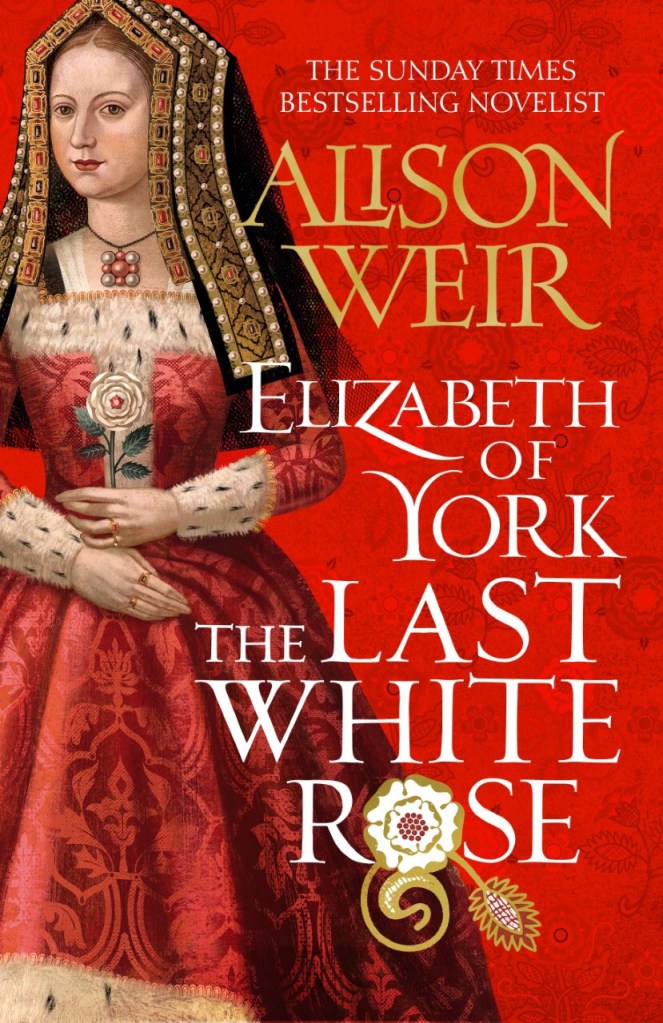
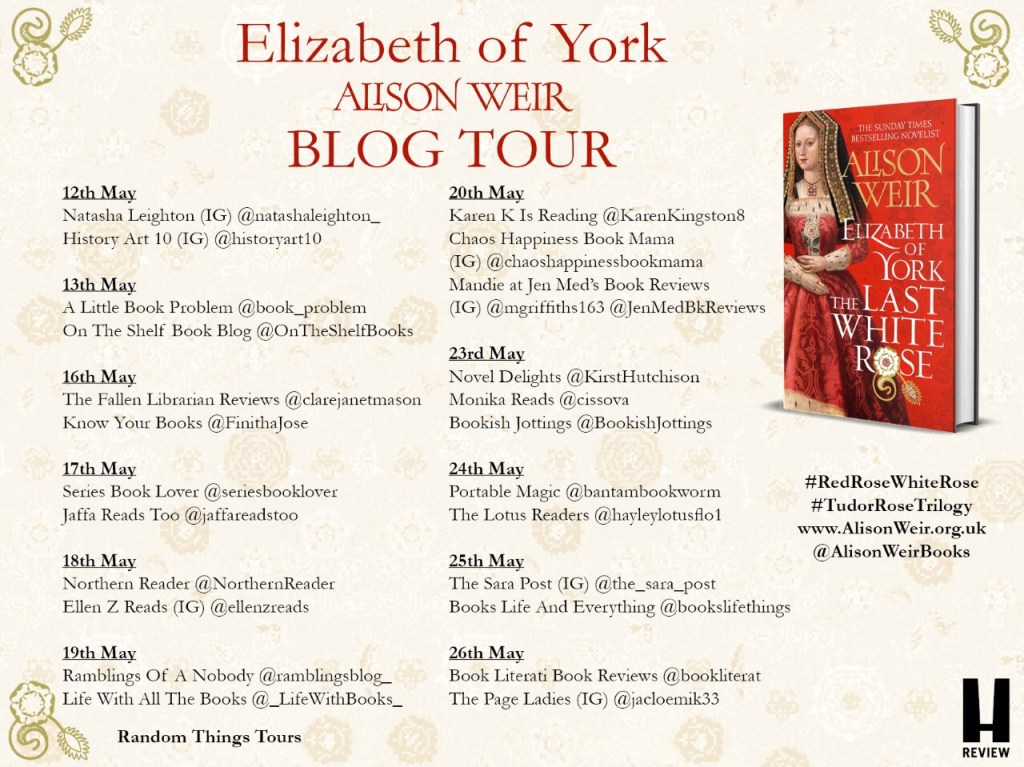
Elizabeth of York: The Last White Rose by Alison Weir

I love novels of courtly intrigue, in fact at my previous home I had shelves placed in the alcoves either side of the fireplace and one whole side was devoted to books on the Tudors and the Wars of the Roses. So the story of Elizabeth of York is familiar to me, but I love Alison Weir’s books and I was interested to see her take on this incredibly important Queen. As Alison Weir states in her afterword, Elizabeth is at the juncture of several important events in England’s royal history. There’s the instability caused by the Wars of the Roses or Cousin’s War, with battles, changes of allegiance and her family’s fortunes rising and falling with every intrigue. There are parts of her life shrouded in mystery and with differing viewpoints from historical researchers and novelists. I have always wondered how her relationship with Richard III changed from niece and uncle, to prospective wife. I have read accounts that suggest an affair between the two, one that took place in front of Richard’s sick wife Anne Neville and was branded scandalous in the court. I wanted to read Alison Weir’s take on this strangely incestuous relationship, whether Elizabeth was complicit and desired the match or whether this was a political match – suggested by Richard who wished to legitimise his rule, above the claim to the crown held by Elizabeth’s brothers and sons of Edward IV. Did Elizabeth, and her mother Katherine Woodville, see this as the only way to secure their family’s safety under Richard’s rule? The other mystery is that of the missing princes in the tower, a subject Alison Weir has looked at closely before. Some accounts suggest a conspiracy drawn up by Henry VII’s mother Margaret Stanley, to advance her son’s claim to the throne and label Richard III forever as guilty of regicide and killing his own nephews. Others lay the blame squarely at Richard’s door, for arranging their murder then forever hiding their remains so they couldn’t even have a proper burial. I was interested in how Elizabeth coped with potential marriages to the very two men who had most to gain from her brother’s killing.

The novel begins at one of life’s terrible downturns for the family, as Edward IV’s wife Katherine is forced to flee to sanctuary with her children, Elizabeth being the eldest. This time shut off from the world and all the comforts they were used to had a huge impression on Elizabeth and could have been enough of a trauma to be an underlying cause of the choices she made in later life. The fear of having nothing, facing poverty and being barred from courtly life is ever present and the privilege of her royal blood, her claim to the crown and her importance to England is drummed into her from a young age. I often think that it was Mary Boleyn who had the right idea, a generation or so later, of leaving court and all it’s intrigues behind and becoming the wife of a farmer. If you are always told you are destined to be a Queen though, does that sort of thought ever enter your head? Court is really the only life that Elizabeth knows. The author really puts across the drama of courtly life, especially during Henry VII’s reign when any whiff of a usurper seems to have him running to her rooms in a panic. The stress seems constant and I did wonder how many of these people died purely from lifestyle.

The feasting was incredible, with weird mixes of courses confusing the eater’s tastebuds and stomach, taking them from brawn, fish in jelly, custard then to peacock. These snippets of courtly life set the scene so well and almost dazzle the reader with such a sense of spectacle. I would find myself distracted from all the stress, and the grief, by the descriptions of week long revels and Christmas celebrations. Just a description of the costumes for a masque or the clothes of the time gave that sumptuous and luxurious feel to the court. I was rather reminded of another Queen Elizabeth and the lavish celebrations planned for the end of this month. Weir captures that element of disguise and distraction that’s still apparent between the royal family’s private and public arenas today. I am largely disinterested in our current royals, but a wedding will dazzle me and I end up watching the whole thing. If told how much it’s cost I get incensed, but then I get sucked in by the whole spectacle. So, in a time when supporting a royal household could mean getting caught up in a costly and dangerous war I could see how the ceremony would have to be even more lavish to gain the public’s attention. Men in the novel don’t have the luxury of choice, so if you were a tenant of the local landowner you were compelled to fight for their cause, no matter whether you agreed or not. Thank goodness that today, royal rivals only parade their discord round the chat shows and not on the battlefield.

Ultimately though, I felt some sympathy for this young woman who was borne of a King who won his crown on the battlefield, then promised in marriage to a man who won his crown in the same way. Like most women of her time, her fate is decided for her, albeit it in a more dramatic way than most. Here she seems to love Henry and the older they get, they mellow and the closer they become. I did wonder whether other novels strayed nearer the truth, that fed up with being constantly touted as the most eligible lady in England, her relationship with Richard was something she was complicit with, a type of rebellion where she was willing to ruin herself just to have some agency in her own life. What I love most about this book was how well written it is, obviously meticulously researched and gave me a slightly different perspective to events I knew well. For example, Margaret Stanley the King’s mother, is described as kind and almost sweet in character for the small ways she tries to look after those around her. I thought that Elizabeth’s relationship with Lord Stanley was interesting and probably gives us the biggest clue to this young woman’s real character and motivations. Stanley is known for changing allegiances when he’s sure which way the battle is turning. At the Battle of Bosworth he rode out with Richard III, only to turn to his stepson’s cause and actually strike down the King, taking his crown and placing it on Henry VII’s head. He and Elizabeth are made of similar stuff, each one watches the way wind blows before committing in order to survive. We can see her as blown about by that prevailing wind or as a politically astute young woman who knows how to secure her children’s future.

Meet The Author

Alison Weir lives and works in Surrey. Her books include Britain’s Royal Families, The Six Wives of Henry VIII, Children of England, Eleanor of Aquitaine, Henry VIII: King and Court, Mary, Queen of Scots and Isabella: She-Wolf of France.