Posted in Random Things Tours

The April Dead by Alan Parks.

NO ONE WILL FORGET . . .

In a grimy flat in Glasgow, a homemade bomb explodes, leaving few remains to identify its maker.

Detective Harry McCoy knows in his gut that there’ll be more to follow. The hunt for a missing sailor from the local US naval base leads him to the secretive group behind the bomb, and their disturbing, dominating leader.

On top of that, McCoy thinks he’s doing an old friend a favour when he passes on a warning, but instead he’s pulled into a vicious gang feud. And in the meantime, there’s word another bigger explosion is coming Glasgow’s way – so if the city is to survive, it’ll take everything McCoy’s got . .

I was lucky enough to be on the blog tour for the third book in Alan Parks’s Harry McCoy series, so it was a real treat to be able to read this one straight away, back to back. This is real Sottish Noir at its best as we follow a new case for Harry, in the crime ridden streets of 1970s Glasgow. I visit Glasgow a lot, and love its galleries, architecture and museums but this isn’t touristy, post-City of Culture, Glasgow. This city is grimy and dangerous, plagued by violence from criminal and sectarian gangs. Harry grew up in these rough, tenement areas of the city and it’s where his friendship with Steve Cooper started; back in their childhoods way before Harry became a police officer, and Stevie went in a very different direction. Harry’s loyalty to his old friend, means that he’s there at the prison gates when Steve gets out after a six-month stretch inside. Steve’s position as the boss of a criminal enterprise means he has to pick up where he left off – looking for whoever betrayed him. Loyalty is vital to an organisation like Steve’s and he won’t rest till he knows where the leak is. No matter how much he still feels like the big crime boss he always was, things have changed. Harry drops him at his old council flat knowing that even his own loyalty may be called into question.

The case Harry investigates is one of a bombing, not that unusual in the 1970s as the sectarian troubles in Ireland spread over to the mainland. However, the IRA’s targets are usually more illustrious than a flat in Woodlands. The only casualty seems to be the bomber with his remains scattered around the property. This is usually a job for Special Branch, so Harry is shocked to find it falls to him, and his sleep deprived colleague Wattie, to investigate. Wattie has become a father and is an easy target for DCI Murray. Murray thinks Wattie isn’t up to the job and Wattie begs McCoy for support, especially when the DCI piles a murder investigation on top of his other work. To make things worse for Harry, the prime suspect in the murder is Steve Cooper. Harry is well and truly in the middle, trying to keep the peace and his loyalty to many different people at once. His main concern is that there will be a bigger bomb, a more public target, and a long list of casualties. When this happens, Harry finds his loyalties called into question again, this time from a Special Branch officer who thinks McCoy may have connections to the IRA.

This investigation will lead Harry into the past, and a history of British military atrocities committed as the empire collapsed and beyond. The bomber follows an old army leader with murderous loyalty, and Harry stumbles across terrible hidden truths. The dark, atmospheric house in the country will stay with me, it’s terrible secrets never known until now as Harry uncovers evidence of torture and killing. Have these horrible acts ended though? Or is someone still carrying out killings in this terrible place? As if Harry doesn’t have enough to do, he’s also charged with finding a missing son of an ex- naval captain. Donnie Stewart was based in Scotland following in his father’s footsteps in the navy, but now he’s gone AWOL. His father travels to Scotland from retirement in America, keeping the pressure on Harry to leave no stone unturned looking for Donnie.

There is so much going on here, and so many loose ends to chase. However, one of the things I love about this series is that the author doesn’t just focus on the plot. He puts the characters and the intricacies of their relationships front and centre too. The relationship between Steve and McCoy is particularly interesting, especially in this instalment where pressure is placed on them both. It’s very interesting to see how Harry balances his job upholding the law, with his loyalty to his friend. Steve drags him into the fight with another crime boss, trying to use Steve’s recent time in prison as a chance to muscle in on his patch. This stretches Harry to his limits and place some edge into their relationship. Yet there is still that sense of a long held friendship that allows some black humour to creep in, even when the stakes are high. McCoy has a similar rapport with his colleague Wattie, but also some sensitivity too. He empathises with Wattie’s position as a new dad, and shows his concern. This is a sensitivity that spills over into his dealings with Donnie Stewart’s father too. I had the sense this wasn’t just being a good police officer, it was a softer side to Harry that maybe had something to do with getting older. What I loved most though is the author’s love of the wonderful city of Glasgow, in all its dark and dirty 1970s glory. He highlights the social injustices of the city, and the wry humour of its people. I would highly recommend this series to anyone who loves crime fiction and I look forward to May in the series.

Check out the other bloggers on the tour and their thoughts on The April Dead.

Meet The Author

Before beginning his writing career, Alan Parks was Creative Director at London Records and Warner Music, where he marketed and managed artists including All Saints, New Order, The Streets, Gnarls Barkley, and Cee Lo Green. His love of music, musician lore, and even the industry, comes through in his prize-winning mysteries, which are saturated with the atmosphere of the 1970s music scene, grubby and drug-addled as it often was. Parks’ debut novel, Bloody January, propelled him onto the international literary crime fiction circuit and won him praise, prizes, and success with readers. The second book in the Harry McCoy series, February’s Son, was a finalist for a MWA Edgar Award. Parks was born in Scotland, earned an M.A. in Moral Philosophy from the University of Glasgow, and still lives and works in the city he so vividly depicts in his Harry McCoy thrillers.

Posted in Random Things Tours

The Source by Sarah Sultoon.

This was one of those books. The ones that make me stay up till 3am because I simply have to see the story through. Sarah Sultoon’s novel takes us straight into the action, starting in 2006 with a very tense scene where a group of men are discussing the terms for the exchange of a trafficked girl. Once outside and in their van, there’s a huge sigh of relief from everyone – the man is a journalist and he is deep undercover trying to expose the horrifying trade in young girls for sexual exploitation. In my head as I continued reading, was the author’s harrowing description of the girl in question. She’s shown off as if at a market, stunned by the terrible experiences she’s gone through so far. A young girl called Marie is working with the team and she has found the sight of the girl deeply upsetting, but is committed to bringing these people to justice and sometimes that means confronting awful practices or seeming complicit in acts that make them sick to their stomach. This time though, they’re sure they’ve got them.

We’re then taken back to our second narrator, a 15 year old called Carly living in an Army town called Warchester. The barracks loom large in town, the pubs are full of squaddies and even the roads have lanes specifically for Army vehicles. The Army has loomed large in Carly’s life too. Her dad is dead, killed in action. She and her brother Jason have never met him, but Jason followed his dad into the family business and is now stationed at the barracks. Carly lives in army accommodation with her mum and half-sister Kayleigh, who is still a baby. They live off her Dad’s pension, but it doesn’t always go far when Mum drinks. Carly is used to coming home to a mum who’s insensible, slumped in front of the TV and Kayleigh screaming her lungs out because she hasn’t been changed or fed all day. Carly is just about holding it together so that social services aren’t on their backs, but it isn’t easy. That’s why she needs time to blow off steam and just be a 15 year old, so when her friend Rachel invites her to a party at the barracks she is tempted. Rachel has a contact, and a secret way in where they won’t be seen. However, I could sense something ominous in Rachel’s reassurances to Carly – to just go along with what they want to do. Her instructions could be construed as grooming and I was worried about exactly what type of party this was going to be.

Our narrative flits between the two different women. Marie has clawed her way up into journalism the hard way, but is a diligent junior member of the term. That is until some news comes through that derails their trafficking expose and seems to shock Marie to her core. A press conference is suddenly called about a previous investigation called Operation Andromeda and the commissioner herself will be making the announcement. Every media outlet needs to be down at New Scotland Yard now, and when the announcement comes the room falls silent. The commissioner recaps for the press that Andromeda was an investigation into the sexual exploitation of young girls by those in the Army, followed by prosecutions. What happened to Carly all those years ago, happened to others too. The commissioner talks about failed victims, up to and beyond the dates they originally investigated. Girls who were let down and soldiers left to commit more crimes on further generations of girls. The news team know that there were potentially two girls exploited and abused in Warchester: Girl A who gave evidence in the original court case, but also Baby Girl A, removed from her parent after the abuse and taken into the care system. Both were given new identities.

This is a complex story in terms of who knew what was happening, who is part of the cover up and who is working on the inside to expose what happened. Although it adds to the tension and rapid pace of the novel it isn’t what grabbed hold of me. It was the human stories that really moved me and its easy in a case this big and a conspiracy so complex to forget what has happened to the individuals involved. By including Carly’s narrative we can see how this happened on a human level. In a town where kids are brought up to revere the army and its men, with few other opportunities and insidious grooming technique at play, it was easy. Rachel is the girl on the inside, recruiting her friends just as she was once recruited – this type of abuse is generational. She coaches Carly in what to do, how to please and slowly ratchets up the pressure for her to do more extreme things until it becomes Carly’s normal too. Generations of Warchester men have joined up and done their service. She’s doing what generations of Warchester girls have done, they do their service too. Yet, because Rachel is over 16 when the original investigation happens she could be tried as an adult for grooming the younger girls, despite having also been groomed into this behaviour when she was a child. The author shows us what happens when abuse is institutional, when safeguarding fails and a community is complicit. It’s a very hard read in parts – the neglect as upsetting as the sexual abuse – but it should be hard and people should be shocked by it. I felt the author had done her research and depicted the psychological effects of abuse thoroughly, showing how they persist into adulthood. She showed the effect of being let down, by family, friends, community and the agencies that are meant to help. However, Carly shows us how one person’s persistence and courage can force justice, of a kind. I love that this author was brave enough to write this novel and that she found a publishing house to share her vision.

Meet The Author

Sarah Sultoon is a journalist and writer, whose work as an international news executive at CNN has taken her all over the world, from the seats of power in both Westminster and Washington to the frontlines of Iraq and Afghanistan. She has extensive experience in conflict zones, winning three Peabody awards for her work on the war in Syria, an Emmy for her contribution to the coverage of Europe’s migrant crisis in 2015, and a number of Royal Television Society gongs. As passionate about fiction as nonfiction, she recently completed a Masters of Studies in Creative Writing at the University of Cambridge, adding to an undergraduate language degree in French and Spanish, and Masters of Philosophy in History, Film and Television. When not reading or writing she can usually be found somewhere outside, either running, swimming or throwing a ball for her three children and dog while she imagines what might happen if…..

Posted in Random Things Tours

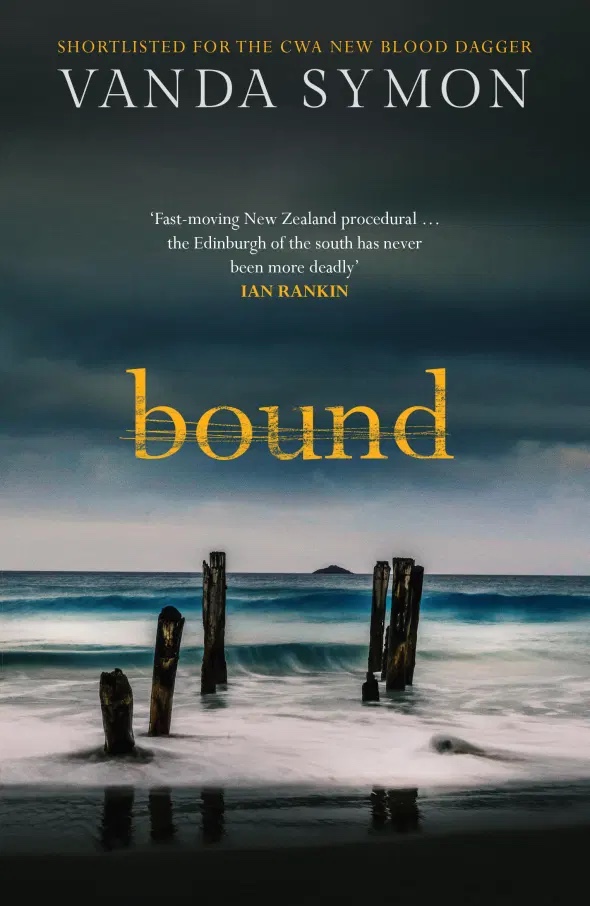
Bound by Vanda Symon.

When the official investigation into the murder of a respectable local businessman fails to add up, and personal problems start to play havoc with her state of mind, New Zealand’s favourite young detective Sam Shephard turns vigilante..

The New Zealand city of Dunedin is rocked when a wealthy and apparently respectable businessman is murdered in his luxurious home while his wife is bound and gagged, and forced to watch. But when Detective Sam Shephard and her team start investigating the case, they discover that the victim had links with some dubious characters.

The case seems cut and dried, but Sam has other ideas. Weighed down by her dad’s terminal cancer diagnosis, and by complications in her relationship with Paul, she needs a distraction, and launches her own investigation.

And when another murder throws the official case into chaos, it’s up to Sam to prove that the killer is someone no one could ever suspect.

I really enjoyed this crime novel with an interesting lead character, a case with so many twists and turns, and an array of background issues to get my teeth into. Our detective Sam Shephard is a strong woman, adept at her job and extremely dedicated too. She lives with a friend, but is in a relationship with Paul, another detective in the squad. When they get the job investigating the murder of reputable local businessman John Henderson, they soon find a link to a previous case. Two well-known criminals are implicated in the brutal shooting, both of them suspected in the murder of their fellow officer Reihana, and attempted murder of Smithy, who is still struggling physically despite being back at work. They need to find the link between regular business and the less ethically sound dealings that has brought the business into the criminal underworld. However, they also need to make sure that all of their dealings with the case, including forensics and other evidence collecting, are squeaky clean. Smithy, and to some extent Sam, will have to be seen to take a back seat on this one. Besides, once the link is found, between the gangsters and Henderson, it should be cut and dried, but is it? Why did they leave his wife Jill bound to a chair, alive? It is possible that someone else in Henderson’s life have reason to kill him?

Sam finds herself impressed by their teenage son, who has had the presence of mind to film the crime scene on his phone before freeing his mother. She creates a good rapport with him and manages to get important evidence about their potential suspects and their business dealings with his father. Sam works with a lot of integrity and will not accept the easy answer, until she’s uncovered everything. She would love to find their suspects guilty, but has her own idea about the motive for this crime that goes against what they know so far. This puts her in contention with the DI and he is not happy, they’ve been butting heads a lot and he’s not going to back her theory. Sam may have to go it alone here and do enough to prove her theory, without him.

I really enjoyed Symon’s mix of the professional and personal in Sam’s life, it felt like a good balance between the two. Sam is trying to keep her relationship with Paul on the down low, but circumstances may be taking that decision out of her control. There was also an interesting family dynamic, as Sam’s father is brought to the hospital and will be discharged to a hospice. These are possibly the final weeks of his life, but it’s clear that her unpleasant boss DI Johns will be less than sympathetic. Even sending her out of state on an errand. Her Mum seems less than impressed with her dedication to her job. There’s clearly history between Sam and her Mum, who accuses her of not being there for her Dad. Sam protests that she will, but her Mum rejects her promise. Sam manages not to snap back knowing that her Mum is angry and scared about her husband and the future, it how long will she able to stay silent. The moment when she sits quietly with her father and whispers to him the one secret she hasn’t told anyone, was so moving.

The pace of the novel is great – one of those where the short chapters create that ‘I can fit in one more chapter before bed’ feeling. Developments come at us thick and fast, both in the case and in her personal life. What I loved is Sam’s absolute dedication to her job, and determination to uphold New Zealand’s laws. Often when female characters have struggles in their personal life, things start to fall apart at work. Not so for Sam, she is good at separating her work life from home life, despite her mother’s digs about her loyalties. I felt I was getting a fully rounded character, not the usual stereotype about strong, working, women who have a messy love life, divorces, a drinking habit. Although we get personal with her, I came out of the novel admiring a good detective, with a full professional and personal life. The fact that this stood out to me is worrying and says a lot about how professional women are still portrayed in fiction. The story kept my attention because it was full of small surprises, such as Henderson’s assistant Astrid, whose previous CV was unexpected. This led me to expect bigger twists and I kept on reading. The author left us a few loose ends too, and I’m a sucker for the unresolved bits. Plus now I’m already hooked into the next book!

Meet The Author

Vanda Symon is a crime writer, TV presenter and radio host from Dunedin, New Zealand, and the chair of the Otago Southland branch of the New Zealand Society of Authors. The Sam Shephard series has climbed to number one on the New Zealand bestseller list, and also been shortlisted for the Ngaio Marsh Award for best crime novel. She currently lives in Dunedin, with her husband and two sons. –This text refers to an alternate kindle_edition edition.

Posted in Random Things Tours

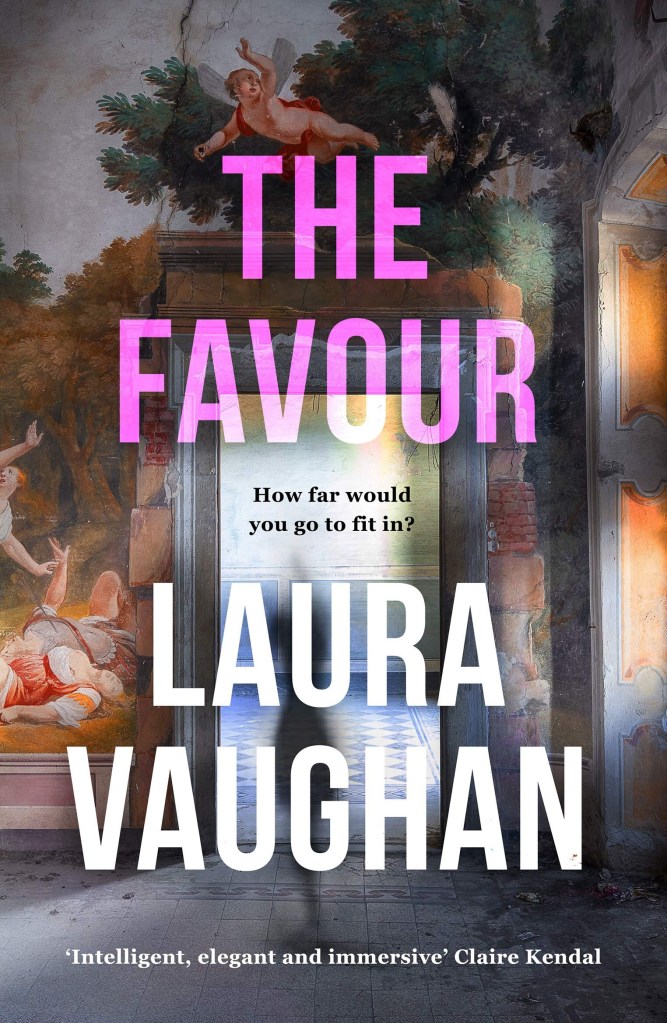
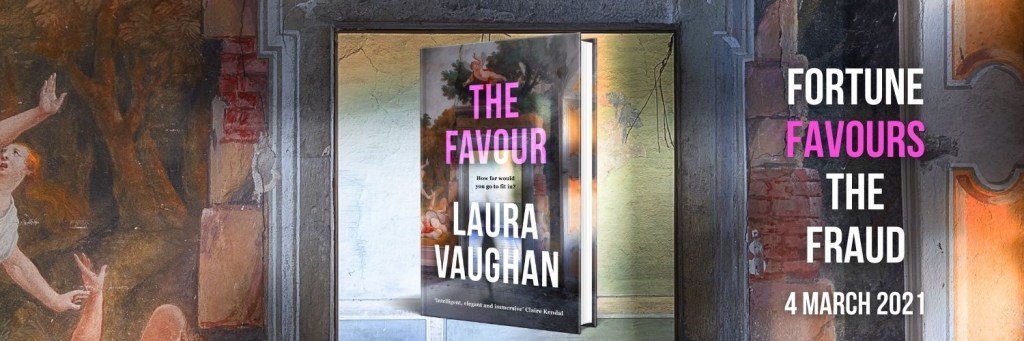
The Favour by Laura Vaughan.

Fortune favours the fraud…

When she was thirteen years old, Ada Howell lost not just her father, but the life she felt she was destined to lead. Now, at eighteen, Ada is given a second chance when her wealthy godmother gifts her with an extravagant art history trip to Italy.

In the palazzos of Venice, the cathedrals of Florence and the villas of Rome, she finally finds herself among the kind of people she aspires to be: sophisticated, cultured, privileged. Ada does everything in her power to prove she is one of them. And when a member of the group dies in suspicious circumstances, she seizes the opportunity to permanently bind herself to this gilded set.

But everything hidden must eventually surface, and when it does, Ada discovers she’s been keeping a far darker secret than she could ever have imagined…

I’m drawn to any book based in the beautiful cities of Italy, but I was also drawn by the premise of Ada’s inability to accept a change in circumstances after the death of her father means selling off the family’s ramshackle mansion in Wales. I felt that I might understand someone struggling to fit in between social circles having come from a working class family then through my 11+ ending up at a very middle class grammar school. I found it very hard to fit in, but once I did, it was just as difficult to fit back where I’d come from, forever caught between two different tribes. However, Ada was in another league altogether, totally unable to accept the life her mother had created for them. A period terrace in London and the local secondary school are not enough for her, nor is a stepfather with an ordinary, dull name like Brian. Her plan to study at Cambridge, at the same college as her father, falls through when she fluffs her second interview. It looks like she might have to accept her more humble lifestyle, but the along comes her godmother’s offer of a modern grand tour with Dilettanti Discoveries.

Now she has to find a way to fit in with the Lorcans and Annabelle’s of this world and she has a plan for that. Ada knows all the right lingo to seem like one of the group – using the phrase ‘we had to sell up’ is a distinctive one for people of a certain class. It has the scent of ‘distressed gentry’, people who have had to sell off the family pile due to death duties or renovation costs on their large country houses. She even talks about Garreg Las as the family’s smaller home, hinting of a more distinguished estate belonging to her father’s family in Ireland. One by one, as they stalk art galleries and churches, Ada tries to ingratiate herself with the group. Will they accept her story or sniff out the truth of who she is and where she belongs? These are deliciously awful people and there isn’t a single one I’d want to spend time with. They had an air of entitlement and superiority, but it was hard not to enjoy their witty, self-assured conversation. There’s a certain polish and charm that makes them alluring, but it’s all surface. Oliver seems suspicious of Ada, and Mallory has also been picked out as an outsider, being American and Jewish. However, Mallory’s attempts at friendship are shunned by Ada, who desperately wants to belong to the most fashionable set. To ingratiate herself with Lorcan, Ada reveals a secret; she has seen Lorcan’s half-sister Annabelle in a romantic clinch with one of their tutors. She agrees to keep the secret between them, to place herself at the centre of the group. Then, when a suspicious death occurs, Ada is not just at the centre of the group, she’s at the centre of a potential crime. She makes a decision to grant one of the group a favour, something you might barely notice, but it furthers Ada’s quest to belong. If one of the group owe her a favour, surely she becomes accepted forever? I didn’t even think about what it could mean going forward, but that’s how clever the book is. You are captive, watching each consequence of Ada’s decision opening up in front of you, one after another, like a set of Russian Dolls.

Meanwhile, in the background, Vaughan creates a beautiful backdrop of art, architecture and soft Italian light. I could imagine what a beautiful film this would make as these intriguing characters stroll through formal Italian gardens, along the Arno or in the twisty, labyrinthine lanes of Venice. All the reference points Vaughan touches upon – such as Ada glimpsing the same fountain where Lucy Honeychurch witnesses a passionate fight in Room With A View – were my own source of inspiration for visiting Italy. Of course the upper classes prefer the more refined Florence, whereas I’ll admit my lower class allegiance to Venice. This revered circle of friends have so many niche rules and in-jokes it’s impossible to negotiate them all, without tripping yourself up. Just like a valuable renaissance painting, being one of the elite is very difficult to fake. In these beautiful backdrops there are constant hints of fakery and disguise: the trompe l’oeil frescos of the country houses; the maze of laurel hedges; the association of Venice with carnival and disguise. Even the example of Room With A View has it’s plot of a well-to-do young girl on her own Grand Tour, trying to keep secret her love for a distinctly lower class clerk she meets at a pensione in Florence. All of this imagery and reference to facade, disguise and things not quite being as they seem adds to the atmosphere and intrigue. It’s like seeing a beautiful bowl of fruit, that at its centre, is rotten to the core. This book will make a great book club read, not only to discuss these awful characters, but to ponder on what we might have done in the same circumstances. As the years roll by, what price will Ada pay and how long can she maintain the facade she has built? This is a complex and intriguing novel, full of flawed characters, with a central character showing all the signs of a borderline personality – Ada simply doesn’t know who she is. There is a void at her centre that can only be filled by imitating and adopting the lifestyle of those around her, with possible lifelong ramifications.

Meet The Author

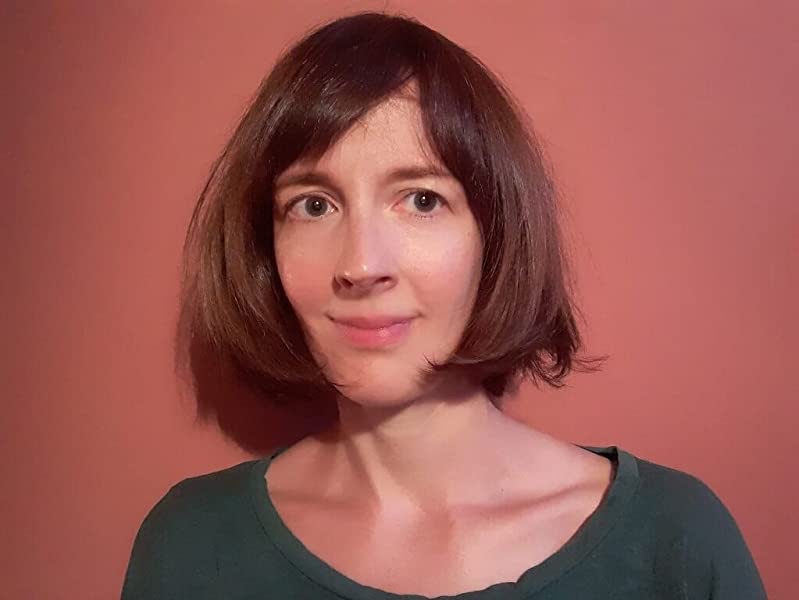
Laura Vaughan grew up in rural Wales and studied Art History in Italy and Classics at Bristol and Oxford. She got her first book deal aged twenty-two and went on to write eleven books for children and young adults. The Favour is her first novel for adults. She lives in
South London with her husband and two children.
For more information, please contact
Kirsty Doole
Publicity Director, Atlantic Books kirstydoole@atlantic-books.co.uk
07850 096902 @CorvusBooks | @theotherkirsty

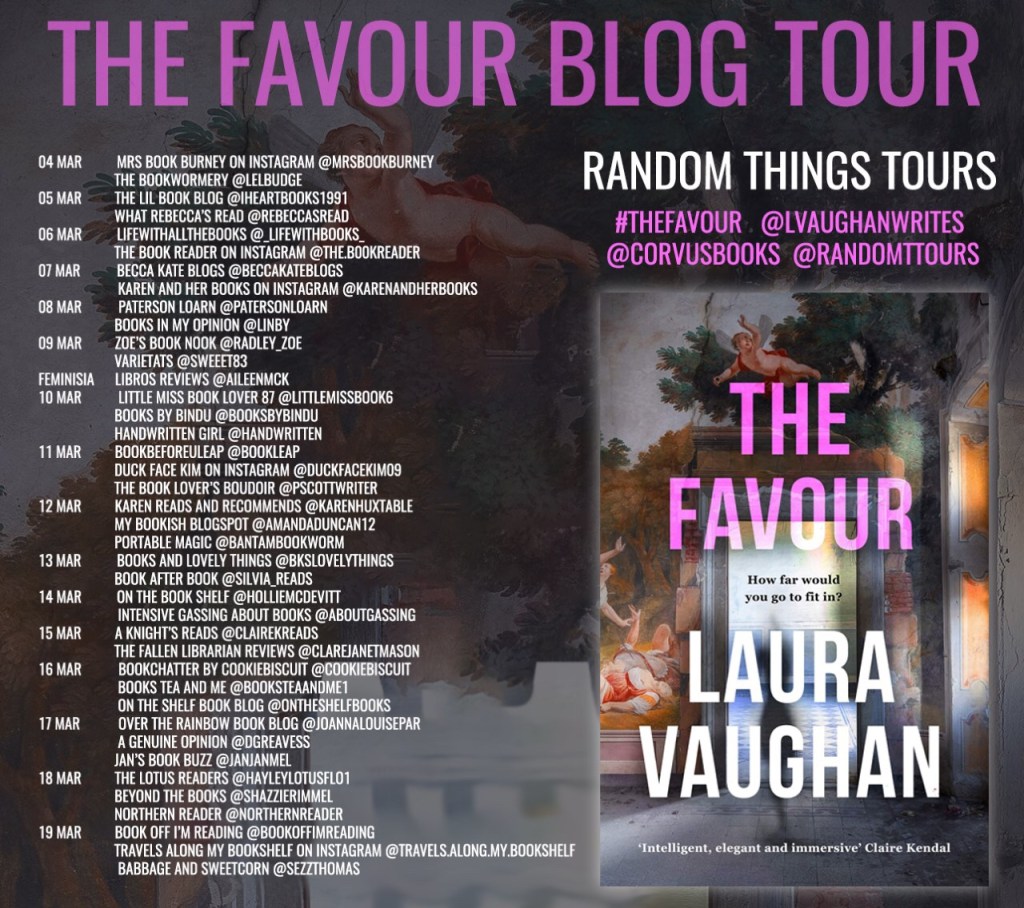
Now check out the other stops on the blog tour:

Posted in Random Things Tours

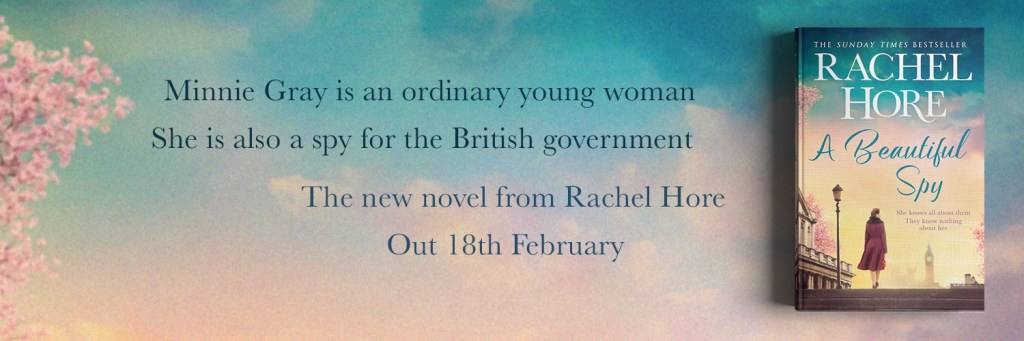
A Beautiful Spy by Rachel Hore

Minnie Gray is an ordinary young woman.
She is also a spy for the British government.

It all began in the summer of 1928…

Minnie is supposed to find a nice man, get married and have children. The problem is it doesn’t appeal to her at all. She is working as a secretary, but longs to make a difference.

Then, one day, she gets her chance. She is recruited by the British government as a spy. Under strict instructions not to tell anyone, not even her family, she moves to London and begins her mission – to infiltrate the Communist movement.

She soon gains the trust of important leaders. But as she grows more and more entangled in the workings of the movement, her job becomes increasingly dangerous. Leading a double life is starting to take its toll on her relationships and, feeling more isolated than ever, she starts to wonder how this is all going to end. The Russians are notorious for ruthlessly disposing of people given the slightest suspicion.

What if they find out?

I became very fond of Minnie Gray as I started to read this interesting new novel by Rachel Hore. Based on the true story of Olga Gray, a young woman recruited by Maxwell Knight in the 1930s, to infiltrate The Friends of the Soviet Union, the author has cleverly blended fact and fiction to create an intriguing and interesting novel. I loved how Minnie felt a little like a square peg in a round hole – even at home in Edgbaston with her mother (where she feels most like she belongs) she’s restless and somehow a little different to the others. At a garden party, she gravitates towards a woman playing croquet; a woman of very individual and modern style. It’s as if she recognises a woman like this wouldn’t be afraid of shaking things up. They talk about the possibility of Minnie making a move to London, that maybe she could be recommended as someone to work for the government. Minnie is so excited, this might just be that direction and purpose in life she’s been looking for. She wants something for herself, not the stereotypical marriage to a nice middle class man to produce 2.4 children, that her mother expects. She’s fed up of being at parties, dangled before an ever dwindling pool of eligible gentlemen. Her excitement, turns to hope as she waits for a phone call and watches the letterbox, but nothing comes. It’s only when she’s lost hope that a call comes for her to interview and she meets her ‘handler’ Max.

I loved the eccentric ‘Britishness’ of the people Minnie meets in her new life. Most interesting is Max, who has a flat like a menagerie, full of various animals including a parrot. She goes to work at the communist organisation as someone interested in helping others, rather than the cause itself. In order to supplement her income, she takes another niche job, typing for a distressed gentlewomen’s charity. Here she makes friends with another typist and starts to have something like a social life. Minnie is thriving out there on her own, but we are privy to her inner thoughts. She’s plagued with self- doubt – ‘is she doing this right?’ It often seems to her that she’s achieving very little, not important enough within the party to make a difference or furnish Max with anything useful. However, espionage is a long game, and the more insignificant and innocuous someone seems the better. Eventually she seems so much a part of the furniture that she is chosen to do something she never imagined. Having never been further than London, Minnie will be undertaking a mission to India as her career in espionage really takes off.

I could see how much work had gone into research, as well as mixing fact and fiction in such a way that it becomes authentic. The author embedded Minnie into the 1930s from her clothes, to societal norms and mentions of world events such as the rise of Nazism. In snippets of chat at the communist organisation I could hear ideas and concerns about the working class and keeping them on board with a left leading political party. This disenfranchised class would be easy pickings for Oswald Moseley’s fascist party in a couple of years time. This is a time of political turmoil across Europe, as the tensions started in the aftermath of WW1 begin to boil over. The author really emphasises the fear and trepidation of choosing a double life, especially as a woman. I loved Minnie’s determination to be different and do something important, despite often feeling lonely and scared. I felt the author balanced this well with her need for adventure, as well as the excitement and thrill that keeps her going as the work gets more and more dangerous. I thoroughly enjoyed this fascinating book. Rachel Hore has created a wonderful heroine who I found inspiring and authentic, with just a hint of vulnerability that made her so sympathetic. I felt completely transported to the 1930s, due to the author’s knowledge of this time period and her deeply layered descriptions of Minnie’s world. I could close my eyes and picture every setting – Minnie’s home, Max’s flat full of animals, an overcrowded train in India and the wall of heat before the monsoon rain. This was an excellent read for anyone who likes their historical fiction and enjoys determined and original heroines whose courage takes them on amazing adventures.

Meet The Author

I came to writing quite late, after a career editing fiction at HarperCollins in London. My husband and I had moved out to Norwich with our three young sons and I’d had to give up my job and writing was something that I’d always wanted to try. I originally studied history, so it was wonderful finally to put my knowledge to good use and to write The Dream House, which is partly set in the 1920s in Suffolk and London.

Most of my novels are dual narrative, often called ‘time slip’, with a story in the present alternating with one set in the past. I love the freedom that they give me to escape into the past, but also the dramatic ways in which the stories interact. My characters are often trying to solve some mystery about the past and by doing so to resolve some difficulty or puzzle in their own lives.

The books often involve a lot of research and this takes me down all sorts of interesting paths. For The Glass Painter’s Daughter I took an evening class in working with coloured glass. My creations were not very amazing, but making them gave me insight into the processes so that my characters’ activities would feel authentic. For A Week in Paris I had to research Paris in World War II and the early 1960s through films and books and by visiting the city – that was a great deal of work for one novel. Last Letter Home involved me touring a lot of country houses with old walled kitchen gardens in search of atmosphere and to explore the different kinds of plants grown there.

Places often inspire my stories. The Memory Garden, my second novel, is set in one of my favourite places in the world – Lamorna Cove in Cornwall – which is accessed through a lovely hidden valley. A Place of Secrets is set in a remote part of North Norfolk near Holt, where past and present seem to meet. Southwold in Suffolk, a characterful old-fashioned seaside resort with a harbour and a lighthouse, has been a much loved destination for our family holidays and has made an appearance in fictional guise in several of my novels, including The Silent Tide and The Love Child. Until very recently I taught Publishing and Creative Writing part-time at the University of East Anglia, but I’ve just become a full-time writer.

I hope that you are able to find my books easily and enjoy them – I am always happy to hear from readers!

Happy reading!  

Visit Rachel at http://www.rachelhore.co.uk, or follow her on Twitter @rachelhore or Facebook

Posted in Random Things Tours

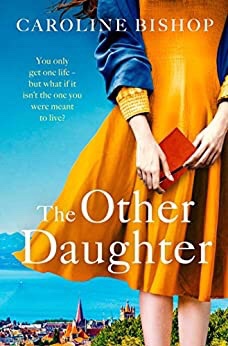
The Other Daughter by Caroline Bishop.

You only get one life – but what if it isn’t the one you were meant to live?

‘When it finally arrived I was shocked to see it; to read the words Mum wrote about these women fighting for rights I know I take for granted. Mum was here. And while she was, something happened that changed the entire course of my life. Perhaps, if I can summon the courage, the next eight weeks will help me finally figure out what that was . . .’

When Jessica discovers a shocking secret about her birth, it affects every area of her life. Her grief leaves her struggling at work and home, and sadly affects her feelings about being a mother. She takes advice from her godmother to take a break and she leaves her London home to travel to Switzerland in search of answers. There she takes a job as a nanny while researching her mother. She knows her journalist mother spent time in the country forty years earlier, reporting on the Swiss women’s liberation movement. What she doesn’t know, is what happened to her while she was there. Can Jess summon the courage to face the truth about her family, or will her search only hurt herself and those around her even more?

The story is told across two timelines. Jess in 2016 is just separated from her husband and taking a sabbatical from work. She has discovered a secret about her birth and wants more information. She knows her mother travelled to Switzerland in 1976 to research their fight for women’s rights. Women only gained the right to vote in 1971 after a referendum and I have always found this surprising. Sylvie travels there on hard won expenses trip. Her boss fails to see the value in an article on women’s rights, but she wins him round. I understood Sylvie’s journalistic interest in how late this date was, so I was interested as she convinced her editor to send her out to Switzerland in pursuit of the story around women’s suffrage in the country.

There was a slow beginning to the book, and it took me a while to gel with the characters. I was so glad I stuck with it though, because this was a slow burner and I became really involved with this family’s story. I know from working as a therapist, how difficult it can be for people to cope with secrets from the past, or an absence of knowledge about where they’re from. It’s this knowledge that Jess is looking for, in order to feel grounded. However, I also know that revelations about our history and background can leave us feeling adrift. We build a narrative about who we are and where we’re from; if that is shattered our sense of self can be too. The author really shows psychological insight, weaving these personal histories into a historical narrative – how Switzerland has treated women, including their legal right to participate in the democratic process and even their rights over their own bodies. I think Jess is so well rounded. There are so many layers to her character, and the deeper historical background mean she felt so real to me. I felt so invested in her story.

The revelations that come through Jess’s digging, but also through Sylvia’s narrative, take us down a path towards the truth. However, truth and written history are often two very different things. I feel that the author is clearly making a point about how a country’s history is written with an agenda. Often minorities and their experiences are erased from history and we need to move beyond the official version of events. I was worried that the truth Jess so desperately needed might not be real and she would be shattered again. The author has so much skill at creating a sense of place, both at the Swiss end and in London. She slowly drew me in and I became so involved in these character’s lives. There were times when they brought a lump to my throat, my emotions were so invested. This is an incredible debut and I look forward to more from this talented writer.

Meet The Author

Caroline is a British freelance writer currently living in Switzerland.

​In the past 15 years or so she has written about travel, food and theatre for newspapers, magazines and websites including The Guardian, The Telegraph, The Independent, BBC Travel, Adventure Travel, France magazine and others. She was also the editor of anglophone Swiss news site TheLocal.ch for two years, during which time she became fascinated with aspects of Swiss history and culture, particularly the evolution of women’s rights, which forms the backdrop to The Other Daughter, her debut novel. 

Visit Caroline’s website at http://www.carolinebishop.co.uk or follow her on Twitter @calbish and Instagram/Facebook @carolinebishopauthor

Posted in Random Things Tours

Smoke Screen by Jorn Lier Horst and Thomas Enger

It’s Oslo, New Year’s Eve and crowds are gathering for the annual fireworks display in the city square, when a huge explosion rocks the area and Oslo is put on terrorist alert. News and crime blogger, Emma Ramm, was down there hoping for some space from her boyfriend. Unfortunately Casper followed her, and was caught up in the explosion with fatal consequences. Instead of stopping and grieving, Emma becomes intrigued with another of the fatalities. Mrs Semplass is blown into the water off the quay and has suffered dreadful injuries. Police officer Alexander Blixx has rushed to help, and he brings Patricia out of the water but it is too late to save her. Ramm and Blixx have a past that will always connect them. He is something of a father figure to Ramm and his concern for her is touching, especially since she gets in his way so much. He also admires Ramm for what she can uncover and her tenacity when following the evidence, however much she treads on his toes. Yet she’s reckless at times and puts herself in dangerous situations which worries him. They both set out to investigate, not just the explosion but the coincidence.

They have come across Semplass before, her daughter Patricia was abducted many years ago, when she was only two years old. The crime remained unsolved and they never found Patricia, something that haunts Blixx to this day. Now that Ruth-Christine is dead, it is the last time Blixx may be able to look at this case again. When another familiar name comes up in the bombing investigation, Blixx suspects this is more than a coincidence and starts to dig. Blixx and Ramm begin parallel investigations in alternate chapters to each other; one hoping to find her boyfriend Casper’s killer, the other hoping to finally break a case that haunted him. They cross paths so many times, reaching the same conclusions, but using different methods. This is a very dark and complex case that will affect all of those concerned.

The characterisation was fantastic, each character was so immediately believable and whole. Emma is a dogged investigator, determined to find the truth whatever the cost to herself and unable to focus on the loss of Casper. She’d had doubts about the relationship before the explosion so she feels awkward. This is confused further when his parents try to look after her and take her back home with them for the funeral. When she finally agrees to stay with them she only manages 24 hours before wanting to be free, chasing her latest clue. It’s as if she’s unable to stand still or accept support from anyone, she prefers to stand alone. I loved how the author made even small characters sympathetic and interesting. A cleaner at the hotel where the bomber stayed really drew me in, first as she kept finding a ‘do not disturb’ sign on his hotel room door, but then in a tense scene as she walks home. She thinks she knows the missing man by his shoe laces, the pace intensifies as she hears someone behind her, the pace quickens and by the time she’s face to face with her pursuer my heart was racing!

The short chapters added to the pace and any switches between writer were seamless, as was the translation. The earlier chapters slowly set the story up and let us try and piece together the clues. The pace picked up considerably towards the end and I ended up reading very late at night to finish it. I’d made some correct guesses about what happened to Patricia Semplass, but I hadn’t fully worked out this complicated plot that neatly ties up all the loose ends. It was the perfect Scandi Noir novel: atmospheric, complex, dark and surprising. I finished the book with an immense sense of satisfaction and another series of novels to collect for my bookshelves.

Meet The Authors

Thomas Enger is a former journalist. He made his debut with the crime novel Burned (Skinndød) in 2010, which became an international sensation before publication. Burned is the first in a series of five books about the journalist Henning Juul, which delves into the depths of Oslo s underbelly, skewering the corridors of dirty politics and nailing the fast-moving world of 24-hour news. Rights to the series have been sold to 28 countries to date. In 2013 Enger published his first book for young adults, a dark fantasy thriller called The Evil Legacy, for which he won the U-prize (best book Young Adult). Killer Instinct, another Young Adult suspense novel, was published in Norway in 2017. Rights have been sold to Germany and Iceland. Enger also composes music, and he lives in Oslo.


Jørn Lier Horst is one of Norway’s most experienced police investigators, but also one of Scandinavia’s most successful crime writers. He writes engaging and intelligent crime novels that offer an uncommonly detailed and realistic insight into the way serious crimes are investigated, as well as how both police and press work. His literary awards include the Norwegian Booksellers’ Prize, the Riverton Prize (Golden Revolver), the Scandinavian Glass Key and the prestigious Martin Beck Award.

Posted in Random Things Tours

Space Hopper by Helen Fisher.

I first read this book last year, but then the release date changed. When I was asked onto the blog tour, I was excited to read it again. I remember being so intrigued by the premise – I always get strangely giddy when an author does something unexpected or genre bending! On the second read I still had me the same sense of delight and wonder as Faye gets into her space hopper box and careers back into the 1970s.

This is a story about taking a leap of faith

And believing the unbelievable

They say those we love never truly leave us, and I’ve found that to be true. But not in the way you might expect. In fact, none of this is what you’d expect.

I’ve been visiting my mother who died when I was eight.

And I’m talking about flesh and blood, tea-and-biscuits-on-the-table visiting here.

Right now, you probably think I’m going mad.

Let me explain…

Although Faye is happy with her life, the loss of her mother as a child weighs on her mind even more now that she is a mother herself. So she is amazed when, in an extraordinary turn of events, she finds herself back in her childhood home in the 1970s. Faced with the chance to finally seek answers to her questions – but away from her own family – how much is she willing to give up for another moment with her mother?

This truly is a unique and original debut novel that mixes a heartfelt story about mothers and daughters, time travel, and the 1970s. I’m a child of the 1970s and though I never owned a space-hopper they were an instantly recognisable symbol of my childhood. The author takes these elements and brings us moments of intense delight – I was smiling to myself as Faye climbs into the ratty and tattered space-hopper box in the attic – but also a poignant and heart rending sense of loss. Faye has a photo of herself in the box, it was taken when she was six and it must have been taken by her mother, Jeanie. Although her Mum isn’t in this photo, everything about it tells her how much she was loved and how much was taken away from her. It’s Christmas and Faye remembers the decorations, the presents and can see the sense of wonder in her little face. She can also see the love, the trust and the sense that her Mum is her absolute world. Her presence in the photograph is so strong, even though we can’t see her. This photo is like a talisman for Faye, and the reader feels the strong emotional pull too.

Yet she doesn’t know her mum. There’s a moment, when adult Faye has hidden herself in the garden shed, and watches her mum open the back door and look down the garden.

‘hands on hips looking straight down the short, narrow garden, straight at me in fact, and took in a long deep breath of cold air. She closed her eyes and smiled. She looked so content and I realised I knew nothing about this woman.’

It questions whether we can ever truly know our mother, even though the emotional bond is so incredibly strong. Faye wonders if, through time travel, she can get to know her mother on an adult-adult level, especially if her mother doesn’t know who she is. Although in a philosophical chat with her friends, they point out that Faye would always know she was Jeanie’s daughter and can only relate to her in that role. The question is, can she tell them what has happened to her? There are pros and cons to having this portal to her past. When she’s with her mother, she worries whether she’ll be able to get back to her husband Eddie and her own daughters Esther and Evie. She wants to be there for her daughters, so they don’t have the very same experience of loss that she had. Eddie is training to be a vicar, so he has a belief in God and the afterlife. Faye has no belief, and worries about where she’ll fit as a vicar’s wife without faith. Now can she ask Eddie to belief she’s found a portal back to her childhood in a ratty, space-hopper box that’s hiding in the attic? Every character is so loving and supportive of Faye, but I have to mention her friend Louis who happens to be blind. I liked the sense in which he takes a leap every single day into a world he can’t see and doesn’t always understand in the same way we do. He makes the point that his inner world is very different from the sighted person’s world, although sighted people always think he sees like they do. If you’ve never seen a cat, you can only go on the way it feels. There’s a brilliant example where he’s asked to draw a bus and he draws one vertical line, followed by three smaller horizontal lines.

His experience of the bus is the vertical handle he holds to get on and three horizontal steps he climbs. Maybe Louis would understand the sense of different worlds?

When working in my day job, I sometimes counsel people who are bereaved. We talk about grief in many different ways, but one of the most popular metaphors is the sea. It tends to come in and out in waves. On anniversaries it sweeps in and then recedes again. There are times when it stays far out of sight and others when it comes in so fast and strong it’s like a grief tsunami! If Faye returns, having got to know her Mum as Jeanie, will she grieve for her all over again? If she’s stuck back there, she will grieve for her family and friends in the present. I was deeply touched by a section where she talks about her childhood grief and needing to ask questions about her mother.

‘ I searched my memory like it was a messy drawer, trying to find an image, some mental recording of a conversation, something to explain exactly why I’d felt so alone in dealing with losing my mum, when Em and Henry had been so supportive, so caring, in every other way. I could see Henry’s face in a memory so coated with dust I could barely picture it. It was his face with a worried look, glancing over at Em as I asked her a question or said something about my mother. What would it have been? ‘I miss my mother. I want to see my mother again. Do you think my mother was happy?’ I had seen those looks of his, and I’d filed them away. I hadn’t thought about it, but I realised what they were: he didn’t want me to upset his wife Em.’

So, in order to avoid upsetting Em she’d kept her questions and her grief to herself. My heart broke for this little girl so alone in her loss. However, despite being deep and poignant, the author has found a way of making the novel fantastical, quirky and even humorous. It’s suffused with love and joy. I’m so impressed with this magical debut, it absolutely charmed me from beginning to end.

Meet The Author

Helen Fisher spent her early life in America, but grew up mainly in Suffolk where she now lives with her two children. She studied Psychology at Westminster University and Ergonomics at UCL and worked as a senior evaluator in research at the RNIB. She is now a full-time author.Space Hopper is her first novel. She is currently working on her second novel.

Posted in Random Things Tours

The Last Snow by Stina Jackson.

What secrets are hidden within the walls of a desolate farmhouse in a forgotten corner of Lapland?

I was chilled by this novel from the first page, as a young girl flits through the woods, only visible in flashes of a pale, frosty moon. She is making her way towards an all-night garage and truck stop, one of those places that feel weirdly outside of time. I could already sense the isolation of this part of Sweden, so far north it’s in the region of Lapland. I could also imagine the boredom and recklessness this teenage girl feels, then I worried about the home she is from.

Then we jump to the present day. Early spring has its icy grip on Ödesmark, a small village in northernmost Sweden, abandoned by many of its inhabitants. But Liv Björnlund never left. She lives in a derelict house together with her teenage son, Simon, and her ageing father, Vidar. They make for a peculiar family, and Liv knows that they are cause for gossip among their few remaining neighbours.

Just why has Liv stayed by her domineering father’s side all these years? And is it true that Vidar is sitting on a small fortune? His questionable business decisions have made him many enemies over the years, and in Ödesmark everyone knows everyone, and no one ever forgets.

Now someone wants back what is rightfully theirs. And they will stop at nothing to get it, no matter who stands in their way…

Usually when writing about a thriller I’m talking about the build up of tension, the breakneck pace of the writing as we reach each reveal. Here Stina Jackson has done completely the opposite and it’s so effective. The pace is glacial, quiet and even contemplative. The result is that you become so lost in the pages that you forget you’re supposed to be breathing. The dreamlike quality of those first lines stays as you are introduced to Liv, working her job in a filling station. There’s a sense that time has stood still. As her father draws up in his old car to pick her up, she could still be a teenager at her Saturday job. Then we find out she has a teenage son and realise she’s older, but very little has changed for Liv. I felt that sense of suffocation, as they return to the house that’s barely standing, with no neighbours in sight, and her father ruling the roost. There’s inertia here; Liv hates being here but can’t summon up the energy to leave. She’s beaten down mentally by privation and the harshness of her father and the landscape. This isn’t a formulaic crime novel, this is also about families and all the emotions encompassed in these relationships. There’s jealousy here, hate and resentment, but also love. Yet over all of that there’s that suffocating sense of paralysis. As if nothing will ever change here.

Liv does have an escape. It’s a tried and tested escape she’s used since she was a teenager. At night she makes her way to an old cabin on their land, takes off her clothes and climbs into bed with the tenant. There’s a calm and matter of fact feel to her liaison, she’s clearly been here many times before. Maybe this is the closest she can get to a relationship. It’s a step up from her midnight travels to the truck stop and the cab of any trucker she can find. At least now she’s a woman, her father Vidar doesn’t track her down and drag her home. Vidar is harsh, cold, mean and according to local gossip, sitting on a fortune. They needn’t live the way they do. Our other perspective in the novel is that of local drug dealer, Liam and his brother Gabriel. Liam feels like Liv’s counterpoint in the novel. He wants to change his life, but is controlled by his brother who has heard of Vidar’s supposed fortune. These two families will come together in a violent and brutal way. All of these characters are so well drawn and they come to the reader in the same way people do in life. Some are open from the beginning, like Vidar who doesn’t hide his cruelty and unpleasantness. Others are more quiet and sly, we have to work to get to know them. Between all of these characters though, there’s a volatile mix of bad blood, greed and so much suppressed rage. When this spills over we are left thinking we know who’s to blame, but we don’t.

The story does slip back and forth in time from the opening scenes in 1998 to a later point as the past informs the future and vice versa. It’s important to concentrate in the past sections, because it really does inform people’s motivations and character. It’s a slow burn, but still kept me gripped throughout. Then the ending comes and while it was shocking, it made sense. This felt like some of the best Scandi Noir series I’ve watched – heavy on atmosphere and character, but takes it time unfolding the narrative and showing us where everyone fits, till the final revealing scene.

Meet The Author


Stina Jackson (b. 1983) hails from the northern town of Skellefteå in Sweden. Just over a decade ago she relocated to Denver, Colorado, where she penned her debut novel, the acclaimed The Silver Road. A runaway bestseller, the novel established Jackson as a rising new star within Nordic suspense.

Posted in Random Things Tours

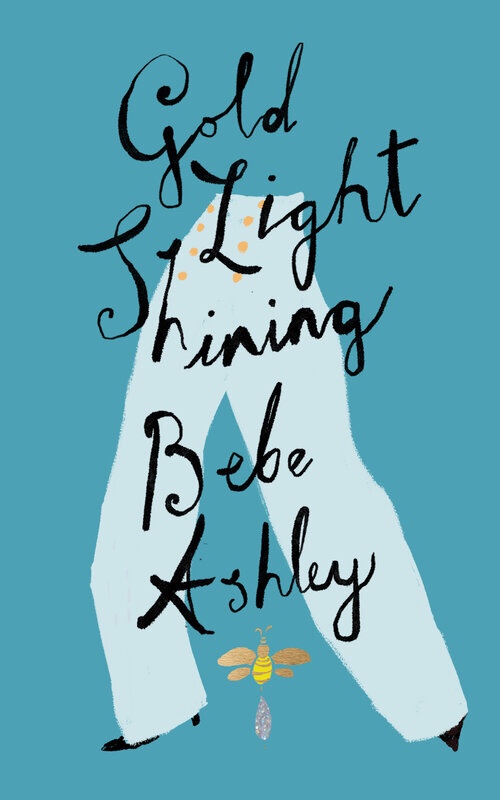
Gold Light Shining by Bebe Ashley.

I would describe Bebe Ashley’s collection as a poetic collage. It ranges across subjects as diverse as fashion, fandom, and families. Ashley elevates the internet into a poetic subject, puncturing the enduring snobbery of high and low culture. She shows us that the internet and some of its subjects are not the cultural wasteland people fear. Rather it is a window on whatever we choose to view from celebrity culture, to youthful yearnings, obsession, awakening sexuality and Harry Styles. The internet can be the cultural rainbow that lights up our grey lives. The focus may well be on our journey into adulthood, but there is another, wiser, voice too. The voice that knows some of this is momentary and that it is in building connections and communities that we find meaning. She also never forgets the meaning in our own families.

I grew up in the eighties, and we had to drive five or six miles to another village to the newsagent who reserved my copy of Look-In magazine, and then Smash Hits. This was my little window into the world and more specifically Adam Ant. My life might have been very different had I been able to access information and my fingertips. I loved the poem ‘Give Pop Music, Give Peace a Chance.’ It’s a grandmother, standing on a hill with her grandchildren reminiscing about this place, the seasons and her awakening to music and celebrity. As she sits in a sunken garden amongst the bluebells a young ranger starts to point out the beauty of the place. She knows. She knew it was beautiful before he was even born. She remembers that age of listening to music and feeling full of potential:

‘’a telegram from John and Yoko/ The thrill of running coloured chalk through the ends of her hair/She remembers sticking her thumb pad against the pin back/of a badge that served as her first concert ticket.’

She includes notes and allusions to Harry Styles, suggesting listening to his music while reading the poetry here. She starts the book with a quote of what looks like song lyrics, where he talks directly to his fans saying that he doesn’t understand or feel exactly what they do, but that he does ‘see’ each and every one of them. This assures the fans that they are noticed, that he appreciates them and this state of ‘fandom’ which is such a strong feeling as a teenage girl. In her poem The Boy Who the narrator gives a brilliant depiction of the chaos of a teenage party. She meets a boy in a Jesus T-shirt who is hiding in the bathroom to get away from people, but to enjoy the music. She lays in the bath and she listens to a tale of finding a friend ‘who he met in a gay club that he definitely didn’t know was a gay club’ and how this friend offered him their couch to sleep on while things were difficult at home.

Although these are longer poems than haiku, it feels like the poet is trying to do the same thing. All of these are brief moments in time, beautifully observed, and structured. The Boy Who is written as a long stream of consciousness with no punctuation or breaths. It’s like a story you’d quickly tell a friend about the party you attended the other night and where you disappeared to. In the final poem she imagines the object of her fandom in Japan, wearing an embroidered hoody and curls that are in need of a cut. The last two lines describe one such moment:

This is the one I’d most like to meet /Of all the moonstruck moments

This is a beautiful collection of poetry that imagines that rush of teenage hormones, burgeoning sexual feelings and the perfect pop star as an object of affection. There is a reverence and respect to how she describes Harry Styles here that I found really endearing. I loved though how the poet describes he importance of music and how we use it to complement or change our emotions. In Breakdown she brilliantly pinpoints the way we might use songs for heartbreak and it reminded me of my friend who was heartbroken and kept playing Coldplay’s The Scientist over and over in the car until me and her other friend stole the CD to break her mood. We were worried that the repetitive playing of it, was hampering her recovery. Here Ashley writes:

‘There was something serendipitous/ About being heartbroken during the release/ Of a heartbreak album, with the postman/ already tired of square sleeved parcels/ And the neighbours already sick of hearing/ Heartbreaker’s twelve songs on repeat.’

Music does affect and influence our emotions profoundly. If I hear certain Snow Patrol songs I’m reminded of a bereavement I had. If I hear ‘Yes’ by McAlmont and Butler it reminds me of feeling positive, hopeful and full of excitement for a new start in my life. Like most of us I even have mood playlists on Spotify for when I need cheering up, motivating or having a good cry. Ashley captures that feeling as well as teenage fandom and the inspiration she gets from Harry Styles’s lyrics. It’s a very readable and relatable collection, that I can tell I’m going to enjoy with further readings.

Meet The Author

Bebe Ashley lives in Belfast. She is a AHRC – funded PhD candidate at the Seamus Heaney Centre for Poetry. Her work can be found in Poetry Birmingham Library Journal, Poetry Ireland Review and others. When procrastinating from her PhD she takes British Sign Language and Braille classes, and writes pop culture articles for United by Pop, specialising in Harry Styles.