Posted in Random Things Tours

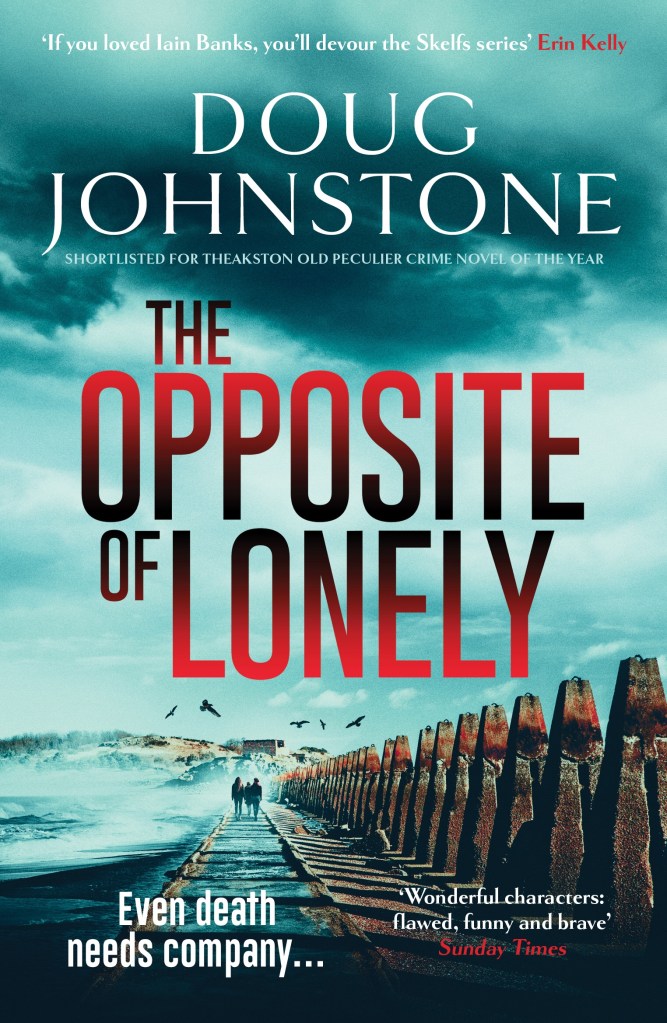
The Opposite of Lonely by Doug Johnstone

As many of you know I am a super fan of Doug Johnstone and particularly his Skelf series of novels, based in Edinburgh and following a family of women, running both a funeral home and a private investigation business. I love the Skelf women because they’re feisty, original, intelligent and incredibly compassionate. This is his fifth in the series and I’m in constant fear of it ending, though if it did this wouldn’t be a terrible way to bow out. In fact this may be the best in the series so far. As usual there’s an eclectic mix of people and cases. Dorothy is investigating a suspicious fire at an illegal traveller’s campsite, but also takes a grieving homeless man under her wing. Jenny is tasked with finding her missing sister-in- law who fled with the body of Jenny’s violent ex-husband Craig. Meanwhile, Hannah meets a women astronaut and is asked to investigate potentially dangerous conspiracy theorists who think she has returned from space ‘changed’. Add to that the new idea of water cremations, funerals for the lonely, strange happenings in space, a body lost at sea and a sexually adventurous man in a rabbit mask and you have all the ingredients to keep a Skelfaholic like me very happy indeed.

I love the Skelf’s outlook on life and other people, it chimes so well with my own family’s philosophy and is such a welcome change from the perspective of our current government. There’s an acceptance of others, whatever way they choose to live or love. They treat people with respect, in whatever circumstances they find themselves. There’s no judgement, something I especially love in Dorothy. She seems to have a knack for reading people and knowing when they’re trustworthy. She has a great track record too, having brought both Archie and Indy into the fold when both were in straitened circumstances. She has moments of exasperation when investigating, especially when she tries a pub local to the traveller camp where a fire happened. When gauging local feeling about the travellers she ends up in a long debate on their behaviour, most of which she dismisses as bigotry, but also their opinion of people ‘on benefits’, refugees, drug takers and women of easy virtue. They are the Daily Mail brought vividly to life and Dorothy notes how easy it can be for someone her age to accept the media narrative and become entrenched in their views. She doesn’t want to be like that and she’s certainly not going to be welcomed back to this pub. Jenny feels much the same.

‘everyone just trying to get to the end of the day and hoping tomorrow would be a little brighter. We didn’t need our homes torched, our dead ex-husbands disappearing, all the hate and bullshit in the world coming to kick us in the arse’.

This outlook also feeds into the sense of place Johnstone creates, something that made me drive around Edinburgh while on holiday earlier in the year. I wanted to get an idea of where these characters lived and was ecstatic to be able to walk on The Links, where Dorothy used to walk their dog and once encountered an escaped jaguar! He describes the strange juxtapositions in Edinburgh, something that happens in all big cities placing very different people up against each other. I was horrified to read once that there’s a street in NYC separating Harlem from the Upper West Side where the life expectancy differs by thirty years when you cross the street. As Dorothy and Archie drive out to Muirhouse she notices the stately home hidden by a high hedge from a caravan park, a halfway house for prisoners next to a posh golf course. It’s not planned of course, but it’s how all big cities grow and develop over time. However, what seems universal is that ‘the poorest people got the shitty end of the stick’ especially in Muirhouse. Johnstone’s current affairs and issues are bang up to the minute, here police officers become implicated in one of their cases. As the women meet for breakfast and a catch up, Jenny observes that cops tend to ‘circle their wagons’ when they’re accused of wrongdoing, especially sexual assault. She references the hundreds of sexual assault cases against police officers and the force’s mishandling of them, or even covering them up.

It’s wonderful to see Jenny in a calmer place, despite the ghost of her ex still hanging over her as she tries to find his sister. Her friendship with Archie, their mortuary assistant, has steadily become a regular part of her life. It feels like unofficial therapy, taking a long walk every couple of weeks and randomly choosing somewhere to eat. There’s something about Archie’s presence that seems soothing and she just enjoys sharing space with him. There’s nothing dramatic or addictive about it. Hannah has noticed them getting closer and observed that it seemed to have pulled her mother together somehow.

‘Maybe all you need is a friendly face once in a while, someone to listen to your bullshit and not judge. Hannah had read once about a man who succumbed to suicide on the Golden Gate Bridge. He left a note at home before walking there, which said that if one person smiled at him on the journey, he wouldn’t jump. Maybe all we need is a smile to stop us jumping’.

Hannah and Indy are tested a little by their new connection to Kirsty, an inspirational woman astronaut she met after her talk at the National Museum of Scotland. Kirsty invites Hannah and Indy to dinner where they meet her partner Mina. Mina is concerned about men who troll Kirsty online and at events, fuelled by a conspiracy theory that something happened to her on the International Space Station. Whether they think she’s had the alien probe up the butt or just some kind of first contact, the phrase used is that she ‘came back wrong’. Mina tells them they’ve had people outside the house, going through their rubbish and they’ve been doxxed. When Mina gets Hannah alone she asks her to do a little digging and to keep an eye on Kirsty. She’s been different since she came back, Mina explains and she’s worried that Kirsty is in danger. This had a strange dynamic to it and I was concerned that Hannah and Indy might be in danger too. I loved the theme of loneliness and dislocation, particularly the idea for The Lonely Funeral, sparked by the story of a middle aged woman who had no family or friends to make arrangements. Dorothy’s thinking had been inspired by projects in the Netherlands and New Zealand where they research the deceased and get a poet to write about them for the funeral. Dorothy has negotiated with the council so that the Skelf’s can carry out the funerals for the basic budget set aside. Brodie, the homeless man Dorothy meets and decides to help, tells her a moving story that I think explains how we all feel at times. I’ve certainly felt it in the depths of grief. It’s about a whale oceanographers had detected with a call that registered 52hz, a pitch that’s higher than other whales. It had no idea that other whales couldn’t hear it and it had spent decades singing out to no one. This story brought a lump to my throat and I’m not surprised that it touches Dorothy too. She decides then and there that Brodie is going to fit in.

It’s not everyday that the heroine of a book takes a walk into the woods to check out a mausoleum, taking the time to think about her father and how much she’s struggled since his death. Then in the next moment, stumbles upon a dogging scene, with one young woman and a quartet of men masked as a badger, deer, rabbit and fox. These juxtapositions keep the reader on their toes, we never really know what might come next or how it might make us feel. Johnstone can take us from tears to gallows humour in a couple of sentences. As he closes the book, with the first of the Skelf’s lonely funerals, Dorothy speaks on behalf of the man in the coffin who they hadn’t known anything about except his name and where he was born. She echoes Hannah’s astronaut friend, whose experience in a solar storm was both spiritual and grounding all at once. What she talks about is connection, in the E.M. Forster sense to ‘only connect’. To connect with others is the most vital thing we do in life. Connectedness is perhaps the best choice of word when trying to work out the opposite of loneliness. She talks about how we tend to close down as we age, to shut off from the world. I’ve observed this with people and noted recently the important of older people connecting with their younger family members using WhatsApp or Snapchat and how it brings daily joy to them, something those that who choose to dismiss new technology miss out on, to their detriment. We need to connect, both with the world we live in and with the people around us. We need to stay part of this great ‘human experiment’ in order to carry on living as fully as possible, for as long as we’re granted.

‘The idea of an impartial, unconnected observer watching the world was totally wrong. We’re all up to our necks in the universe, we can’t be separated from it’.

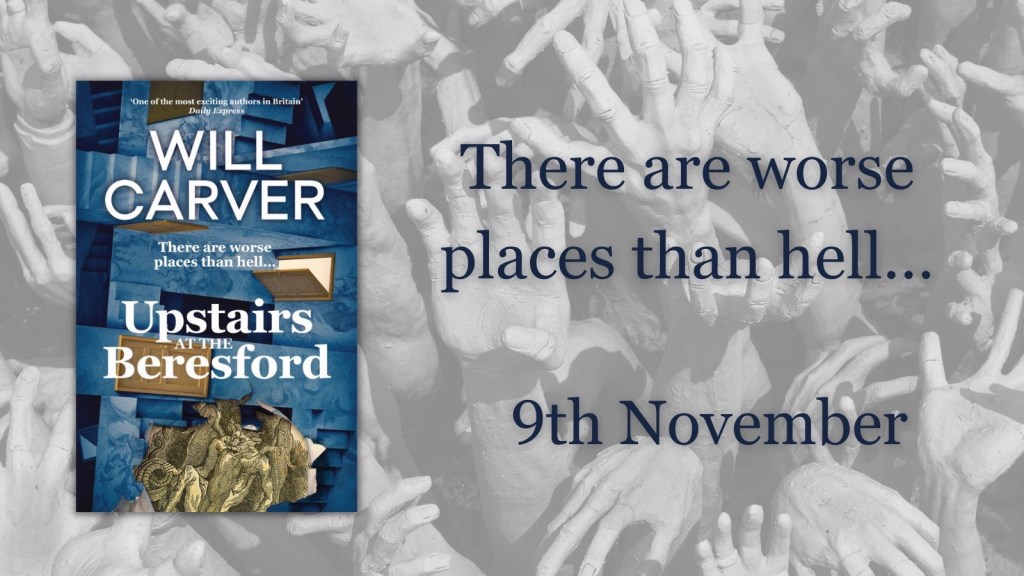
Out 14th September 2023 from Orenda Books

Doug Johnstone is the author of fifteen novels, most recently The Space Between Us (2023). Several of his books have been bestsellers, The Big Chill (2020) was longlisted for the Theakston Crime Novel of the Year, while A Dark Matter (2020), Breakers (2019) and The Jump (2015) were all shortlisted for the McIlvanney Prize for Scottish Crime Novel of the Year. He’s taught creative writing and been writer in residence at various institutions over the last two decades including festivals, libraries, universities, schools, prisons and a funeral directors.

Doug is a Royal Literary Fund Consultant Fellow and works as a mentor and manuscript assessor for many organisations, including The Literary Consultancy, Scottish Book Trust and New Writing North. He’s been an arts journalist for over twenty years and has also written many short stories and screenplays. He is a songwriter and musician with six albums and three EPs released, and plays drums for the Fun Lovin’ Crime Writers, a band of crime writers. He’s also co-founder of the Scotland Writers Football Club.

Posted in Sunday Spotlight

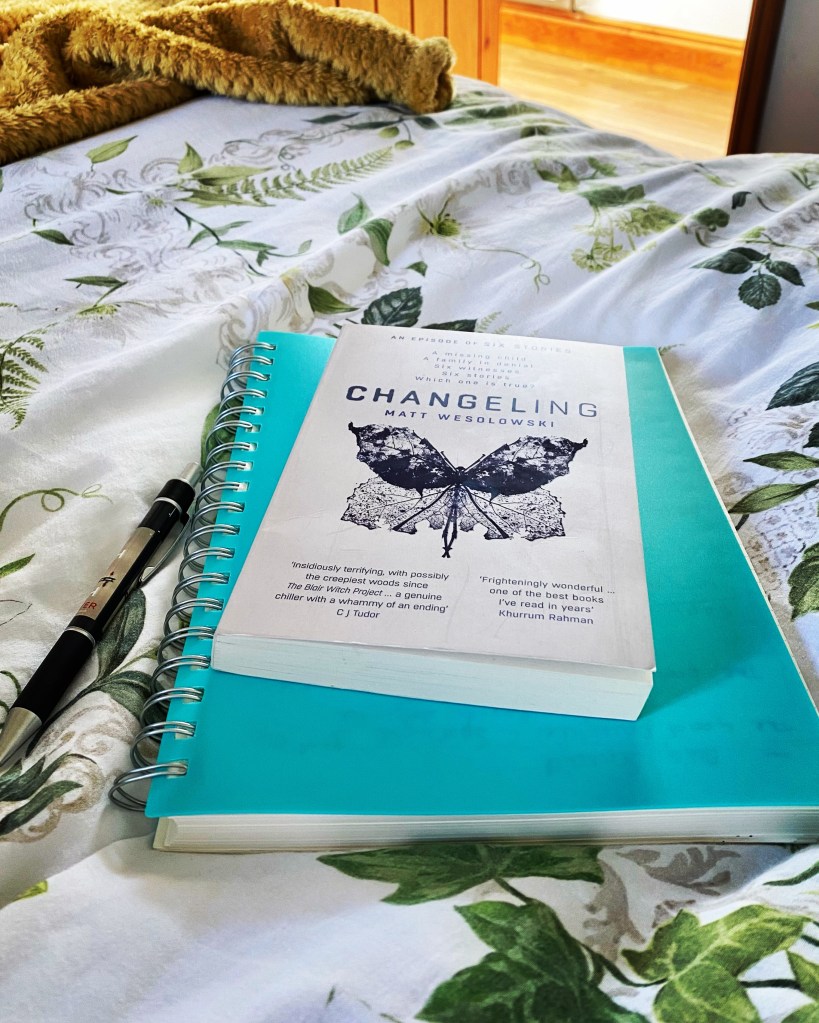
Changeling by Matt Wesolowski

I spent some of my recent holiday going back to the earlier books in a series I picked up half way through. I often review for Orenda books blog tours and this has meant picking up on some fabulous authors who are on the fourth or fifth book in a series. I then slowly buy the previous novels in the series and take them on holiday so I can wallow in them for a couple of days. So, it was with no idea of the subject matter, except it would be a mystery and was being revisited by a podcast called Six Stories where Scott King interviews six people connected to the case. It’s not that he expects or aims to solve the case, although that’s a possibility, it’s about hearing different voices, perhaps ones that haven’t been heard or have something to add to their original evidence. I had no idea of the geographical location in The Changeling, nor could I have predicted reading it when I did. The case begins on Christmas Eve 1988 when Sorrel Marsden is travelling along the Wentshire Forest Pass, a road between Chester and Wrexham in North Wales. He hears a knocking sound in the car and decides to pull over in a lay-by to investigate. As he gets out he glances back to check on his son Alfie who is fast asleep in his booster seat in the back. Sorrel checks under the bonnet of the car, but not seeing anything obvious he decides to continue his journey. However, as he drops the bonnet he notices the rear passenger door is open and Alfie’s booster seat is empty. He looks for his son on the edges of the forest, but with no clue where Alfie has gone he goes to the phone box and calls the police.

We holidayed on the welsh borders, with the River Wye running through the garden of the cottage. We were travelling back from Chester Zoo when I started to read The Changeling and I’d passed navigation duties to my stepdaughter so I could put my feet up in the back. So I read Sorrel Marsden’s account of his son’s disappearance as we drove from Chester into Wales! Wesolowski is skilled at creating a setting that slowly unnerves the reader and I felt this as I read about the history of the forest and the interview King does with a contractor working on the construction of a holiday park. He was working in the forest at the time of Alfie’s disappearance and tried to help with the search for the boy. Not that searching was easy, as floodlights that worked earlier that day completely malfunctioned when needed. It was also impossible to move vehicles from the area of the search, the very embodiment of a ghost in the machine or gremlins in the works. The builder claimed that strange events started happening when they tried to remove ancient trees from the woodland. With normal tools not working, they were reduced to hacking at the trunks of the trees with little success except for a few blood injuries. They were sleeping onsite in temporary buildings when the knocking started, insistent and gaining in volume despite having no visible source. Most fanciful were his stories of seeing an animal out the corner of his eye, possibly a goat or wild boar. What i found most chilling though were the voices, whispery and urgent little voices that were indecipherable but angry in tone. Sorrel Marsden has made a point of walking the pass every year on the anniversary of Alfie’s disappearance. He never claims to hear or see anything on his treks, but they do serve a purpose. They set him up as the victim, the hero of the piece, especially then compared with Alfie’s mother Sonia who has never taken part in the search or been interviewed about her son. Until now.

The character’s in the novel are open to interpretation and our impression of them might change, depending on whose account we are listening to. Part of Sorrel’s story of that night is as damning for Sonia as her absence at memorials and other events. He claims to have suggested to spend Christmas with his estranged wife and son, but as Sonia’s drinking worsened he decided to remove Alfie from his mother’s care and return with him to his own home in Wrexham. This would have given people a terrible impression of Sonia and as an uncaring and unfit mother. Yet we haven’t heard her or anyone else’s opinion, only Sorrel’s. People tend not to question or accuse the bereaved and with Sorrel being found by police curled up in the phone box in a foetal position, it’s hard to blame those in attendance for treating him with care and compassion. Yet Sonia does consent to meeting King and talks for the first time about that awful Christmas. She doesn’t deny drinking, but has some explanations for her actions. She claims that Sorrel is an unusual man, with an ability to draw people to him that goes beyond his looks or personality. She recalls being belittled and controlled. Yes she struggled as a very young and isolated mum, but no help came. Despite claiming she was a bad mother, Sorrel left her alone with Alfie and rarely visited. I loved the women who contacted Scott King to tell their story of encounters with Sorrel. Like a mini ‘Me Too’ movement these women come together to talk about coercive control, psychological abuse, strange knocking sounds keeping them awake and leaving them unnerved. These women have incredible strength and having experienced a relationship like this I had my suspicions about Sorrel Marsden.

Sorrel is controlled, especially in his work as a chef. Other kitchen workers comment on his admiration for the military way of running a kitchen, a system of rules and regulations he also expects in his kitchen at home. Women refer to an unusual feeling they’d experience, as if he had them in an enchantment. It made me think of the word ‘glamour’ in the way it’s applied to witches – folk tales tell of a witch’s ability to ‘glamour’ people, to only show those sides of themselves they wish to be seen, often appearing as a beautiful young woman when they are in fact a shrivelled old woman. If we look at it realistically, Sorrel is a master manipulator and serial abuser able to charm and convince women to trust him. He then slowly isolates them, breaks down their confidence, gaslights them and convinces them they are worthless. When his story is picked apart there are holes everywhere, including a past link to the forest. When Alfie is a toddler he suggests a family camping holiday to the forest, with a friend of his called Wendy to help with the childcare. On this trip Alfie ‘disappeared’ into the forest for the first time, found by Sorrel who walks back into the clearing with his son in his arms. Both Sonia and Wendy claim that Alfie was never the same after this trip. I could only wonder why Sorrel would have taken them to a wood with no facilities and such a haunted reputation. Did Sorrel know what was in the woods? Was Alfie some sort of sacrifice? From then on Sonia would hear strange voices and knocking when no one was there.

The section that genuinely lifted up the hairs on the back my neck seemed a bit tenuous at first. King interviews a man whose mother has recently died. She was a teacher back in the 1980’s and as part of her training she was gathering research on pupils who had behavioural issues. When she died her son found the research in the attic and was intrigued by her notes on Child A, because Child A was Alfie Marsden. Delyth recorded his behaviour on several occasions and the more she saw, the more scared she was. Alfie would turn his back on other pupils, deliberately not participating in what everyone else is doing. Alone with him, Delyth heard muttering and although he wasn’t moving, she could hear a strange knocking. There were times where she was scared to look him in the face. Yes, other teachers warned her that he might bite or lash out, but with her he was unnaturally still as if he was listening somewhere else or to something else. Did Alfie just have behavioural issues or was there something more sinister at play? Were the knockings and strange voices similar to those mentioned by the building contractors or by the women who knew Sorrel?

By the final stages of the book I was wondering exactly who is The Changeling of the story? Was Alfie’s sudden change after visiting the forest on the camping trip a sign that he was possessed or changed in some way? Or was Sorrel’s affinity with the forest a sign that he’d been there before? A Changeling is a child swapped in it’s infancy by the fairy folk, either because something wrong or because fairies want to strengthen their fairy blood. The behaviour of a Changeling is ‘unresponsiveness, resistance to physical affection, obstreperousness, inability to express emotion, and unexplained crying and physical changes such as rigidity and deformity.’ Some are unable to speak at all. I was also a little unnerved by the psychic who was brought in after Alfie’s disappearance, then stalled proceedings by saying Alfie was ‘in a Royal Court.’ It has never made sense and it never changed. As she corresponds with Scott I was unnerved by her, what does she know and how? There are a couple of utterly brilliant twists towards the end, neither of which I’d expected and one made me rethink everything I’d read up to that point, in a Sixth Sense way. I wanted to go back and reread with that knowledge, to see how I’d missed it. This was a brilliant and disturbing novel, a clever mix of psychological and supernatural elements that’s very addictive and will stay with you long after the book is finished.

Out now from Orenda Books

Meet the Author

Matt Wesolowski is an author from Newcastle-upon-Tyne in the UK. He is an English tutor for young people in care. Matt started his writing career in horror, and his short horror fiction has been published in numerous UK- and US-based anthologies, such as Midnight Movie Creature, Selfies from the End of the World, Cold Iron and many more. His novella, The Black Land, a horror set on the Northumberland coast, was published in 2013. Matt was a winner of the Pitch Perfect competition at the Bloody Scotland Crime Writing Festival in 2015. His debut thriller, Six Stories, was an Amazon bestseller in the USA, Canada, the UK and Australia, and a WHSmith Fresh Talent pick, and film rights were sold to a major Hollywood studio. A prequel, Hydra, was published in 2018 and became an international bestseller. Changeling, the third book in the series, was published in 2019 and was longlisted for the Theakston’s Old Peculier Crime Novel of the Year. His fourth book, Beast, won the Amazon Publishing Readers’ Independent Voice Book of the Year award in 2020. Matt lives in Newcastle with his partner and young son, and is currently working on the sixth book in the Six Stories series. Chat to him on Twitter @ConcreteKraken.

Posted in Random Things Tours

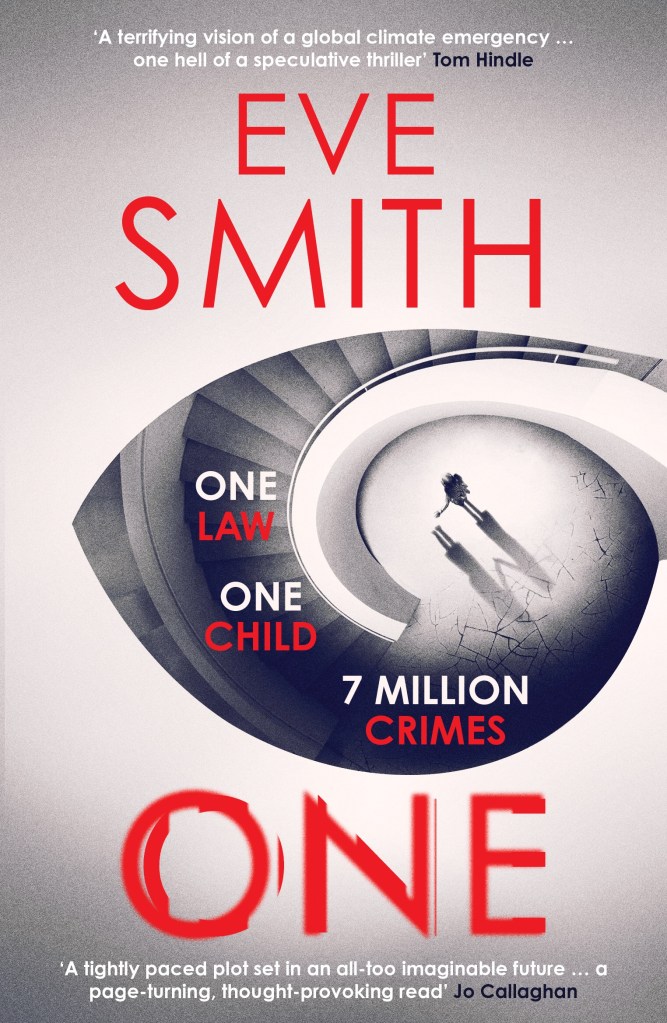
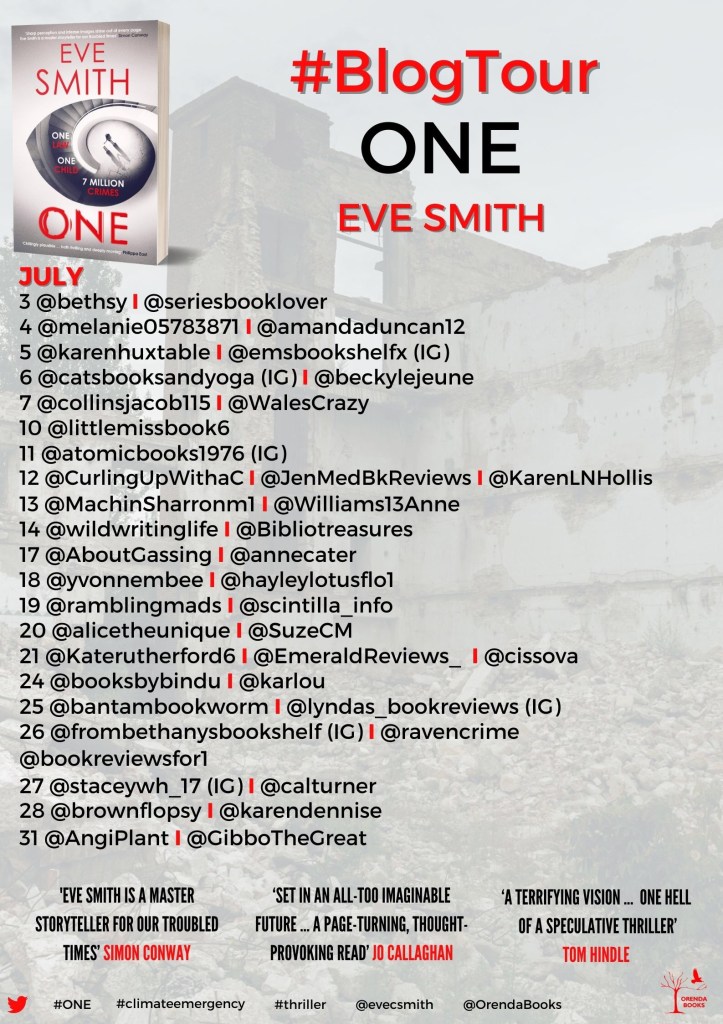
One by Eve Smith.

A catastrophic climate emergency has spawned a one-child policy in the UK, ruthlessly enforced by a totalitarian regime. Compulsory abortion of ‘excess’ pregnancies and mandatory contraceptive implants are now the norm, and families must adhere to strict consumption quotas as the world descends into chaos.

Kai is a 25-year-old ‘baby reaper’, working for the Ministry of Population and Family Planning. If any of her assigned families attempts to exceed their child quota, she ensures they pay the price.

Until, one morning, she discovers that an illegal sibling on her Ministry hit- list is hers. And to protect her parents from severe penalties, she must secretly investigate before anyone else finds out.

Kai’s hunt for her forbidden sister unearths much more than a dark family secret. As she stumbles across a series of heinous crimes perpetrated by the people she trusted most, she makes a devastating discovery that could bring down the government … and tear her family apart.

I LOVE the way Eve Smith doesn’t baby her readers. If there are hover cars that’s what she gives us. A two word description. No long flowery explanations of how they came to be, she just tells us what IS. She expects our own imaginations to keep up. The immediacy of her writing brings us slap bang in the middle of this alien world and it’s exhilarating.

Our narrator Kai is a perfect ministry operative. She’s brainwashed from birth into accepting the world as the ministry present it. The political party One came to power with an unusual mix of ecological and anti-immigration policies. We might expect that ecological parties are more left-wing and we expect our totalitarianism to come in a right wing package. The lack of resources has left the country without options (although other countries have less draconian regimes) and any political movement can become a totalitarian one. Due to the climate emergency there are now places it is impossible to live so immigration is rising. The government used predictions of climate disaster to ease the population in to accepting extreme policies to reduce consumption and the population. Each family has a consumption quota to cover things like food, travel and water usage. I loved little touches like Kai’s grandparents always being the ones to overuse their quota, still used to the old days. The one child policy is the most extreme and the administration and enforcement of the policy is down to officers like Kai. The reality of her job is devastating. Women’s fertility is controlled by the Destine implant, a contraceptive with a chip that means it can be switched off when a woman wants to start a family, it is then switched back on after her only pregnancy. All women of child-bearing age have their HCA levels monitored by the government and as soon as any change is detected Kai’s department would know. In the case of a second child they must schedule a termination, but if they don’t that’s where Kai’s job begins. She must visit the woman and ensure that a second appointment is kept. Termination even applies in cases of twins. Prison awaits anyone who conceals a second pregnancy.

The reality of their policies as they affect real people is hard to read and Kai seems as obedient and capable of free thought as her robotic pet dog. I have found the author terrifyingly prescient in the past and I hope that’s not the case here. This isn’t necessarily our future but it could be. Every terrible policy here has it’s roots in our current world and that’s what’s so scary. The effects of climate change can seem a long way away so it was very disconcerting to find out that in this world Horncastle was on the coast! My stepdaughter’s other home is there and it’s only a half hour journey up the road from me. My home county is essentially a wetland. Despite this, I loved the inventiveness of the resistance movement Free, from their houses on rafts and living walls to the ability to morph their features. Again the author gives us just enough information to see it, because everything we see comes through Kai and to Kai this is normal. She has no memories of a world we would recognise, because she hasn’t lived in it. A bit like the way my stepdaughters gasp when I tell them there was no internet when I went to university and I had to do all my dissertation research from books. The immigration policies are an obvious extension of comments like ‘we can’t take any more people we’re all full up’. There’s an immigration centre coming three miles from us on an old RAF base and although we object to the plan on humane grounds – the government plan to keep people on the runway in storage containers – we were shocked to find how racist a lot of the opposition was. On our return from holiday recently we found a large St George’s Cross with crusader had been placed at the gates and we’ve vowed to go back in the dead of night and take it down. I often wonder if our government’s alarmist immigration rhetoric is simply a precursor to warring over the world’s remaining resources. Kai’s world played on some of my worst nightmares.

Despite Kai’s blinkered perspective, I did find myself respecting her as the story developed. She fears the ministry and her rather formidable boss Minister Gauteng. Yet, Kai doesn’t report the sibling she has found at first, showing a loyalty to her parents above that she gives her workplace. She undertakes her own investigation and puts herself in some very risky situations. She faces up to her own parents and the choices they made and is willing to sacrifice herself for a family member. This shows incredible bravery and her fortitude in the face of the new version of the world her sister Senka is describing to her is incredible. As she learns she shows remorse for the women she’s forced into terminations. One member of Free tells Kai that opening your eyes to a new reality of the world is like going cold turkey. She copes with this admirably. The reality of Senka’s life is also horrific. Tales of reallocation, trafficking, abuse in the care system all have their root in the here and now. It’s an age old story of vulnerable children being failed and preyed upon. There was one scene that genuinely brought a lump to my throat, a future version of some of the horrors of the old Magdalene Laundries. If we don’t know the past, we can’t stop ourselves from repeating patterns. We like to think that we wouldn’t follow a government like this, but terrible times make people do terrible things.

Whether it’s a termination, finding out your husband has a baby with another woman so you can’t have one, or having to give your baby to be reallocated it is the women who most bear the grief of this life. As Kai works to uncover a further atrocity committed by her employers, we realise it’s a grief that will be repeated down the generations. As we hurtled towards an ending, full of action, I wanted One to be ousted and held to account. I think some of my anger at the regime was rooted in my real-life anger at where we are in the world. As the author says in her afterword the control of women’s bodies is becoming an issue again. As regimes become more controlling it is always women who are targeted – just like the recent clampdown on a woman’s right to choose in some states of the USA. There are states where certain books are banned, immigration is being reduced and I genuinely wondered how far are we from this future? This is an incredibly intelligent dystopian thriller. It’s a fantastic read and although it scared me I wouldn’t have put it down. Now I need to go put my house on the market and look for something further inland, on a big hill.

Meet the Author

Eve Smith writes speculative thrillers, mainly about the things that scare her (and me). Longlisted for the Not the Booker Prize and described by Waterstones as ‘an exciting new voice in crime fiction’, Eve’s debut novel, The Waiting Rooms, set in the aftermath of an antibiotic resistance crisis, was shortlisted for the Bridport Prize First Novel Award and was a Book of the Month in the Guardian, who compared her writing to Michael Crichton’s. It was followed by Off-Target, about a world where genetic engineering of children is routine. Eve’s previous job at an environmental charity took her to research projects across Asia, Africa and the Americas, and she has an ongoing passion for wild creatures, wild science and far-flung places. She lives in Oxfordshire with her family.

Posted in Random Things Tours

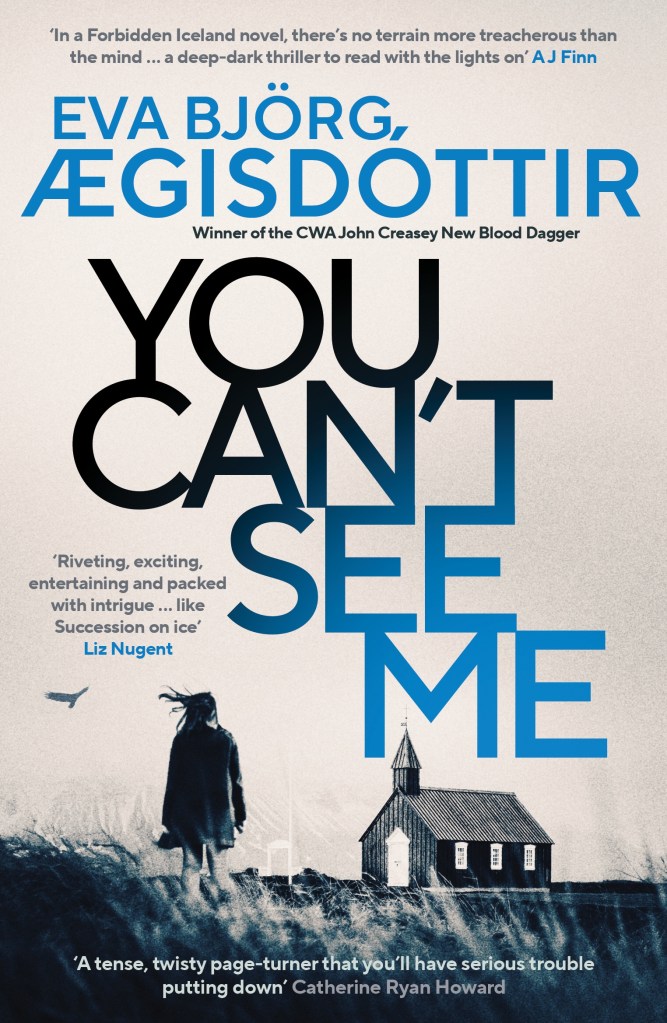
You Can’t See Me by Eva Björg Ægisdottir

Translation by Victoria Cribb.

Evil creatures here abound. We must speak in voices low. All night long I’ve heard the sound. Of breath upon the window.

Sixteenth-century verse by Þórður Magnússon á Strjúgi

The wealthy, powerful Snæberg clan has gathered for a family reunion at a futuristic hotel set amongst the dark lava flows of Iceland’s remote Snæfellsnes peninsula.

Petra Snæberg, a successful interior designer, is anxious about the event, and her troubled teenage daughter, Lea, whose social- media presence has attracted the wrong kind of followers. Ageing carpenter Tryggvi is an outsider, only tolerated because he’s the boyfriend of Petra’s aunt, but he’s struggling to avoid alcohol because he knows what happens when he drinks … Humble hotel employee, Irma, is excited to meet this rich and famous family and observe them at close quarters … perhaps too close…
As the weather deteriorates and the alcohol flows, one of the guests disappears, and it becomes clear that there is a prowler lurking in the dark.
But is the real danger inside … within the family itself?

I LOVED the first two books in the Forbidden Iceland series, featuring detective Elma, recently returned to her home town of Akranes after several years working in Reykjavik. This story is a prequel and we meet her eventual partner Sæver as he looks into some very strange events surrounding a family reunion. This is not your average family though and I don’t think I’ve ever wanted to be at a party less! My sympathies were largely with hotel employee Irma who views the Snæberg family as if they are a totally different species. In a way they are, set apart by their successes and their wealth from the everyday hotel employee. So wealthy in fact that they’ve hired this entire luxury hotel for the weekend, with a full itinerary of activities and boozy dinners at night. It isn’t long before tensions and differences come to light: judgements and opinions on each other’s partners; family members who’ve lost touch and resent each other; teenagers who’d rather be elsewhere; parents who can’t connect with their children. All cooped up together for a whole weekend. As the author moved our point of view from one character to another we realise this family has so many secrets.

The setting is isolated and bleak. No amount of candlelight could ever convince me that concrete looks anything but brutally uncomfortable. However, thanks particularly to interior designer Petra Snæberg who can’t stop snapping for her Insta followers, the hotel’s phone is ringing and bookings are going through the roof. Set on a remote peninsula there is nowhere to go, except the equally bleak outdoors and with a set itinerary in place there’s no escape from each other. The atmosphere the author creates is incredible and had me veering from suspicious to unsettled to really creeped out. The uncovered windows leave guests feeling exposed, realising that if a light goes on they are lit up like a theatre stage. Not helped by the fact that an app controls heating and lighting, so easy to plunge another guest into darkness or into light by accident or just when they least expect it. We realise that certain people are watching others, but we’re not exactly sure why, whose stare is benign and whose stare means danger is lurking? Some narrators send icy cold shivers down the spine. Petra’s daughter Lea receives a message from an unknown number:

The video is dark, taken outside at night. Instinctively I bring the phone closer to my face, to see better. I turn up the volume. The sound crackles with the wind, then I hear a crunching of gravel. Footsteps. Someone is walking outside, along a gravel path. The video ends with the sound of a throat being cleared and a cough. I turn to the window, feeling the sweat break out all over my body. Isn’t there a gravel path leading to the hotel? Again I hear a rustling sound outside the door, then more knocking. Two taps, like before. Tap, tap.

Some of the scariest moments happen to Petra too. There’s a tension between her and her cousin Stefania who grew apart years ago when they were teenagers. An awkward drink with the two women and Stefania’s brother Viktor starts to open up old wounds. Petra is haunted by a misunderstanding that had tragic consequences, but does she even know the full story? Why does she find her hotel room door open when she’s been inside, showering and sleeping? Then there’s the creepy notes under the door. It’s enough to make the hair stand up on the back of your neck.

Then there’s Irma, who seems intrigued by this glamorous family who are so ‘together’. They’re Insta-perfect and seem so far outside her experience. She mocks Petra’s overuse of the word ‘sanctuary’ which is what your home is supposed to be, a place that reflects who you are. When Irma thinks of her flat it’s merely a box and her shelves are merely a place to keep stuff. It’s boring, functional and sparse – does that reflect who she is?

Mum always said I had an overactive imagination. As a child I lived in a world that no one else could see. One that was much brighter and better than the real one, like a fairy tale or story, because as I turned the pages of books I became the characters. […] But the older I got, the more difficult it became. I started comparing myself to other people. I realised that the flat Mum and I lived in probably wasn’t that tasteful, and the life we lived wasn’t actually that exciting. Perhaps it wasn’t so desirable after all to be constantly moving from place to place, constantly changing schools and spending most of my evenings alone at home.“

She imagines living like the family do, envious of the freedom to walk around the supermarket and pick up whatever they want, with no fear of their bank card being rejected. Irma’s not completely taken in by appearances though, while she scrolls she reminds herself of the gap between the selves we are on social media and the reality. She looks forward to people watching, spotting where the cracks are. Those tiny resentments. The things they keep from each other. After all, no family is perfect.

However it’s Lea who I’m most scared for because she’s just so vulnerable. Lea is a confused teenager and she is never without her phone. A lack of friends and support at home has left her so open to exploitation. She has a friend called Birger who might be staying nearby, maybe they might finally meet? Lea seems to get validation from his messages on her photos. In fact it’s that very validation and a need to be seen that convince her to do something dangerous. She realises how exposed she is too late and the signs that she’s struggling are being missed, until she walks out into the sea in all her clothes. All the ‘what ifs’ begin to race through her mind, but not once does she wonder whether Birger might not be who he claims to be. Then there’s Gulli, an older man who’s very appreciative of her posts and so easy to talk to, but the unease sets in when he too turns out to be nearby. There’s the old man she saw wandering the corridors, even though her family are the only guests. Is it her aunt Oddny’s unusual boyfriend Tryggvi, an outsider thanks to his job as a joiner and his unique dress sense? Could he be watching? Lea begins With her mum embroiled in secrets and lies of her own, will anybody notice that Lea is standing on a knife edge. Lea is being watched of course, but is that enemy looking in through the windows or are they closer? Inside the building?

The suspense builds beautifully and reaches fever pitch on the last night. Tryggvi falls drastically off the wagon on an important anniversary. Petra has made a bloodstained find in one of the bedrooms. Victor’s much younger, pregnant girlfriend has left the hotel in the night despite being unable to drive. Lea is also drinking heavily, scared about who is stalking her. While Petra has a long overdue conversation about the past, but can she trust her version of events? As a storm begins to roll in, cutting the hotel off from civilisation, horrifying truths bubble to the surface. Someone who has been waiting a long time for their moment makes their move in this complicated chess game. We don’t always see those who hide in plain sight and those we think we know could be monsters in disguise. I love this author’s ability to get inside the heads of her characters and pull the reader along with her. Here she builds a labyrinth of clues, red herrings and suspicious characters that I found absolutely impossible to resist. That’s why I was awake at 3am, with my attention split between the page in front of me and my ears attuned to even the slightest creak downstairs. After all you never know who might be watching.

Published by Orenda Books Thursday July 6th.

Meet the Author

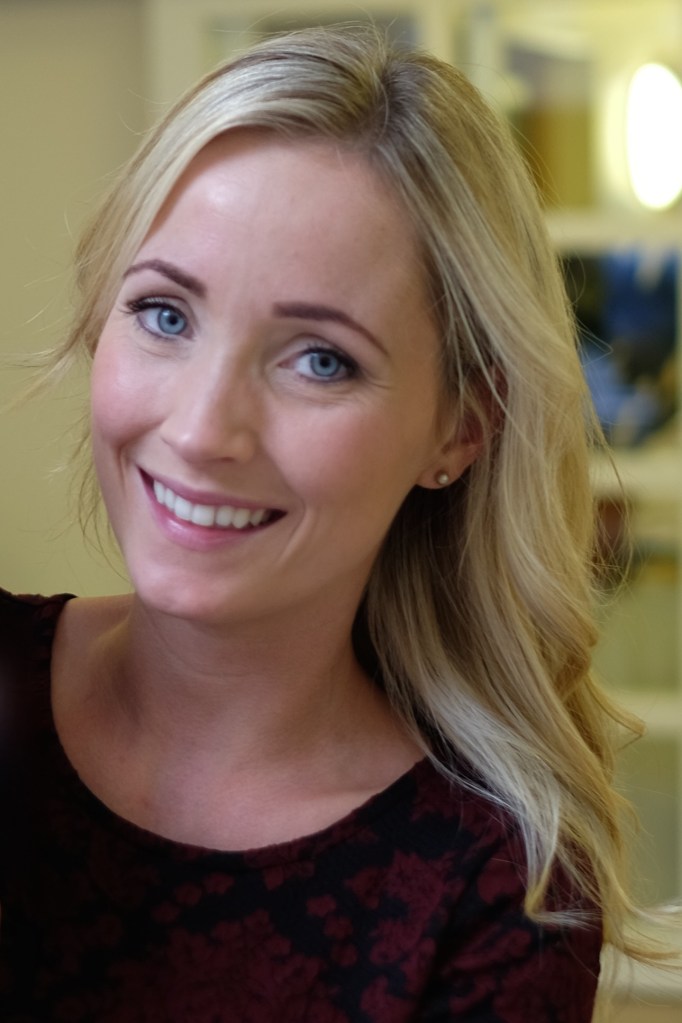
Born in Akranes in 1988, Eva Björg Ægisdóttir studied for an MSc in globalisation in Norway before no one can be trusted, as the dark secrets
returning to Iceland to write her first novel. Combining writing with work as a stewardess and caring for her children, Eva finished her debut thriller The SCnreæakboenrgthfeaSmtaiilrys,awrheicuhnwcaosvpeurbelidsh…edaind the 2018. It became a bestseller in Iceland, going on to win the Blackbird Award. Published in English by Orenda Books in 2020, it became a digital number-one betseller in three countries, was shortlisted for the Capital Crime/Amazon Publishing Awards in two categories and won the CWA John Creasey Dagger in 2021. Girls Who Lie, the second book in the Forbidden Iceland series was shortlisted for the Petrona Award and the CWA Crime in Translation Dagger, and Night Shadows followed suit. With over 200,000 copies sold in English alone, Eva has become one of Iceland’s – and crime- fiction’s – most highly regarded authors. She lives in Reyjavik with her husband and three children.

Thanks to Anne Cater at Random Things Tours and Orenda Books for having me on the blog tour, to see more reviews and giveaways follow the rest of the tour.

Posted in Orenda, Random Things Tours

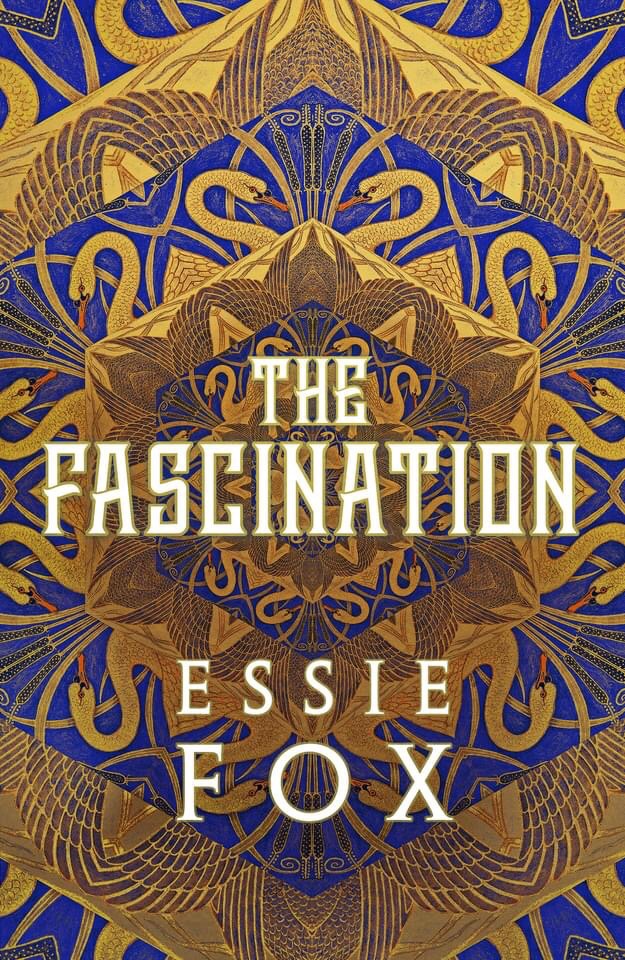
The Fascination by Essie Fox.

Victorian England. A world of rural fairgrounds and glamorous London theatres. A world of dark secrets and deadly obsessions…

Twin sisters Keziah and Tilly Lovell are identical in every way, except that Tilly hasn’t grown a single inch since she was five. Coerced into promoting their father’s quack elixir as they tour the country fairgrounds, at the age of fifteen the girls are sold to a mysterious Italian known as ‘Captain’.

Theo is an orphan, raised by his grandfather, Lord Seabrook, a man who has a dark interest in anatomical freaks and other curiosities … particularly the human kind. Resenting his grandson for his mother’s death in childbirth, when Seabrook remarries and a new heir is produced, Theo is forced to leave home without a penny to his name. Theo finds employment in Dr Summerwell’s Museum of Anatomy in London, and here he meets Captain and his theatrical ‘family’ of performers, freaks and outcasts.

But it is Theo’s fascination with Tilly and Keziah that will lead all of them into a web of deceits, exposing the darkest secrets and threatening everything they know…

Exploring universal themes of love and loss, the power of redemption and what it means to be unique, The Fascination is an evocative, glittering and bewitching gothic novel that brings alive Victorian London – and darkness and deception that lies beneath…

As regular readers to this blog know, I am never happier than when I’m reading a book about the seedy underbelly of Victorian society. I love being able to disabuse people of the notion that the Victorians were so buttoned up they would cover the legs of a grand piano! In fact the Victorians were no different to us, trying to keep a veneer of respectability on the surface whilst having all manner of private interests and lifestyles underneath. Essie Fox has created an absolute phantasmagoria of fairgrounds, travelling ‘snake oil’ salesmen, freak shows and private bestiaries. Her vivid descriptions really grabbed me early on and they create such a strong, colourful sense of place. This is the written equivalent of The Greatest Showman or a Baz Lurhmann film like Moulin Rouge, a dazzling spectacle that tantalises the senses. However, as with all shows, away from the bright lights and trickery there is a darker history and the author doesn’t shy away from showing it to us. There are those addicted to opium to dull their mental and physical pain and others who are dependent on the fake ‘cures’ offered by the twin’s father. Out of all people who are other, some find the relative safety of a troupe or family put together by someone like the Captain, others are less lucky and end up enslaved, forced into degrading displays with no means of escape. There are greedy men, pillaging the world for various specimens of flora and fauna, similarly there are more specialist collecting men like Lord Seabrook who keeps a private collection of human freaks with no understanding that these are people not specimens.

Women are shown to be particularly vulnerable to exploitation. Our central characters, Keziah and Matilda are sold, but are very lucky to end up with the Captain who keeps them and places Matilda in various pantomimes and shows in the West End. There’s a conflict here between our outlook on disability today and that of 150 years ago. We might look at freak shows and displays with distaste, but without a welfare state and with superstition and shame surrounding disabilities and disfigurements, they were a legitimate and lucrative way to earn money. If the decision to display their unusual body was an independent one and they received a decent portion of the money they earned it could allow a person with a disability to support themselves. Matilda has the addition of a beautiful voice, a talent that would interest London theatres rather than a freak show or circus. The vulnerability of all women is shown by those like Mrs Miller, friend and patron of our hero Theo, who admits to an unexpected pregnancy in her youth and a baby born with wings or shoulder blades that developed outside the skin. Her condition left her penniless and abandoned by her lover, then bereaved when she wakes after the birth to be told her child has died. Women with differences were exploited terribly, from freak shows to private displays in gentlemen’s clubs and large private homes, all the way to brothels who had workers for the more unusual tastes. I feared for the twins who are both vulnerable, but especially Matilda who craves the pretty clothes, the bright lights and the adulation of the crowd. The author fills her performances with a sense of wonder as she flies over the heads of her audience with her iridescent fairy wings. Her love for this incredible feeling does lead her down a dangerous path, with Keziah and the Captain worried for her life.

The twins path crosses with Theo’s as they travel with their father and the fairground, but it’s as he meets them again in London that their stories cross over and his fascination with them continues. His father, Lord Seabrook, has a love of human curiosities and the ruthless way he dispenses with his own son made me wonder what lengths he might go to if he sees something he wants for his collection. I enjoyed the crossover between Theo’s interest in medicine as a career and the way he ends up earning a living at Dr Summerwell’s Museum of Anatomy. Obviously, medical researchers are also interested in difference and disfigurement, just with a slightly different gaze. Yet I don’t think Theo expected to be in a shop with leathery bats wings hanging from the ceiling and a model of the insides of a pregnant woman on display. The history of medicine is fascinating and this type of medical study leads to the classification and medicalisation of disability we see today. The author cleverly explains the changes in how disfigurements were viewed in the character of Martha who has a hare lip and wears a veil outside to cover her face. In times past a ‘hare’ lip, now known as a cleft lip/palate, would have been viewed with superstition and it was thought to be caused by a hare startling the pregnant woman. It’s now known that the lip and palate don’t develop properly and it’s usually corrected by surgery. Here Essie Fox tells us about the new operations in the 19th Century using pieces of wood or a piece of flesh taken from the leg to stitch the skin over and close the gap. It shows how something once inexplicable goes from being magical or suspicious to become something medical to be cured. I really enjoyed and appreciated the background research lying underneath the fantastical surface.

This really is a magical bit of storytelling with a couple of great heroines who I was rooting for throughout and a hero I was very unsure of till the end. I admit to being a little bit in love with the Captain with his long silver hair, his musical talent and his lost love. Having a disability myself I was firmly on the side of those thought of as ‘other’ and there are messages here about accepting difference that are just as pertinent in the 21st Century. I also felt there were warnings about over-medicalising difference. Labels are important in some ways, but they can also restrict and mislead. When counselling, if I see people with my disability, multiple sclerosis, I remind them that this is known as the ‘snowflake’ disease; from a distance it’s the same, but when you look closer we’re all uniquely different. This is a wonderfully Gothic tale, but is also full of colour, humour, love and life – in all it’s wonderful forms.

Meet the Author

Essie Fox was born and raised in rural Herefordshire, which inspires much of her writing. After studying English Literature at Sheffield University, she moved to London where she worked for the Telegraph Sunday Magazine, then the book publishers George Allen & Unwin – before becoming self-employed in the world of art and design.

Always an avid reader, Essie now spends her time writing historical gothic novels. Her debut, The Somnambulist, was shortlisted for the National Book Awards, and featured on Channel 4’s TV Book Club. The Last Days of Leda Grey, set in the early years of silent film, was selected as The Times Historical Book of the Month. Her latest novel, The Fascination is based in Victorian country fairgrounds, the glamour of the London theatres, and an Oxford Street museum full of morbid curiosities.

Essie is also the creator of the popular blog: The Virtual Victorian She has lectured on this era at the V&A, and the National Gallery in London.

Posted in Cover Reveal, Squad Pod

Orenda Books and Awais Khan Cover Reveal!!!

Author of the bestselling #NoHonour @AwaisKhanAuthor returns with an exquisite, heart-wrenching, eye-opening new novel #SomeoneLikeHer

And LOOK at this jacket!

The blurb:

A young Pakistani woman is the victim of an unthinkable act of vengeance, when she defies tradition … facing seemingly insurmountable challenges and danger when she attempts to rebuild her life.

Multan, Pakistan. A conservative city where an unmarried woman over the age of twenty-five is considered a curse by her family.

Ayesha is twenty-seven. Independent and happily single, she has evaded

an arranged marriage because of her family’s reduced circumstances. When she catches the eye of powerful, wealthy Raza, it seems like the answer to her parents’ prayers. But Ayesha is in love with someone else, and when she refuses to give up on him, Raza resorts to unthinkable revenge…

Ayesha travels to London to rebuild her life and there she meets Kamil,

an emotionally damaged man who has demons of his own. They embark on a friendship that could mean salvation for both of them, but danger stalks Ayesha in London, too. With her life thrown into turmoil, she is forced to make a decision that could change her and everyone she loves forever.

Exquisitely written, populated by unforgettable characters and rich with

poignant, powerful themes, Someone Like Her is a story of love and family, of corruption and calamity, of courage and hope … and one woman’s determination to thwart convention and find peace, at whatever cost…

Out in August! Pre-order your copies today!

Print – https://geni.us/AXv7bEbook – https://geni.us/6hAyuR

Meet The Author

Awais Khan is a graduate of the University of Western Ontario and Durham University. He has studied creative writing with Faber Academy. His debut novel, In the Company of Strangers, was published to much critical acclaim and he regularly appears on TV and Radio. The critically acclaimed No Honour was published in 2021. Awais also teaches a popular online creative writing course to aspiring writers around the world. He is currently working on his third book. When not working, he has his nose buried in a book. He lives in Lahore.

Posted in Orenda, Random Things Tours

Thirty Days of Darkness by Jenny Lund Madsen

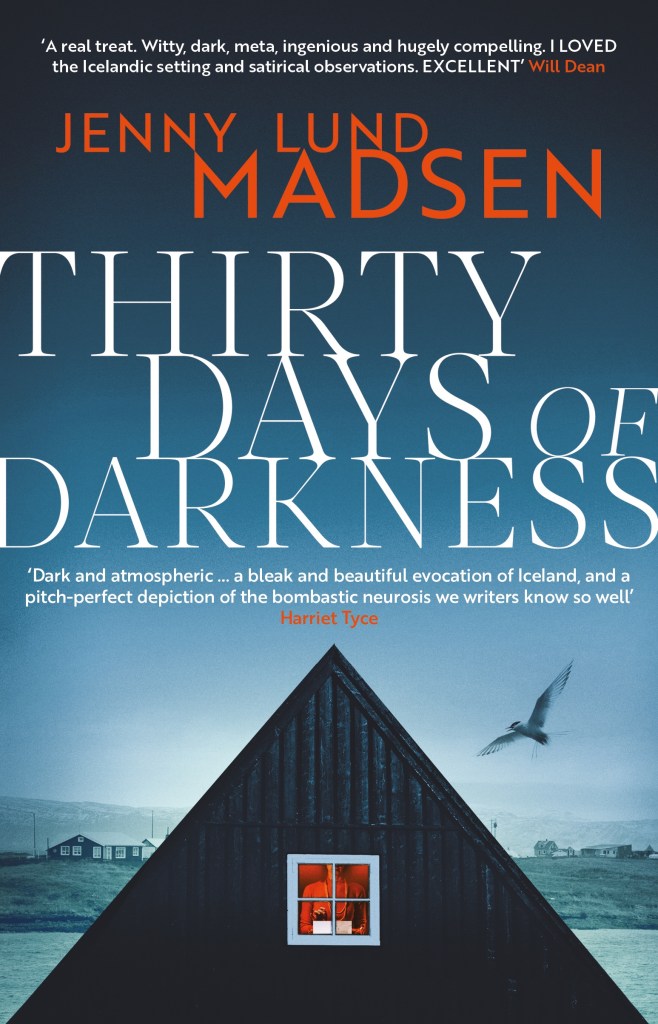
The first thing I loved about this book was that stunning cover. I hadn’t fully taken it in when I received the book, but once I’d found my reading glasses I couldn’t stop looking at it. That tiny lit up window, a little orange glow of creativity in the darkness really fired up my imagination. I’d love Orenda to create some book posters to accompany their author’s work. The blurb drew me in with it’s conflict between genre authors and their supposedly high brow literary fiction colleagues. Hannah writes literary fiction and is dismayed at a book festival to see the crowds attending a Q and A with Jørn Jenson, the darling of Scandi Noir, who churns out a formulaic book every year. Yet he’s filling a tent with fans and she’s in a lonely booth waiting for someone to drop by. I loved that she launched a book at his head! In the ensuing row, Jensen goads Hannah into saying she could write a crime novel in a month. Her agent uses the incident as a great marketing strategy and pours fuel on the fire, talking to the press about the wager and even putting Hannah on a plane to Iceland as a writing retreat. There she will live with a lady called Ella and hopefully, within thirty days, complete a commercial success. Yet within days of Hannah’s arrival there’s a real life crime, as Ella’s nephew Thor is found drowned in the waters of the harbour. Can Hannah use the case to write her crime masterpiece? As she starts to ask questions about this small town community will she find inspiration, or will she be in more danger than she ever imagined?

Hannah is an interesting heroine in that she isn’t all that likeable at first. She’s prickly, arrogant and a definite book snob.

“Hannah Krause-Bendix has never received a bad review. Not once has anyone had a negative thing to say in any of the reviews of her four novels. A literary superstar, twice nominated for the Nordic Council Literature Prize. Didn’t win, but that doesn’t matter; anyway, she doesn’t believe the mark of good literature is how many awards it’s won. She’s actually refused the numerous other prizes she’s won over the years. No – Hannah sees herself as a forty-five year old living embodiment of integrity and will always maintain that it is beneath her to seek commercial success.”

I was starting to feel sorry for her editor and publisher. Her disgust for the current literary scene is obvious. She hates festivals and signings, prizes, social media and is dismissive of bloggers (how dare she – *swoon*). As she picks up Jensen’s latest book as if it is ‘a pair of homeless man’s lost pants’ she notes that most of the reviews are from obscure bloggers she’s never heard of. She’s no better as she arrives in Iceland, annoyed that her new landlady is late, that her jeep looks and sounds like it’s five miles off it’s new home at the scrap yard, plus she drives with her steamed up glasses so close to the windscreen that Hannah wonders whether she can drive, or even see. Then she makes the terrible faux pas of calling her friend and publisher Bastian to get her a flight back to Copenhagen, assuming Ella can’t understand her. Of course she can. I was cringing about her behaviour. Yet I didn’t dislike her. Despite these failings, plus the alcoholism, infidelity, snooping and complete conviction she’s in the right, there’s something rather freeing about her impulsiveness. We all have those thoughts, those imps of the perverse, that pop into our mind and encourage us to poke that person who’s bending over to reach a low shelf in the supermarket. We don’t do it of course, but Hannah does. In the course of the novel she randomly feels a homeless man’s head, buys the town teenagers alcohol, starts an affair with someone she’s barely met and as we know, tries to hit a man in the head with a book. She seems disconnected from others in the sense that we don’t know her family, she has few obligations and she thinks nothing of asking very personal questions in entirely inappropriate circumstances. I sort of loved that.

There is definitely a blackly comic element to this story and a satirical eye for both the book world and crime fiction in general. There’s a meta element to the story too, as Hannah makes observations and discoveries about crime fiction that then seem to bleed into the actual case. She observes that her investigations are suggesting the case is actually quite simple to solve, Jørn, who has followed her to Iceland, advises that in crime fiction the killer is never the most obvious suspect. Subsequently, her enquiries move from the her current suspect and start to take a darker turn, towards the last people she’s suspected. Jørn tells her:

“ a good crime novel has three crucial components. One: a spectacular and violent opening, preferably a murder. Two: false leads and false suspects. […] Point three is surprises.’

He also rather amusingly points out that the protagonist shouldn’t be likeable, because no one enjoys a likeable protagonist in crime. In fact during a violent clash with her first, rather boringly obvious suspect, she even doubts her own credentials as a protagonist. As she fights for her life, she berates herself for her stupid plan of luring him to a window, because she’s now in front of an open window with a possible murderer.

Of course, he isn’t the murderer after all. In the end the crime is complex and rather like the book of Icelandic sagas that Ella gives her to read. The roots of this murder lie way in the past with the last people Hannah suspected. In fact in the echo of the saga, someone takes something that is highly prized and didn’t belong to them, setting in motion years of secrets, lies and denial. Yes, there’s a lot of the clever stuff going on that us ‘weirdo’ readers like, as one teenager describes Hannah’s fan base, but there’s also a solid thriller as well. It’s a bleak and claustrophobic atmosphere as soon as Hannah reaches the island where she knows no one and feels alien. The remoteness of the town and it’s isolation when the bad weather comes just add to that sense of being completely alone. This is not a place to be injured or to be a victim of crime; there is only one police officer in town, with back up over an hour away on a good day. Jørn may preen and prance around like the archetypal action hero, but he is surprisingly very useful to have around in a sticky situation and despite his woeful writing, is possibly a good friend to have, especially where he’s the only familiar and friendly face. Alongside Hannah I suspected three or four different people and the author kept me guessing, just leaving tiny clues along the way. At first there was a little bit of scepticism -I remember watching Murder She Wrote with my parents when I was younger and my dad wondering why nobody told Jessica Fletcher to ‘bugger off and mind her own business’. However, once the action started to heat up I forgot that Hannah had no business interrogating suspects and just kept reading. She’s no Jessica and this is definitely not cozy crime. It’s dark, disorientating and scary as hell, but you’ll not be able to put it down. This is an incredible debut and I’d love to see where Hannah ends up next. Now back to that cover – I think it would make a lovely tote bag ……

Meet The Author

Jenny Lund Madsen is one of Denmark’s most acclaimed scriptwriters (including the international hits Rita and Follow the Money) and is known as an advocate for better representation for sexual and ethnic minorities in Danish TV and film. She recently made her debut as a playwright with the critically acclaimed Audition (Aarhus Teater) and her debut literary thriller, Thirty Days of Darkness, first in an addictive new series, won the Harald Mogensen Prize for Best Danish Crime Novel of the year and was shortlisted for the coveted Glass Key Award. She lives in Denmark with her young family.

Posted in Random Things Tours

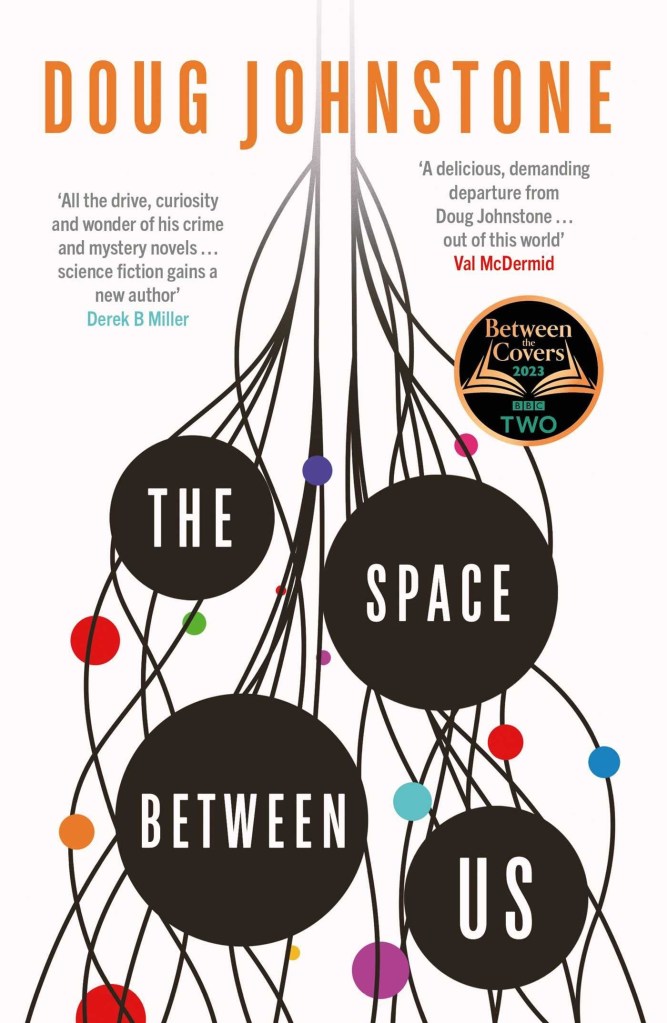
The Space Between Us by Doug Johnstone.

“Why, sometimes I’ve believed as many as six impossible things before breakfast.” Alice Through the Looking Glass.

Normally, I’d say this is the most unusual book I’ve read in quite a while, but in fact it’s been a brilliant month for Orenda Books as both their March releases have been quirky, original and quietly brilliant. It’s no secret that I love Doug Johnstone’s Skelf series and it’s mix of philosophy, astronomy, family and crime. This stand alone novel has some of the same attributes and a whole lot more besides. One night a strange occurrence in the Scottish night sky brings together strangers Ava, Lennox and Heather. Several people see the strange light and sparks in the air and all have severe cerebral haemorrhagic strokes. These are the most rare type of strokes and usually they’re fatal. Ava, Lennox and Heather are the only people to wake up the next day completely unscathed. Each one has their problems: Heather had been wading into the water with stones in her pockets after receiving a terminal cancer diagnosis but is saved by something in the water. Lennox is a lonely teenager, bouncing round children’s homes and is being set upon by bullies when he sees the lights in the sky and the stroke hits. Ava is pregnant and desperate to get away from husband Mike, a vile abuser obsessed with power and control. Meanwhile, on the beach lies a strange octopus or giant squid, sprawled on the sand and guarded by police. This cephalopod appeared as these unusual strokes happened and no one knows what to do with it. It’s not the usual octopus as it only has five tentacles and it has strange rippling colours under it’s surface. Police officer Nina is on the case and reporter Ewan is determined to find out the link between the creature and the three disparate people who band together to rescue the creature and have now gone on the run.

None of the three fugitives can understand why the extraterrestrial life form has chosen them. At first their link with Lennox seems most powerful. Despite his background of being let down by others, Lennox is very open to the creature and is the one to name them Sandy. He has even allowed them to form a telepathic connection by leaving a sort of organic hearing aid in his ear, turning them into ‘Lennox-Sandy-Partial’. It’s hard for Lennox to explain Sandy, he immediately uses ‘they’ as Sandy’s pronoun, not because of a dual gender but because they’re a dual person. Lennox thinks Sandy may be part of a larger whole or has a hive mind, one that can link with humans should they wish. For Lennox, being part of a larger whole must sound wonderful and grounding in a way he’s never experienced before.

‘It was weird, having spent his life in the care system, he didn’t have a fucking clue who he really was. The policy preventing you finding out about your birth parents out about your birth parents until you were eighteen was strict, and even then, the chaotic system of records meant you might never find out. Shit just got lost. So he’d drifted rudderless through his early life, with no sense of community or belonging anywhere.’

Ava is the next to connect with Sandy, mainly because she trusts him to tell her whether her unborn baby is okay. Ava is also alone in the sense that she alone knows the truth about her life with husband Michael. Ava was already running when she encountered Sandy, running from Michael and his attempts to destroy her. Michael is the archetypal abuser, who started out by separating her from friends and family then used techniques like gaslighting so she would question herself, even her own sanity. Then the physical and the sexual violence began. Even Ava’s mother has abandoned her, thinking Michael is a lovely man who simply has his wife’s best interests at heart. Ava wants to leave before her baby is born and her decision to flee with Sandy up to the north of Scotland is partly because she hopes Michael won’t find her there. These are the first people to meet Ava and accept her for who she is and they immediately believe her account about her marriage.

The last to connect with Sandy is Heather and that’s because she’s deliberately closed herself off to others. Heather has a terminal brain tumour, something she’s been keeping from everyone including her new friends. She has immediately taken on the role of Mum, looking after all of them and even preparing to deliver Ava’s baby. When they approach Heather’s ex-husband for help, the others are surprised, but Heather assures them he is one of life’s good guys. She is clearly genuinely pleased to see him. However, seeing him with a new wife and starting a family is particularly painful. A terrible tragedy forced this couple apart and seeing him brings it flooding back. Can Sandy approach her now, when she’s at her most vulnerable and what help can he offer? All three are fascinating characters and as a group they seem unbeatable. It’s their very connection that gives them strength. However, they are being pursued; by the police, the journalist called Ewan and a shadowy group of men in black who seem capable of anything if it gets them closer to Sandy.

As always Doug Johnstone is capable of taking several unusual, even improbable scenarios but writing about them in such a clever way you don’t question it. I never once stopped to think it seemed incredible. Similarly, our three main characters never pause or worry they’re doing the wrong thing. There’s one incidence where Lennox stops to question what’s happening:

‘There weren’t many Google hits for ‘telepathic octopus’. Shocker. Lennox looked up from his phone and stared at Sandy. He felt like a different person to the one who walked through the park two days ago. Now he was wanted for murder and kidnapping, sitting in a cheesy brown van with an old woman and a pregnant teacher, and getting psychic messages from a telepathic octopus.’

Usually a story like this would be set in a fantasy or dystopian future, but we’re definitely in the here and now. The settings are so ordinary. I could imagine pulling into a viewing point near Loch Ness and meeting Ava, Lennox and Heather when they’ve broken down and are waiting for a lift. Yet, within moments Lennox has been absorbed by Sandy and is diving through the water like a seal, breathing easily and feeling completely at home. These sequences are fantastical, stunningly beautiful and transcendent. He makes us want to be there experiencing it all. I think the key is that despite the strangeness of a tentacled cephalopod shivering with excitement at the thought of swimming in a loch we’re learning from Sandy. He’s showing us how to love life more, to find the wonder of things, to connect more, grow together and to experience everything:

“Suddenly his host shot upward towards one of the bigger cracks in the ice. A jet stream flowed from a volcano on the seabed, like a fountain through the sea to the opening in the ice. They joined it and shot through the ice shelf into space, surrounded by millions of particles of water and ice. He turned and looked at Saturn, huge and orange in the sky. He realised they were in one of the rings, they were the ring […] floating in space, swaying and drifting.”

As always with Doug’s writing there are literary and philosophical references throughout and I was delighted to find one of my favourite thoughts from Susan Sontag who wrote about illness and disability and their surrounding metaphors. Within the medical model of illness, particularly with cancer and other auto-immune illnesses, the metaphors of battle are commonly used as Heather points out:

“She hated the military terminology that people used around cancer: ‘She lost her brave battle with cancer.’ The cancer was part of you, you created it from nothing, so that language meant you were fighting yourself. Turning everything into a battlefield was a masculine, wrong-headed way of looking at things.”

She hates the assumption that if the cancer has spread or become terminal it’s because she is weak and hasn’t battled hard enough. Sometimes the words we choose are very important.

There are allusions to Alice Through the Looking Glass, to Virginia Woolf in Heather’s method of suicide – wading into water with stones in her pockets. There’s also a hint of Howard’s End in Sandy’s ability to connect with his fellow cephalopods and other species. It should make us rethink how we connect with one another. Howard’s End presents people of different classes who normally wouldn’t associate with each other, but people are really all the same. We should connect with all sorts of people in different age groups, abilities, religions and races. Here Lennox truly understands this:

‘It didn’t make sense to think of himself as Lennox anymore, he was a compound of a million things – bacteria in his gut, microscopic bugs in his hair, Xander’s body passing through his own, Sandy inside his neurons. It finally made physical sense, the idea that Sandy was plural. We all are. And the human idea of being singular, apart, alone, was a ridiculous and lonely way of looking at life.”

In fact what our different characters show us is how strong we can be, if we work together, especially characters with very different skills and personalities. Being part of a whole makes us stronger. Despite the danger and tension of their quest to reach Ullapool where everyone converges on the harbour, I found the ending so positive. Sandy asks us to rethink our lives, let others in and perhaps look at the world in a different way. Why do we think of our planet as ‘Earth’ when the largest proportion of our globe is ocean? We look at everything through the filter of our own class, education, experience and privilege. So, we should take time to view things through someone else’s filter. This was a fascinating, funny and uplifting literary journey that challenges us to move closer and reduce the space between us. In other words ‘only connect’.

Published 2nd March 2023 by Orenda Books

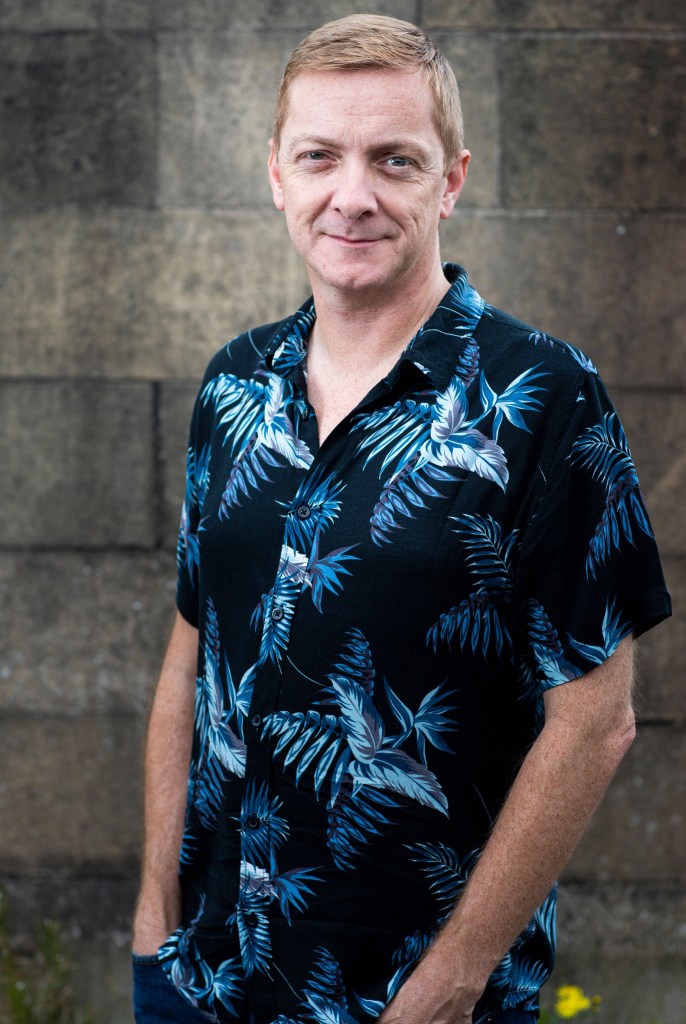
Doug Johnstone is the author of twelve novels, most recently The Great Silence, the third in the Skelfs series, which has been optioned for TV. In 2021,The Big Chill, the second in the series, was longlisted for the Theakston’s Old Peculier Crime Novel of the Year. In 2020, A Dark Matter, the first in the series, was shortlisted for the McIlvanney Prize for Scottish Crime Novel of the Year and the Capital Crime Amazon Publishing Independent Voice Book of the Year award. Black Hearts (Book four), will be published in 2022. Several of his books have been best sellers and award winners, and his work has been praised by the likes of Val McDermid, Irvine Welsh and Ian Rankin. He’s taught creative writing and been writer in residence at various institutions, and has been an arts journalist for twenty years. Doug is a songwriter and musician with five albums and three EPs released, and he plays drums for the Fun Lovin’ Crime Writers, a band of crime writers. He’s also player-manager of the Scotland Writers Football Club. He lives in Edinburgh.

Posted in Orenda, Publisher Proof

Beautiful Shining People by Michael Grothaus

I don’t tend to read a lot of science fiction and dystopian novels, often because I find them depressing and life is tough enough at the moment. I often I feel as if the author has become so carried away with world building that they forget the human element of their story. Almost like watching one of those films where the special effects are amazing, but the characters and their dialogue is an afterthought leaving me with an empty feeling. This book sounded intriguing though and once I started reading it I was completely blown away. This is science fiction with a heart and a lot to say about the human experience. Our narrator John is an awkward 17 year old, from a dysfunctional family and with deeply personal body issues. He also happens to be a coding genius, talented in quantum code and greatly in demand by tech companies. He is spending some time in Tokyo while signing a deal with Sony and comes across a small cafe that offers ear cleaning. Inside he finds a huge Japanese man working behind the counter, a quirky dog with a spherical head and his owner, a pretty and rather enigmatic young girl called Neotnia. This chance meeting develops into an incredible journey that will take them from the neon city of Tokyo, to the tragic past of Hiroshima and finally the beautiful mountains of Nagano.

Michael Grothaus also takes us on a journey of genre, starting the novel with a chilled travelogue style, interwoven with a tender story of first love, via body shame and finally becoming a dystopian thriller. The author knows how to build a world that feels dislocated and distant from us with just one simple sentence, such as the description of the night sky with three objects visible from earth. The moon’s light picks out the twin space stations being built by the world’s two superpowers; China and the USA. The author’s journalism background and research into the world of fake video production has helped in creating a believable and brilliant backdrop of warring superpowers in a daily information war. ‘Deep Fake’ videos are used to produce fake news, meaning people must question, not just everything they read, but everything they see. Warfare has become a barrage of misinformation and cyber attacks, at their worst disrupting every aspect of daily life. He also weaves in social issues that are already evident worldwide for us, such as the rapidly ageing population in Japan. People are now routinely living into their nineties, but need care for longer and there simply aren’t enough young people to pay for or provide the care needed. This is a world that’s ours, but not as we know it. I loved how I would be relaxing in a park, looking at a familiar landscape of trees and pagodas and then I’d be blindsided by a tourist information bot. When the group all go on a car journey I couldn’t work out who was driving; the answer was no one. Often I didn’t know where we were going next but I was so bewitched by his writing that I’d have followed him anywhere.

I loved the relationship that builds slowly between Neotnia and John. She has a quiet, calming manner that seems to soothe him and a caring nature that John has never really experienced before. They seem to connect on a deep level very quickly, but there are people around her who are very protective. Goeido is a disgraced sumo wrestler and owns the cafe where Neotnia both lives and works. He doesn’t speak much, but John is aware of his concern because of the barely concealed scowling and head shaking. Neotnia takes John to a nursing home where she volunteers, to meet an elderly American man she has a friendship with. John enjoys meeting him, but also gets a feeling this meeting was some sort of test. Why are these men so protective of her? His relationship with Goeido only improves when they drink sake together and next morning John wakes up still in the booth where they had dinner. They seem to have connected, but John is very confused by a disturbing dream involving a bath and a toaster! Despite this John and Neotnia’s relationship does deepen and I was so drawn into their tender love story. There is something they’re both hiding and strangely it’s the biggest thing they have in common. Then comes the massive twist that I really didn’t see coming. The clues are there but the idea is so fantastical it’s quickly dismissed.

The beautiful backdrop of Japan really brought the place alive for me and made me think deeply about some aspects of it’s history. The city of Tokyo is wonderfully varied with it’s neon signs, bubblegum fashions, restful gardens and kamii shrines dotted everywhere. I learned more about Japanese belief systems, the differences between Buddhism and those who believe in kamii. The history around Hiroshima was so devastating, as was the knowledge that any advance in science seems to be harnessed for the purposes of war. The full impact of the bomb on the population of Hiroshima was devastating as the author tells us about those damaged by the blast, but left with terrible injuries. That complete change of abilities, identity and living standards could be seen as a more terrible end than those at the bomb’s epicentre who were simply vaporised. I loved how philosophies of life were discussed too. In conversation with Neotnia, John explains that her age group’s concerns and anxieties about the space stations and cyber attacks haven’t affected younger generations because they’ve never known anything different. This is probably something we’ve all experienced and it’s interesting to think that a small child now will grow up with the cost of living, climate change and hybrid vehicles as their norm. Whereas someone like me who has lived half their life really feels the changes and is more likely to find them unsettling. I found the end so emotional and I was moved by John’s thought that the common thread of humanity is suffering. It’s something I’ve thought about a lot, both in my personal life and in my therapy work. My brother says that I think everyone needs counselling, because I’m a therapist. I always reply that everybody needs counselling at some point in their life. Yet, John’s experience makes him rethink his original statement and this took me from heartbreak to a glimpse of hope. This is a beautifully written story that’s definitely science fiction, but is also a deeply felt love story about difference and human connection. If this isn’t your usual genre, please give it a go. I’m so glad that I did.

Published by Orenda 16th March 2023.

Meet The Author

Michael Grothaus is a novelist, journalist and author of non-fiction. His writing has appeared in Fast Company, VICE, Guardian, Litro Magazine, Irish Times, Screen, Quartz and others. His debut novel, Epiphany Jones, a story about sex trafficking among the Hollywood elite, was longlisted for the CWA John Creasey (New Blood) Dagger and named one of the 25 ‘Most Irresistible Hollywood Novels’ by Entertainment Weekly. His first non-fiction book, Trust No One: Inside the World of Deepfakes was published by Hodder & Stoughton in 2021. The book examines the human impact that artificially generated video will have on individuals and society in the years to come. Michael is American..

Posted in Random Things Tours

Expectant by Vanda Symon

Expectant is the fifth novel in Vanda Symon’s Detective Sam Shephard series and I finished this late last night so I can reveal it’s brilliant and full of tension as the countdown to catch a murderer coincides with the last weeks of Sam’s pregnancy. This great series, set in Dunedin New Zealand, never lets me down. Sam is a fantastic character, who I’d happily go for a drink with. She’s professional and has one of those faces that people trust immediately, meaning she can elicit new leads and confessions from the unlikeliest criminal. She’s stubborn and outspoken, very ballsy and, although she tries her best not to use it, has an incredible swearing vocabulary. She and partner Paul are expecting their first child and she’s working up to two weeks before her due date. They haven’t found time to organise their endless piles of baby kit into a nursery when a case comes in that Sam can’t help but be drawn into. A group of kids who are hoping to tag the wall down a quiet side street find a woman covered in blood and only one of them has the conscience to stay and ring an ambulance. He’s willing to face the music for the graffiti if he can save her. At first it’s thought to be a stabbing, but it soon becomes clear this is something more sinister. A pregnant woman has been subjected to a rudimentary Caesarian and left for dead, even worse there’s no sign of the baby. This must be someone with a certain amount of medical skill. For Sam, who’s at her most vulnerable, it’s scary to think this might have been someone the victim trusted and it makes her more determined to catch her killer.

I found the pace slightly slower than previous novels, but I found that fitting considering that Sam is slowing down too. The days are winding down towards her maternity leave and her due date. In fact the days are dragging as her boss is reluctant to have her start something as important as a murder case before her leave starts. He feels it would be disruptive to the family and her colleagues, so she’s on desk duty, trawling through evidence. That’s before we factor in her physical condition, she’s so big that she gets stuck in some automatic barriers; a brilliant comic moment in this dark subject matter. Luckily it’s partner Paul on hand to lift her clear. Also, with unusual sensitivity, the boss thinks that placing a pregnant woman with the family would be distressing for them. Especially until they find the baby. This isn’t just a murder case, the baby is missing and the reasons why someone would steal a newborn baby are running through the heads of every team member. However, this is where Sam’s pregnancy could be a super power, being an expectant mum means her thoughts are different to the others. Could they provide a breakthrough?

The theme of mothers and their children, particularly daughters, is front and centre in this story. Whether it is Sam’s relationship with her own mother who has concerns about her working this close to her due date. There’s also Sam’s best friend, currently still living with her but due to move away imminently. She has a unique position in Sam’s life and is always there as a shoulder to cry on, but here she provides some important psychological insight. Sam’s need to be involved with this case could be linked to the spare room full of decorating supplies and boxed nursery furniture. There are so many changes coming, might Sam be paralysed from moving forward? Of course it is Sam who makes some major breakthroughs in the case in the final moments before she clears her desk. One of which seems to be a coincidence at first. As the final chapters started to race and fill with tension my heart was pounding. Just as Sam has let her guard down and accepted what’s next in her life, everything she’s looking forward to could be ripped away from her. In fact, if you are pregnant, maybe keep this one for after the birth. I was genuinely scared for her and even though she’s the one who most understood the killer’s motivations, will she still be shocked by their identity? You’ll be holding your breath to the very end with this one. Sam’s vulnerability is terrifying and I was praying that she would be okay while reading. As if she’s a living and breathing human being. That’s the power of Vanda Symon’s writing and how much of that magic she’s poured into this brilliant character.

Published 16th Feb 2023 by Orenda.

Meet the Author

Vanda Symon lives in Dunedin, New Zealand. As well as being a crime writer, she has a PhD in science communication and is a researcher at the Centre for Pacific Health at the University of Otago. Overkill was shortlisted for the 2019 CWA John Creasey Debut Dagger Award and she is a three-time finalist for the Ngaio Marsh Award for Best Crime Novel for her critically acclaimed Sam Shephard series. Vanda produces and hosts ‘Write On’, a monthly radio show focusing on the world of books at Otago Access Radio. When she isn’t working or writing, Vanda can be found in the garden, or on the business end of a fencing foil.