Posted in Random Things Tours

Dance of the Earth by Anna M Holmes

London, 1897. Nobody, least of all Molly, knows why she ends up taking the foundling home from her job at the Alhambra Theatre. Molly is a seamstress, creating costumes for ballerinas who perform within the music hall tradition. She loves dance but with her built up shoe and awkward gait she is as close to the stage as she can get. When a baby is discovered on the steps of the theatre everyone discusses who could be the mother, but they’re at a loss. It’s hard to hide a pregnancy in a shared dressing room and with seamstresses who note the tiniest change on a tape measure. She takes Rose home, but her upbringing is also at the theatre where everyone takes an interest in this little girl who grows up enjoying the colours, fabrics and feathers of the sewing room but reserves her love for the ballerinas. When she’s old enough she wants to learn and grows into a role in the chorus very quickly. Rose is determined to succeed and keeps pushing for that breakthrough that will give her the starring role. Molly knows Rose is pregnant before she tells her, the result of an affair with a wealthy married man, but the abortion they arrange is abandoned when Rose changes her mind. Rose’s twins are born backstage at the theatre, where life starts and then life ends as Rose’s dancing dreams die. So the boy, Walter, is sent to live with his father and stepmother and Nina stays with Molly. This decision means that Nina has the same upbringing as Rose and becomes even more determined than her mother to be the best dancer she can be. The younger generation pursue their ambitions, loves and dreams in a new world shaped by the pioneering Diaghilev and his dazzling Ballets Russes, Stravinsky’s dissonant music, and the devastating First World War.

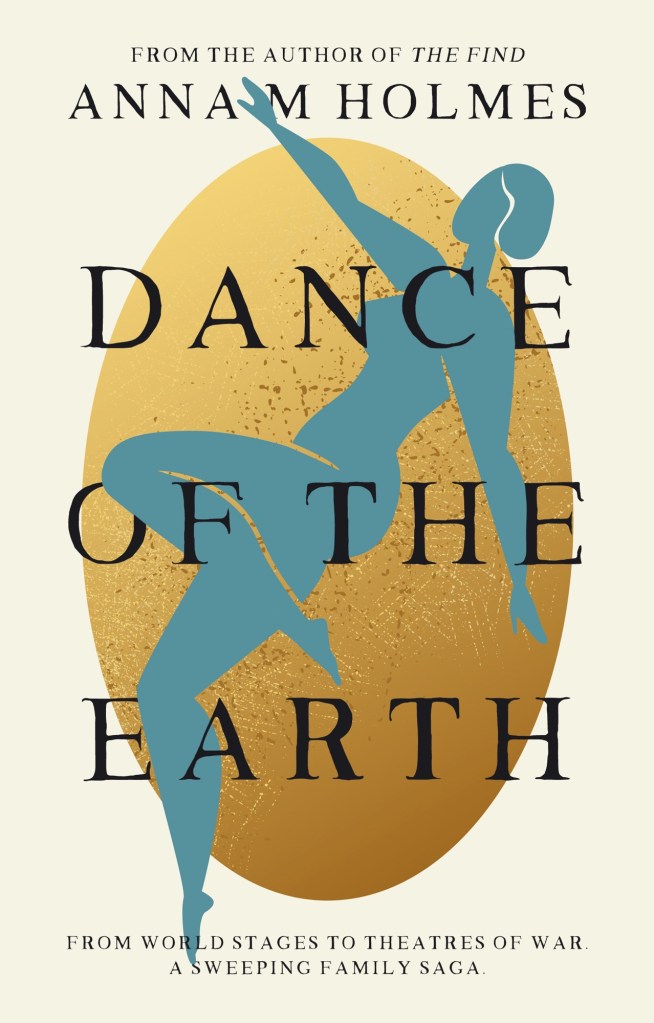
I asked to read and review this book because I enjoy ballet, particularly the more lyrical modern ballets by Mathew Bourne and the brilliant Northern Ballet based in Leeds who often do literary adaptations such as Wuthering Heights and The Great Gatsby. I’m also fascinated with this period of history, particularly when it comes to the huge impact of WW1 and the way it affected class structures and the lives of the women left behind. The author weaves her story into this time and society beautifully and with such care over every detail. Even the cover shows her themes of rebirth and regeneration with its large golden egg and a female figure as if drawn by Matisse, non-sexualised and not constricted by the corsets and crinolines of earlier generations. Her shape reminded me of the new ballets produced by Diaghilev and choreographed by Fokine that also showed more freedom in their movements and looser costumes. Rose and Nina have a very different upbringing from the average Edwardian woman, the music hall theatre wouldn’t be considered respectable by the middle and upper classes. Molly has no choice but to work so both Rose, and later her daughter Nina, fell asleep to the sound of sewing machines and have clothes that are colourful and unique, thrown together from fabric remnants. Both are dazzled by the dancers and want to be on the stage and both are successful to different extents. Nina is utterly determined and visits all the ballets she can while training, because she’s aiming beyond the music hall and into the world of modern ballet. She hears of the Ballet Russes and Diaghilev’s new approach, she identifies herself with his ‘Firebird’ – another symbol of renewal and regeneration:

‘Tamara Karsavina wore a magnificent head dress – long flaming feathers quivering – a bodice of brilliant reds and oranges […] she adored the exotic creature”. 

The premiere of this ballet was in 1910 at the Opera de Paris and showed off the choreography of Diaghilev’s collaborator Fokine which was ground breaking. This dancer had to represent an element, with all the wildness of fire, something we think of as hard to contain and dangerous to be near. It’s definitely a force that’s in Nina and represented the changing roles of women in the early 20th Century: women who wanted to go to university, to have a career, to have the vote. Imagine how strange it must have been to see a woman on stage who’s a rebel and has power, especially with its incredible costume and free expressive dancing. 

‘This firebird was her – Nina – aflame, all sharp angles radiating determination’. 
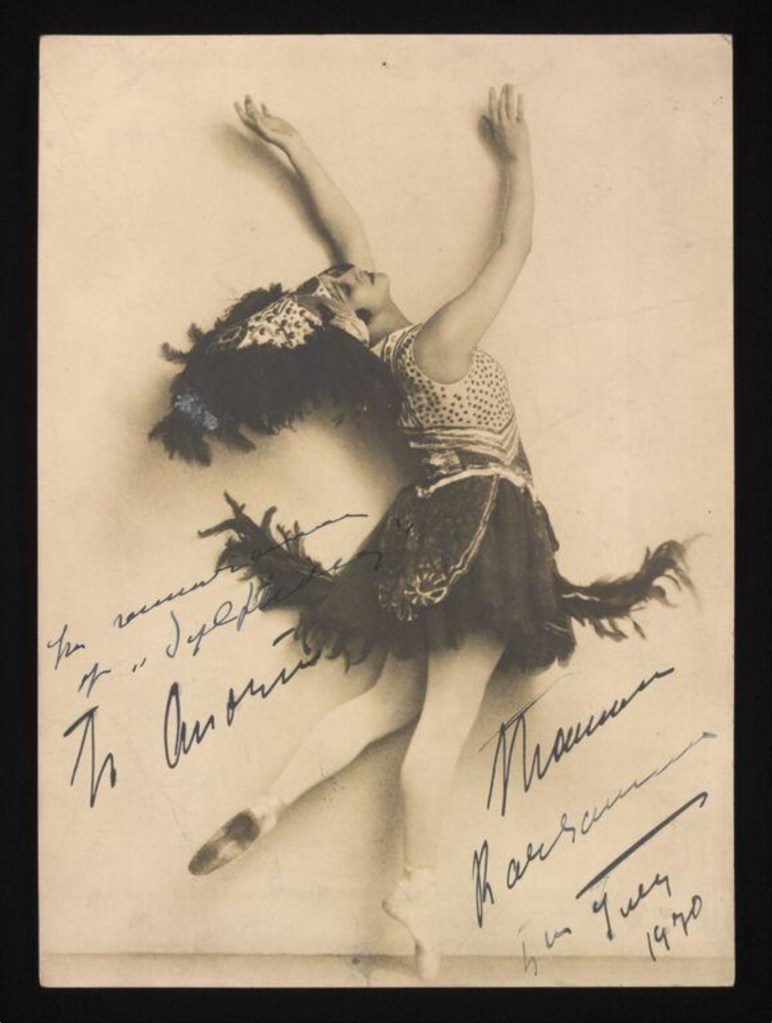
The Firebird from V and A archive

Walter is almost his sister’s opposite, a person you could easily miss in a room and caused by his upbringing. Brought up by his mother’s lover Arthur and his wife Beatrice, he is rich in every sense except the one we most need – love. Beatrice was cold, although it is hard to imagine what it felt like to meet the proof of her husband’s infidelity at the breakfast table each morning, especially when she couldn’t have children of her own. I was intrigued by the differences between the twins and what it said about the nature/nurture debate. Nina has been brought up by the entire theatre community of women from Molly’s fellow seamstresses to the dancers, which gives her so much confidence, drive and inspiration. She sees women making their own money and in a creative career, so she knows women can make it on their own in this world. All Walter seems to learn at home is to stay as small as possible and not upset anybody, something he takes to boarding school with him. His masters at school are trying to turn out traditional middle class men, who go on to university and have a profession. The assumption is they will have a career that can support a family, but Arthur’s only love is music but he doesn’t have the confidence or self-worth to make that happen. When Arthur died I thought Beatrice was particularly brutal in dismissing Walter, making it clear he will liaise with his father’s solicitor from now on. When children are rejected they don’t think something is wrong with the parent, they internalise the rejection and are left feeling something is wrong with themselves. For Walter this is compounded at boarding school where he is not athletic or competitive, he is teased, bullied and never stands up for himself. As he discovers his Grandmother and Nina he’s also having feelings that seem natural, but must be kept secret. When they all go to see the Rite of Spring he watches Nijinsky mimicking an ecstatic and sensual moment on stage and becomes aroused. He’s mortified and has to leave immediately. I kept wondering how he would cope with war on the horizon and the huge pressure on young men to enlist. I couldn’t imagine how he would survive the brutality of the experience. 
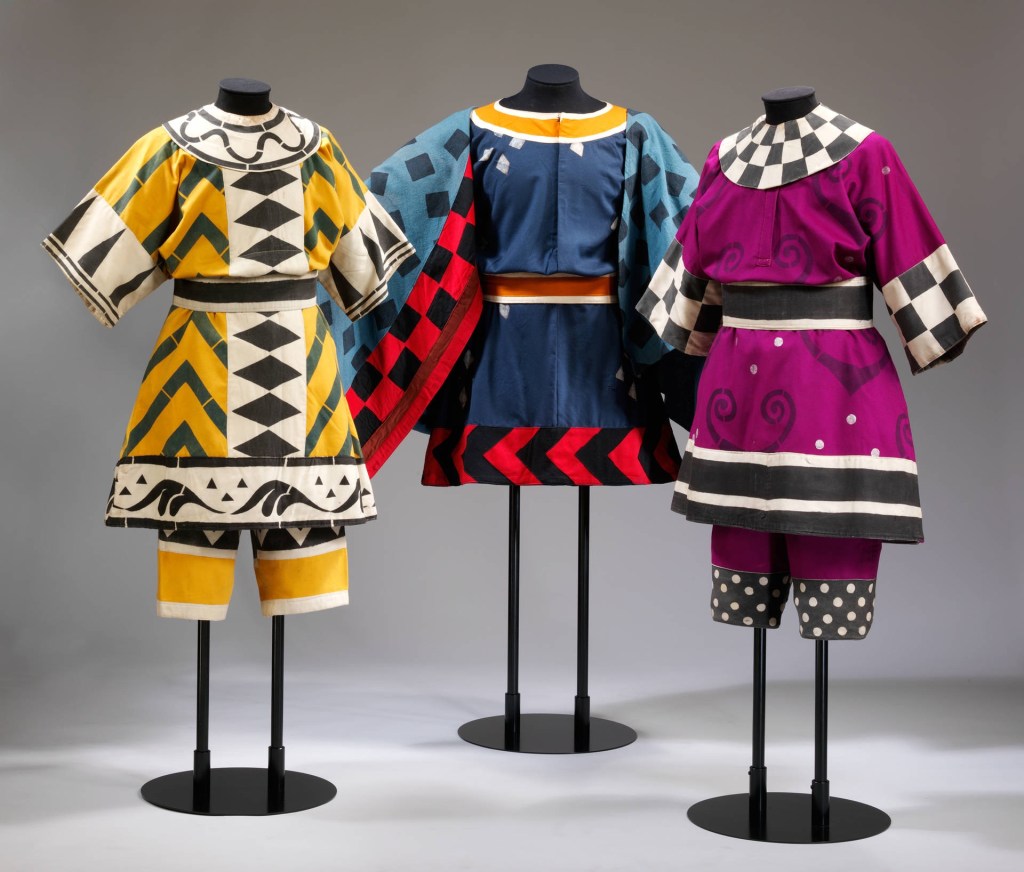
Costumes from the Ballet Russes

This fascinating family story feels absolutely real and that is down to the incredible amount of research the author has undertaken. She wholly embeds these characters into the history of the time, weaving social, cultural and political history around them, along with her incredible knowledge on dance history. I loved the vividness of the theatre, the backstage bustle and the magic that is produced for the audience especially when what they’re seeing is groundbreaking. She applies equal care to the war sections of the novel too. It feels like you are in those trenches because there’s an immediacy to them. These sections are also graphic and raw, which makes them hard to read about war when you’re invested in the characters. It had to be strong and true to life for us to understand how and why this war tore straight through the lives people had known before. Although changes were already happening at the turn of the century, WW1 was the first mechanised war and the sheer number of casualties were hard to comprehend. It wiped out a generation of men and afterwards there’s an acceleration of modernism that’s visible in the arts and everyday people’s lives. The aristocracy struggle to hold on to property and land as they are tied up with death duties, sometimes more than once. Middle class women who have always relied financially on men have to face life alone and discover ways of making money – less servants, taking in lodgers and finding jobs. If men came back, they came back changed forever due to shell shock (now PTSD) or physical injury and couldn’t work. Women didn’t want to give up jobs they’d done throughout the war and a freedom they’d never had before. Also contraception becomes more freely available and this was the earliest stages of some women not having to choose between career and relationships. As Nina joins the Ballet Russes she becomes more independent, travelling all over the world and living the life her mother had dreamed of. When we see her reach her first stop in the south of France she is utterly in her element and it’s no surprise that she enters into a controversial mixed race relationship, something more acceptable in that time within the bohemian and arty circles she inhabits. It’s almost as if the war curtailed the freedom of men, especially when conscription began, but emancipated women.  
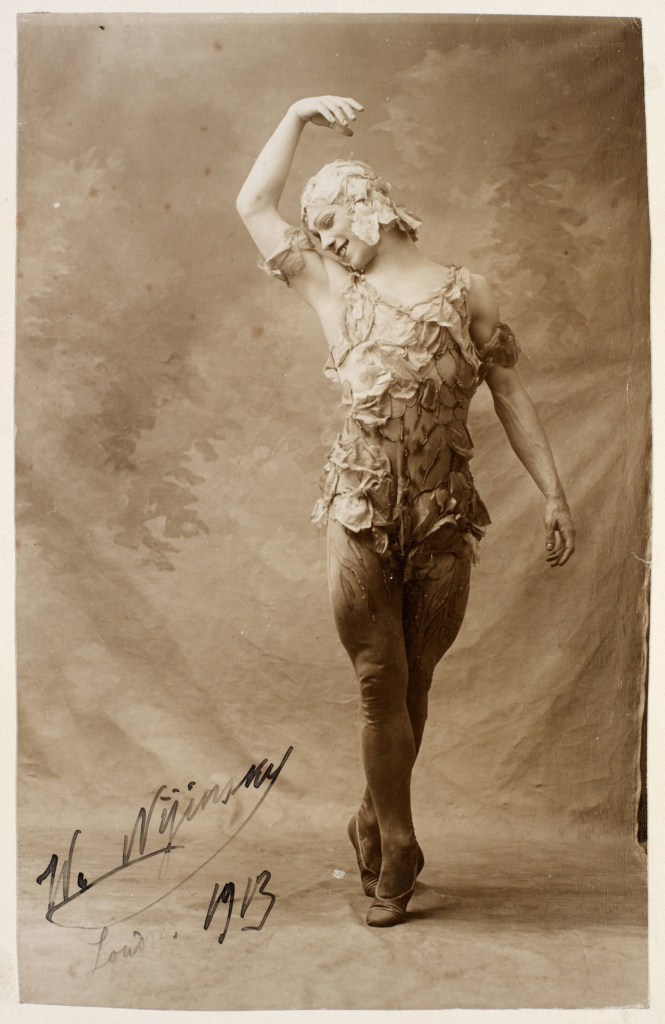
Nijinsky

In 2010 I visited an exhibit at the Victoria and Albert Museum in London, called Diaghilev and the Ballet Russes which focused on costume and design including collaborations with artists like Picasso and the music of Stravinsky These sketches and costumes were like nothing I’d ever seen, seeming both weirdly modern but archaic at the same time. There’s nothing pretty about them and no tulle in sight, they’re loose with strong colours, geometric shapes and sharp zig-zags. I could see the point being made – by being so aggressively modern it almost forces change and expectation of what a ballet is. I could see how they matched Stravinsky’s music because there was a segment of the Rite of Spring with its themes of growth, fertility and desire. I could see why audiences found this piece so shocking because it has that same aggressive feeling with unusual rhythms and sudden loud bursts of sound. It’s harsher on the ear than the usual score for ballets and the sets were purposely sparse. The dancing had a primitive feel and the subject matter of a young woman sacrificed to the spring is like a modernist version of the contemporary horror film Midsommar. It was reported that people rioted at the premiere, which is probably an exaggeration, but I can imagine an audience finding it strange and confronting when we think of the opulence and beauty they were used to in ballet. It’s such an important piece in the history of dance and without it we wouldn’t have contemporary dance. I came away from the novel feeling I’d learned so much about dance and the early 20th Century in general. While all the characters touched me in different ways I did have a soft spot for Molly, who stands out within these themes of fertility and desire. I thought she was the most incredible mother, yet had never given birth to either of her children. She has a disability but spends her time within a world where bodies are pushed to their limit, creating beauty in their movement. Her love of dance is built into every one of the costumes she lovingly creates and the colourful outfits she makes for her daughters. She provides stability and love for Rose and Nina, plus she never judges their mistakes. She is the earth, grounding these fiery women and eventually Walter, for the rest of her life. She is the heart of this novel for me and Nina can only be what she is because of her. I could imagine her as the central character in an incredibly lush and powerful period drama with the war breaking through everything in its brutality. This is a must read for both lovers of dance and historical fiction. 
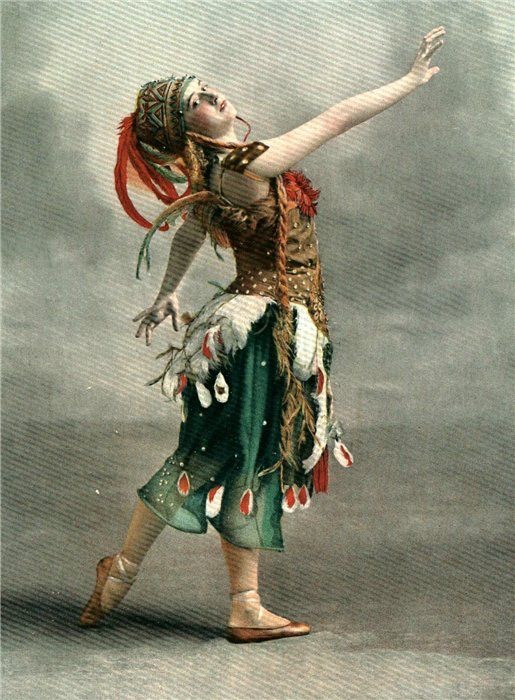
The Firebird

Meet the Author

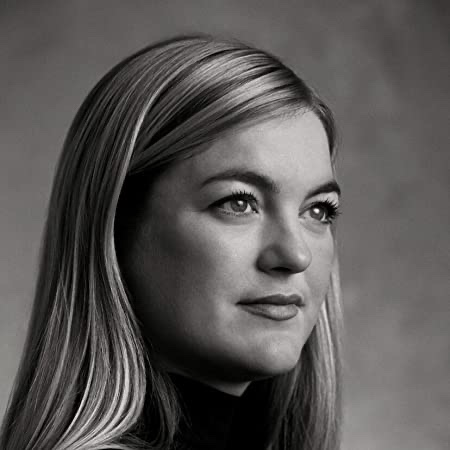
Stories with big themes written as page-turners are Anna M Holmes’s speciality. With an extensive background in dance and theatre, Dance of the Earthis a story she has longed to write. Her novels- The Find, Wayward Voyage, and Blind Eye-are all typified by deep research. Anna worked as a radio journalist before embarking on a career in arts management. Originally from New Zealand, she now lives in South-West London.
Posted in Personal Purchase

The Flames by Sophie Haydock

I knew this book would be one I enjoyed, after all it encompasses some of my favourite things: History between the World Wars; the Vienna Secession and Gustav Klimt; Art Nouveau; a feminist narrative. However, I didn’t expect it would grab hold of me in the way it did! I sat down with it in the garden one Sunday afternoon and read two thirds straight away. When duty and blog tours called that week I had to set it aside, but I kept glancing over at it like a lost lover all week. Despite recognising the featured portraits, I didn’t know much about Egon Schiele, other than he was a protégée of Klimt. I have only seen one of the paintings, Portrait of a Woman modelled for by his sister Gertrude Schiele because it was at the Metropolitan Museum of Art in NYC. Schiele is described as a figurative painter and as an artist under the banner of the Vienna Secession he was pushing the boundaries, trying to create something completely new or ‘art nouveau’. This was the time of a rebirth in painting, writing and all other art forms towards a new way of describing the world – the birth of Modernism. The unusual shapes and colours in his work is reminiscent of writers like Virginia Woolf who were throwing out the rule book and wrote novels with unusual timelines, streams of consciousness and complex characters whose inner world was often more important than events outside it. Haydock’s book uses some of these devices and a way of ‘writing back’ to art history and challenging Schiele’s representation of these women. Schiele’s portraits are not life-like reproductions of his model and while they might shed light on aspects of their characters, they can only ever be the artist’s view of that woman with all the prejudices and biases of his time. Here we get to hear the women’s stories as they see themselves and their relationship with Schiele.

We start with Adèle, one of a pair of sisters living opposite Schiele in an upmarket district of Vienna. Adele is transfixed on Schiele as soon as he arrives on moving day and is glued to the window seat every day in the hope of catching his eye. However, both Adèle and her sister Edith are from a very well respected family and there isn’t a chance that their father would accept Schiele as a choice for his daughter. Adèle is persistent though and soon the sisters meet Schiele on the street outside, alongside the woman they see coming and going from the flat, Wally. Although there is a part of her who knows the relationship between Wally and Schiele must be a complex one, she tucks it to the back of her mind, and begins to feel she might be making headway with him. Surely Wally is a maid, someone who cleans and models for him? Using Edith as her foil they do have a cinema outing, a very awkward foursome, and Adèle is so glad to have a sister that’s quiet, in the background, and goes unnoticed. She’s the perfect chaperone for this relationship she’s building in her head. She’s in love with Schiele and he must be in love with her, in fact she never has a moment’s doubt. Haydock writes a brilliant opening section here, with a perspective that we’re never fully sure of and a course of action that could be leading to disaster. It’s almost painful to be inside the mind of this highly strung young woman, whose class and status keeps her in a constant waiting position. There’s so much she’s dreamed of doing, but can only do them when she is a married woman. Women of Edith and Adèle’s class can’t make decisions for themselves, don’t get up and go travelling, or go to university or even go to the theatre alone. There are times, imprisoned behind her window when she envies Wally’s freedom to come and go as she pleases. Adèle is bored and I feared some of her reality was little more than the daydreams of an under stimulated mind. There’s a sense that an emotional storm is brewing.

The second section of the book is focused on Gertrude Schiele, Egon’s younger sister who started posing for his sketches when they still lived at home. Through Gertrude we experience Schiele’s early years, with her perspective as the filter. Born to a man who worked on the government railways, the family were respected, although the shadow of mental health does fall here too. We see the germination of an unusual relationship between brother and sister, with hints of impropriety on both sides where her modelling for him is concerned. It’s clear to see Schiele’s incredible artistic drive, thriving in limited circumstances and with a father who wishes his son wanted to follow him into a respectable job on the railways. Art is no way to make money, but there is a sense it’s more than that driving his father, possibly the praise that would come his way for having such a loyal son who wants to follow in his father’s footsteps. However, when his father’s behaviour becomes erratic what will happen to them all? As for Gertrude we see a strange dynamic when Schiele uses other models or is in a relationship? There is jealousy there which is interesting to watch as we move through the next few years. In the third section we meet Wally, artist’s model for some of Schiele’s best work and a partner to him in every way. I loved this section, because I found Wally inspiring in her choice to live in the way she wants despite the consequences. Wally is probably his most professional model, with an energy and intensity that leaps off the canvas. She openly lives with Schiele, travelling with him to a couple of country houses before settling in Vienna near her family. Wally knows where the line is and in the years she is with Schiele his behaviour gets them noticed in all the wrong ways, including with the authorities who label him a pornographer. She does not leave his side. There’s a core of steel in this woman, who will not hear him talk of love – possibly because she knows what verbal declarations are worth – and will never ask him to stay. However, I wanted him to stay with this woman, who I felt understood what he needed better than anyone, but didn’t ask for the usual protections her gender would be afforded, like marriage. I wondered whether, as she watched Wally from the window of her gilded cage, Adèle truly understood the responsibilities and the cost of being as ‘free’ as Wally seems?

Finally we come full circle, back to Schiele’s arrival in Venice and moving in opposite Adèle and her sister, but this time from Edith’s perspective. It was fascinating to see the same events play out through a different pair of eyes and we soon realise that despite her quiet demeanour and acquiescence to the rules her parents lay down, Edith is not as passive as she has appeared up to now. In fact she has the determination and deceptive skills her sister does, but the difference is that it’s not expected of Edith. As a result she has more freedoms than her sister and doesn’t get caught. She too is mesmerised by Schiele, but by the man rather than what he represents. Adèle wants freedom, to challenge boundaries, to scandalise society. Whereas Edith just wants the man, but does she truly know him and will she risk losing her sister to get him? We do get a sense of Schiele through these women, particularly Gertie because she’s there for the formative years. I often found him infuriating, because I felt he wanted to be a modern man, unrestricted by society’s rules and expectations on one hand, but then showed a total disregard for the women who were willing to break rules with him. There was a slight Madonna/Whore complex at work here, where women were compartmentalised into those to have fun with and those acceptable for marriage. Some of his choices felt like betrayals to those women who risked everything by literally laying themselves bare before him and the world, for his sake and for the sake of art. I thought Haydock beautifully captured this sacrifice and it’s consequences, something picked up beautifully in the short interludes from the 1960’s where an elderly woman searches for a painting she’s glimpsed of someone she loved. Desperate to give an apology she never heard in life. Haydock beautifully captures a rapidly changing Vienna between two World Wars where barriers of class and gender are breaking down. She also captures the complexities of the barriers for women and those who have the pioneering spirit to break them. She gives a voice to their silent gaze. This is one of the best books I’ve read so far this year and I read it greedily in two sessions, but I’m already looking forward to entering Haydock’s world and savouring these wonderful women again.

Meet The Author

Sophie Haydock is an award-winning author living in east London. Her debut novel, The Flames, is about the four muses who posed for the artist Egon Schiele in Vienna more than 100 years ago. She is the winner of the Impress Prize for New Writers.Sophie trained as a journalist at City University, London, and has worked at the Sunday Times Magazine, Tatler and BBC Three, as well as freelancing for publications including the Financial Times, Guardian Weekend magazine, Arts Council, Royal Academy and Sotheby’s. She has interviewed leading authors, including Hilary Mantel, Maggie O’Farrell, Bernardine Evaristo, Sally Rooney and Amy Tan. Passionate about short stories, Sophie also works as a digital editor for the Sunday Times Audible Short Story Award and is associate director of the Word Factory literary organisation. She judges writing competitions and hosts her own short story club.Her Instagram account @egonschieleswomen – dedicated to the women who posed for Egon Schiele – has a community of over 100,000 followers. For more information, visit: sophie-haydock.com

Published 17th March 2022 by Doubleday

Posted in Personal Purchase

Throwback Thursday! The Enchanted April by Elizabeth Von Armin.

This is such an apt novel for the time of year, but I’ve found myself thinking about it recently for two other reasons. Of course spring is on it’s way, but this year is something of a personal renaissance. I’ve been shielding since the second lockdown, because I have multiple sclerosis and it means I have a few issues with swallowing and breathing. This was a personal choice, but thank goodness I did, because I did receive a government letter four weeks ago telling me I should have been shielding. A brilliant bit of irony. So now I can have friends come and join me for a dog walk or sit in my garden for a cuppa together. I can’t explain how joyful this makes me feel. I will feel connected to the world again – well, as much as I ever want to be. I can also have my hair coloured silver blonde with lilac dip-dye! Hairdressers here I come.

The other reason is that four weeks ago I moved to my new home. It’s an 18th Century cottage in a really happy village, and I feel like the real me is re-emerging. We’d been living in the city, on a relatively new estate and I had no idea how much of an effect this as having on my mental health. I was sitting on my reading couch at the weekend with the sun coming in, next door have an apple tree and the branches hang over the fence, so I can smell the blossom when I have the window open. On Sunday afternoon we had a pot of tea and our Easter cake outside in the garden, where an enormous jasmine hangs heavily on the wall wafting a heady scent over the whole garden. I started planning what I’d like in the garden across the seasons and that always feels like a corner has been turned. It’s as if we went into hibernation in winter 2019 and we’re only just coming out and that feeling reminded me of the characters in this novel.

The premise of the book is that a discreet advertisement appears in The Times, addressed ‘To Those who Appreciate Wisteria and Sunshine’. On offer is a small medieval castle for rent, above a bay on the Italian Riviera. Four very different women – the dishevelled and downtrodden Mrs Wilkins, the sad, sweet-faced Mrs Arbuthnot, the formidable widow Mrs Fisher and the ravishing socialite Lady Caroline Dester – are drawn to the shores of the Mediterranean that April. As each, in turn, blossoms in the warmth of the Italian spring and finds their spirits stirring, quite unexpected changes occur. These characters drive the novel, as it is their responses to each other and to Italy that take centre stage. Mrs Wilkins and Mrs Arbuthnot are the first to respond, both ladies living resignedly, but quietly, in unhappy marriages. They are joined by Lady Caroline, a younger, beautiful woman who has found that her looks can be more of a burden than a blessing. Finally, there’s Mrs Fisher. A formidable woman who has a very strong will, which she tries to impose on the other women. The author is so perceptive when it comes to human foibles and how personalities rub against each other when living side by side. Tiny little acts of pettiness and selfishness can take on huge importance in these situations. However, what the author also shows is that one person’s character failing can have a transformative effect on someone else. One woman’s need to be in charge, inspires assertiveness in a quieter, more timid member of the party. The early chapters are a comedy of errors and miscommunication as the women try and often fail to understand each other.

The author deliberately creates an opening that feels like being under a rain cloud. The weather is miserable and cold, each woman feels unhappy or have lost themselves in some way. Then as they’re thrown together for this month in the castle we wonder if they’ll ever get along and if Italy will work its magic on them. The second half of the book feels like entering spring, the sun is shining and the surroundings start to work on each woman, even Mrs Fisher. The characters and the surroundings come into bloom. There are vivid descriptions of the castle and its gardens so the reader can really visualise the setting. It feels like a literary painting. Slowly, each woman begins their transformation. In the case of the married ladies, they invite their husbands to join them in Italy. Could this special place transform their marriages, relight a spark or remind them of the deeper love they once shared?

The movie version of the novel.

The novel is charming and light, without falling into whimsy or sentimentality, showing extraordinary skill in the writer. Despite barely having a plot, the book can be read as a satire on class and society post WW1. It could be read as a travel novel or just a study in how a different culture, characters and nature can soften and change us for the better. There isn’t a single character here who isn’t changed by the magic of Italy, and that’s the final reason I love this book. I was meant to get married last spring and go to Venice for my honeymoon. I picked the perfect hotel room with a double aspect and a balcony over one of the smaller canals. It would have been my third trip to Venice, but I don’t think I’ll ever tire of it. The first time I visited we arrived at night and took a water taxi in the dark across the lagoon. We arrived at a small jetty and it was so quiet, just the sound of water lapping against the buildings. The lamplight was reflected in the ripples on the surface, as well as tiny lanterns as we stepped up into a small garden. We walked through a courtyard with pots, pergolas with hanging plants and the tiny points of light hanging within. It was such a surprise because gardens are rare in Venice, but there it was. I did feel changed by my visit. I felt amazed that such a beautiful place actually existed and that I could go there whenever I wanted. It improved my confidence, my creativity and taught me to go a bit slower. If I never go abroad again in my life, I’ll be happy because I went to Venice. This book captures some of that transformative feeling; its a witty and delightful depiction of what it is like to rediscover joy.

Elizabeth von Arnim (1866-1941) was an Australian-born British novelist who was married to a Prussian aristocrat. Her most famous works include Elizabeth and Her German Garden and The Enchanted April