
This is the story of three women – one an orphan and refugee who finds a place in the studio of a famous French artist, the other a wife and mother who has stood by her husband for nearly forty years. The third is his daughter, caught in the crossfire between her mother and a father she adores.
Amelie is first drawn to Henri Matisse as a way of escaping the conventional life expected of her. A free spirit, she sees in this budding young artist a glorious future for them both. Ambitious and driven, she gives everything for her husband’s art, ploughing her own desires, her time, her money into sustaining them both, even through years of struggle and disappointment.
Lydia Delectorskaya is a young Russian emigree, who fled her homeland following the death of her mother. After a fractured childhood, she is trying to make a place for herself on France’s golden Riviera, amid the artists, film stars and dazzling elite. Eventually she finds employment with the Matisse family. From this point on, their lives are set on a collision course….
Marguerite is Matisse’s eldest daughter. When the life of her family implodes, she must find her own way to make her mark and to navigate divided loyalties.
Based on a true story, Madame Matisse is a stunning novel about drama and betrayal; emotion and sex; glamour and tragedy, all set in the hotbed of the 1930s art movement in France. In art, as in life, this a time when the rules were made to be broken…
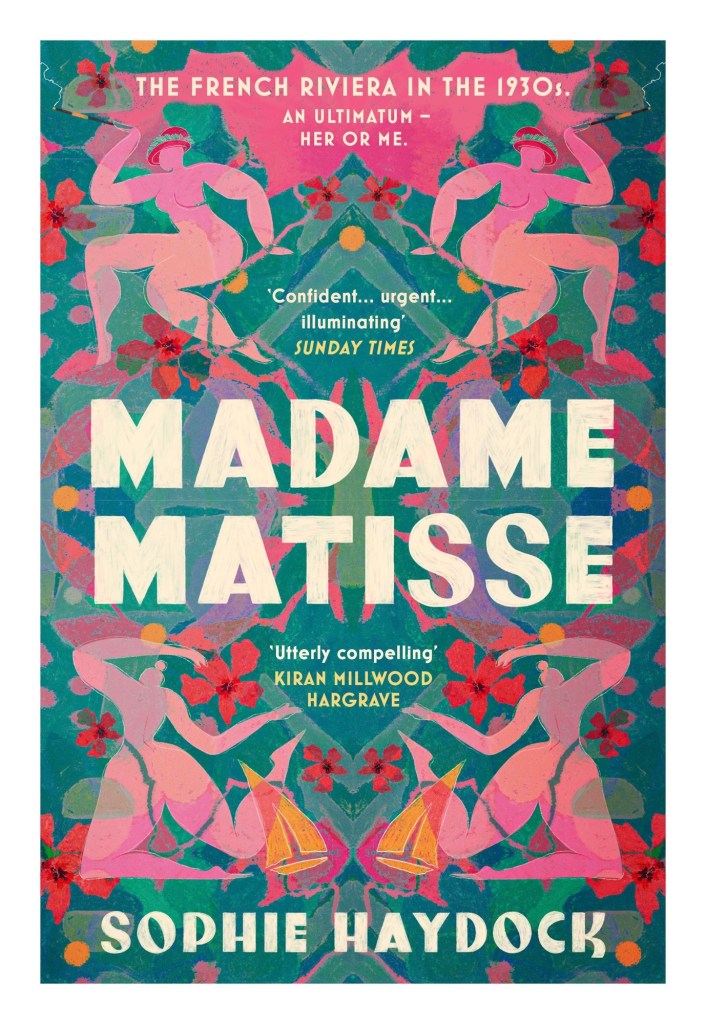
Almost eleven years ago my lovely arty friend Mandy wanted to visit the Matisse exhibit at Tate Britain. I really hope I didn’t ruin it for her. I probably did. I confess I’m not a lover of modernist art. We went to the Guggenheim in New York and I proclaimed it disappointing. We had to go across to the MET and see their collection of Impressionists to cheer me up. My loves are the Pre-Raphaelites and the Art Nouveau/ Arts and Crafts period so we’re a long way away from each other in preference. Art is her subject so I’m happy to own that she certainly knows a lot more than me. I was interested to read in her afterword that the author has always had an interest in Matisse, with a black and white postcard of him on her notice board for several years. I have one of Gustav Klimt wearing an artist’s smock and clutching a cat, with a look of devilment on his face. It makes me smile whenever I see it so I understand how a particular artist can inspire your imagination. Sophie’s first novel, The Flames, was about a protégé of Klimt. It was narrated by the women in the life of Egon Schiele, the subjects of four of his paintings. Here she takes a similar look at the women who surrounded Henri Matisse, showing how they advised, supported and sustained him in his endeavours, but remained completely in the background to his talent.
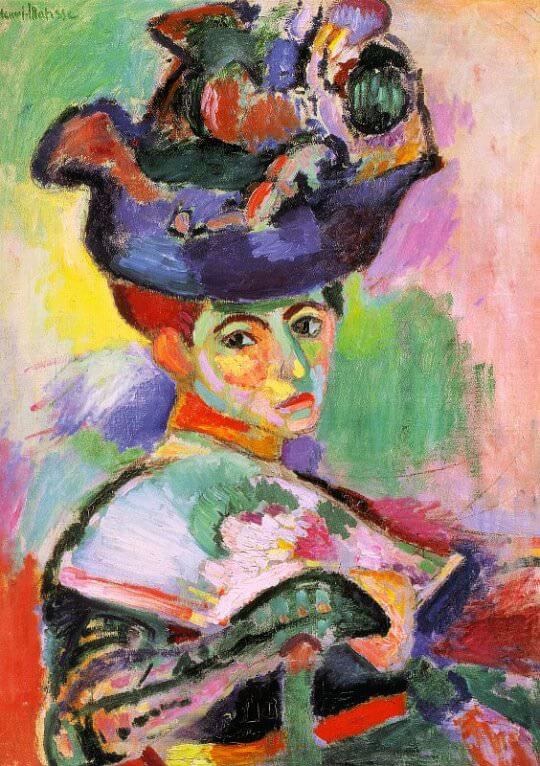
The story starts with Amélie, an incredibly brave young woman who takes a chance on marrying an artist rather than a more conventionally acceptable partner. She sees something in Matisse’s paintings, recognising the way his work could be at the forefront of modernism. Previously his colourful style has been rejected for exhibition in Paris, but Amélie knows that innovative artists often take a while to break through. In fact it is a painting of Amélie that is the catalyst for Henri’s career to take off. Woman in a Hat is exhibited in Paris and bought by siblings Gertrude and Leo Stein, a bohemian pair central to the art world throughout the early 20th Century. This is where Amélie makes the bravest and most important decision of her husband’s career. The Stein’s offered only two thirds of the asking price. Eager to make a sale to the influential pair, Henri is willing to give the discount but Amélie advises him to wait and hold out for the asking price. He takes her counsel and they go and meet the Steins, convincing them that Henri is central to the next great artistic movement. The Steins pay the full price. The couple are a great team with Amélie making all the household and business decisions, freeing Henri to paint and become a famous member of the Fauvist Movement. She also brings Henri’s daughter Marguerite into their growing family, when her own mother is struggling to care for her. Yet, not everything about their relationship runs smoothly. Once they are able to afford a family home with a garden and studio for Henri, Amélie’s help is no longer needed. Henri takes on a series of young assistants and Amélie has the more traditional wife’s role which doesn’t suit her. It’s fascinating to read about the changes, once their joint struggle is over they cease to become a team and the problems begin.
Another section of the novel is devoted to Marguerite, Henri’s illegitimate daughter. Once Amélie has brought her to live within their family, Marguerite seems to blossom under the care of her stepmother. She also makes herself useful to her father, tidying his studio and anticipating his needs. It is interesting to hear about Amélie and Henri’s relationship from her perspective and her anxieties that the family she’s been brought into, stays together. She shares a lot of Amélie’s suspicions about some of the assistants who breeze in and out of their lives. She’s also a strong advocate for her stepmother, even into her parent’s old age. Yet there were times when I felt she was taken advantage of by Amélie and her father. There’s a sense in which, despite seeming kind, loyal and trustworthy, Matisse does use the women around him. The household was entirely groomed to anticipate his needs and the women are sacrifices for his artistic genius.
Most interesting to me was Lydia Delektorskaya, born in Tomsk, Russia, in the tumultuous period after the revolution. After the murders of the Royal family, Lydia has just lost her mother when her father decides she must leave the country. He gives her a gun with three bullets left in their chambers and sends her to China on the Trans-Siberian Express with her Aunt Berthe. After building a life there Lydia must make a choice between the Sorbonne in Paris or to marry her lifelong friend and stay. Lydia takes neither choice and instead aims for the South of France, a place that couldn’t be more different to the place she was born. She spends time working in a bar but when she sees a job with the Matisse family she decides to apply. The job is to look after Henri’s wife Amélie who has a chronic illness and is confined to their apartment. Lydia has experience of working with her mum and her aunt and felt fulfilled by her caring role. Once she starts work though, some of her duties are to assist Henri in his studio, eventually sitting for portraits and sketches. Amélie eyes their relationship with suspicion despite there being no evidence of impropriety. This is more than an affair, it’s a meeting of souls and when ultimatums are made they have terrible consequences.
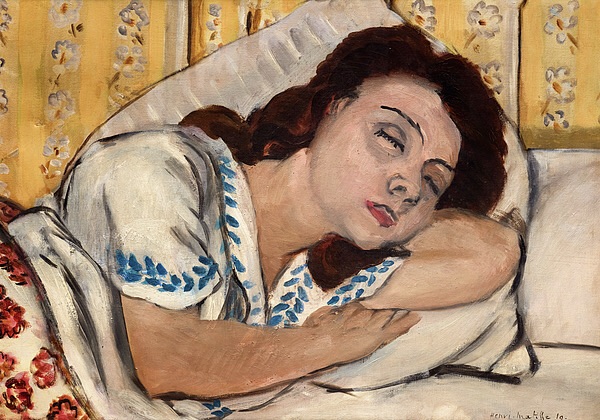
I loved reading about these fascinating women, all of which step outside the traditional role of most women of the time. Sophie beautifully situates Matisse within his peer group, especially his great rival Picasso. She situates each woman perfectly within their history, the most in depth being Lydia’s Russian background and Marguerite’s incredible bravery in WW2. Both are fascinating to read and show us the extreme cruelty and playbook of totalitarian regimes. She also shows us how incredibly brave and resourceful each woman is, more involved in the world and bigger risk takers than Matisse. Lydia’s realisation of what her father truly sacrificed to stay in Russia happens when she is older. First they came for the royal family and aristocracy, then those with intelligence and the ability to challenge them, just as the Nazis did in Poland. This perhaps has more resonance thanks to current world events. I thoroughly enjoyed looking up the paintings mentioned and seeing Matisse’s representation of the three women who were closest to him and I found myself reading articles about him and Picasso. It left me with a sense of anger and empathy for how much women sacrifice so that men can excel at what they do, realising their ambitions while their wive’s ambitions are forgotten or buried under a suffocating mental load – still the thing women in my group talk about most. These women never take the limelight away from Matisse, even while stripped bare for people to view. The focus is always on the painter, their brush strokes, choice of colour and artistic decisions. I love that in this novel they are more than body parts, they’re shown as the vital, brave, complex and generous women they clearly were.

Meet the Author

Sophie Haydock is an author, editor and journalist (Sunday Times, Financial Times, Guardian), based in Folkestone, Kent, where she is curator of Folkestone Book Festival. Her debut, The Flames – about the women who posed for the scandalous artist Egon Schiele in Vienna a century ago – was named by the Times as one of the Best Historical Fiction Books of 2022. It was longlisted for the HWA Debut Crown Award, and the Italian translation, Le Fiamme, won the Premio Letterario Edoardo Kihlgren for debut novels. She worked for the Sunday Times Short Story Award and is associate director of the Word Factory. Her Instagram @egonschieleswomen has 110,000 followers. Visit: sophie-haydock.com

 The Lotus Readers