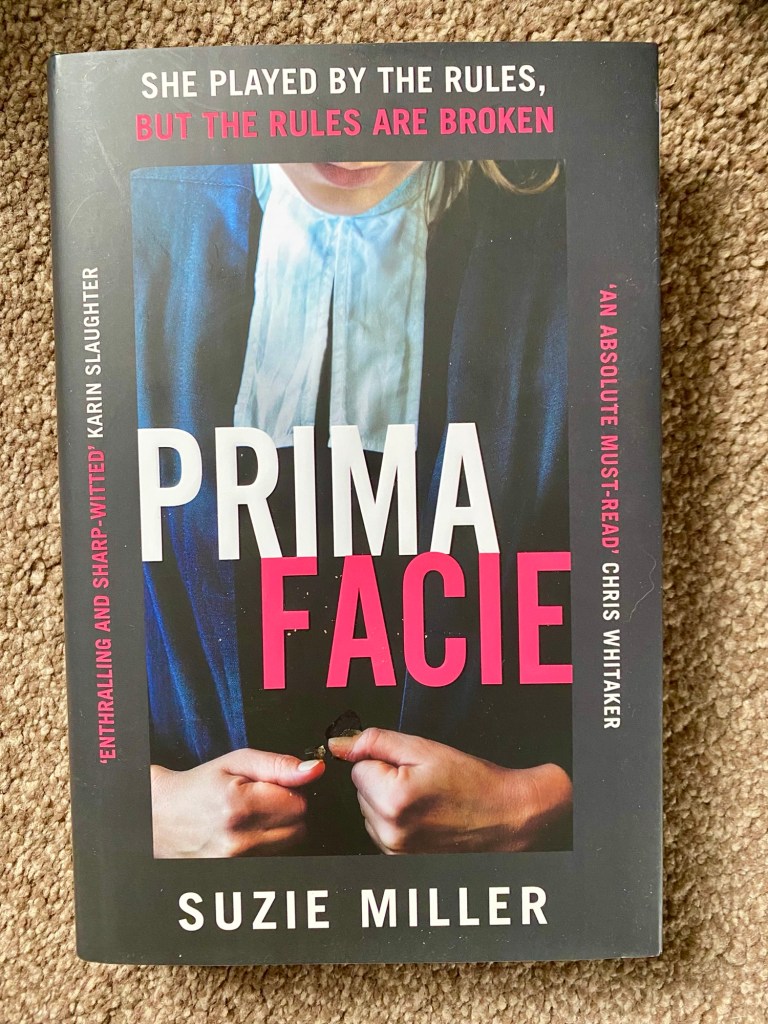
I was only a few pages into this thriller, when I wished I’d seen Suzie Miller’s stage play of the same name running in the West End with an award-winning performance by Jodie Comer. I could see that Comer was the perfect choice for Tessa because I imagine she would understand this character perfectly. Tessa has brought herself from the council estates of Liverpool, via similar areas in Luton, through Cambridge University to one of the best barrister’s chambers in London. Tessa is a defence barrister, one of the best in the competitive area of criminal law. She thinks like a lawyer, her job isn’t about the truth. It isn’t about whether her client is innocent or guilty, in fact she doesn’t want to know. It’s about following the intricacies of the law. It’s about looking for the holes in the prosecution’s case and exploiting them, bringing them to the attention of the jury and creating doubt. All she has to do is create enough reasonable doubt in the minds of the jury that the law directs them to an acquittal. It’s almost a game. A very high stakes game for the defendant, but Tessa gets paid either way. For her it’s the enjoyment of winning and seeing the the system she believes in, applied correctly. However, when Tessa goes on a date with a fellow barrister from her chambers, something goes wrong. Then she realises that the law might not be in her favour after all. Perhaps justice is more equal for some than others.
I was immediately enthralled by Tessa’s narrative voice. She’s smart, a quick study of other people and how they present themselves to the world. She is a brilliant, intelligent and careful lawyer. The author presents law like a religion. Tessa believes in the British justice system, that although there are anomalies, by and large justice does get served. After making a huge jump from her estate and family to Cambridge, she’s become a quick study of class and tribes. As she arrives at her first university lecture she spies a group of staff in suits hanging around the entrance and wonders if she’s been found out – ‘maybe I fluked it and one of those suited people are going to barge in with a list and call out my name. Tessa Ensler? I’m sorry there’s been a terrible mistake’. The boy sat on her right has clearly come from public school. He has that assured way of being that comes from knowing he belongs here and that he will be among those who change the country. The dean tells them that 1 in 3 of them will fail. As she looks to her other side she sees a girl trying to look dishevelled but with clothes deliberately made that way, rather than being worn out. With her layers of necklaces and raggedy clothes she’s showing that she has the confidence to look bedraggled, whereas as Tessa looks down at her own new jumper and knows she doesn’t belong. They know she doesn’t belong. What if she is the 1 in 3?
Yet she adapts and educates herself in how to blend in and even as a fully-fledged barrister years later, she is still well-versed in the unwritten codes of both the court room and the women barrister’s robing room. She refers to her fellow barristers as thoroughbreds. It isn’t enough for her to be a barrister, she has to know how to look and seem like a barrister. She knows the uniform – grey or blue understated suit, low comfortable heels for standing in court, hair that can withstand the wig, not too much make-up. It’s acceptable to show individuality with some quirky earrings, unusual glasses or chunky heel ankle boots. These little details are the way women have learned to own their own space, to show they are serious about the law, but do it differently to the men. Some things are sacrosanct such as the right shoes – the same designer brand, low key and stylish, but very expensive for a shoe that’s so boring. Yet within her first year as a barrister Tess has the same brand on her feet. Her rebellion comes in tiny acts like wearing a collarless shirt, coloured tights or eye-catching earrings. Individual, but not so out there it would frighten the horses. She also doesn’t have a wig tin, choosing instead to keep her wig in a Tupperware box borrowed from her mum. This is deliberate, it reminds her of where she’s from and how to remain grounded. She resists anyone’s offer to buy a wig tin for her, especially when they refer to her choice as ‘slumming it’. She’s mainly played by the rules and thinks she’s become one of them.
I will mention that there are graphic depictions of sexual assault that are a hard read, but they are necessary. They show the ambiguity that can be brought into the legal arguments. Anyone who reads the account has no doubt what happened between Tessa and her colleague. Yet already I could see the ‘holes’ in her story, the things she does ‘wrong’ and how the difference she thought was invisible, being brought up to weaken her account. She can probably imagine the way a defence barrister will cross-examine her and which parts of her story he will exploit to create doubt in the jury’s mind. I found it so painful when she overhears other female barristers discussing the accused, Julian. Julian was always hoping to be a barrister, his father was before him and is now a judge. He is immediately accepted into this world without once having to work out how to be. As the women discuss going to his dinner party and how terrible this false accusation is for him it’s clear he’s one of them, they probably went to the same school and, like her pupil Phoebe, knew which shoes to buy before they even got here. One female barrister asks her outright why she would accuse Julian, when everyone knew she was into him. She must know it’s hurting her own reputation and her career, she’s alienating the ‘very people who will decide whether she gets silk’. In that moment Tessa wonders why it isn’t hurting Julian’s reputation? There are solicitors who will never instruct her again, people who will not share chambers with her and she will likely never progress with her career again. But he will. It brings home everything about her difference from that clique – the small world of London chambers – her disadvantages as a woman, as someone from the wrong school and the wrong type of estate.
I was fascinated with whether or not Tessa would realise that the law isn’t the same for everyone and that her belief in the system she has worked for is left crumbling at her feet? Added to everything else Tessa feels foolish for every time she has said that the law dispenses justice more or less, for everyone. Now she knows it doesn’t. Even before she’s in the court room she knows that it was her difference that made her a victim in the first place. This wouldn’t have happened to Alice or Phoebe because they are protected by their class:
‘I really had thought that I was now untouchable. That if I just did my job, didn’t stand out, won my cases, I’d be like everyone else in chambers. But I am not. I am disposable, I am rapeable. Just like when I was a kid on the estate. Nothing has changed, other than the class of man that can rape me.’
In being exposed to the way the world works for the right type of people, she has naively assumed that it now works that way for her too. We are so intimate with Tessa, her inner world is huge – full of contradictions and fierce intelligence with a veneer of upper middle-class lifestyle overlying strong working class roots. I was totally engrossed in her and recognised something of myself in that working class background rubbing roughly alongside years of middle class education and lifestyle. I’m conscious of a difference in the way I view the world from the rest of my family, but I’ve always wanted to keep them close. I know that if anything terrible happened they would be there for me, just as I hoped Tessa’s mum would be there for her. I’m aware of the difference in my accent honed by seven years of grammar school, a change that turned me into a vocal chameleon, picking up a trace of wherever I go, wanting to fit in. Tessa notices this with other barristers who have accents, there’s always a court voice that’s clear, concise and authoritative. There are so many points in the story where the author captures a current change in how the world has changed, particularly for women. Tessa recalls a sexual encounter in her teens which was only borderline consensual, but back then was chalked up to experience. I remember these days well: a push up against the wall followed by an unwanted kiss so hard it bruised my lip; a grab of the hips from a man as I reached over to answer a phone in a busy office; a teenage boy who thought that because my friend was snogging with his mate, I was up for it too. These seemed like minor incidents, but wouldn’t be accepted by young women today.
Tessa’s story brought up all those issues of consent that I find so interesting – does consenting to one sexual act mean you’ve consented for everything else? If we consent to sex once, does that mean we’ve consented for that whole night? Does it cover the next morning too? My husband was horrified that in law there was no such thing as marital rape until 1991. Consent was given by the woman through her marriage vows. Alarmingly there are still people who think as long as there is no violence, forced or coerced sexual intercourse within marriage does not constitute rape. The court scenes are electric, written with such tension and power. Watching the balance of that power shifting between defendants and prosecution witnesses and the barristers in their robes, posing the questions with scepticism, repeating them till you trip up and then diving in for the attack. I found myself dreading what would happen to Tessa if she didn’t get justice. Would she cope emotionally? Also, what would it mean for her professionally? Would she be trusted again? I would say ‘reading this….’ in my reviews normally, but I felt more like I was ‘experiencing this’ by Tessa’s side and sometimes in her head. She was as close as my own thoughts at times. I wondered whether it’s possible for someone to be as educated, honed and prepared for such an establishment career as the law, without becoming someone altogether different. Is there a way to separate the professional from the personal, to take on some of the female barrister’s characteristics and traditions but keep a little bit more of who you are? To take a bigger Tupperware box from home and seal even more of that professional persona inside along with the traditional wig. Her struggle between being the Tess she became at Cambridge and her chambers and the Tess who lived for a weekend house party with her friends from the estate is the struggle of every university graduate whose family earned a living in a manual job. A family who encouraged her to push herself, to reach grammar school, then be the first to go to university didn’t realise that with each step they’d lose her a little bit. A gap opens up, created by education, money, culture and lifestyle. I was strongly reminded of Tony Harrison’s poem ‘V’ that beautifully captures this dichotomy within a person, a Northerner that’s settled and makes both their name and their living in the south. Yet one line stood amongst all that anger and dislocation: ‘the ones we choose to love become our anchor’. He meant new friends but I hoped in Tessa’s case she would learn that she can be part of her family, while still being successful. To recognise them as her strength and support, rather than something you drift away from. This book is right up there, with the best I’ve read this year. Don’t miss it.
Published on 14th March by Hutchinson Heinemann. With thanks to the Squad Pod for having me in this month’s book club choice
Meet the Author
Suzie Miller is an international playwright, librettist and screenwriter. She has a background in law, and has won numerous awards, including the Australian Writers’ Guild, Kit Denton Fellowship for Writing with Courage and an Olivier Award. She lives in London and Sydney and is developing major theatre, film and television projects across the UK, USA and Australia.

 The Lotus Readers