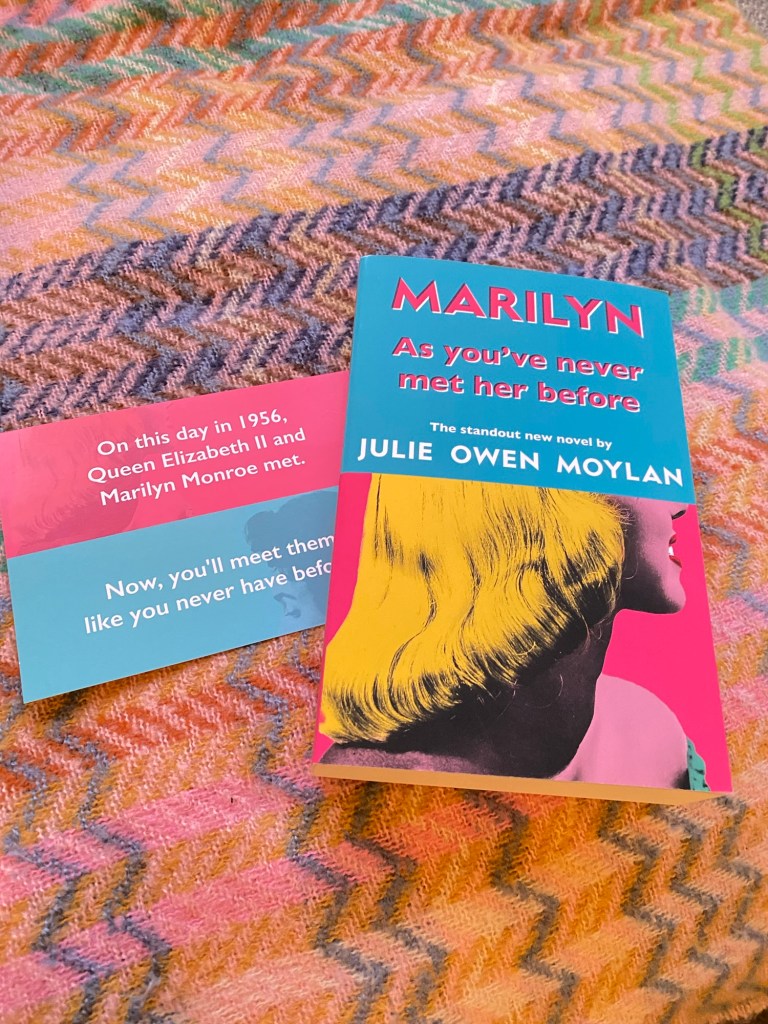
London, October, 1956. A glittering Royal Film Premiere. The whole world is watching . . .
Tonight, Elizabeth II will formally greet an array of stars. Though she was not born to be Queen, this young mother and wife has embraced her patriotic duty and its unforgiving demands.
A limousine pulls up. Out steps a vision in dazzling gold: Marilyn Monroe. A money-making machine for Hollywood, with curves that drive men wild and a smile that lets women know she’s in on the joke.
As the two most famous women in the world come face to face, they look to be worlds apart. Yet beneath the glamorous costumes, both are fighting to keep the men they love, while trying to do their work in a man’s world. And they have spent the summer of 1956 battling secret demons the public could never imagine.
Now, Marilyn steps forward. These photographs will be on the front page of every newspaper in the morning.
But this isn’t their first meeting. And the story behind the headlines is even more sensational . . .

As soon as I knew that Julie’s next novel was going to feature these two women I was intrigued, because until now the comparison between Hollywood stars and our royal family has been Marilyn and Diana, Princess of Wales. Both were globally famous, incredibly beautiful, hounded by the press and died far too young. This comparison was compounded when Elton John rewrote Candle in the Wind, formerly about Marilyn Monroe, for the late Princess of Wales and played it at her funeral. I was around eight years old when Diana came into public view and I was obsessed for a couple of years with her beautiful dresses and how glamorous it all was, but of course as I grew older her story became more complex and tragic. I think my initial intrigue was due to my age, because to me Queen Elizabeth had always seemed old. This was partly to do with her style I think, but she was in her early fifties (as I am now) when I was taken to the bridge that crosses the River Trent in Keadby, North Lincolnshire to see her car pass by in the silver jubilee year of 1977. I was three and being around for 50 years seemed a million miles away. However, this book focuses on 1956 when the Queen was still a young woman in her twenties and experiencing a very turbulent year. She hadn’t had time to fully settle into her role, she’d had to advise her own sister that she couldn’t marry the man she loved if she wished to remain a princess and her relationship with Prince Phillip had it’s problems. Marilyn was in London to film The Prince and the Showgirl opposite one of our most acclaimed actors, Laurence Olivier. She too was coming into a turbulent phase of her life, after spending some time living in Manhattan and studying the acting ‘method’ theorised by Stanislavski and taught by Strasberg. The idea was to act in a natural way, experiencing what the character is going through, to bring personal emotion and past trauma into the scene, or even stay in character between scenes to keep the intensity in your performance. This was going to prove entirely at odds with Olivier’s way of working. She was also recently married to playwright Arthur Miller, making headlines around the world as the ‘egghead and the hourglass’. The couple came to London in lieu of a honeymoon and were living in a house situated next to the Windsor Castle estate so for a while, the two women were neighbours. The author has taken this background and created a fascinating story about stratospheric levels of fame, how women are treated in the media, and the difficulty of negotiating the line between public and private.
Each woman has their own narrative and we’re taken inside their deepest fears and emotions. This is incredibly difficult to do with such famous subjects because both women are so iconic and we all have an idea in our heads of what they were like and who they were. I found I couldn’t come to them as new characters straight away, but I did find each woman’s inner voice convincing and engaging. This approach means we get to experience each woman in three different ways: the public face; the private face; and their innermost thoughts. Each has an insecurity about their relationship. Marilyn feels that Arthur does see the real her underneath the persona but fears that he will find the press, the attention from other men and her role as Marilyn Monroe too taxing. Where they would have liked a cute little cottage away from it all to spend their honeymoon alone, they have a huge house with staff and constant requests for photo opportunities. Will Arthur always accept that his wife frequently has to switch Marilyn on? The Queen has had two children with Prince Phillip and now has a very busy public role, while his own is largely undefined. This has left him racketing around town with his Private Secretary Michael, attended a gentleman’s club which has a whiff of scandal about it. The Prince seems very aware of the duality of his wife, but being the Queen means playing that role even within her own family at times. There’s the recent unhappiness with Princess Margaret where Elizabeth the sister wanted to grant her wish to marry Group Captain Pete Townsend, but Elizabeth the Queen couldn’t. Prince Phillip refers to her “Queen Face” and she employs it as a shield so nobody knows what she’s thinking or for when she has to deliver news that family members might dislike. When scandal rears it’s head, the Queen has to think every carefully about how she handles her husband but first and foremost she must protect the crown. Will her relationship suffer because of this?
Marilyn’s excitement about her new film is tempered by the tone as soon as she arrives to meet Laurence Olivier and his wife, Vivien Leigh. It seems Leigh has played this role on stage and perhaps hoped to be in the film? It’s hard to read how eager Marilyn is to be with these revered British actors who she sees as the real deal. There’s an incident with Dame Sybil Thorndike at the read through that really does reinforce Marilyn’s ability to switch her star power on and off. It’s a defence mechanism to cover her natural shyness, but also a response to her childhood experiences. It’s clear when she’s bullied on set, her response comes from trauma – the muteness, the stammering and getting her lines wrong. Her past experiences are devastating and we can see them playing out in her work and her relationship with Miller, who she calls ‘Pa’ in private. The author poses the dilemma of each woman being much more famous than their husband and worrying about how to negotiate that imbalance. Marilyn is constantly placed in the middle by the press and her commitments to the film, meaning she’s forced to switch Marilyn on even in private events like a party. Can Miller accept this duality and the constant demands on her time while still seeing the real her? If the Queen makes the decision to act in the way her courtiers advise will Phillip forgive her? If only these women could have known what the other was going through – how impossible it is to be a wife, or a sister and also be a global icon. It made me think of the Queen in a new light and I wondered whether she ever thought of her younger experiences when Diana was globally famous. This is a really interesting read, shedding light on a fascinating time and showing how impossible it is to please everyone, something most women find particularly hard. I was moved by something attributed to the Queen:
“I want to be something constant to people – beaming out a little ray of light that provides a sort of normality. A kind of ‘if she’s still there doing her duty, then all will be well”
I think she achieved this because her death felt seismic and I think as a country we’ve been all at sea since she died. While politics were in turmoil the Queen was a constant for every generation since my mum who was born in 1953 and also has pictures of Marilyn in her bedroom. Both women have a legacy but only one got to live out her life in full, both publicly and privately. This is a beautifully judged piece of modern historical fiction, getting underneath the skin of women we feel like we knew well but perhaps didn’t know at all. The book goes beyond the facts and lets us wonder how these women could have had insights into each other’s lives. With all the research and sensitivity I’ve come to expect from this author, she has once again captured the mid-20th Century perfectly while also showing us that our modern preoccupations with image and celebrity are perhaps not as new as we thought.
Out Now from Penguin

Meet the Author

Julie Owen Moylan is the author of three novels: That Green Eyed Girl, 73 Dove Street and Circus of Mirrors.
Her debut novel That Green Eyed Girl was a Waterstones’ Welsh Book of the Month and the official runner up for the prestigious Paul Torday Memorial Prize. It was also shortlisted for Best Debut at the Fingerprint Awards and featured at the Hay Festival as one of its TEN AT TEN debuts.
73 Dove Street was recently named as a Waterstones’ Book of the Year and Daily Mail Historical Fiction Book of the Year with the paperback a Waterstones Welsh Book of the month in 2024.
Her writing and short stories have appeared in a variety of publications including Sunday Express, The Independent, New Welsh Review and Good Housekeeping.
Elizabeth and Marilyn will be released in April 2026.

