Posted in Netgalley

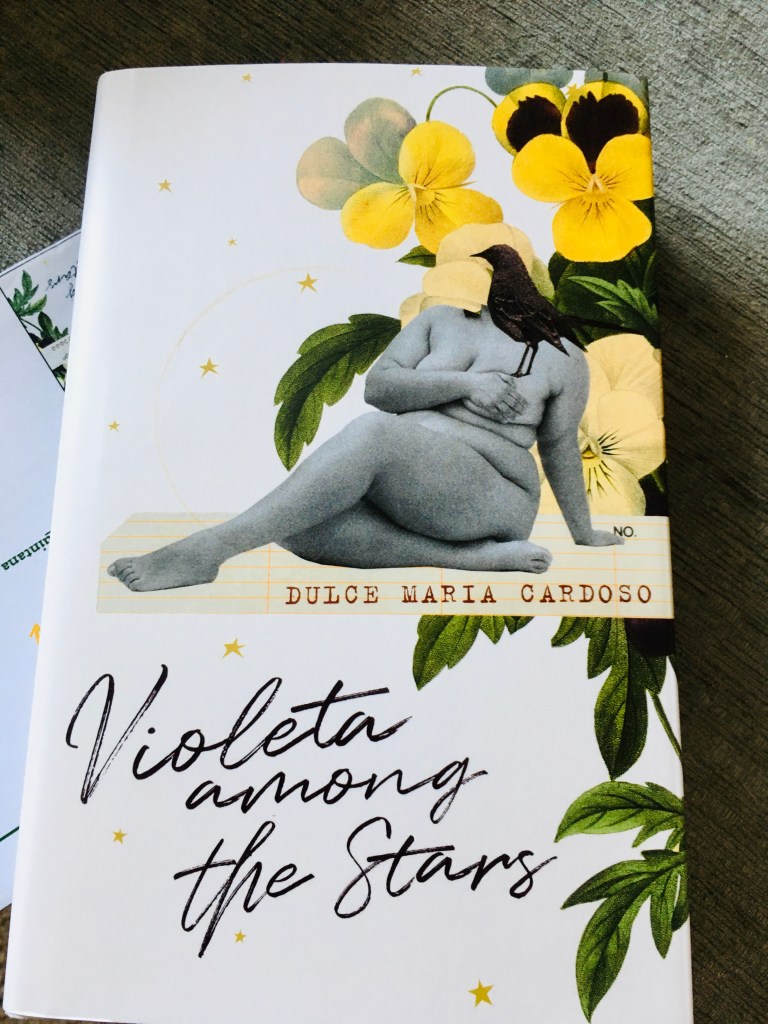
Violeta Among The Stars by Dulce Maria Cardoso.

I think this beautiful novel was sent to me at the right time. Two things have happened lately. I’ve had a relapse of my long term illness Multiple Sclerosis, and it has affected my sight, balance and vertigo. Secondly, I’ve been reading several books where the central theme is that even small lives can be extraordinary or have a huge effect in the world. I think the two things are linked, because I’m a big believer in finding the right book at the right time. When I don’t have a groaning TBR bookcase, I tend to choose my reading very emotionally. What do I feel like reading? I can’t understand readers who are able to read books in chronological order, whatever the subject or however they’re feeling. I really have to be in the mood. It took me several years to read Middlesex by Jeffrey Eugenides, but when I did I absolutely loved it. I think this is the reason many bookworms have buckling shelves – we know we’ll want to read that new book, just not right now. Well, this book was the right one for right now – a look at how the ordinary life of one woman, becomes extraordinary because of the way it is told. A reminder for me that though I may live a quiet and often restricted existence, I can still have an impact on the world.

This particular novel is unique, because it carries a whole lifetime suspended in a single moment. Violeta is drunk and in utter despair when she crashes her car. As she’s thrown around in the car, her seat belt locks and she’s left suspended both physically and metaphorically. As she hangs between life and death, memories of her life flash before her all at once and in no particular order. Memories of her distant mother collide with her everyday life on the road selling waxing products. She remembers moments fumbling on toilet floors with truck drivers she barely knows at motorway service stations. A thousand seemingly ordinary encounters pass through her mind and make up a life. Her past comes up for scrutiny, culminating in how she sacrificed the dreams she had for adolescent relationships that simply let her down. Through this poetic meditation, an ordinary life becomes epic.

This whole book is written as a stream of consciousness so don’t expect tidy chronological memories or carefully constructed sentences. This is one, long paragraph without punctuation, cleverly keeping the reader hanging in the same position as the author. This is a raw examination of the ‘self’, how it is constructed and whether it is ever a constant, unchanging thing. Or is it more like Frankenstein’s creature? Hastily stitched from parts of our parents, our experiences, and those things we like and dislike. An ever changing collage rather than a single, fixed identity. Memories weave in and out of each other, past and present collide and sentences drift away unfinished. We are listening in on Violeta’s inner thoughts so they are never censored or tidy. This is a troubled woman. She’s at war with her family, her own body and her own anonymous sexual conquests. Yet, even though there’s no real structure or plot, we start to understand her. She has an incredible sense of humour and there is a feminist element too, particularly the way we wage war on body hair – Violeta sells waxing products. There’s also the open expression of sexuality, when young she would experiment with local boys and age now visits truck stops for anonymous sexual with strangers. What is transgressive about these encounters, is that the narrator’s active sex life should not be available to a fat woman. I’m a bigger woman, we’re not meant to be attractive in our imperfect bodies. Yet, just like Violeta, I’ve never had a problem finding someone to have sex with. Men are not meant to want sex with fat women, but the truth is, they do.

However, it’s not just other people and our identity under scrutiny. The physical world and concept of time also shifts around us; the reader’s perception of this world expands alongside Violeta. She stands beside us. She experiences the world around her as layers of time, shown in time-slip moments such as when she recalls the previous day’s meal at a restaurant, but simultaneously remembers visiting the shop when it was a hair salon, alongside her mother. Places and people exist simultaneously in the past and future, something I can definitely understand as I get older. Violeta awoke a fire in me. I had a few moments full of emotion and kinship for those bigger women who accept being the butt of a joke, feel inadequate or even hate their bodies so much they accept the abuse meted out by others. There are elements of the book that are painful, especially when we read about her childhood. This goes some way to explaining the detachment we see in the interactions with her own daughter, highlighting the concept of inter-generational pain. I’ve never read a book like this one, especially the structure and the leaps from poetry to philosophy. It reminds me of another book I recently read, where the author attempts to grasp what it is to be a human being. A wonderful, occasionally dark, but unusual look at life from the perspective of someone whose life is, quite literally, hanging in the balance.


suddenly


I should have stayed at home, I should have stayed at home, I should have stayed at home, for some time, seconds, hours, I can do nothing,


suddenly I stop

Posted in Rachels Random Resources

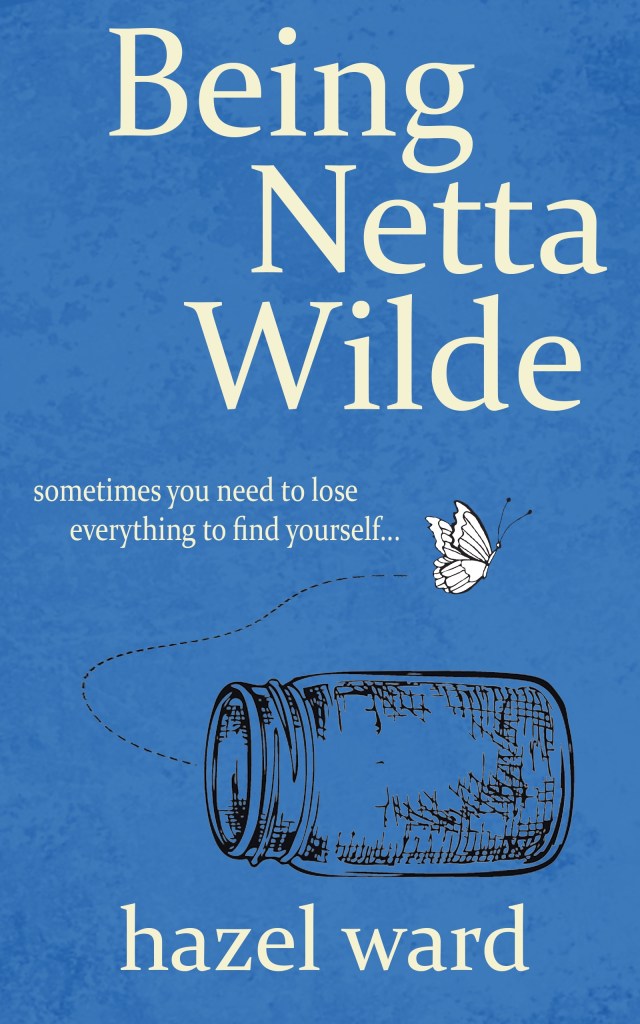
Being Netta Wilde by Hazel Ward.

An uplifting story of love, loss and second chances that celebrates friendship and human connections.

Netta Wilde was all the things Annette Grey isn’t. Netta Wilde was raw, unchecked and just a little bit rebellious. She loved The Clash and she loved being Netta Wilde.

Annette Grey is an empty, broken woman who hardly knows her own children. Of course, it’s her own fault. She’s a bad mother. An unnatural mother. At least, that’s what her ex-husband tells her.

The one thing she is good at …

the one thing that stops her from falling …

is her job.

When the unthinkable happens, Annette makes a decision that sets her on a journey of self-discovery and reinvention. Along the way, her life is filled with friends, family, dogs, and jam. Lots of jam.

Suddenly anything seems possible. Even being Netta Wilde again.

But, is she brave enough to take that final step when the secrets she keeps locked inside are never too far away?

I chose to read this novel, purely because I am a middle-aged woman who looks back to the nineties from time to time and wonders what would that girl think of who I am now? I still wear floral dresses, Doc Marten boots and big slouchy cardigans. I still listen to the same music sometimes, go to gigs and read, constantly. Of course there are times I think I’ve lost myself – that underneath the avalanche of life experience I’ve taken on a different shape. There are times life has been so difficult I haven’t been able to find the girl I was. I’m at my happiest when I’m close to her. When I feel we’re still connected. The times when I can’t find her and I feel completely lost, she’s still there. She never really goes away.

Annette Gray doesn’t know that. She thinks she’s lost her self. She’s become drab, miserable and as Gray as her name suggests. I thought it was clever to create a structure where the actual story feels dull and slow, just as Annette does. It just didn’t come alive at first. Then I realised what the author was doing. As we see flashbacks to her university days they do come alive like the bit in Wizard of Oz where Dorothy wakes from her black and white world to glorious technicolour. It isn’t surprising that she feels so drained. Under the pressure of a terrible marriage where all of her confidence was eroded, it was no surprise to me that she had lost herself. Colin, thankfully now her ex-husband, is unfortunately still playing a huge role in her life. Not only is he a spiteful bully, he has conditioned his children to treat their mother the same way. While working she has footed the bill for their life, while never getting chance to see her children or even put across what life was life was like for her. Even now they’re grown up, their Dad still influences how they feel about her.

When Netta is made redundant I worried that this was another setback for her and when Colin starts complaining about his hand-outs I worried she would crumble. However, this is where the book really does take on some colour and Annette Gray starts to find her inner Netta Wilde again. I loved the joy she found at the foodbank and the new friends she makes there. She also has time for a new hobby that brings her happiness and self-fulfilment – jam making. As a jam maker, I know the satisfaction that comes from a completed batch on the pantry shelf. Like Sophie’s mum in Peep Show, I like to give my batches quirky names that remind me of when I made them – Blair Resignation Plum and Downton Abbey Zingy Damson being two from my shelves! This new lease of life and financial upheaval really opens Netta’s eyes. She can no longer afford to subsidise Colin or her children the way she has, and when she realises she’s been taken for a ride, even more revelations come to light that made me furious. I was dying for the children to realise what a thoroughly unpleasant man Colin is. I also wanted them to see the real person Netta was, someone willing to give up her home to live more simply so she could look after others. Her fellow volunteers at the foodbank really do rally round and become the family she’s been missing for so long.

I think many women lose each themselves, because of the expectation that we’re the caregivers in life. Not just for children, but for elderly parents, disabled siblings and sick spouses. Instead of rebelling, we internalise this and blame ourselves for our rebellious and ‘unnatural’ feelings if we don’t want to do it. Often we don’t even stop and ask ourselves if the men in our family and of our age have the same expectations placed upon them. I think the book captures an experience familiar to many middle aged women. It is peopled with great characters and has a real sense of someone awakening to who they want to be for the next chapters of their life. Someone who’s still a little bit Netta Wilde of yesteryear, but brought bang up to date. The Netta Wilde for now.

Meet The Author

Hazel Ward was born in a back-to-back house in inner city Birmingham. By the time the council knocked the house flat and packed her family off to the suburbs, she was already something of a feral child who loved adventures. Swapping derelict houses and bomb pecks for green fields and gardens was a bit of a culture shock but she rose to the occasion admirably and grew up loving outdoor spaces and animals. Especially dogs, cats and horses. 

Strangely, for someone who couldn’t sit still, she also developed a ferocious reading habit and a love of words. She wrote her first novel at fifteen, along with a lot of angsty poems, and was absolutely sure she wanted to be a writer. Sadly, it all came crashing down when her seventeen-year-old self walked out of school after a spot of bother and was either too stubborn or too embarrassed to go back. It’s too long ago to remember which.  What followed was a series of mind-numbingly dull jobs that paid the bills but did little to quell the restlessness inside. 

Always a bit of a smart-arse, she eventually managed to talk herself into a successful corporate career that lasted over twenty years until, with the bills paid and the children grown up, she was able to wave it all goodbye and do the thing she’dalways wanted to do. While taking a fiction writing course she wrote a short story about a lonely woman who was being made redundant. The story eventually became her debut novel Being Netta Wilde.

Hazel still lives in Birmingham and that’s where she does most of her writing. When she’s not there, she and her partner can be found in their holiday home in Shropshire or gadding about the country in an old motorhome. Not quite feral anymore but still up for adventures. 

Social Media Links – 

https://hazelwardauthor.com

https://www.facebook.com/hazelwardauthor

https://twitter.com/hazelward

https://www.instagram.com/hazel.ward

https://www.youtube.com/channel/UCrmdeA7DKEXhrj6n


Purchase Links

UK – https://www.amazon.co.uk/Being-Netta-Wilde-Hazel-Ward-ebook/dp/B0947351XQ

US – https://www.amazon.com/Being-Netta-Wilde-Hazel-Ward-ebook/dp/B0947351XQ

Posted in Random Things Tours

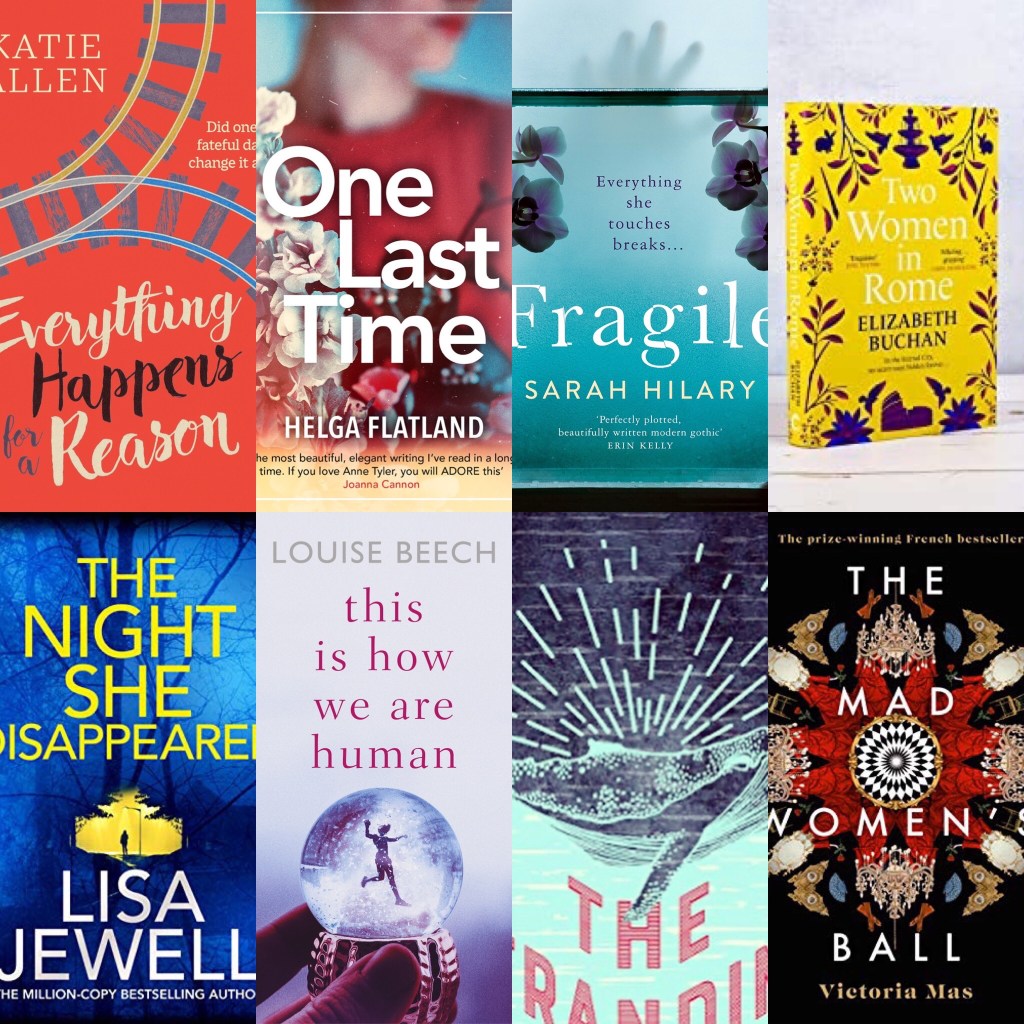
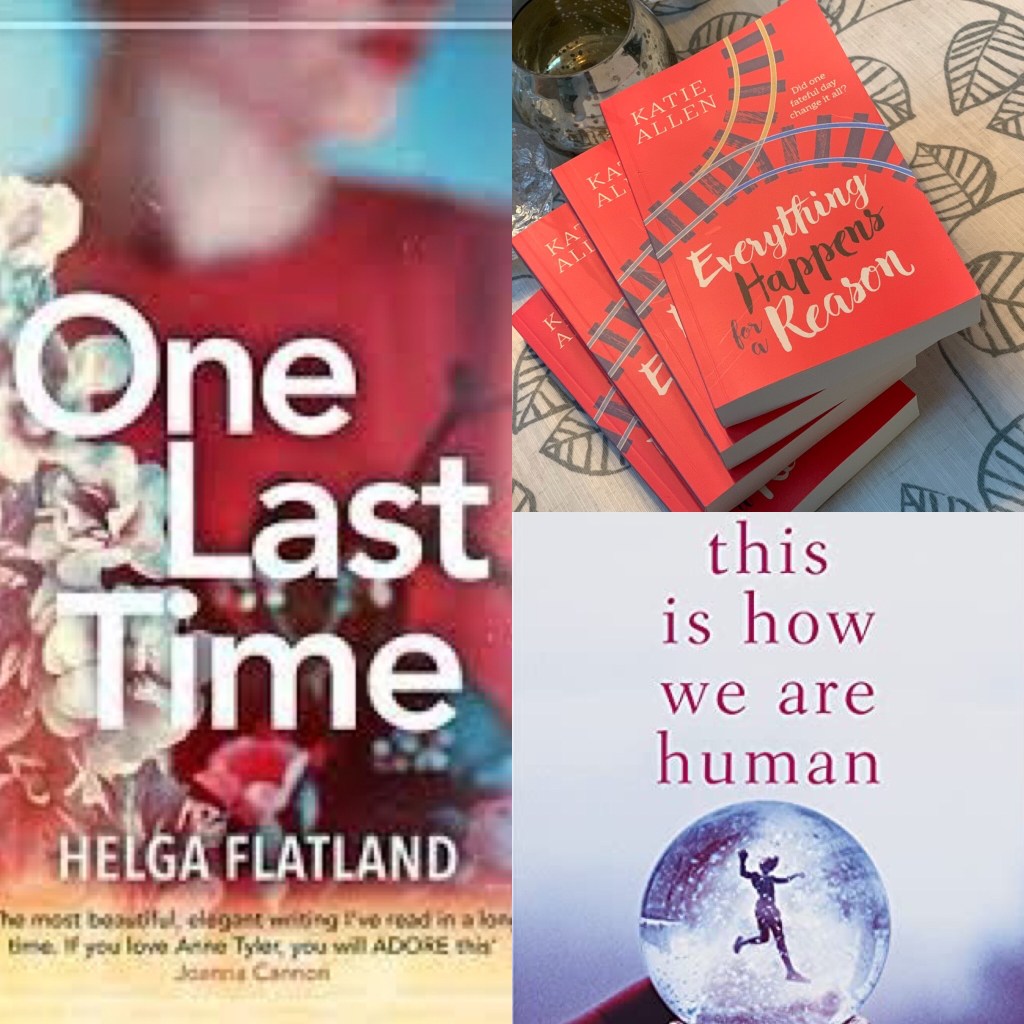
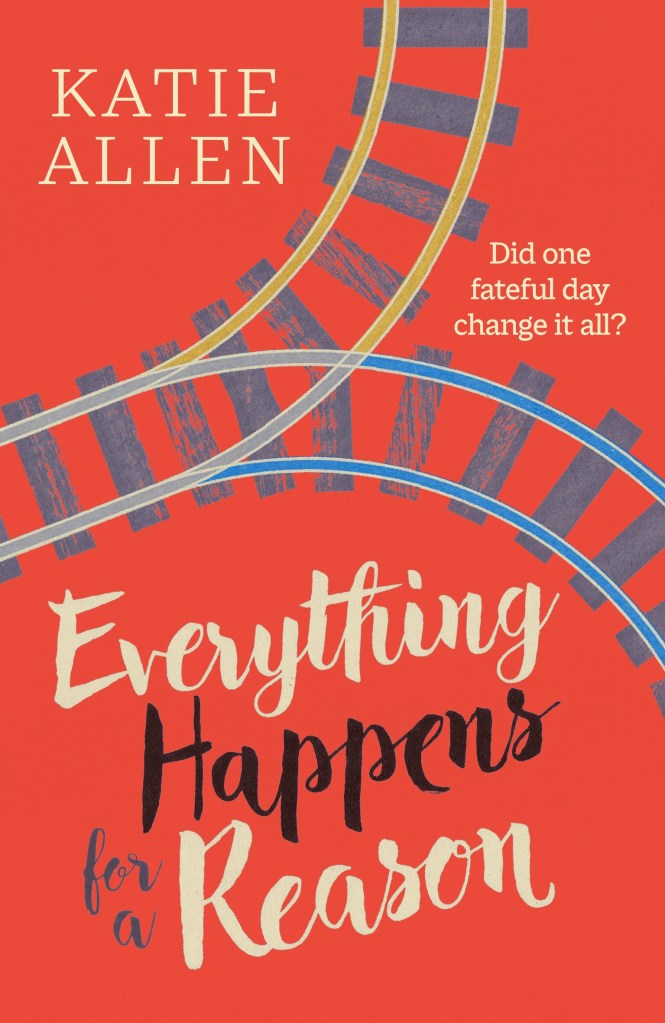
Everything Happens For a Reason by Katie Allen.

Mum-to-be Rachel did everything right, but it all went wrong. Her son, Luke, was stillborn and she finds herself on maternity leave without a baby, trying to make sense of her loss.

When a misguided well-wisher tells her that “everything happens for a reason”, she becomes obsessed with finding that reason, driven by grief and convinced that she is somehow to blame. She remembers that on the day she discovered her pregnancy, she’d stopped a man from jumping in front of a train, and she’s now certain that saving his life cost her the life of her son.

Desperate to find him, she enlists an unlikely ally in Lola, an Underground worker, and Lola’s seven-year-old daughter, Josephine, and eventually tracks him down, with completely unexpected results…

Both a heart-wrenchingly poignant portrait of grief and a gloriously uplifting and disarmingly funny story of a young woman’s determination, Everything Happens for a Reason is a bittersweet, life- affirming read and, quite simply, unforgettable.

When I first talked to Karen Sullivan at Orenda about this incredible book – part of the Jubilant June publishing event – she told me I would cry but I would love it. She was right. I did cry. I cried buckets. I did love it too. This novel reminded me so much about my own loss. I cried for Rachel, I cried for the author, and I cried for anyone who has suffered this terrible loss. Mostly, and selfishly, I cried for myself. I do know the profound sense of loss Rachel goes through, because I lost three pregnancies, one with twins, when I was in my twenties. Of course these were miscarriages, not full term pregnancies, and as someone once tactfully told me ‘better to lose them earlier, than to actually have to give birth, or to have your baby die after a few days’ as if we were playing some sort of ‘Grief Top Trumps’. I was told many things in the months after each miscarriage: there was probably something wrong with the baby; we don’t always understand God’s plans; maybe it wasn’t meant to be. People don’t say these things because they’re malicious. They say these things because they don’t know what to say and silence seems unacceptable. The most useful thing anyone said was from the nurse who discharged me the first time. I was so traumatised by the past 24 hours I was staring ahead, not really seeing and not really listening. She touched my hand and said ‘it isn’t your fault, remember that’.

However, as it happened again and again, I did feel guilty and wracked my brain looking for things I might have done wrong. Rationally I knew it was not my fault, but I wasn’t always rational. Was this to do with my MS? Did I take a tablet I shouldn’t? Should I have helped in the charity shop sorting and labelling clothes, moving boxes? I wasn’t trying for a baby so was it the lack of vitamins? No folic acid? My body felt like such an inhospitable place. It was already attacking itself, now it was attacking my babies. Is it because I shouldn’t be a mum? Did I have a right to bring a baby into my already imperfect world, with my imperfect body? My brain switched off. My heart broke. I was told I had incomplete miscarriages, the baby dies but doesn’t ‘come away’. I then had to read and sign a clinical form that referred to my baby as the ‘products of conception’ and was headed ‘Consent for Termination’. My guilt clicked in again. What if they were wrong and I was killing my baby? To really complete the trauma I contracted an infection after my third miscarriage, and the doctor who had to examine and admit me to hospital actually slapped me on my bare leg because I wasn’t moving fast enough. I felt like my body wasn’t mine anymore. It broke my relationship. It took me on a long, painful journey of finding out that becoming a Mum was going to be more difficult for me because I had Hughes Syndrome, a clotting abnormality. It would be so difficult that I had to choose my own mental health over becoming a mother. I couldn’t make sense of what I’d done wrong to deserve this, on top of my other disabilities.

This is all our central character, Rachel, is trying to do. She wants to make sense of why her baby, Luke, died. She latches onto a platitude and weaves a story around it. If everything does happen for a reason, what could that reason be? Then she thinks of that fateful day when she stopped a stranger from jumping in front of a train, the same day she found out she was pregnant. What if he’d been meant to die? Then, because he was saved, someone else had to die in his place. It’s not clear if she truly believes this, or whether she has to think a greater purpose is at play, because if Luke’s death is without a reason she will fall into the abyss. So, we follow her search for the man she saved. Maybe if she sees him making the most of his second chance at life, she can accept her loss. There is, of course, sadness and grief on the journey, but there’s also humour and the hope that Rachel will work through the worst of her loss and find some peace and acceptance in this awful situation.

The writer is incredibly courageous to take her experiences and lend them to Rachel for the purposes of the novel. As we follow her ‘non-maternity leave’ she tells her story with such a frank, raw, and brutal honesty. This could be a difficult read for someone only just going through the same experience, but for me, I felt like someone had finally seen the pain I was carrying. I would no longer have to stand in the Post Office queue, watching people going about their business, with a terrible inner urge to scream ‘my baby died’. Rachel’s story is told through a series of emails addressed to the son she’s lost. In this private correspondence she can express her worst fears and nothing is left unsaid. There is also a sense for her, that she can send them somewhere; that somehow, Luke can see them. The authenticity of this stream of consciousness can only be achieved by letting us delve deeply into Rachel’s feelings and state of mind. It seems so authentic, because it is. Katie has delved into her very soul for this novel and welcomed us in. I can’t thank her enough. I admire her enormously. It inspires me to keep going, to keep writing my own story.

The fact that this is Rachel’s world means that everyone we meet, we can only see through her eyes. I really enjoyed some of these characters and they do bring balance to a tough story by creating some of the lighter, more humorous moments. Josephine, the daughter of a woman who helps Rachel in her search, has an offbeat humour that I really enjoyed. She really doesn’t have the ability to filter her thoughts before they come out of her mouth, and while that’s always funny, it can also be very insightful in a quirky way. The author has a unique ability to affect the reader’s emotions in one way and then switch them round again very quickly. Rachel’s family mean well when they help and hope she can ‘move on’ from her grief. Some don’t fully understand her quest and want the very best for her. I found myself understanding their confusion and agreeing with their wish that she heals emotionally. The next second I’d be furious, because something has been said that’s so glaringly insensitive. I’d want to turn the air blue with a few ‘F’ words.

I know I have rambled about my own experiences here and maybe I haven’t said enough about why you should read the book. However, I can honestly say this is the book about the loss of a baby, and the chance to be a mother, that is the most authentic I have ever read. I felt represented by this story and by this talented debut author. It’s unique structure, it’s rawness and ability to plumb the depths of despair, while still making you laugh and dare to hope, is simply extraordinary. It is beautifully written and captures our human need to make sense of something that is senseless. No one should be told how to grieve. Each person, and each individual loss is different. We humans find it difficult to accept that some life-experiences have no explanations or answers. When we can’t find meaning, we create it. So, we tell each other stories.

I’d like to say a big thank you to Karen at Orenda for putting this book in front of me months ago, then waiting patiently for my response. I’d also like to thank Anne Cater for letting me ramble like this on the blog tour.

Meet The Author

Everything Happens for a Reason is Katie’s first novel. She used to be a journalist and columnist at the Guardian and Observer, and started her career as a Reuters correspondent in Berlin and London. The events in Everything Happens for a Reason are fiction, but the premise is loosely autobiographical. Katie’s son, Finn, was stillborn in 2010, and her character’s experience of grief and being on maternity leave without a baby is based on her own. And yes, someone did say to her ‘Everything happens for a reason’.
Katie grew up in Warwickshire and now lives in South London with her husband, children, dog, cat and stick insects. When she’s not writing or walking children and dogs, Katie loves baking, playing the piano, reading news and wishing she had written other people’s brilliant novels.

Posted in Publisher Proof

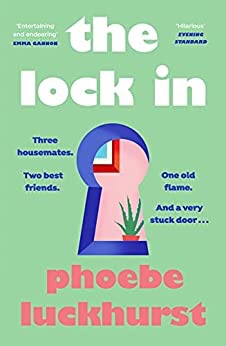
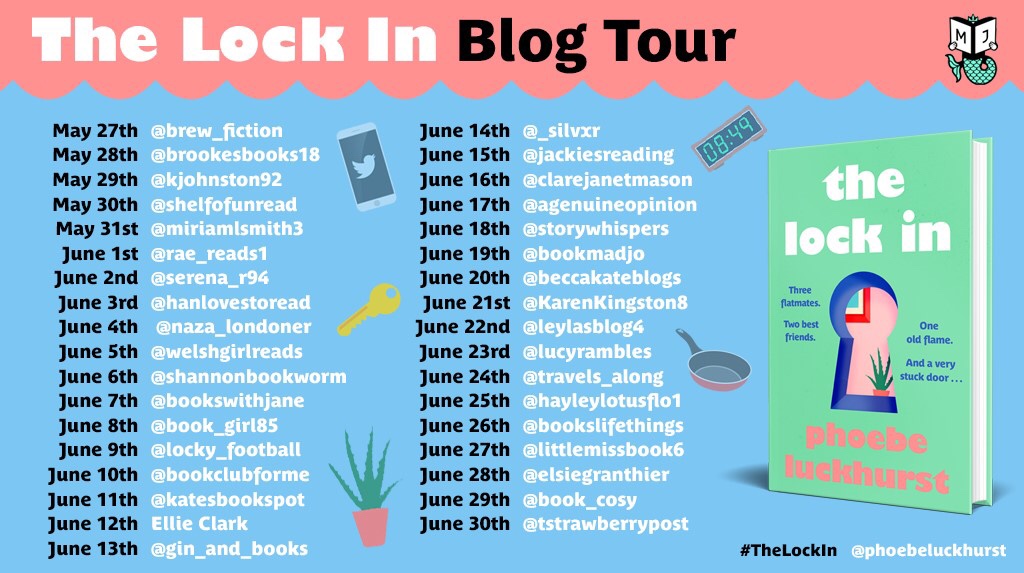
The Lock-In by Phoebe Luckhurst.

Ellen and Alexa have survived hangovers, dodgy landlords and most of their twenties together.

But can they survive this?

After waking up with a terrible hangover, Ellen’s day is about to get much worse. It’s Saturday morning and a flooded kitchen leads best friends Ellen and Alexa into their attic looking for a stopcock. Their scream, after finding a mouse, leads their friend and housemate Jack up there too. But when Ben – Alexa’s date from the night before – walks in, the handle breaks, and all are trapped.

While Ellen nurses her hangover, she watches her best friend fall for this gorgeous stranger. Only to come to the horrifying realisation that she knows him from somewhere. Frantically searching her memories, Ellen wonders: is Ben really who she thinks he is?

And more importantly, what on earth is she going to do about it . . . ?

This is a fun rom-com and one of those deceptively light novels, that’s actually very difficult to write. It feels light-hearted and restricts the characters to one space – an attic within their shared home. I need a wee every five minutes, so I’d have ransacked every box in the attic for something to force the door open! I can’t possibly wee in a room with strangers! On a more serious note, the attic is a great dramatic device because it heightens tensions and seeing how that affects characters, is so interesting.

To create a good sense of the shifting perspectives in the room, the author gave each character their own narrative in the novel. It worked brilliantly because we could get a sense of how the existing relationships in the house worked, and how Ben’s presence changed that dynamic. It gave us different perspectives on what was happening too – who is panicking, who is a natural leader in a group, who comes up with creative solutions to the situation they’re in? It also showed how Alex’s presence with a man, a man she seems to be falling for, affects the others. When friends fall in love we’re happy for them, it’s a good thing, but will it change our relationship with them? Is the beginning of their relationship, necessarily the end of an era as single twenty-somethings sharing a home? I felt for Jack, who feels like an outsider in the house. Everything about him told me he was a warm-hearted and kind. Yet he seemed shy and a little bit awkward to. My heart went out to him.

There were some times I felt so old and I’m also completely out of touch with urban Iiving. I’m 47 years old and I’ve lived in a rural county my whole life. There were many references lost on me. Their teenage years may well have been spent on MSN messenger, mine was spent drinking on a riverbank and dancing in a psychedelic hoody to the Happy Mondays. My teenage years are pre-internet, which makes me feel prehistoric. I enjoyed the stories of internet dating, but my dates had to run the gauntlet of my Dad and suffer stifled, anxious, phone calls taking place in our living room with my whole family listening. I’ve heard stories of terrible landlords from friends who have lived in London, but here no one can afford to rent anything till they’re in their thirties. So I had to enjoy this as an amused older generation, learning about the world as it is now or might be for my stepdaughters (although that’s slightly worrying).

This is a great summer read, if you’re looking for something light-hearted with characters you’ll enjoy stuck in a very awkward situation. It’s a very modern room-com, bringing the genre bang up to date with some good laughs along the way.

Meet The Author


Phoebe Luckhurst is a journalist and author, who has written for publications including the Evening Standard, ES Magazine, ELLE, Grazia, Sunday Times Style, Guardian, Telegraph and Grazia. The Lock In is her first novel, and she is currently writing her second.

Posted in Publisher Proof

Sleepless by Romy Hausmann.

Reading this book was a little like trying to get a knot out of a necklace chain, it seems impossible to unravel, until suddenly one move loosens it and the whole thing unknots very quickly. Our central character, Nadja Kulka, was convicted for a terrible crime in her native Poland, many years ago. Now she’s out of prison she’s looking for the simple everyday things that others have: a job, a nice flat to live in and eventually a few friends. She just wants a ‘normal’ life. She does make one friend. Laura Von Hoven is her boss’s wife and a beautiful woman, who’s very free spirited. When she asks for Nadja’s help, of course she wants to give her friend a hand. However, Laura has killed someone and wants Nadja’s help to conceal the body. Nadja doesn’t feel like she can refuse, showing how her earlier trauma, from the original crime and punishment, has affected her emotionally. She’s full of anxiety, awkward with people and easily talked into bad ideas. Nadja isn’t a likeable character at first, there’s a stand-offish, prickly sort of manner she has that keeps people at a distance. Yet, underneath these defences, she’s vulnerable and naive. When they find the perfect place to hide the crime, an abandoned cabin in the woods, the rest seems easy. However, their seemingly simple plan falls apart and Nadja finds herself in a game of cat and mouse. It’s a deadly game and one that’s stacked against Nadja, because she’s the perfect murderer as well as a perfect victim.

I was very disorientated at first by the disparate strands of this complex thriller. We have three separate narratives, two different narrators plus a set of letters that don’t sound like they belong. I thought there were three different people here, because the author of the letters feels different to the others. Unlike her novel Dear Child, these separate threads feel a long way apart and it’s impossible to make them diverge into one clear narrative. I found the chopping and changing too ‘bitty’. I would pick it up after a break and found I couldn’t pick up the thread without going and re-reading previous pages. It was only when I read a good third of the book that I really started to make sense of the story and these narrative voices clicked into place. However, after sitting back and thinking, I wondered if this confusion wasn’t deliberate? Haussmann doesn’t strike me as a writer who makes mistakes, I think her plotting and structure are very deliberate, so what is she trying to telling the reader with this complicated beginning?

In retrospect, I feel that the author likes to manipulate and control her readers. She was giving us the same experience as her characters, like we’re in the centre of a complicated web waiting for a spider to strike. I was exasperated with certain characters here and there, but I found myself willing Nadja to come out of this okay, despite her past and her faults. My advice is to keep reading; things become clearer and after that prepare to set aside a whole evening to finish the story in one go. The pace quickens, increasing the tension and rushing us towards a conclusion. By this point I was intensely invested in the characters and how this would play out. I wasn’t disappointed and Hausmann kept a few final twists in reserve, that I didn’t expect. This isn’t an easy read at first, but it’s clever and psychologically astute. I loved trying to work out who had the upper hand in the web of lies. So in the end, this book firmly places Hausmann as a must read author for me.

Meet The Author

Romy Hausmann was born in the former GDR in 1981. At the age of twenty-four she became chief editor at a film production company in Munich. Since the birth of her son, Romy has been working as a freelancer in TV. Dear Child is her thriller debut. She lives with her family in a remote house in the woods near Stuttgart.

Posted in Netgalley

The Maidens by Alex Michaelides

There’s probably a word in another language that properly describes the weird combination of trepidation and excitement a bookworm feels when they see a second book coming. You see they loved the first one. It was different. With an incredible twist that no one saw coming! It was like seeing The Sixth Sense for the first time, being blown away, then wondering what M. Night Shymalan could possibly do to follow it? If this is what it likes for the reader, imagine the writer’s fear in following such a smash hit as Alex Michaelides’s The Silent Patient. It must have been incredible. So I approached The Maidens as if it was a piñata filled with bees!

The premise sounded interesting. Psychologist Mariana Andros is summoned to Cambridge University by her niece Zoe. It’s a place filled with memories for Mariana, because it’s where she met her late husband Sebastian. For Zoe it is now the place where her best friend Tara has been murdered. Zoe is very special to her aunt, because they are each other’s only family. They have been closer since the death of Sebastian, who drowned on a romantic holiday in the Greek Islands only a year ago. Mariana knows how desperate Zoe must feel, so cancels her group therapy clients and sets off to meet her in Cambridge, where she stays in university lodgings. Here she meets the charismatic and Byronic Professor Fosca who teaches Classical Philology. Mariana is disturbed by him and his habit of gathering together ‘special scholars’ who receive group tuition from him. They are called The Maidens – although whether this is Fosca’s invention or the girls we are never sure and, of course, each one of them is incredibly beautiful, including their missing member, Tara.

Zoe is convinced Fosca is behind the murder, but with no evidence except a strange feeling and dislike of his odd circle of academic groupies, nothing can be done. I had the feeling that this tutor was perhaps a genius in his field, but was socially awkward and unaware of societal norms. Did he think his maidens gave him an air of eccentricity perhaps? However, he was too obvious to be the real villain of the piece. Yet, no matter how hard I tried, I couldn’t guess the answer. Thankfully the book had a great pace and once it had it me hooked, I just couldn’t leave it alone. I read it in my car on the way to our holiday cottage, in the bath, and in the park. However, I still couldn’t possibly have guessed at the incredibly tense showdown at the end.

For me there were some negatives. I had difficulty connecting to the characters emotionally, especially Mariana who never fully came to life for me. The Greek tragedy element was clever, as quotes on postcards sent to the victims felt like clues to the killer’s identity. However, I was taught classics at school so these references were familiar to me and I wondered how this whole theme would be received for someone without any knowledge of Greek myths. I also felt that how Mariana inserted herself into the investigation was highly unlikely. However, I did enjoy the academic setting and I felt the author captured that sense of importance academics can have about their subject area. I thought the he represented academia well, like being in a bubble, living and breathing your passion. The murders punctured their way through this protective layer, bringing the real world into a rarefied way of life. The passing connection to The Silent Patient wasn’t needed, but did add an interesting aspect to the ending; I now have my own epilogue running in my head, following certain characters into that other fictional world.

I was disturbed by the visitation of a swan, described as having black eyes that bored right through Mariana. I wondered what this represented and thought of the famous Greek myth of Leda and the swan – where Zeus disguises himself as a swan in order to rape/seduce Leda who has no knowledge of the swan’s true identity. For me this conjured up ideas around love or infatuation being blind, loving and trusting someone who isn’t what they seem. What I loved most of all though, was perhaps linked to the swan. The author has created a therapist with all the skills of perception and understanding in her toolbox, but an inability to apply them in her own life. She loves those closest to her blindly, never seeing their true nature just as Leda only sees a swan. Swans are also our analogy for someone very serene on the surface, but masking anxiety or the great effort it takes to be present. Swans look beautifully calm and composed above the water and this reminded me of Mariana; the calm and stability is only skin deep. I thought the novel was part psychological suspense, part crime fiction, and part gothic novel, but it was definitely all thriller.

Meet The Author.


Alex Michaelides was born and raised in Cyprus. He has a MA in English Literature from Trinity College, Cambridge University, and a MA in Screenwriting from the American Film Institute in Los Angeles. The Silent Patient was his first novel. It spent over a year on the New York Times bestseller list and sold in a record-breaking 49 countries. He lives in London.

Posted in Random Things Tours

One Last Time by Helga Flatland.

Translated by Rosie Hedger.

I was utterly bowled over by this beautiful examination of life, death and how ordinary lives can be the most extraordinary of all. Our narrator, Anne, unexpectedly finds herself contemplating the end of her life, and so much sooner than expected, when she faces a diagnosis of colon cancer. Her husband Gustav has been hovering between two states for a number of years after several strokes slowly incapacitated him. His permanent disabilities started with paralysis of one of his arms and ending with all limbs affected and personality changes that are the hardest to cope with. With a heavy heart Anne has allowed their GP and hospital team to make the decision that Gustav should be placed in a nursing home. There’s a sense in which Anne had felt immune from further tragedy, as if Gustav had paid the price for them all. Meanwhile, we also meet Anne’s two grown-up children, Magnus and Sigrid. Sigrid is our second narrator and through her story we can see Anne in a different light, as a mother. However, we also see Sigrid as a mother and it’s on these relationships the book focuses; those complex emotions and connections between mothers and daughters.

Anne’s life has been a difficult and hard-working one. There’s been the farm she kept with Gustav in an isolated region of Norway, her job as teacher, the role of carer for Gustav, and her role as mother. From the outside looking in she’s an amazingly strong woman for whom fate has dealt a very rough hand. From the inside she sees herself as almost subsumed by the needs of other people, particularly Gustav, but has done the best job she could in very difficult circumstances. However, from Sigrid’s perspective, she allowed herself to be subsumed by Gustav’s needs at the expense of her children. Sigrid feels that her father listened to her, they would play records together from his vinyl collection and he took time to understand her. She feels her mother is distant at best and at worst, neglectful and selfish. We also see Sigrid’s own mothering skills, dealing with her teenage daughter Mia and the sudden return of Mia’s biological father Jens. The author takes us back to Sigrid’s rebellious teenage years, her pregnancy at 19 and Jens’s abandonment of her just before the Mia’s birth.

The author cleverly shows us how mother and daughter can see the same incident very differently. In a conversation about teaching in Norwegian in schools, Sigrid suddenly bursts out with:

I was so cold, freezing all through primary school, do you know what it was like, sitting through a whole day in class with wet socks, ice cold, not daring to take them off for fear someone might see?’

Anne is a bit stunned, but relates back to everything that was on her plate at the time. She was looking after Gustav, constantly making sacrifices:

‘You’re hardly the true victim in all this, I told her in as measured a tone as I could muster. She said nothing, waited a few seconds before getting up and leaving. I woke that night and remembered at least one occasion when Sigrid had been at high school and I had urged her to wear her boots, she had flown into a rage with me, stormed out the door and into the icy rain in her trainers and denim jacket’.

This is how mother and daughter speak to each other, in cross words with even more crossed wires, and bogged down with specifics. The overarching truth neither wishes to acknowledge is that Sigrid’s memories of her father are in a nostalgic past before she was seven years old. He will never grow old. He took up so much of her mother’s time that both Magnus and Sigrid fended for themselves on occasion. I felt so sad for Sigrid that her family forgot her birthday once or twice. However I also felt sad for Anne, who was dealt a rough hand in life and now has another in death. The time she’s had for herself is minimal, and the retirement she expected with her loving husband has been stripped away. There’s a deep sense of loss in Anne, from the family life she expected, her marriage, loss of a lover and of a warm, loving relationship with her daughter. She thinks back to those times she had supported Sigrid which don’t get mentioned. After Jens left, Anne collected a 19 year old Sigrid and took her back home for some much needed TLC and to have help after the birth. Sigrid isn’t angry with her Dad, she can’t be because he’s sick, so her anger is saved for Anne who for several years chose Gustav’s needs above those of her children.

Then, in turn, Sigrid is at crossed purposes with her own daughter. Jens has returned after sixteen years and is now the object of Mia’s affections. Sigrid feels for her partner Aslak, who has been there for both of them, since Mia was a small baby. She thinks she’s been a great Mum to Mia, never shirking responsibility or neglecting them. However, there are times Mia has felt stifled and there’s a way in which Sigrid’s need to control everything feels like anxiety to others. The author manages to convey how these parenting choices feel to the daughter. There are times when intention and result just miss each other by a hair’s breadth and I found this incredibly moving. It made me think about how I view my own mother and where I’ve been harsh in my assessment of her, but others might view things with more empathy. I found it interesting in light of her accusations about Anne’s parenting, that Sigrid feels it is Mia at fault in their misunderstandings. Mia’s reply is a real piece of wisdom and could have come from a therapist:

‘Isn’t it interesting how everyone else is always letting you down Mum?’

Helga Flatland writes so beautifully, that I was in the events of the book immediately and then carried into the very heart of this one ordinary family. She is a master at creating tension between people, finding those spaces between a conversation’s intent and how it’s received by the other person. I was desperately hoping for some sort of understanding between mother and daughter, before it was too late. I felt Sigrid needed that reconciliation even more than Anne. I loved the atmospheric feel of the country with its crispness underfoot, constant dusting of snow and all the hearty foods Anne mentions from elk to mutton, slow cooked and filling the house with delicious meaty casserole smells. I also loved the way she conveyed the closeness of a couple who live together, the way you know how their skin smells or what they’re going to say before they say it. I was so moved by Anne’s predicament of a much loved partner leaving you by slow degrees and how she would simply lie on the mattress next to Gustav hoping to regain some of that comfort she would get from his body. Most of all, her depiction of illness and deterioration is the best I’ve ever read and I’ve read a lot. Small losses, like medication changing the way the way someone smells, are actually huge because it takes them from the familiar to a complete stranger. She explores how illness suddenly demotes you from being in control of the smallest things in your life, like what you will eat for dinner or whether people will stay in your house. Who decides whether you need to be looked after and how? The way your body doesn’t belong to you anymore, or even feel and look like yours. People who once saw us as sexual beings, might cease to see us that way. Our bodies become a no-man’s land that people will fight and negotiate over, but rarely ask what we think, feel or need. This made the book incredibly moving, honest and real. This small family story is exquisite and truly special. You simply must read it.

Meet The Author

Helga Flatland is already one of Norway’s most awarded and widely read authors. Born in Telemark, Norway, in 1984, she made her literary debut in 2010 with the novel Stay If You Can, Leave If You Must, for which she was awarded the Tarjei Vesaas’ First Book Prize. She has written four novels and a children’s book and has won several other literary awards.


Her fifth novel, A Modern Family (her first English translation), was published to wide acclaim in Norway in August 2017, and was a number-one bestseller. The rights have subsequently been sold across Europe and the novel has sold more than 100,000 copies. One Last Time was published in Norway in 2020, where it topped the bestseller lists, and was shortlisted for the Norwegian Booksellers Award.

Posted in Random Things Tours

Mary Jane by Jessica Anya Blau.

What a great coming of age novel this is as we follow Mary Jane Dillard’s summer of 1978, caught between her straight-laced and devout home, that’s all rigorous routine and tidiness, and the home where she ‘nannies’, which is untidy, chaotic, has no rules and is harbouring a famous rock star and his girlfriend as he dries out from drink and drugs! Fourteen year old Mary Jane has a complete culture shock when she takes a summer job working for the Cone family down the road. Her role is to look after the daughter, Izzy, but as she finds out roles and rules are not very clearly defined in the Cone household. Mary Jane has grown up with rules, and her favourite things up till this point are cooking with her mother and singing in the church choir. Her mother is the great organiser of their household: tea is always on the table at the same time; they go to the same weekly church activities; she shops for groceries every Friday and always knows where her daughter is. Dr Cone’s professional status is enough for Mary Jane’s mother, who imagines a serious, professional man with a wife who keeps the household running like clockwork. Nothing could be further from the truth and even Mary Jane’s dad points out they might be different – they’re Jewish he tells his family, their name would have been Cohen but they’ve changed it. Besides which, Dr Cone is a doctor of psychiatry and has his own unusual treatment methods.

If the state of your house is truly reflective of who you are (overstuffed, slightly shabby, but full of charm in my case) then the Cones are chaotic, anarchic, full of ideas and very well read. Just like all children, Mary Jane has imagined all homes are like hers and looks at this one with horror and wonder too. There are things everywhere and in Izzy’s room she can’t even see the floor. The family are not just incontinent with their belongings, but their affections too. Mary Jane’s parents don’t show their emotions and seldom show physical affection, but here Izzy’s parents are full of kisses and hugs – something that takes quite a bit of getting used to on Mary Jane’s part. I grew up in a similarly religious and strict family during my adolescence and although my parents were always very loving, I was very shocked when friend’s mums talked to them openly about sex and relationships, or allowed them to read or watch anything, go out till late and wear what they liked. I really felt Mary Jane’s bewilderment at this complete lack of rules or schedules. As it neared late afternoon she would be surprised that no one had thought about what to have for dinner, or that no one had ironed Mr Cone’s shirts. Mr Cone’s office was in the garden, but his methods are rather unorthodox and within the week the house has two new guests; the rock star called Jimmy and his movie star wife Sheba. Jimmy is drying out, which seems to involve eating a lot of very sugary sweets! Mary Jane has been asked to tell no one the couple are there and this is the first thing she has ever kept from her parents. The second thing is her cut off shorts that Sheba has cut so high they only just cover her bum cheeks – I loved the bit where Mary Jane’s mum bumps into her and Izzy in the supermarket, and she hastily throws on an apron to cover her modesty. She knows that if her mother knew even the half of what is happening over at the Cone’s residence, her summer job would be over, and now she’s grown to love both Izzy and their happy go lucky lifestyle.

Of course these two families are not simply good and bad, they’re just different and that difference is appealing when we realise that Mary Jane is getting from the Cone family, exactly what she is missing at home. Her own mother, although rigid and a little remote, is not a bad woman. Yes she has elitist, and often, judgemental views – the first thing she asks about the Cones is which country club they belong to? She also lives a very ‘Stepford Wife’ existence, with a rota of family chores to follow and the ingrained view that a woman looks after the house, children and her husband. In teaching Mary Jane how to cook and clean, she is preparing her for a similar role in life because that is her norm. They belong to a church that reinforces those same views. However, Mary Jane is well cared for and has a very stable home life, with a mother who wants to keep her safe. By contrast, Bonnie Cone is openly affectionate, praises her cooking and cleaning skills as if they’re a magic art, and encourages her to express herself both emotionally and creatively, but she does have shortcomings. She doesn’t work outside the home, but Izzy is often unfed, unwashed and without Mary Jane’s input could be neglected. As a couple, the Cones choose to bring a known addict into their home who is a total stranger, leave food to rot in the fridge and are effectively allowing a fourteen year old to run their home, cook all their meals and be a full-time nanny to their daughter.

Whilst there is so much charm in their lifestyle and love in their hearts, it doesn’t always translate to action and could be seen as dysfunctional. I can imagine many people finding their nudity troublesome – Mrs Cone is often without a bra and Mr Cone wanders naked from bedroom to bathroom, knowing Mary Jane is in the house. As I was reading I found myself drawn to the Cone’s way of life, but also a little troubled by it. While I dislike rigid, religious upbringings I had to feel a drop of sympathy for Mrs Dillard who thinks she is doing the best thing for her family and often is, in a practical sense. While Izzy seems a happy and well- adjusted little girl now, would that continue into her teenage years or might she crave some structure and safety? There’s a scene, early after Sheba and Jimmy’s arrival where the whole household sit and watch Russian and American astronauts meet in space for the first time. Mary Jane observes that as they all sit together, on or in front of the sofa, everyone has an arm round or hand on someone else. It’s a big affectionate sprawl she describes as being like a litter of puppies. This description stayed with me, and I think it is because they all seemed to be on a equal footing. There are no adults and children here – they are all children. This can also be seen in later descriptions of evenings where everyone sings together, dances to the Jimmy’s records and the adults smoke joints. She is even included in group therapy sessions where everyone is encouraged to be honest and has equal status. I couldn’t tell whether it was the whiff of 1970s nostalgia that made this communal living sound idyllic. There were times when I wondered if any five year old brought up in a similar atmosphere now, might even be flagged up at school or to social services.

However, the author’s skill is in creating that nostalgia for the past, the music, the peace, the love and the permissive family. The atmosphere is warm and welcoming and the reader is charmed into wanting to be a member of this loving and accepting household. I felt seduced by it, but then I was Izzy’s age in 1978 and it does feel like a golden time. These are the rose coloured spectacles of a child. Yet, if I asked my parents what was really going on in our lives then, I might get a completely different story. This is how I felt about Mary Jane, that naïvety she has lead to her being charmed by the Cones. She hasn’t stopped to think what would be happening to Izzy if she wasn’t hired for the summer? On one of the last weeks of summer, they all decamp to the coast, sharing a beach house for the week. I was simply waiting for these couples to clash, or something else to go wrong. One thing is definitely true, seeing an extremely different lifestyle opens Mary Jane’s eyes and gives her a more definite picture of who she wants to be and what to do with her life. This is an interesting, nostalgic and funny coming of age novel with a sympathetic heroine who I really enjoyed.

Meet The Author

Jessica Anya Blau is the author of US bestselling novel The Summer of Naked Swim Parties and three other critically acclaimed novels, most recently The Trouble With Lexie. Her novels have been recommended and featured on CNN, NPR, The Today Show and in Vanity Fair, Cosmo, O Magazine, and many other US magazines and newspapers.

Posted in Netgalley

Waiting for the Miracle by Anna McPartlin

I loved The Last Days of Rabbit Hayes and it’s sequel, both written by this talented author, so I looked forward to starting her new one as soon as NetGalley granted it. As usual for this author it was full of big emotive issues, mixed with the funniest dialogue, strong female characters and an interesting set up. In the narrative from 2010, our four characters meet at an infertility support group. There is a second narrative from 1976 where we meet Catherine, a young girl from Ireland who becomes pregnant as a teenager and is sent to one of the now infamous homes for young mothers, run by the Roman Catholic Church. Coming from a Catholic family myself and finding out I would find it hard to conceive at the age of 25, I was concerned the storyline might be too close to home. I remember being given a list of telephone numbers at the hospital, of women who volunteered for a charity supporting those who had miscarried. I only called one number. Next to the names on the list was a little warning that some of these women had gone on to have healthy pregnancies and there might be children in the house when I called. I knew my outcome would be different by this point. I didn’t have the mental or physical strength to keep getting pregnant, then lose the baby multiple times. I had decided after losing my fourth child that I couldn’t keep going. It was a very hard choice, but the right one for me. I can remember ringing that number for support, only to hear a baby crying in the background. I put the phone down and locked myself in the bathroom so I could grieve in peace. As I read though, I found a kinship with these characters and wished I’d had a group like this to belong to, at a time when my family and friends were supportive, but really didn’t know what it felt like.

Within the group there are women at different stages of this difficult journey. There are so many different reasons for infertility and the author covers most situations within the group: those pursuing IVF; some going through the adoption process; some using donor sperm to have a baby with their same sex partner; women with medical conditions like endometriosis. One has anti-phospho lipid syndrome (often named Hughes Syndrome after the doctor who discovered it) which is my diagnosis and means that it’s possible for patients to get pregnant, but difficult to sustain a pregnancy. Patients with Hughes have sticky blood, making it very difficult to for blood flow to go through the placenta and to the baby. Pregnancies usually fail within the first trimester, my latest miscarriage was at just 12 weeks with twins. As the character in the book relates to the others, often it isn’t detected until the first scan and then an operation must be performed to ‘to remove the products of conception’. As she points out, the medical language may create a distance for the doctor, but for the patient it feels very wrong to see the words ‘termination’ on the consent forms and even harder to sign away the baby you have wanted for so long. The interactions with the NHS were so true to life it felt like the author had popped inside my head and rifled around in my memories. However, there was comfort in knowing this was a shared experience and that other women had been through this feeling exactly the same as I did.

Four women with very different reasons for their fertility problems are drawn together in the group and slowly develop a very strong friendship. A new face in the group sessions seems to bring them together. Ronnie is challenging at first. She seems super confident, asks uncomfortable questions, and invites the others to the pub. She has a strange ability to pull uncomfortable truths and intimate details from those around her, but never seems to disclose much of herself. I found myself starting to question why she was there in the group. Yet as time went on I warmed to her, she seemed feisty and frequently made me smile. Caroline is just about to hit rock bottom in her fertility journey. They have spent a lot of money on medical bills and rounds of IVF, but have never conceived. After discussion with her husband some time ago, they are meant to be never going through it again. Yet Caroline can’t stop yearning for a baby of her own and in her desperation she’s driving her husband away. To make things worse her beloved dog has just died. In a very fragile state she starts to consider just one more round of fertility treatment but her husband isn’t on board. She has to face a very hard decision; is her desire to be a mother, stronger than her love for him? Natalie and her girlfriend have decided to have children using a donor who is very close to home – her girlfriend’s brother. Her girlfriend thinks that if the baby is a blood relative to her, she might be more invested in the idea of becoming parents. Janet’s husband may be having an affair with one of the receptionists from his work place. How can she find out what’s going on? The women are very much a team and support each other, even if one of them is doing something crazy.

Between the present day sections there is the story of a girl called Catherine, back in 1976. Catherine finds herself pregnant after her very first sexual experience with a boy from school. He claims to love her, but she is about to be let down very badly. Catherine’s family are poor, whereas her boyfriend’s family are wealthy and well known in the area. His father is a local magistrate. So when Catherine tells her religious parents what has happened they immediately summon the parish priest and before she knows it Catherine is sitting at the back of his back being shipped off to the nuns at a mother and baby home. We already know the terrible way young girls were treated in these places from films like The Magdalene Laundries and Philomena, but I must admit there were parts of Catherine’s story that genuinely made me cry. I couldn’t believe the casual brutality of these nuns, who are supposed to be women of God. They really made my blood boil. I found it was Catherine’s story that drove the book for me, her plight kept me reading and there were a couple of moments in her story where I was so involved I forgot everything going on around me! The heartbreak, betrayal and psychological abuse this girl goes through is horrendous and her ability to keep going and survive is incredible.

I think that this author enjoys writing about women’s issues and their friendships. She has an awareness, that although we love our partners in life, it is often our female friends that hold us up and keep us going through the worst times. I refer to my best friends as my non-sexual life partners! I had an inkling about the mystery at the centre of the story. What did happen to the baby Catherine had stolen from her at the mother and baby home? I read this in a day, because I was so drawn in by the story and these women who felt completely real to me. Anna McPartlin has such a storytelling skill. She has a way of mining your emotions until you’re sobbing over someone who isn’t even real. For those who’ve been through any of the experiences featured, it might be a difficult read in parts, but I promise you won’t feel let down or misrepresented by the way she depicts your experience. This was sad, funny, warm and poignant. A little bit like life.

Meet The Author.

From Anna’s Amazon Author Page.

Hello reader, 

I’m an Irish novelist and a TV scriptwriter. Currently with 7 fiction titles available to buy online and one children’s title under the name Bannie McPartlin. As of August 2019 I’ve just finished writing ‘Under The Big Blue Sky,’ the follow up to international best selling title ‘The Last Days of Rabbit Hayes.’ This title will be published by Bonnier Zaffer and will be available UK &I IRE and amazon Summer 2020. 

My previous short incarnation as a stand-up comedian left an indelible mark. I’m described by all who know me as a slave to the joke and my work focuses on humour and humanity in even the darkness situations.

So if you’d like to take a trip to the dark side and if you are a fan of big, bold characters check out my titles and I hope you enjoy.

PS

If you are not a fan of moderate to severe cursing, best to move on. Either way good luck to you. 

PPS

I dabble in twitter but often forget it’s there (@annamcpartlin). I’m better on Facebook but not brilliant Anna McPartlin and I really giving it a good old go on instagram #Trying (mcpartlin.anna) and my website is annamcpartlin.com.

Anna McP XXX

Posted in Random Things Tours

Heatstroke by Hazel Barkworth.

Do I really see what’s in her mind, Each time i think I’m close to knowing She keeps on growing, Slipping through my fingers all the time. ABBA

Years ago, when Mamma Mia first came out at the cinema, I went to see it with my Mum. When it came to the wedding day and Meryl Streep helping her daughter get ready for the ceremony, I saw so much emotion flow through my Mum’s face. I didn’t want to make a fuss, because I knew that if I touched her or asked if she was ok it would make things worse. It threw me a little bit because I couldn’t remember my mum ever being sentimental about me. I’d always been someone, she thought, could took care of herself. On our drive home I asked her what about the scene made her emotional, and she said it wasn’t the scene it was the song ‘Slipping Through My Fingers’. It talks about a mother who never seems able to fully capture a moment with her daughter, because she moves just out of reach all the time. Away to school, on to grammar school, to new friends, boyfriends, university and into a fully grown woman. I’m not sure I fully understood what she felt, I don’t have children, but more recently I became a stepmum to two teenage girls. I can see now, with my eldest, how girls grow so quick and out of your influence. How friends become the people who understand them, how they’re constantly making plans to get away, to visit other places, to move on, to study in another city. It’s as if the woman they’re becoming wipes away the trace of that little girl you once did everything for. This book is about that point between mother and daughter; Rachel sees her daughter Mia slipping through her fingers.

The backdrop to this mother -daughter story is a heatwave and a scandal. The nightmare begins when Mia’s school friend Lily disappears one night when she’s supposed to be at a sleep over with her friends. Mia socialises in a group of five girls, and in parallel Rachel keeps a What’s App group of their mothers aimed at keeping in touch with their daughter’s plans and keeping them safe. Lily disappears in the midst of the heatwave and the author very cleverly uses it to ratchet up the tension. At home and at Mia’s school, where Rachel works as a teacher, the heat is relentless. Rachel notices the girls in class lifting their long curtains of hair, and twisting it into a top knot just to feel some air on the back of their neck. Everyone is somehow more aware of each other’s bodies: the smells, the damp as you stand up from a sitting position, or on your back as you stop driving and get out of the car. Rachel’s also aware of so much young flesh on show. The girls and their golden legs, without a trace of hair. They’re perfection and by comparison Rachel is aware of her own flesh as less taut, just a millimetre too saggy at the jawline.

At night it’s impossible to sleep. In between the oppressive heat and worry about Lilly, there are short chapters detailing an illicit relationship. It feels obsessive and dangerous. There are no names used. Could it be Lily or is someone else keeping a secret? Then police find that Lily took something with her. A piece of lingerie belonging to her mother. That means she chose to go and for a moment everyone breathes, until they realise that means she didn’t go alone, but with a person is possibly older and might still mean her harm. Rachel asks Lily’s parents if she can look over her bedroom, just in case there is something the police have overlooked. Something that might only have meaning to those who know the girls well. She finds, on Lily’s notice board, some song lyrics and straight away she knows, she knows who Lily is with. The shock reverberates through her. She should tell the police straight away, but she can’t, she needs to process it first. To think it through before the police do find out, because that could bring even worse trouble. Yet, if it’s ever found out that she knew and kept it to herself, she could be in trouble with the police or even lose her job.

I enjoyed the author’s depiction of how Rachel copes with growing older, made especially difficult by her past and Mia’s growing beauty, Rachel has placed a photo outside the downstairs loo. It shows her at her peak of youth and beauty as the singer in a band. In skimpy clothes and torn tights I imagined her look like Courtney Love, the lead singer in Hole back in the 1990s. Rachel seems to be embarrassed when people recognise her, but it seems likely that people will see it, because of where it’s placed. It’s as if she wants to show she was once cool and beautiful. It’s an ego boost for her. There’s a disturbing scene later, when she takes Mia’s prom dress and tries it on. She’s pleased to be able to fit into it, but what seemed harmless turns into something else when Mia comes home. In another scene she has thoughts about Lily, and her first time sharing a living space with a man. Rachel imagines her worrying about how to do all the things that make her beautiful: the shaving, plucking and preening are no longer private and mysterious I l if these concerns were really for Lily or whether they were about her own beauty rituals. Would she ever be able to accept her ageing process and know she can be attractive at any age?

The mysterious man at the centre of Lily’s disappearance exerts a strange hold over the women involved with him. The author doesn’t ever give us his thoughts or feelings. We just get snippets of musical taste, but it’s clear he is either beguiling or emotionally/psychologically abusive. One disturbing scene shows him and his unnamed lover enter a freezing cold river in their underwear. He goes in first as if to give her the motivation and even though he says very little, it’s clear the female feels compelled to move in deeper and deeper until she feels the current trying to carry her away. I sensed that he wants her to feel powerless without him. I wasn’t surprised to learn who the anonymous lovers are in these sections, but the ending did surprise me. As everything comes to a head towards the Prom, Rachel gets a chance to see her daughter anew. Rachel learns so much about herself and how wrong she has been about any things. As she rushes to support her daughter it’s as if that stifling heat has been affecting her ability to think straight. As the rain starts to come down outside, leaving it’s own unique smell rising from the boiling pavements, Rachel’s eyes clear to see that within the beautiful woman in front of her, there is still a glimmer of the little girl inside again.

Meet The Author

HAZEL BARKWORTH grew up in Stirlingshire and North Yorkshire before studying English at Oxford. She then moved to London where she spent her days working as a cultural consultant, and her nights dancing in a pop band at glam rock clubs. Hazel is a graduate of both the Oxford University MSt in Creative Writing and the Curtis Brown Creative Novel-Writing course. She now works in Oxford, where she lives with her partner. HEATSTROKE is her first novel.

Why not check out these other book bloggers on the tour?