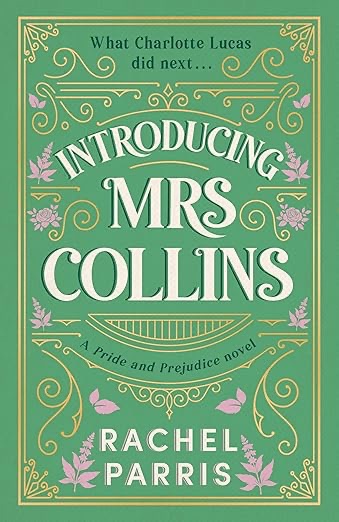
Charlotte Lucas has never been a romantic. Practical to a fault, she accepted Mr Collins’s proposal with clear eyes and a steady heart, trading passion for security. Life at Hunsford Parsonage may be quiet and predictable, but it is hers to manage – and she’s determined to make the best of it, whatever Elizabeth Bennet may think.
That is, until an unexpected guest at Rosings Park turns Charlotte’s careful world on its head. He sees her, challenges her – and a spark is lit. But true contentment is not only about who you choose to love, but who you choose to be. For the first time, she wonders: has playing by the rules kept her on the sidelines of her own life?
It is a truth, universally acknowledged that a sick woman in bad humour will be revived in the company of a witty novel…
This is the Pride and Prejudice inspired novel I’ve been waiting for and it came at the perfect time, when I’ve been feeling very unwell and was stuck in bed. I read for two days between sleeping and I swear it kept me sane. I always felt that Lizzie Bennett underestimated her friend Charlotte and I wondered what happened to her and Mr Collins in the future. It’s a great reminder that we only see a novel’s events through the gaze of our narrator and central character. The same events, viewed from a different perspective, bring a more balanced and multi-faceted view of what happened in the novel and its characters. The events of Parris’s novel take place during and after Pride and Prejudice, from the point that Lizzie rejects Mr Collins proposal. A decision that pleases her father but sends her mother into conniptions! Lizzie’s choice means that once Mr Bennett dies, Mrs Bennett and all of her daughters are at the mercy of Mr Collins, the male heir. Whoever he chooses to marry will become mistress of the Bennett’s home Longbourne. Charlotte Lucas is our focus, Lizzie’s best friend and now the recipient of Mr Collins’s attentions. The author has added inserts from the past, adding depth and insight to both Charlotte and Mr Collins’s characters as adults. We see events that we have only imagined, like the Darcy’s wedding at Pemberley and its ensuing drama. However we also see Charlotte settle into the everyday of married life, with all its strangeness and frustrations. I left Pride and Prejudice a little worried about Charlotte, even though the way she does talk about life at the parsonage with humour and optimism when Lizzie visits. So this story of her growing relationships, her new home and her dissatisfactions with her new life is so welcome. What she misses most is passion, but if it arose would she be able to resist it?
Charlotte is viewed with pity by the Bennetts, apart from Mrs Bennett who is wailing that she will be the mistress of their beloved home. I felt like Charlotte knows her prospects are few. She’s witty and fun, but she knows she doesn’t have the charm and looks of Lizzie. She is someone who people get to know slowly and hasn’t reached her full potential yet. Mr Collins was always a pragmatic choice, but here I could also see it as a mature and confident choice. The Bennetts may see Mr Collins as ridiculous and in some ways he is, but Charlotte doesn’t see her worth as solely defined by the man she chooses to marry. He may be thought of as silly, but that doesn’t mean she is. Also, as Mrs Collins she has a beautiful home and garden, a steady income and a benefactor in Lady Catherine de Bourgh. As a married woman she has status and purpose, going out to visit sick parishioners and keeping the home running smoothly. While Mr Collins is busy Charlotte spends her hours in her library continuing to educate herself, she tends her garden and she practises her piano at Rosings. Charlotte is able to be happy and content in her own company, separate from Mr Collins’s anxieties and emotions. In this light we also see Lizzie differently, perhaps even as a little spoiled. As we see in this book, Mr and Mrs Bennett are the architects of their daughter’s misfortunes and their attitudes are clear in two crucial letters they send to the parsonage. Darcy’s assessment of the family, unwisely passed on to Lizzie during his first proposal, is absolutely correct. Mr and Mrs Bennett’s leniency with their younger daughter’s behaviour allows a window for Mr Wickham to connect with the foolish Lydia. It’s their behaviour that prompts both Darcy and Caroline Bingley to warn Mr Bingley away from his attachment to Jane. In letters to both Charlotte and Mrs Collins, the Bennett parents show they are both fierce in the defence of their daughters but spiteful towards the recipients. Mr Bennett calls Lydia unwise, but at least not judgmental – a criticism that Mr Collins perhaps deserves. However, in a letter to Charlotte Mrs Bennett shows awful spite in an unnecessary postscript:
“I saw your Maria this week at church and she is become such a beauty! What a pleasant girl – always with a smile and a manner that puts one at ease. You would not think you were sisters.”
However, I did come away with some forgiveness for Mrs Bennett’s view that Lizzie might have thought of her mother and sisters when she refused Mr Collins, because now they would surely lose their home. It’s clear that Mr Bennett has little respect for his wife and for good reason on some occasions. However, he does favour Lizzie and perhaps his treatment of her has led to Lizzie thinking she has better prospects than she does. Luckily fate brings her Darcy but I did understand Charlotte for thinking that luck just seems to fall into her friend’s lap.
I felt like Charlotte blossomed in her new environment and that sometimes it is because of Mr Collins not despite him. If nothing else he shows kindness and understanding. The vignettes of his childhood show a sad history that goes some way to understanding his character better. However, it is a connection that she never expected that seems to bring out a new side to Charlotte. An unexpected visitor to Rosings Park brings her friendship and an affinity she never expected, not to mention a passionate spark. I loved the point in the novel when Mr Collins has both a revelation about his wife and is genuinely awe inspired by her. As she plays a piece on the piano for a gathering at Rosings, Mr Collins sees his wife anew:
“This poised assertive woman was a vision, undaunted by entertaining a room of high-born people in a house such as this with the talent he had no idea she possessed […] she was splendid and her splendour shook the foundation of his peace of mind. Whereas another man might have felt only pride in his wife, for Collins, this feeling was mixed with something much more disquieting. She is beyond me: what he felt was I will not be able to keep her.”
This is a worry born of never being enough for his father, who tried to change him by whatever means necessary. I felt the author didn’t excuse all of his failings, but explained what was behind them. The narrative voice is so incredibly good that this didn’t feel like a stranger telling me about these characters I knew very well. It felt like a continuation; a meeting with old friends. Of course the author does bring some of our modern thinking to the story, otherwise we wouldn’t be hearing about Mr Collins’s childhood – a psychological aspect to character we wouldn’t perhaps expect in a book pre-Freud. I won’t touch on Charlotte’s eventual fate but I will say that Mr Collins definitely has a part in it. Maybe not in the most romantic sense, but sometimes there’s a kind of love in duty and honour. I love Rachel Parris’s humour and there’s plenty of that here, with the tone and the wit feeling positively Austen-esque. I could tell by how well each character was drawn that the author loved her books and wanted to do them justice. I think she has.
Meet the Author

Rachel Parris is a BAFTA-nominated comedian, musician, actor and improvisor, best known for her viral segments on The Mash Report and Late Night Mash, which have garnered over 100 million views. Her TV appearances include Live at the Apollo, Would I Lie to You?, QI and Mock the Week, and she is a regular guest on Radio 4’s The Now Show and I’m Sorry I Haven’t a Clue. She co-hosts the popular podcast How Was It for You? with her husband Marcus Brigstocke. Rachel also wrote and presented a Jane Austen comedy programme, Austensibly Feminist, about how to view Jane Austen as modern feminists. Rachel is a founding member of the critically acclaimed improv comedy group Austentatious, in which the all-star cast invent a play based on a title suggestion from the audience. As a touring comedian she has performed her award-winning musical comedy to sell-out audiences across the UK.
 The Lotus Readers