Posted in Squad Pod Collective

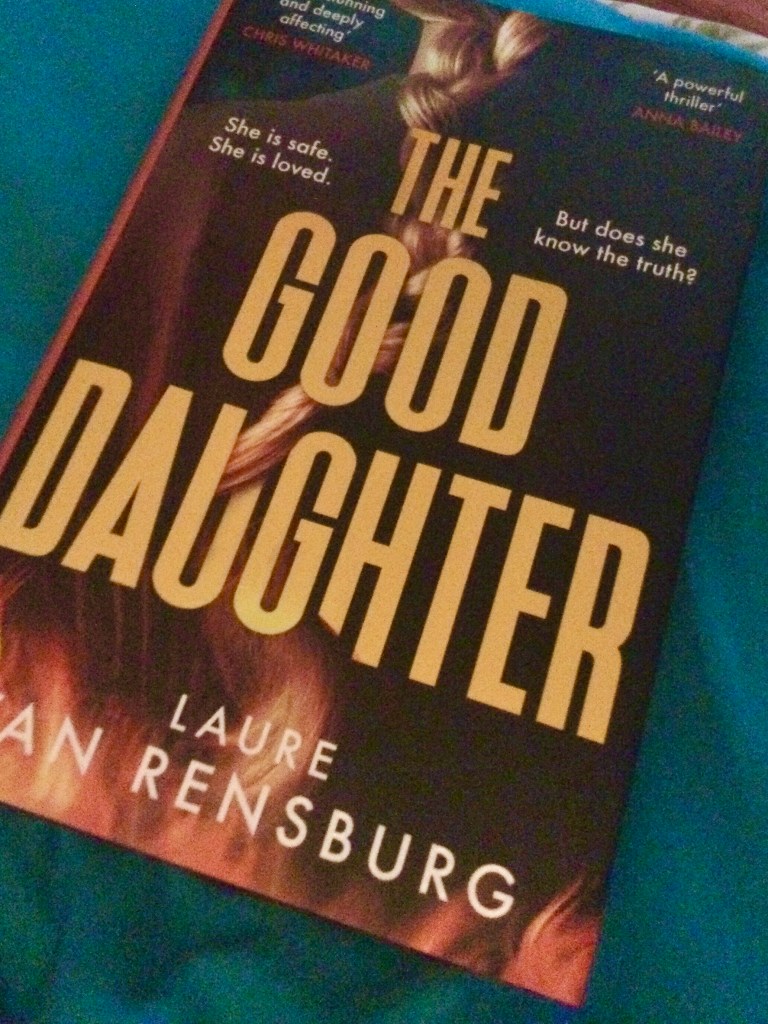
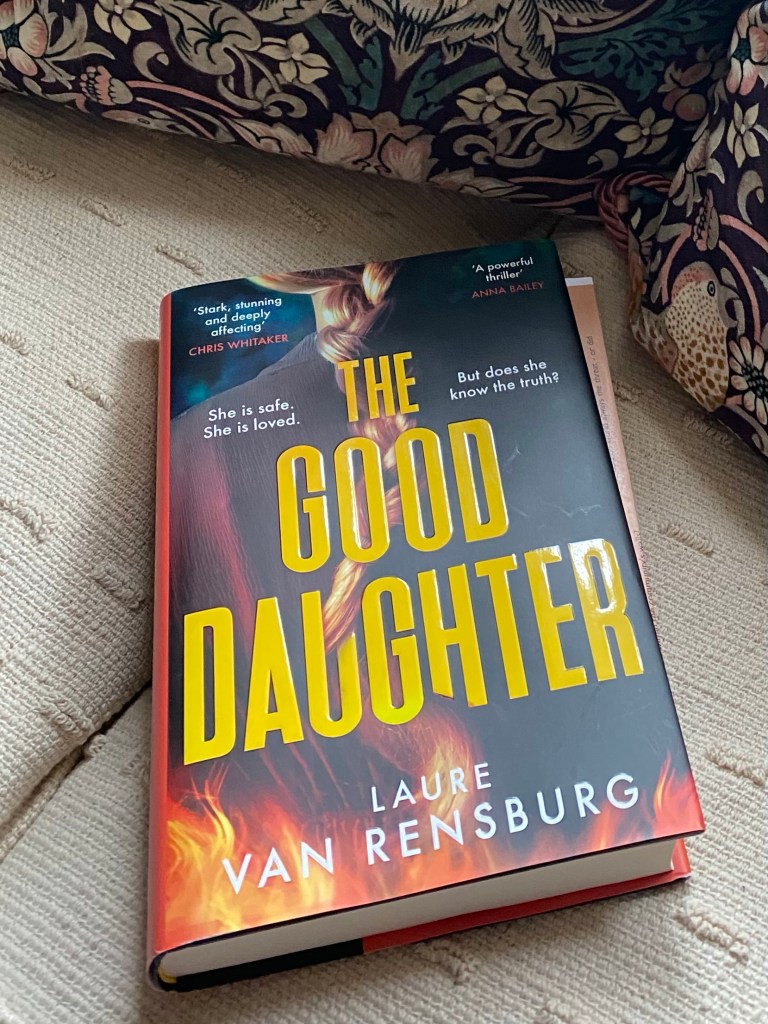
The Good Daughter by Laure Van Rensburg

Abigail is a proud member of the New America Baptist Church. A Christian community miles away from the nearest town in South Carolina, she is safe from the depraved modern world.

She is a good daughter. A valued member of the community.


So when she is the sole survivor of a fire that burns her family’s home to the ground, it seems like a tragic accident.

Until a surprising discovery is made: before the fire, Abigail let a stranger in.

Who was the stranger? What started the fire? And was the outside world always the threat – or did danger lurk within the community’s walls?

I became completely immersed in this fascinating story about faith and the complexities of memory while on holiday. Having spent part of my childhood in a church from the American Christian Fundamentalist tradition, I am always alert to the insidious nature of spiritual abuse and cultish techniques used to entrap converts in evangelical churches. The book opens with a death, immediately filling the reader with questions and drawing them into the story. A document tells us about the wreckage of the house, following a fire. From there the author tells her story in two parts: the present day and then back to three weeks before the fire happened. In between these two timelines there are more documents and discussions that work like ‘real life’ pieces of evidence. There are news reports, public comments and podcast transcripts, all working to verify the story and establish a factual perspective opposing the emotion and confusion of our narrator. The opening is dramatic and emotive, as we realise Abigail has lost her parents; Genevieve and Pastor John Heywood were discovered dead after the fire. Yet Abigail survived. Her parent’s congregation are secretly suspicious about Abigail and think she may have started the fire. The police are beginning to think the same, but what reason does Abigail have for doing something so awful? She’s always been a good girl, dutiful and obedient. Or is that just an act? We experience everything through Abigail and her mind is a complex and intense place to be. She felt like a real person to me very quickly.

Their neighbourhood, in a remote part of South Carolina, is entirely made up of New American Baptist church members. The church members, including Abigail’s family, live according to strict rules based on the Bible. They don’t mix with non-church members and have a domestic life where the man is the head of his household. He goes out into the world to provide for his family and the wife is the homemaker, looking after the house and their children according to the principles laid down by her husband. This is a philosophy I’m very familiar with and I remember, even from a young age, wondering how could I possibly defer to my husband if he happened to be a complete idiot? Abigail doesn’t question the religious rules that govern her life, but then she meets a stranger who changes everything. Summer comes to the community to interview church members for a podcast she’s making about the New American Baptist Church. She asks to interview Abigail. They are completely different in terms of life experience but a friendship starts to grow. It’s fascinating watching the changes in Abigail and her characterisation is excellent, as is that of Summer. She is a catalyst of so much and the storytelling is strong, but follows an unpredictable path. It’s a slow start, then as Summer arrives the story takes off and becomes the pacy and addictive psychological thriller I expected from this writer.

Laure Van Rensburg has taken a very sensitive, difficult subject and has managed it with a great deal of care and empathy. It’s hard to tell such a powerful story with the right amount of sensitivity, while also creating a gripping narrative that keeps readers turning the pages, but I think the author has managed that balance well. We’re taken deeper into life on the plantation with brilliant descriptive passages that create insight into the group. There’s a lot here that wasn’t weird to me, although I think it would be for most readers. If I say to people religious fundamentalism most people don’t really know what that means. I was taught to take every word in the Bible as the absolute truth: Noah built an ark, we all come from Adam and Eve and the world was created in 7 days. Every word comes direct from God with no room for interpretation, symbolism, or the historic period or culture it was written in. Years later, when studying literature at university, I was asked to consider the Bible as a book. I had to research how it was produced, when and by whom. It’s obvious why all books included in the New Testament are written by men. It became a written text in AD325 and powerful men decided what went in (at least that explains the prominence of St. Paul the misogynist). Emperor Constantine and a council of men had the final say, but when the reformation swept through Europe in the 16th Century there was a further split on the books included by the existing Roman Catholic Church and the newly formed Protestant belief system. It’s no wonder then, that the New Testament preaches female modesty and subservience; it suited the church and the men in control of it.

When you imagine that that belief system preached to you every Sunday, borne out by the way your home functions it’s clear to see the damage it can do to self-esteem and the way young women form relationships. That was certainly the case for me. It’s a potent recipe of coercive male control and dominance over women and I could feel a familiar conflict brewing within Abigail as she tries to follow the path forced upon her by both the religious group and all the families around her, but starts to wonder if there’s more. Of course the church is judged and treated with suspicion from outside the community, but there’s no room for questions inside. Questioning the status quo is seen as rebellion, a loss of faith or even a spiritual battle going on within the soul. However, as with all organisations, there are disturbing secrets that lies beneath. I will admit that this was difficult to read in parts, because it set off a chain of little light bulb moments for me. Although, I think it would be an emotional experience for any reader. There’s a creeping sinister feeling, but the increasing tension and twists in the tale keep you glued to the page. I came away feeling so many emotions, but mainly I was so angry, for Abigail and the other young women in the community. Of course some of that anger was for me and the other young women who grew up in my church, many of whom I’m in contact with and who, despite all of them leaving the church in their teens and twenties, are still affected by the experience and their internalisation of the church’s teachings. As Amber’s real memories began to appear I was hooked and had to know what had happened and how she was going to move forward.

I am so impressed by the level of research Laure Van Rensburg has done into this type of church and the sinister way it works. She has really captured the narrative that’s constructed, using the Bible to create an outmoded and illusory vision of the world. If you follow their teachings and actively apply them to your life, God will protect you and keep you safe. The loneliness felt by church members when something bad happens to them or their family is heart-breaking; I was told that my multiple sclerosis would be healed by prayer and when it wasn’t it couldn’t be a failure of God, or their prayer. It was my lack of faith. I found Laure’s writing absolutely mesmerising, the Newhaven community felt just as real as Abigail. I could see it vividly in my mind’s eye. Then when she allowed the outside world to encroach on the narrative it came as a shock, because you realise just how far these people are removed from modern society and even reality. Your mind will flit between whether Abigail is genuinely traumatised by the community and the terrible night of the fire, or whether she’s a psychologically astute and proficient liar. It has a slow start, but by the end I was questioning everything! For me, although it’s at the extreme end of experience in a church like this, the teachings and the coercion were no surprise at all. Most readers will be familiar with these but see them as the practices of cults or churches like the Latter Day Saints. I think they might be a lot more comfortable imagining this mistreatment of women is confined to religions like Islam. It will surprise a lot of readers to learn that a modern Christian church could be like this. They do exist, both here and in USA. As both the restriction of women’s rights over her own body and book banning is in progress now in some US states, the timing of this book is just right. It’s not much of a leap from here to The Handmaid’s Tale. I found this a disturbing, dark and addictively intense read that you really won’t want to put down.

Meet the Author

Laure Van Rensburg is a French writer living in the UK and an Ink Academy alumna. Her stories have appeared in online magazines and anthologies such as Litro Magazine, Storgy Magazine, The Real Jazz Baby (2020 Best Anthology, Saboteur Awards 2020), and FIVE:2:ONE. She has also placed in competitions including 2018 & 2019 Bath Short Story Award.

The Good Daughter is out now from Michael Joseph Books

Posted in Squad Pod Collective

Minor Disturbances at Grand Life Apartments by Hema Sukumar

The Grand Life Apartments are a series of dwellings with beautiful garden surroundings in the coastal city of Chennai. It’s residents are varied and each one has their own sections to the story. Kamala is a dentist on the edge of retirement who counts down the days to her annual visit from daughter Lakshmi who is studying at Oxford University in the U.K. Her tendency towards religious offerings and a more traditional view on marriage and family, sometimes put her at loggerheads with Lakshmi. Revathi is 32 and a successful engineer who lives alone, something her mother never tires of reminding her is not normal. She is reaching her expiry date in the arranged marriage market. Reva likes her freedom and has entertained thoughts that maybe not everyone is cut out for marriage and a family, but hasn’t dared tell her mother who is setting up her latest ‘introduction’. Then there is Jason, a young British chef who has impulsively decided to work at an exclusive hotel in Chennai. He has been driven from his London home by an awful break-up that he’s struggling to get over. In the meantime he is making friends with his neighbours and helping out Mani, the owner of the apartments. Mani is facing his own struggle though. A developer offered him a sum of money for the apartments, planning to level them and their gardens so they can extend their luxury apartment blocks across the street. Mani refused their offer, setting off a dangerous and dramatic series of events that will bring the residents together.

I thoroughly enjoyed this slice of life in Chennai, narrated by the the various inhabitants of Grand Life Apartments. I feared a sanitised setting, rather like the The Great Exotic Marigold Hotel’s beautifying of India. However, here the author manages a great balance of being honest about the difficulties of India, whilst also showing it’s warm welcome and sense of family and community. She also showed how travelling or working in the city could sustain someone and take them on an uplifting and life changing journey. A setting with this dichotomy of incredible positives versus the difficulties of corruption and poverty, is very difficult to write in a light-hearted novel. It takes serious skill and I was surprised to find it was a debut novel. It was no surprise to learn that Hema had been a travel writer, because when reading I did feel like I was there. This wasn’t the tourist route either, but real people living and working in the heat and smog of the city. The heat comes across strongly (possibly more to do with my menopause when I think about it) and the dust laying over everything. There was a great mix of things that are comforting and welcoming, but other stories and mentions that reinforced the foreignness of India. These momentary snippets of Indian daily life were brilliant, I loved Jason Skyping his mum who was terrified to see a lizard walking up the wall of his living room! ‘Oh that’s just Lizzie the Lizard’. The apartment’s beautiful gardens are a wonderful touch of old and new, as well as the place where residents tend to come together. It’s a unifying force for the residents and allows young and old to come together – such as on Kamala’s birthday where a power cut and Jason’s rice pudding are central to the impromptu celebration.

This is a book where the characters are really important, because the story comes out of their relationships and personality. Kamala’s daughter Lakshmi comes to stay and with incredible bravery shares a secret about her life that she knows will shock and possibly disappoint her traditional and religious mother. I loved the detail of Kamala’s life, the descriptions of her spice filled cooking and the rituals of her worship at her homemade shrine, with the flowers she buys to accompany her prayers. There’s a solidity about Kamala, she knows who she is and what she believes. Now her thoughts on life are being challenged and she’s having to step out of her comfort zone and let go of the things she expected for her life. I loved the scenes with her friend Sundu (a formidable woman and lawyer) when they come to England. Sundu forces Kamala into trainers on their trip to London and is often amused by her rather blinkered view of the world. The scene with the group of young men on a corner and Kamala’s observation that they smelled of a spice she’d never encountered before, made me laugh out loud.

I felt something for Reva, a connection of some sort although I couldn’t pinpoint why. The way Reva wants to be really does rub up against cultural and familial expectations in her personal life, whilst also coming up against the patriarchy at work. She’s an engineer who knows her own talent and ability to manage a team, but she finds her experience and ability overlooked by management. She’s thinking of moving to another company if they choose to promote a man over her this time, but is she too old to start again or choose a start-up company? She’s contemplating the same risk in her personal life. The pressure she feels from her mother, who doubts her prospects on the marriage market as a woman in her thirties, means she meets men that her mother has arranged. We see her on these ‘dates’ and she does meet nice men, but is ‘nice’ enough? Her mother can’t control Reva’s inner voice and it tells her to hold out for a love match. She knows it’s a risk, but what would happen if she didn’t find love? She would live the life she lives now: working, meeting friends, socialising with her neighbours and checking in on the older residents like Mani and Kamala. Would that be so bad? Does her freedom mean that much to her?

Finally there’s Jason and he has the part of an Englishman abroad. He’s an incredibly sensitive man who has come to Chennai on an impulse to avoid heartbreak at home. His relationship with Elizabeth came to an abrupt end and he’s facing that period of ruminating on the state of their relationship. He was imagining marriage, possibly a family and he thought they were on the same page. Clearly she wasn’t, so was she tricking him or was he simply so caught up in his own expectations he never noticed that she was lagging some way behind. He does spend time checking her social media profiles, dreading but knowing that eventually he will see a hand on her shoulder or a grinning face next to hers. However, when the news comes, it’s nothing he expected and he feels sick. It feels like a betrayal. I was desperately holding out hope that Jason would blossom in Chennai and I loved reading tiny steps towards this. His relationship with Kamala is based on food, she wants him to experience real South Indian food and he desperately wants to impress her. She feels like a grandmother figure to him and he’s so respectful of her. His relationship with Mani is great too and I loved how he helped with the garden, understanding how important it is to Mani and his memories, but also making small changes that help it sustain the lives of the people currently living at the flats. I was more than a little bit desperate for him to forget his heartbreak and maybe spend time with someone a little closer to his new home.

The corruption seen in the building company plot line isn’t the only real or gritty bit of the tale. Begging comes up a few times and Reva thinks about women who fall foul of the social rules and can find themselves drowned in the village pond! There’s also a young boy who rushes around delivering from the local store and has a manner like a little old man. It was great to have this edge because it made India feel real, rather than a Disneyfied version. I found the book, especially Jason and Reva’s journeys, really inspiring. They’ve both made big choices in life – to go away to university, to become a chef, to fly to the other side of the world even! I loved the way Jason was learning a new skill, with Kamala’s advice and making steps towards moving forward in life, by getting rid of his social media. Could they perhaps move forward towards each other? I kept hoping. I had visions of their setting as the perfect haveli with a stone courtyard, beautifully scented climbers and water feature at the centre with just the right trickling sound. I was scared for Mani and not just because the developer’s threatening behaviour worsened. With all of his memories tied up in these apartments, it would be an emotional upheaval for him to leave. I was left with some questions unanswered and I hope this means a sequel might be in the pipeline. I wondered: where Jason and Reva’s lives might go; how Lakshmi might build her life, knowing how much her mum is trying to understand; would Sundu be able to save the apartments? I was deeply invested in these characters and their journeys. The author engaged my senses and my emotions in her debut novel, so much so that I’m already waiting for what comes next.

Out now from Coronet Books.

Book blogger problems No 1: Nosy cats 🐈
Posted in Squad Pod Collective

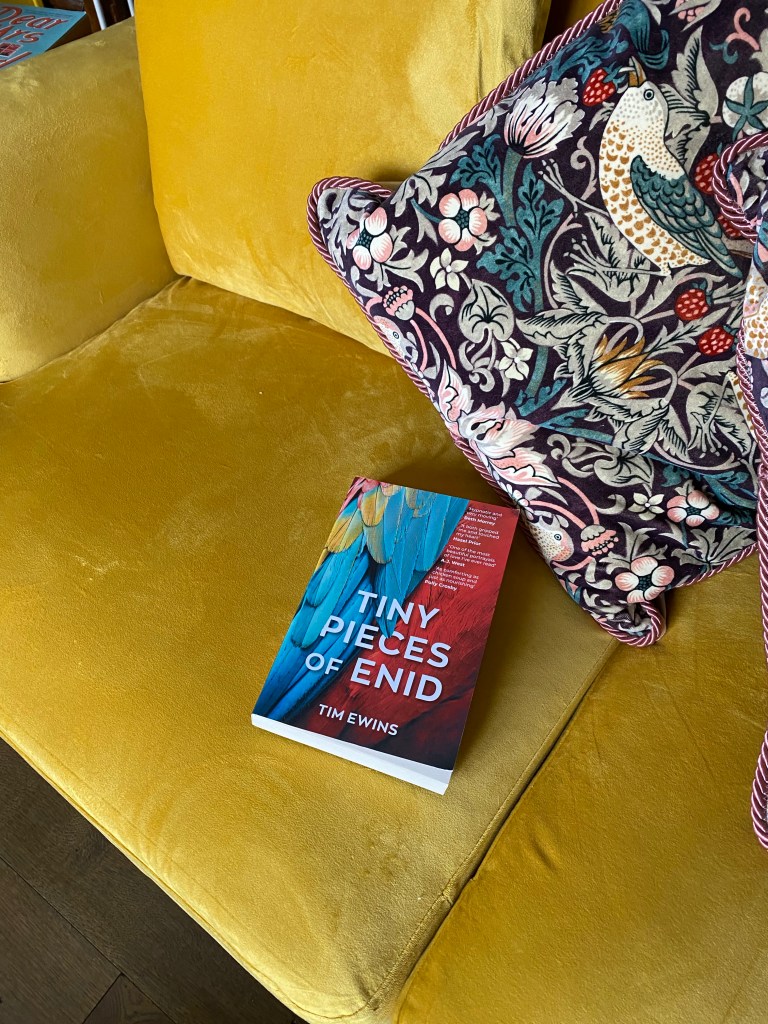
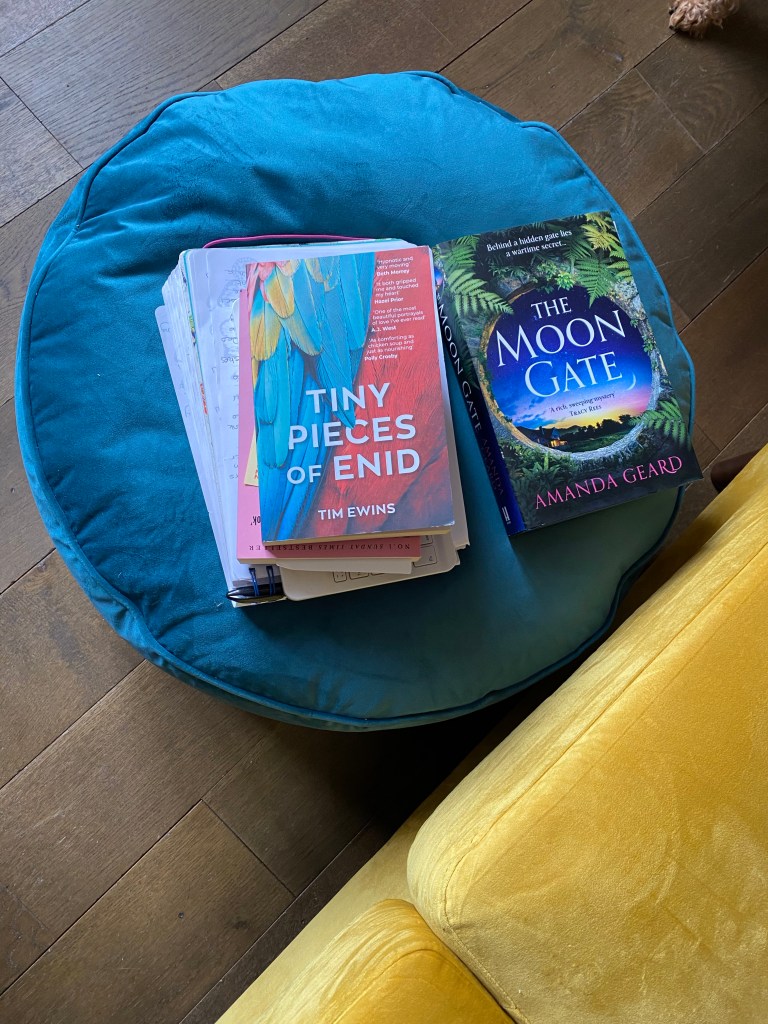
Tiny Pieces of Enid by Tim Ewins

I was so emotionally invested in this deeply moving story, written with such care and empathy for the characters, but also the people who are going through similar experiences in real life. I would also suggest hankies or tissues, a big bar of chocolate and a cat to cuddle. This is an incredible read – but you will cry, in fact if you don’t there’s probably something wrong with you. Our heroine Enid has had a stroke and also has a diagnosis of dementia. She has aphasia causing problems with comprehension and formulation of words. Often, people with aphasia know what they want to say, but find something stops them expressing it. Having looked after people who’ve had a stroke I know it is one of the most frustrating neurological symptoms someone can have. The author has set the book inside Enid’s brain – we learn that she’s not completely senile, in fact she has moments of incredible clarity and is often witty, with a great sense of humour. However, she is forgetful and shows a lot of frustration about her lot. Enid has lived with husband Roy for many years, but after another incident at home their daughter Barb has to make a horrible decision. She decides her mum would be better in a specialist nursing home, but this means separating her from her beloved husband. Enid believes that this is a temporary separation and that soon Roy will come live with her in the nursing home. Meanwhile Roy is trying to cope alone, missing his wife terribly but having to plod on without her.

In the home Enid meets Olivia, a young mum who frequently visits another resident and they have an affinity. While they might seem to be very different on the surface, they connect on a deep emotional level. Every time Olivia visits, Enid is reminded of her first marriage and the memories are painful. Enid’s husband was violent and she can see that Olivia’s husband is also a very angry man. She wants to help, to explain that she doesn’t have to stay with him, that there is happiness beyond here. The fact that Olivia and Enid become friends, despite all of Enid’s challenges is so important because Enid’s life experience could help Olivia make a definitive decision. To save her own life. Their experience shows that friendship comes in so many forms and we shouldn’t make snap judgements about who can bring something meaningful to our lives. It made me think of an observation I made a long time ago, when someone has a long term illness their life doesn’t stop at the time of diagnosis. Some people seem to think that an unwell person steps out of life, has treatment, then comes back when they’re cured but it isn’t so. There are so many of us out here, like Enid, living with an illness and even if our lives look different they’re still meaningful and worthwhile.

When Enid isn’t watching life pass by she’s remembering, it’s like her own personal movie running behind her eyes. She sees Roy, from their earlier life together and when they’re falling in love after the trauma of her first marriage. There’s her old home and her daughter Barb who was fascinated with birds, her Tom Jones & Elvis records waiting to be played. She then remembers a scar she has on her forehead. When was that from? It feels like another life. Then she’s back with Roy. Remembering their love story. Roy is her best friend.

The way the author has constructed Enid’s inner world is brilliant. All the information is there, but it’s fractured and complicated. It isn’t always there when she needs it. She’s a time traveller, not present in the moment but enjoying her early years with Roy. Then she’s with a little girl, her daughter. These memories are so clear, but the moments of lucidity are so fleeting and we’re aware that eventually they may disappear altogether. I’ve worked in a dementia unit and every week I would push one of our residents down through the village to the home he’d shared with his wife. He seemed to have no idea where we were, he was rarely, fully in the room. Mostly we would do jigsaws and he would try to wipe his nose on my cardigan. One day we were sat with his wife in the kitchen and I was helping him with his cup of tea when he looked over at her. Then he looked at me and said ‘I don’t know who this lady is, but isn’t she kind? I like her’. It made me cry that they had a whole history that he couldn’t recall, but in that moment he knew she was special. There was a little glimmer of feeling. It’s hard to live separately from someone you’ve had a life with, especially when the relationship hasn’t ended. You’re living like a single person again and while you can always visit your partner (and appreciate the respite from being a full time carer) there are parts of that person you miss. The tragedy is you didn’t need to separate from the person, just their condition. So it was easy to understand Roy’s decline without Enid, he’s lost the shared jokes, the conversational shorthand and that sense of it being the two of them against the world. Although Enid is safe, part of Roy will wish she was still at home with him. I would imagine he must miss her sense of mischief more than anything. Enid will try anything to be with Roy again, and she relies on an imaginary parrot to help her.

Tim Ewins has written a really special book with such fully rounded characters who have busy inner lives, including Enid. I have a long-term illness and it’s great to read a writer who understands that journey and shows how rich our lives can be, even if they are different. My late husband had the same illness as me and this book reminded me of the snatched moments we spent together between carers, district nurses, palliative stays and hospital admissions. Despite all of that ‘stuff’ no one could take away that connection we had and some of my happiest memories were in those snatched moments; the tiny pieces of life that Enid remembers might seem commonplace, but they are the very moments I’ve treasured and remembered ever since. This is a special book, written with such heart and compassion.

Meet The Author

Tim has enjoyed an eight-year stand-up career alongside his accidental career in finance.

He has previously written for DNA Mumbai, had two short stories highly commended and published in Michael Terence Short Story Anthologies, and enjoyed a very brief acting stint (he’s in that film Bronson, somewhere in the background). We Are Animals is his first novel.

When not writing, he enjoys travel, reading (of course), cycling and spending time with his wife, son and dog in Bristol. Follow him on Instagram @timewins and @quickbooksummaries where he writes inaccurate but humorous book reviews.

Posted in Paperback Publication, Squad Pod Collective

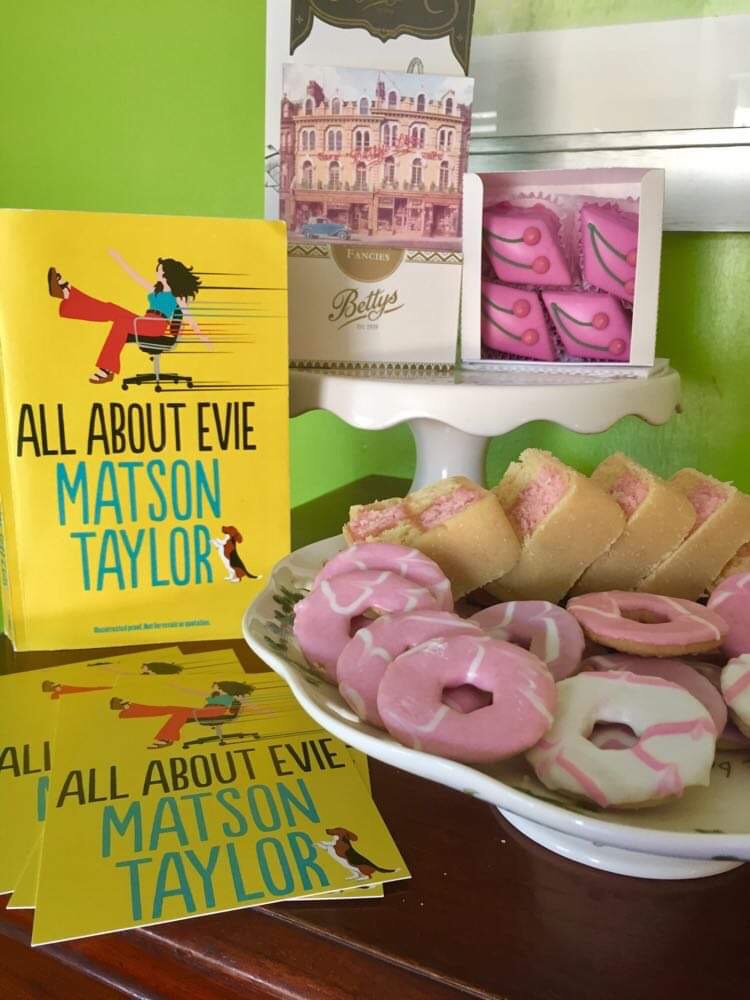
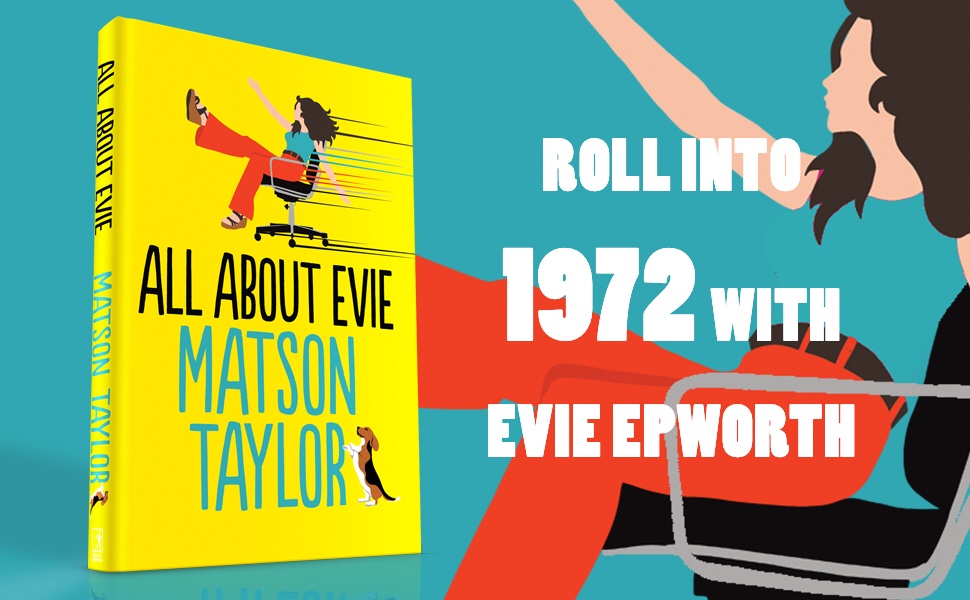
All About Evie by Matson Taylor

This novel is the second in Matson Taylor’s series following Evie Epworth (Yorkshirewoman, Fashion Lover, List Maker). So now, I can categorically say that each time I finish a book about Evie I have a big sunny smile on my face. Of course all books make us feel things, even if it’s to throw them out of the nearest window, but it’s a rare book that gives us a real physical reaction such as the spooky ones that give us goosebumps on the arms or lift the hairs on the back of our neck. I’ve only spontaneously burst into tears once, thanks to David Nicholls’s One Day and that twist none of us saw coming. Not only is Matson is great at those laugh out loud moments, such as the ‘cow incident’ that precipitated her car accident in the first book. As I finished All About Evie I found myself unable to stop smiling. This book feels like liquid sunshine being poured into your veins.

Our previous book ended as Evie is being waved off to an adventurous new life in London, alongside mentor Caroline, the unconventional and glamorous daughter of Evie’s lifelong neighbour and baking partner Mrs Scott-Pym. All About Evie starts ten years later in 1970’s London, where Evie is working in a junior role on BBC Radio Four’s Women’s Hour. Previously, we met Evie at time of great change and this novel is no different. Thanks to a terrible incident with a visiting Princess Anne and the misuse of a mug Evie is sacked from the BBC. Does this mean her life in her little London flat is in jeopardy? Caroline thinks this is an opportunity to try something new so Evie tries working in an art gallery. When it turns out art, particularly the modern variety, isn’t for her she lists things she’d like to do and falls upon the idea of writing for a magazine. She finds the magazine Right On in an office above a sex shop – handy windows for checking one’s hair before walking into the office – and asks for a job. Assuming she’s been a journalist at the BBC, NickStickUpBum and NickWithCollars agree to give her a trial on the listings pages, essentially long lists of what’s on in London across the arts from opera to poetry evenings. With the offer of help from Lolo (Radio Three producer, homosexual, basset owner) on the classical music listings, Evie decides to give it a go and sprinkle some sunshine over her work, in her own inimitable way.

In between Evie’s story there are a couple of flashbacks to other character’s lives. Evie’s neighbour Mrs Scott-Pym has died recently and we see her packing a case for Evie, with little artefacts to remind Evie of their time together – including a pestle and mortar wrapped in a tea towel of Bolton Abbey. Evie is grieving for her old friend, but the reminiscences become even more emotional when we realise that Mrs Scott-Pym was, aside from Dad Arthur, the only link back to Evie’s mum Diana. Preserving her memories of their friendship for Evie is so poignant and it does make Evie think about her future. Can she keep dating totally unsuitable men, who she carefully and comically lists for us, or does she want to meet someone she can share her life with? I thoroughly enjoyed the tension between Evie and her rather hippy dippy workmate Griffin. Griffin is a proponent of high culture and wants the magazine to remain intellectual rather than popular. So to try something a little more highbrow, Evie accepts Lola’s invitation to her first opera. Afterwards, NickWithCollars suggests she write a review for the magazine. This infuriates Griffin who thinks Evie is definitely low culture and would rather they published one of her own poems. When the men are out of the office, Griffin places herself in charge and gives Evie petty tasks to fulfil, often creating a mistake to trip Evie up or keep her working late. Evie tries to take the high road, but her yoga chant trick is absolutely brilliant and well deserved. I couldn’t wait for Griffin to receive her real comeuppance! Meanwhile, there’s a lovely friendship forming between Evie and Lolo, as well as his basset hound.

Yet underneath the humour, there’s so much more going on. A beautifully poignant thread running through the novel is that of motherhood. There are memories of Evie’s mum of course and we’re aware of all the life experiences Evie would have loved to share with her. Evie’s mum never got to see her grow and all that promise is encapsulated in one little throwaway object from the suitcase. Evie has many mother figures though, obviously Mrs Scott-Pym and her friend Mrs Swithenbank who gives Evie a call every week just to check in. Caroline and her lover Digby are disagreeing over the possibility of becoming parents, particularly as Caroline would have to carry the child and believes she doesn’t have that maternal instinct. However, both women have been invaluable to Evie, she even loves popping in and watering their plants while they’re away. Their house gives her the sense of having a family in the city, an anchor that keeps her from being swept away amongst the crowds. We see Evie draw on all these maternal figures when Mrs Swithenbank’s daughter Genevieve turns up in London in search of a fashion career. Genevieve carries just one suitcase, but is full of ideas and her outlandish outfits were so funny – one inflatable hoop dress brought back terrible memories of being stuck in a dress in Laura Ashley’s changing rooms and having to ring my Mum to get me out. Evie feeds Genevieve, lets her stay and starts introducing her to the right people. Every day she comes home, dejected from receiving lots of knockbacks, despite her inventive fashion portfolio. Every time Evie props her up and brings her spirit back. It was lovely to see Evie in this life stage, being the mentor and feeling so confident. As much as I love London, it was also nice to see her at home on the farm with old friends reunited and new ones being introduced, plus a very exciting finale which gives us a nod towards what Evie might do next. I can’t wait to celebrate this fantastic novel with a 1970s party. I’m hoping for a cheese and pineapple hedgehog and Babycham to toast this joyful new stage in the Evie story.

Published 21st July 2022 by Scribner UK

Meet The Author

Matson Taylor grew up in Yorkshire (the flat part not the Brontë part). He comes from farming stock and spent an idyllic childhood surrounded by horses, cows, bicycles, and cheap ice-cream. His father, a York City and Halifax Town footballer, has never forgiven him for getting on the school rugby team but not getting anywhere near the school football team.

Matson now lives in London, where he is a design historian and academic writing tutor at the V&A, Imperial College and the Royal College of Art. Previously, he talked his way into various jobs at universities and museums around the world; he has also worked on Camden Market, appeared in an Italian TV commercial and been a pronunciation coach for Catalan opera singers. He gets back to Yorkshire as much as possible, mainly to see family and friends but also to get a reasonably-priced haircut.

He has always loved telling stories and, after writing academically about beaded flapper dresses and World War 2 glow-in-the-dark fascinators, he decided to enrol on the Faber Academy ‘Writing A Novel’ course. All About Evie is his second novel.

Posted in Squad Pod Collective

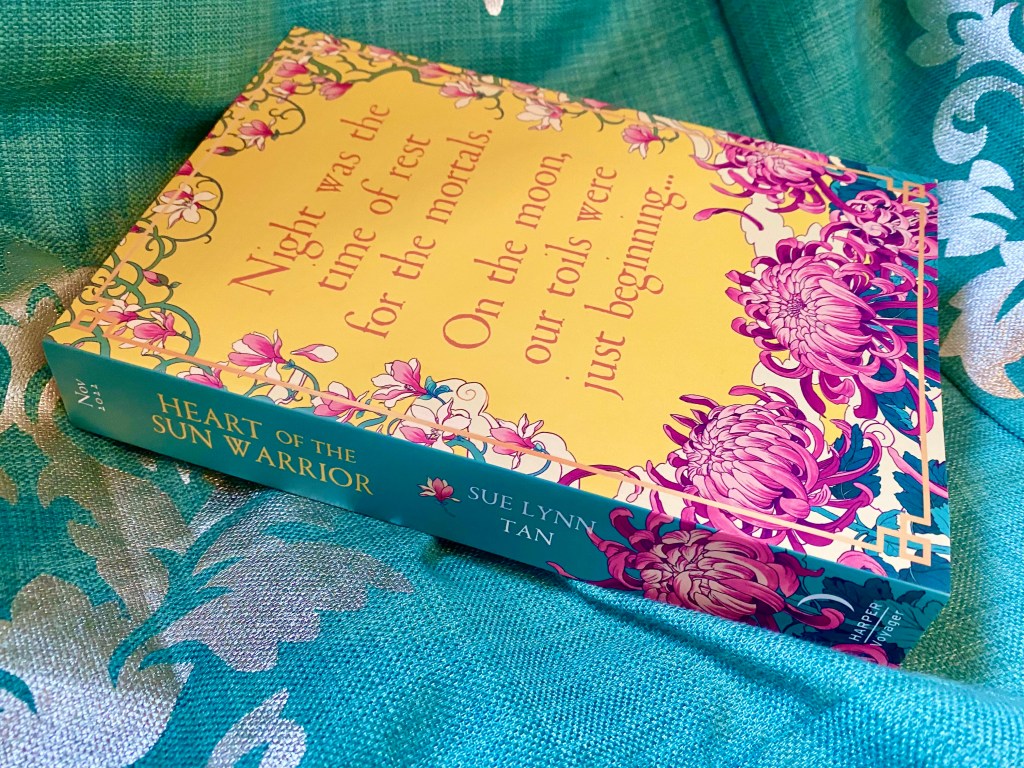
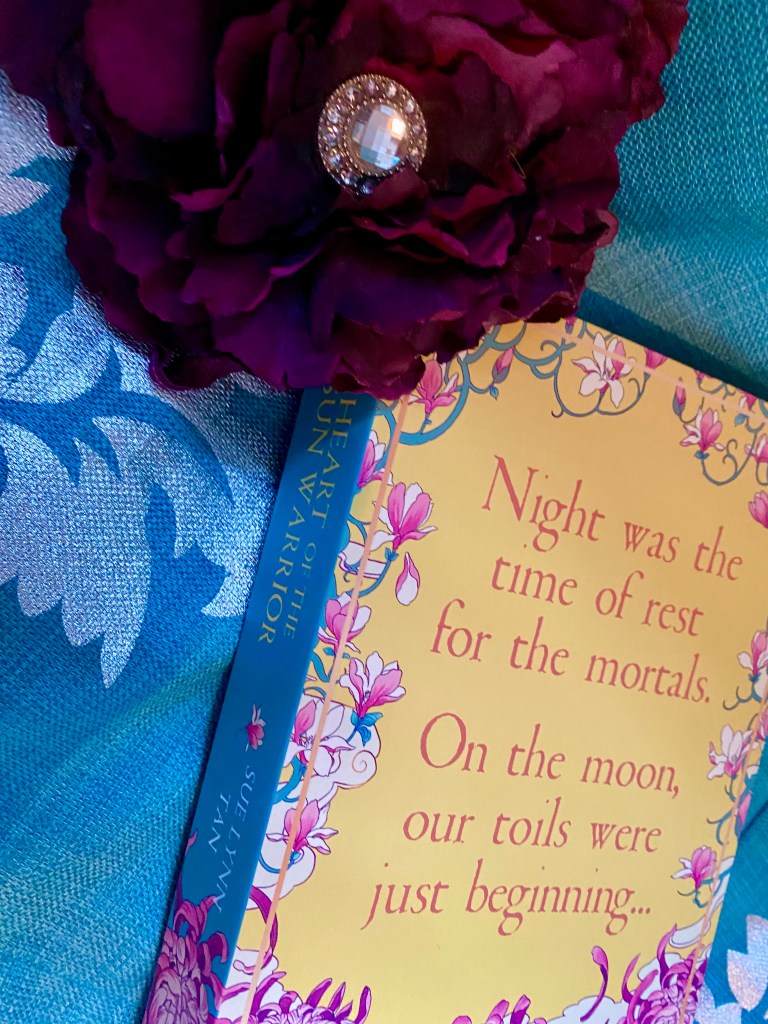
Heart of the Sun Warrior by Sue Lynn Tan

I never stop counting my lucky stars that I’m a member of the Squad Pod Collective – a group of friends formed organically on Twitter who have formed a book blogging community. Not only are they lovely women who support each other daily they are very talented writers and book reviewers. Each month we have a book club pick and I’ve been lucky enough to have time at the end of the year to read this stunning fantasy duology back to back and I’m so glad I did. I loved escaping into the clouds in Sue Lynn Tann’s first instalment, Daughter of the Moon Goddess because it lured me into a richly evocative world of goddesses, monsters, warriors and Chinese mythology. I’m so in awe of this author’s imagination and I was fascinated to see the next part of Xingyin’s journey. The first book has really set the scene for this sequel in terms of the relationships and character developments that are immediately picked up where we left them last time. We meet Xingyin, now reunited with her mother and living contentedly back on the moon. However, this is only a short moment of peace because there is a power shift in the Celestial Kingdom and Xingyin is forced to flee from her home again and defend the realm.

The author’s vivid imagination can be seen on every page, with such lush description that I fully believed in this incredible world she builds, but her attention to detail doesn’t stop at the setting. Once again she takes her heroine through ordeals and personal choices that build real character growth. Her journey is an emotional one and her growing maturity is shown in the tough decisions she makes both in her quest and in her personal life. I felt that the romance angle was more successful this time, with all characters in the love triangle showing more maturity. This could be just my age and experience though and young adult readers may well identify strongly with the set up of this storyline in the first book. Here she has to face betrayal and I was caught up in this powerful dynamic that threatens to tip over into enemies, rather than potential lovers. Her sadness and conflicted feelings over Wenzhi’s betrayal work well and he’s still very much part of the story. In my opinion he brings that spark of chemistry too. He really wants to make things right with Xingyin and shows this by devotedly sticking by her side to be there whenever she needs him. There is less instant chemistry between Xingyin and Liwei, but there is strong friendship and loyalty. He shows he is willing to defy his parents for her which removes the main obstacle to their potential romance. The mental push and pull between these very polarised relationships was definitely more engaging this time and I became more and more interested to see who, if anyone, she would choose.

The pace of the novel did ebb and flow, with a quieter middle section followed by a helter -skelter rush towards the conclusion. The battle sequences are incredibly effective because they feel dynamic and there’s genuine peril – characters do die here. The decision to make this a duology was a clever one. As the novel rushed towards it’s conclusion I worried that it might feel jumbled or sudden, but everything worked and I came away feeling satisfied. In many ways The Heart of the Sun Warrior worked better for me than the first novel, taking the story to new places with higher stakes and life-changing consequences. There was more tension, a faster pace and a few twists and turns to surprise the reader. As mentioned the romance seemed better worked out here too, but everything Sue Lynn Tan did well in the first novel is maintained. We didn’t lose any of the luscious description and lyrical language that she does so well, drawing the reader into her magical world. As with the first novel though, it was the heroine’s self-growth that I enjoyed most and those life lessons extended to the other characters too, who go on their own inner journey. Of course there’s the strength and courage you would expect from warriors, but that conflict also brought lessons in loss and coping with grief. Each character had to practice forgiveness and learn what it means to give unconditional love. These deeper emotional elements really elevated this book for me and along with the strength of Chang’e and Xingyin’s mother/daughter relationship, they give a very magical world it’s human heart. Sue Lynn Tan should be incredibly proud of these debut novels and her beautiful, poetic writing style. What finishes these books off beautifully are those stunning covers, both of which would look perfect as framed book posters on my bedroom wall (if anyone’s listening).

Published 10th November 2022 by Harper Voyager

Meet The Author

Sue Lynn Tan writes stories inspired by the myths and legends she fell in love with as a child. After devouring every fable she could find in the library, she discovered fantasy books, spending much of her childhood lost in magical worlds.

​Daughter of the Moon Goddess is her debut, the first in the Celestial Kingdom duology – a fantasy of immortals, magic and love, inspired by the beloved legend of the Chinese moon goddess, Chang’e. Its sequel, Heart of the Sun Warrior, is also out now.

When not writing or reading, she enjoys exploring the hills, lakes, and temples around her home. She is also grateful to be within reach of bubble tea and spicy food, that she unfortunately cannot cook.

Find her on Instagram and Twitter @SuelynnTan, or on her website http://www.suelynntan.com

Posted in Squad Pod Collective

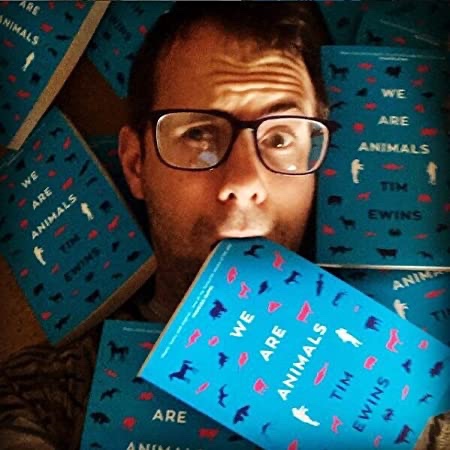
We Are Animals by Tim Ewins.

I’m so happy to be part of the Squad Pod’s first blog tour for this unusual but uplifting book by Tim Ewins. To describe what it’s about is quite difficult, and I loved Tim Ewins’s own words in his interview with Emma from Emma’s Biblio Treasures blog: ‘I can tell you a bit about the book in a very literal sense: It’s about a bloke on a beach that meets a kid on a beach and tells that kid his life story. They both get drunk and watch a cow dance to dance music.’

Of course there’s much more to it than that, it’s philosophical, romantic, humorous and uplifting. A man called Jan and a teenager called Shakey meet on a beach in Goa. Shakey dismisses Jan as a ‘moustache’ – slightly boring, set in his ways and unable to have a good time. Jan dismisses Shakey as a vest. Vests are kids who come out to Goa and pretentiously think they have found themselves by visiting one beach and one club. They go back home, pretending to be enlightened and changed by their visit to Goa, despite having no experiences at all except alcohol and a bar. However, the two do meet and sit having a drink together. Shakey wants to know what has kept this moustache coming back to this beach time and time again. So he is told a love story, how Jan is in love with a woman (also called Jan). ManJan and WomanJan have come in and out of each other’s lives over the years, but this time she hasn’t come back in. So ManJan sits on this beach, that’s special to them both, and hopes for her to appear.

The only other living creature close to them on the beach is a cow and she gets her own short chapter. This may seem totally off the wall and quirky, but go with it. As I was reading I thought there were a lot of similarities between ManJan and the cow. Both have a set daily routine involving the beach and both are evolving alongside the place. When ManJan first came to Goa this place was unspoiled, much quieter and less commercialised. Now it’s full of vests like Shakey, dance music and glow sticks. Yet ManJan finds Shakey a good listening ear, so maybe there’s more to these vests than meets the eye? The cow meanwhile, weaves happily between tourists and even finds herself meditatively nodding along to the thumping dance music.

We hear ManJan’s story and the curious way certain things keep cropping up in his life, like the fishing he thought he’d left behind in England, but crops up again in Scandinavia. WomanJan also turns up for the first time in Sweden and steals his passport, leading to a caper through, Europe, Russia and India. Each destination is beautifully evoked, in very few words we know exactly where we are. In each location an unusual array of characters come into the orbit of this couple and have an influence on their journeys. Then between each section of the story are the animal scenes, throwing light on the human situation or a particular character in some way, which is so clever. Throughout, ManJan and WomanJan keep bumping into each other and eventually love happens. However, this is the longest time they’ve been away from each other, they’ve always found each other in the past. When tragedy ripped them apart, he assumed they’d simply run into each other again, but maybe they won’t this time.

I thought this was one of the more quirky novels I’d ever read and it is unusual in structure and characters. It’s a love story, travelogue, meditation, comedy and tragedy all in one. What Ewins does, rather brilliantly, is keep the balance between these elements, using the animal chapters as literary palate cleansers. In the end though, all these disparate strands come together to create a beautiful story about being human and doing what E.M.Forster suggested was our purpose on earth – to connect.

Meet The Author

Tim Ewins had an eight-year stand-up career alongside his accidental career in finance, before turning to writing fiction. He has previously written for DNA Mumbai, had two short stories highly commended and published in Michael Terence Short Story Anthologies, and had a very brief acting stint (he’s in the film Bronson, somewhere in the background). He lives with his wife, son and dog in Bristol. We Are Animals is his first novel.

Posted in Squad Pod Collective

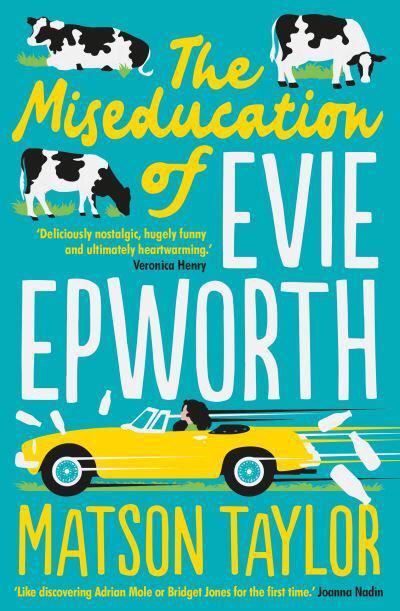
The Miseducation of Evie Epworth by Matson Taylor.

Happy Paperback Publication Day to Matson Taylor for his joyous novel The Miseducation of Evie Epworth. I’ve wanted to read it again this year I’ve loved it so much. As a reminder here’s my review from last year and don’t forget to join the #SquadPodCollective @squadpod3 on Twitter for the celebratory #cakeblast on Saturday 1st May where we are all sharing our Evie themed bakes across social media.

I was only three pages in to this book and I knew that Evie was going to be one of my favourite literary characters. Favourite as in – on my list next to Jo March, Cassandra Mortmain and Adrian Mole, characters I’ve also experienced growing up and setting out into the world. The book was off to a good start anyway, then as we followed Evie jumping into her father’s MG to do the milk round there was a scene so funny I laughed out loud at 2am waking both the dog and my other half. I devoured this book in 24 hours, knowing part of me would be sorry when it ended, but not able to slow down either. 

We meet Evie when she’s at a crossroads in life. She’s in that limbo summer between GCSE and deciding what to do next. Evie’s plan, if she gets the right results, is to do her A Levels. Till then she plans to spend the summer delivering milk from the family farm, baking with Mrs Scott-Pym next door, and reading all the books she can get her hands on. There is only one thing in her way; her Dad Arthur’s girlfriend, Christine. Chrissie has moved into the farmhouse and is setting about making changes. This is 1962 and she’s all for embracing the new. She wants to get rid of the old unhygienic wood in the kitchen, because what they need is some nice modern Formica. She’s already replaced the Range with an electric cooker, because she couldn’t work it. As Evie says, it takes quite an intellect to be outwitted by a kitchen appliance. Worst of all she’s replaced Evie’s Adam Faith clock with a chicken! It has always just been Evie and her Dad, Arthur, as far back as she can remember. Her mum died when Evie was little and she has no memories of her. Chrissie needs to be dealt with, but how? Arthur is a disappointment. Mrs Scott-Pym says he’s like all men, weak and easily confused by a pair of boobs. 

I have lived in villages and on farms for my whole life so I can honestly say that the author’s depiction of the characters and events of country life are not exaggerated – no, not even that cow scene. There are still characters like this in rural villages. The comedy comes from the brilliantly blunt Yorkshire dialogue, the gap between what we as adults understand and Evie doesn’t yet, but mainly the amazing characters created by the author. Mrs Swithenbank is a comedy gem, always at the mercy of her explosive bowels. The long suffering Vera, Chrissie’s mother, who is never far behind her daughter like a human ‘buy one-get one free’ offer. Then, Mrs Scott-Pym’s daughter Caroline, comes into the village like a whirlwind and along with Evie shows that constant dilemma young people in villages face – do they stay put or go out into the wider world, perhaps needing to try the anonymity of the city? It can be hard to develop into your true self in a village where everyone knows who you are and any attempt to change is the object of ridicule. I remember a perm I had at 15, thinking I looked like Baby from Dirty Dancing, only to hear ‘ugh what have you done to your hair’ at every house on the pools round. I loved the depiction of the petty rivalries around the village show and what a surprise it is that Chrissie, who struggles with making toast, wins the best fruit cake. On top of everything else she does, the fact that she possibly cheated at the village show is viewed as the worst crime and given the last reveal. 

Chrissie though is the best comic creation of the lot, but isn’t left to be one dimensional either. Though she is truly awful in a lot of ways, it’s clear that she’s from a poorer family in the village and her upbringing hasn’t been easy. There’s class war over the Range cooker for sure. She lets slip in an exchange with Evie that she’d done every job going, from waitressing to wiping arses. While that might excuse her yearning for an easier life, it doesn’t excuse her way of getting it. There are times when it’s all out war at the tea table and Arthur stays behind his paper hoping it will blow over. I loved her ever present ‘pinkness’ and a crimplene wardrobe that Evie observes doesn’t end in Narnia, but at a bingo hall in Scunthorpe (I love seeing my birthplace in print). Poor Vera is always struggling a few paces behind, usually sweating and doing all the fetching and carrying. Chrissie is always exhausted – I need to put my feet up, Mum put the kettle on – and always rushing towards getting another grasping finger on Arthur, preferably a finger with a ring on it. This should have been a mild flirtation or dalliance at most, everyone can see they are not suited. 

There are interludes between Evie’s chapters where we see the meeting of her parents, Arthur and Diana. They are serene, even romantic chapters where we see them meet at a dance, get married in a rush during the war and settle at the farm. We see Diana form a friendship with Mrs Scott-Pym and rush round to tell her friend when Evie is on the way. There’s so much of this interesting woman left, hidden in plain sight such as a particular teaspoon in the drawer and the recipe book Mrs Scott-Pym has kept for Evie. It’s so sad that Evie and her Dad don’t talk about her more openly and honestly. If wishes and spells aren’t going to change this, there needs to be a catalyst. When Mrs Scott-Pyle falls down the stairs and her daughter Caroline arrives we see a force of nature equal to Chrissie. She wears elegant clothes, big black sunglasses and scarves tied round her neck like the French do. Evie is very impressed with her sophistication, but also her nerve. She cooks up a great scheme to get Evie out of working in the village salon, takes her to Leeds to shop in an Italian deli and has the means by which Chrissie’s true nature can be revealed. She is also the only lesbian Evie has ever met, leading to her asking visiting friends of Caroline’s whether they are a lesbian too as a conversation starter! Evie is trying on different futures, and may be adding Caroline as an extra role model alongside The Queen, Charlotte Bronte and Shirley MacLaine. 

This novel is an absolute joy. A great read to cheer you up and honestly, make you laugh out loud. Every character is beautifully drawn and the comic timing is perfect. I couldn’t believe it was a debut, because it has all the confidence and timing of Sue Townsend and also made me think back further to the blunt Yorkshire characters of James Herriot. On a personal level I needed a lift, after being very strict with lockdown rules due to my MS, and this was just the lift I needed. Thank you Matson, for such a great set of characters and for providing exactly the book I needed at exactly the right time.