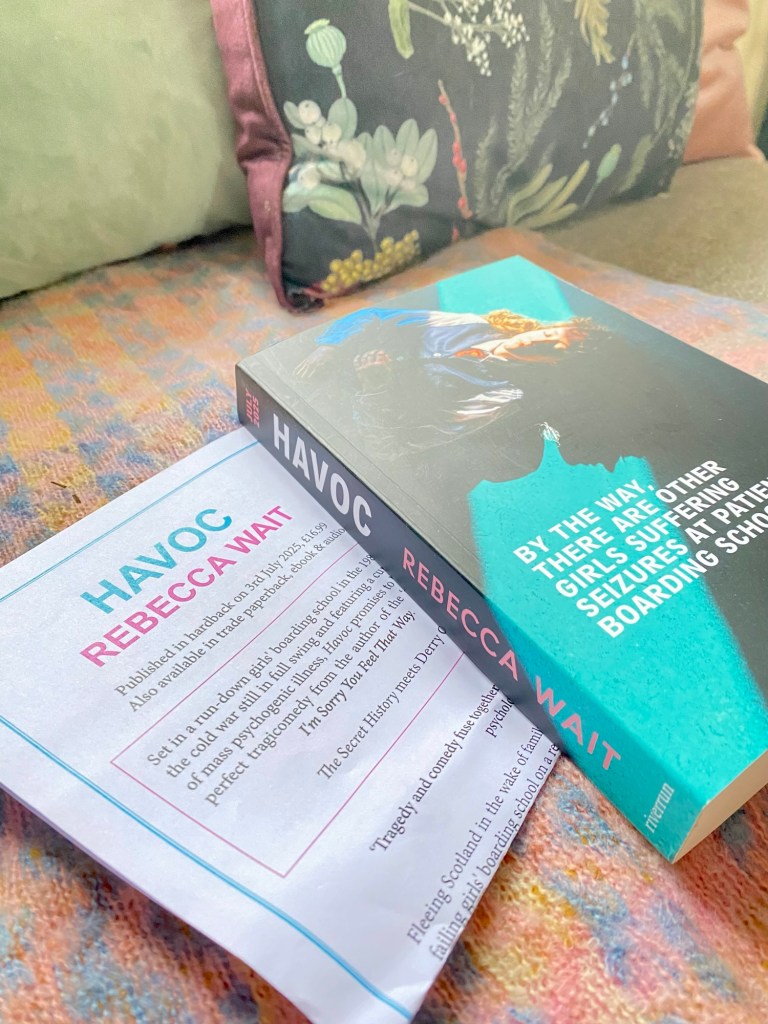
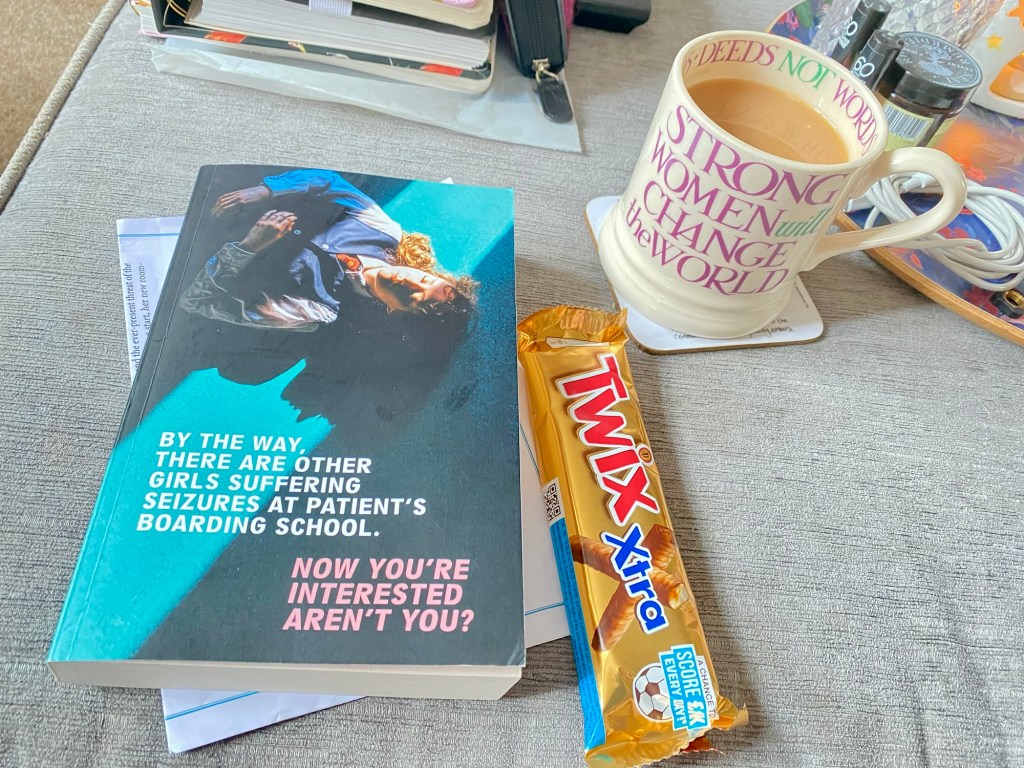
Havoc is one of the Squad POD Collective’s featured books this month and is a brilliant combination of school drama, mystery and dark comedy featuring a wonderful character called Ida. Ida and her family live on a remote Scottish island after fleeing from her mother’s controlling boyfriend Peter. What started as a lonely but safe place to live, has become impossible since her mother did something unforgivable and the island’s inhabitants turn against them. Deciding she wants to leave, Ida looks for private boarding schools who provide scholarship places. She finds a school as far away from Scotland as she can find. St Anne’s sits on the south coast of England, so remote that the only diversion is a bus ride to a small town with a choice of two tea rooms. The school are terribly surprised when their scholarship student turns up, no one ever has before, so they don’t have anywhere suitable to put her. The school is ramshackle and in danger of falling off the cliffs and the food is questionable and often tastes of fish, even when it isn’t. Ida is placed in a double room with school miscreant Louise and starts to settle in. However, things take a very strange turn when Head Girl Diane becomes unwell, starting with strange jerks of the arms and soon descending into a full blown seizures. Soon after, Diane’s friend April is sick and then starts the familiar pattern of jerks. By the time a third girl has the same symptoms outside agencies such as environmental health, doctors and the police start to descend on the school. Is this illness a virus, or is it environmental? Or could it be something more sinister like poison?
Not only is this a fascinating mystery, the characters are so endearing and I loved the deliciously dark sense of humour. We follow Ida’s story but also that of geography teacher Eleanor. Both are characters are quiet and unassuming but with hidden depths. Eleanor is coping with a change of living arrangements rather like Ida. She was all set to marry boyfriend Anthony, but it was suddenly called off. She’s been used to living in a solo room at the school, but a space in one of the sought after flats has come available. The problem is it means sharing with fellow teacher Vera and they’re not exactly friends, but she’ll gain a sitting room and a kitchen and surely they can get on? Then the first ever male teacher arrives and it’s clear that he’s quiet and ill equipped to deal with the dreamy and rather nosy English teachers. He and Eleanor get along well though, often lunching together at school and sharing the bus into town on their rare day off. However, he does seem to lack a back story and after what happened with Anthony, she’s very wary.
Despite some serious subject matter and St Anne’s having a rather 1980’s morbid fascination with the nuclear holocaust, there is a lot of humour and witty exchanges, even if they are rather black (my favourite kind of comedy). Both Eleanor and Ida have to accommodate their rather forthright and eccentric roommates. Louise comes with many warnings from the school mistress, but their meeting is hilariously slapstick after a mishap with a trapdoor. Louise seems to sense Ida’s intriguing hidden depths and they definitely share an affinity for causing mayhem. As their friendship developed I did worry for the rest of the school’s pupils. Eleanor’s roommate Vera is a comic delight and I imagined her as a young Miriam Margoyles – abrupt to the point of rudeness and very definite in her opinions. On a visit to the tearoom in town she berates the poor waitress for not having Battenberg cake. When she suggests their Victoria Sponge, Vera exclaims loudly that it’s usually dry. Then as she eats it, loudly confirms to the other patrons that is just as dry as she expected. She has no filter, volume control or embarrassment. In between the main narrative, are faxes from the neurologist treating the girls and his previous colleague and even these take a turn you won’t expect. He writes of his concern about Diane, the first girl who fell ill and his confusion at the symptoms displayed by the others. He is the first to notice strange anomalies in the seizures but has a hard time convincing his colleagues, the police and the environmental health of his eventual diagnosis.
I enjoyed the medical mystery at the heart of this novel, just as interesting as a crime novel with plenty of twists and turns along the way. Having had a rather unusual neurological condition myself this was an accurate representation of how our bodies can surprise and betray us. Of course this has the added intrigue of multiple patients at once and the cause being very difficult pin down — is it poison, environmental or the rather unusual and fishy meals from the school kitchens? There are other mini mysteries too such as why Eleanor didn’t get married and what made new teacher Matthew move to an isolated all girls school? Once the press are on the trail of the mystery illness many more secrets could come to light, including why Ida arrived in the first place. Ida is such an interesting teenager and her growing friendship with roommate Louise is both touching and unexpected. The author has captured the inner world of Ida so authentically that you feel connected to her and the interactions between the students is a familiar combination of funny, bitchy and a little bit guarded. So when the guard drops and real emotions spill out it is all the more surprising and touching. This was an absolute treat to read and I have no hesitation in recommending it.
Meet the Author
Rebecca Wait is the author of four novels, the most recent of which, I’m Sorry You Feel That Way, was a book of the year for The Times, Guardian, Express, Good Housekeeping and BBC Culture, and was shortlisted for the Nota Bene Prize.
Her previous novel, Our Fathers, received widespread acclaim and was a Guardian book of the year and a thriller of the month for Waterstones.
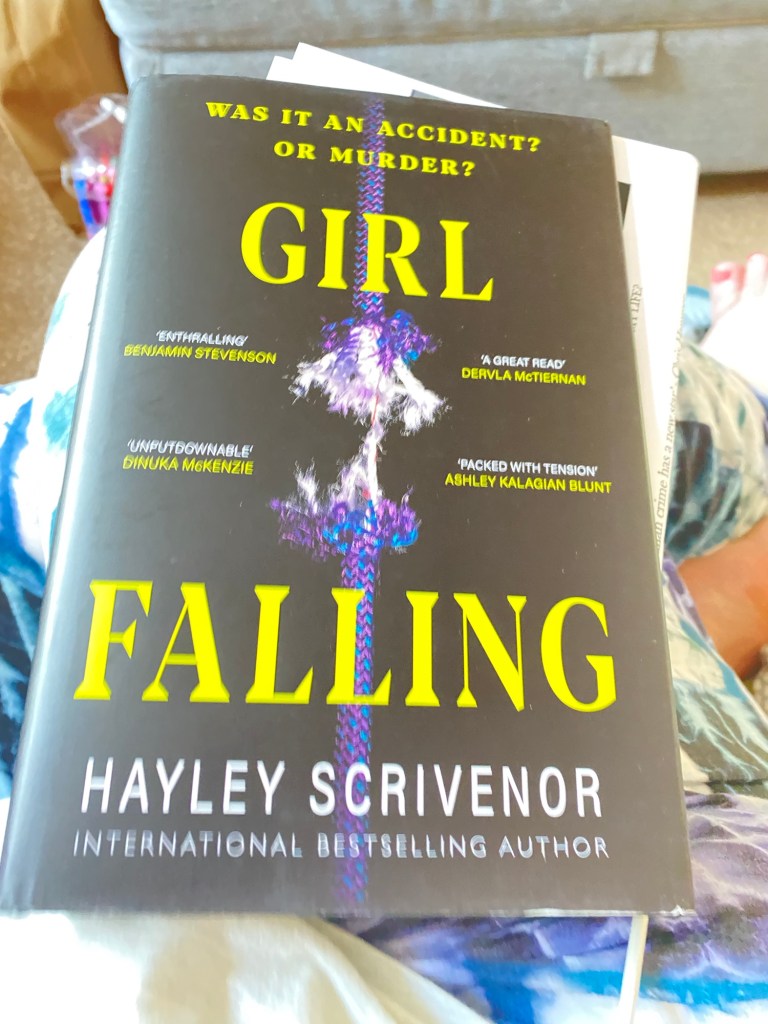
Finn is taking her girlfriend Magdu climbing for the first time. Magdu is nervous about heights so Finn is taking extra special care to explain everything about the abseil they’re attempting. As Finn lowers herself over the edge to control the descent from beneath, she is sure she has Magdu ready and composed on the blue rope, with friend Daphne on the red rope. She’s waiting to feel the weight of someone lowering them selves over the edge, but is surprised when it seems to be the wrong side. Magdu was meant to come over first but this is the red rope so it must be Daphne. The next thing Finn sees is Magdu hurtling towards her and then towards the ground, with a haunting scream. As both Finn and Daphne are taken in to the police station for questioning, Finn starts to think of an earlier time in her life when someone else she loved fell to their death. The truth of that day is something she’s only ever shared with Daphne. This time it’s a potential murder investigation so she’s going to have to protect herself, but might that mean the end of her friendship with Daphne?
My goodness this was a deliciously toxic friendship to get my therapist’s mind whirring. Finn and Daphne meet at school after a very traumatic occurrence in Finn’s family life. Finn is so vulnerable and hasn’t shared with anyone what truly happened when her little sister Suzy lost her life on a family camping trip. Suzy fell from a cliff edge in the night, but is that all there is to it? Daphne, who has also suffered the loss of a sibling, so knows exactly what to do with someone in that state of mind. She can’t change anything but she can sit with Finn and share her sadness and guilt. Finn is our narrator and we see everything through her eyes and she’s also been struggling with her sexuality, until Magdu comes along. However, I could also see how the combination of Finn’s kindness and fear of being exposed, left her open to exploitation. I didn’t fully bond with Finn as a narrator, I was unsure whether to trust her or not. She did set off my maternal streak though, because I wanted to see her safe and protected. She’s kind and cares about the environment, her family and climbing. My instinct was that she needed to be as far away from Daphne as possible. She’s manipulative, knowing exactly what and how much to tell Finn to draw her into her confidence and keep her beholden. I wasn’t even sure whether it was the truth.
I felt, very early on, that Daphne wanted Finn all to herself. When Finn first introduces her to Magdu at a club, its not long before Daphne finds a way to get Magdu alone. She lets slip a secret, making sure Finn doesn’t know exactly how much of the story she’s revealed. As Magdu leaves after the confrontation, Daphne tells Finn it’s her own fault. If she’d wanted Daphne to lie she could have just told her. I was unsure whether Daphne and Finn’s relationship is platonic or romantic, but I was sure about it’s complexity. There’s no room for a third person. Finn tells us about Daphne’s hair and how beautiful she is, there’s clearly an attraction but Daphne also likes to flirt with the male climbers in front of Finn. On the day of the accident there’s a very handsome climber hanging around at the top of the cliff with a huge hunting knife and Daphne makes a bee line for him. She’s used Finn’s grief and guilt and their shared loss of a sibling, to keep her constantly on a tight rein. I felt like Daphne was absolutely capable of harming Magdu. She potentially harms their relationship then reminds Finn that she is the only person who truly knows her, that it’s the two of them against the world. Yet Finn isn’t innocent in this toxic mix, she is complicit by not telling Magdu the same secrets that Daphne knows. Finn is a troubled soul, plagued with insomnia and often going for midnight walks. I thought she needed to choose between her friend and her lover, but I also wondered what Daphne was capable of doing if Finn chose Magdu. In amongst all the psychological machinations and flashbacks the author keeps bringing us back to the present and the more precise methods of the police investigations.
The flitting back and forth between the narrators gives rise to the tension that keeps you reading. Both are utterly unreliable and untrustworthy, especially when we think about the enormity of their secrets. The two are bonded and no one else could come between them, it’s as if Finn has been in a relationship with Daphne all along without realising. I craved some input from Daphne’s perspective because I imagined her version of events would look very different, although not necessarily true. They would also be a fascinating insight into her mind. I kept coming back to personality disorders and the way people portray their lives to the rest of the world. Daphne genuinely struck me as a person with potential narcissistic personality disorder. She has a version of the long held friendship she’s had with Finn and she’s keen on putting that version in front of others, especially Magdu. To use an inelegant phrase it’s like a dog marking their territory. The question is, how much of that version is actually true? One of the markers of NPD is the person’s manipulation of both people and events, but it isn’t a conscious action. They believe in their truth wholeheartedly, sometimes repeating a made-up narrative over and over until it actually becomes a the truth in their mind. When they first meet, Daphne and Finn discuss their shared experiences and Daphne explains how she chose to rewrite her story as an ancient myth, invoking Greek gods and particularly epic poetry. She has taken the heightened and exaggerated heroism of these stories to spin her own life narrative and has rewritten her personality to match. I wasn’t sure about the ending I would get, but there was a twist and it was a satisfying conclusion. My only criticisms of the book would be that it was slow in parts and I felt the author could have used the setting more, because apart from a mention of the Blue Mountains I didn’t feel the characters connected with it enough, especially Finn. However, this was a very character driven thriller which really enjoy and it’s deep delve into the motivations and desires of Finn and Daphne were absolutely compelling.
Meet the Author
Hayley Scrivenor is the author of DIRT TOWN, which published internationally in 2022 (published as DIRT CREEK in the U.S., where it was a USA TODAY bestseller) and quickly became a #1 Australian bestseller. The novel has been shortlisted for multiple national and international awards. In 2023, it won a Lambda Literary Award and General Fiction Book of the Year at the Australian Book Industry Awards. DIRT TOWN has been translated into several languages. GIRL FALLING, described as “a remarkable exercise in complex storytelling written in Scrivenor’s idiosyncratic, metaphorically vivid prose”, is her second novel.
Hayley has a PhD in Creative Writing from the University of Wollongong and lives on Dharawal country, on the east coast of Australia.
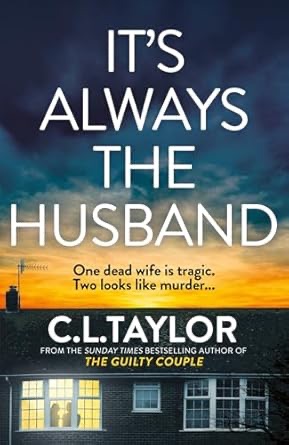
This is one of those thrillers where you’re immediately sucked into this narrator’s life and her new circle of school mums or frenemies. When Jude first arrives in Lowbridge with daughter Betsy it’s a new start and she’s keen to get to know the other mums. However, she soon works out that Victoria is the queen of the school mum scene and everyone wants to be in her clique. Victoria appears to have her shit together – a lovely home with all those aspirational touches like a fire pit table, matching lawn chairs and fluffy blankets for when it gets cool in the evening. She has two kids, heads up the PTA and runs her own business as a personal trainer. Although Jude finds the mums a bit cliquey she does hit it off with one of the dads. Will has a little girl of Betsy’s age and is a widower, there is something very attractive about him and Jude receives the red flag a little too late. When finally invited to a garden get together at Victoria’s she’s warned that not only did Will’s first wife die, but his second wife Robyn went missing and lightning doesn’t strike in the same place twice. It seems that the mums don’t believe in coincidences. When Sorrel, another one of the mums, is targeted by a blackmailer pretending to be Robyn she is stunned that Robyn might still be alive. With a husband struggling with depression, three children and a pottery to run Sorrel has her hands full. Her husband Finnley did go out a few nights ago, he rang her to say he’d hit an animal and the bonnet has a large dent in it. So why is this woman so sure he wasn’t where he claimed to be and that he’s responsible for a hit and run miles away. Victoria’s husband Andy is a detective and they’ve split fairly recently. He was struggling because he couldn’t solve the missing person case and he still doesn’t know where Robyn went. As Sorrel, Victoria and Jude come together to solve this case they know it isn’t going to be easy and that it comes with great risk. There is a killer in Lowbridge and they’re determined to find who it is.
This perfectly paced thriller is narrated by all three women, with short excerpts from a diary Jude finds under Will’s bed that they assume is Robyn’s. It shows a side to her that’s completely different to the sweetness and light image she projected while with Will. Her dedication to him and the little girl who’s already lost one mum gives her an almost saintly reputation, but someone knows better. If she’s behind the blackmail plot there’s something Machiavellian about her ability to act and manipulate those she wants to fool. These are ballsy women across the board though, with none of them running to men to get this sorted. Victoria pursues one mum called Theresa down to Devon after she leaves unexpectedly and with no goodbye. Stalking her her husband’s open Facebook page Victoria notices an open, but unpacked box. In it she sees an expensive bird ornament that disappeared from her own house, plus some things belonging to other mums. Maybe Theresa is involved somehow? She’s clearly perfectly willing to steal from them. When she finally tracks Theresa down to the local pub for a confrontation, the answers she gets are definitely not the ones she was expecting. Similarly Jude goes her own way, getting hold of the diary and reading through it for clues. She knows it might jeopardise her relationship with Will but she needs to know, the fact that he keeps Robyn’s favourite cheesecake in the fridge just in case she comes back, strikes her as odd. Especially if he killed her. Sorrel surprised me the most as she seemed so calm and a definite ‘earth mother’ type. Jude notices her unstyled hair, the way she dresses and her lack of make-up, compared to the others. She cares so much about her husband Finnley, worried every time she returns home that she might find him dead. His depression has lead to weeks off work so far, so she’s surprised to find him heading out to for an emergency appointment. He’s a dentist with anaesthetic training and they need him to sedate a patient. Why is this patient so special? When she receives the blackmail message she goes to her secret bank account, finding it completely empty. How long has Finnley been blackmailed for? I almost expected her to crack but she doesn’t. Often just going through the motions at work and home, she’s just as determined as Jude and Victoria to nail this person. When the three of them find another dead body, the tension ramps up a gear.
Once you’ve started to read, this is very hard to put down. I love Lisa Jewell and Louise Candlish and I found this very similar in the way it gripped me. It’s addictive and there are a few red herrings thrown in to keep you off the scent. It certainly didn’t go the way I expected. It’s telling that the author references The Handmaid’s Tale, as the women definitely pull towards each other as a team rather than the men in their lives. These women, although involved with men and wanting a partnership, are good at stepping back and looking for those red flags. In some cases they are instrumental in checking out their stories and even bringing anyone who needs it to justice, no matter how they feel about them. From a psychological point of view Will’s daughter Milly worried me. She’s clearly spent a long time with Robyn and has understandable issues with grief, but her reaction to seeing Jude in the room that was ‘Daddy and Robyn’s’ and the daily uneaten cheesecake were definite indications of trauma. It also seemed strange she didn’t have the same fixation on her actual mother. She may have been young when she died, but I wondered if Robyn hadn’t manipulated Milly into being her little ally. There’s nothing more attractive than a girlfriend your kids fall in love with. I did find myself having to go back after reading the unexpected final pages to see all the clues I missed. This is a great thriller, full of action, danger and unexpected twists. It’s also deliciously catty and full of gossip. A brilliant read for anyone who loves domestic thrillers.
Meet the Author
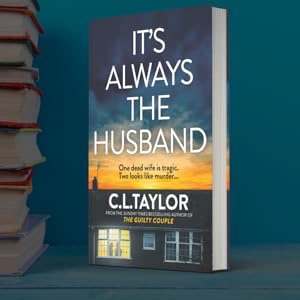
C.L. Taylor is an award winning Sunday Times bestselling author of ten gripping psychological thrillers including EVERY MOVE YOU MAKE, a Richard and Judy Book Club pick for autumn 2024, THE GUILTY COUPLE, (Richard and Judy Book Club 2023) and SLEEP (Richard and Judy Book Club 2019).
C.L. Taylor’s books have sold over two million copies in the UK alone, hit number one on Amazon Kindle, Audible, Kobo, iBooks and Google Play, and have been translated into over 30 languages and optioned for TV.
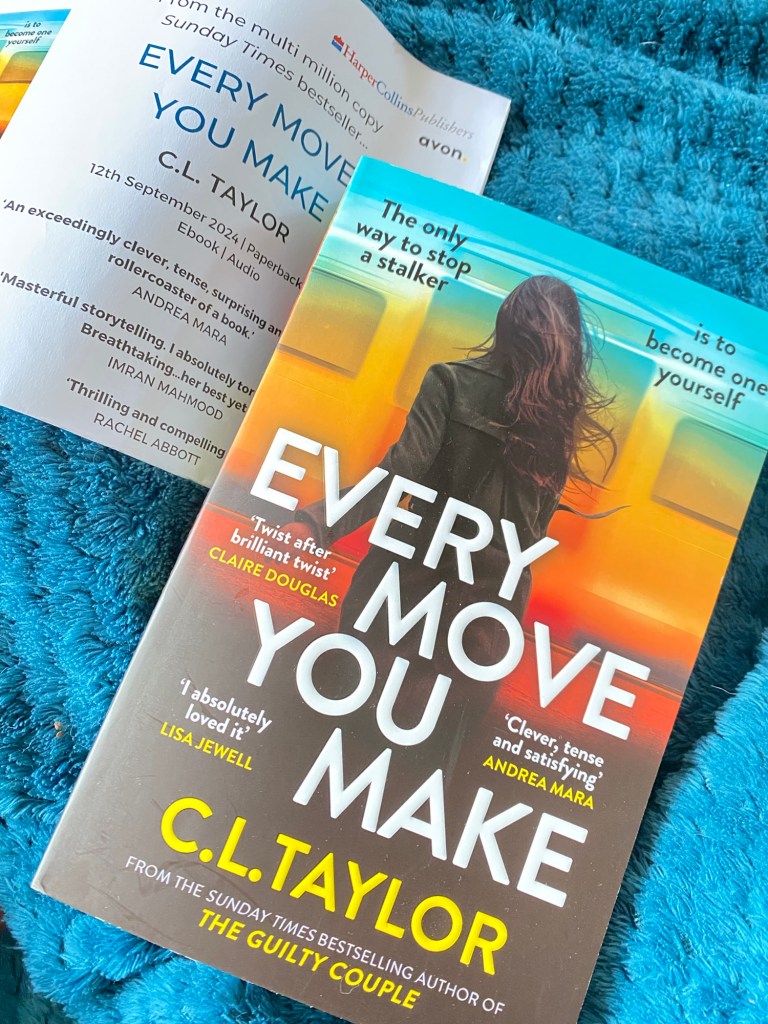
Alexandra, Lucy, Bridget, River and Natalie. Five friends who wish they’d never met. Because the one thing they have in common is the worst thing in their lives: they are all being stalked.
When one of their group is murdered, days after their stalker is released from prison, time stands still for them all. They know their lives could end just as brutally at any moment – all it takes is for the people they fear the most to catch up with them.
When the group receive a threat that one of them will die in ten days’ time, the terror that stalks their daily lives becomes all-consuming. But they know they don’t want to be victims anymore – it’s time to turn the tables and finally get their revenge.
Because the only way to stop a stalker is to become one yourself…
After starting the novel with a tense and terrifying narrative of a woman being stalked, the author jumps forward and shows us how the loss of Natalie has affected those around her so deeply. For a handful of mourners, her loss is a terrible reminder of how they met and increases the fear of their own fate. Natalie’s friends tell their stories through the WhatsApp group they share. Alex, Lucy, Bridget and River are all victims of stalking. They formed their group to support each other and as a way of looking out for each other, using it to check in when outside their homes and when they return. However, when a very clear threat is made against them, they have to protect themselves. What lengths will they go to? The structure takes us between characters giving us a little bit of their story each time. Each of their stories slowly weaves together to create a whole; the phrase ‘one more chapter’ is very apt for this book. Sometimes you get caught up in a particular story, reach a cliffhanger and realise you have to read through three more chapters to find out what happened. It’s a interesting mix of characters, choosing women of different ages and a man shows us that it’s not only young women who are victims of stalking. I could sense that there were secrets to unearth with all of them and I found myself unable to fully trust anyone. They were complex and I thought the author explored their character and the group dynamics really well. I found myself switching between who I mistrusted and why. This suspicion did ramp up the tension not to mention the thrilling action scenes.
The other aspect of this novel that is brilliantly executed is the description of the psychological impact that the stalking has on each character. We can see each character dealing with their situation differently, based on their personality, past experiences and who is stalking them. Some know exactly who their stalker is, while others are stalked by a complete stranger. The author manages to put across the constant vigilance, that feeling of always looking over your shoulder and the fear of what the stalker might do next. She shows how some stalkers escalate, keeping their victim behind closed doors, terrified to venture into the outside world alone. There’s also an element of victims taking their power back and carrying out acts of retaliation. The remaining four of the group do this by tagging their stalkers so they can monitor their whereabouts at all times. To do this without the stalker realising is incredibly dangerous. As each chapter counts down to the potential murder of one of the victims, the sense of fear really does set in and keeps those pages turning.
Reading this in the same week that Louise, Hannah and Julie Hunt’s killer was found guilty of their murder really hit home. Misogyny and violence against women seems to be on the rise at the moment. Often violence follows months or even years of abuse, coercive control and stalking. It also seems that women are losing trust in the system that’s designed to protect them, especially since Sarah Everard was killed by a serving police officer. Here the characters are avoiding telling the police and I was left wondering it was disillusionment with the police force or whether some characters had something to hide. For the person who once professed to love you, to exhibit such abusive behaviour, must be terrifying. In fact it is often walking away from the relationship and cutting off communication that leads to escalation, just when the victim is settled and starting to feel safe again. The author’s writing brings the truth of this issue to light, because it shows how important it is to have all the parts of a story. The problem is, stalking is often a case of one person’s word against the other. The book’s structure shows how one person’s account either illuminates or throw suspicion on someone else. Whether they’re guilty or not can depend upon their eloquence and ability to charm others. This is such a timely novel and it was interesting to read how the author’s research and personal experience informed her story. For me it was this personal insight that made her story feel so authentic.
Available now. Published by Avon Books
Meet the Author
C.L. Taylor is an award winning Sunday Times bestselling author of ten gripping psychological thrillers including EVERY MOVE YOU MAKE, a Richard and Judy Book Club pick for autumn 2024, THE GUILTY COUPLE, (Richard and Judy Book Club 2023) and SLEEP (Richard and Judy Book Club 2019).
C.L. Taylor’s books have sold over two million copies in the UK alone, hit number one on Amazon Kindle, Audible, Kobo, iBooks and Google Play, and have been translated into over 30 languages and optioned for TV.
Her books are not a series and can be read in any order:
I’m a little late and probably too old for the sudden popularity of Korean culture. I’m aware of BTS and Squid Game, but have never listened to or watched either of them. Despite that, I’m aware from my step-daughters, nieces and nephews that Korean music and film-making are innovative and unique, two words I’d apply to these novels. I loved the premise, that there is a department store that supplies people with dreams. Our heroine Penny gets a job at the Dallergut Dream Department Store, somewhere she’s dreamed of working. There’s something hypnotic about the world this author has created, because it’s fantastical and unlike anything I’ve read since childhood. As Penny finds her feet we start to see the way the store works: the communication between the menagerie of unusual creatures who run each department and the actual dream makers who craft their dreams to the individual. These are the upper echelon of the organisation, craftsmen who have to weave a narrative that answers life’s questions, builds hope of love in the air and solves problems. When the dreamer comes in they are served by one of the staff in the store. As soon as I realised this, my mind drifted to the hope they were wearing pyjamas. Some don’t and have to be given something to put on, which maybe explains the strange clothes I’m often wearing I’m my dreams. After a spell of flying dreams I always wear pyjamas!
I really loved the quirkiness of how the store and the system worked. Each sleeper then discusses their needs or can be given hints by those who work in the store – sort of like an Apple Genius, but with dreams. We’re also shown how their dreams pan out with in the real world and whether they help the dreamer make a decision or help them unravel a sticky situation. The dreamer does have to pay for their nighttime adventure and they pay with emotions, which are then recycled by the dream-makers into even more detailed and elaborate dreamscapes. I’m such a sucker for whimsical stories and characters that are complex and quirky. The author delivers on both fronts here.
Return to Dallergut Dream Department Store
If you wish to delve deeper into the Dallergut Dream Department Store this is the second instalment. It takes the reader back to Penny and her colleagues drafting dreams. Penny has finished her first year at the store which means she is now officially part of the dreams industry. She can now go behind the scenes to the Company District, on a special express train of course, where the raw materials for dreams are stored. She’s hoping to have some of her questions answered by this peek behind the scenes. She wants to understand more about customers, especially those that buy a dream but don’t return to the store. It would be great if she could find a way to improve repeat custom. As always though, when we delve deeper behind the scenes of any industry, we see it’s darker side. There is a complaints process for customers and they end up at the Civil Complaints Centre where Penny starts to find answers about those non-returning customers. Their concerns were very relatable and it was interesting to see how customers with disabilities were being accommodated. They are striving to be inclusive and I loved that, having had many discussion with friends who have disabilities about whether they have a disability in their dreams (sometimes I do and sometimes I don’t). Alongside the emotional and slightly darker elements was the usual whimsical and quirky world of the first book, alongside the tiniest hint of romance. Ultimately, this is a warm-hearted fantasy that’s like a hug in a book.
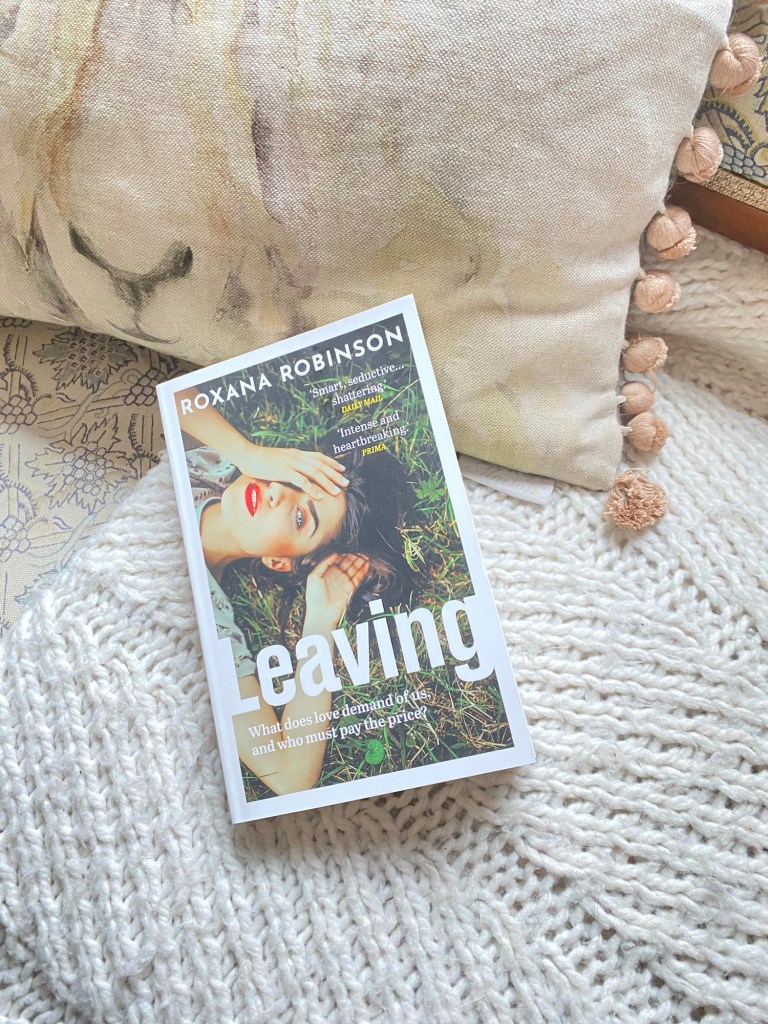
For years and years, when I’m asked the question which book has hit me hardest emotionally I’ve always had to say One Day by David Nicholls. It’s the last book that made me cry spontaneously for one of the characters. I still remember the exact line. Now I’ll be able to say Leaving was the last book that absolutely tore my heart out. Sarah sees Warren, who she dated for a while in their college years. She had ended it, unsure whether they were a good fit. Yet they never stopped thinking about each other. Sarah is divorced now and lives alone in her country home with her dog Bella for company. She has a daughter who’s married and lives a distance away with her husband and two children. Sarah works at a gallery, currently putting together an exhibition about the Bloomsbury Group. Warren lives just outside Boston and has his own architectural practice in the city. He’s married to Janet, exactly the sort of wife he has needed: attractive, a good hostess and great mum to their daughter Kattie who is an older teenager. However, his wife is also a snob, very aware of who should be in their social circle and how things should be done. They don’t talk about current affairs together, listen to an opera or read the same books. Perhaps their marriage has always been like this, but it feels empty since he saw Sarah again. Can he spend the rest of his life in this marriage as he promised or can he be with Sarah? If he leaves what price will he have to pay?
This novel is so clever in the way it engages with your morals and emotions. I was so caught up with the romance of Sarah and Warren, so much sweeter because it is second time around. I felt their urgency. It’s unthinkable thar they shouldn’t grab, what feels like, a last chance of happiness. I felt so much for Sarah, who is an intelligent and self-sufficient woman post divorce. She has such a solitary life, seemingly with a handful of friends. Her life is made up of her job, her home with poodle Bella and occasional visits with her daughter and son-in-law. I loved the tender moments she has with her dog, something I understand completely and just as important as anyone else when considering big life decisions. It feels like she’s where she belongs on the edge of the reservoir walking with her canine companion, so in tune together. She does feel a little remote from her daughter, wanting to be like other grandmothers who look after their grandchildren regularly and have one multi-generational family. Sarah doesn’t quite feel invited into her daughter’s life. I didn’t feel any dislike for her or begrudge her happiness with Warren, even though it comes at the cost of his wife’s happiness. They felt easy and uncomplicated together. Sarah thinks of his wife but doesn’t feel like the other woman because he was hers first. Their relationship is a continuation of something started long ago, or is this simply their justification for something outside their normal moral code. The author beautifully captures those heady romantic moments of a new relationship with simple moments, the joy of receiving flowers or the secret smile that comes from a loving text in the middle of a working day. Sarah doesn’t lie to her own children, she tells them she’s seeing someone from her past. That he’s married. They are happy for her.
Warren’s life is more complicated. The author takes us between his and Sarah’s inner thoughts seamlessly. They are two halves of a whole. By comparison his married life feels mundane and rather one note, but it’s unfair to compare a new love or even a recaptured love with thirty years of married life. A few deft touches show us a marriage that’s become routine, Janet’s red house dress being just one. The reappearance of a frozen chicken pot pie is a beautifully used example. It appears early on, only to be replaced with a beautifully cooked beef bourguignon as Janet tries to win her husband back. It promises so much, this is how it will be from now on. Only to revert to chicken pot pie again, but it isn’t just a pie, it signifies a marriage that’s fallen back into a well worn groove. It screams ‘is this it?’ Janet has done nothing wrong, they haven’t had a bad marriage and when Warren feels the weight of those years there’s a fondness, a gratitude for all those shared moments that make up a marriage. He is both grateful for them and buried beneath them. Does he deserve to climb out from underneath them? Or is it an unforgivable betrayal of everything they’ve shared as a couple and a family?
I loved some of the subplots to the main love story. I found Sarah’s work fascinating. I remember talking to someone ar the V & A about one of their fashion exhibits and the process of creating something with such impact. I hadn’t known a job existed where you could sit and discuss a artist’s work, then choose the pieces you want to tell a story. I thought the quandary over whether to go with a well- known scholar on the Bloomsbury group versus a newer academic voice echoed the love story so completely. The best known scholar may promise something new but will likely deliver something competent but safe. The newer voice might offer something dynamic and new but they aren’t a very big name yet, is newer always better? Sarah’s daughter’s third pregnancy isn’t easy and terrible news brings Sarah deeper into their lives and closer to her grandchildren. I also loved how Kattie’s wedding placed stress on her whole family, especially where Janet wants the big, formal society wedding and her daughter starts to feel overwhelmed. The wedding planner tells them that a wedding is basically a microcosm of society, the one of which their family is a part. People aren’t perfect, so weddings never are either. Neither is marriage.
Everything about this novel rings true, from the details that set each scene to the love story that binds everything together. It’s exquisitely written, drawing you in so very slowly, then unravelling quickly to it’s emotional conclusion. There’s a point in the book where I have never wanted to slap a character more! Even though their actions are understandable and possibly morally justified, I was still absolutely furious and had to share the story with my husband whose immediate response was exactly the same. Once an affair starts to turn into something more, so many decisions have to be made and the sacrifices those choices will create become stark and very real. Sarah has imagined living with Warren, but she’s always thought of them at her home. This is where she rebuilt herself after her divorce. It’s a place she loves and doesn’t think she can give up. Arguably, Warren’s choices are even more difficult. He knows if he does this, his relationship and happiness with Sarah will come at the cost of someone else’s feelings. On the scales does one happiness outweigh another? Or are some costs simply too great? I simply loved this book and although it’s only January but I have no doubt this will be in my best books list come the end of the year. I would happily read everything else the author’s ever written.
Published by Magpie Feb 2024
Meet the Author
Roxana Robinson is the author of eleven books: seven novels, three story collections, and the biography of Georgia O’Keeffe. Four of these were New York Times Notable Books.
Robinson was born in Kentucky, but grew up in Bucks County, Pennsylvania. She attended Bennington College and graduated from the University of Michigan. She worked in the art world, specializing in the field of American painting, before she began writing full-time. Her novel, Cost, was a finalist for the NEBA, was named one of the five best fiction books of the year by the Washington Post and received the Fiction Award from the Maine Publishers and Writers Association.Her novel, Sparta, was named one of the ten best books of the year by the BBC, and won the James Webb Award for Distinguished Fiction from the USMC Heritage Foundation, and the Fiction Award from the Maine Publishers and Writers Association. Her fiction has appeared in The Atlantic, The New Yorker, Harper’s, Tin House, Best American Short Stories, and elsewhere. Her non-fiction has appeared in The New York Times, The Washington Post, Bookforum, Harper’s, and elsewhere. She was twice a finalist for the NBCC Balakian Award for Criticism and has received fellowships from the National Endowment for the Arts and the Guggenheim Foundation. She teaches at Hunter College, has twice served on the board of PEN, and was President of the Authors Guild, where she continues to serve as a member of the Council. She lives in New York and Connecticut, and spends as much time as she can in Maine.
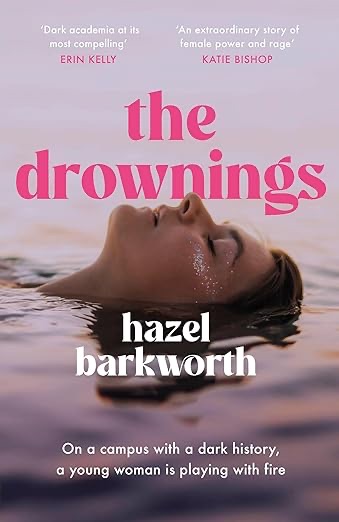
This is a fascinating read from Hazel Barkworth, capturing so much about the times we’re in while also exploring themes of identity, obsession, use of social media and modern day witch-hunts. Serena was born to swim. Her body is honed by years of training to be the best. When she thinks about her body, she imagines it sleek and pointed like an arrow shooting through the water. Her trainer Nico thinks she can go as far as the Olympics and within the family her winning streak makes her the centre of attention. Then one day it all goes wrong, because despite her training, focus and visualising the win, she loses. She can’t fathom why or what went wrong, but to add to her shock she then slips in the changing area and damages her knee. Now she’s on crutches and cannot swim at all. She knows she will not be ready to meet the next Olympics and the disappointment is crushing. Even worse, within her family, attention shifts to her cousin Zara. Zara has always had issues with her body image, but started an Instagram account promoting body positivity. Her curated Insta in shades of peach, teal and gold, is gathering momentum. She is blossoming in her success and has enough followers for companies to start sending her free products in the hope she might promote them. Just as Zara is making peace with her body and finding success, Serena has no idea who she is. With most of her time previously taken up with diet, exercise, warm-ups and time-splits, she doesn’t recognise herself. Her body only had one purpose and now it’s let her down. How can she be Serena, when the Serena she knew doesn’t even exist any more?
Serena decides to take up a place at university, at Leysham Hall, where her cousin already has a place. Here they both fall under the spell of their feminist lecturer in history, Jane. Serena meets her entirely by accident when walking the grounds one night. She sees a young woman poised by the edge of the river, that rushes downstream at this point of the campus. There have been warnings about this stretch of water, young women going missing and discussions about lighting the area always come to nothing. When the girl disappears, Serena rushes forward to help her. There is no hesitation when she realises the girl isn’t a strong swimmer and is in serious trouble. She leaps in and then Jane appears, just in time to help Serena bring the girl up to the surface and out. She doesn’t notice much about her that night, but she does end up in Jane’s history tutorial group and from that point on she feels drawn to the academic. It’s not a sexual attraction, she doesn’t want to be with her, it’s more that she wants to be like her. She loves the unfussy but stylish way that Jane dresses. She admires the knowledge and passion she has about her subject. Totally at odds with her dress sense, Jane’s tutorial room is a riot of colour turning the functional and boring space into something cozy and colourful. There are so many mementoes of places she’s been, feminist posters, colourful rugs and cushions. Mostly, I felt Serena is drawn to the fact that Jane seems so entirely sure of who she is.
A few of my reads this year have touched on a couple of very specific themes and when I thought about why, I could see that this is a product of the times we’re in. There’s the theme of witches and the witch hunting of the 17th Century which grew rife due to the obsession of James I /James VI of Scotland. The second was the influence and power gained by becoming part of all-male, elite, private school gangs like the Bullingdon Club, a club in which David Cameron, Boris Johnson and George Osborne were all members. The club carried out ‘pranks’ such as trashing the restaurant they met in and simply fixing the problem with family money. They burned ten and twenty pound notes in front of homeless people. I also believe this club may have been the source of the Infamous David Cameron and pig story. At Serena’s college it’s the Carnforth Club, named after their school founder they are robed from head to foot to keep their identities secret. As far as witches go, the words witch-hunt are being co-opted by men in powerful positions who don’t like it when their actions have consequences. We have seen it in the aftermath of the #MeToo movement, where men who are finally facing courts of law after years of abuse and sexual assault allegations, are claiming they are victims. The most recent is Russel Brand who has used his YouTube channel to protest his innocence, but has the tried to rehabilitate himself by becoming ‘born again’ and hiding within the Trump family, of all places. These and other men like Prince Andrew. Kevin Spacey, Jeffrey Epstein and Harvey Weinstein have all used the excuse that the media want to take them down. However, it’s not a witch-hunt when you’re one of the most privileged demographics of the world. If you’re moaning about witch-hunts you must genuinely be a victim and since most of these men are always punching down, I think we’re being gaslit.
The original witch-hunts were brutal and targeted mainly women. Jane tells them that witch trials took place where they now study and in fact, the place where Serena had jumped in to rescue a student was where witches were ducked. After a brutal interrogation that included torture, coercion and violation, suspected witches were taken to a river and ‘ducked’. If they drowned they were innocent but if they lived they were declared a witch and burned alive. Jane places this within a feminist framework. We know that ‘witches’ were usually women who lived alone, earned their own living from medical and herbal knowledge, often helped deliver babies in their area and helped other women. By offering advice on things like fertility, preventing pregnancy and helping girls in trouble, local ‘wise women’ gave the women around them some control and autonomy when it came to their own bodies. A woman like his is a threat to men and to the teachings of the established church. No wonder James I worked to the edict from Exodus ‘ thou shalt not suffer a witch to live’. Working as a counsellor and in chronic pain management for years I often realise I have quite a few friends who might come under suspicion from the witch finders.
Both Serena and Zara are dazzled by Jane, Serena has even wondered if Jane and Zara may be attracted to each other. Using Zara’s quite considerable social media platform, they encourage young women in the college to speak out about any sexist and misogynistic treatment they’ve suffered there, particularly if linked to the Carnforth Club. They are soon inundated with messages alleging everything from online abuse to sexual assault. Their anger comes to a head one night at a rally where both Zara and Jane will speak to any of the students who will turn up. Round a campfire they start to share their stories, with the evening rounded off with a call to arms. They must campaign for change. At the crucial moment, Zara is expecting the megaphone to be passed over, but instead Jane chooses to hand it to Serena. Fired up by the atmosphere Serena dives in and starts to rally the women and she is inspired. The night ends as Serena starts to lead a ritualistic dance and before she knows it she’s the leader, whipping up the women into a frenzy as they take off their clothes and follow her. Next day Serena is a little bemused at what happened, but it felt right at the time and she went with it. Even as she goes to sleep, someone is sharing a photograph of her naked and marching in the light from the campfire. It’s sent to the whole college. In the aftermath, Jane wants them to keep up the momentum and break into the hall, where a portrait of the college founder and instigator of the Carnforth Club has pride of place. While most of the group are happy to break in and cause mischief, Jane is considering something much darker and more dangerous. Will everyone go along with her plan? Since the rally, Serena has noticed that Zara is not herself. She seems to have lost some of her audience and her confidence seems to be following. Now that Serena is finding herself, it seems that Zara is losing herself.
The tension really builds here as the author takes us into final third of this thriller and I was fascinated to see how it turned out. I felt for Serena who seems to have found confidence and a sense of what kind of woman she wants to be, but is it real? She struck me as one of those children who’ve been pushed into specialising too early in life with no back-up plan. In all those dark, early mornings at the pool and the times she had to say no to social occasions to train, there’s someone who isn’t allowed to explore who she is and what she enjoys. Her time is so limited and she doesn’t form any meaningful friendships either. How do we know what we love in life if we’ve never tried anything else? She also has a very distant relationship with her own body that’s merely an athletic instrument. She’s used to ignoring aches and pains, divorcing her mind from how far she’s pushing her growing body and never seeing her it as a source of pleasure. Then suddenly she’s surplus to requirements and has no other plan. Placed into the chaos of fresher’s week and meeting so many different and strong characters must be bewildering. When people ask about herself, who is she? She struck me as a borderline personality, who takes on the issues and characteristics of whoever she’s with. She’s vulnerable, used to obeying authority figures and having them control everything down to her food. Zara seems equally fragile though, growing up in the shadow of a cousin who might go to the Olympics is not easy. She’s so proud of her influencer award and in a way, her Insta has been as much about her own validation and acceptance of her body, as it has about inspiring others. Once her star begins to fade, Zara’s confidence plummets and she becomes desperate to make her mark. The author shows us how fragile today’s young women can be with misogyny seemingly rife and the added pressure of a global audience on social media. I wasn’t sure how far either of these girls might go to impress their tutor and display who they are. That’s if this is who they are? This was a brilliant contemporary thriller that asks serious questions about how the authentic self forms within this confusing and dangerous world.
Published 1st August by Review.
Meet the Author
Hazel grew up in Stirlingshire and North Yorkshire before studying English at Oxford. She then moved to London where she spent her days working as a cultural consultant, and her nights dancing in a pop band at glam rock clubs. Hazel is a graduate of both the Oxford University MSt in Creative Writing and the Curtis Brown Creative Novel-Writing course. She now works in Oxford, where she lives with her partner. Heatstroke was her first novel and The Drownings is her second.
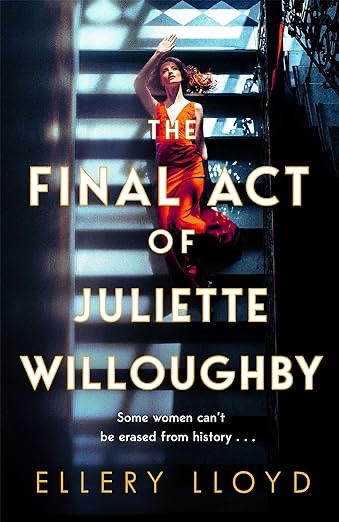
Having just read about female surrealist artists in The Paris Muse by Louise Treager I was so ready for this story about the art world, women painters and a mystery surrounding British artist Juliette Willoughby. The writers tell their story across three timelines. In 1938, Juliette Willoughby is living and painting alongside her lover Oskar in Paris. A British heiress, she left her family and their money behind for a life as an artist who is best known for her painting ‘Self-Portait as Sphinx’, thought to be lost in a studio fire where she also lost her life. We meet our main characters Caroline and Patrick at Cambridge in 1991, where they are both studying art history and specialise in the Surrealists. They are sent to the same dissertation supervisor and while researching come across something sinister about Juliette’s death. Their investigations may expose terrible secrets about the Willoughby family, who are acquaintances of both students and aristocrats who don’t want their family history out in the open. Our final timeline is present day Dubai where Patrick is an art dealer and lives with his wife. Caroline is now an academic and expert on Surrealism, especially Juliette Willoughby so when a new Self-Portrait as Sphinx is uncovered he asks her to fly to Dubai and authenticate the painting. A sale is on the cards and Patrick needs to know if this painting is a second version by the artist and potentially worth millions. He plans a night for collectors to view the painting and offer sealed bids, but the night ends with Patrick in a cell accused of murdering one of his closest friends – the last surviving member of the Willoughby. There are now three suspicious deaths linked to this painting, but can Caroline unlock the mystery before Patrick is charged with a crime he didn’t commit?
I have a real interest in art history and the lives of artists, probably formed when I studied Victorian art history as part of my literature degree. My particular interests are the Pre-Raphaelites, the Arts and Crafts movement, Klimt and Frida Khalo, so it was brilliant to learn more about the Surrealists who are outside of my experience. My only understanding is that the artists may be representing the contents of their subconscious rather than the conscious. I can be a little bit scathing of some modern art, having my teenage years in the 1990s we were in the world of the YBAs – such as Damien Hurst and Tracey Emin. I have been to gallery openings where I could only conclude that other people had an ability to see something I couldn’t or that everyone was affected by a dose of the Emperor’s New Clothes – too scared to say anything negative they just nodded along and agreed it was good. I will never grasp why people spend a fortune on paintings that are nothing more than a red square on a beige background. As you can imagine, I drove my artist friend crazy when we visited the Guggenheim in NYC. I understand a piece that hits you in the emotions or a true passion to own and look at something incredibly beautiful every day, but it seems that more often than not investors pay millions for something that will sit in a storage unit. I thought I might find the art world in the book pretentious, but I could understand Caroline’s deep fascination with Juliette. There’s something about a female artist, often overshadowed by the man she lives with, that brings out the feminist in me. From Dora Maar whose photography and painting was eclipsed by Picasso to authors like Zelda Fitzgerald, thought to have contributed greatly to F. Scott Fitzgerald’s writing, there’s an urge to uncover their talent and put them in their historical context. This is the passion of Caroline, but Patrick is definitely complicit in trying to solve the mysteries the this particular painting found at a party in the Willoughby mansion.
This story has all the ingredients of a good old-fashioned mystery with the archetypal eccentric aristocratic family at it’s centre. Juliette’s father is an Egyptologist who never got over the death of her younger sister Lucy who drowned in the lake. Juliette is aware that she can never measure up to the baby of the family, who never reached her teenage years or tested her family. After her death, her father built a pyramid shaped sarcophagus on the island in the middle of the lake. Close to Lucy’s death, a maid disappeared from the house and then Juliette’s cat went missing too. Keeping the Egyptian theme was the club the Willoughby men formed at university, which had several similarities to the Bullingdon club. It was like an American college fraternity with it’s own initiation tests, pranks and hazing rituals. All members wear a signet ring with an Egyptian hieroglyph. Patrick was friends with both Harry and Freddie Willoughby, but the brother’ enmity for each other ran deep. At the party attended by Caroline and Patrick, Freddie disappeared after falling from some scaffolding during an argument with his brother. The amount of blood left behind would indicate a severe head injury but he is nowhere to be found, much to the distress of his girlfriend Athenia. It’s this same night when Caroline finds Juliette’s masterpiece and her diary. On impulse she takes the painting, wraps it carefully and places it in the boot of Patrick’s MG. What can she do with it from here and will the Willoughby’s know that it’s gone? Patrick suggests it’s placed in a small country sale where it’s value will go under the radar and they should be able to legitimately buy it, yet the unthinkable happens and the painting soars above when they can afford. Caroline still has the diary though and through it we can hear about her life with Oskar and the inspiration for the painting. She brings 1930s Paris alive for us a d provides clues to the symbolism of her Sphinx painting.
Finally, these sections are interspersed with the present day where Patrick has asked Caroline to come to Dubai. This is all the more tense because she is his ex-wife and Patrick has remarried. He wants her in Paris to answer questions that potential investors might ask. How can she know this piece is by the same artist as the 1930’s painting and is it from the same time period? There are differences in the smaller narrative parts of the painting in the background, why would the artist change them? Soon the presence of the painting brings other people from the past into Dubai, including Freddie’s girlfriend from the 1990’s Athenia. She is advising one investor who wants to remain nameless and as they all gather to make their bids in just one night it becomes clear that Patrick and Caroline’s reputations hang in the balance. However, it’s Patrick who finds himself in a cell, losing his standing, his financial future, his liberty and possibly even his marriage. What could have gone so wrong? This is such a complex mystery and as we get closer to unravelling some of the secrets, the tension starts to build. It definitely grips you and keeps the pressure on. I loved the history unravelled through Juliette’s diary and her take on what it’s like to live and work alongside another artist. There’s a certain point where I found myself reaching for the book in my downtime more than putting on the TV or radio. It’s a real skill to build tension like these authors do, slowly but surely sucking you in. You will find that you want the answers as much as Caroline and Patrick do. I also thought there were more tangled questions than they could ever resolve, but keep going. It’s definitely worth it and there are no loose ends left untied. I found myself focused on Juliette, Caroline and Patrick more than any other characters. Others are definitely hard to like – especially those with the hint of the Bullingdon Club in their pasts and a sense of elitist entitlement in their characters. These are people who will commit any sort of crime to keep their status and the respectability of their family. I found this attitude strangely believable in the recent political climate where lies and cover-ups seem to be the norm. I was amazed how well it was all tied-up and how the author used distraction and first person narrative to make sure we only read what they wanted us to. The novel moves effortlessly from writer to writer and I wouldn’t have known it was a writing team. They are masters at letting us into some secrets while shielding others until later on, right up until the last few pages.
Out now from Pan MacMillan
Meet the Authors
Ellery Lloyd is the pseudonym for New York Times bestselling husband-and-wife writing team Collette Lyons and Paul Vlitos.
Collette is a journalist and editor, the former content director of Elle (UK) and editorial director at Soho House. She has written for The Guardian, The Telegraph, and the Sunday Times.
Paul is the author of two previous novels, Welcome to the Working Week and Every Day is Like Sunday. He is the program director for Professor of Creative Writing at the University of Greenwich.
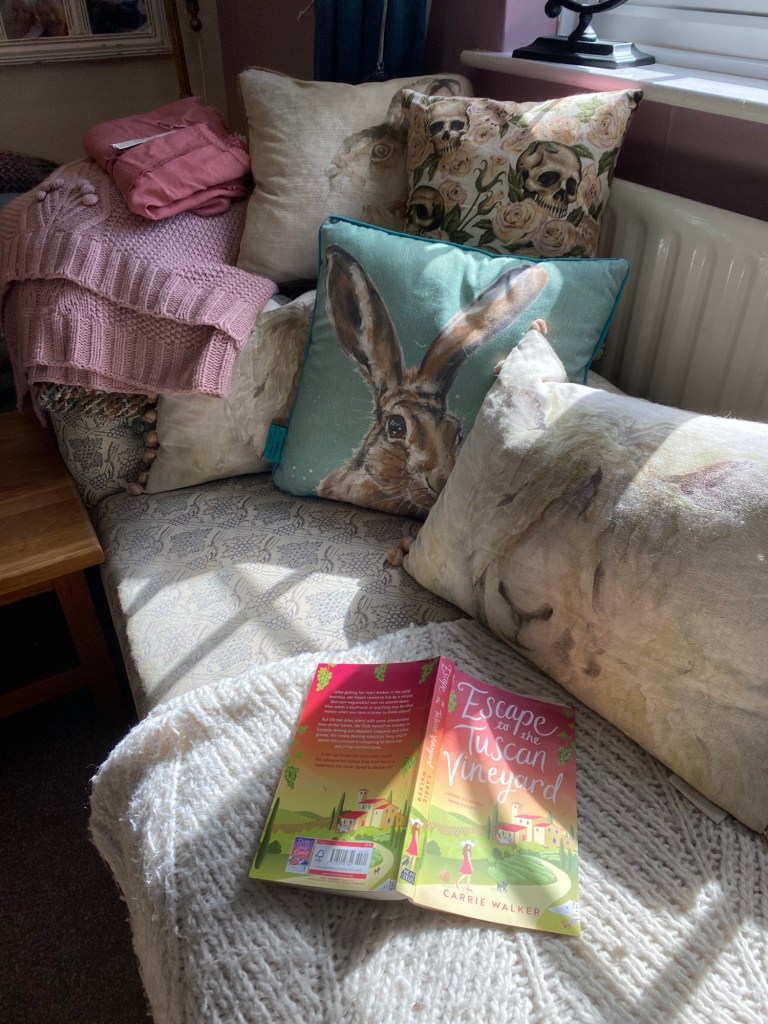
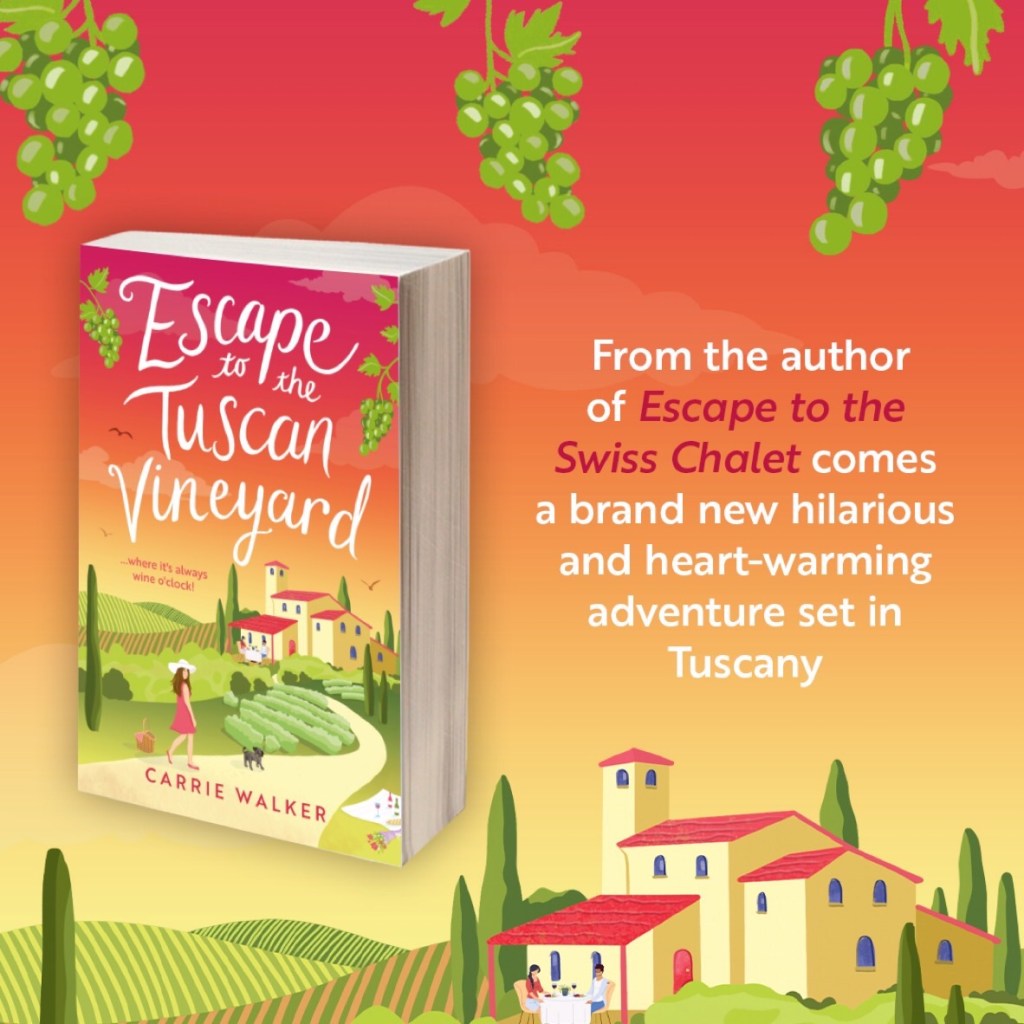
Just when Abi thinks she’s getting her big break as a movie make-up artist, everything starts to go wrong. When she’s told her booking on Moonmen was a mistake, she wonders if it had anything to do with her encounter in a sauna with a good looking guy who wasn’t honest about who he was. Nevertheless she has been paid for a month and when she tells her best friend Holly, she says there’s no excuse not to fly out to Tuscany and pay her a long overdue visit. When she makes it to San Gimignano she’s charmed by the ancient town and the lovely B and B that she’s booked into. The owners, Mia and Paulo are just starting out and Abi has the chance to be a guinea pig, sampling their food, activities and the wine from the attached vineyard. Then she meets Tony, a handsome American Italian man at Holly and her boyfriend Xavier’s restaurant and she decides to have a little holiday fling. Since the heartbreak she encountered in her last long term relationship, Abi has a rule when it comes to affairs of the heart; single encounters only because then she can’t get attached and can’t be hurt. However, something told me that Tony might not be discouraged as easily as she thinks.
Well this novel is a lovely slice of Italian sunshine! It can be read in a day and is the perfect escapist read. I’m not a usual romance reader so this wasn’t something I’d normally pick up. I wasn’t even sure I was going to like it at first because Abi was the type of person who rubs me up the wrong way. In fact there were moments I wanted to give her a slap. When we first meet her she’s running everywhere, helping her Mum out with hair and make-up when an ill advised spray tan and hair tint have left her looking like an Oompa Loompa. Luckily Abi has all the fixes to get her glowing again then she’s off picking up balloons and cake, getting changed and decorating a party room ready for her friend’s surprise birthday ‘do’. She’s so precise and controlled about everything. The discipline she has to get up every morning and pull on her running gear, even when she isn’t working, made me shudder.
‘A quick shower and I was in full make-up by 7.35am and ready for the day ahead. Which suddenly felt like a lot of time to fill. I made the pot of chamomile tea and opened my notepad to start a fresh, new list and get myself organised. I loved a list. It helped me feel in control.’
Abi is all routine and organisation, with no fun or relaxation. Luckily I’m a huge fan of transformation and I had a feeling that this one was going to be worth waiting for. I really enjoyed the humour in the story and I knew if anything could change someone Italy could. Abi loosened up by slow degrees – with a cake for breakfast here and a lie-in there. This is mainly because Italy forces her to be spontaneous. Despite a well planned itinerary Abi can’t sightsee because the buses don’t always run on time and sometimes don’t turn even up. People often close their shops to pop for lunch or an afternoon nap when the heat becomes too much. There’s nothing to do some days except be in the pool and the shade. She soon realises that La Dolce Vita is the only way and she’ll have to get on board with it. I started to enjoy this more relaxed Abi and as we hear more of her story and her feelings of loss and heartbreak the more we understand her.
The setting is simply magical. The vineyard view with the red roofs of the town in the distance sounded idyllic and the food made my mouth water. I’m also a massive fan of Glow-Up even though I rarely use make-up myself, so I loved all the detail about Abi’s career and how skilled she is creating everything from a face painted with bunches of grapes to a full Venetian mask with feathers and gold detailing. When she’s using her skills to help the vineyard and the people she loves, Abi really does shine. I did get drawn in by the romance because it’s impossible to dislike Tony. He’s a straight forward decent man who doesn’t play games and respects Abi’s boundaries. I wanted him to be able to break them down, but I didn’t know if he’d be able to. Ironically, in her desperate need to avoid being hurt, she’s hurting herself. I felt like I’d had a holiday myself when I finished the book. I’d thoroughly enjoyed the villa, especially the wine festival with its incredible food and a fairy lit pergola – the perfect venue for dancing the night away. The family of puppies were pretty irresistible too. Venice was the absolute crowning glory of the story, with Abi making-up the movie stars she’s longed to work with and dealing out some sweet revenge at the same time. Plus it’s my favourite place in the world so that helps. It’s wonderfully uplifting to see someone leave behind painful and negative patterns, it’s one of the reasons I love counselling. Even more than I wanted Abi to find romance, I wanted her to truly live life again instead of trying to control it. I could see a whole new world opening up for her and that made for a very satisfying read. I remember a bit of Eat, Pray, Love by Elizabeth Gilbert where she’s done the praying and the eating and falls in love on the island of Bali. She goes to her herbal doctor who listens as she panics that she’s not kept to her meditation routine and she’s going to lose the balance she’d worked so hard for. Her doctor smiles at this and points out that if we look at our lives overall there has to be some imbalance, otherwise it won’t be balanced. This is something Abi has had to realise for herself.
‘I didn’t want to slip back into my old, controlling ways. I needed to start taking chances again. My lists had to be less about cleaning and more about trying new things and going to new places. I’d wasted so much time…’
And what about Tony? I’ll leave you to find that out for yourself.
Meet the Author
Carrie Walker is a Brummie born romcom lover with a lifelong passion for travel. She has lived in a ski resort, by a beach, in the country and the city, and travelled solo through Asia, South America and Europe.
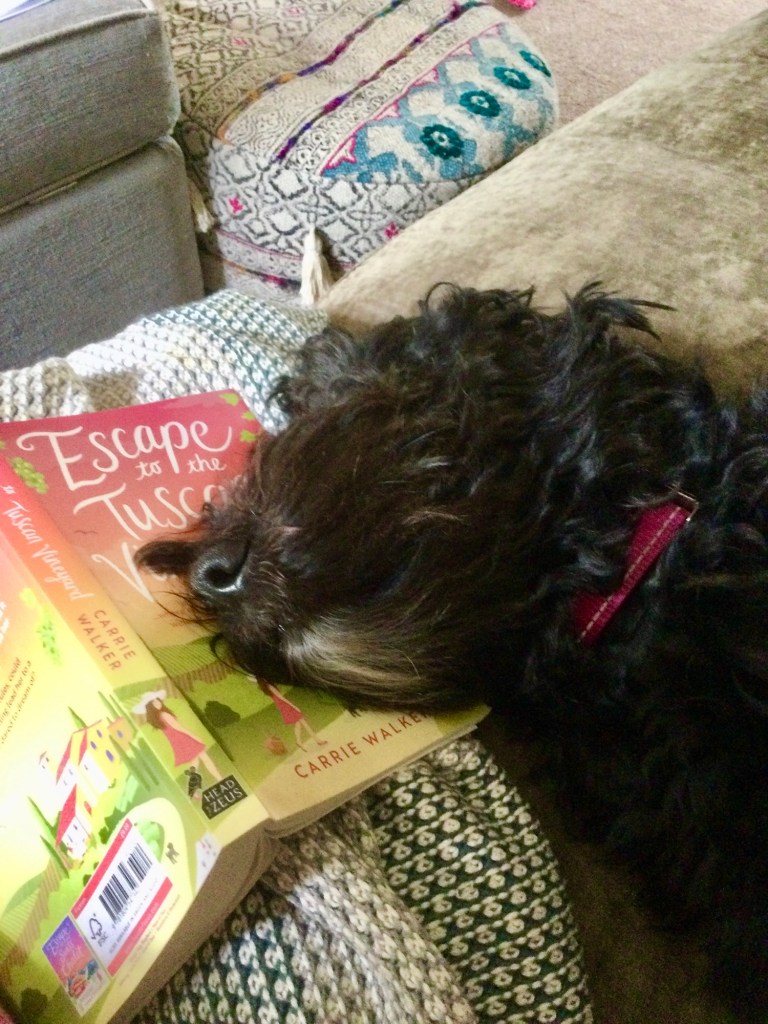
Her own love life was more com than rom until she met her husband a few years ago and settled down with him and her dog Ziggy in a pub-filled village in Essex.
Longlisted for Helen Lederer’s Comedy Women in Print prize in 2021, writing has long been Carrie’s side hustle, penning columns and features for newspapers and magazines, while working in many other jobs. She has been the CEO of a global disability movement, a board director of a brand agency, the editor of a newspaper, a radio presenter, a football mascot, dressed up as a carrot for the BBC and now she is writing books. Escape to the Swiss Chalet was her debut novel.
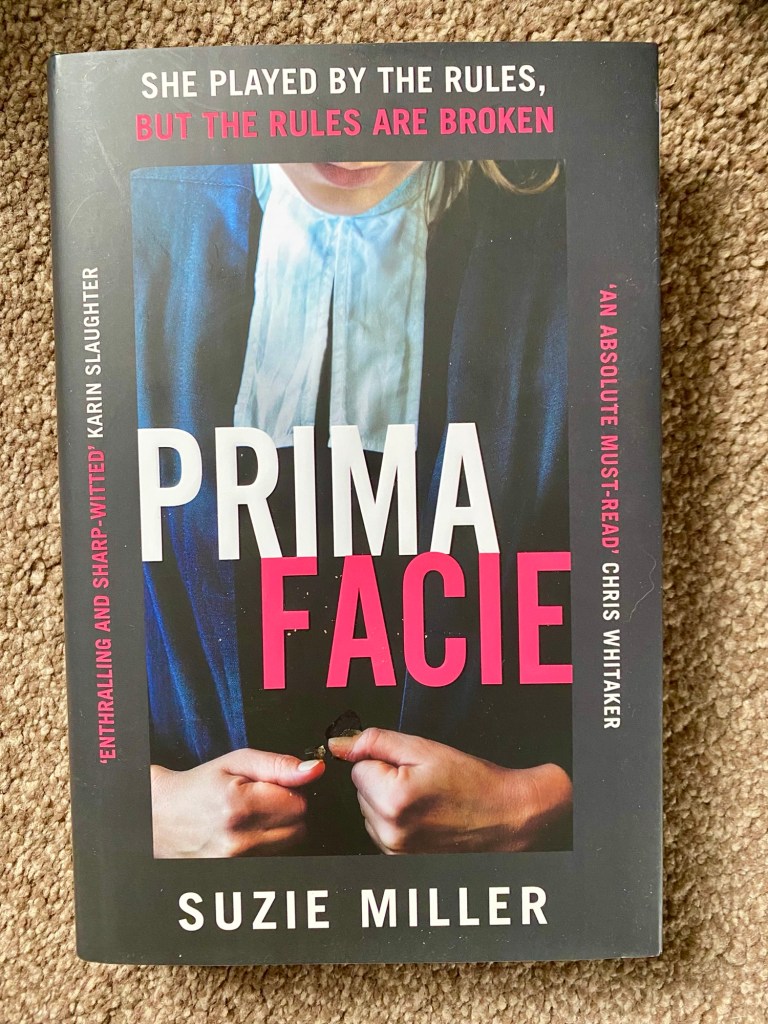
I was only a few pages into this thriller, when I wished I’d seen Suzie Miller’s stage play of the same name running in the West End with an award-winning performance by Jodie Comer. I could see that Comer was the perfect choice for Tessa because I imagine she would understand this character perfectly. Tessa has brought herself from the council estates of Liverpool, via similar areas in Luton, through Cambridge University to one of the best barrister’s chambers in London. Tessa is a defence barrister, one of the best in the competitive area of criminal law. She thinks like a lawyer, her job isn’t about the truth. It isn’t about whether her client is innocent or guilty, in fact she doesn’t want to know. It’s about following the intricacies of the law. It’s about looking for the holes in the prosecution’s case and exploiting them, bringing them to the attention of the jury and creating doubt. All she has to do is create enough reasonable doubt in the minds of the jury that the law directs them to an acquittal. It’s almost a game. A very high stakes game for the defendant, but Tessa gets paid either way. For her it’s the enjoyment of winning and seeing the the system she believes in, applied correctly. However, when Tessa goes on a date with a fellow barrister from her chambers, something goes wrong. Then she realises that the law might not be in her favour after all. Perhaps justice is more equal for some than others.
I was immediately enthralled by Tessa’s narrative voice. She’s smart, a quick study of other people and how they present themselves to the world. She is a brilliant, intelligent and careful lawyer. The author presents law like a religion. Tessa believes in the British justice system, that although there are anomalies, by and large justice does get served. After making a huge jump from her estate and family to Cambridge, she’s become a quick study of class and tribes. As she arrives at her first university lecture she spies a group of staff in suits hanging around the entrance and wonders if she’s been found out – ‘maybe I fluked it and one of those suited people are going to barge in with a list and call out my name. Tessa Ensler? I’m sorry there’s been a terrible mistake’. The boy sat on her right has clearly come from public school. He has that assured way of being that comes from knowing he belongs here and that he will be among those who change the country. The dean tells them that 1 in 3 of them will fail. As she looks to her other side she sees a girl trying to look dishevelled but with clothes deliberately made that way, rather than being worn out. With her layers of necklaces and raggedy clothes she’s showing that she has the confidence to look bedraggled, whereas as Tessa looks down at her own new jumper and knows she doesn’t belong. They know she doesn’t belong. What if she is the 1 in 3?
Yet she adapts and educates herself in how to blend in and even as a fully-fledged barrister years later, she is still well-versed in the unwritten codes of both the court room and the women barrister’s robing room. She refers to her fellow barristers as thoroughbreds. It isn’t enough for her to be a barrister, she has to know how to look and seem like a barrister. She knows the uniform – grey or blue understated suit, low comfortable heels for standing in court, hair that can withstand the wig, not too much make-up. It’s acceptable to show individuality with some quirky earrings, unusual glasses or chunky heel ankle boots. These little details are the way women have learned to own their own space, to show they are serious about the law, but do it differently to the men. Some things are sacrosanct such as the right shoes – the same designer brand, low key and stylish, but very expensive for a shoe that’s so boring. Yet within her first year as a barrister Tess has the same brand on her feet. Her rebellion comes in tiny acts like wearing a collarless shirt, coloured tights or eye-catching earrings. Individual, but not so out there it would frighten the horses. She also doesn’t have a wig tin, choosing instead to keep her wig in a Tupperware box borrowed from her mum. This is deliberate, it reminds her of where she’s from and how to remain grounded. She resists anyone’s offer to buy a wig tin for her, especially when they refer to her choice as ‘slumming it’. She’s mainly played by the rules and thinks she’s become one of them.
I will mention that there are graphic depictions of sexual assault that are a hard read, but they are necessary. They show the ambiguity that can be brought into the legal arguments. Anyone who reads the account has no doubt what happened between Tessa and her colleague. Yet already I could see the ‘holes’ in her story, the things she does ‘wrong’ and how the difference she thought was invisible, being brought up to weaken her account. She can probably imagine the way a defence barrister will cross-examine her and which parts of her story he will exploit to create doubt in the jury’s mind. I found it so painful when she overhears other female barristers discussing the accused, Julian. Julian was always hoping to be a barrister, his father was before him and is now a judge. He is immediately accepted into this world without once having to work out how to be. As the women discuss going to his dinner party and how terrible this false accusation is for him it’s clear he’s one of them, they probably went to the same school and, like her pupil Phoebe, knew which shoes to buy before they even got here. One female barrister asks her outright why she would accuse Julian, when everyone knew she was into him. She must know it’s hurting her own reputation and her career, she’s alienating the ‘very people who will decide whether she gets silk’. In that moment Tessa wonders why it isn’t hurting Julian’s reputation? There are solicitors who will never instruct her again, people who will not share chambers with her and she will likely never progress with her career again. But he will. It brings home everything about her difference from that clique – the small world of London chambers – her disadvantages as a woman, as someone from the wrong school and the wrong type of estate.
I was fascinated with whether or not Tessa would realise that the law isn’t the same for everyone and that her belief in the system she has worked for is left crumbling at her feet? Added to everything else Tessa feels foolish for every time she has said that the law dispenses justice more or less, for everyone. Now she knows it doesn’t. Even before she’s in the court room she knows that it was her difference that made her a victim in the first place. This wouldn’t have happened to Alice or Phoebe because they are protected by their class:
‘I really had thought that I was now untouchable. That if I just did my job, didn’t stand out, won my cases, I’d be like everyone else in chambers. But I am not. I am disposable, I am rapeable. Just like when I was a kid on the estate. Nothing has changed, other than the class of man that can rape me.’
In being exposed to the way the world works for the right type of people, she has naively assumed that it now works that way for her too. We are so intimate with Tessa, her inner world is huge – full of contradictions and fierce intelligence with a veneer of upper middle-class lifestyle overlying strong working class roots. I was totally engrossed in her and recognised something of myself in that working class background rubbing roughly alongside years of middle class education and lifestyle. I’m conscious of a difference in the way I view the world from the rest of my family, but I’ve always wanted to keep them close. I know that if anything terrible happened they would be there for me, just as I hoped Tessa’s mum would be there for her. I’m aware of the difference in my accent honed by seven years of grammar school, a change that turned me into a vocal chameleon, picking up a trace of wherever I go, wanting to fit in. Tessa notices this with other barristers who have accents, there’s always a court voice that’s clear, concise and authoritative. There are so many points in the story where the author captures a current change in how the world has changed, particularly for women. Tessa recalls a sexual encounter in her teens which was only borderline consensual, but back then was chalked up to experience. I remember these days well: a push up against the wall followed by an unwanted kiss so hard it bruised my lip; a grab of the hips from a man as I reached over to answer a phone in a busy office; a teenage boy who thought that because my friend was snogging with his mate, I was up for it too. These seemed like minor incidents, but wouldn’t be accepted by young women today.
Tessa’s story brought up all those issues of consent that I find so interesting – does consenting to one sexual act mean you’ve consented for everything else? If we consent to sex once, does that mean we’ve consented for that whole night? Does it cover the next morning too? My husband was horrified that in law there was no such thing as marital rape until 1991. Consent was given by the woman through her marriage vows. Alarmingly there are still people who think as long as there is no violence, forced or coerced sexual intercourse within marriage does not constitute rape. The court scenes are electric, written with such tension and power. Watching the balance of that power shifting between defendants and prosecution witnesses and the barristers in their robes, posing the questions with scepticism, repeating them till you trip up and then diving in for the attack. I found myself dreading what would happen to Tessa if she didn’t get justice. Would she cope emotionally? Also, what would it mean for her professionally? Would she be trusted again? I would say ‘reading this….’ in my reviews normally, but I felt more like I was ‘experiencing this’ by Tessa’s side and sometimes in her head. She was as close as my own thoughts at times. I wondered whether it’s possible for someone to be as educated, honed and prepared for such an establishment career as the law, without becoming someone altogether different. Is there a way to separate the professional from the personal, to take on some of the female barrister’s characteristics and traditions but keep a little bit more of who you are? To take a bigger Tupperware box from home and seal even more of that professional persona inside along with the traditional wig. Her struggle between being the Tess she became at Cambridge and her chambers and the Tess who lived for a weekend house party with her friends from the estate is the struggle of every university graduate whose family earned a living in a manual job. A family who encouraged her to push herself, to reach grammar school, then be the first to go to university didn’t realise that with each step they’d lose her a little bit. A gap opens up, created by education, money, culture and lifestyle. I was strongly reminded of Tony Harrison’s poem ‘V’ that beautifully captures this dichotomy within a person, a Northerner that’s settled and makes both their name and their living in the south. Yet one line stood amongst all that anger and dislocation: ‘the ones we choose to love become our anchor’. He meant new friends but I hoped in Tessa’s case she would learn that she can be part of her family, while still being successful. To recognise them as her strength and support, rather than something you drift away from. This book is right up there, with the best I’ve read this year. Don’t miss it.
Published on 14th March by Hutchinson Heinemann. With thanks to the Squad Pod for having me in this month’s book club choice
Meet the Author
Suzie Miller is an international playwright, librettist and screenwriter. She has a background in law, and has won numerous awards, including the Australian Writers’ Guild, Kit Denton Fellowship for Writing with Courage and an Olivier Award. She lives in London and Sydney and is developing major theatre, film and television projects across the UK, USA and Australia.



















 The Lotus Readers