Posted in Random Things Tours

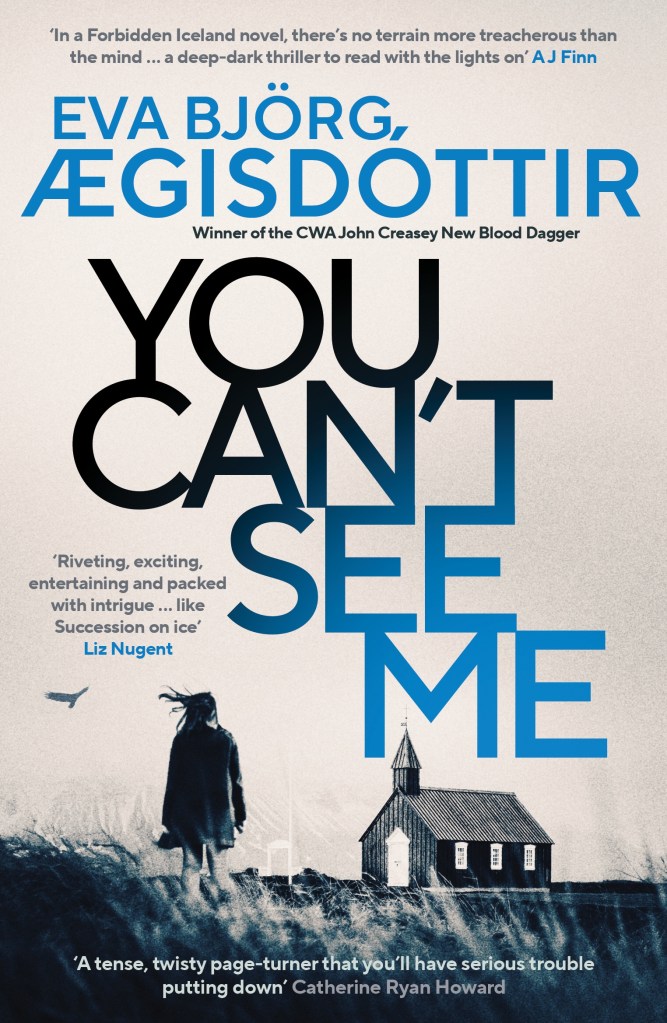
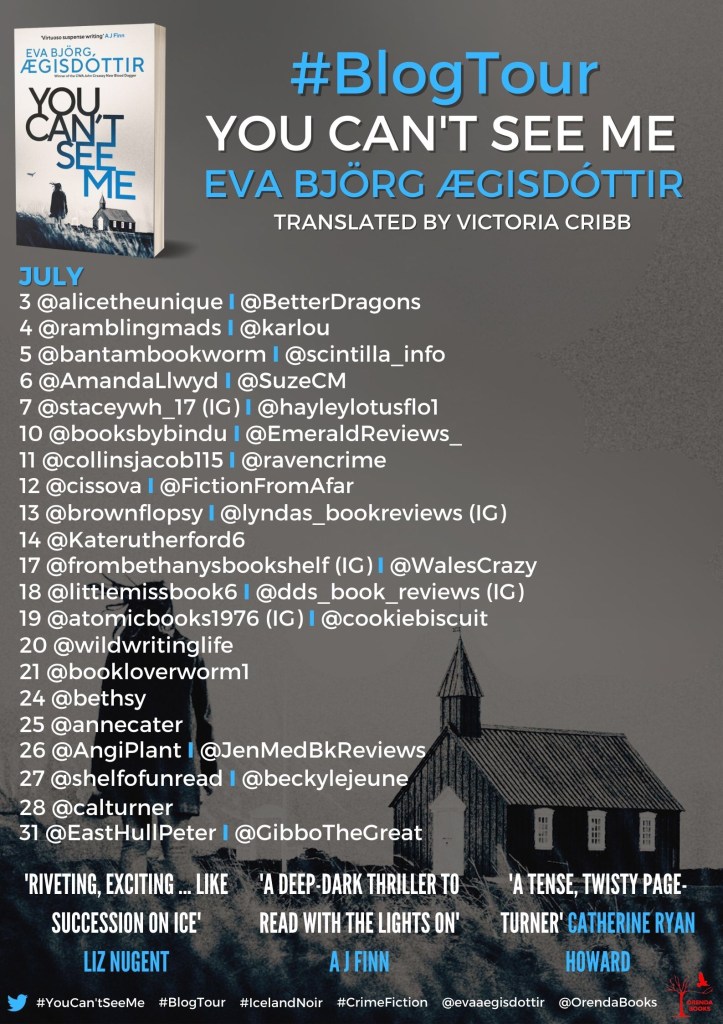
You Can’t See Me by Eva Björg Ægisdottir

Translation by Victoria Cribb.

Evil creatures here abound. We must speak in voices low. All night long I’ve heard the sound. Of breath upon the window.

Sixteenth-century verse by Þórður Magnússon á Strjúgi

The wealthy, powerful Snæberg clan has gathered for a family reunion at a futuristic hotel set amongst the dark lava flows of Iceland’s remote Snæfellsnes peninsula.

Petra Snæberg, a successful interior designer, is anxious about the event, and her troubled teenage daughter, Lea, whose social- media presence has attracted the wrong kind of followers. Ageing carpenter Tryggvi is an outsider, only tolerated because he’s the boyfriend of Petra’s aunt, but he’s struggling to avoid alcohol because he knows what happens when he drinks … Humble hotel employee, Irma, is excited to meet this rich and famous family and observe them at close quarters … perhaps too close…
As the weather deteriorates and the alcohol flows, one of the guests disappears, and it becomes clear that there is a prowler lurking in the dark.
But is the real danger inside … within the family itself?

I LOVED the first two books in the Forbidden Iceland series, featuring detective Elma, recently returned to her home town of Akranes after several years working in Reykjavik. This story is a prequel and we meet her eventual partner Sæver as he looks into some very strange events surrounding a family reunion. This is not your average family though and I don’t think I’ve ever wanted to be at a party less! My sympathies were largely with hotel employee Irma who views the Snæberg family as if they are a totally different species. In a way they are, set apart by their successes and their wealth from the everyday hotel employee. So wealthy in fact that they’ve hired this entire luxury hotel for the weekend, with a full itinerary of activities and boozy dinners at night. It isn’t long before tensions and differences come to light: judgements and opinions on each other’s partners; family members who’ve lost touch and resent each other; teenagers who’d rather be elsewhere; parents who can’t connect with their children. All cooped up together for a whole weekend. As the author moved our point of view from one character to another we realise this family has so many secrets.

The setting is isolated and bleak. No amount of candlelight could ever convince me that concrete looks anything but brutally uncomfortable. However, thanks particularly to interior designer Petra Snæberg who can’t stop snapping for her Insta followers, the hotel’s phone is ringing and bookings are going through the roof. Set on a remote peninsula there is nowhere to go, except the equally bleak outdoors and with a set itinerary in place there’s no escape from each other. The atmosphere the author creates is incredible and had me veering from suspicious to unsettled to really creeped out. The uncovered windows leave guests feeling exposed, realising that if a light goes on they are lit up like a theatre stage. Not helped by the fact that an app controls heating and lighting, so easy to plunge another guest into darkness or into light by accident or just when they least expect it. We realise that certain people are watching others, but we’re not exactly sure why, whose stare is benign and whose stare means danger is lurking? Some narrators send icy cold shivers down the spine. Petra’s daughter Lea receives a message from an unknown number:

The video is dark, taken outside at night. Instinctively I bring the phone closer to my face, to see better. I turn up the volume. The sound crackles with the wind, then I hear a crunching of gravel. Footsteps. Someone is walking outside, along a gravel path. The video ends with the sound of a throat being cleared and a cough. I turn to the window, feeling the sweat break out all over my body. Isn’t there a gravel path leading to the hotel? Again I hear a rustling sound outside the door, then more knocking. Two taps, like before. Tap, tap.

Some of the scariest moments happen to Petra too. There’s a tension between her and her cousin Stefania who grew apart years ago when they were teenagers. An awkward drink with the two women and Stefania’s brother Viktor starts to open up old wounds. Petra is haunted by a misunderstanding that had tragic consequences, but does she even know the full story? Why does she find her hotel room door open when she’s been inside, showering and sleeping? Then there’s the creepy notes under the door. It’s enough to make the hair stand up on the back of your neck.

Then there’s Irma, who seems intrigued by this glamorous family who are so ‘together’. They’re Insta-perfect and seem so far outside her experience. She mocks Petra’s overuse of the word ‘sanctuary’ which is what your home is supposed to be, a place that reflects who you are. When Irma thinks of her flat it’s merely a box and her shelves are merely a place to keep stuff. It’s boring, functional and sparse – does that reflect who she is?

Mum always said I had an overactive imagination. As a child I lived in a world that no one else could see. One that was much brighter and better than the real one, like a fairy tale or story, because as I turned the pages of books I became the characters. […] But the older I got, the more difficult it became. I started comparing myself to other people. I realised that the flat Mum and I lived in probably wasn’t that tasteful, and the life we lived wasn’t actually that exciting. Perhaps it wasn’t so desirable after all to be constantly moving from place to place, constantly changing schools and spending most of my evenings alone at home.“

She imagines living like the family do, envious of the freedom to walk around the supermarket and pick up whatever they want, with no fear of their bank card being rejected. Irma’s not completely taken in by appearances though, while she scrolls she reminds herself of the gap between the selves we are on social media and the reality. She looks forward to people watching, spotting where the cracks are. Those tiny resentments. The things they keep from each other. After all, no family is perfect.

However it’s Lea who I’m most scared for because she’s just so vulnerable. Lea is a confused teenager and she is never without her phone. A lack of friends and support at home has left her so open to exploitation. She has a friend called Birger who might be staying nearby, maybe they might finally meet? Lea seems to get validation from his messages on her photos. In fact it’s that very validation and a need to be seen that convince her to do something dangerous. She realises how exposed she is too late and the signs that she’s struggling are being missed, until she walks out into the sea in all her clothes. All the ‘what ifs’ begin to race through her mind, but not once does she wonder whether Birger might not be who he claims to be. Then there’s Gulli, an older man who’s very appreciative of her posts and so easy to talk to, but the unease sets in when he too turns out to be nearby. There’s the old man she saw wandering the corridors, even though her family are the only guests. Is it her aunt Oddny’s unusual boyfriend Tryggvi, an outsider thanks to his job as a joiner and his unique dress sense? Could he be watching? Lea begins With her mum embroiled in secrets and lies of her own, will anybody notice that Lea is standing on a knife edge. Lea is being watched of course, but is that enemy looking in through the windows or are they closer? Inside the building?

The suspense builds beautifully and reaches fever pitch on the last night. Tryggvi falls drastically off the wagon on an important anniversary. Petra has made a bloodstained find in one of the bedrooms. Victor’s much younger, pregnant girlfriend has left the hotel in the night despite being unable to drive. Lea is also drinking heavily, scared about who is stalking her. While Petra has a long overdue conversation about the past, but can she trust her version of events? As a storm begins to roll in, cutting the hotel off from civilisation, horrifying truths bubble to the surface. Someone who has been waiting a long time for their moment makes their move in this complicated chess game. We don’t always see those who hide in plain sight and those we think we know could be monsters in disguise. I love this author’s ability to get inside the heads of her characters and pull the reader along with her. Here she builds a labyrinth of clues, red herrings and suspicious characters that I found absolutely impossible to resist. That’s why I was awake at 3am, with my attention split between the page in front of me and my ears attuned to even the slightest creak downstairs. After all you never know who might be watching.

Published by Orenda Books Thursday July 6th.

Meet the Author

Born in Akranes in 1988, Eva Björg Ægisdóttir studied for an MSc in globalisation in Norway before no one can be trusted, as the dark secrets
returning to Iceland to write her first novel. Combining writing with work as a stewardess and caring for her children, Eva finished her debut thriller The SCnreæakboenrgthfeaSmtaiilrys,awrheicuhnwcaosvpeurbelidsh…edaind the 2018. It became a bestseller in Iceland, going on to win the Blackbird Award. Published in English by Orenda Books in 2020, it became a digital number-one betseller in three countries, was shortlisted for the Capital Crime/Amazon Publishing Awards in two categories and won the CWA John Creasey Dagger in 2021. Girls Who Lie, the second book in the Forbidden Iceland series was shortlisted for the Petrona Award and the CWA Crime in Translation Dagger, and Night Shadows followed suit. With over 200,000 copies sold in English alone, Eva has become one of Iceland’s – and crime- fiction’s – most highly regarded authors. She lives in Reyjavik with her husband and three children.

Thanks to Anne Cater at Random Things Tours and Orenda Books for having me on the blog tour, to see more reviews and giveaways follow the rest of the tour.

Posted in Random Things Tours

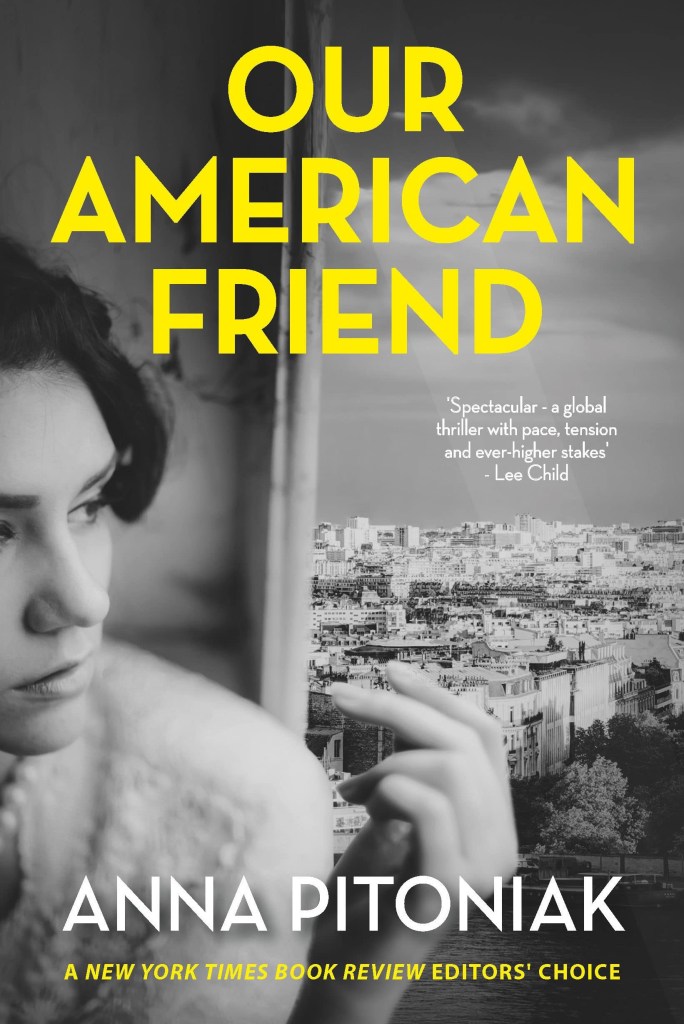
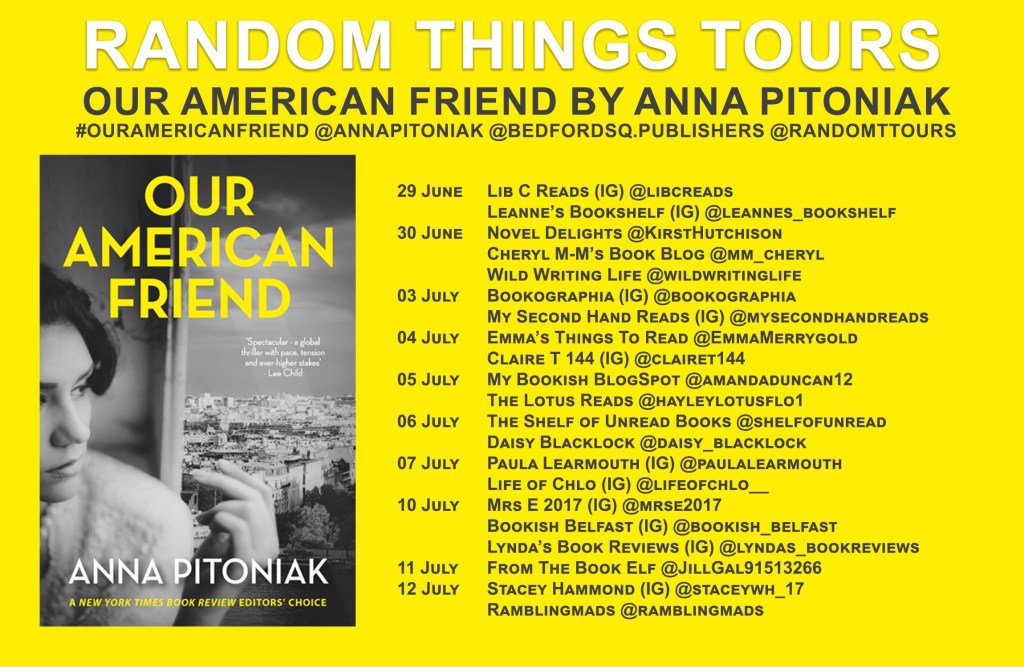
Our American Friend by Anna Pitoniak

A mysterious First Lady. The intrepid journalist writing her biography. And the secret that could destroy them both. Tired of covering the grating dysfunction of Washington and the increasingly outrageous antics of President Henry Caine, White House correspondent Sofie Morse quits her job and plans to leave politics behind. But when she gets a call from the office of First Lady Lara Caine, inviting her to come in for a private meeting with Lara, Sofie’s curiosity is piqued. Sofie, like the rest of the world, knows little about Lara – only that she was born in Soviet Russia, raised in Paris, and worked as a model before moving to America and marrying the notoriously brash future president. When Lara asks Sofie to write her official biography, and to finally fill in the gaps of her history, Sofie’s curiosity gets the better of her. She begins to spend more and more time in the White House, slowly developing a bond with Lara. As Lara’s story unfolds, Sofie can’t help but wonder why Lara is rehashing such sensitive information.Why tell Sofie? And why now? Suddenly, Sofie is in the middle of a game of cat and mouse that could have explosive ramifications.

I read a very odd tagline to a review for this book that likened it to Emily in Paris and the TV series Scandal – the comparison to either is inaccurate, because while this has the addictive quality of a thriller it goes much deeper and is clearly well-researched. The blurb immediately took me to Donald Trump and his rather enigmatic First Lady, Melania. A very different First Lady from her predecessor Michelle Obama, she certainly didn’t fit the usual mould and curiosity about their relationship and her past is certainly perfect material for a good thriller. I’m not the first to wonder whether they met at the notorious parties in NYC where very young models were supplied to meet wealthy and powerful men. The potted biography of our character Lara Caine certainly seemed to echo Melania’s journey towards becoming the President’s wife, so this hooked me straight away.

The author sets her characters within the current political climate, the era of fake news, conspiracy and what seems like a complete lack of accountability. I’m not alone in wondering who to believe any more and constantly searching for the truth beneath the headlines. The author certainly conjures up this complicated present and what it’s like to be a journalist within this maze of misinformation, but she also weaves in the fascinating Cold War era, a time absolutely ripe with complicated plots and conspiracies. It’s a clever combination, because when we think back to America and the Cold War we think of the containment of Russia, the Berlin Wall, the arms and space race between the US and USSR, and the Cuban Missile Crisis. At this time even a hint of collaboration between East and West rising to the surface, was investigated robustly and punishments were harsh. McCarthyism was the epitome of the type of paranoia on display as actors and other people working in Hollywood were interrogated and their movements restricted if any socialist or communist sympathies were found. In this country the Profumo affair brought to light a sexual scandal where our Secretary of State for war was having an extra-marital affair with 19 year old model Christine Keeler, who was also sleeping with a Russian naval attaché. Again the root of the problem was secret parties held by osteopath Stephen Ward, where he introduced young models that he knew to powerful men in politics and possibly in the Royal Family too, as portrayed in the series The Crown. This book contrasts these two moments in history as we travel back and forth in time to uncover Lara’s story. It seems that where there were once barriers, there are now complex financial and political relationships between old enemies. Russian financing seems to be behind many Western political campaigns including our own Brexit referendum. Is this simply business or have our old enemies found a more creative way to destabilise the West? I find these complicated collaborations fascinating, so this was fertile ground for a very enjoyable novel as we moved through Paris, Moscow, Washington and New York.

Anna Pitoniak uses the character and background of Lara to explore these contrasting time periods in politics. She could have been a cipher, but she’s more than that and is definitely intriguing from the start. Why would the First Lady approach a journalist who is retiring from politics and whose own political leanings are at odds with the President? Why is she choosing to share her life now, especially when there are so many secrets and who is her reader? Is she perhaps getting ahead of a narrative she knows will come out anyway, creating a chance to influence the story and perhaps gain sympathy from the reader. Sofie has to wonder whether she’s been chosen because the First Lady has had a change in outlook or because her choice of a liberal journalist will influence readers into thinking the book is a fair account, more balanced than if she’d chosen a right wing author. All of these questions were running through my head while reading, as if there aren’t enough on the page. I was full of suspicion, but Lara seems open and welcoming, giving Sofie access to her life. Slowly a relationship builds between these two very different women, potentially a friendship. There is trust but does it really work both ways? Lara gives Sofie previously hidden stories from her childhood and adolescence with access to close family members as a back up. Yet I understand Sofie’s confusion, as she starts to like this woman but remains opposed to everything about Lara’s husband – his politics, morality and the way he’s conducted himself in office. So when Lara discloses a huge secret, something serious enough to upset not just her family but global politics too, she may as well have handed Sofie a ticking time bomb. It’s a journalist’s dream to have such a scoop, but there’s a certain amount of trepidation too. This is a slow burn of a novel, but it is engaging and once you’re hooked you’ll want to see what happens. There are some twist and turns to keep the reader entertained, but the author always keeps it intelligent and historically factual underneath, especially in the Cold War sections. While I didn’t form an attachment to either character I did enjoy the story, showing how the things most important to us like love and family become threatened when pulled into the world of espionage. There are also themes of complicity and the lack of integrity rife in modern-day politics, so current as we go through scandals such as Partygate and see the daily revelations from the COVID Enquiry. I also enjoyed reading a political thriller with two women as the focus, something often lacking in this genre. This is my first novel by this author and I look forward to reading others.

Released by No Exit Press in the UK on 29 June 2023.

Meet the Author

Anna Pitoniak is the author of The Futures, Necessary People, Our American Friend, and the forthcoming The Helsinki Affair. She graduated from Yale, where she majored in English and was an editor at the Yale Daily News. She worked for many years in book publishing, most recently as a Senior Editor at Random House. Anna grew up in Whistler, British Columbia, and now lives in East Hampton and New York City.

Posted in Random Things Tours

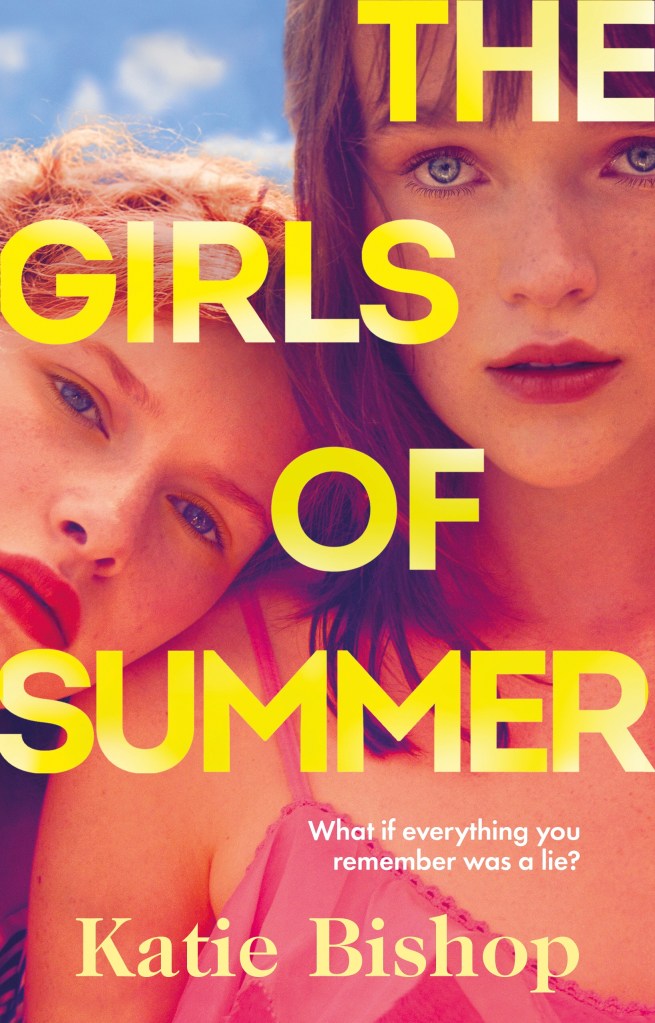
The Girls of Summer by Katie Bishop

Rachel has loved Alistair since she was seventeen.

Even though she hasn’t seen him for sixteen years and she’s now married to someone else.

Even though she was a teenager when they met.

Even though he is almost twenty years older than her.

Now in her thirties, Rachel has never been able to forget their golden summer together on a remote, sun-trapped Greek island. But as dark and deeply suppressed memories rise to the surface, Rachel begins to understand that Alistair – and the enigmatic, wealthy man he worked for – controlled much more than she ever realized.

Rachel has never once considered herself a victim – until now.

I devote a lot of my time to reading, but there are times when a book makes me drop everything. I carry it in my bag to read while waiting for appointments. It takes precedence over Netflix and all the other streaming channels that lure us into watching the screen every evening. I spent my whole morning in pyjamas reading, because I needed to finish this novel in one greedy gulp. I was completely transfixed by this story of a young girl taking a holiday to Greece that completely changes her life. Rachel is a naïve seventeen years old when she sets out to the island for a holiday with her friend Caroline. She sells it to her worried parents as being no different to a gap year, just a year earlier than normal. Once on the island they meet a group of girls who work in a local bar, belonging to entrepreneur Harry Taylor. When Rachel meets his right hand man Alistair she feels an immediate attraction but does he feel the same way? Surely she isn’t going to capture the attention of a handsome and sophisticated older man. She does notice him looking at her and it sends a shiver through her. Rachel has never thought of herself as beautiful, especially next to the other girls here, but as Alistair singles her out for attention she feels special. They have a connection, so strong that she makes a huge decision. She isn’t going to return to England with Caroline at the end of the holiday. She is going to work in the bar alongside the girls she’s made friends with and share their rather chaotic house nearby. Why would she return to her parent’s suffocatingly ordinary semi and her A’Levels when she can be on this golden island with Alistair and frequent the glamorous parties held by his mysterious boss at his enormous villa in the hills?

The structure of the book is interesting, because usually in time slip novels we have a protagonist in the here and now trying to solve a mystery interspersed with glimpses into the past that make sense of the present. Here the author turns that on it’s head. Rachel, now in her thirties and married to Tom, knows what happened in the past. She holds her relationship with Alistair up on a pedestal, their love was special and those months with him on a beautiful Greek island have been her benchmark of how love should be. It’s a revisit to the island with Tom and bumping into Helena that starts to unravel the rather idealised past she’s been narrating to us. The present actually deconstructs her past. As each new revelation washes over Rachel in the present it takes us into a past that’s changed a little, becoming murkier and more sinister. Rachel is still friends with Jules, a friend she made on the island who was separate to the bar. In fact it’s Jules who gives seventeen year old Rachel a warning, the locals think there’s something ‘off’ about the bar and perhaps it would be best to stay away. In the present Jules and her husband have Rachel and Tom over for dinner. They’re chatting about having a family, but Rachel and Tom have been trying for around a year without success. Tom mentions that they’ve talked about seeing a doctor to have a few things checked out when Rachel responds angrily that he wants to see a doctor, she hasn’t agreed to anything. Her harsh responses change the night and seem out of character. She’s told us about how easy it was to fall in love with Tom and how they’d taken steps to move in together almost without realising it, when she’d stayed for a few days while some work was being done on her flat. Of course by now we know that Rachel has Alistair’s number and has made plans to see him again. Could that have made her less invested in her future with Tom? Later we see that she’s stashed her contraceptive pills in a box of sanitary towels under the bathroom sink, she’s still been taking one regularly every day.

IT’S TOO HOT to be outside for long. Sweat is starting to dampen my scalp, thickening in the roots of my hair and pooling in the crevices of my collar bone. My t-shirt sticks to my spine and my arms are tinged pink, an ungainly line of skin beginning to blister along the top of my thigh in the almost unseasonable blaze of sun. I curl my toes into the damp sand and feel the sharpness of a small shell against the sole of my foot.

Our setting so powerful, that beautiful sun soaked island with the sound of boats rocking rhythmically in the harbour and that incredible opening line that took me straight back to standing in the sea and feeling that sharp edge of a sea shell. She captures that push and pull between the tourists and the locals who, even thought they’re in exactly the same place, see it completely differently – rather like Rachel and the other girls. I could see the slightly scruffy house they all share and the chaos and fun of getting ready together, sharing clothes and cheap bottles of wine. Harry’s house in the hills is another contrast, sleek and modernist with contemporary art on the walls. Even the sea looks different from high in the hills, appearing flat and smooth like a lake on the surface, but with dangerous riptides underneath. The present sections mainly take place in London and the author shows us the city as visitors probably don’t see it. She describes a rather special Sunday evening feel to the tube when it’s almost empty and strangely quiet, as if having a rest before the Monday morning commuter rush. She describes sudden rain showers and people having to improvise and use their handbag to shield their hair from the downpour. Rachel loves living in the capital, compared to her parent’s suburban family home. There’s an energy and unpredictability to it’s rhythms, a sense that there are so many options, anything could happen. Whereas home has a particular tameness and routine that Rachel finds stifling. Could Rachel’s decision to stay on the island and even her attraction to Alistair have something to do with the way she views her mum and dad’s life? We see Rachel fighting something similar in her marriage, the ordinariness igniting that constant yearning for something more, something others can’t see:

She was ‘hoping this trip would reignite some of the heat that has been missing from my marriage. Instead, I look across at my husband and feel faintly repulsed. His underarms are damp and staining the shirt he put on especially for our last night here. He’s staring out at the sea, but I know he isn’t seeing it the way I do. To him it could be anything. Any view, anywhere. To me the swell of the tide speaks of secrets, the salty air smelling irrevocably of promise.’

It’s very easy to understand the teenage Rachel. I fell in love at seventeen and had my heart broken. For years I idealised that relationship, using it as a benchmark for subsequent relationships that in hindsight had much more potential. She is so naïve that she can’t see what’s happening and how much she is being controlled. It’s almost apt that the book should come out in the light of the Phillip Schofield scandal, because it struck me how the responses to what happened are very different to the responses we might have had when I was seventeen in the early 1990s. Our gradual understanding of coercive control, grooming and power imbalances in relationships have coloured the way we view all relationships completely. An affair with a much older man probably wouldn’t have raised much of an eyebrow then, it’s only with hindsight that it becomes worrying. It’s only once the affair is viewed through the prism of our later experiences, such as having our own daughters, that our perspective changes. The #MeToo movement has changed how we see things. When I watched the film Bombshell I talked with friends I’ve had since I was a teenager and as the author writes in her afterword, we’ve all had experiences: of being groped without consent while waitressing or working behind a bar; having a boss who was a bit ‘handsy’ or made inappropriate comments; being touched an a crowded dance floor at a club. One of the most disturbing stories I have ever heard was from a woman who had known ‘wrestling’ between boys and girls in the school playground turn into sexual assault. I love that my stepdaughters are so much better informed than I was and are very conscientious about keeping each other safe when out with friends, although it frustrates me that they have to be so vigilant just to go out on a Friday night.

The Girls of Summer was born out of this strange and sometimes conflicting intersection between nostalgia and trauma, memories and the truth, power and sexuality. It explores the grey areas of consent, deepening a debate that has shifted and broadened since the #MeToo hashtag first took social media by storm. It interrogates what it means when we are forced to reframe a narrative that is so central to who we are that we aren’t sure who to be when that narrative turns out to be false. Is it better to face up to this truth, and all of the pain that comes with it, or to keep it hidden in the dark?

The Girls of Summer, Afterword

Watching the teenage Rachel walk into danger is upsetting because this reader was ahead of the narrative and knew something was very wrong with the island set-up, particularly the extravagant parties. There was no explanation for all the male party guests and the mysterious Harry rarely appeared. On her way to a party, Rachel is excited and hopes Alistair loves her dress, she’s grateful that the girls have been invited never realising that they are the reason for the party. The gaslighting afterwards was painful to read – ‘you had fun didn’t you?’ Or ‘don’t feel bad about what happened, it’s okay, you enjoyed it.’ When they’re in the middle of that level of pressure, manipulation and controlling the narrative how would they be able to see through it and understand what’s truly going on? Even for an adult Rachel it’s hard. Her relationship with Alistair and it’s veracity is part of who she is, how she views men and relationships and determines her friendships with the very women who might understand her most. When the truth of everything is revealed, the horror of the Full Moon party and further painful revelations, it’s so hard for her to absorb and accept it. I found it deeply sad that even towards the end of the book, Rachel has still held a tiny shred of hope that her version of the relationship with Alistair will prove to be the love story she wanted.

When the truth is so deeply painful and damaging, isn’t it understandable that she would want to sugar coat things a little? To push away the truth and not have to confront what happened to you. To not feel like a victim. I could truly understand the women coming together to confront the past and I found myself thinking about how powerful men frame the narrative. They talk about a cabal or coven of women coming together to destroy them. Women who have been taking drink or drugs and having an encounter they bitterly regret in the morning. I can only imagine what effect it must have on the individual, to hear comments like Prince Andrew’s ‘I have absolutely no memory of ever meeting that woman’. For Rachel, who lost absolutely everything that summer, the denial of her experience actually brings the first chink of light into her situation. I felt hopeful that with the help of this group of women, friends like Jules and an acceptance of the truth she could start to rebuild. The fact that I’m talking about Rachel like this, as a real person, is testament to the brilliant writing of Katie Bishop. She has created a real, flesh and blood woman in Rachel and I found myself almost wishing I could see her as a client, I so wanted a recovery for her. This is a powerful story, that may trigger some people who’ve had similar experiences, but it’s important for stories like this to be told. I could really see this as a television series, with some reviewers seeing a similarity with The White Lotus – a beautiful setting, a luxury resort and the dark truths lurking underneath all that perfection. I loved the ending though, a return to that beautiful place but with the ability to see the reality instead of a fantasy. I wanted her visit to the island to be different to the one she had with Tom at the beginning of the book. To accept that she will never feel the excitement and promise she felt all those years ago, but that she will experience new feelings that are every bit as worthwhile.

I had thought I could recapture something of how I felt all those years ago by coming back here, but it has only served to remind me how slippery and impossible it is to summon the past. Perhaps this is simply the nature of growing up. Of growing older. Perhaps I will never feel the same again.

Meet The Author

Katie Bishop is a writer and journalist based in the UK. She grew up in the Midlands before moving to Oxford to work in publishing in her early twenties. Whilst working as an assistant editor she started writing articles in her spare time, going on to be published in the New York Times, Guardian, Independent and Vogue.

Katie started writing The Girls of Summer during the first UK COVID lockdown, after becoming increasingly interested in stories emerging from the #MeToo movement. The novel is inspired by her own experiences of backpacking, and by her interest in how our personal narratives can be reshaped and understood in light of cultural and social changes.

In 2020, Katie moved back to the Midlands, and now lives in Birmingham with her partner. She is a full-time writer.

Posted in Orenda, Random Things Tours

The Fascination by Essie Fox.

Victorian England. A world of rural fairgrounds and glamorous London theatres. A world of dark secrets and deadly obsessions…

Twin sisters Keziah and Tilly Lovell are identical in every way, except that Tilly hasn’t grown a single inch since she was five. Coerced into promoting their father’s quack elixir as they tour the country fairgrounds, at the age of fifteen the girls are sold to a mysterious Italian known as ‘Captain’.

Theo is an orphan, raised by his grandfather, Lord Seabrook, a man who has a dark interest in anatomical freaks and other curiosities … particularly the human kind. Resenting his grandson for his mother’s death in childbirth, when Seabrook remarries and a new heir is produced, Theo is forced to leave home without a penny to his name. Theo finds employment in Dr Summerwell’s Museum of Anatomy in London, and here he meets Captain and his theatrical ‘family’ of performers, freaks and outcasts.

But it is Theo’s fascination with Tilly and Keziah that will lead all of them into a web of deceits, exposing the darkest secrets and threatening everything they know…

Exploring universal themes of love and loss, the power of redemption and what it means to be unique, The Fascination is an evocative, glittering and bewitching gothic novel that brings alive Victorian London – and darkness and deception that lies beneath…

As regular readers to this blog know, I am never happier than when I’m reading a book about the seedy underbelly of Victorian society. I love being able to disabuse people of the notion that the Victorians were so buttoned up they would cover the legs of a grand piano! In fact the Victorians were no different to us, trying to keep a veneer of respectability on the surface whilst having all manner of private interests and lifestyles underneath. Essie Fox has created an absolute phantasmagoria of fairgrounds, travelling ‘snake oil’ salesmen, freak shows and private bestiaries. Her vivid descriptions really grabbed me early on and they create such a strong, colourful sense of place. This is the written equivalent of The Greatest Showman or a Baz Lurhmann film like Moulin Rouge, a dazzling spectacle that tantalises the senses. However, as with all shows, away from the bright lights and trickery there is a darker history and the author doesn’t shy away from showing it to us. There are those addicted to opium to dull their mental and physical pain and others who are dependent on the fake ‘cures’ offered by the twin’s father. Out of all people who are other, some find the relative safety of a troupe or family put together by someone like the Captain, others are less lucky and end up enslaved, forced into degrading displays with no means of escape. There are greedy men, pillaging the world for various specimens of flora and fauna, similarly there are more specialist collecting men like Lord Seabrook who keeps a private collection of human freaks with no understanding that these are people not specimens.

Women are shown to be particularly vulnerable to exploitation. Our central characters, Keziah and Matilda are sold, but are very lucky to end up with the Captain who keeps them and places Matilda in various pantomimes and shows in the West End. There’s a conflict here between our outlook on disability today and that of 150 years ago. We might look at freak shows and displays with distaste, but without a welfare state and with superstition and shame surrounding disabilities and disfigurements, they were a legitimate and lucrative way to earn money. If the decision to display their unusual body was an independent one and they received a decent portion of the money they earned it could allow a person with a disability to support themselves. Matilda has the addition of a beautiful voice, a talent that would interest London theatres rather than a freak show or circus. The vulnerability of all women is shown by those like Mrs Miller, friend and patron of our hero Theo, who admits to an unexpected pregnancy in her youth and a baby born with wings or shoulder blades that developed outside the skin. Her condition left her penniless and abandoned by her lover, then bereaved when she wakes after the birth to be told her child has died. Women with differences were exploited terribly, from freak shows to private displays in gentlemen’s clubs and large private homes, all the way to brothels who had workers for the more unusual tastes. I feared for the twins who are both vulnerable, but especially Matilda who craves the pretty clothes, the bright lights and the adulation of the crowd. The author fills her performances with a sense of wonder as she flies over the heads of her audience with her iridescent fairy wings. Her love for this incredible feeling does lead her down a dangerous path, with Keziah and the Captain worried for her life.

The twins path crosses with Theo’s as they travel with their father and the fairground, but it’s as he meets them again in London that their stories cross over and his fascination with them continues. His father, Lord Seabrook, has a love of human curiosities and the ruthless way he dispenses with his own son made me wonder what lengths he might go to if he sees something he wants for his collection. I enjoyed the crossover between Theo’s interest in medicine as a career and the way he ends up earning a living at Dr Summerwell’s Museum of Anatomy. Obviously, medical researchers are also interested in difference and disfigurement, just with a slightly different gaze. Yet I don’t think Theo expected to be in a shop with leathery bats wings hanging from the ceiling and a model of the insides of a pregnant woman on display. The history of medicine is fascinating and this type of medical study leads to the classification and medicalisation of disability we see today. The author cleverly explains the changes in how disfigurements were viewed in the character of Martha who has a hare lip and wears a veil outside to cover her face. In times past a ‘hare’ lip, now known as a cleft lip/palate, would have been viewed with superstition and it was thought to be caused by a hare startling the pregnant woman. It’s now known that the lip and palate don’t develop properly and it’s usually corrected by surgery. Here Essie Fox tells us about the new operations in the 19th Century using pieces of wood or a piece of flesh taken from the leg to stitch the skin over and close the gap. It shows how something once inexplicable goes from being magical or suspicious to become something medical to be cured. I really enjoyed and appreciated the background research lying underneath the fantastical surface.

This really is a magical bit of storytelling with a couple of great heroines who I was rooting for throughout and a hero I was very unsure of till the end. I admit to being a little bit in love with the Captain with his long silver hair, his musical talent and his lost love. Having a disability myself I was firmly on the side of those thought of as ‘other’ and there are messages here about accepting difference that are just as pertinent in the 21st Century. I also felt there were warnings about over-medicalising difference. Labels are important in some ways, but they can also restrict and mislead. When counselling, if I see people with my disability, multiple sclerosis, I remind them that this is known as the ‘snowflake’ disease; from a distance it’s the same, but when you look closer we’re all uniquely different. This is a wonderfully Gothic tale, but is also full of colour, humour, love and life – in all it’s wonderful forms.

Meet the Author

Essie Fox was born and raised in rural Herefordshire, which inspires much of her writing. After studying English Literature at Sheffield University, she moved to London where she worked for the Telegraph Sunday Magazine, then the book publishers George Allen & Unwin – before becoming self-employed in the world of art and design.

Always an avid reader, Essie now spends her time writing historical gothic novels. Her debut, The Somnambulist, was shortlisted for the National Book Awards, and featured on Channel 4’s TV Book Club. The Last Days of Leda Grey, set in the early years of silent film, was selected as The Times Historical Book of the Month. Her latest novel, The Fascination is based in Victorian country fairgrounds, the glamour of the London theatres, and an Oxford Street museum full of morbid curiosities.

Essie is also the creator of the popular blog: The Virtual Victorian She has lectured on this era at the V&A, and the National Gallery in London.

Posted in Publisher Proof, Random Things Tours

Henry VIII The Heart and the Crown by Alison Weir

I came to this book with quite a store of Henry knowledge – I promise not all of it comes from The Tudors, but this has been a great excuse to dig out the series again and enjoy Henry Cavill in leather trousers. In my previous home I had the alcoves each side of my fireplace turned into bookshelves and one side was all books on the Tudor period. A mix of novels and non-fiction it covered all the usual authors: David Starkey, Phillipa Gregory, Lucy Worsley, Alison Weir and many more. I have read each of Weir’s six wives series and her other novels on Elizabeth I and Lady Jane Grey. Her last novel was based on Elizabeth of York, Henry’s mother and daughter of Edward IV. All of them have been that brilliant mix of sound background research and an ability to get inside the characters and bring them to life. However, you don’t have to read any of her earlier work to enjoy this book, I’m just a Tudor Nerd! I wondered how Henry would fare, given that her previous books have shown great empathy for the position women found themselves in at the Tudor Court, especially where that ill treatment was at Henry’s hands. Interestingly, I read this alongside Prince Harry’s autobiography Spare, something that fascinated me given that Henry VIII’s story is largely influenced by that dynamic of ‘heir and spare.’ Henry is the man who was never intended to be king. Only the death of his brother Arthur, Prince of Wales, opened the way for a king who seemed almost meant to be. How could this well-built, ornately dressed and powerful man of the Holbein portrait not have been the King? It seems strange to think he was probably destined to be Duke of York and of much lesser importance than the huge presence he still is in our royal history. Did I see parallels between the man whose Twitter followers call Good King Harry and this similarly red-haired Tudor spare? Only a few!

I thought what Weir did really well was put Henry’s controversial and bloody reign into context. It’s easy to forget where Henry comes from and how violent and treacherous the route to the Crown was prior to his birth. As Weir explains, Henry’s maternal grandfather was Edward IV, a man who took the crown in the years of fighting between the York and Lancaster royal houses, known as the Wars of the Roses after the county emblems of the white and the red rose. However, it was also known as the Cousin’s Wars and to put that in a modern context it’s as if Princes Harry and William fought for the crown against Princesses Beatrice and Eugenie. It took a concerted effort by Henry’s grandmothers Margaret Beaufort and her rival Elizabeth Woodville to bring both houses together with a royal marriage and the new emblem of the Tudor Rose. Margaret was Henry VII’s mother and fought hard for her son to claim his crown, which he eventually did on the battlefield against Richard III. Elizabeth was Edward IV wife and despite losing both her sons, the rightful heirs to the throne who are believed to have been murdered in the Tower of London, she encouraged her daughter Elizabeth of York to make a political marriage to Henry Tudor, the new King. The emblem of their arranged marriage was a red rose for Lancaster with a white centre for York. These became known as the Tudor Rose and can be seen in many Tudor palaces and churches like York Minster. The country had endured years of in-fighting, from huge battles to hidden murders such as Edward IV and Richard, then Duke of York, allegedly murdering their brother by drowning him in a barrel of malmsey. Henry’s parents brought some stability to the country, despite Henry VII’s constant paranoia about usurpers and the lost Princes from the tower reappearing. If we imagine all of this followed by the death of Henry’s elder brother Arthur who died without heirs, it’s possible to see some of pressure upon the young king’s shoulders. Considering the paranoia he witnessed in his own father and his grandmother Margaret who drilled it into Henry that the only way to keep the crown secure was to have heirs, we can see the seeds of Henry’s own obsessions, paranoia and hatred of betrayal.

Often we only see the later King Henry on television and in fiction, because those latter years of his reign from meeting Anne Boleyn onwards are so dramatic. It’s easy to forget that Henry ruled and lived happily with his first wife and Arthur’s widow Catherine of Aragon from 1509 until he met Anne Boleyn in 1525, although he remained married to Catherine until 1533. There are only fourteen years between his marriage to Anne until his own death in 1547, in which he married, divorced or beheaded four more wives. I loved how Weir captures the earlier and often ignored years of Henry’s reign because we see something of the great prince that all of Europe were talking about. A tall, handsome and robust young man in direct contrast to his brother Arthur, he was also a great horseman and a competitive jouster. He was often reprimanded for missing lessons in order to go hunting or practising in the tilt yard with his companions, usually Charles Brandon. Yet he wasn’t just an imposing physical presence, Henry was very intelligent in that he spoke French and understood Latin and was even taught by the philosopher Erasmus. He could compose music and was an elegant dancer, with a definite eye for the ladies of the court. Even his early happy years with Catherine were littered with affairs, the most famous being Anne’s sister Mary Boleyn and Bessie Blount, both of whom were rumoured to have the King’s illegitimate children. It was interesting to read about Henry’s role in welcoming Catherine as Arthur’s bride and how much he admired her from a very young age. After Arthur’s death he was adamant he wanted to marry Catherine, with a dispensation sought from the Pope for their union. Henry’s father seemed reluctant to solemnise the match, despite a betrothal ceremony taking place. I have read elsewhere that the King had considered Catherine for himself and it was only when the King died that their marriage took place, in fact it was one of the first things Henry did as King. He may not have been faithful physically but there was a constancy in Henry’s feelings for Catherine, he admired her greatly and felt she would be a fitting queen for him.

Weir also shows how different Henry’s court was from his father’s. Henry VII had faults, but he was contemplative, careful when making decisions and had financially secured their reign after finding a depleted treasury due to years of war. Henry wanted to be a generous King, known to keep a a celebratory and ostentatious court. He undertook building new palaces, promoting art and culture, keeping a generous table and was determined to use some of the money saved by his father to take Calais and become King of France once more. He wanted to excel in all things, but this extravagance was also a sign of things to come, developing from generous young King to a petulant and spoiled man with a body ruined by greed, excess and risk taking. The most damaging risk being his jousting accident, where he was knocked out cold for some time and sustained a leg wound that never healed, caused intense pain and smelled terrible due to infection. I have often wondered whether it was possible that he sustained a head injury in this accident, because it does seem to be a turning point in his life, after which he made several questionable decisions. He decreed that his courtiers should acknowledge and accept his relationship with Anne Boleyn as well as his plan to make her Queen. His insistence on this point led to a relationship breakdown with one of his most trusted advisors, Sir Thomas More. The day he executed More was also a point of no return, I believe it haunted him for the rest of his life that he’d killed a good man, a man of God.

Weir made me look at Henry’s early life with more empathy than I have before. She brings to life the childhood loss of his mother (another event in common with our Prince Harry) and the huge impact it had. He remembers her softness and her gentle voice, a memory he needs when his father is preoccupied with duty. Henry has to grow up early, but little reminders of his mum pop up everywhere, especially her smell. I felt he could have been a different man if she had lived. There are some warning signs of the tyrant he becomes, because he’s jealous of Arthur from a young age. Arthur keeps his own court in Wales and Henry would love to have his own court, his own income and a bit of Arthur’s power, not to mention wanting Arthur’s bride from when she first arrived in the country. When all of it becomes his I did wonder whether there was a bit of survivor’s guilt. His father’s paranoia about losing the crown and his over-protectiveness after the death of his first son, mean he keeps Henry from carousing in bars with his friends and preserves some of his reputation for marriage. Weir shows us the weight of that history and expectation on the young prince’s shoulders. It’s something Henry is constantly pushing against, so that when he does unexpectedly become King he is determined to make changes. He has a tendency to promote men who are self-made, above the usual courtiers or advisors of his father’s. He relies on Cardinal Wolsey and after that he promotes Thomas Cromwell, a commoner and son of a blacksmith. The men who advised his father are old now and have known Henry his whole life, they’re aware of a recklessness in the young King that needs reigning in. Newly made men show the deference Henry expects as a King, but being younger and perhaps more aware of the way the world is changing they also allow him to take risks. We also see Henry’s own paranoia emerging when he and Catherine start to lose children, most particularly his two month old son. I felt like I understood Henry better after reading this novel and it was interesting to see some thoughts I’d had about Henry’s personality and behaviour placed in context. I didn’t like him more, but I did feel sorry for him in parts especially in his difficult relationship with his father. Weir provides possible reasons for the cruel and changeable behaviour that made Henry the most famous King in our history. I felt completely immersed in his psyche but also the whole Tudor court because Weir breathes life into a story we all know something about, turning historical caricatures into real people. Their problems also seem less far-fetched given Royal headlines over the last few years, although this spare ended up with the crown.

Many thanks to Headline Review and Caitlin Raynor for my proof copy of this novel and to Anne at Random Things Tours for my place on the blog tour and your support.

Meet the Author

Alison Weird is a bestselling historical novelist of Tudor fiction, and the leading female historian in the UK. She has published more than thirty books, including many leading works of non-fiction and has sold over three million copies worldwide. Her novels include the Tudor Rose trilogy which spans three generations of history’s most iconic family – The Tudors, and the highly acclaimed Six Tudor Queens series about the wives of Henry VIII, all of which were Sunday Times bestsellers. Alison is a fellow of the Royal Society of Arts and an honorary life patron of Historic Royal Palaces.

Posted in Orenda, Random Things Tours

Thirty Days of Darkness by Jenny Lund Madsen

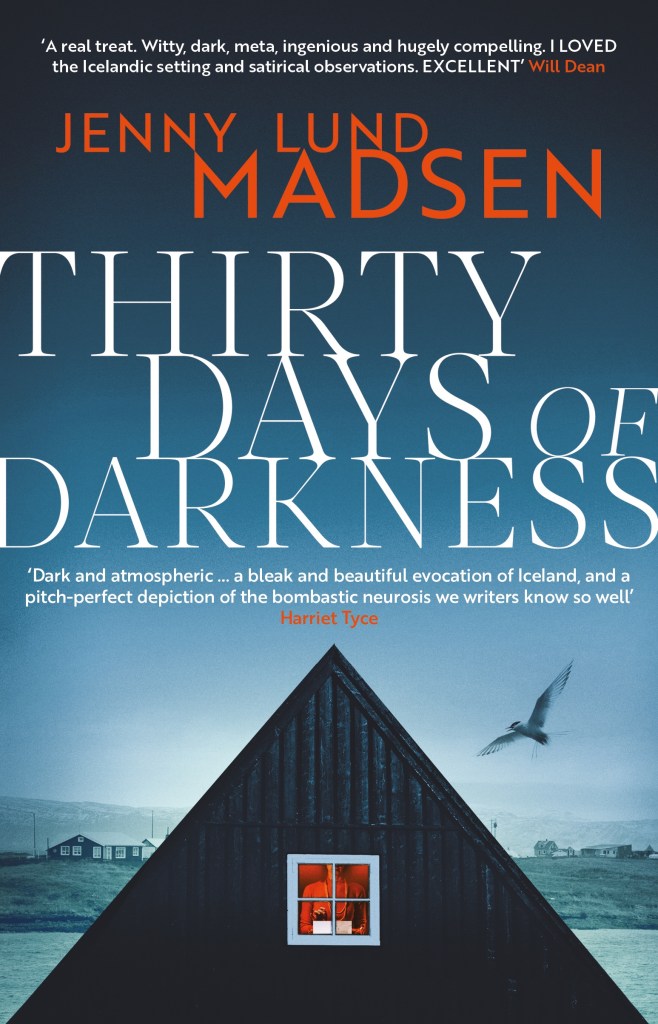
The first thing I loved about this book was that stunning cover. I hadn’t fully taken it in when I received the book, but once I’d found my reading glasses I couldn’t stop looking at it. That tiny lit up window, a little orange glow of creativity in the darkness really fired up my imagination. I’d love Orenda to create some book posters to accompany their author’s work. The blurb drew me in with it’s conflict between genre authors and their supposedly high brow literary fiction colleagues. Hannah writes literary fiction and is dismayed at a book festival to see the crowds attending a Q and A with Jørn Jenson, the darling of Scandi Noir, who churns out a formulaic book every year. Yet he’s filling a tent with fans and she’s in a lonely booth waiting for someone to drop by. I loved that she launched a book at his head! In the ensuing row, Jensen goads Hannah into saying she could write a crime novel in a month. Her agent uses the incident as a great marketing strategy and pours fuel on the fire, talking to the press about the wager and even putting Hannah on a plane to Iceland as a writing retreat. There she will live with a lady called Ella and hopefully, within thirty days, complete a commercial success. Yet within days of Hannah’s arrival there’s a real life crime, as Ella’s nephew Thor is found drowned in the waters of the harbour. Can Hannah use the case to write her crime masterpiece? As she starts to ask questions about this small town community will she find inspiration, or will she be in more danger than she ever imagined?

Hannah is an interesting heroine in that she isn’t all that likeable at first. She’s prickly, arrogant and a definite book snob.

“Hannah Krause-Bendix has never received a bad review. Not once has anyone had a negative thing to say in any of the reviews of her four novels. A literary superstar, twice nominated for the Nordic Council Literature Prize. Didn’t win, but that doesn’t matter; anyway, she doesn’t believe the mark of good literature is how many awards it’s won. She’s actually refused the numerous other prizes she’s won over the years. No – Hannah sees herself as a forty-five year old living embodiment of integrity and will always maintain that it is beneath her to seek commercial success.”

I was starting to feel sorry for her editor and publisher. Her disgust for the current literary scene is obvious. She hates festivals and signings, prizes, social media and is dismissive of bloggers (how dare she – *swoon*). As she picks up Jensen’s latest book as if it is ‘a pair of homeless man’s lost pants’ she notes that most of the reviews are from obscure bloggers she’s never heard of. She’s no better as she arrives in Iceland, annoyed that her new landlady is late, that her jeep looks and sounds like it’s five miles off it’s new home at the scrap yard, plus she drives with her steamed up glasses so close to the windscreen that Hannah wonders whether she can drive, or even see. Then she makes the terrible faux pas of calling her friend and publisher Bastian to get her a flight back to Copenhagen, assuming Ella can’t understand her. Of course she can. I was cringing about her behaviour. Yet I didn’t dislike her. Despite these failings, plus the alcoholism, infidelity, snooping and complete conviction she’s in the right, there’s something rather freeing about her impulsiveness. We all have those thoughts, those imps of the perverse, that pop into our mind and encourage us to poke that person who’s bending over to reach a low shelf in the supermarket. We don’t do it of course, but Hannah does. In the course of the novel she randomly feels a homeless man’s head, buys the town teenagers alcohol, starts an affair with someone she’s barely met and as we know, tries to hit a man in the head with a book. She seems disconnected from others in the sense that we don’t know her family, she has few obligations and she thinks nothing of asking very personal questions in entirely inappropriate circumstances. I sort of loved that.

There is definitely a blackly comic element to this story and a satirical eye for both the book world and crime fiction in general. There’s a meta element to the story too, as Hannah makes observations and discoveries about crime fiction that then seem to bleed into the actual case. She observes that her investigations are suggesting the case is actually quite simple to solve, Jørn, who has followed her to Iceland, advises that in crime fiction the killer is never the most obvious suspect. Subsequently, her enquiries move from the her current suspect and start to take a darker turn, towards the last people she’s suspected. Jørn tells her:

“ a good crime novel has three crucial components. One: a spectacular and violent opening, preferably a murder. Two: false leads and false suspects. […] Point three is surprises.’

He also rather amusingly points out that the protagonist shouldn’t be likeable, because no one enjoys a likeable protagonist in crime. In fact during a violent clash with her first, rather boringly obvious suspect, she even doubts her own credentials as a protagonist. As she fights for her life, she berates herself for her stupid plan of luring him to a window, because she’s now in front of an open window with a possible murderer.

Of course, he isn’t the murderer after all. In the end the crime is complex and rather like the book of Icelandic sagas that Ella gives her to read. The roots of this murder lie way in the past with the last people Hannah suspected. In fact in the echo of the saga, someone takes something that is highly prized and didn’t belong to them, setting in motion years of secrets, lies and denial. Yes, there’s a lot of the clever stuff going on that us ‘weirdo’ readers like, as one teenager describes Hannah’s fan base, but there’s also a solid thriller as well. It’s a bleak and claustrophobic atmosphere as soon as Hannah reaches the island where she knows no one and feels alien. The remoteness of the town and it’s isolation when the bad weather comes just add to that sense of being completely alone. This is not a place to be injured or to be a victim of crime; there is only one police officer in town, with back up over an hour away on a good day. Jørn may preen and prance around like the archetypal action hero, but he is surprisingly very useful to have around in a sticky situation and despite his woeful writing, is possibly a good friend to have, especially where he’s the only familiar and friendly face. Alongside Hannah I suspected three or four different people and the author kept me guessing, just leaving tiny clues along the way. At first there was a little bit of scepticism -I remember watching Murder She Wrote with my parents when I was younger and my dad wondering why nobody told Jessica Fletcher to ‘bugger off and mind her own business’. However, once the action started to heat up I forgot that Hannah had no business interrogating suspects and just kept reading. She’s no Jessica and this is definitely not cozy crime. It’s dark, disorientating and scary as hell, but you’ll not be able to put it down. This is an incredible debut and I’d love to see where Hannah ends up next. Now back to that cover – I think it would make a lovely tote bag ……

Meet The Author

Jenny Lund Madsen is one of Denmark’s most acclaimed scriptwriters (including the international hits Rita and Follow the Money) and is known as an advocate for better representation for sexual and ethnic minorities in Danish TV and film. She recently made her debut as a playwright with the critically acclaimed Audition (Aarhus Teater) and her debut literary thriller, Thirty Days of Darkness, first in an addictive new series, won the Harald Mogensen Prize for Best Danish Crime Novel of the year and was shortlisted for the coveted Glass Key Award. She lives in Denmark with her young family.

Posted in Random Things Tours

When We Fall by Aoife Clifford

I’m slowly becoming a fan of ‘Outback Noir’ so I guess I picked up Aoife Clifford’s new novel with certain expectations. I was pleasantly surprised to find a few differences in this crime novel and a labyrinthine story that really pulls the reader into small town Australia with its complicated relationships. As one Merritt resident says:

“People here are a bit like trees, with roots deep in the earth, far more tangled than what’s visible on the surface.”

Criminal barrister Alex has returned to her home town to spend some time with her mother Denny and have one of those difficult conversations. Denny is struggling with dementia, but is stubborn and in denial. She had a distant relationship with her own parents and had Alex as a young Mum. Alex has bad memories of her grandparents so Merritt isn’t her favourite place, but Denny is getting worse, no matter how much she tries to cover it up and Alex must talk to her about sheltered accommodation. It’s on a beach walk trying to broach the subject that they find a dismembered leg with a distinctive black feather tattoo. It turns out that the leg belongs to art gallery owner Maxine MacFarlane and local police chief Kingsley ‘King’ Kelly dismisses it as a boating accident when the rest of her body is found further up the coast. But Alex’s barrister’s instincts tell her there might be more to this than meets the eye and she starts to snoop. King Kelly warns her off very early on and comes across as the archetypal small town cop – lazy, prejudiced and jaded, not to mention a misogynist. He holds court in his local cafe and seems well connected in the town, especially with people who matter. Alex wants to question a possible link between Maxine’s death and the disappearance of artist and activist Bella Gregg two years before. Not only did Bella exhibit at Maxine’s gallery, but as an activist she often protested wearing black feather wings that went missing at the same time she did. There’s also a strange symmetry about their autopsy results – Maxine was washed up on the sea shore but didn’t have saltwater in her lungs whereas Bella did have saltwater in her lungs but was found inland. There was also an upcoming exhibition at Maxine’s gallery, linked to Bella’s death. Could this have laid the blame for Bella’s death at a local’s door?

The plot is intriguing, full of different avenues that are never obvious. Some keep you reading ferociously but turn out to be red herrings, while truths lurk underneath like a riptide. One minute I suspected someone, then someone completely different, although that’s not surprising in a town where male suspects are plentiful. My eye was on King Kelly throughout because he’s a thoroughly unpleasant character, but there are strangers in town; a new doctor who’s just arrived, as well as a visiting investor in a potential eco-friendly extension of the town. Locally there’s the rep for the town extension who seems keen to do anything for a better future than the local fishermen he went to school with. Bella’s own stepfather is known to be dealing drugs and there’s even a link to Alex’s family, with one thread involving a GP who was the partner of her grandfather. The past definitely has a role here, both in the crime and in the questions Alex has about her childhood. I was nervous for her in a town where outspoken women seem to get silenced. Alex is just as stubborn as her mother once she has an idea in her head and she’s been without cases to distract her of late.

Aside from the crime, Alex has a lot to contend with: her husband Tom is pushing for their divorce to move a bit quicker; her career seems to have taken a nosedive since their separation; then there’s her formidable mother to contend with. I loved the snappish and often humorous dialogue between Alex and Denny. There was a lot of truth in their exchanges, but that humorous edge offered a bit of light in the shade of a terrible crime. Alex’s instincts are strong, she’s perceptive and intelligent but seems to have a blind spot when it comes to danger. She places herself in potentially life threatening situations without seeing the danger looming over her. I didn’t always understand why, but felt it might have had something to do with her childhood in Merritt. Clifford surprised me with Alex’s home town, because I didn’t get the dry outback setting I expected. Despite wanting to develop as a holiday destination, it didn’t feel very welcoming and it seems to be raining constantly. Everyone is in raincoats. This is a small seaside town and has a claustrophobic feel without the outback heat. She shows it through the people, like the local cop with a finger in every pie and suspicious residents who are reluctant to talk. She gave me an Australia I hadn’t seen before and it gave this read a unique feel. This was such a well-written book, sinister and complicated with an ending that felt just right. I’m now looking for a gap to read her earlier novels, because I’ve already ordered them.

Meet the Author

Aoife Clifford is the author of All These Perfect Strangers, which was long-listed for both
the Australian Industry General Fiction Book of the Year and the Voss Literary Prize, and Second Sight, a Publishers Weekly (starred review) and PW Pick for Book of the Week. Aoife’s short stories have been published in Australia, United Kingdom and the United States, winning premier prizes such as the Scarlet Stiletto and the S.D. Harvey Ned Kelly Award.

Posted in Random Things Tours

The Forgotten Garden by Sharon Gosling

Thanks to enjoying the blog tour for Sharon Gosling’s first novel, The House Beneath the Cliffs, she became an author I kept an eye on. I was on the look out for her next and The Lighthouse Bookshop confirmed for me that if I’m looking for an escapist read, she is one of my go-to authors. She seems to effortlessly blend a mix of sadness and heartache, secrets, warmth and potential romance into an engrossing read that’s so enjoyable. Our main character, Luisa McGregor, has allowed herself to become stuck. A life that once felt safe, secure and predictable is now starting to stifle Luisa and she needs more, a new challenge perhaps. Then into her lap falls great opportunity. Her friend Oliver presents a daunting, but tantalising proposition. Instead of carrying on as a gardening assistant to a woman she feels increasingly out of step with, she should check out an opportunity to build a whole new garden at a site near the Cumbrian coast. There’s a pot of money available to build a community garden on wasteland next to a gym and youth club. Luisa agrees to visit the site and is daunted by the amount of work needed, but also inspired by what could be achieved there. As we meet the people of this disadvantaged area of Collaton, we can see what a community garden could mean to these people. There’s teacher Cas, who is pouring all of his energy and spare time into the young people of the area. Harper is a teenager with a lot on her plate, but determined to find a way out of Collaton towards a different future. Can Luisa design a garden that brings both healing, inspiration and a stronger sense of community for the residents?

I did connect with Luisa and the position she has become stuck in. She has had to recover from the terrible trauma of losing her husband in an accident. She has dragged herself up from the darkest and most difficult days following her husband’s death, to a point where she feels she has rebuilt her life. She’s working in garden design, even if she doesn’t like her boss, she has a nice home and great support in her sister. Really though, she’s just treading water and terrified of stretching herself or reaching for something that she could lose. I loved the way the author shows Luisa coming alive again as she works on the new garden. She literally blooms alongside her plants and seems to gain something from working with others and passing on her skills. Without trying too hard, the garden draws in those who need it including a woman who’s been her husband’s carer since an accident paralysed him. He’s initially sceptical and annoyed that his wife’s attention has been captured by Luisa’s plans, but just a few hours a week gaining respite from her caring role has transformed her. It’s not long before he’s creating bespoke benches for the garden, adapting the way he uses his joinery skills to his disability. Harper is a character who really stands out, she’s a young girl brimming with potential, but struggling to escape the difficult circumstances of her life. She is the main caregiver for her younger brother, now that their mum has died and their father has escaped into the bottle. Harper has a skill for mechanics, engineering and invention. She spends her spare time either at the club with Cas or helping at the local garage where she’s doing up a battered old Mini that Cas has gifted to her. Harper’s story shows us how hard it can be for someone to escape where they live and their family circumstances. Her cousin Darren is out of prison and is back dealing drugs in the area again, Harper is devastated when he preys upon her younger brother, Max. Max is easily influenced, especially when it comes to friendships. He struggles to make friends and has been subjected to bullying, so when someone older and seemingly cool pays him attention it’s an easy conquest. Darren wants him as a drug runner or lookout, but Harper puts her foot down and offers herself up instead. I was on tenterhooks, knowing that this decision would have consequences in the future.

There are a few powerful scenes that really stand out. Max has a secret that he’s been working on in Harper’s absence, inspired by the garden and when it was unveiled I almost held my breath. I loved the idea for his garden and the description was so lush and vivid I could almost smell the vegetation and feel the warmth. I could imagine sitting there, early on a sunny morning and enjoying a coffee. I also kept thinking what an incredible wedding venue it would be. It’s clear as soon as Cas and Luisa meet that there is potential for romance, but I wondered if both of them were too hurt by their pasts to take the chance. I was sure it needed a catalyst and the author certainly gives us one. The scene where Darren’s thugs get into the garden was heartbreaking and heart-stopping. I could actually feel the fear of the volunteers and residents as Darren shows his true colours and the bad boy reputation he’s trying to create for himself in the community. However, the gang don’t expect to be challenged, with devastating results. I was rooting for Cas and Luisa, with their endeavours in the community and their potential romance too. I read to the end quickly, determined to see the garden succeed and whether Luisa would overcome her fear of love and inevitable loss. I took the book on holiday with me and it was an enjoyable and emotional read, with an ending that was truly satisfying. This is an author who understands that life has seasons and that women have an amazing capacity to accept life’s changes, as well as the resilience to reinvent themselves and start over again.

Published by Simon and Schuster UK 27th April 2023

Meet the Author

I’ve been writing since I was a teenager, which is now a distressingly long time ago! I started out as an entertainment journalist – actually, my earliest published work was as a reviewer of science fiction and fantasy books. I went on to become a staff writer and then an editor for print magazines, before beginning to write non-fiction making-of books tied in to film and television, such as The Art and Making of Penny Dreadful and Wonder Woman: The Art and Making of the Film. 

I now write both children’s and adult fiction – my first novel was called The Diamond Thief, a Victorian-set steampunk adventure book for the middle grade age group. That won the Redbridge Children’s prize in 2014, and I went on to write two more books in the series before moving on to other adventure books including The Golden Butterfly, which was nominated for the Carnegie Award in 2017, The House of Hidden Wonders, and a YA horror called FIR, which was shortlisted for the Lancashire Book of the Year Award in 2018. 

My debut adult novel was published by Simon & Schuster in August 2021. It was called The House Beneath the Cliffs and it was set in a very small coastal village in Scotland. The idea for it had lodged in my head years before. I have a love for unusual dwelling places and I came across a tiny house that completely captured my imagination. My adult fiction tends to centre on small communities – feel-good tales about how we find where we belong in life and what it means when we do. Although I have also published full-on adult horror stories, which are less about community and more about terror and mayhem…

I was born in Kent but now live in a very small house in an equally small village in northern Cumbria with my husband, who owns a bookshop in the nearby market town of Penrith.

Posted in Random Things Tours

These Envoys of Beauty by Anna Vaught

It was only yesterday on the blog that I was welcoming spring by talking about a book of poetry aimed at helping people with their mental health. Nature was one of the main ways we could boost our well-being, so it seems very fitting that I was also reading this beautiful memoir by Anna Vaught where she shares her very personal mental health journey and how nature became her best coping mechanism from a very young age. The book is made up of a series of essays, each one beginning with a quote from Ralph Waldo Emerson’s Nature including the book’s title.

If the stars should appear one night in a thousand years, how would men believe and adore; and preserve for many generations the remembrance of the city of God which had been shown! But every night come out these envoys of beauty and light the universe with their admonishing smile.

Ralph Waldo Emerson. From Nature, Chapter One.

His words bring a sense of wonder to the natural world, and if kept and nurtured, that sense of almost childlike wonder is an amazing antidote to the hurried and stressful way of life we now have. In fact if we still have that ability to stop and be with the natural world around us, it becomes a time out of time. We come out of those moments and back to reality amazed at how much time has passed and how everything else in life receded and allowed us that enjoyment. As some of my bookish friends know, I have recently been struggling with my mood due to the frustration of having a multiple sclerosis relapse. While I am in pain and battling fatigue, my very busy brain is desperate to carry on writing my book. Basically my body can’t keep up with the breadth of my imagination and the desire to put it down on paper. Yesterday, we drove to our local farm shop and on the way home we passed a field that’s had a winter crop harvested and is only just growing a short covering of grass. From a distance away I suddenly saw two young hares – my favourite animal – chasing each other, weaving and winding around each other at speed then every so often stopping to stand on their hind legs and attempt to box. We pulled over and for a short while we lost ourselves watching these mystical creatures performing the rituals of their ancestors. My partner commented on how my face lit up while watching them, possibly because one of my earliest memories involves a leveret found by my dad that I was able to hold in my palm. I remember the softness of it’s fur, the cartilage of it’s ears and the way the light shone through the pink inside of the ear to show blood vessels coursing their way through.

Like Anna Vaught’s family we were rural working class, with my father either a farm labour or working in land drainage – a very important role in Lincolnshire where the 14th Century system of dykes designed by Vermuyden still keeps the county’s land drained for farming. As children, my brother and I would leave the house in the morning and not return till late afternoon. Vaught’s description of her childhood reminded me of those days where we would lie and read in trees, suck the nectar from sweet nettle flowers and watch the wildlife. I was obsessed with the Country Diary of an Edwardian Lady, so while my brother was fishing I’d do botanical sketches of foxgloves, campions and cow parsley. These countryside hours feel idyllic, but the truth was my mum struggled with untreated depression till I was a teenager. Since then my brother and I have both had our own bouts of depression, but thanks to better treatments and to my training in mental health I had the skills to know what was happening and ask for help. I have also developed my own toolbox for days when my mental health and physical health are having a battle with each other. Like the author, spending time in nature is definitely a large part of that. I truly bonded with this incredible, honest and moving book and was profoundly moved by the author’s decision to share her more painful life experiences. This is partly why my response is also very personal.

The author bases each chapter on a plan, such as Rosebay Willowherb or lichen and moss. She writes about the wonder of each living thing, but it’s also a kicking off point for her own memories and feelings at the time. She writes a deeply moving section in the first chapter where she admits that she was reciting the Latin names of plants in her head to calm herself and try to get to sleep. She told many different adults – the dinner lady, the teacher, the vicar – that she felt compelled to say them out loud ‘so as not to make the dreadful thing happen’ possibly the emergence of OCD. These little glimpses of the child Anna show how lost and unsafe she felt with her parents:

If, as a child you are surrounded by a sort of passionate morbidity, by a frightening psychiatric incident in the family – which is frightening because it is spoken of behind closed doors and euphemism – it may be that you need to latch on to things around you which provide stability and reassurance. Much of this was in the natural world for me.

P26

Vaught is open, raw and deeply moving in the sections where she writes about her childhood experience and it is worth mentioning that the book contains childhood mental illness, emotional abuse, suicide, depression and anxiety. She places her own warning for these subjects at the beginning of the book so I felt they were worth mentioning here. It is emotionally devastating to read someone crying out for help, but receiving nothing from the people expected to care for her most. She describes feeling dissociated, cut off from the world and the people in it as if she was living behind a sheet of glass. She writes quite bluntly that her parents did not talk about it or try to help her. Her mother’s view was the depressed people were indulging themselves. Teenage moods and PMS were imaginary and people who professed to be mentally I’ll had ‘failed to control themselves.’ I felt this in my core. To be so dismissed and gaslighted to this extent in your own family must be devastating to self – esteem and leaves you questioning and testing yourself permanently. She writes that she felt, not just unwanted, but a malevolent creature that might easily do someone harm, an idea that meant making friends and keeping relationships with extended family was quite difficult. It was also instilled in her that it wasn’t just her mum, that other family members and visiting friends had notice she was different too. Her father was distant, but when she was allowed to go out with him she felt chosen and would chatter away to him, probably making up for lost time, until he would snap and tell her to be quiet. On one occasion telling her that they preferred to spend their time with their ‘Number One Son because he listens and likes to be with us, and he never says a word. And you should know you are here under sufferance.’ How crushing must it have been to hear that, especially with her mother so angry with her, something she can only say now after years of therapy.

However, this is far from a misery memoir. I would say it is a story of resilience, of finding the things that boost it and removing from your life those things that crush your spirit. She provides possible mindful exercises that might calm and lists the places she finds most inspiring to visit and experience nature. She signposts the reader to other books that might give you coping mechanisms, while being mindful there is no one size fits all approach because we are all very different. One thing that caught my eye was something I have taught to my groups with chronic ill health and pain; that even in the depths of depression we must be mindful without our bodies and our emotions. We must observe how depression is making us feel both physically and emotionally. What is it about the weeks leading up to this bout of illness that you notice? Were you under stress at work? Were there financial pressures? Were you worried about someone else in your life? Then also make notes on what you did during the worst weeks that made you feel okay? Which strategies brought calm when your mind was spiralling with anxiety? Which people were the best to have around and vice versa? So in this way, a bout of depression or mental ill health has taught us something – what are the best ways to live that might help boost our resilience in the future? As with illnesses like MS, M.E. and various types of chronic pain, stress does worsen symptoms. Using these personal strategies may not totally remove the mental or physical ill health, in fact we may live our lives in seasons ( I always know I will have a short relapse in spring and another in the autumn) but we can be resilient, we can keep in mind that despite being in the depths of winter we can always come out the other side. This is one of the main lessons that the author has always taken from nature, it’s ability to heal itself and come back in the spring. We have faith that at this time of year, plants will start pushing through and now the hellebores and snowdrops of late winter are giving way to tulips, daffodils and bluebells. We plant our brown, unpromising bulbs in the late autumn into cold soil with complete faith they will push through and bring us joy, just when the winter has seemed so long.

If you can cope with the internal winter of depression then depression can be your friend’.

P 117

Not that we would wish depression on anyone, but that it can be a learning experience. It can teach us how to manage the next time it recurs and realise that even a life with limits has richness. This is something I’ve taken on board while reading and it started me off writing a short journal piece about what my bouts of MS can teach me and again it’s resilience. That just as it’s sure to happen again, I can also be sure that it will pass. I can use it to rest, to read and scribble notes, perhaps even to read solely for pleasure. My relapses are simply my body’s winter. To finish I loved her reference to Wilson A. Bentley who lived in Vermont and gave a great deal of his life to studying snowflakes, a natural phenomenon that’s so transient, simply melting away as though it never existed. Bentley felt they were a reminder of how transient earthly beauty can be, but that rather than rendering his study of them pointless, it made it more special because:

‘In the ephemeral nature of phenomena, however, he also found comfort, because while the beauty of the snow was evanescent, like the seasons or the stars he saw in the evening sky, it would fade but always come again.’

Introduction, The Envoys of Beauty.

Meet the Author.

Anna Vaught is an English teacher, mentor and author of several books, including 2020’s Saving Lucia. She has also written a short story collection, Famished. She is currently a columnist for MsLexia and has written regularly for The Bookseller. Anna’s second short fiction collection Ravished was published by Reflex Press in 2022 and 2023 will see five books including this one published across Europe. She volunteers with young people and is founder of the Curae prize for writer-carers and edits it’s journal. She works alongside chronic illness and is a passionate campaigner for mental health provision. Anna is published by Reflex Press and is currently working on another novel.

Posted in Random Things Tours

The Walled Garden by Sarah Hardy

I found this historical fiction debut absolutely captivating from the beginning. It begins with Lord and Lady Rayne who live in the big house, Oakburne Hall, with just enough room to avoid each other as much as possible. In fact since he returned from the war, Stephen has slept in a small room in the servant’s quarters while Alice lays alone in their marital bed. She finds refuge in their garden, hoping that even in these dark post-war years some seeds of hope will grow.

‘Some secrets are too terrible to tell. And in 1946 Britain is a country where most keep silent. What you witnessed during the war, what you sanctioned, what you are still afraid of, is left unsaid. For those bitter years of conflict and separation you buoyed yourselves up on sentiment, crooning ‘We’ll Meet Again’. And we did meet again, thinks Alice Rayne, only to discover we have nothing to say to one another.‘

No one survives war unscathed and though bodies are healing, their psychological wounds run deep. Those who were left behind are just as scarred as those who left to fight. Stephen Rayne was once sweet and gentle and his wife Alice truly loved him. Yet he has returned a man that she doesn’t recognised. He is bitter and angry, destroyed emotionally by what he has seen and done, holding on to secrets Alice can only guess at. She is lonely and although she hates to admit it, she is increasingly afraid of the man her husband has become, Alice is struggling to put together the pieces of her marriage and save Oakbourne Hall from total collapse. After two lots of death duties, money is incredibly tight so she begins with the walled garden and, as it starts to bear fruit, she finds the seeds of a new and forbidden love being sown.

I had so much empathy for Alice and all women who longed for the man they loved to return, only to find their relief and joy cut short when a stranger came home in their place. I’ve read a lot of novels set post-WW1, but not many set after WW2, but the same social changes come up in 1946. People are struggling financially, at the big house two world wars have taken two heirs in quick succession and the family can’t afford to repair or develop the hall. The villagers are coping with grief, poverty and rationing, and still waiting for men who’ve not yet returned. Women have once again stepped into the breech and taken on men’s jobs, giving them even more freedom and an unwillingness to be pushed back into their traditional roles. In this village, it’s not only Stephen and Alice who are suffering and as they come up against other people’s trauma the results are profoundly moving. The social change is well explored through the character of the village GP, another changed man whose longing for social justice leads to arguments with his wife and children, not to mention Stephen. Clergyman George holds so much guilt, because his ill health meant he didn’t go to fight. How can he minister to these men who’ve been through so much, things he can’t even imagine? As Stephen isolates himself more from his wife, Alice finds solace restoring the walled garden and in talking to George with whom she strikes up a friendship. He is learning about gardens and she is learning about his love of classical music.

As the friendship between George and Alice deepens, she has to think about what she wants. She has loved Stephen for so long, but his angry and violent outbursts are scaring her. Can she love this new person? George listens and appreciates her opinions, in a way she hasn’t had for a long time. When she takes a break from Oakbourne and visits her sister in London, she meets with George in a pub where his beautiful singing voice is in demand at the piano. This interlude is like a time outside of reality, where all worries and cares are set aside. With the late hour and room for George to stay at her sister’s flat will emotion boil over? In all this time, George is struggling with his ministry and his feelings for Alice. When Stephen also confides in him he has a terrible choice to make, does he guide Stephen towards speaking to his wife and saving his marriage? On the other hand, he could advise him in a way that would benefit his feelings for Alice. It’s a terrible choice to have to make, even worse he knows that his lungs are deteriorating and if he doesn’t take up the GP’s offer of treatment abroad he has only months to live. Will he follow his heart or will he sacrifice his own feelings to minister to this couple as their spiritual guide?

This is such an emotional crescendo, especially since we’re also sent back into the war and Stephen’s time infiltrating the french resistance and helping them to fight against the Germans. There, he has to make a horrible choice in order to save someone from a worse fate. His choice haunts him, although in reality he is forced to act by his knowledge of the barbarity of the German soldiers. The Maquis hail him a hero and now want to give him an honour, setting off terrible flashbacks, insomnia and guilt. Even if he tells Alice everything, can their marriage recover? I was so involved with these characters, they were so incredibly real and full of complex emotions. I loved the walled garden as a symbol of hope for the future and Alice’s work there is an act of faith, planting her hope in a symbolic gesture to her marriage and the country as a whole. I think the most moving thing about the whole novel is that this is a war that my grandparents lived through. We are so used to seeing this generation as an example, even recently our actions through Covid and the current cost of living crisis are meant to resemble their grit and determination. I believe the famous David Cameron quote is ‘we’re all in it together’ evoking the stiff upper lip of this very generation. I think because of this nostalgic view on WW2 we forget that this generation had the same emotions and complicated relationships that we do now. This book stopped me from thinking of that generation as a whole and instead to think about individuals and what they went through, how it affected them and their families and the emotional turmoil wrought by couples being apart for years. It was the wartime sections of Andrea Levy’s Small Island that first made me think about these issues and this novel woke those thoughts up again, just in a more rural setting. No generation is better than any other when it comes to trauma, we are all human. This is a stunning debut from Sarah Hardy and I’d love to read her work again.

Meet the Author

Sarah Hardy has lived for the last 10 years on the Suffolk coast which is where her novel is set. Before that she lived in London, Dublin and the Hebrides. She has worked on national magazines and newspapers.