Posted in Squad Pod

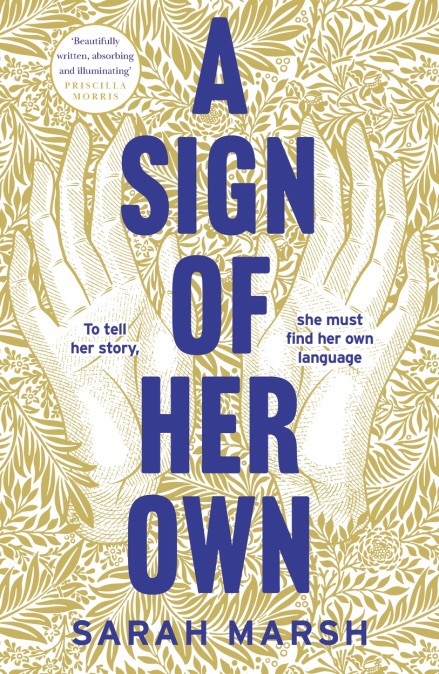
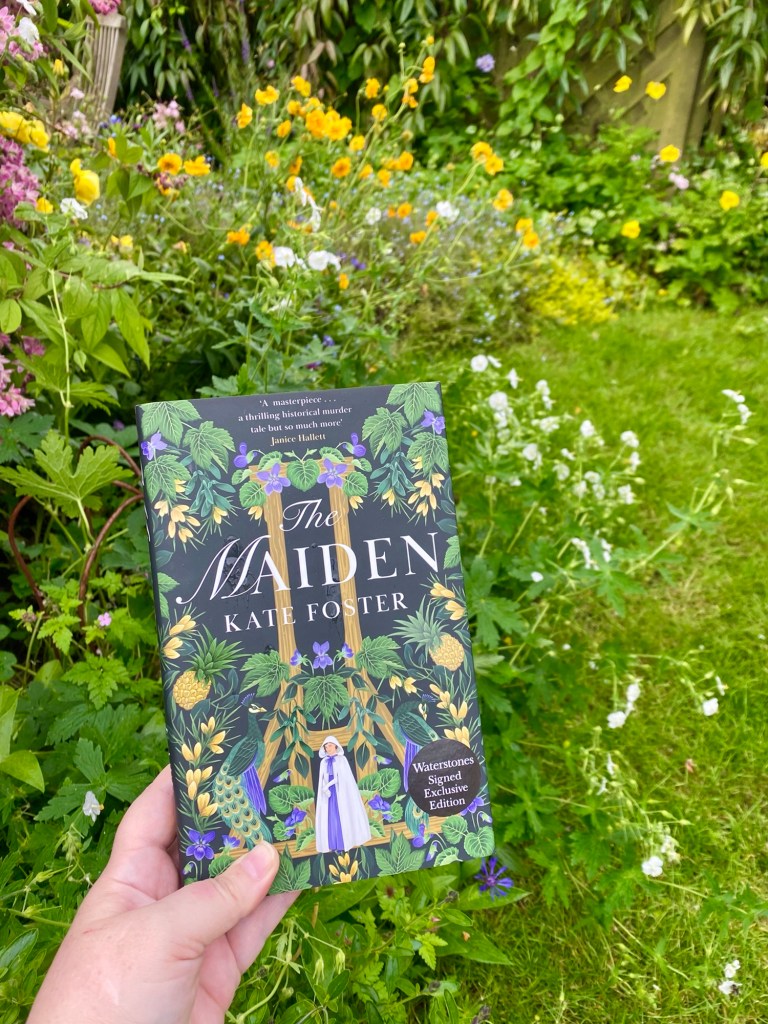
A Sign of Her Own by Sarah Marsh

“Peach. Its shape floats on Mr Bell’s mouth. The pinch of the p, followed by a rounded push of the lips, sending the last syllable hard across the tongue. My hand nearly reaches for my pocket, as if the feather from our lessons might still be found there. It’s been a long time since I thought of the feather. I would balance it on my knuckles and make it quiver with the puff of my ps. Puh-puh-puh. I stop myself just in time, folding my hands against my skirts.”

I found the opening scene of this novel incredibly moving and so skilful, placing us so close to our heroine that we understand the barriers she faced being deaf at that point in history. In it, Ellen and her fiancé receive an unexpected visit from Alexander Graham Bell. As the two men converse, Ellen is picking up body language and tone of voice which indicate a serious topic but she notices a repeated word ‘peaches’. Her attention moves to the beautiful jar of peaches preserved by her mother on the dining table. Yet she’s wrong, as she passes Mr Bell the jar and urges him to take it he tells her no, the word he was saying was ‘speeches’.

As Ellen reminisces, so did I. I was propelled back to the early years of my nephew Charlie, who was born visually impaired. Before we knew the full implications of his sight loss, we’d noticed he was behind in his development. He wasn’t moving round much, had put on weight and wasn’t speaking. It then occurred to us. In order to learn something for the first time, we tend to copy it. If you can’t see, you can’t imitate others and just as Ellen is struggling to get the full meaning of Mr Bell’s conversation, Charlie couldn’t form the words if he didn’t know how to use his mouth to make the noises. So Mum used the same technique she’d used with us when we were small. When a specific noise was needed like the ‘puh’ sound in the book, Mum would raise his hand to her mouth and make the sound against his fingers. He would then put his fingers to his own mouth a copy her. It was lovely to relive that memory and feel perhaps a tiny bit of what Ellen is feeling too.

A Sign of Her Own is narrated by Ellen Lark across two timelines and it’s an incredible feeling to be in her world, because it’s so different from the world we know. It felt similar to when actress Rose Ayling-Ellis did Strictly in 2021 and performed a ‘Couple’s Choice’ dance with Giovanni Pernice, choreographed to bring the audience into Rose’s world. At a certain point, the music stopped but the couple continued to dance and we realised that this was Rose’s world. For us the music would return, but she carried on dancing into the silence. She somehow used her trust in Giovanni and read his body to perfect her dance routines. It was moving, disorienting and a complete revelation so it was no surprise to me that they were winners of that year’s BAFTA for a memorable TV moment.

Ellen’s inner world is also a revelation and the author communicates it so beautifully. She lost her hearing as a child during a bout of scarlet fever and communicated with her mother using a language of signs they made up as they went along. It broke my heart to read how the sound of her speech was viewed by local children. Restricted to vowel sounds, because she couldn’t hear the precision of the consonants, Ellen feels shame about how she sounds. Her personal sign language seems to suit her, but it’s her grandmother who comes up with the idea of using Alexander Graham Bell’s ‘Visible Speech’. Students of his method were banned from using any sort of sign language, but were allowed to use a notebook. Family politics played their part in the decision, because the family were in debt to their grandmother. Luckily Ellen enjoyed studying and proved to be incredibly clever, even if she was unsure about Bell’s method and his motives. She has to be perceptive and learns to read people very quickly, including Bell. As we move into the present day, Ellen and her fiancé are visited by Bell who is embroiled in a fight to be recognised as the sole inventor of the telephone. He wants Ellen’s support as a character witness, but Ellen doesn’t have good memories of her time under his tutelage. She feels like he betrayed her and other deaf students for his own fame and recognition. How can she support him when she feels so conflicted?

During the later timeline Bell’s fight becomes all consuming. He is full of determination and I felt torn about his character because on one hand he appears to be paying attention to a group of people rather alienated by the rest of society so his work could be seen as altruistic. On the other hand it’s as if the people he’s helping don’t really matter to him. There’s a narcissism or selfishness in his character that means he only sees his students in terms of how they can help him potentially find fame. I felt like he didn’t appreciate their characters or individuality. I found myself disliking him intensely. By contrast, Ellen is instantly likeable and intelligent. Through her we are invited into the deaf community and the debate over sign language and visible speech is fascinating. As someone who has studied disability theory, I was very aware that some people don’t consider their deafness a disability. If they sign, they simply see themselves as speakers of a different language. I was interested in the politics and ethics of a speaking world imposing a method of communication on the deaf community, rather than the community coming to society with their own choice of language or speech method. I think there are many readers who might never have considered these issues and wondered how the book is being received in the deaf and/or disabled community. I was impressed that the author wanted to bring these issues to the fore and loved the enthusiasm she clearly has about her subject and her heroine. This is a well researched debut clearly inspired and informed by her own experiences of deafness as a child. It puts us into the centre of that experience and I came away feeling like I had a renewed awareness of sensory disability.

Thank you so much to the Squad Pod Collective and Tinder Press for my copy of A Sign of Her Own, published on Feb 1st 2024

Meet the Author


Sarah Marshwas short-listed for the Lucy Cavendish Prize in 2019 and selected for the London Library Emerging Writers Programme in 2020.A Sign of Her Ownis her first novel, inspired by her experiences of growing up deaf and her family’s history of deafness

Posted in Squad Pod

The Knowing by Emma Hinds

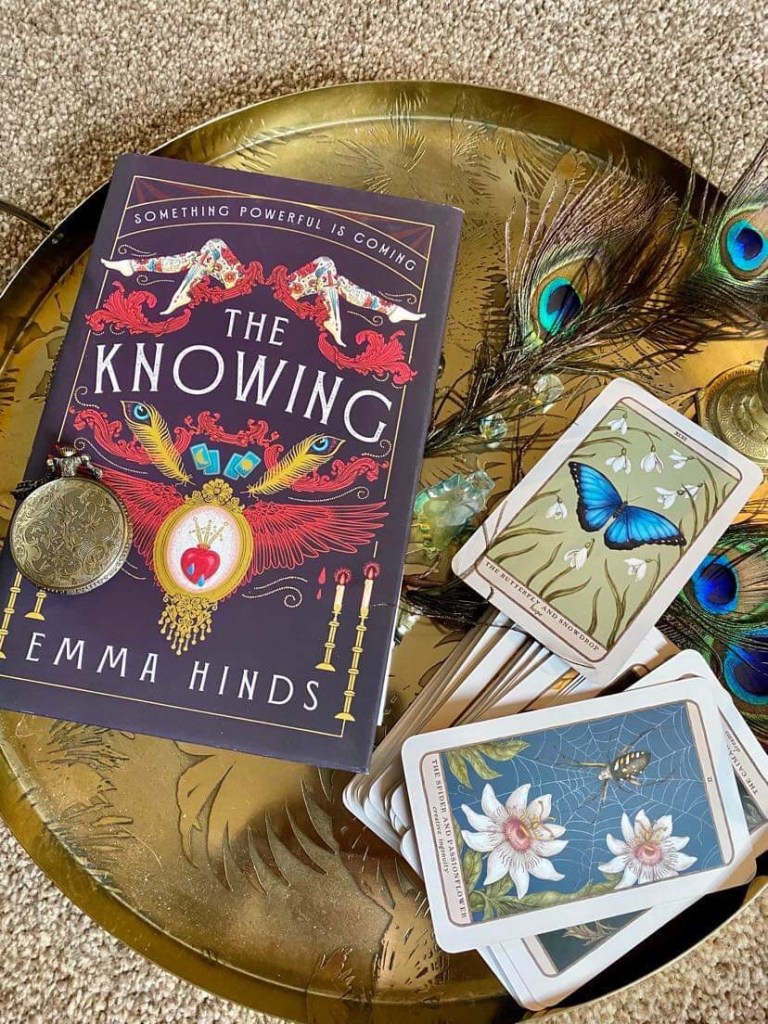
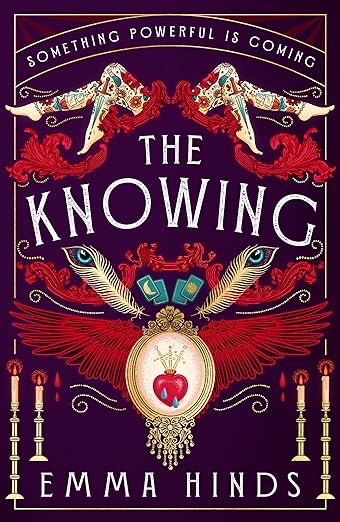
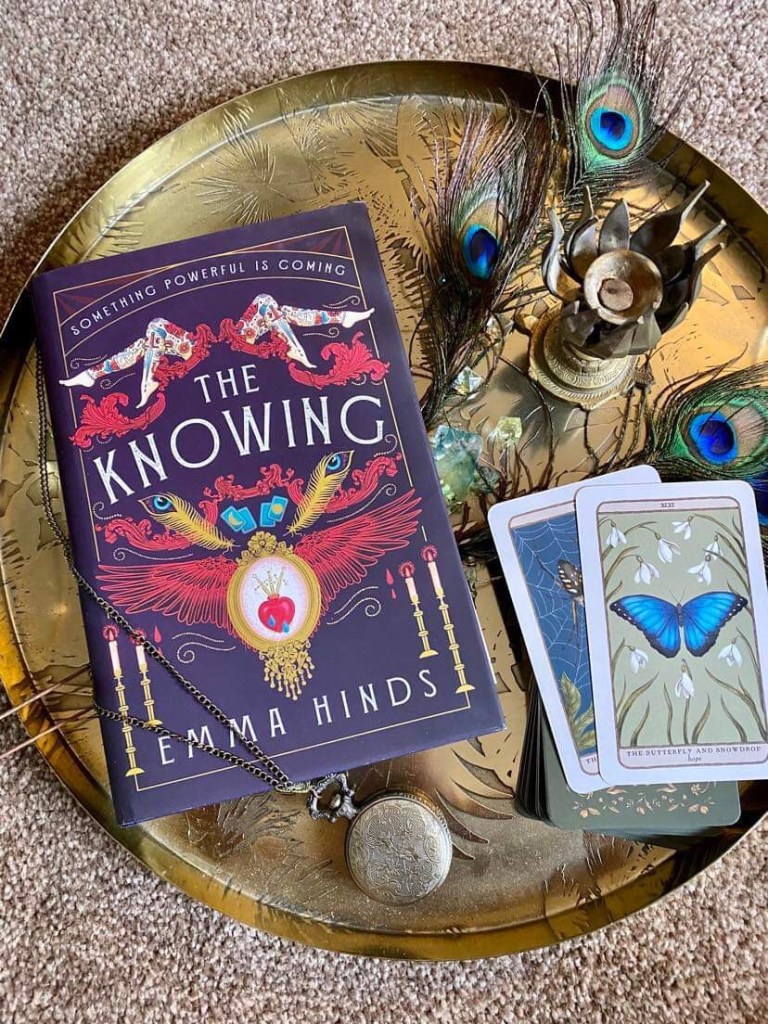
If this author had a certain readership in mind when writing this debut novel, she might as well have had a picture of me. I would have picked this book up on the strength of the cover alone. Three of my all time favourite books are: The Crimson Petal and the White set in the seedier areas of 19th Century London with a heroine is a prostitute called Sugar; The Night Circus that appears without warning, held together by real magic and the result of an epic battle between two magicians; The Museum of Extraordinary Things where our heroine is a mermaid, exhibited in a freak show at Coney Island. See what I mean? It’s perfect for me. The blurb promised me a tattooed mystic, a show run by a prostitute with dwarfism and real life New York gangs and Barnum as their contemporaries. It’s quite a heady mix and I was enthralled from page one. Flora is a tattoo artist and mystic, in an abusive relationship with a tattooist called Jordan, a member of an Irish gang the Dead Rabbits. She longs for escape from the slums of Five Points and the degrading relationship she’s been in since she was a teenager. Then she meets Minnie, a beautifully dressed woman whose dwarfism has led her to a career as a circus and freak show performer. Minnie promises Flora a career and life in an opulent town house uptown, not to mention her freedom. However, the freedom she’s promised comes with certain conditions.

Flora stays with Minnie, in her palatial bedroom and bathroom within the townhouse that belongs to her lover, Chester Moreton. Avoiding Chester’s advances seems to be one condition of Flora’s freedom, along with constant worry about being found by Jordan’s friends in the Dead Rabbits gang. She’s to earn her keep as a mystic, with her tattoos and tarot cards the centre of attention. Minnie knows that Flora’s skills run deeper, although she’s always been warned to hide them and ‘tell nuthin’. Flora’s gift is ‘the knowing’ an ability to summon the dead that’s always on the periphery of her performances, but kept at bay by Flora’s willpower. It’s when she’s pushed into allowing her spirit guide to break through that the trouble begins. At the Hotel du Woods she exposes the abuser and killer of a young boy, setting in motion a chain of events including suicide, murder and madness. Flora and Minnie escape and voyage to Manchester, where they try to survive on what they can earn from sex work and Flora’s tarot readings, but the past is never far behind and once again Flora finds herself at the centre of a love triangle where obsession and betrayal are medicated with drugs and alcohol and a tragic end seems inevitable.

I felt fully immersed in the novel immediately as the author creates an incredible sense of place. Five Points is grimy, deprived and controlled by gangs. I loved how the author used the grotesque throughout the novel and particularly where she’s describing the slums of New York and Manchester, filled with rats, unwashed bodies and an ever present grime that’s sticky on the skin. This took me straight back to university and Kristeva’s theory of abjection. The things that women’s bodies can do are magical or monstrous. Flora’s body is a conduit, allowing the dead to speak through her. Minnie’s body is seen as grotesque by others, but she wears angel’s wings and when she’s in bed with Flora it’s the softness of her skin that’s noticed first. All women have a transformative power to produce another life, when their pregnancy isn’t terminated by the men in their lives. The author doesn’t hold back when describing the reality of life for women, particularly women like Flora who haven’t had choices. Bodies seem divorced from minds when it comes to sex with men, as torsos become slabs of meat, breaths are whisky sour and skin is raw, red and broken. Sex is rarely consensual and always comes with violence. It’s a grim world so any chance to escape into a better future is welcome. The gentle and pleasurable attentions of Minnie are a promise of things to come, where Flora could have choices and sexual experiences that come from a loving place instead of a place of ownership.

No one here is perfect. Each character is morally grey and I loved that complexity in their personalities and the ambiguity it brought to their actions. I was also transfixed by the sheer power of Flora’s ‘knowing’. Mediumship has become something of a joke these days, a formulaic stage show where people are picked out of the audience and told that Grandad left the priceless clock in the attic or under the floorboards. It’s always benign and a little bit boring. Flora’s spirits are not there to guide her and they’re definitely not benign. They want to expose truths, tell the subject’s darkest secret and even mete out punishment where necessary. The first seance at Hotel du Woods is successful from one viewpoint – the spirits do come through – but a disaster from the other side when a vengeful spirit talks a man into killing himself. No one will be booking them again! Flora will have to learn how to control the spirit’s power and keep the vengeful ones at bay. Strangely, for a story where our main character is prevented from carrying children, this felt like a story about mothers too. It’s about the lack of a mother when growing up and how the lack of motherly love and protection feels, but it also shows the people who fill that void and become mother figures. This could be a difficult read for some, especially the sexual violence, but it would have been the daily reality for women living in 19th Century slums and for some women in upper Manhattan townhouses. I desperately wanted Flora to survive and have the right people around her, to give her the feeling of being loved and wanted. This is an addictive read of vengeance, betrayal and obsessive love and I couldn’t stop reading until I knew the truth of Flora’s fate.

Meet the Author

Emma Hinds is a queer novelist and playwright from Manchester. She focuses on untold historical Queer narratives and her debut novel, The Knowing, from Bedford Square Publishers is coming in January 2024.

Posted in Squad Pod

First Lie Wins by Ashley Elston

Everything she is about to tell them is a lie…

Evie Porter has everything a girl could want: a doting boyfriend, a house with a picket fence, a fun group of friends.

The only catch: Evie Porter doesn’t exist.

First comes the identity. Once she’s given a name and location by her employer, she learns everything there is to know about the town and the people in it.

Then the mark: Ryan Sumner.

The last piece of the puzzle is the job. For Evie, this job feels different. Ryan has gotten under her skin and she’s started to picture another kind of life for herself – one where her boss doesn’t pull the strings. But Evie can’t make any mistakes. Because the one thing she’s worked her entire life to keep clean, the one identity she could always go back to – her real identity – just walked right into this town. A woman, who looks just like her, has stolen her name – and she wants more. As Evie’s past begins to catch up with her, can she stay one step ahead to save her future?

Evie has never seen herself as the sort of girl who could have everything. The things many young girls dream of -marriage, security, family – have never really factored in her life, especially since she started working for the man on the end of the telephone. They’ve never met in person, but he is able to control her whole life even the person she’s going to be. From petty theft and credit card fraud she has been noticed by the boss and honed into one of his best operatives, able to throw on a new identity and slip into the mark’s life within a matter of days. Strangely, despite her criminality, the writer managed to make me feel empathy for Evie and even root for her a little bit. Her relationship with Ryan is at a stage where the friends are asking questions and want to meet this new woman. It’s a small town where everyone knows everyone else, especially the moneyed circles that Ryan grew up in. The rules dictate that he can dabble where he likes when it comes to liaisons, but when it comes to settling down it should be within their hallowed circles. An outsider might be tolerated if they’re rich, but Evie isn’t and neither is she one of them. As she dresses for a lunch date with the women from his circle of friends I found myself willing her to succeed. She’s clever in how she dresses – a bit like them but with a boho edge, enough to be accepted but still seem as an individual. I was nervous for her because it felt like she was being dropped into a shark tank and I had to keep reminding myself that Evie is the shark. As the weeks go by she’s starting to think she can relax, when she’s thrown a curve ball. At a horse racing event Ryan introduces her to a couple she’s never met before, a man who he clearly knows well with a woman who is closer to home than either of them realise. This is an old friend, but he’s with a woman Ryan doesn’t know and when she introduces herself Evie realises that her boss is playing games. The woman introduces herself as Lucca, Evie’s real name. Could she be about to lose the only thing that belongs to her – her true identity?

The author cleverly uses shorter chapters in between the main timeline that take us back through Evie’s previous jobs. They are glimpses into her past, teasing the reader with tidbits of information until we finally meet the real Evie. Sometimes our questions are answered and other times we’re surprised by a revelation that takes us in a different direction. We see how she’s pulled into her boss’s orbit, then tested until she’s the best operative he has. There’s a sadism and an element of gaslighting in what he does, sometimes sending multiple people on the same job to see who gets there first – the first prize is staying on his payroll. Although, people don’t get to just walk away from his employment because they know too much. So far Evie has had a great track record, earning well and staying on his good side, but on the last job something went wrong, could this new game be her punishment? There are only two people who Evie trusts, one is her fellow operator Devon – a man she employs to keep her safe and one step ahead of the competition. They have become close over time and he is her family. The other person is George, a messenger man for the boss who brings her the paperwork for each new identity. Can she really trust both of them? Oddly, even though she knows there must be something dodgy about him, she’s starting to trust Ryan more too and that’s a dangerous place to be. She knows there must be something dodgy about his haulage operation, because why else would she be here? Yet, even though this started as a job she feels they’re growing closer. It’s a rare feeling that’s never happened to her before. Could her fake relationship be developing into something real? The author keeps us guessing to the final pages and it’s so tense as Evie has to question the loyalties of those closest to her and juggle her burgeoning feelings for Ryan. Could he be playing her too? Has the boss pitted them against each other to see who comes out on top?

I enjoyed the back story of how Evie had ended up in this life of criminality. It was interesting to see her pluckiness and street smarts pitted against the women in Ryan’s circle. They’re so awful that I was rooting for her. The author has created an original and pacy thriller, full of intrigue and adrenaline filled moments. I found my usual loyalties and moral code turned completely on their head and was left hoping the con artist would win.

“There’s an old saying: The first lie wins. It’s not referring to the little white kind that tumble out with little to no thought; it refers to the big one. The one that changes the game. The one that is deliberate. The lie that sets the stage for everything that comes after it. And once the lie is told, it’s what most people believe to be true.”

Published by Headline 2nd January 2024

Ashley Elston lives in North Louisiana with her husband and three sons. She was a wedding and portrait photographer for ten years so most of her Saturday nights included eating cake, realizing no shoe is comfortable after standing for more than six hours and inevitably watching some groomsman do the alligator across the dance floor. Now, Ashley helps her husband run their small business and she writes as often as possible.

Posted in Squad Pod

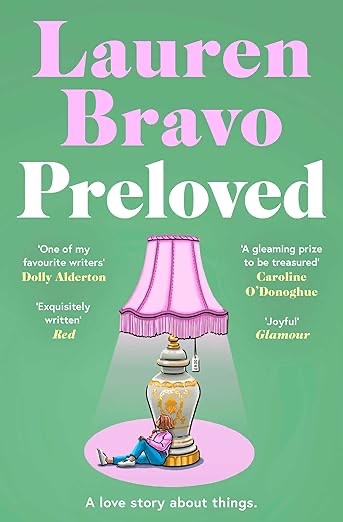
Preloved by Lauren Bravo

Gwen is coasting through life. She’s in her mid-thirties, perpetually single, her friends are busy procreating in the countryside and conversations with her parents seem to revolve entirely around the council’s wheelie-bin timetable.

And she’s lonely. But then, isn’t everyone? 

When she’s made redundant from a job she hardly cares about, she takes herself out for a fancy dinner. There she has the best sticky toffee pudding of her life and realises she has no one to tell. She vows to begin living her life fully, reconnect with her friends and family, and finally book that dentist’s appointment. 

Gwen decides to start where all things get a second chance: her local charity shop. There, with the help of the weird and wonderful people and donated items bursting with untold stories, Gwen will find a way to move forward with bravery, tenacity, and more regular dental care.

Dazzlingly witty, Preloved is a tale about friendship, loss and being true to yourself no matter the expectations. Lovingly celebrating the enduring power and joy of charity shops.

I absolutely loved this charming book about Gwen’s experiences volunteering in a charity shop, but so much more besides. Gwen has lost her job and this catalyst starts a new train of thought. Maybe instead of jumping into the next thing that comes along, she could budget her redundancy money and spend the summer taking stock. Gwen lives alone and some distance from her family, but she hasn’t struck up any meaningful friendships either. She’s alone a lot of the time. She desperately wants change but doesn’t know how to get there. So she takes a voluntary role at her local charity shop a couple of days a week, giving her time to work out what’s next in a more focused way. I felt for Gwen immediately and identified with the life crisis she’s in, having just turned 50 and facing the very real possibility that I might never be well enough to work has felt strange. I’ve never been a focused, goal setting type so I got Gwen’s tendency to drift into work without a plan. As everyone else was leaving sixth form knowing what they wanted to do, I had no clue. It took years for me to move into mental health and my own ill health provided the emotional kick up the bum – if I didn’t choose something I could do flexibly and get some training completed – my MS could advance and I was going to run out of time. Some people do simply drift, but with Gwen I knew there was an underlying reason. Her inability to call her parents and tell them about her redundancy was a powerful first clue. Did she want to avoid making them worry? Would they be angry or disappointed in her? 

Gwen tells her story and she’s a great narrator. We slowly start to build up a picture of the way she relates to others and how limited her support system seems to be. As mentioned she seems estranged from her parents and her best friend Suze has become a mum, such a big life change that means there’s less room for friends. As she gets to know the other volunteers at the shop there’s an opportunity to make friends. One lady in particular strikes up a friendship, inviting Gwen round for dinner to get to know her. The charismatic and energetic Connie is a blast of fresh air rather than a breath. She’s full of ideas to Gwen participating in life again which is inspiring and exciting, but also ever so slightly exhausting. There’s even a touch of romance too, although that’s never the real focus. The author knows this is Gwen’s story and if there is change it has to come from within herself. Only Gwen has the power to change her life and make it fulfilling again. In between the chapters there are small, magical snippets about objects or clothing that’s found it’s way to the charity shop, invariably telling a story about the person that’s donated it or the person who decides to buy it. I loved these little gems because they highlight the importance of these transitional items in their owner’s lives, but also the role of the charity shop in it’s community. They serve a practical purpose in terms of recycling, but also a community purpose because staff know people who pop in on certain days, whether they might need some company and if they don’t turn up, checking if they’re okay. They are places where lonely people can expect a cheery smile and a chat. It sounds simple, but these little interactions can be the highlight of someone’s day. 

However, what the author captures most beautifully is the magic of charity shops. How many of us bookish types have been thrilled with a find from the bookshelves – for me it was a pristine folio society edition of Isak Dennison’s gothic tales. We might find: the perfect pair of vintage shoes; a 1990’s grunge dress that’s come full circle again; old China tea sets that will look beautiful at an afternoon tea party. You never know what might jump off the rails or shelves and become a precious ‘find’ rather than someone else’s clutter or trash. I love that, in a way, Gwen is like one of these objects – made redundant and sitting patiently in place until a new future opens up before her. However, before that happens she must go through the process of clearing out, sorting through the rubbish and throwing out what’s broken. For Gwen that means confronting a life changing event that’s so painful it’s blocking her whole life. I was rooting for her, right up to the very last page.

Published on 18th January 2024 by Simon and Schuster UK

Posted in Squad Pod

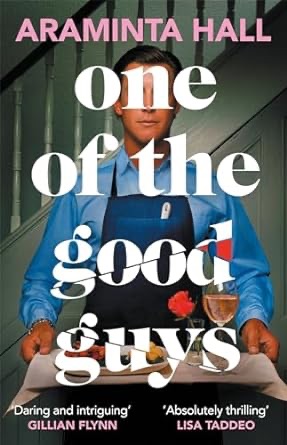
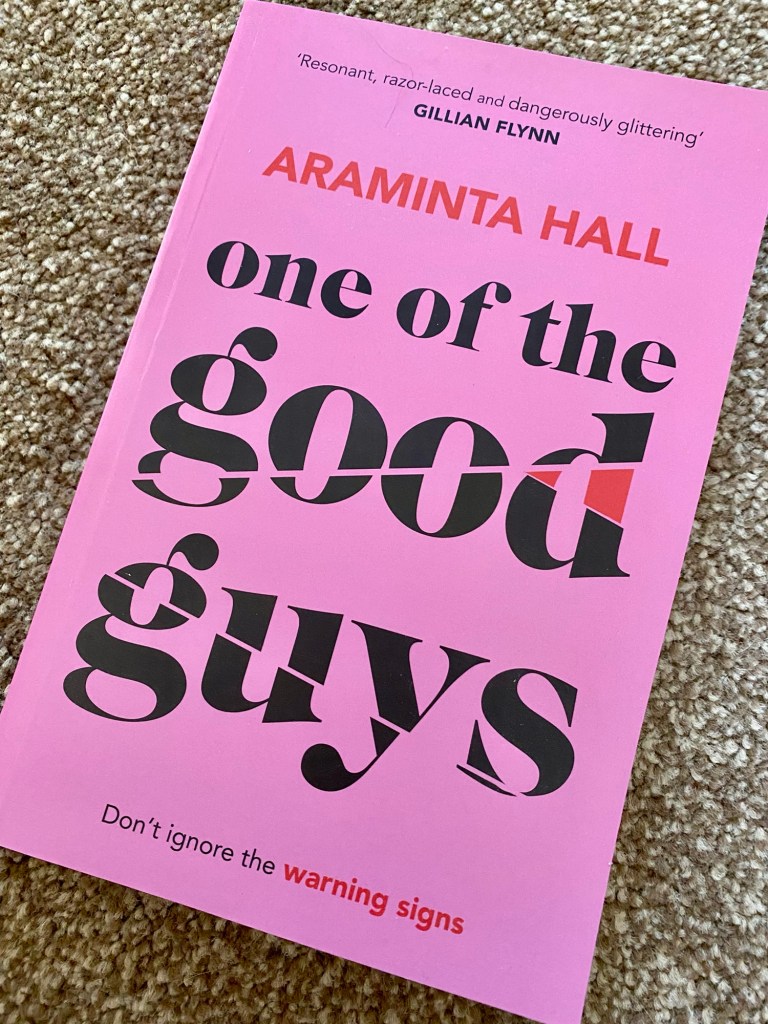
One of the Good Guys by Araminta Hall

Cole is the perfect husband: a romantic, supportive of his wife, Mel’s career, keen to be a hands-on dad, not a big drinker. A good guy.

So when Mel leaves him, he’s floored. She was lucky to be with a man like him.

Craving solitude, he accepts a job on the coast and quickly settles into his new life where he meets reclusive artist Lennie.

Lennie has made the same move for similar reasons. She is living in a crumbling cottage on the edge of a nearby cliff. It’s an undeniably scary location, but sometimes you have to face your fears to get past them.

As their relationship develops, two young women go missing while on a walk protesting gendered violence, right by where Cole and Lennie live. Finding themselves at the heart of a police investigation and media frenzy, it soon becomes clear that they don’t know each other very well at all.

This is what happens when women have had enough.

Wow! This blows your eyes wide open. I warn you not to start reading at night, unless like me you have a total disregard for tomorrow. Even if I wasn’t actively reading it, I was thinking about it. Cole has moved to a remote part of the coast for a total life change after the collapse of his marriage. Cole considers himself one of the good guys. In fact he would probably call himself a feminist. So the marriage breakdown and Mel’s reasons are inexplicable to him. He was proud of Mel, who was launching her own business, but as they crept towards their late thirties he was starting to wonder if they were leaving it a bit late to start the family they both wanted. After trying for a while, they’d decided on IVF which he knows was more gruelling for Mel than him, but was she really giving their embryos their best chance? Always working late, not eating properly and popping back to work after implantation were all endangering their chances of a viable pregnancy. Despite cooking and caring for her, and supporting her business dreams, Cole is now facing a pile of legal papers on the kitchen table – divorce papers, financial settlements and perhaps most hurtful, a form agreeing to destruction of their final three embryos. What can he have done to deserve this?

As he slowly heals he notices someone is living in the old coastguard’s cottage, a woman he can’t stop watching. She seems so feminine, but yet grounded enough to put her wellies on with her dress while she’s gardening. She is an artist and when they meet a party she introduces herself as Lennie. When he asks what it’s short for she tells him it’s Leonora. No one calls her that but Cole insists. It suits her better he tells her, softer and more feminine. Could the two of them strike up a friendship, or even more? In the background, getting air time on radio and television, are two young women in their twenties who have decided to take on a challenge – a fitting continuation of the work done by women’s movement in the 1970’s. They want to highlight the daily misogyny and violence against women that’s endemic in society. So they plan to walk over 300 miles of the coastal path, camping out each night in a tent. They know that this is dangerous but they want to support a domestic violence charity and raise as much awareness as possible for those women and girls living in daily fear of violence. However as the girls go missing one night it seems they may have fallen victim to their own cause. Could they have become lost and died from exposure? Could they have misjudged their steps and fallen from the cliffs? Or has something far more sinister happened – one of their online trolls following through on comments like ‘you deserve to be raped’.

I loved the way the author put her story together, using fragments from lots of different stories and different narrators. Just when we get used to one and start to see their point of view, the perspective shifts. I thought this added to the immediacy of the novel, but also reflected life and the constant bombardment of information and misinformation we sift through every day. As well as Cole we have narration from Lennie and Mel interspersed with transcripts of radio shows and podcasts, Twitter threads and TV interviews. All give their perspective or commentary on the casual misogyny and violence against women that almost seems like the norm these days. Just like real life the book sometimes felt like a merry-go-ground of opinion, counter argument and trolling. Sometimes I was left so twisted around I wasn’t sure what I thought any more. The only thing I was sure about was much I disliked every single character, but I couldn’t stop reading them either. I would believe one narrator, but then later revelations would blow what I thought right out of the water. As the missing person’s case continues, everyone is weighed up then torn apart on social media and in the press. It made me ask questions: about the nature of art and it’s ethics; about whether all men truly hate women; to what lengths do we go to protest; when is enough, enough? It’s been over a week since I finished this extraordinarily controversial story and I still can’t stop thinking about it. Is it too early to predict a book of the year? I don’t think so.

Thanks to Macmillan and The Squad Pod Collective for my proof copy of this amazing novel.

Meet The Author

Hello, I’m a writer of thrillers and a lover of stories. 

My latest book, ONE OF THE GOOD GUYS, was inspired by a groundswell of anger I’ve been feeling myself and amongst the women I know. Because if we don’t feel safe in the world, then it’s still a very unequal world. This is my answer to what happens when women have had enough of being scared.

I hope you enjoy this tense story set in a remote seaside location. I’d love to know if you guess the twist – I’m on instagram and X @aramintahall 

And, if you do enjoy this one, I’ve published five other novels, EVERYTHING & NOTHING (2011), DOT (2013), OUR KIND OF CRUELTY (2017), IMPERFECT WOMEN/PERFECT STRANGERS (2019) & HIDDEN DEPTHS (2021

Posted in Squad Pod

Her by Mira Shah

This has been my ‘in the bath’ book for the last three or four days and I don’t mind saying that I have been like a prune during that time because I kept reading ‘just another chapter’. I also drove my other half crazy by topping up the hot water every time I gave in to the story. I have to follow an unusual reading regime in my house. It was built in 1787 and has a lot of ‘quirks’, including the emptying of my entire tub of bath water into the kitchen below instead of the usual plumbed in route. A further quirk is that if I take my iPad into the bathroom to read from Kindle or NetGalley, it simply switches itself off. I can sometimes bypass this by putting the iPad into airplane mode before going into the bathroom, but it’s not a fail-safe method. So I tend to read real proof copies in the bath and downstairs, keeping my iPad for bed where I don’t want to wake my other half. I don’t like to put on a reading light or do what my sister-in-law does and go to bed in my brother’s night fishing hat with built in head-lamp. She didn’t like to keep him awake by reading with a light on in their camper van.

So now you know that we’re all a bit odd in my family, I’ll come back to the book, one that grabbed me straight away and kept hold of me till the final page. There’s just something compulsive about it. It could be the short chapters that are so snappy and often end on a cliffhanger. It could be the alternating narration between neighbours Natalie and Rani who live across from each other. The women have such strong narrative voices and are both in completely relatable positions in life; Natalie is the beautiful neighbour with the killer job and the lovely house across the road that Rani has been coveting since she moved here. In fact as soon as the For Sale sign went up she was over there with a different name and address, swanky clothes and great back story in order to view it. So when Natalie moves in Rani knows exactly which high end work tops she butters her toast at in the morning and the surprisingly sheltered garden made for children to play in. We all think the grass is greener at times, but few of us would go to the lengths that Rani will.

Natalie does appear to have everything going for her. She’s undeniably beautiful with honey blonde hair and designer clothing. Naturally she’s the high flyer in a corporate law firm, with the opportunity to become the youngest ever woman at her firm to become partner. Her handsome and older husband Charlie is attentive and thoughtful. The pair married in Tuscany and Charlie is keen to start a family, hence the beautiful home in just the right area. Sometimes, when people really love a house they’ve looked at, they might claim to feel immediately at home there or be able to see them living in these perfectly curated spaces but for Natalie it’s less of a feeling and more of a certainty. She has lived here before, right at the beginning of her life, before her dad left and when she had an imaginary friend, Noemi, to run around with. She knows she was running a risk not telling Charles, but when the elderly next door neighbour doesn’t seem to recognise her she seems to have a got away with it. What is luring her back there? Her mother Luella is unlikely to enjoy a trip down memory lane, in fact she’s the first to remind Natalie how her dad left them in a terrible state, financially as well as emotionally. She likes to remind Natalie what a good man Charles is: all Charles wants is to settle and have a family; to look after Natalie; to take the burden of her high-powered career away; help her cultivate the right sort of friends. Surely that can’t be bad?

Rani lives opposite in her cramped flat, being a full-time mum and wearing supermarket clothes. She watches Natalie settle in and we can see a perfect psychological storm starting to build. Rani will happily admit that, at times, Natalie’s lifestyle must be hard to keep up. Although that revelation only surfaces when she realises it does take work to be that put together and professional. At first though, Rani feels almost as if Natalie is a fantastical creature who simply drifts out of bed with not a hair out of place, naturally smelling of roses and never working for her enviable figure. Rani feels out of place next to her, in her daily mum uniform of leggings and a t-shirt. However, these thoughts come from Rani’s anxieties and feelings of inadequacy. Although she loves her beautiful girls, she does miss going to out to work and having something that is entirely hers. She also feels disconnected from Joel, although she loves him the years of babies and toddlers have wiped out any spontaneity or time for themselves. When Joel commits a huge betrayal Rani has a huge choice to make. Can they find a way back to each other?

Just like Rani, we are drawn in more and more by Natalie’s life. Cleverly the author has made sure that we get to see more than Rani, through Natalie’s chapters we get her inner thoughts while everyone else is still seeing the perfect exterior. We know that she’s having nightmares again, full of people close to her but who don’t look quite right. Noemi is back too, breaking into her thoughts and becoming so tantalisingly real. As the two women become friends, I was actually a little bit scared for Rani. She doesn’t know what she’s getting into, although she has an inkling the perfect marriage to Charles may not be all it seems. I was unsure where the danger was coming from, was Charles much more dangerous than he at first appears or is Natalie’s strange past all in her imagination? Why did she choose to live in this house, when her childhood seems like an endless nightmare and Luella comes across as a harsh and controlled woman? It’s as if she adopted the Royal family’s motto for her family; ‘never complain, never explain’. Rani is the first true friend Natalie has had in her adult life, so she’s not always as open as she could be or is so used to thinking what Luella’s take on the situation might be, she comes out with something that sounds wrong. As Natalie starts to enjoy a little freedom, what will Charles’s reaction be and what dangers might the two women face if they start to dig up her past? This book is so well paced and the tension just keeps building. I enjoyed the female characters in the book and the unflinching depiction of domestic abuse that forms part of the story. I found Rani a more engaging and rounded character than Natalie, but of course she would be – none of her past is missing. Natalie comes across as a borderline personality, she has no sense of her own identity and has always gone along with the strongest person in the room, adopting their values and attitudes as her own. Rani has a lot more to lose, not material possessions but a family and roots that she knows keep her grounded. It’s knowing the threat and knowing how much Rani has to lose that kept me reading, even if the bath water was getting a little cold.

Meet the Author

Mira V Shah is a writer, former City lawyer turned legal editor and the proud owner of three good dogs. She is the daughter of Indian African parents and lives in North London with her husband and the pack – merely a few miles from where she grew up, although she often dreams about retiring in Italy should her intermittent lottery entries prove successful.

She wrote her first ever novel in 2020 during the first UK lockdown after studying on the Curtis Brown Creative novel writing course. HER was published by Hodder and Stoughton in November 2023.

Posted in Squad Pod

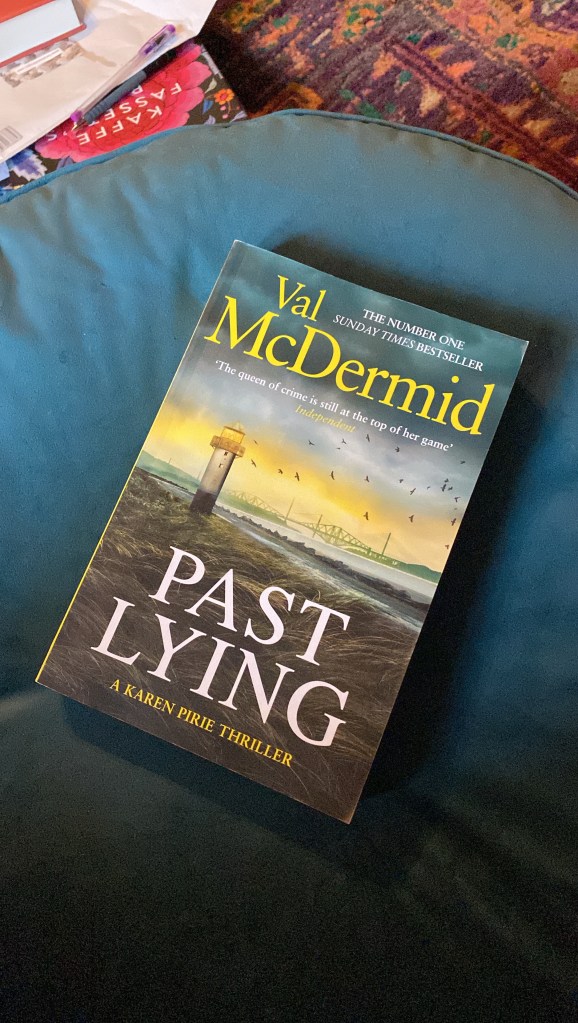
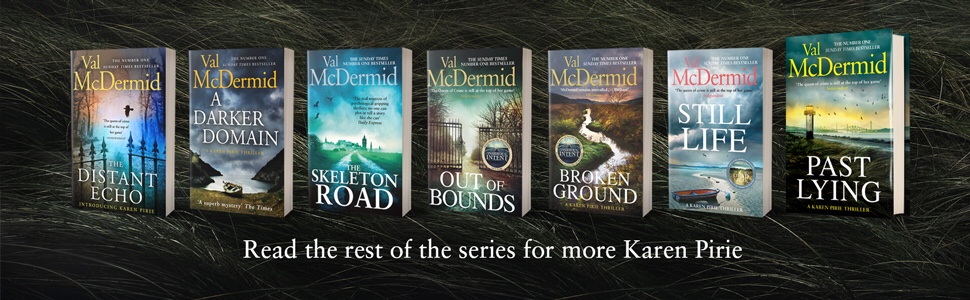
Past Lying by Val McDermid. Karen Pirie Series.

I was so blown away by my first Val McDermid novel last month that I couldn’t settle to any other reading when I knew that this sequel was waiting for me on the book trolley! So in the end I gave in. We left DCI Karen Pirie at the beginning of lockdown, which she’d decided to spend in her lover Hamish’s huge Edinburgh flat with her new constable Daisy. It was a hurried and unexpected choice, with Hamish retreating to his Croft in the Highlands where he was now making hand sanitiser and profiting nicely. The team are officially stood down from working, but Karen had ordered some cold case files to be taken to the flat so they could at least read and review them. She isn’t known for being good at following rules so lockdown is a challenge, with her midnight walks and checks on the old flat she bends things a little to suit her. It would be impossible to imagine her not working though and luckily her DS Jason gets an unexpected call that triggers something. A librarian is using lockdown to file away items donated to the archive and she has been working on the papers of the late author Jake Stein. In them she found an unfinished manuscript that bothered her. The narrator is a crime writer and he abducts an aspiring writer from one of his workshops, a young girl called Laurel Oliver. He describes taking her to a shack in the woods and strangling her, then planting her body in the garage of another crime writer, Rob McEwan. Rob and Jake met at a festival and became friends, with Jake being the big name and Rob just starting out. They discovered a mutual love of chess and would play each other each week at Jake’s house, where he has the classic car, the high end kitchen decor and a beautiful wife. A beautiful wife who seems to get along with Rob very well. Stars in any creative field can fall as well as rise and as the tables start to turn for these two could Jake have carried out this murderous blueprint? All the way down to the detail of concreting her body into the inspection pit of Ron’s swanky new house? Since once of their cold cases is a young girl called Lara Hardie who did disappear in Edinburgh at the time of this manuscript, Karen can’t afford to take any chances.

It must have been very hard to write tension and excitement into a situation where people can’t go far and are largely researching online and in archives. It’s not fast paced activity and I always remember laughing out loud at a moment in one of Dan Brown’s thrillers where his hero tries to make running to the library sound macho and full of action. It could have gone horribly wrong, but somehow Val McDermid brings real tension to the case. That’s without the anxieties of every day life at this very surreal time, which are captured perfectly by the author. She relates to us the strange emptiness of a busy capital city and the difficulty of having to apply the intricacies of COVID legislation to your every movement, even if it’s just looking at papers in a library. Karen is possibly even more impatient in her working life, so there are times to bend the rules a little, but it means she never slips into the slapdash lazy ways of other people who seem to think it’s an excuse to shut down. Her boss ‘the Dog Biscuit’ thinks she could easily stay at home because HCU cases can wait; the case has no urgency, since the main suspect, Jake Stein, will never come to trial. However, maybe because she lost the love of her life to murder, Karen understands that the sooner a victim’s family finds out the truth, the better. This applies whether the suspected killer is alive or not. Besides, despite what the manuscript suggests, she’s not going to pigeon hole the case just yet. Things aren’t always what they seem.

Her relationship with Hamish is proving difficult and not because he’s in the Highlands on his croft. They actually have more problems when they see each other, probably because they shouldn’t be. There’s something about Hamish’s cheerful ability to make money out of other people’s misery that rankles with Karen. He’s angry to find Karen isn’t home in the night, but she’s out walking. Unbeknownst to Hamish, there’s an asylum seeker staying in Karen’s flat after threats were made against his life. It’s a favour for a good friend and Karen is so moved by his situation that she buys him new clothes and stocks the cupboards. We see a side to Hamish we’ve never seen before when he has a confrontation with Daisy after turning up at the flat with no warning and against regulations. This time he threatens Daisy, but on a second illegal visit he becomes violently angry to find this strange man staying in Karen’s flat. When he tries to break the door down Karen is furious: it’s her flat and it’s not Hamish’s place to tell her who can be in it; he has no empathy for the man’s plight and zero understanding of his own privilege. Plus, he shouldn’t be here in the first place. Could this be the end for their relationship? Despite this, the COVID journey that Daisy and Karen have is a lot better than most. They have plenty of room in the flat they’ve borrowed from Hamish and their frustrations are small ones, mainly confined to how difficult it is to investigate a case when every establishment seems to be working to their own idea of the rules. Jason has a truly terrible experience when his mum is hospitalised with the virus, because they can’t see her or reassure her unless the staff organise a FaceTime session. Jason’s brother takes his frustration to the extreme while Jason is just terribly sad and scared for her. The snippets of her small team’s personal lives are more apparent now that their living and working spaces are in one place. Jason is in lockdown with girlfriend Eilidh, but has proximity made their relationship stronger? Daisy has been hiding a secret about her personal life and finds lockdown a difficulty when embarking on a new romance.

Karen’s grief for Phil ebbs and flows, not helped by the extra time she has to overthink. She has to think about whether her relationship with Hamish gives her what she needs. They miss a shared outlook on the world, something she had and lost with Phil. The case didn’t go the way I expected at all, making the last sections really gripping. Karen’s ability to get results in a global pandemic doesn’t surprise me. Where some potential witnesses try to fob her off, using COVID as an excuse, Karen always tries to find a way to stay within the law while still getting the job done. I love seeing her come across petty bureaucracy, it makes me laugh because they have no idea what they’re dealing with if they take on Karen. This is crime fiction at it’s best and I’m now starting back at the beginning with the first novel featuring this interesting and incredibly insightful detective.

Out on 12th October 2023 from Sphere

Meet the Author

Val McDermid is a number one bestseller whose novels have been translated into more than forty languages, and have sold over eighteen million copies. She has won many awards internationally, including the CWA Gold Dagger for best crime novel of the year and the LA Times Book of the Year Award. She was inducted into the ITV3 Crime Thriller Awards Hall of Fame in 2009, was the recipient of the CWA Cartier Diamond Dagger in 2010 and received the Lambda Literary Foundation Pioneer Award in 2011. In 2016, Val received the Outstanding Contribution to Crime Fiction Award at the Theakstons Old Peculier Crime Writing Festival and in 2017 received the DIVA Literary Prize for Crime, and was elected a Fellow of both the Royal Society of Literature and the Royal Society of Edinburgh. Val has served as a judge for the Women’s Prize for Fiction and the Man Booker Prize, and was Chair of the Wellcome Book Prize in 2017. She is the recipient of six honorary doctorates and is an Honorary Fellow of St Hilda’s College, Oxford. She writes full-time and divides her time between Edinburgh and East Neuk of Fife.

Posted in Squad Pod

Still Life by Val McDermid. Karen Pirie Series

As you all know I’m quite happy to admit so called ‘guilty pleasures’ and glaring omissions from my library. You also know I like nothing better than discovering someone I haven’t read before, who has along back catalogue to enjoy. I am absolutely thrilled that the Squad Pod chose Val McDermid for our October book club. This is probably sacrilegious in crime reading circles, but I haven’t read a single book by the Queen of Tartan Noir. She is definitely deserving of the title and after reading Still Life I’ve purchased all the Karen Pirie series so I can read from the beginning and start my Val McDermid journey. Next month we have her new novel in the series Past Lying so my October is going to be pretty much dedicated to her.

Our story is a complicated combination of current and historic case that Pirie is set to investigate from the Historic Cases Unit. A trawler pulls a body from the Firth, eventually identified as a man called James Auld. His brother, Iain Auld, worked in the Scottish Office in Westminster and also disappeared, ten years ago. Even more odd, James had been living as Paul Allard and working in a jazz band in Paris. Two other events come up when researching the two men. Firstly, the paintings chosen from the National Collection for the Scottish Office, were found to be barely passable fakes when the government changed. Secondly, when a fire that destroyed an art gallery in Brighton appears in the press, a photograph seemed to show Iain Auld. An old school friend swears it was Iain, but he was already declared dead by this point. DCI Pirie’s starting point will have to be Iain’s widow Mary, who lives alone and has stayed in touch with brother-in-law James ever since Iain disappeared. Their second case seems less urgent and regards historic remains found in the camper van in the garage of an empty house. The van might have belonged to a young silversmith called Dani, a free spirited and bohemian girl in a relationship with a slightly older accountant called Andrea. Could this body be one of those women?

Both cases were intriguing and grabbed the attention. The story that emerges from their investigation into the camper van skeleton is one of opposites attracting. Opposites can attract, but can they co-exist over time? Dani was clearly the more bohemian of the pair and a bit younger too. She wanted to travel, design her jewellery and perhaps gain inspiration from staying at an artist’s commune. Andrea was more conservative, happy to stay in the same home and go to the same job. Andrea’s parents are abroad, could she have killed her partner and left the country? However, when they visit Dani’s father his first reaction is to ask what his daughter has done this time? So the weight of suspicion falls on her. Then they find a lead, a possible art collective where Dani is mentioned, over near Manchester. Karen sends her sergeant Jason to check things out, putting him in terrible danger. The visit quickly goes from being slightly comical (an elderly person’s painting class) to absolutely filled with tension and deadly. The case of the Auld brothers had so many facets to it and opened up the characters for me. It covered the issue of finding yourself in love with someone of the same sex after years of being heterosexual. The art and political elements were so interesting too. The criticism of the old Lib/Con coalition and the way Westminster works in general was something that chimed with my own views. The musing on Scottish independence and the way Scottish people feel about England really did interest me, but it also firmly sets a character in their place and time.

These subjects showed the reader how forthright and decisive Karen is, something we see in her professional life too – sometimes to her detriment. She had so many sneaky ways around her boss, known as the ‘Dog Biscuit’ thanks to her surname being the same as a brand of dog treats. It might not always be appreciated by her superiors but she does it to get results, out of a desire to help those affected by the crime and also because she has a disgust for unwanted bureaucracy and procedures. When she needs a European arrest warrant she goes direct to a contact who can organise it immediately, not through the boss. Often though, these short cuts do get the job done. She knows it pisses the boss off, but she’s willing to take the flak and smooth it over later. She’s a maverick whose not afraid to take a risk or spend money if it brings results for the victims of crime. I found her intelligent, determined, rebellious and competitive. She would probably drive me crazy in reality, but as a character I loved her. I also loved the way she’s trying to cope with ongoing grief for her partner Phil, while starting a new relationship with Hamish. I’ve been there so I understand the conflicting emotions, the guilt and the desire to move forward. This was so well written. She’s asserting her boundaries and trying not to jump in with both feet? There’s something she’s uncomfortable with about the relationship, but she talks herself round to the positives. Hamish’s business and the Croft in the Highlands keeps him busy and sometimes absent which I think suits her. It gives a distance to the relationship that she needs for now.

Her dogged determination and that of her team can lead to taking risks, but they don’t hesitate. Karen gives Jason his own tasks showing trust and confidence in him. She keeps her borrowed recruit Daisy close to her, they’re very different but there’s definitely an attention to detail in Daisy that echoes Karen’s. She instils in both of them her philosophy that just because it’s a cold case doesn’t mean they do half a job, or a slow one. She holds these mispers and victims of crime in high regard and expects the same from her team. As the COVID pandemic starts to move across the world there’s a further sense of urgency to their work. While the case of the body in the camper van starts to resolve, the Auld brothers case takes many unexpected turns. As the trail moves over to Ireland, using the art world to unravel some clues, it was great to see that Karen is happy to get her hands dirty and isn’t the sort of boss who hands that stuff to her juniors. Here she’s sitting in vegetation, watching a house for suspects and deftly deploying a tracker. She’s just as deft when walking into a small gallery and questioning an art dealer. Whatever it takes to uncover the next steps. When talking about her cold cases, Karen articulates something that crime readers often feel. She knows there’s an explanation that solves all these clues and exposes a pattern, but she just can’t see it yet. You have to let it wash over you, read more and hope that all will become clear. The difficulties solving this one kept me reading and kept me thinking about the case when I was doing other things. As COVID worsens and starts to lock down the country, decisions have to be made about how the team work and live. Karen makes a choice I didn’t see coming and I would be interested to read how it works out moving forward. This was one of the best crime novels I’ve ever read, with a fascinating central character that I can’t wait to read more about.

Meet the Author

Val McDermid is a number one bestseller whose novels have been translated into more than forty languages, and have sold over eighteen million copies. She has won many awards internationally, including the CWA Gold Dagger for best crime novel of the year and the LA Times Book of the Year Award. She was inducted into the ITV3 Crime Thriller Awards Hall of Fame in 2009, was the recipient of the CWA Cartier Diamond Dagger in 2010 and received the Lambda Literary Foundation Pioneer Award in 2011. In 2016, Val received the Outstanding Contribution to Crime Fiction Award at the Theakstons Old Peculier Crime Writing Festival and in 2017 received the DIVA Literary Prize for Crime, and was elected a Fellow of both the Royal Society of Literature and the Royal Society of Edinburgh. Val has served as a judge for the Women’s Prize for Fiction and the Man Booker Prize, and was Chair of the Wellcome Book Prize in 2017. She is the recipient of six honorary doctorates and is an Honorary Fellow of St Hilda’s College, Oxford. She writes full-time and divides her time between Edinburgh and East Neuk of Fife.

Posted in Squad Pod

The Continental Affair by Christine Mangan

Meet Henri and Louise.

Two strangers, travelling alone, on the train from Belgrade to Istanbul. Except this isn’t the first time they have met. It’s the 1960s, and Louise is running: from her past in England, from the owners of the money she has stolen―and from Henri, the person who has been sent to collect it. Across the Continent―from Granada to Paris, from Belgrade to Istanbul―Henri follows. He’s desperate to leave behind his own troubles and the memories of his past life as a gendarme in Algeria. But Henri soon realises that Louise is no ordinary traveller.

As the train hurtles toward its final destination, Henri and Louise must decide what the future will hold―and whether it involves one another. Stylish and atmospheric, The Continental Affair takes you on an unforgettable journey through the twisty, glamorous world of 1960s Europe.

All the way through the novel I kept thinking of The Thomas Crown Affair, the glamorous and seductive 1960’s film starring Faye Dunaway and Steve McQueen as a rich playboy suspected of stealing a priceless painting and the insurance investigator sent in to catch the thief. The Continental Affair had that same mix of incredible style, plot twists and wonderful locations. I mustn’t forget the sexual tension – that chess scene alone is a masterclass in seduction! Christine Mangan’s third novel is similarly alluring, from the Hitchcock-esque cover design to the incredible cat and mouse tale within.

The story is told through a dual timeline narrative, enhancing the sense of cat and mouse between the characters. Yet they have more in common than we might initially think. Yes, the chase has this cat and mouse running in the same direction but it’s not just about the chase, they’re both trying to escape their past as well. From the moment they ‘meet’ in a train compartment on the way to Istanbul they’re playing a game. They might be acting as if they’ve never met, with their polite conversation, but Henri knows who she is because he’s been tracking her from country to country. Similarly, Louise knows exactly who Henri is and why he’s there. She first ventured into Europe as an escape from a cruel and restrictive family life in England. Then, in Granada she stole from a criminal gang and went on the run. Henri was related to the criminal gang who sent him to collect an amount of money, only to witness Louise stealing it right in front of him. Yes, he’s been sent to retrieve the money but he’s also driven by a fascination in Louise and the more he follows her, the more fascinated he is. Interestingly, Henri worked in Algeria as a gendarme and this past plays on his mind constantly, yet once he starts pursuing Louise he’s distracted from his own demons. This is a police officer who finds himself on the wrong side of the law. Henri is the first narrator and once I got to know him I expected to be on his side. Then I heard Louise’s back story and I felt sorry for her, struggling with her disabled father after her mother left the family home. The only joy and escape she had was in books and I was torn between my understanding for her and my knowledge that she’s taken someone else’s money.

Reading this book felt like the Saturday afternoons I spent with my grandad watching old black and white films, where he’d teach her me who all the actors and actresses were. This could have been the gentleman Cary Grant pursuing Grace Kelly with her sleek, sophisticated glamour. I’m now waiting for a gap in reads so I can go back and read the author’s previous novels on the strength of this one. I enjoyed all the settings, the incredible landmarks, the food and the two intriguing people I was travelling alongside. I was glued to this tale wondering whether Henri would overcome his fascination and retrieve the money or whether this developing relationship would take our pair to becoming friends, or even more. I’d had this book on NetGalley for quite a while and I can’t believe I left it until the Squad Pod got the chance to read and review? It’s the sort of book I love to get lost in because it combines such evocative descriptions of European destinations and the 1960’s era. I felt like I was there for every moment and I when I was away from the book, I missed it. I loved the journey, the actual and the emotional one. Henri and Louise want the same things and it was delicious watching them realise this and become ever closer. I was transfixed, waiting to see if Henri would actually complete his mission to retrieve the family money, or whether he’d forget their game of cat and mouse. Christine Mangan has created two such intriguing characters who despite their mistakes are incredibly likeable and memorable. This a wonderful escapist read full of both style and substance.

Meet the Author

Christine Mangan has a PhD in English from University College Dublin, where her thesis focused on eighteenth-century Gothic literature, and an MFA in fiction writing from the University of Southern Maine. Tangerine is her first novel

Posted in Squad Pod

Lowbridge by Lucy Campbell

This story really crept up and took hold of me. It’s a slow burn, dual timeline mystery set in small town Australia. Katherine has moved to her husband James’s hometown of Lowbridge, a town with a very clear line between ‘the haves and have-nots’. Katherine is struggling with her mood and self-medicating with drink. James is hoping that the move will help her and has made it clear that they can’t continue as they are. He encourages her to get dressed and leave the house or go for a run like she used to. It’s clear something momentous has happened and their lives have imploded, but they are each dealing with it in different ways. In fact their teenage daughter Maggie was killed in a car accident, where the designated driver had been drinking. When Katherine does leave the house she accidentally stumbles across the town’s historical society and shows an interest in the exhibition they’re putting together. It’s something she can potentially help with and it’s enough to get her motivated. However, when she comes across a thirty year old mystery, problems start to arise. The disappearance of a young girl called Tess during the summer of 1987 has remained unsolved and Katherine thinks it may be time to highlight the case and perhaps jog people’s memories. She knows she must involve Tess’s family in the decision, but she doesn’t expect opposition from anyone else. It’s James’s opposition that surprises her most. He tells her to leave the mystery alone, that it will stir up trouble and it’s would be unhealthy for her to become wrapped up in another family’s grief. Katherine is determined though and with Tess’s family on board she starts to research what happened in 1987.

From the beginning, the author really gives us the sense of what it’s like to live in a small town where everyone knows each other. Having grown up in a small market town I know it’s rare for me to run errands without seeing someone I know. I still have friends that I had when I was thirteen and when I was sixteen a friend of mine was murdered, a few days before Christmas. A death like that sends a shockwave through the whole town and I could clearly imagine the collective grief and anger that Katherine would unearth as she investigates what happened. In the summer of 1987 the town was already at odds over a women’s clinic being proposed by a local doctor. This has enraged the anti-abortion lobby leading to protests and appeals to the locals authorities to stop the development. Three teenagers from the ‘right side’ of town are reaching an age where they’re asserting their independence and finishing their leaving certificates at school. Tess and Sim are friends with the slightly younger Luisa who is from an Italian family. The girls try to keep the clinic out of their conversation because it is Sim’s mother fighting to get the clinic open and Luisa parents are Roman Catholics, utterly opposed to abortion. Because they’re from the more middle class part of town they tend to keep separate from the ‘Pitsville’ kids, the area mainly inhabited by miners and their families. The author has really captured what it’s like to be a teenage girl on the cusp of womanhood. In the girl’s conversations there are all those insecurities about how they look and what they wear, their popularity and how boys view them. All three acknowledge that one girl at school really does capture the boy’s attention.

Jac is thought of as ‘easy’ by other girls, mainly because of the attention she receives from boys but also because of her sexy clothes. A lot of the derision also comes from the fact she’s a miner’s daughter from Pitsville, but they rarely think about what her life is actually like. The author takes us into her home, with a father who works and drinks heavily, often bringing other miners back to the house to continue drinking late into the night. Unbeknownst to anyone it’s on one of these nights that something terrible happens to Jac, setting in motion a sequence of events that will change her life. As Tess disappears off the face of the earth, Jac also goes missing but no one notices. I enjoyed this angle on the story very much, because it injects a element of social injustice into the mystery. We know that when girls go missing, even now, there are all sorts of social factors that play into the way the police investigate and the media report on the story. Often girls from black british and other minority communities go missing and don’t even make the evening news. Sim and Tess take Luisa to a house party after drinking a lot of home made ‘punch’. When they lose sight of their friend they go searching and find a brawl going on in an upstairs bedroom. Luisa is on the bed and two boys are fighting, each one claiming to be the knight in shining armour who’s found Luisa being attacked. It’s such a big story that everyone at school knows by Monday morning. It’s a big story because it’s Luisa. If it was a Pitsville girl would the popular kids get to know? Would they even care?

Katherine is a complicated heroine. She’s trying to avoid grief by drinking and I had a huge amount of empathy for her. Yet in a vicious argument with husband Jamie, he tells her a few home truths that made me think about it a different way. She wants him to grieve the same way she does, but he points out that he’s never been able to. It’s not that he doesn’t want to cry and shut the world out, it’s that he’s never had the luxury of falling apart. When their daughter Maggie was killed Katherine was able to keep her wonderful memories. She can imagine their daughter’s beautiful face when she thinks of her, but only because he had to see her broken and bleeding. He identified Maggie so that Katherine could keep her memories intact. He went to the inquest, so she didn’t have to hear the horrific details. She has felt alone, but so has he. I found this really powerful and I could understand why he thought involving herself in another family’s grief was unwise. Yet that’s not the full story, because Jamie has been keeping something from Katherine. That last summer when Tess disappeared, Jamie was secretly in a relationship with her. Maybe it’s in Jamie’s interest to stop Katherine from digging up the past. Could it be that he knows more than he’s letting on? The story dragged me in different ways, as each revelation came to light. I loved that the more we found out about Tess, the more special she became. It was wonderful to see her offer support and practical help to others, even to people others might have overlooked. She’s aware of the popular crowd’s opinion, but doesn’t let it sway her. She makes her own decisions and sets aside judgement. I had to have an early night to finish the book in one go, because I didn’t want to miss anything. This is a fascinating mystery, with a powerful theme running throughout about women’s rights over their lives and their own bodies.

Thank you to the Squad Pod Collective and Ultimo Press for my copy of this book.