Posted in Paperback Publication

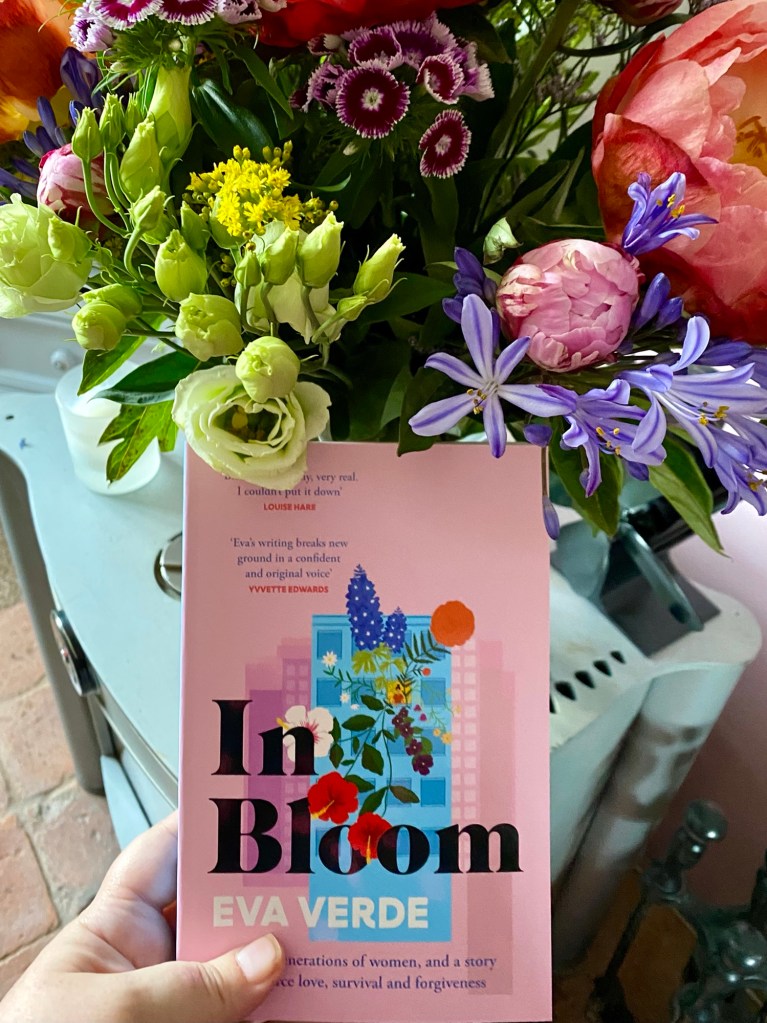
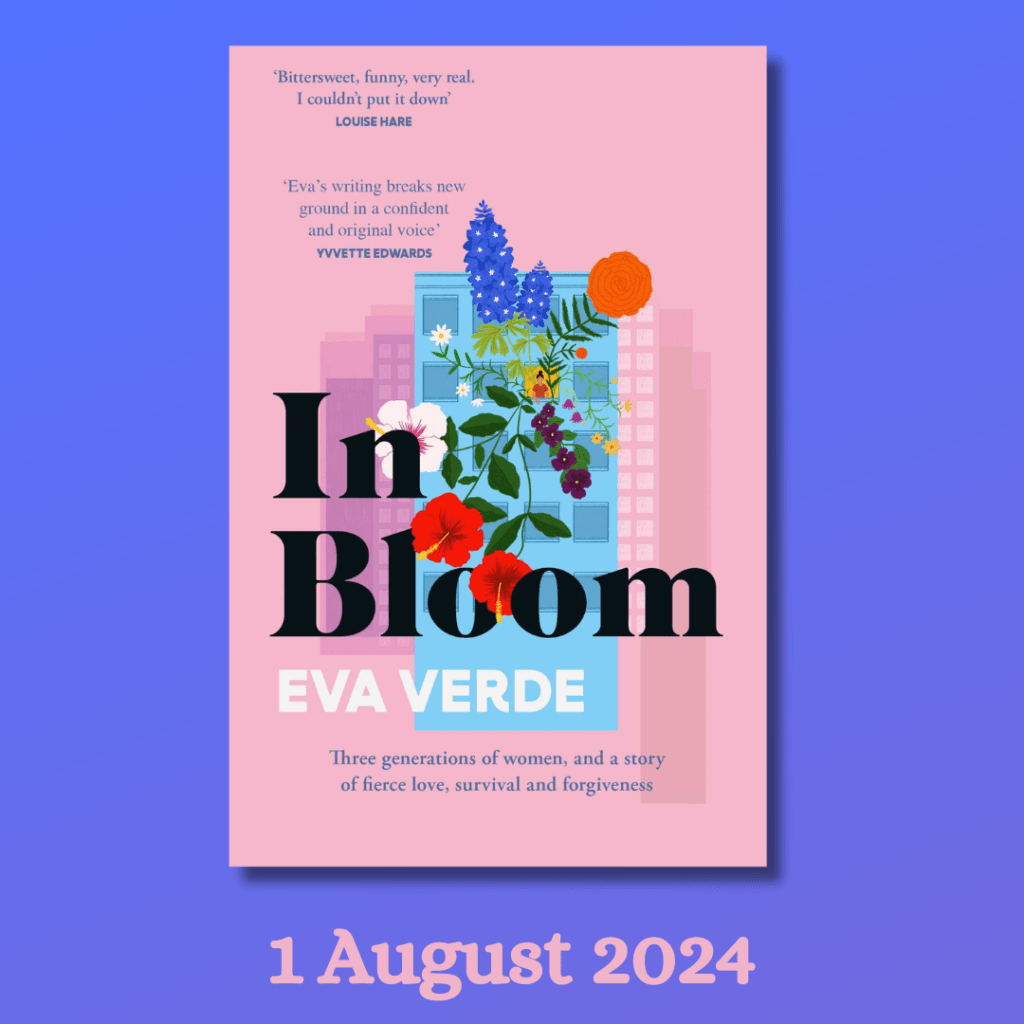
In Bloom by Eve Verde

‘This is my family story. From all I’ve sown together, through all I couldn’t ask. I want to be the bud who makes it.’

In Bloom tells of strength, survival, forgiveness, resilience and determination, and the fierce love and unbreakable bonds between mothers and daughters.

Ever since Sol’s untimely death left her pregnant and alone at twenty-two, Delph’s kept herself small as a form of self-protection. Now, over a decade later, she lives with their daughter Roche and her new partner Itsy, a kind and protective cabbie, on the fourteenth floor of Esplanade Point on the Essex coast.

But Delph’s protective bubble bursts when Roche moves in with her estranged nan, Moon. Feeling on the outside of the bond between her fierce-yet-flaky tarot-reading mother and volatile martial-arts-champion daughter, Delph begins questioning her own freedom. And when Roche’s snooping into her grandmother’s past unearths a familial line of downtrodden women; a worrying pattern emerges. Has keeping small and safe truly been Delph’s choice all these years…?

I’m hosting the paperback blog tour for this wonderful book today and it’s lost none of its charm and power since I read it last year. I don’t believe in trigger warnings, despite their intended purpose to flag up material that may ‘trigger’ difficult emotions in the reader, I feel that they might stop someone experiencing a connection with a text. It might well be a trigger, but that doesn’t always have to mean it’s a negative one. It might be a trigger that starts a healing process. If anyone should have avoided this book it was me, because I was Delphine. I lost the love of my life in my early thirties and then sleepwalked into a coercive and damaging relationship. Yes, it was a hard read at times, but it wasn’t a remotely negative experience. Moon, Delphine and Roche are three generations of a family. Each woman has her own issues, but they all stem from one place. Right back at the beginning.

As the book opens Roche can no longer live with her mother and Itsy, the man she’s been living with for most of Roche’s life. So she decamps to her grandmother Moon’s house. Roche can’t stand Itsy, he dislikes her and wishes she wasn’t there. In fact what he wants is Delphine all to himself, it’s easier to control someone who’s isolated. Delphine has had a glazed over look ever since he arrived in her life and she doesn’t seem like her mum anymore. Delphine has done everything she can to keep Itsy happy. She’s changed how she dressed, made herself less beautiful, stayed at home and stopped going out with friends. Every day she makes herself smaller to make more space for him and Roche can’t watch it anymore. However, things are changing slowly. Delphine has a job she enjoys at B & Q, new connections with her colleagues and today she has made a choice. Delphine is pregnant and she knows deep down in her soul that ‘the thought of more years, more life, tied to him’ is more than she can bear. She goes quietly on her own for an abortion, the quietest but most powerful act of rebellion she can make. Then comes her opportunity, Itsy receives a phone call from Jamaica to tell him his mother is dying. He must jump straight on a flight, so Delphine lets him go alone, knowing that now she has several weeks to herself. She doesn’t stop Roche from moving out and accepts this as her time to heal, time to be the parent that so often Roche has to be for her. However, this isn’t the only recovery needed in the three generations of this family thanks to the actions of men.
I felt at first that I was slowly piecing together the story of a client. Being a person- centred therapist means letting the client choose what they want to talk about. I would use my counselling skills to tease out that story and ask questions where it needs to be clarified or where I might only be getting one perspective. Here the story has it’s own pace and each woman narrates her own section. We flit back and forth, also delving into the past here and there and it’s like doing a jigsaw puzzle but only being handed one piece at a time, then another from a different angle. It takes some time to perceive the whole and that was definitely the case here. Only we the reader can see where they all are in relation to one another. The reality of being a woman in today’s world is explored fully, there is no doubt that these women’s lives would have been immeasurably better had they not encountered men. It takes Roche to articulate this properly with the words and wisdom of her generation.

“Roche knows, remembers, how her life changed at around the time she started secondary, and her bubble of invisibility popped. How, despite the school uniform screaming otherwise, she very suddenly became the inhabitant of a woman’s body, complete with a depressing self-awareness that this was now Roche’s life until one day men deemed her invisible again. In fairness, it’s not her contemporaries who usually do the perving – no, it’s men, grown–ass men who have always done the bulk of the wolf–whistling, the innuendoes and basic compliments that they expect her to ‘smile, love’ and be grateful for.”

As a middle aged woman I now know the power of that invisibility and how, in many ways, it’s a blessing.

I love how carefully the author drew the threads between generations, those behaviours that create a pattern of intergenerational trauma. There are moments in her journey where Delph needs her daughter by her side, but she recognises that it’s a selfish need. Delphi’s lived experience stops her; “is not for a child to fix the parent. Nor is Roche the ointment to Delph’s current troubles”. Then we go back into her mother Moon’s early years, when her grandmother is in hospital, suffering from mental ill health. Her name was still Joy back then and her job is to dispense sunshine to a women who can’t even remember her name. ‘Come on,’ Ma says, in a giddy-up way. ‘You know how happy your little face always makes her.’ This a learned behaviour, people pleasing and exactly what Delph is trying to avoid for her own daughter, three generations later. By sitting with her own pain, Delph is avoiding instilling that behaviour in her own daughter, she’s actively breaking the cycle. Yes, there are traumatic moments in these women’s lives, Moon’s story being particularly harrowing, but we can also see the women’s determination to change. It’s that change and what it means for Roche that brings such an uplifting feeling to the book. For me it’s Delph’s struggle that touched me deeply. The loss of Sol, who’d been there her entire life, is devastating. So moving out of Itsy’s orbit and the mental paralysis she’s been living with means opening up her emotions. That’s all of the emotions including her grief, but it’s a process that needs to happen so that Roche can talk about her father openly and in a joyful way. I found myself more engrossed in the later stages of the book as I had to see whether these women could heal together. This is beautifully written and manages to be funny, moving and hopeful.
Posted in Paperback Publication, Squad Pod Collective

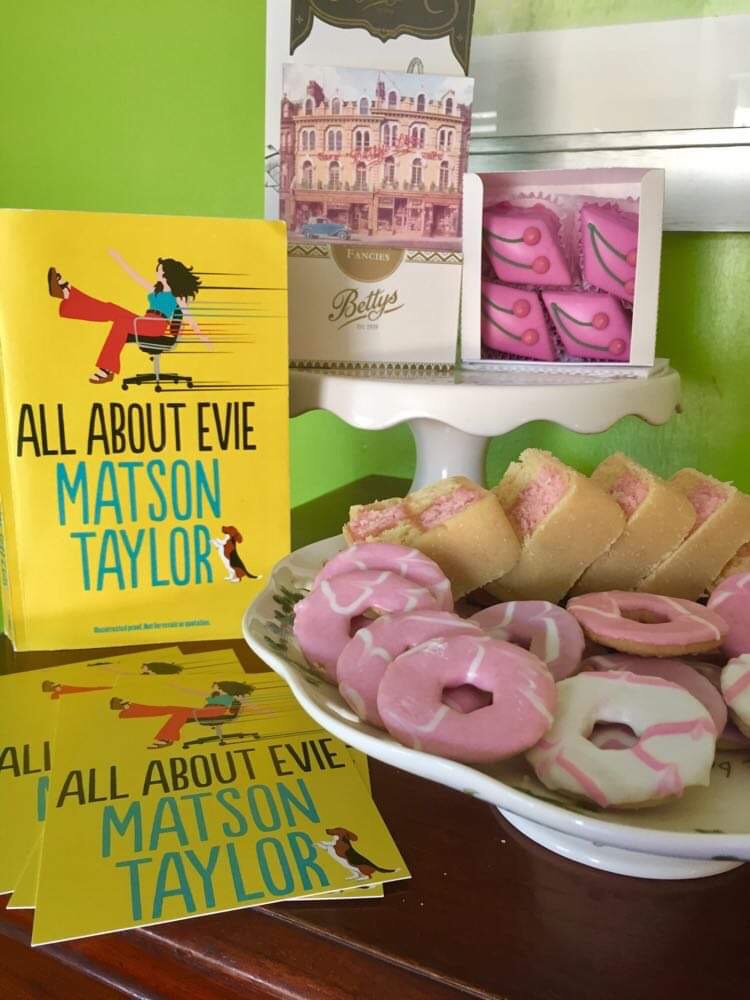
All About Evie by Matson Taylor

This novel is the second in Matson Taylor’s series following Evie Epworth (Yorkshirewoman, Fashion Lover, List Maker). So now, I can categorically say that each time I finish a book about Evie I have a big sunny smile on my face. Of course all books make us feel things, even if it’s to throw them out of the nearest window, but it’s a rare book that gives us a real physical reaction such as the spooky ones that give us goosebumps on the arms or lift the hairs on the back of our neck. I’ve only spontaneously burst into tears once, thanks to David Nicholls’s One Day and that twist none of us saw coming. Not only is Matson is great at those laugh out loud moments, such as the ‘cow incident’ that precipitated her car accident in the first book. As I finished All About Evie I found myself unable to stop smiling. This book feels like liquid sunshine being poured into your veins.

Our previous book ended as Evie is being waved off to an adventurous new life in London, alongside mentor Caroline, the unconventional and glamorous daughter of Evie’s lifelong neighbour and baking partner Mrs Scott-Pym. All About Evie starts ten years later in 1970’s London, where Evie is working in a junior role on BBC Radio Four’s Women’s Hour. Previously, we met Evie at time of great change and this novel is no different. Thanks to a terrible incident with a visiting Princess Anne and the misuse of a mug Evie is sacked from the BBC. Does this mean her life in her little London flat is in jeopardy? Caroline thinks this is an opportunity to try something new so Evie tries working in an art gallery. When it turns out art, particularly the modern variety, isn’t for her she lists things she’d like to do and falls upon the idea of writing for a magazine. She finds the magazine Right On in an office above a sex shop – handy windows for checking one’s hair before walking into the office – and asks for a job. Assuming she’s been a journalist at the BBC, NickStickUpBum and NickWithCollars agree to give her a trial on the listings pages, essentially long lists of what’s on in London across the arts from opera to poetry evenings. With the offer of help from Lolo (Radio Three producer, homosexual, basset owner) on the classical music listings, Evie decides to give it a go and sprinkle some sunshine over her work, in her own inimitable way.

In between Evie’s story there are a couple of flashbacks to other character’s lives. Evie’s neighbour Mrs Scott-Pym has died recently and we see her packing a case for Evie, with little artefacts to remind Evie of their time together – including a pestle and mortar wrapped in a tea towel of Bolton Abbey. Evie is grieving for her old friend, but the reminiscences become even more emotional when we realise that Mrs Scott-Pym was, aside from Dad Arthur, the only link back to Evie’s mum Diana. Preserving her memories of their friendship for Evie is so poignant and it does make Evie think about her future. Can she keep dating totally unsuitable men, who she carefully and comically lists for us, or does she want to meet someone she can share her life with? I thoroughly enjoyed the tension between Evie and her rather hippy dippy workmate Griffin. Griffin is a proponent of high culture and wants the magazine to remain intellectual rather than popular. So to try something a little more highbrow, Evie accepts Lola’s invitation to her first opera. Afterwards, NickWithCollars suggests she write a review for the magazine. This infuriates Griffin who thinks Evie is definitely low culture and would rather they published one of her own poems. When the men are out of the office, Griffin places herself in charge and gives Evie petty tasks to fulfil, often creating a mistake to trip Evie up or keep her working late. Evie tries to take the high road, but her yoga chant trick is absolutely brilliant and well deserved. I couldn’t wait for Griffin to receive her real comeuppance! Meanwhile, there’s a lovely friendship forming between Evie and Lolo, as well as his basset hound.

Yet underneath the humour, there’s so much more going on. A beautifully poignant thread running through the novel is that of motherhood. There are memories of Evie’s mum of course and we’re aware of all the life experiences Evie would have loved to share with her. Evie’s mum never got to see her grow and all that promise is encapsulated in one little throwaway object from the suitcase. Evie has many mother figures though, obviously Mrs Scott-Pym and her friend Mrs Swithenbank who gives Evie a call every week just to check in. Caroline and her lover Digby are disagreeing over the possibility of becoming parents, particularly as Caroline would have to carry the child and believes she doesn’t have that maternal instinct. However, both women have been invaluable to Evie, she even loves popping in and watering their plants while they’re away. Their house gives her the sense of having a family in the city, an anchor that keeps her from being swept away amongst the crowds. We see Evie draw on all these maternal figures when Mrs Swithenbank’s daughter Genevieve turns up in London in search of a fashion career. Genevieve carries just one suitcase, but is full of ideas and her outlandish outfits were so funny – one inflatable hoop dress brought back terrible memories of being stuck in a dress in Laura Ashley’s changing rooms and having to ring my Mum to get me out. Evie feeds Genevieve, lets her stay and starts introducing her to the right people. Every day she comes home, dejected from receiving lots of knockbacks, despite her inventive fashion portfolio. Every time Evie props her up and brings her spirit back. It was lovely to see Evie in this life stage, being the mentor and feeling so confident. As much as I love London, it was also nice to see her at home on the farm with old friends reunited and new ones being introduced, plus a very exciting finale which gives us a nod towards what Evie might do next. I can’t wait to celebrate this fantastic novel with a 1970s party. I’m hoping for a cheese and pineapple hedgehog and Babycham to toast this joyful new stage in the Evie story.

Published 21st July 2022 by Scribner UK

Meet The Author

Matson Taylor grew up in Yorkshire (the flat part not the Brontë part). He comes from farming stock and spent an idyllic childhood surrounded by horses, cows, bicycles, and cheap ice-cream. His father, a York City and Halifax Town footballer, has never forgiven him for getting on the school rugby team but not getting anywhere near the school football team.

Matson now lives in London, where he is a design historian and academic writing tutor at the V&A, Imperial College and the Royal College of Art. Previously, he talked his way into various jobs at universities and museums around the world; he has also worked on Camden Market, appeared in an Italian TV commercial and been a pronunciation coach for Catalan opera singers. He gets back to Yorkshire as much as possible, mainly to see family and friends but also to get a reasonably-priced haircut.

He has always loved telling stories and, after writing academically about beaded flapper dresses and World War 2 glow-in-the-dark fascinators, he decided to enrol on the Faber Academy ‘Writing A Novel’ course. All About Evie is his second novel.

Posted in Paperback Publication, Publisher Proof

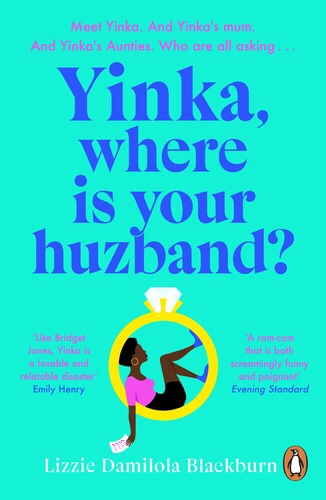
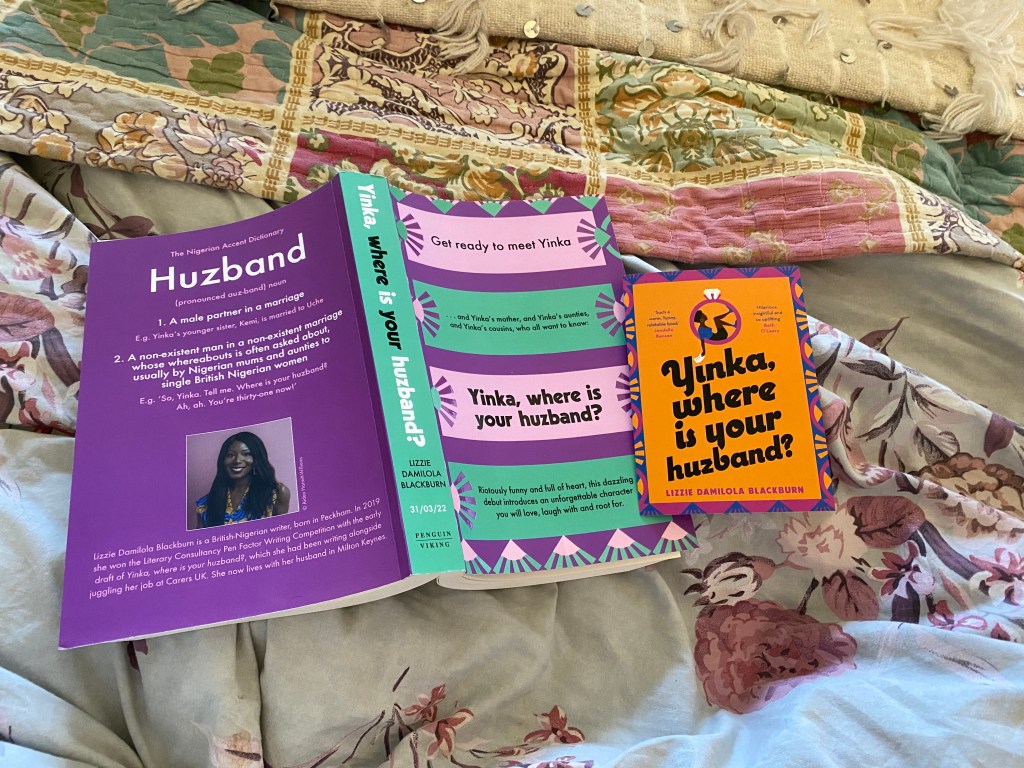
Yinka, Where Is Your Huzband? By Lizzie Damilola Blackburn

I have absolutely loved reading this charming and uplifting debut novel from Lizzie Damilola Blackburn and I already know it’s one I will keep on the bookshelves and read again in the future. It has such charm and a huge heart at it’s centre. Yinka is a 31 year old British Nigerian woman with a degree from Oxford and a brilliant job at an investment bank, but despite all that she has going for her, she hears only one thing from her mother and aunties. Why is she still single? What exactly is she doing wrong? A perfect storm of circumstances affects Yinka’s confidence: her baby sister Kemi is about to have a baby; her friend Rachel becomes engaged and starts planning her wedding; then she expects a promotion at work and is instead made redundant. When her Mum and Aunty Debbie both pray out loud for her to find a man at Kemi’s baby shower, Yinka feels humiliated. Using her project planning skills she decides on a course of action. She will find a man in time to take a date to Rachel’s wedding.

I found the themes of identity woven into the storyline fascinating and complex. At the start of the novel Yinka is wearing her hair short and natural, is more likely to be in jeans than traditional Nigerian fabrics and prefers to eat fried chicken than learn to cook African food. Yet there are so many opinions and judgements, both in her everyday life and on social media, on what it means to be a British Nigerian and an attractive, desirable black woman. The men she meets aren’t short of opinions either. Donovan, who she knows from her gap year working for charity, despairs of her lack of knowledge about hip-hop and music of black origin in general. She accepts an introduction to Alex, a single man at her Mum’s church and they start to chat on social media. He seems to think she should be more aware of her Nigerian culture. He voices surprise, and judgement, that she can’t cook Nigerian food and she doesn’t know many words of the Yoruba language. A Tinder meet up goes horribly wrong when her date makes the assumption she will sleep with him on their second date. When Yinka explains that part of her faith is prizing her virginity and that sex is sacred, something she would only do with her husband. He seems okay about it, but then ghosts her, finally accusing Yinka of misleading him, because this is something she should have made clear up front. Her experience with Emmanuel was the one I found most painful and my heart broke a little for her. He goes to her Mum’s church and she has to swallow her pride just to agree on a number exchange. On FaceTime though he seems disappointed and admits that he agreed to pass on his number, because he thought she was someone else. It’s not his fault, he says, but he does prefer girls with lighter skin. It’s not hard to see how these experiences and opinions chip away at Yinka until she feels like she’s lost herself.

Yinka is constantly receiving messages about the woman she should be, through her experiences, the constant badgering from her Mum, and from social media. The black women society deems beautiful have lighter skin in caramel tones, long and flowing Western hair, and are curvaceous. Yinka feels her skinny body, her J shape bottom and dark skin are not good enough. Even the messages she is receiving from her own family don’t help. Her Mum openly criticises her short Afro hair, it used to be so long and beautiful, how will she get a huzband if she doesn’t make an effort? Yinka has internalised these messages all her life – the lighter her skin, the rounder her bottom, the longer and more Western her hair, the more attractive she will be. She tries a wig for a date then is constantly terrified of the parting being off centre and when her date touches it she knows he has never dated a black woman before – black men know not to touch women’s hair. When she gets a weave and wears one of her friend Nana’s dresses, made from African fabric, her Mum radiates approval – see how pretty she is? My heart went out to her when she remembers her Dad saying to her that the moon is just as beautiful as the sunshine, that midnight has a beauty all of its own. Another problem is the comparisons her Aunties and her Mum make, between Yinka and her sister or her friends, creating division and resentment. Her mum’s constant praise of the beautiful light skinned Kemi, the little sister who has pipped Yinka to the post by getting married and now adding to the family with her new son Chinedu, makes Yinka resent her sister. They become more distant from each other and never talk about the way their mum behaves. Her cousin Ola even laughs when the older women badger Yinka and embarrass her, Ola is married with three children, but is she as happy as her aunties assume she is?

The two aspects of the book I related to so strongly were the culture around Pentecostal Christianity and the role of counselling. Yinka normally attends the Church of England, but her Mum and Aunties frequent the All Welcome Pentecostal church and this felt so familiar to me as I grew up in a New Life Pentecostal Church. I found the scenes with the church so humorous and true to life, especially the constant praying out loud, even at parties. It was a very hard church to grow up in and those teenage years onward when I was single I felt hounded by youth leaders telling me what I could and couldn’t do in a dating situation, that I should only date other Christians and then pushing me towards people I didn’t find remotely attractive. I had a ‘boyfriend’ at church when I was 12 and we only saw each other at youth group and church. It really was more of a friendship, but youth leaders treated it like a serious relationship and when I wanted to break up I was forced to pray about it in a group. The youth leader prayed that God would bring us back together in the future. I felt that single girls were treated with suspicion and that adults were just waiting to matchmake. I rebelled at 16 and walked away, because I felt judged and stifled. It was wonderful though, to read about these experiences and hear certain phrases like being ‘in the spirit’, the endless praying out loud, the sense of having elders to answer to, because it’s rare for someone to understand my experience. It’s even more rare to see it in fiction in a way that acknowledges its drawbacks, but also its benefits and the deep well of humour it provides.

Counselling is something that my church would have been very resistant to, but I am now a counsellor myself and I loved seeing how positively it was portrayed in the book. The use of writing as therapy is something I do with clients and I was moved by Yinka’s letter to her younger self, going back and undoing some of the negative judgements and ideals she had internalised. It was brilliant to see how it took Yinka deeper, into how imbalanced those parental injunctions had become once she lost her father. I wanted Yinka to realise she had two incredible role models to aspire to; her Aunty Blessing who is happy and fulfilled despite having no husband or children and her friend Nana who is simply not bothered with dating and is pouring her energies into building her fashion brand. I loved both of these women and how they really pull Yinka back from the brink, help her untangle the lies she’s told and work out what and where she really wants to be in life. It reminded me of the power of female friendship and how it is most often the women who will hold you up in life. I loved how Yinka’s changes through counselling rippled out to others around her too. Once she has started to talk there are relationships she can mend and maybe others that need some redefining and new boundaries set. Her realisations, about her Mum particularly, are interesting and Yinka’s bravery in trying to address how she has felt made me feel so proud of her. It showed how counselling doesnt just create change in one person, it can change the people around them too. I don’t know if Yinka will ever return, but she was a great character to spend time with and I’d definitely be first in the queue for more. This was a pleasure to read from beginning to end, full of strong female characters, emotionally aware and addressing some really tough issues in a humorous and ultimately uplifting way.

Meet The Author

Lizzie Damilola Blackburn is a British-Nigerian writer, born in Peckham, who wants to tell the stories that she and her friends have longed for but never seen – romcoms ‘where Cinderella is Black and no-one bats an eyelid’. In 2019 she won the Literary Consultancy Pen Factor Writing Competition with the early draft of Yinka, Where is your Huzband?, which she had been writing alongside juggling her job at Carers UK. She has been at the receiving end of the question in the title of her novel many times, and now lives with her husband in Milton Keynes.