Posted in Personal Purchase

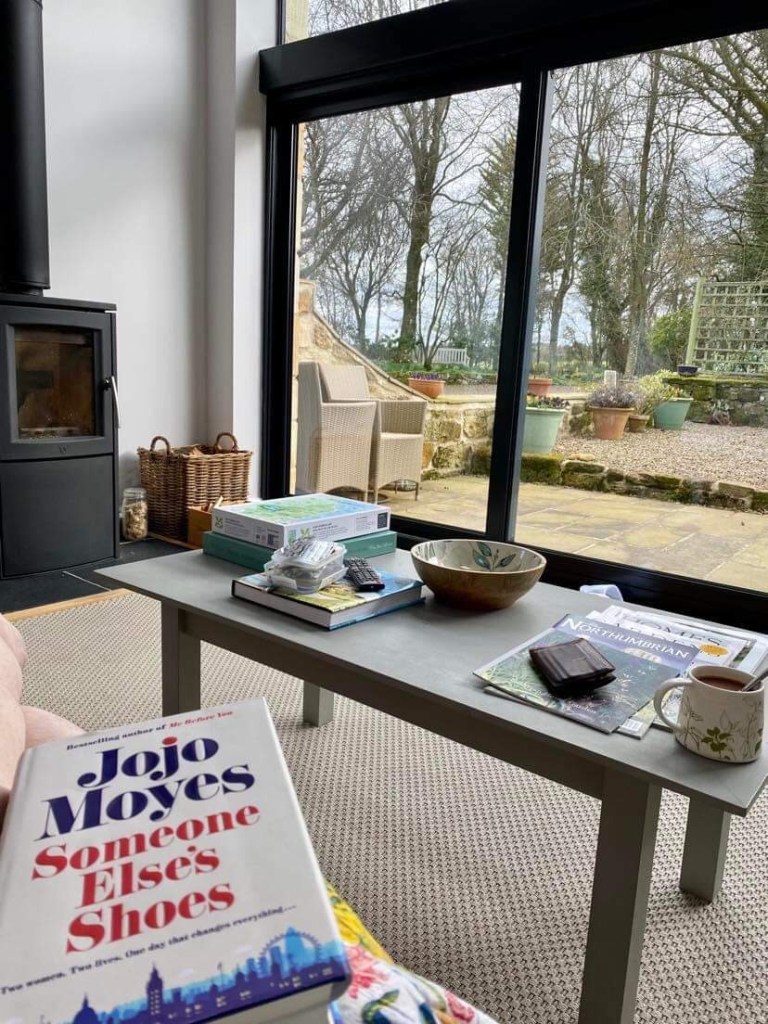
Someone Else’s Shoes by Jojo Moyes.

MEET SAM
She’s not got much, but she’s grateful for what she has: a job she’s just about clinging on to and a family who depend on her for everything. She knows she’s one bad day away from losing it all – and just hopes today isn’t it . . .

MEET NISHA
She’s got everything she always dreamed of – and more: a phenomenally rich husband; an international lifestyle; and . . . she’s just been locked out of all of it after her husband initiates divorce proceedings . . .

Sam and Nisha should never have crossed paths. But after a bag mix-up at the gym, their lives become intertwined – even as they spiral out of control.

Each blames the other as they feel increasingly invisible, forgotten, lost – and desperately alone.

But they’re not.

No woman is an island. Look around. Family. Friends. Strangers.
Even the woman you believe just ruined your life might turn out to be your best friend.
Because together you can do anything – like take back what is yours . . .

When Sam and Nisha swap bags accidentally at the gym, one a Marc Jacobs knock-off, the other is the real deal, they are in very different places in life. Nish is living in the penthouse suite of the Bentley Hotel, even though her husband Carl owns several homes around the world. She is living the high life and has for the past eighteen years. She’s used to the best service and the bespoke experience, as Sam finds out when she opens the bag before a business meeting to find a pair of red Christian Louboutin heels instead of her trusty black pumps. Destined for a business meeting where she can’t turn up bare foot, Sam has to take the plunge and put them on. They’re the sort of shoes that get a woman noticed, not always for the right reasons. Sam is so easy to get to know and love, because if you’re a middle aged woman you’ve probably been there. She’s feeling the squeeze of still having a teenage daughter at home, while taking on the shopping and cleaning for her parents too. Husband Phil has been no further than the sofa for months, he lost his job and then his dad died. Since then Phil’s been suffering with depression, but won’t go for counselling or go to the GP for medication. He’s not touched the camper van he bought with the last of their savings and can’t even get up to let their geriatric dog Kevin out. Sam is greeted by dog mess in the hallway and a tired husband who immediately goes off to bed on her return. Yet this day feels different. When Sam notices clients looking at her shoes, they make her feel powerful. At the end of the day she’s made three out of four deals for the printing company, but will that appease new boss Simon who seems to have made a beeline for the only 40+ woman in the office?

Nisha is also facing massive changes since the bag swap. On her return to the hotel she is told that Carl has given orders to his security not to let her in. He’s locked her out of the penthouse, their bank accounts and his line of credit at the hotel. All she has is Sam’s bag and the clothes she’s standing up in. Left penniless and homeless after eighteen years, Nisha is mourning the loss of her life and the fact she can’t call her son in New York to let him know. Ray is in a mental health unit and usually they speak every day. Hoping to gain access to the penthouse and all of her clothes, Nisha dresses like one of the housekeeping staff but is mistaken for the real deal by Jasmine, a senior housekeeper who rushes Nisha through checks and has her working alongside her in minutes. Nish can’t believe she’s fallen from the penthouse, to scrubbing poo marks off a toilet bowl. However, she needs something to pay for the cheap B and B she’s found. All the time she’s scrubbing, she’s assessing her eighteen year marriage and realising she’s come out of it with no friends, no family and not a single person she can call for help. After a disastrous attempt to get her clothes, Jasmine stands up for her and fixes the issue. Once Nish has come clean, Jasmine becomes her guardian angel and takes her home to the little flat she shares with daughter Grace that’s covered with laundry and clothing needing alterations – Jasmine’s second job. When she finally gets to confront Carl she’s baffled by his position; there will be no financial settlement until she has the red Louboutins back. Nisha has no idea how to find them, but is determined try as it is the only way she can be reunited with her beloved son.

There is a little touch of romance in the novel, which was a lovely thread, but I loved the sense of sisterhood in the novel most, particularly those who come to learn the importance of the women in their lives. Nisha needs to learn about female friendship, having had only one friend in NYC who Carl persuaded her to give up. She’s stunned that Jasmine would help her and the depths of her generosity in giving her a job, a bed and a roof over her head. This flat that Jasmine shares with her daughter Grace is not large and what space they do have is often covered with clothes that she’s either laundering or altering. It’s amazing to Nish that someone who has so little, is prepared to share it. When Sam and her friend Andrea come along, the last thing Nish expected was to like her, but she’s also impressed with the way Sam lives. She notices that Sam’s home is a huge contrast to the way she’s been living. Having several homes and living in a hotel is impersonal. While she wouldn’t want Sam’s decor, she can see it’s a celebration of her family and their life together. This is something Nish has never had. She’s stayed in some of the most expensive places in the world, but has never had a home. Could this group of women become that for her? I loved how they all embraced each other and the times that they were all together simply leapt off the page. These are complex, funny and generous women who felt completely real and made me miss my women. I’m out of the habit of socialising after shielding during lockdown and I miss that camaraderie, swapping wisdom and having a laugh. It has inspired me to reach out to my friends and try to see them a bit more, because when it comes to those tough parts of life, it’s your women who hold you up and see you through.
Meet the Author

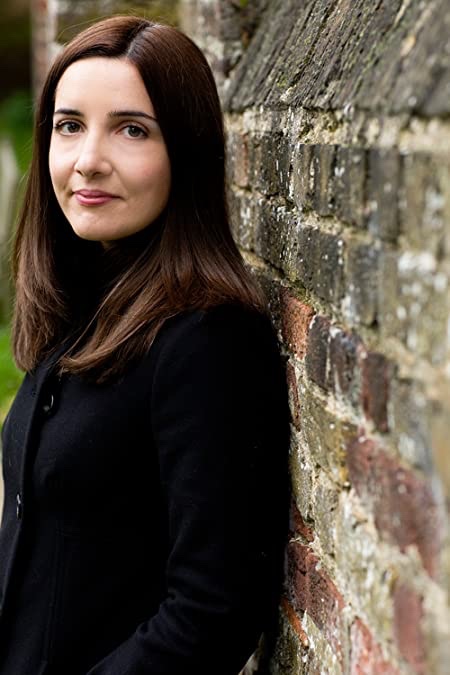
Jojo Moyes is a novelist and screenwriter. Her books include the bestsellers Me Before You, After You and Still Me, The One Plus One, The Giver of Stars, the forthcoming Someone Else’s Shoes and her short story collection Paris for One and Other Stories. Jojo’s novels have beentranslated into forty-six languages, have hit the number one spot in twelve countries and have sold fifty-one million copies worldwide. Me Before You has now sold over fifteen million copies worldwide and was adapted into a major film starring Sam Claflin and Emilia Clarke. Jojo lives in London.
Posted in Netgalley

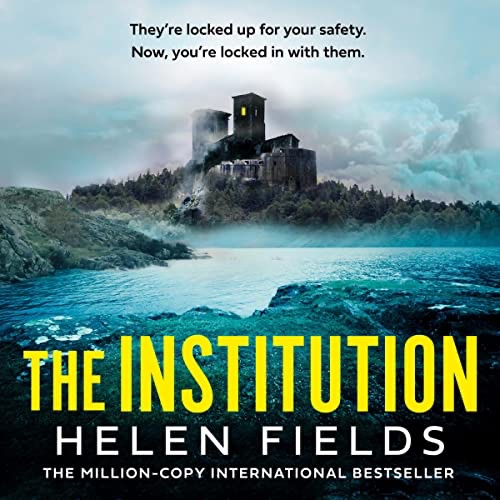
The Institution by Helen Fields.

I was eager to read this having loved her previous novel The Last Girl To Die, so I’ve felt very lucky to be granted early access to it on NetGalley. Our heroine is Dr. Connie Woolwine, a behaviourist and profiler rather than a psychiatrist, she works privately alongside her investigator Brodie. She has access to The Institution to look for a killer within the high security wing. Housed in one of the towers, the wing is known as ‘heaven’ and has six inmates, all of whom are either serial or spree killers. Her cover story is an unusual one. Brodie will go deep undercover as a potential inmate, with Connie as his current therapist. Brodie has been in the millitary and suffers from PTSD amongst other issues, so Connie is there to assess the ward, meet the inmates and decide whether it’s the best place for Brodie to be treated. The truth is a lot more gruesome. A nurse from the ward has been found dead on one of it’s treatment rooms. Tara was restrained and had a rudimentary caesarean performed on her, but was then left to bleed to death. The baby has not been found and the killer could only have been on the unit. With a grieving family waiting for a ransom demand, staff and inmates at the unit have been given a different story about this well-liked member of staff. They are told that Tara will be resting at home for the final stages of her pregnancy. Now Connie is on the clock, desperately trying to find baby Aurora and which one of the killers could have murdered the ward’s most popular nurse in such a brutal way.

Connie seems maverick, with strange methods such as talking to, sniffing and touching Tara’s body. She’s an unusual narrator because I didn’t always feel sure of her. We find out that when she was a young woman she was admitted to a mental health unit after an accident left her mute and doctors couldn’t find a physical cause. She was given ECT and treated by psychiatrists until a new doctor decided to re-scan her brain and found a previously hidden blood clot. Once removed, Connie could speak again. This experience has left it’s mark and it seems very important to her, even when self-disclosing to a patient, that they know she wasn’t really mentally unwell. We’re mainly in Connie’s world with interspersed short chapters on an assessment session, each subject’s name as the title. These sections read like session notes and give us Connie’s views of each inmate. Rubio for example, acts like a baby and wants to be cuddled and nursed. He gave me the creeps, especially when he’s wearing a nappy. The Professor is more on Connie’s level intellectually, but acts very superior. I didn’t feel that the sessions were helping me understand who might have done this. In fact I think I learned more about Connie than the patients. In the meantime, poor Brodie is living with these inmates and has gone through being sedated and restrained by staff. The staff are incredibly suspicious, with orderlies who enjoy their power too much, nurses who seem to resent Connie’s presence and a male doctor who makes a pass at her almost immediately. I kept wondering who would choose to work here, in such a dangerous and bleak place?

I felt it was clever to keep the reader questioning Connie and it wasn’t just her inner world that worried me. There were points in the story where her instincts really concerned me, such as going off alone to very remote places in the building and on the grounds. There was also a major flaw in the plan, in that her investigator is so confined by his role as a patient he can only observe. This really does leave Connie to take on the more dangerous part of physically investigating, but as she’s untrained for this role and potentially more easily overpowered, it left me feeling on edge. Also someone who is thinking ahead of her could use her seemingly erratic behaviour and appearance to make her worst fears comes true. The tension is unrelenting and nowhere is safe, including rooms that have a lock! The claustrophobia is intense and works like a set of Chinese boxes: from the location and the effects of the storm, the compound, the locked building, the high security tower within the whole institution, all the way down to the treatment room and it’s restraints. These layers of confinement did make me uncomfortable and when a character is further confined with drugs or the threat of ECT, it brings it home how powerless patients and the murder victim were. These layers also emphasise the brutality about drugging someone and stealing a baby from the ultimate place of safety, their mother’s womb.

There is a strange fascination in hearing about the inmate’s crimes, mainly because they seem so at odds with the men we encounter through Connie. Her sessions feel slightly strange from a therapy perspective, but of course Connie is not really there to engage in a therapeutic relationship. Unknown to them and the staff, she’s using the session to assess whether they’re behind the crime and I was interested in the ethics of this approach. As disaster strikes and the ward has to be evacuated, the tension jumps up a level with men who are usually in their cells now roaming free. For those left on the ward it becomes a fight for survival, with only a basic knowledge of the inmates to inform them about which ones can be trusted and those who must be avoided. This was an exciting end to the novel and really did keep me gripped to the bitter end, waiting for the perpetrator to admit their role in the murder and kidnap plot. I was biting my nails, worried that Connie wouldn’t find baby Aurora before it was too late. This was an intelligent thriller, full of tension and unexpected twists and turns. It’s cemented my suspicion that Helen Fields really is a must-buy author.

Meet the Author

An international and Amazon #1 best-selling author, Helen is a former criminal and family law barrister. Every book in the Callanach series has claimed an Amazon #1 bestseller flag. ‘Perfect Kill’ was longlisted for the Crime Writers Association Ian Fleming Steel Dagger in 2020, and others have been longlisted for the McIlvanney Prize, Scottish crime novel of the year. Helen also writes as HS Chandler, and has released legal thriller ‘Degrees of Guilt’. In 2020 Perfect Remains was shortlisted for the Bronze Bat, Dutch debut crime novel of the year. In 2022, Helen was nominated for Best Crime Novel and Best Author in the Netherlands. Now translated into more than 20 languages, and also selling in the USA, Canada & Australasia, Helen’s books have won global recognition. She has written standalone novels, The Last Girl To Die, These Lost & Broken Things and The Shadow Man. Her first UK hardback, The Institution, comes out in March 2022. She regularly commutes between West Sussex, USA and Scotland. She lives with her husband and three children. Helen can be found on Twitter @Helen_Fields for up to date news and information or at http://www.helenfields.co.uk.

Posted in Random Things Tours

The Walled Garden by Sarah Hardy

I found this historical fiction debut absolutely captivating from the beginning. It begins with Lord and Lady Rayne who live in the big house, Oakburne Hall, with just enough room to avoid each other as much as possible. In fact since he returned from the war, Stephen has slept in a small room in the servant’s quarters while Alice lays alone in their marital bed. She finds refuge in their garden, hoping that even in these dark post-war years some seeds of hope will grow.

‘Some secrets are too terrible to tell. And in 1946 Britain is a country where most keep silent. What you witnessed during the war, what you sanctioned, what you are still afraid of, is left unsaid. For those bitter years of conflict and separation you buoyed yourselves up on sentiment, crooning ‘We’ll Meet Again’. And we did meet again, thinks Alice Rayne, only to discover we have nothing to say to one another.‘

No one survives war unscathed and though bodies are healing, their psychological wounds run deep. Those who were left behind are just as scarred as those who left to fight. Stephen Rayne was once sweet and gentle and his wife Alice truly loved him. Yet he has returned a man that she doesn’t recognised. He is bitter and angry, destroyed emotionally by what he has seen and done, holding on to secrets Alice can only guess at. She is lonely and although she hates to admit it, she is increasingly afraid of the man her husband has become, Alice is struggling to put together the pieces of her marriage and save Oakbourne Hall from total collapse. After two lots of death duties, money is incredibly tight so she begins with the walled garden and, as it starts to bear fruit, she finds the seeds of a new and forbidden love being sown.

I had so much empathy for Alice and all women who longed for the man they loved to return, only to find their relief and joy cut short when a stranger came home in their place. I’ve read a lot of novels set post-WW1, but not many set after WW2, but the same social changes come up in 1946. People are struggling financially, at the big house two world wars have taken two heirs in quick succession and the family can’t afford to repair or develop the hall. The villagers are coping with grief, poverty and rationing, and still waiting for men who’ve not yet returned. Women have once again stepped into the breech and taken on men’s jobs, giving them even more freedom and an unwillingness to be pushed back into their traditional roles. In this village, it’s not only Stephen and Alice who are suffering and as they come up against other people’s trauma the results are profoundly moving. The social change is well explored through the character of the village GP, another changed man whose longing for social justice leads to arguments with his wife and children, not to mention Stephen. Clergyman George holds so much guilt, because his ill health meant he didn’t go to fight. How can he minister to these men who’ve been through so much, things he can’t even imagine? As Stephen isolates himself more from his wife, Alice finds solace restoring the walled garden and in talking to George with whom she strikes up a friendship. He is learning about gardens and she is learning about his love of classical music.

As the friendship between George and Alice deepens, she has to think about what she wants. She has loved Stephen for so long, but his angry and violent outbursts are scaring her. Can she love this new person? George listens and appreciates her opinions, in a way she hasn’t had for a long time. When she takes a break from Oakbourne and visits her sister in London, she meets with George in a pub where his beautiful singing voice is in demand at the piano. This interlude is like a time outside of reality, where all worries and cares are set aside. With the late hour and room for George to stay at her sister’s flat will emotion boil over? In all this time, George is struggling with his ministry and his feelings for Alice. When Stephen also confides in him he has a terrible choice to make, does he guide Stephen towards speaking to his wife and saving his marriage? On the other hand, he could advise him in a way that would benefit his feelings for Alice. It’s a terrible choice to have to make, even worse he knows that his lungs are deteriorating and if he doesn’t take up the GP’s offer of treatment abroad he has only months to live. Will he follow his heart or will he sacrifice his own feelings to minister to this couple as their spiritual guide?

This is such an emotional crescendo, especially since we’re also sent back into the war and Stephen’s time infiltrating the french resistance and helping them to fight against the Germans. There, he has to make a horrible choice in order to save someone from a worse fate. His choice haunts him, although in reality he is forced to act by his knowledge of the barbarity of the German soldiers. The Maquis hail him a hero and now want to give him an honour, setting off terrible flashbacks, insomnia and guilt. Even if he tells Alice everything, can their marriage recover? I was so involved with these characters, they were so incredibly real and full of complex emotions. I loved the walled garden as a symbol of hope for the future and Alice’s work there is an act of faith, planting her hope in a symbolic gesture to her marriage and the country as a whole. I think the most moving thing about the whole novel is that this is a war that my grandparents lived through. We are so used to seeing this generation as an example, even recently our actions through Covid and the current cost of living crisis are meant to resemble their grit and determination. I believe the famous David Cameron quote is ‘we’re all in it together’ evoking the stiff upper lip of this very generation. I think because of this nostalgic view on WW2 we forget that this generation had the same emotions and complicated relationships that we do now. This book stopped me from thinking of that generation as a whole and instead to think about individuals and what they went through, how it affected them and their families and the emotional turmoil wrought by couples being apart for years. It was the wartime sections of Andrea Levy’s Small Island that first made me think about these issues and this novel woke those thoughts up again, just in a more rural setting. No generation is better than any other when it comes to trauma, we are all human. This is a stunning debut from Sarah Hardy and I’d love to read her work again.

Meet the Author

Sarah Hardy has lived for the last 10 years on the Suffolk coast which is where her novel is set. Before that she lived in London, Dublin and the Hebrides. She has worked on national magazines and newspapers.

Posted in Squad Pod

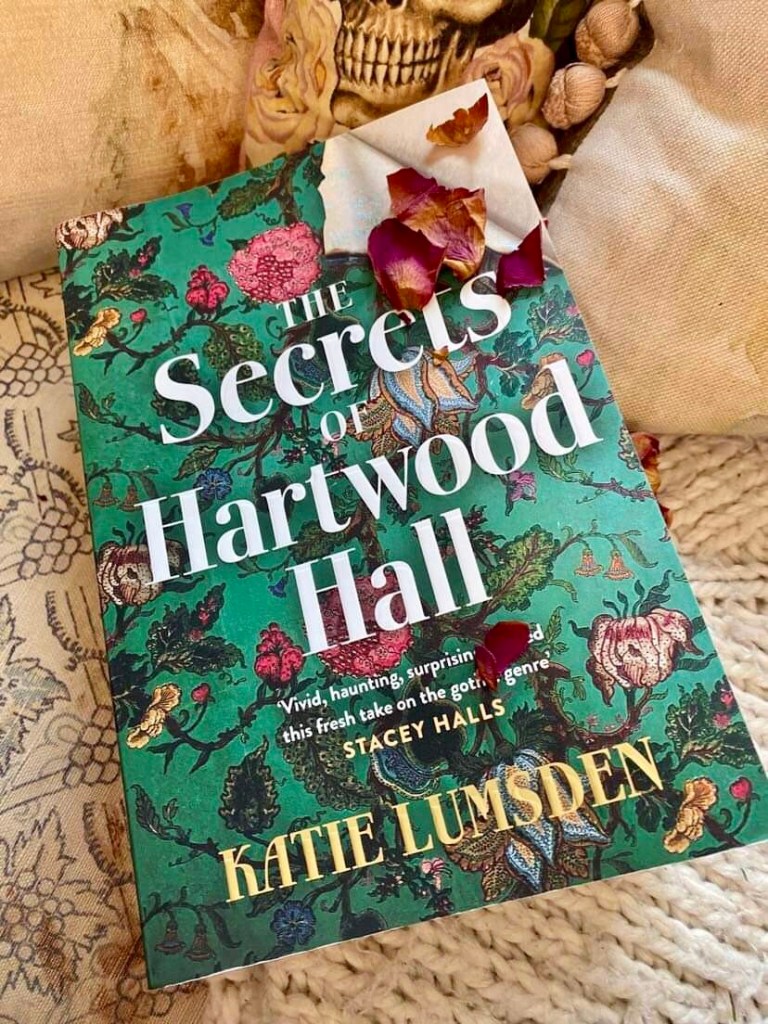
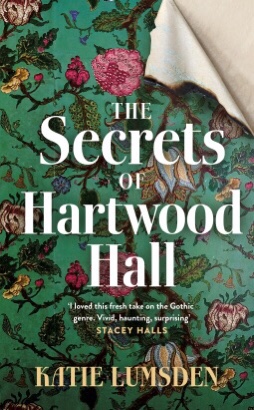
The Secret of Hartwood Hall by Katie Lumsden.

There couldn’t have been a better choice for a squad of female bookworms than this gothic mystery, full of spooky incidents, forbidden love, an orphan governess and within a house that holds many secrets. There was such a Jane Eyre feel about the book and also an hint of the Daphne Du Maurier opening as our narrator looks back to the hall’s approach.

‘when i think of Hartwood Hall, there are moments that come back to me again and again, moments that stain me, that cling like ink to my skin. My first view of the house: a glimpse of stone, of turrets and gables, tall windows and long grass’.

Our heroine is Margaret Lennox, recently widowed and forced to find paid work when her husband leaves his estate to his mother. She is offered a post by the mysterious Mrs Eversham, to educate her son Louis. This should be a moment of freedom for Margaret, but she notes the strange mood of the coach driver as soon as they enter the boundaries of the hall. Local people do not come near here. There is also a very clear rule: do not enter the East Wing of the house, because it is no longer used. As Margaret starts to find her way in Hartwood Hall and enjoys her time with Louis, she does notice a few strange things. She seems under suspicion from one of the existing staff, Susan. She has noticed Margaret’s response to a letter she receives at the breakfast table and is keen to find out more. Stranger than that, she has seen a distance figure in white out in the gardens and followed a figure with a candle down the stairs and towards the East Wing. Maybe the house is haunted, but there are other mysteries too such as what happened to Mr Eversham and why do people in the village treat this woman and her boy with such suspicion and fear?

I was hooked by this story straight away. Just like the author, Jane Eyre was the first grown up book I ever read and I was enthralled with it as a gothic story, years before I started to deconstruct it’s complexity at university. I was also hooked by the Sunday teatime BBC series starring Timothy Dalton as Mr Rochester. It’s the perfect mix of ghostly mystery, intrigue and romance. This book was inspired by the classic but breaks new ground of it’s own in terms of forbidden relationships, marital abuse, and freedom. The freedom of women making their own choices, having freedom of sexual expression and to earn their own living. The governess has always been a liminal figure in literature because they are educated more than other servants and even the woman of the house. They are usually single so have more freedom in their lifestyle and finances. Here Margaret is a widow, she chooses her own destiny and can shape her life as far as choosing where she works and for whom. She also has the choice of what to do with her spare time, no household chores or husband and family to consider. We learn that Margaret’s marriage was not a happy one and she has never felt the love that’s spoken of in literature and poetry. In fact she is surprised to learn it exists and it is joyous to watch her explore that chemistry, even if I did fear for her recklessness. She also becomes the face of Hartwood Hall in the village, choosing to take Louis to church and sit in the hall’s pew, whereas the hall’s gardener sits with his family. She even makes friends with the minister’s wife, although the rest of the village seem to avoid and ostracise them.

As always in these mysteries Margaret is drawn towards the very part of the house she is told not to enter, in fact it is a perfect way into the house after the main doors are locked at night. She is sure she’s seen a candle moving around the East Wing’s rooms when walking in the gardens one evening. There are also noises in the dead of night that can’t be accounted for, but for me the tension really arises at the less mysterious points in the novel. The sly, unpleasant Susan really made my pulse race at points and her blackmail of Margaret feels grubby. She really enjoys the power of knowing something that gives her power over the other person and she seems to enjoy taking something valuable or precious from her victim. The way she commits little acts of dissent when only Margaret is looking, such as stuffing bacon in her mouth in the breakfast room shows resentment about her position. As I could see Margaret settling and enjoying her new pupil I desperately didn’t want Susan to ruin it. The period where both Louis and Susan are ill was truly tense as the whole house waits for the fever of the measles virus to pass. The isolation of Mrs Eversham and her boy is brought into stark relief when they can’t secure a nurse from the village to care for the patients. Mrs Eversham is in despair:

‘So these people will let a child and a young woman die because they suspect me, because they distrust this house? […] Because they believe in ghosts and spirits and curses? Or because they think I am a woman of low character, that I have never had a husband?’

This speech reveals another possibility about their isolation, that Mrs Eversham’s widowhood is not what it seems. It also shows me that Mrs Eversham has a different set of morals to the Victorian norm, she is wiling to set aside ideas about decency and propriety when it comes to saving a life. Margaret is so relieved when Miss Davis appears from nowhere claiming she’s come from the further village of Medley because she heard there was a child who needed a nurse. Yet the other servants seem uncomfortable and even Mrs Eversham seems on edge. Margaret wonders whether Mrs Pulley knows something troubling about this young woman. This brings another yet another layer of mystery to the house: why isn’t Miss Davis as prejudiced against the hall as the locals? Where did she spring from so quickly? By this time I was fascinated and couldn’t stop myself from picking the book up at every opportunity to resolve all my suspicions. Needless to say that when the truth comes out, it was nothing I expected and I loved it! I loved that these strong, determined female characters were living according to their authentic selves. There’s a lot of discussion around the ending of Jane Eyre, I’ve even had an argument about it at a literature talk. A woman said that she felt let down by the ending and Jane’s choice to return to Rochester, because it betrayed her feminism. I argued that she goes back a different woman, with her own money and able to make her own choices. Rochester is her choice and their relationship is on her terms. The ending of Hartwood Hall definitely goes further. It was really heart-stopping, but also satisfying. Both Mrs Eversham and Margaret make their independent choices and decide to live life on their own terms. I throughly enjoyed this atmospheric gothic mystery and it’s strong, forward-thinking, female characters.

Meet the Author.

Katie Lumsden read Jane Eyre at the age of thirteen and never looked back. She spent her teenage years devouring Victorian literature. She has a degree in English Literature and History from the University of Durham and an MA in Creative Writing from Bath Spa University. Her short stories have been shortlisted for the London Short Story Prize and the Bridport Prize, and have been published in various literary magazines. Kate’s YouTube channel Book and Things has more than 20,000 subscribers and was long listed for the Book Vlogger of the Year Award at the London Book Fair Awards 2020. She lives in London and works in publishing.

Posted in Paperback Publication, Squad Pod Collective

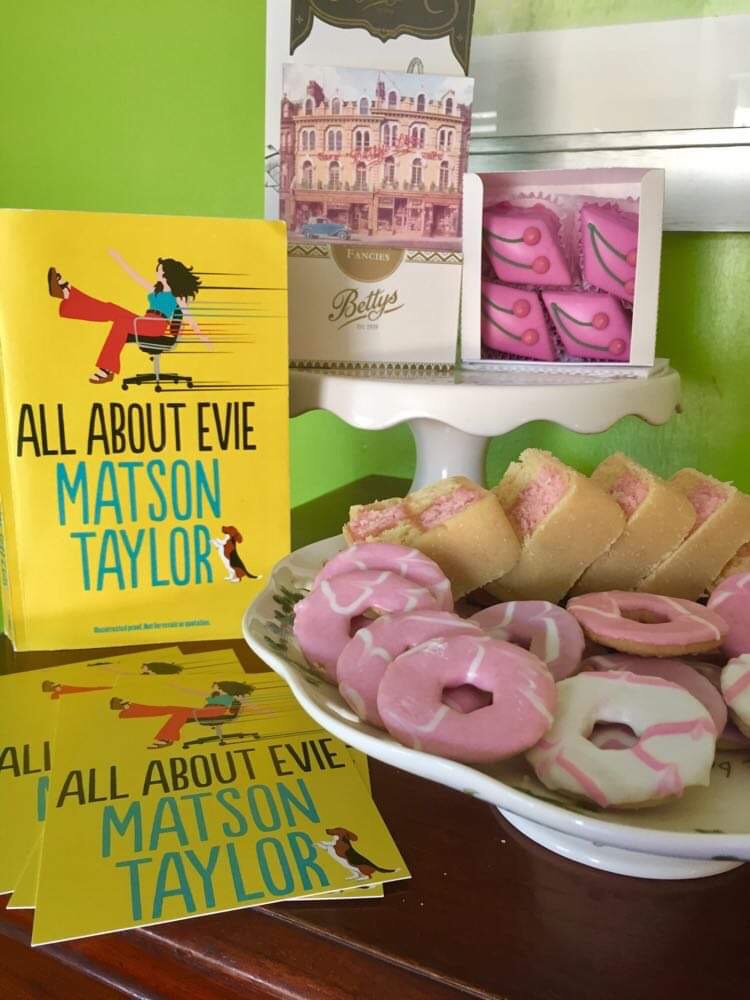
All About Evie by Matson Taylor

This novel is the second in Matson Taylor’s series following Evie Epworth (Yorkshirewoman, Fashion Lover, List Maker). So now, I can categorically say that each time I finish a book about Evie I have a big sunny smile on my face. Of course all books make us feel things, even if it’s to throw them out of the nearest window, but it’s a rare book that gives us a real physical reaction such as the spooky ones that give us goosebumps on the arms or lift the hairs on the back of our neck. I’ve only spontaneously burst into tears once, thanks to David Nicholls’s One Day and that twist none of us saw coming. Not only is Matson is great at those laugh out loud moments, such as the ‘cow incident’ that precipitated her car accident in the first book. As I finished All About Evie I found myself unable to stop smiling. This book feels like liquid sunshine being poured into your veins.

Our previous book ended as Evie is being waved off to an adventurous new life in London, alongside mentor Caroline, the unconventional and glamorous daughter of Evie’s lifelong neighbour and baking partner Mrs Scott-Pym. All About Evie starts ten years later in 1970’s London, where Evie is working in a junior role on BBC Radio Four’s Women’s Hour. Previously, we met Evie at time of great change and this novel is no different. Thanks to a terrible incident with a visiting Princess Anne and the misuse of a mug Evie is sacked from the BBC. Does this mean her life in her little London flat is in jeopardy? Caroline thinks this is an opportunity to try something new so Evie tries working in an art gallery. When it turns out art, particularly the modern variety, isn’t for her she lists things she’d like to do and falls upon the idea of writing for a magazine. She finds the magazine Right On in an office above a sex shop – handy windows for checking one’s hair before walking into the office – and asks for a job. Assuming she’s been a journalist at the BBC, NickStickUpBum and NickWithCollars agree to give her a trial on the listings pages, essentially long lists of what’s on in London across the arts from opera to poetry evenings. With the offer of help from Lolo (Radio Three producer, homosexual, basset owner) on the classical music listings, Evie decides to give it a go and sprinkle some sunshine over her work, in her own inimitable way.

In between Evie’s story there are a couple of flashbacks to other character’s lives. Evie’s neighbour Mrs Scott-Pym has died recently and we see her packing a case for Evie, with little artefacts to remind Evie of their time together – including a pestle and mortar wrapped in a tea towel of Bolton Abbey. Evie is grieving for her old friend, but the reminiscences become even more emotional when we realise that Mrs Scott-Pym was, aside from Dad Arthur, the only link back to Evie’s mum Diana. Preserving her memories of their friendship for Evie is so poignant and it does make Evie think about her future. Can she keep dating totally unsuitable men, who she carefully and comically lists for us, or does she want to meet someone she can share her life with? I thoroughly enjoyed the tension between Evie and her rather hippy dippy workmate Griffin. Griffin is a proponent of high culture and wants the magazine to remain intellectual rather than popular. So to try something a little more highbrow, Evie accepts Lola’s invitation to her first opera. Afterwards, NickWithCollars suggests she write a review for the magazine. This infuriates Griffin who thinks Evie is definitely low culture and would rather they published one of her own poems. When the men are out of the office, Griffin places herself in charge and gives Evie petty tasks to fulfil, often creating a mistake to trip Evie up or keep her working late. Evie tries to take the high road, but her yoga chant trick is absolutely brilliant and well deserved. I couldn’t wait for Griffin to receive her real comeuppance! Meanwhile, there’s a lovely friendship forming between Evie and Lolo, as well as his basset hound.

Yet underneath the humour, there’s so much more going on. A beautifully poignant thread running through the novel is that of motherhood. There are memories of Evie’s mum of course and we’re aware of all the life experiences Evie would have loved to share with her. Evie’s mum never got to see her grow and all that promise is encapsulated in one little throwaway object from the suitcase. Evie has many mother figures though, obviously Mrs Scott-Pym and her friend Mrs Swithenbank who gives Evie a call every week just to check in. Caroline and her lover Digby are disagreeing over the possibility of becoming parents, particularly as Caroline would have to carry the child and believes she doesn’t have that maternal instinct. However, both women have been invaluable to Evie, she even loves popping in and watering their plants while they’re away. Their house gives her the sense of having a family in the city, an anchor that keeps her from being swept away amongst the crowds. We see Evie draw on all these maternal figures when Mrs Swithenbank’s daughter Genevieve turns up in London in search of a fashion career. Genevieve carries just one suitcase, but is full of ideas and her outlandish outfits were so funny – one inflatable hoop dress brought back terrible memories of being stuck in a dress in Laura Ashley’s changing rooms and having to ring my Mum to get me out. Evie feeds Genevieve, lets her stay and starts introducing her to the right people. Every day she comes home, dejected from receiving lots of knockbacks, despite her inventive fashion portfolio. Every time Evie props her up and brings her spirit back. It was lovely to see Evie in this life stage, being the mentor and feeling so confident. As much as I love London, it was also nice to see her at home on the farm with old friends reunited and new ones being introduced, plus a very exciting finale which gives us a nod towards what Evie might do next. I can’t wait to celebrate this fantastic novel with a 1970s party. I’m hoping for a cheese and pineapple hedgehog and Babycham to toast this joyful new stage in the Evie story.

Published 21st July 2022 by Scribner UK

Meet The Author

Matson Taylor grew up in Yorkshire (the flat part not the Brontë part). He comes from farming stock and spent an idyllic childhood surrounded by horses, cows, bicycles, and cheap ice-cream. His father, a York City and Halifax Town footballer, has never forgiven him for getting on the school rugby team but not getting anywhere near the school football team.

Matson now lives in London, where he is a design historian and academic writing tutor at the V&A, Imperial College and the Royal College of Art. Previously, he talked his way into various jobs at universities and museums around the world; he has also worked on Camden Market, appeared in an Italian TV commercial and been a pronunciation coach for Catalan opera singers. He gets back to Yorkshire as much as possible, mainly to see family and friends but also to get a reasonably-priced haircut.

He has always loved telling stories and, after writing academically about beaded flapper dresses and World War 2 glow-in-the-dark fascinators, he decided to enrol on the Faber Academy ‘Writing A Novel’ course. All About Evie is his second novel.

Posted in Netgalley, Publisher Proof

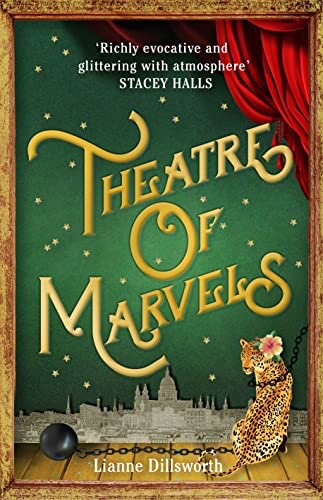
Theatre of Marvels by Leanne Dillsworth

You may have heard of Sarah Baartman, a Khoekhoe woman from South West Africa who was exhibited as a freak show attraction in 19th-century Europe under the name the Hottentot Venus. She was even exhibited after her death, with one showman dissecting her body and keeping her genitalia and skull. Another museum displayed her skeleton and a body cast, which were still exhibited up till the 1970’s. She was exhibited for her steatopygic body type, where body fat is concentrated on the bottom and thighs. This body type wasn’t seen in Europe and was perceived as a curiosity. She was also a subject of scientific interest, but through the gaze of racial bias and erotic projection. In the 19th Century her body could be viewed for two shillings and for a bit extra you could poke her with a stick. Her genitalia were of specific interest as they were said to show her sexual primitivism, although this was more about the men’s erotic projection than Sarah’s own sexuality or libido. Recently, black women in academia and culture have been using her story and reframing it as a source of empowerment, rejecting the ideals of white mainstream beauty, and embracing more curvaceous figures as a source of female beauty. This is the historical and social background that I had in mind while reading this fascinating debut novel from Lianne Dilsworth. I was swept up into her world straight away and my personal academic interest in disability and the display of ‘other’ bodies added to my enjoyment.

Our setting is a theatre and a group of performers from singers to magicians who perform a variety show under the watchful eye of Mr Crillick. His current headline act is Amazonia – a true African tribeswoman, dressed in furs and armed with a shield and spear, her native dancing brings down the house in Crillick’s show. The audience watch, transfixed with fear and fascination, never realising that she is a ‘fagged’ act. Zillah has never set foot in Africa and is in fact of mixed race heritage, born in East London. She is making her money by pretending to be what the, largely white, audience wants to see. It doesn’t sit well with Zillah, but she is alone in the world and does need to make money. Besides it’s better than the other options for a young woman who finds herself in poverty. She’s used to slipping between worlds on stage and in her private life, renting a room in the rough St Giles area of the city, but regularly making her way to a more salubrious area and the bed of a Viscount by night. She and Vincent have been lovers for some time, but he is estranged from his family and can easily keep her a secret, never even walking with her in public. Their shared bed is situated in the middle class home of her boss Crillick. Now, everything is about to change, as Zillah’s consciousness is raised in several ways.

First, she realises that Vincent will never admit to their relationship in public, as he yet again cancels plans to take her to Richmond for the day. Secondly, she meets a young black man called Lucien, who is campaigning in the street. He addresses her in Swahili, with a suggestion this may be the native language of her ancestors, and he places a question in her mind that she can’t shake off. How does it feel to earn money misrepresenting her ancestors? In fact she is representing her ancestors through the gaze of a white audience. The sense that this is wrong, has always been on the edge of her conscience, but Lucien gives her doubts a voice and opens a door towards embracing both sides of her identity. While she dismisses him at first, the thought of him seeing her as Amazonia seems to fill her with shame. Lucien is working on a campaign to relocate black and mixed race Londoners to Africa and the first site is in Sierra Leonne. Meanwhile, Crillick has returned from a trip abroad with shipping containers that suggest he’s been gathering props and it seems he’s been finding new acts too. He taunts Zillah with the suggestion he has found an act that may even eclipse her and one night at his house she sees a new act unveiled to a small group of people. She is horrified to see him parade a terrified women he’s called the ‘Leopard Lady’, with strange white patches all over her dark skin. The men in the party are fascinated, drawing near and touching her skin, even roughly scratching it to see if it comes off. When Zillah notices medical implements laid out on a tray, the horror of what might happen to this woman overwhelms her. She must rescue the Leopard Lady from Crillick’s clutches. There’s a freedom Zillah has compared to a lot of Victorian heroines we might remember, due to her station in life there are certain rules and etiquette of dress and behaviour that don’t apply. Although that freedom does come at a cost – poverty, not belonging anywhere, and the way she is viewed in more polite society. She knows that if she could be with someone like Lucien then she’d be settled in a place society expects of her, still in poverty but at least belonging to a community. Her feelings for Vincent can never come to anything, because his society would never accept her and they would always be a secret.

Through Zillah’s search for the Leopard Lady, we see the truth of a man wiling to make his money treating human beings as objects for display. Whereas before Zillah’s act has at least had the sheen of the theatre world, the Leopard Lady will not be afforded that excitement and sense of performance. This is because Zillah was acting a part, whereas this poor woman is being shown as she is because due to how she looks and where’s she’s from. Zillah chooses to put on her Amazonia costume and take to a stage, if living hand to mouth is ever a choice. Crillick’s plans revolve around his ‘Odditorium’, but in the meantime he plans to show his new acquisition privately to small groups of men. I could imagine these sordid gatherings taking place, with men enjoying an after dinner viewing where the woman is both viewed, potentially sexually assaulted and experimented on. It made me feel sick. I was willing Zillah on in her efforts to find and free the lady, and I found her quest tense and gripping. I thought Zillah’s awakening was handled really well, but I was in two minds about where I wanted her to story to end. Of course there’s an opportunity of relocation to a new life in Sierra Leone, but here I felt strangely similar feelings to those I had about another 19th Century heroine Jane Eyre. We know that Jane’s flight from Thornfield Hall, and the man she loves, is the right move for her. Yet despite the space and time it’s given her to process Rochester’s attempt at bigamy, I never warm to St John Rivers. Although he rescues her from the moors and gives her life purpose again, when he proposes, I can’t be the only reader who’s screaming ‘No’ in her head. As for Zillah, I though Lucien was a good, honest and intelligent man, but to me he feels like the wrong choice. The contrast between him and the passionate relationship she has with Vincent is rather like the two sides of her identity battling against each other. I was hoping that, for a while at least, she could find a way for herself, separate from them both.

This was an exciting and fascinating tale, with elements of the thriller and a central character who is resilient and brave in her quest. I found the settings of the theatre, and Crillick’s home, beautifully rich. Whereas the St Giles area is brought to life with descriptions of sights, smells, many bodies sharing rented rooms and even beds in an attempt to keep costs down. The author has backed up her tale with solid research into freak shows, the many layers of Victorian society and details of food, fashion and leisure time. Through her main character we get an insight into women’s lives, the realities of being bi-racial and the struggles of identity and belonging. I also enjoyed the themes of ‘otherness’ and how outsiders survive in society; the complexities of display and exploitation when weighed against poverty and deprivation. Can freak shows be acceptable if individuals make a choice to exhibit themselves? Or should any exhibition of ‘different’ bodies be unacceptable? This is a question that still needs debate in light of television shows that exhibit overweight and disabled bodies in a prurient way. I really liked Zillah‘s quest to rescue another woman in danger and her own personal journey too. I read this so quickly and will definitely be putting a finished copy on my bookshelves, because I know it’s one I’ll want to read again and again. I just know I’ll find more and more detail in this brilliantly atmospheric exploration of the dark corners of Victorian London.

Published Penguin 28th April 2022.

Meet The Author

Lianne Dillsworth

Lianne Dillsworth has MAs in Creative Writing and Victorian Studies and won a place on the London Library Emerging Writers Programme. She was first runner up in the 2020 SI Leeds Literary Prize for Black and Asian Women Writers in the UK. Lianne lives in London where she works on growing inclusion within the Civil Service. Theatre of Marvels is her debut novel.

Posted in Paperback Publication, Publisher Proof

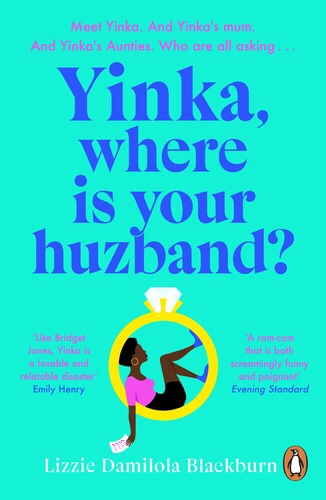
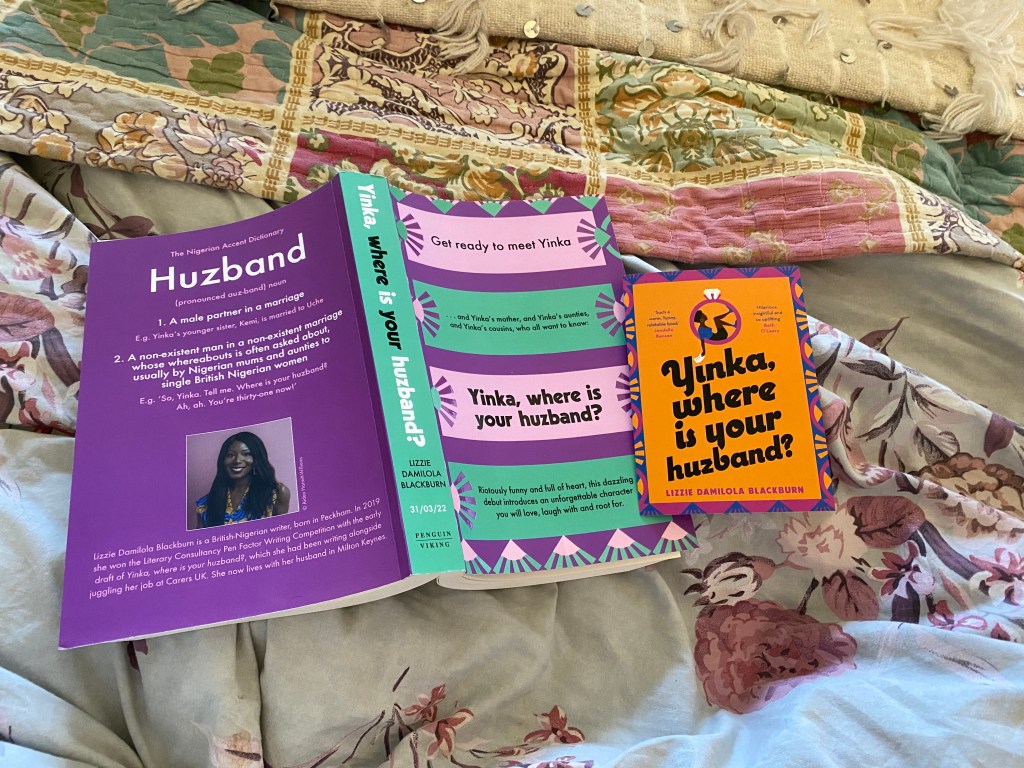
Yinka, Where Is Your Huzband? By Lizzie Damilola Blackburn

I have absolutely loved reading this charming and uplifting debut novel from Lizzie Damilola Blackburn and I already know it’s one I will keep on the bookshelves and read again in the future. It has such charm and a huge heart at it’s centre. Yinka is a 31 year old British Nigerian woman with a degree from Oxford and a brilliant job at an investment bank, but despite all that she has going for her, she hears only one thing from her mother and aunties. Why is she still single? What exactly is she doing wrong? A perfect storm of circumstances affects Yinka’s confidence: her baby sister Kemi is about to have a baby; her friend Rachel becomes engaged and starts planning her wedding; then she expects a promotion at work and is instead made redundant. When her Mum and Aunty Debbie both pray out loud for her to find a man at Kemi’s baby shower, Yinka feels humiliated. Using her project planning skills she decides on a course of action. She will find a man in time to take a date to Rachel’s wedding.

I found the themes of identity woven into the storyline fascinating and complex. At the start of the novel Yinka is wearing her hair short and natural, is more likely to be in jeans than traditional Nigerian fabrics and prefers to eat fried chicken than learn to cook African food. Yet there are so many opinions and judgements, both in her everyday life and on social media, on what it means to be a British Nigerian and an attractive, desirable black woman. The men she meets aren’t short of opinions either. Donovan, who she knows from her gap year working for charity, despairs of her lack of knowledge about hip-hop and music of black origin in general. She accepts an introduction to Alex, a single man at her Mum’s church and they start to chat on social media. He seems to think she should be more aware of her Nigerian culture. He voices surprise, and judgement, that she can’t cook Nigerian food and she doesn’t know many words of the Yoruba language. A Tinder meet up goes horribly wrong when her date makes the assumption she will sleep with him on their second date. When Yinka explains that part of her faith is prizing her virginity and that sex is sacred, something she would only do with her husband. He seems okay about it, but then ghosts her, finally accusing Yinka of misleading him, because this is something she should have made clear up front. Her experience with Emmanuel was the one I found most painful and my heart broke a little for her. He goes to her Mum’s church and she has to swallow her pride just to agree on a number exchange. On FaceTime though he seems disappointed and admits that he agreed to pass on his number, because he thought she was someone else. It’s not his fault, he says, but he does prefer girls with lighter skin. It’s not hard to see how these experiences and opinions chip away at Yinka until she feels like she’s lost herself.

Yinka is constantly receiving messages about the woman she should be, through her experiences, the constant badgering from her Mum, and from social media. The black women society deems beautiful have lighter skin in caramel tones, long and flowing Western hair, and are curvaceous. Yinka feels her skinny body, her J shape bottom and dark skin are not good enough. Even the messages she is receiving from her own family don’t help. Her Mum openly criticises her short Afro hair, it used to be so long and beautiful, how will she get a huzband if she doesn’t make an effort? Yinka has internalised these messages all her life – the lighter her skin, the rounder her bottom, the longer and more Western her hair, the more attractive she will be. She tries a wig for a date then is constantly terrified of the parting being off centre and when her date touches it she knows he has never dated a black woman before – black men know not to touch women’s hair. When she gets a weave and wears one of her friend Nana’s dresses, made from African fabric, her Mum radiates approval – see how pretty she is? My heart went out to her when she remembers her Dad saying to her that the moon is just as beautiful as the sunshine, that midnight has a beauty all of its own. Another problem is the comparisons her Aunties and her Mum make, between Yinka and her sister or her friends, creating division and resentment. Her mum’s constant praise of the beautiful light skinned Kemi, the little sister who has pipped Yinka to the post by getting married and now adding to the family with her new son Chinedu, makes Yinka resent her sister. They become more distant from each other and never talk about the way their mum behaves. Her cousin Ola even laughs when the older women badger Yinka and embarrass her, Ola is married with three children, but is she as happy as her aunties assume she is?

The two aspects of the book I related to so strongly were the culture around Pentecostal Christianity and the role of counselling. Yinka normally attends the Church of England, but her Mum and Aunties frequent the All Welcome Pentecostal church and this felt so familiar to me as I grew up in a New Life Pentecostal Church. I found the scenes with the church so humorous and true to life, especially the constant praying out loud, even at parties. It was a very hard church to grow up in and those teenage years onward when I was single I felt hounded by youth leaders telling me what I could and couldn’t do in a dating situation, that I should only date other Christians and then pushing me towards people I didn’t find remotely attractive. I had a ‘boyfriend’ at church when I was 12 and we only saw each other at youth group and church. It really was more of a friendship, but youth leaders treated it like a serious relationship and when I wanted to break up I was forced to pray about it in a group. The youth leader prayed that God would bring us back together in the future. I felt that single girls were treated with suspicion and that adults were just waiting to matchmake. I rebelled at 16 and walked away, because I felt judged and stifled. It was wonderful though, to read about these experiences and hear certain phrases like being ‘in the spirit’, the endless praying out loud, the sense of having elders to answer to, because it’s rare for someone to understand my experience. It’s even more rare to see it in fiction in a way that acknowledges its drawbacks, but also its benefits and the deep well of humour it provides.

Counselling is something that my church would have been very resistant to, but I am now a counsellor myself and I loved seeing how positively it was portrayed in the book. The use of writing as therapy is something I do with clients and I was moved by Yinka’s letter to her younger self, going back and undoing some of the negative judgements and ideals she had internalised. It was brilliant to see how it took Yinka deeper, into how imbalanced those parental injunctions had become once she lost her father. I wanted Yinka to realise she had two incredible role models to aspire to; her Aunty Blessing who is happy and fulfilled despite having no husband or children and her friend Nana who is simply not bothered with dating and is pouring her energies into building her fashion brand. I loved both of these women and how they really pull Yinka back from the brink, help her untangle the lies she’s told and work out what and where she really wants to be in life. It reminded me of the power of female friendship and how it is most often the women who will hold you up in life. I loved how Yinka’s changes through counselling rippled out to others around her too. Once she has started to talk there are relationships she can mend and maybe others that need some redefining and new boundaries set. Her realisations, about her Mum particularly, are interesting and Yinka’s bravery in trying to address how she has felt made me feel so proud of her. It showed how counselling doesnt just create change in one person, it can change the people around them too. I don’t know if Yinka will ever return, but she was a great character to spend time with and I’d definitely be first in the queue for more. This was a pleasure to read from beginning to end, full of strong female characters, emotionally aware and addressing some really tough issues in a humorous and ultimately uplifting way.

Meet The Author

Lizzie Damilola Blackburn is a British-Nigerian writer, born in Peckham, who wants to tell the stories that she and her friends have longed for but never seen – romcoms ‘where Cinderella is Black and no-one bats an eyelid’. In 2019 she won the Literary Consultancy Pen Factor Writing Competition with the early draft of Yinka, Where is your Huzband?, which she had been writing alongside juggling her job at Carers UK. She has been at the receiving end of the question in the title of her novel many times, and now lives with her husband in Milton Keynes.

Posted in Netgalley

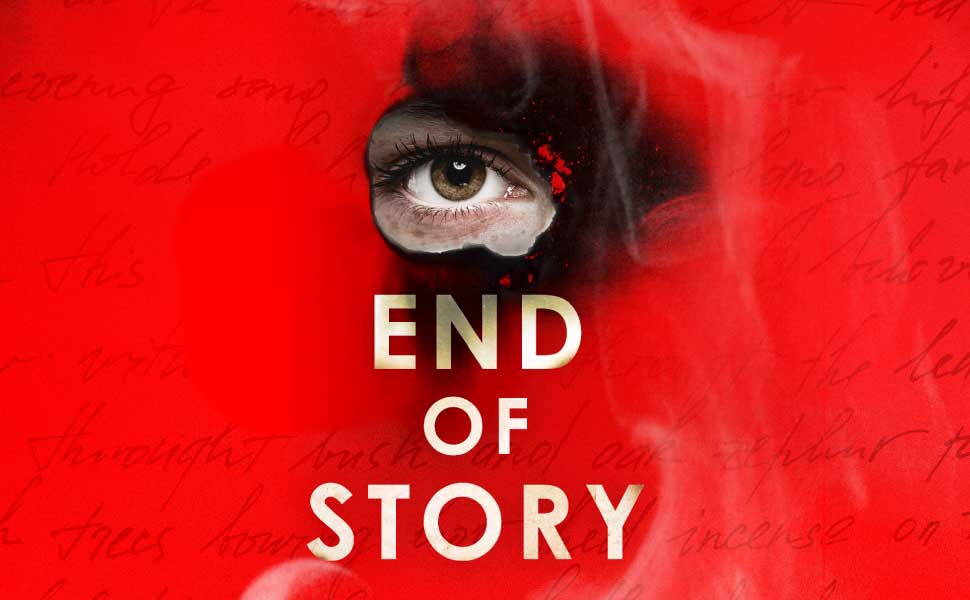
End of Story by Louise Swanson

There are times when I think I could write a book. Why not? I have a first in English and I’ve been reading voraciously since I was 5. I have even started a memoir. Surely I could do it. They say everyone has a book in them don’t they? Then I read this. This astounding, raw, unflinching and inspirationally creative novel is proof that some of us were born to write. This book, is quite simply astonishing.

I can’t write much about the content of the book without ruining it for others and that’s the last thing I want to do, So I’ll tread carefully…

Our narrator Fern Dostoy is a writer, one of the ‘big four’ novelists of the not too distant future. This is a future where the Anti-Fiction Movement’s campaign to have all fiction banned has been successful. It was Fern’s third novel, Technological Amazingness, that was cited as a dangerous fiction likely to mislead and possibly incite dissent in it’s readers. She had created a dystopian future where two major policies were being adopted as standard practice. To avoid poor surgical outcomes, only patients who are dead can have an operation. Secondly, every so often, families would be called upon to nominate one family member for euthanasia – leading to the deaths of thousands of elderly and disabled people. All fiction authors, including Fern, are banned from writing and the only books on sale are non-fiction. The message is that fiction is bad for you, it lies to the reader giving them misleading ideas about the world and how it’s run. Facts are safe. AllBooks dominated the market for books until it became the only bookshop left, state sanctioned of course and only selling non-fiction. From time to time they hold a book amnesty where people can take their old, hidden novels to be pulped. Fern now cleans at a hospital and receives unannounced home visits from compliance officers who question her and search her house to ensure she’s not writing. Added to this dystopian nightmare are a door to door tea salesman, an underground bedtime story organisation, a mysterious appearing and disappearing blue and white trainer, re-education camps for non-compliant writers and a boy called Hunter. All the time I was reading about this terrible new world, I was taking in the details. and trying to imagine living in it.

Yet there was a little voice in the back of my mind telling me this wasn’t the real story. I’d figured that out, even though I was confused, this was one of those books where it would all come together and I would understand. I had strange feelings of anger and frustration with the narrative, not because it isn’t brilliantly and vividly brought to life, but because I could sense something else going on underneath. I couldn’t quite get to the bottom of it. As the pressure built and the compliance officers started to push Fern into telling the truth, I inexplicably felt a lump building in my throat. I’d no idea why I was feeling so choked up. I read the final third with tears streaming down my cheeks, followed by full-on sobbing. I hadn’t known my emotions were so engaged with Fern’s story until my husband came home and I couldn’t even speak to explain why I was crying. It was like I’d known this was where the story was going all along.

I want to say thank you to Louise. Thank you for this incredible book and the emotions it unleashed. I can’t even say why the book had this effect on me without ruining it. This is a real work of genius. It shows us how strong our minds can be at protecting us from things we don’t want to face. I understood Fern and her story moved me deeply. This is, without doubt, a contender for book of the year and an unparalleled look at allowing ourselves to be vulnerable and open; to be human. This is an incredibly powerful novel about storytelling, creativity, grief and fear. It also asks the question: who are we when everything that defines who we are, is taken away?

Published by Hodder and Stoughton 23rd March 2023.

Meet The Author

Louise Swanson is the pen-name of bestselling author Louise Beech, who has published seven novels with Orenda Books. Her work has previously been longlisted for the Not the Booker and Polari prizes and shortlisted for the Romantic Novel awards. She also won Best’s Book of the Year with her 2019 psychological thriller CALL ME STAR GIRL. Aside from being a novelist, she regularly writes travel pieces for the Hull Daily Mail, where she was a columnist for ten years. She also recently worked as the Front of House for the Hull Truck Theatre.

Louise Swanson’s debut End of Story arrives in March 2023. She wrote the book during the final lockdown of 2020, following a family tragedy, finding refuge in the fiction she created. The themes of the book – grief, isolation, love of the arts, the power of storytelling – came from a very real place. Swanson, a mother of two who lives in East Yorkshire with her husband, regularly blogs, talks at events, and is a huge advocate of openly discussing mental health and suicide.

Her memoir, Daffodils, was released in audiobook in 2022, and the paperback version, Eighteen Seconds, will be out April 2023.She blogs regularly on louisebeech.co.uk, and is on Twitter under the name @LouiseWriter.

Posted in Random Things Tours

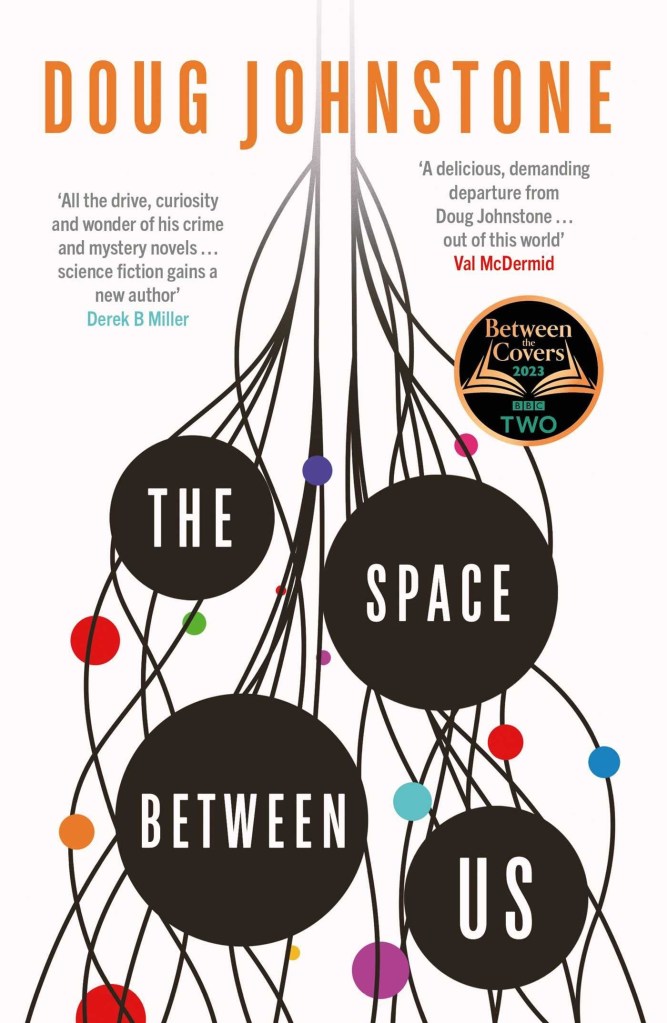
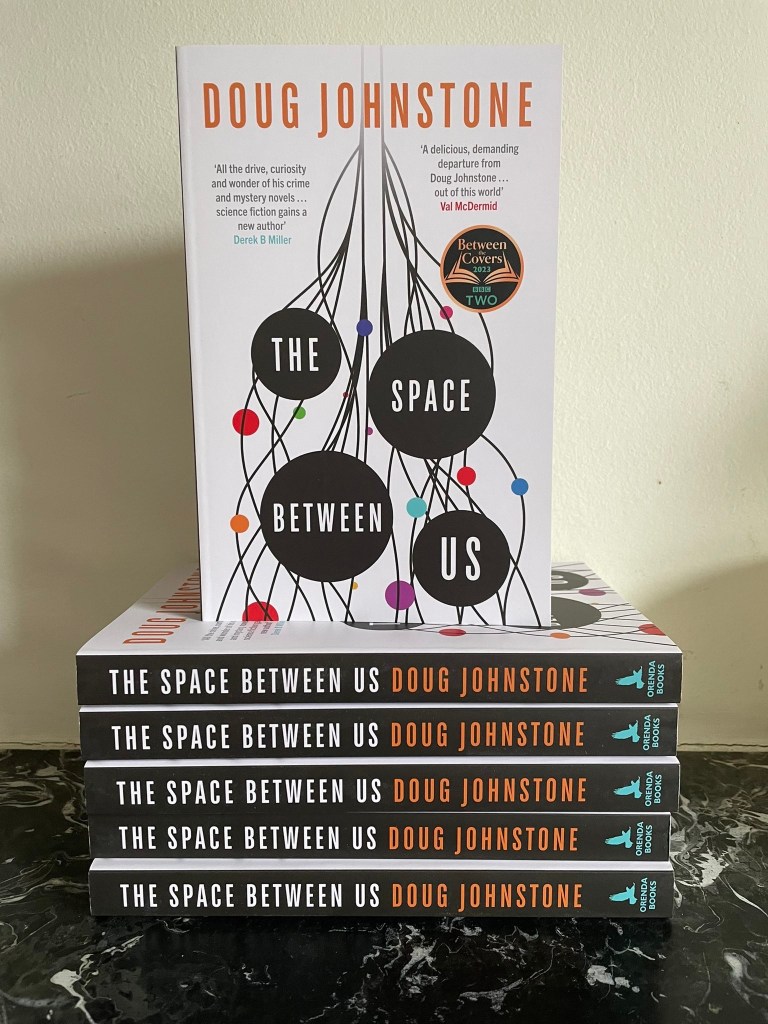
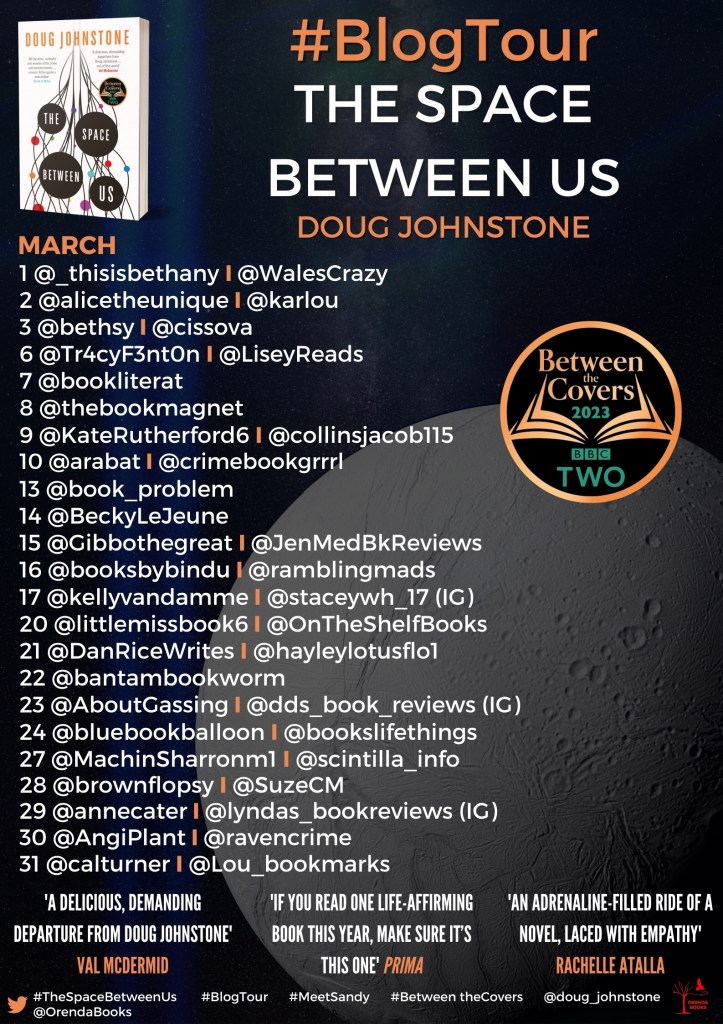
The Space Between Us by Doug Johnstone.

“Why, sometimes I’ve believed as many as six impossible things before breakfast.” Alice Through the Looking Glass.

Normally, I’d say this is the most unusual book I’ve read in quite a while, but in fact it’s been a brilliant month for Orenda Books as both their March releases have been quirky, original and quietly brilliant. It’s no secret that I love Doug Johnstone’s Skelf series and it’s mix of philosophy, astronomy, family and crime. This stand alone novel has some of the same attributes and a whole lot more besides. One night a strange occurrence in the Scottish night sky brings together strangers Ava, Lennox and Heather. Several people see the strange light and sparks in the air and all have severe cerebral haemorrhagic strokes. These are the most rare type of strokes and usually they’re fatal. Ava, Lennox and Heather are the only people to wake up the next day completely unscathed. Each one has their problems: Heather had been wading into the water with stones in her pockets after receiving a terminal cancer diagnosis but is saved by something in the water. Lennox is a lonely teenager, bouncing round children’s homes and is being set upon by bullies when he sees the lights in the sky and the stroke hits. Ava is pregnant and desperate to get away from husband Mike, a vile abuser obsessed with power and control. Meanwhile, on the beach lies a strange octopus or giant squid, sprawled on the sand and guarded by police. This cephalopod appeared as these unusual strokes happened and no one knows what to do with it. It’s not the usual octopus as it only has five tentacles and it has strange rippling colours under it’s surface. Police officer Nina is on the case and reporter Ewan is determined to find out the link between the creature and the three disparate people who band together to rescue the creature and have now gone on the run.

None of the three fugitives can understand why the extraterrestrial life form has chosen them. At first their link with Lennox seems most powerful. Despite his background of being let down by others, Lennox is very open to the creature and is the one to name them Sandy. He has even allowed them to form a telepathic connection by leaving a sort of organic hearing aid in his ear, turning them into ‘Lennox-Sandy-Partial’. It’s hard for Lennox to explain Sandy, he immediately uses ‘they’ as Sandy’s pronoun, not because of a dual gender but because they’re a dual person. Lennox thinks Sandy may be part of a larger whole or has a hive mind, one that can link with humans should they wish. For Lennox, being part of a larger whole must sound wonderful and grounding in a way he’s never experienced before.

‘It was weird, having spent his life in the care system, he didn’t have a fucking clue who he really was. The policy preventing you finding out about your birth parents out about your birth parents until you were eighteen was strict, and even then, the chaotic system of records meant you might never find out. Shit just got lost. So he’d drifted rudderless through his early life, with no sense of community or belonging anywhere.’

Ava is the next to connect with Sandy, mainly because she trusts him to tell her whether her unborn baby is okay. Ava is also alone in the sense that she alone knows the truth about her life with husband Michael. Ava was already running when she encountered Sandy, running from Michael and his attempts to destroy her. Michael is the archetypal abuser, who started out by separating her from friends and family then used techniques like gaslighting so she would question herself, even her own sanity. Then the physical and the sexual violence began. Even Ava’s mother has abandoned her, thinking Michael is a lovely man who simply has his wife’s best interests at heart. Ava wants to leave before her baby is born and her decision to flee with Sandy up to the north of Scotland is partly because she hopes Michael won’t find her there. These are the first people to meet Ava and accept her for who she is and they immediately believe her account about her marriage.

The last to connect with Sandy is Heather and that’s because she’s deliberately closed herself off to others. Heather has a terminal brain tumour, something she’s been keeping from everyone including her new friends. She has immediately taken on the role of Mum, looking after all of them and even preparing to deliver Ava’s baby. When they approach Heather’s ex-husband for help, the others are surprised, but Heather assures them he is one of life’s good guys. She is clearly genuinely pleased to see him. However, seeing him with a new wife and starting a family is particularly painful. A terrible tragedy forced this couple apart and seeing him brings it flooding back. Can Sandy approach her now, when she’s at her most vulnerable and what help can he offer? All three are fascinating characters and as a group they seem unbeatable. It’s their very connection that gives them strength. However, they are being pursued; by the police, the journalist called Ewan and a shadowy group of men in black who seem capable of anything if it gets them closer to Sandy.

As always Doug Johnstone is capable of taking several unusual, even improbable scenarios but writing about them in such a clever way you don’t question it. I never once stopped to think it seemed incredible. Similarly, our three main characters never pause or worry they’re doing the wrong thing. There’s one incidence where Lennox stops to question what’s happening:

‘There weren’t many Google hits for ‘telepathic octopus’. Shocker. Lennox looked up from his phone and stared at Sandy. He felt like a different person to the one who walked through the park two days ago. Now he was wanted for murder and kidnapping, sitting in a cheesy brown van with an old woman and a pregnant teacher, and getting psychic messages from a telepathic octopus.’

Usually a story like this would be set in a fantasy or dystopian future, but we’re definitely in the here and now. The settings are so ordinary. I could imagine pulling into a viewing point near Loch Ness and meeting Ava, Lennox and Heather when they’ve broken down and are waiting for a lift. Yet, within moments Lennox has been absorbed by Sandy and is diving through the water like a seal, breathing easily and feeling completely at home. These sequences are fantastical, stunningly beautiful and transcendent. He makes us want to be there experiencing it all. I think the key is that despite the strangeness of a tentacled cephalopod shivering with excitement at the thought of swimming in a loch we’re learning from Sandy. He’s showing us how to love life more, to find the wonder of things, to connect more, grow together and to experience everything:

“Suddenly his host shot upward towards one of the bigger cracks in the ice. A jet stream flowed from a volcano on the seabed, like a fountain through the sea to the opening in the ice. They joined it and shot through the ice shelf into space, surrounded by millions of particles of water and ice. He turned and looked at Saturn, huge and orange in the sky. He realised they were in one of the rings, they were the ring […] floating in space, swaying and drifting.”

As always with Doug’s writing there are literary and philosophical references throughout and I was delighted to find one of my favourite thoughts from Susan Sontag who wrote about illness and disability and their surrounding metaphors. Within the medical model of illness, particularly with cancer and other auto-immune illnesses, the metaphors of battle are commonly used as Heather points out:

“She hated the military terminology that people used around cancer: ‘She lost her brave battle with cancer.’ The cancer was part of you, you created it from nothing, so that language meant you were fighting yourself. Turning everything into a battlefield was a masculine, wrong-headed way of looking at things.”

She hates the assumption that if the cancer has spread or become terminal it’s because she is weak and hasn’t battled hard enough. Sometimes the words we choose are very important.

There are allusions to Alice Through the Looking Glass, to Virginia Woolf in Heather’s method of suicide – wading into water with stones in her pockets. There’s also a hint of Howard’s End in Sandy’s ability to connect with his fellow cephalopods and other species. It should make us rethink how we connect with one another. Howard’s End presents people of different classes who normally wouldn’t associate with each other, but people are really all the same. We should connect with all sorts of people in different age groups, abilities, religions and races. Here Lennox truly understands this:

‘It didn’t make sense to think of himself as Lennox anymore, he was a compound of a million things – bacteria in his gut, microscopic bugs in his hair, Xander’s body passing through his own, Sandy inside his neurons. It finally made physical sense, the idea that Sandy was plural. We all are. And the human idea of being singular, apart, alone, was a ridiculous and lonely way of looking at life.”

In fact what our different characters show us is how strong we can be, if we work together, especially characters with very different skills and personalities. Being part of a whole makes us stronger. Despite the danger and tension of their quest to reach Ullapool where everyone converges on the harbour, I found the ending so positive. Sandy asks us to rethink our lives, let others in and perhaps look at the world in a different way. Why do we think of our planet as ‘Earth’ when the largest proportion of our globe is ocean? We look at everything through the filter of our own class, education, experience and privilege. So, we should take time to view things through someone else’s filter. This was a fascinating, funny and uplifting literary journey that challenges us to move closer and reduce the space between us. In other words ‘only connect’.

Published 2nd March 2023 by Orenda Books

Doug Johnstone is the author of twelve novels, most recently The Great Silence, the third in the Skelfs series, which has been optioned for TV. In 2021,The Big Chill, the second in the series, was longlisted for the Theakston’s Old Peculier Crime Novel of the Year. In 2020, A Dark Matter, the first in the series, was shortlisted for the McIlvanney Prize for Scottish Crime Novel of the Year and the Capital Crime Amazon Publishing Independent Voice Book of the Year award. Black Hearts (Book four), will be published in 2022. Several of his books have been best sellers and award winners, and his work has been praised by the likes of Val McDermid, Irvine Welsh and Ian Rankin. He’s taught creative writing and been writer in residence at various institutions, and has been an arts journalist for twenty years. Doug is a songwriter and musician with five albums and three EPs released, and he plays drums for the Fun Lovin’ Crime Writers, a band of crime writers. He’s also player-manager of the Scotland Writers Football Club. He lives in Edinburgh.

Posted in Netgalley

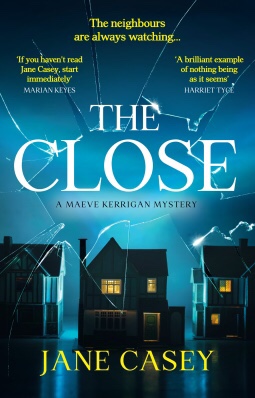
The Close by Jane Casey. A Maeve Kerrigan Mystery.

I absolutely loved being back in the world of Maeve Kerrigan. So much so I read this straight through in one day. The set up was brilliant – a modern slavery racket is suspected and Maeve must get close to one of the conspirators, an unlikely criminal. The mayor of London’s assistant has brought a sad case to their attention. A young man called Davey who died after suffering neglect, starvation and physical abuse. He was the perfect target for slavery, an easily influenced man with learning disabilities but physically strong and capable. Strangely, there have been other young men go missing from the system after using the same address, that of an elderly lady in a normal suburban close. There needs to be close surveillance so Una Burt puts her best officers on it, Maeve must move into the close with Josh Derwent as her boyfriend, pretending to dog sit for the usual occupant. Josh thinks Maeve needs a break from her normal routine, because after the court case convicting her partner of domestic abuse Maeve has been drifting and not herself at all. Similarly, Maeve thinks Josh could do with a break away from his live in girlfriend Melissa. How will they fare as a couple on the close and will they be able to flush out the conspirators in the slavery case?

I loved the tension between Derwent and Maeve in this story, close together in the house and away from all their usual distractions it brings their chemistry into focus. Every time they behaved like a couple it felt completely natural, until it was imagining them going back to colleagues was unthinkable. They have had so many obstacles in their time as friends, always something preventing them from becoming more, so could this be the perfect timing? At times the tension in their house was more unbearable than the tension in the case! There are parts of Derwent that I don’t like, but I can see ways in which he’d be good for Maeve and vice versa. They ingratiate themselves with the neighbours easily because they sense this chemistry, they seem like a real couple. The elderly lady in question is tricky, seemingly an innocent and kindly woman but if she is involved with mistreating these men, her kindness is all a front. She reveals that she does provide a bed for young men with disabilities from time to time, but doesn’t elaborate on whether it’s an official arrangement. When Maeve discovers there’s a oreviously unknown son, whose wife runs a care home, the chain starts to come together. However this isn’t the only crime lurking under the respectability of suburbia. The author uses short chapters narrated by a man who is very unpleasant and possibly dangerous. He lurks after dark watching through the windows of those who don’t close their curtains, even Josh and Maeve. He has a very incel vibe, so could he be a lone male with little female attention and experience, or is he hiding his feelings about women under the veneer of a happy family man?

I enjoyed watching these people through Maeve’s eyes as her instincts are usually spot on and her insight seems to be coming back to her as the novel continues. This break is exactly what she needed. Her interactions with a lady with dementia in the close are brilliant because Maeve doesn’t dismiss what she claims to have seen just because of her illness. Maeve knows there are moments of lucidity and keeps thinking about what she’s said and trying to interpret it. When she goes missing in the dark Maeve is desperate to find her, but so is our unknown man and it’s a real heart pounding part of the book, hoping against hope that Maeve gets to her first. It’s clear that this seemingly happy and respectable close is anything but, with the men hiding all sorts from irritating foibles to murder. Towards the end I was powering through the pages to find out who was hurting girls in the close, whether Maeve’s fire and copper’s instinct was returning, but also whether Josh and aMaeve were going to confront their feelings for each other. This was an addictive thriller, focusing on one of my favourite fictional police duos and I loved seeing them in a different environment, but still flushing out crime.

Published by Harper Collins 2nd March

Meet The Author

Jane Casey is a bestselling crime writer who was born and brought up in Dublin. A former editor, she has written twelve crime novels for adults (including ten in the Maeve Kerrigan series) and three for teenagers (the Jess Tennant series). Her books have been international bestsellers, critically acclaimed for their realism and accuracy. The Maeve Kerrigan series has been nominated for many awards: in 2015 Jane won the Mary Higgins Clark Award for The Stranger You Know and Irish Crime Novel of the Year for After the Fire. In 2019, Cruel Acts was chosen as Irish Crime Novel of the Year at the Irish Book Awards. It was a Sunday Times bestseller. Stand-alone novel The Killing Kind was a Richard and Judy Book Club pick in 2021, and is currently being filmed for television. Jane lives in southwest London with her husband, who is a criminal barrister, and their two children.