Posted in Personal Purchase

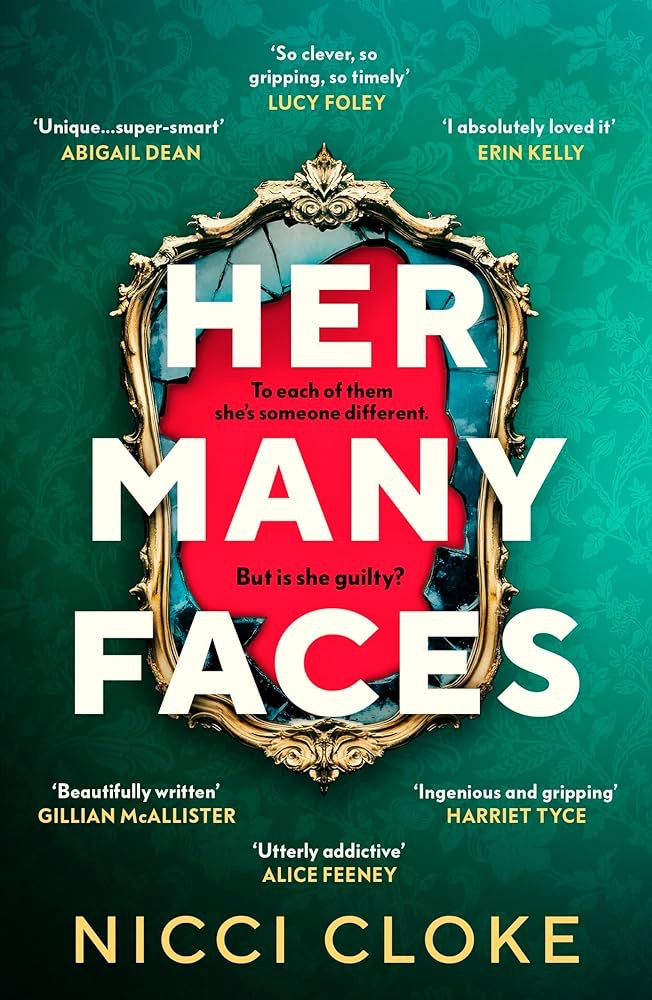
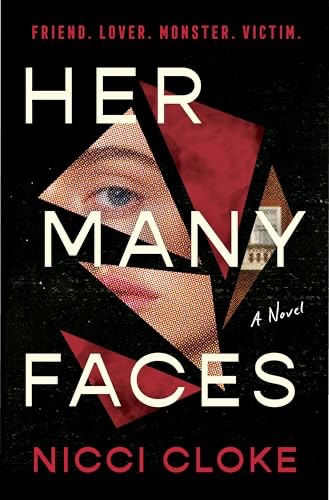
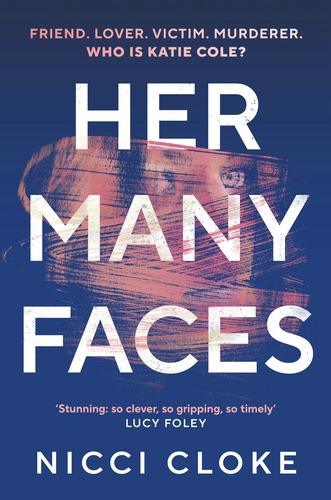
Her Many Faces by Nicci Cloke 

ONE TRIAL. FIVE TRUTHS. BUT ARE THEY READY FOR HERS?

When a waitress is charged with murdering four men at an exclusive private club, her personal life and upbringing are thrust into the spotlight. During the trial, people closest to Katie start to question what they know about her.

Her father remembers the sweet schoolgirl.

Her childhood friend misses her kindness and protection.

Her lover regrets ever falling for her.

Her lawyer believes she is hiding something.

A journalist is convinced she is a cold-blooded killer.

To each of them she’s someone different. But is she guilty?

This thriller grabbed me straight away and never let go! The pace was fast, with short punchy chapters containing the narratives of five men each linked in some way to a woman called Katie. Each man has his own name for this woman and their narratives tell us her story as they see it. John is her father, Gabe is her childhood friend, Conrad is her lover, Tarun is a lawyer and Max is a journalist. Each one thinks they know her, each one presents a different face. But who is she and which is her real identity? Is she a combination of all five or nothing like this at all. It’s a timely, compelling and addictive story that you’ll want to finish in one go. 

The murder that has taken place at March House has killed four very important men at once. Lucian is a businessman and owner of March House, a private members club for the richest and most influential men in the UK and their guests. His guests that night were Harris Lowe, Lucian’s new right hand man, Dominic Ainsworth MP and Russian millionaire Aleksander Popov. They appear to have been poisoned with an incredibly expensive bottle of brandy laced with poison. Only one person has been serving the party all evening and that is waitress Katie. She is soon under arrest, but what possible motive could she have had to kill these men? Yet when police apprehend her not long after she’s left work for the evening she is reported as saying ‘they got what they deserved’. Is this an admission of guilt or an acknowledgment that whoever killed them, did the world a favour? 

It’s hard to get to know Katie because she is simultaneously a wildcat, a conspiracy theorist, a squatter, a farmhand, a waitress or the accused. These are just some of the descriptive words used to label her by the men in her life, but we have to remember that they are viewing her through their own lens. How much can we trust their impressions of her and do we accept that they’re telling the truth? She’s clearly beautiful, even without the ‘right’ clothes she has something that men desire. Conrad feels this when she’s helping out with the pigs on her uncle’s farm but then is shocked when she turns up at his club and his boss Lucien clearly desires her too. Both of them see a sex object rather than the young, troubled woman in front of them. John still sees his little girl, unable to equate the terrible crime she’s accused of with his daughter. However, we learn that she’s always been sympathetic and perhaps a little soft where his daughter is concerned whereas her mother sees her as a naughty child who grew up still getting into trouble. If anyone sees a more rounded Katie it’s her childhood friend Gabe, even if he is in love with her. She pulls him into her internet wormhole of conspiracy theories and he follows her down to London, ready for direct action to change everything that’s wrong with society. Yet when he gets there, Katie is living in a squat and has moved on in her belief system. Gabe has fallen under the spell of the elusive Mr E who appears in the comments under YouTube videos, disparaging the rich and the corruption within the system. He’s saddened to find her working at March House, the centre of online rumours about secret cabals and the ‘real’ people who run the world. He sees the Katie who had these beliefs as the real Katie and now she doesn’t believe or belong to him anymore. Similarly, Conrad sees her as this beautiful, innocent farmhand: 

“You’d taken on a hazy, pure quality, a perfume ad of a person. In the cafe you looked ordinary.” 

Every so often a book comes along that captures a moment and this definitely does. It isn’t the first book I’ve read where online radicalisation is part of the story and how dangerous it can be to become drawn in by conspiracy theorists. We tend to use the word grooming when it refers to children, but young adults and people with learning disabilities are also vulnerable and political or conspiracy theories seem to be changing the way people view the world without them even leaving the house and experiencing it for themselves. The echo chambers created when we look at certain subjects means people can be left thinking they have the majority viewpoint, no matter how crazy or extreme the ideas. Conspiracy theories are popular because it gives explanations for events that are incredibly complex and totally outside of our control. The realisation that a small group of individuals could hijack a few planes and attack the most powerful cities in the USA is almost too scary. People didn’t want to feel that their country was that vulnerable and open to attack, so they created stories that their own government must have been involved. Mr E directs his followers to March House as the real seat of power and their list of members could easily feed into that narrative. There is no doubt that some dodgy deals and introductions go on there, but the difficulties facing the country are international and much more complex than a few smoking men in a private room, but for some, life being random chaos is a scary prospect. 

At the centre of all this is Katie, a lost young woman unsure of who she is and what she wants from life. With no plan or purpose, she lurches from one crisis to the next never feeling safe or grounded. The novel made me angry, especially with Conrad and Max who want to use and exploit Katie. Conrad has the audacity to suggest his connection to her was flimsy at best: 

“I could barely even remember your real name. You had come onto me so hard, when I looked back, that in a way it was embarrassing. I was embarrassed for you”. 

I was furious and desperately wanted him pulled apart in court by her barrister Tarun. It reminded me of how women who are seen as controversial, such as Caroline Flack or the Duchess of Sussex, are presented and packaged by the media. There’s misogyny at the root of this and it’s the same with the male characters in the book who package Katie into roles and personalities that absolves them for the harm they cause and assuages their guilt. This is brilliantly done by the author who doesn’t put a foot wrong in her characterisation and the pace of this novel. It’s fast moving and she doesn’t waste a single word, keeping you gripped by what might happen next. We’re never sure on what has happened or who is responsible and the courtroom scenes are brilliant meaning it was impossible to put down – there was one late night where I completely wrote off the following day for anything useful. This is powerful and will make you angry, but you won’t be able to stop those pages turning. 

Meet the Author

Nicci Cloke is an author and editor based in Cambridgeshire. Her novels have been published in twelve languages, and she has previously worked as a nanny, a cocktail waitress and a Christmas Elf. Before being published, she was a permissions manager, looking after literary estates including those of Sylvia Plath, Ted Hughes and T. S. Eliot, and was also communications manager at the Faber Academy.

Posted in Netgalley

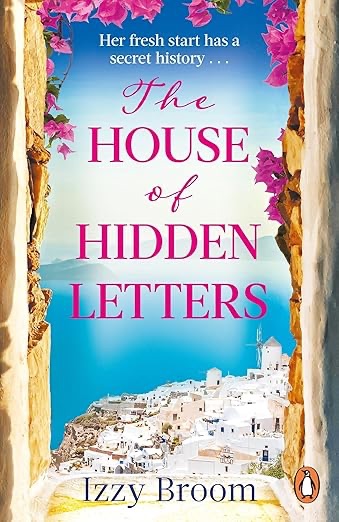
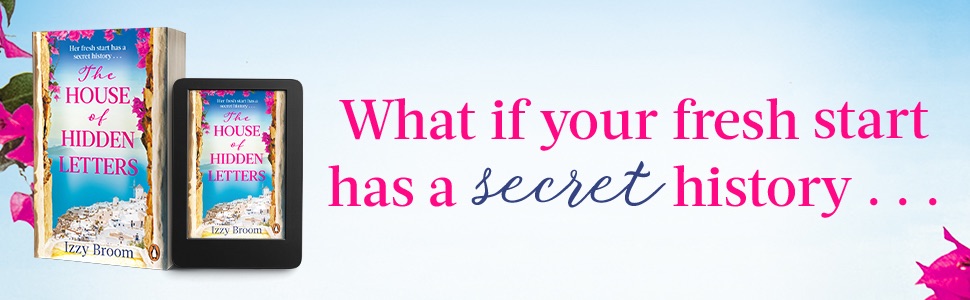
The House of Hidden Letters by Izzy Broom 

Be whisked away to Greece with this dual narrative novel set on the Greek Islands. Greek cottage. Price: One Euro. Skye doesn’t make impulsive decisions. But when she sees a derelict Greek cottage for sale by lottery, she enters with dreams of a fresh start. However, her heart sinks as she pushes open the tattered blue door weeks later. Can this wreck ever be her home? Then Skye finds a bundle of letters hidden in the fireplace, their faded pages drawing her in with a story of long-forgotten love, tragedy, and unbelievable bravery during WW2. But all the while, Skye’s own past is circling. No matter how far she goes, fate is never far behind…

I throughly enjoyed this novel that treads the difficult line between feeling escapist while looking back to harrowing events in the island’s history. The people who buy the one Euro houses bring an optimism and sense of renewal to the island. The current residents of the island are a joy, incredibly generous with the new arrivals and particularly Andreas who is the builder commissioned to renovate the houses. He is hospitable, showing Skye around her new home and chatting ideas, but he goes above and beyond when he realises she is staying in the empty house so brings her groceries and coffee. When some of the other residents arrive the place is full of camaraderie and new friendships. These are mainly women. Joy is an artist from Australia who clicks with Skye straightaway. There are three sisters, one of which is a builder determined to renovate in her own way much to Andreas’s disgust. As Skye wanders through her house alone, taking in the sea view from the attic room we get a sense of freedom and independence from her, possibly a feeling she hasn’t had for some time. All of this activity is exciting and hopeful, a light-heartedness that’s at odds with the reasons Skye left the UK and her new home’s sad history. Skye and Andreas find Nazi dog tags and a stash of letters in a half collapsed wall, so they know these are from the time of occupation, when Italian and German soldiers were present in the islands. It’s more troubling when remains are unearthed in the garden, some of which appear to be human. What has happened on this particular street? 

I found Katerina’s letters and the times we delve back into the island’s history so vivid and there were scenes so memorable, I don’t think I’ll forget them. It really engaged my emotions and I fell in love with Katerina when we first meet her as she’s climbing to reach her goats. Her relationship with the little three legged goat is so touching. It’s also the reason she meets Stefanos, as her goat climbs a little higher than she should considering her poor balance. Katerina tucks her skirt into her knickers and shows off her own climbing skills. It feels like love at first sight for these two, but war will get in the way of their courtship. This heroine is bold and brave and even though she faces some terrible events she never loses her determination or her love. This is a turn around for the girl who scorned her sister’s marriage and the constraints it placed on her.

“Love, such a stupid thing. She was eighteen, strong, healthy and free to roam between chores. A man would not let her behave in such a way.” 

I found the islander’s experiences at the hands of their occupiers harrowing. They take everything they can from the villager’s stores of food, requisition their animals and leave them starving slowly. Katerina can see her sister is becoming frail, but doesn’t realise what she’s enduring in order to secure the tiny amount of food they have. One particular soldier takes an interest in her and she knows he won’t take no for an answer, even though she is expecting to marry Stefanos if he comes home. As she symbolically tries on her mother’s wedding dress she feels the strength of the older generation with her. This is a strength she sees when encountering an elderly man on the beach who greets her warmly then simply walks away into the sea, unable to cope with what is happening on the island and knowing the young need to be priority when it comes to resources. It’s the young who have to fight, including Stefanos and her sister’s husband, but it’s easy to forget that occupied women are also fighting in their own way. That might be foraging for food, hiding supplies from the occupiers, or even collaborating to survive – something that women were often punished for by their community, but is understandable when there are children to feed and refusal only means they take what they want anyway. Katerina’s principles are steadfast, even when starving and pregnant, but they also lead to devastating consequences. I loved the author’s focus on women helping women, even across the barriers between them. 

Skye arrives in a timid state, but blossoms on the island. She has come through a period of grief after losing her father, but there’s something more in the way she reacts to men and in the joy she takes in making her own choices for her new home. She gains the confidence to tutor some of the children and her friendship with the bold and liberated Joy seems to be exactly what she needs. She also builds a good relationship with Andreas, they work well on the house together and he quickly learns her boundaries. If something has to be done his way because of safety or local regulations he stands his ground, but all other decisions belong to Skye. He literally gives her own power back to her by remaining respectful and passive with decision making. It’s a marker of how broken the mother daughter relationship is, that Skye’s mother turns up on the island with her husband. If I’d disappeared across the continent with no forwarding address my mum would know something was very wrong back home. The author illustrates so well how grief is life-altering, leaving us potentially vulnerable to those who seem to offer love and protection, but actually want to control. With a total break from her usual life and the new people she has around her, I hoped Skye would have enough strength to break from relationships that have become abusive. It emphasises ‘found family’ and shows that community is vitally important to our wellbeing. 

This was a fabulous read, a dual narrative storyline where both timelines held my interest and kept the pages turning. Of course Katerina’s experiences have more power because of the horrors they faced during occupation. I also particularly loved Katerina’s bond with Chrysi her little goat, a relationship that was so touching it brought me to tears. Skye is also fighting for her survival, to build a life that’s how she wants it and the freedom to make her own choices and mistakes. I loved the hint of romance that didn’t overpower or devalue the serious points being made about the strength of women and their supportive bonds with each other. The historical finds that are made really piqued my interest and it was fascinating to see Katerina’s story slowly uncovered and I have wondered since finishing what she might have done next. There is loss, domestic abuse and sexual violence which can be a tough read if you’ve been through it, but all are handled well and felt authentic. I felt Katerina’s despair when she realises she no longer ‘feared the enemy, not their guns and bombs. It was the sorrow that terrified her.’ Like Skye she realises that she must use this as a strength going forward. I was rooting for both women throughout, dealing with the oppression of men and finding their own path. 

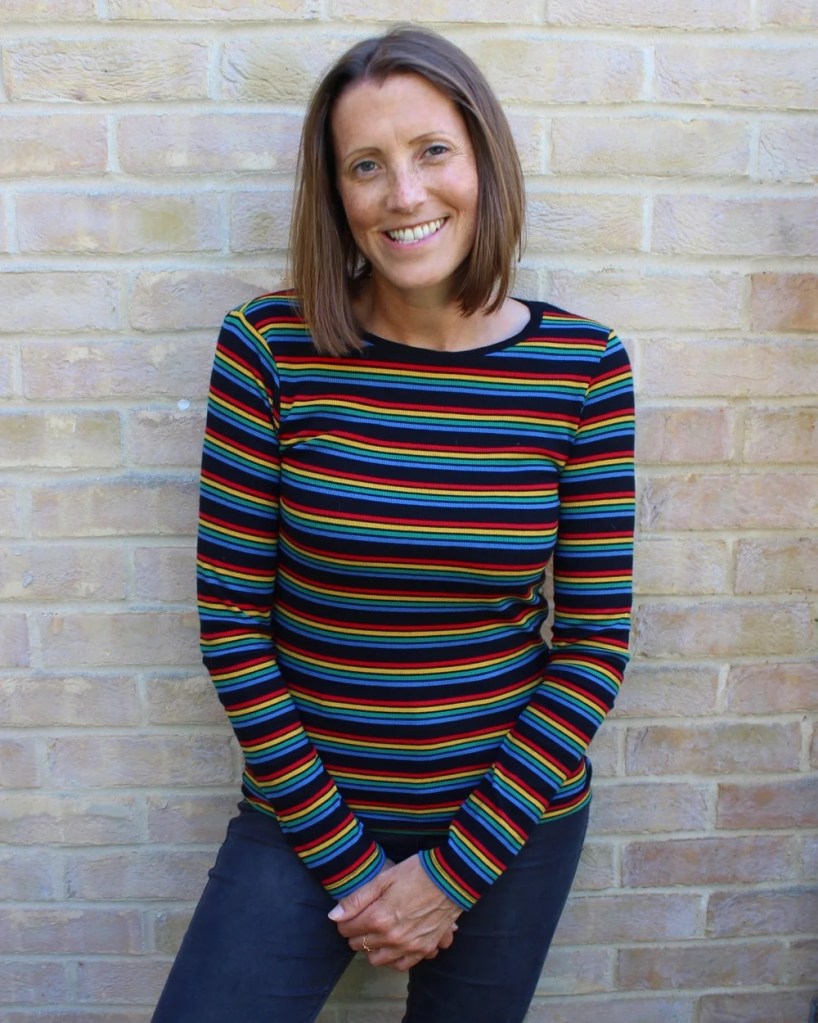
Meet the Author

My career as an author really began when I won The Great British Write Off competition in 2014 with a short story called The Wedding Speech. It was the first time anyone in the publishing industry had looked at my writing, and their collective advice and guidance gave me the confidence to complete a proper novel. My Map Of You was the result.

I write escapist fiction because travel is in my soul. My books are about all facets of life and often feature a love story. Getting inside the hearts and minds of my characters continues to fascinate me, as does searching the globe for settings in which to set their stories. I have scaled mountains in Sri Lanka, watched fireworks over Lake Como, swam in crystal clear Croatian waters, made wishes in Prague, hunted for orange houses in Mallorca, fallen off chairs in French bistros and wept over the beauty of the stars in Zakynthos – and these experiences are just the tip of the iceberg.

Each of my novels comes with a promise: to take my readers on an adventure and leave them with hope in their hearts. I hope you enjoy reading them as much as I love writing them.

Posted in Random Things Tours

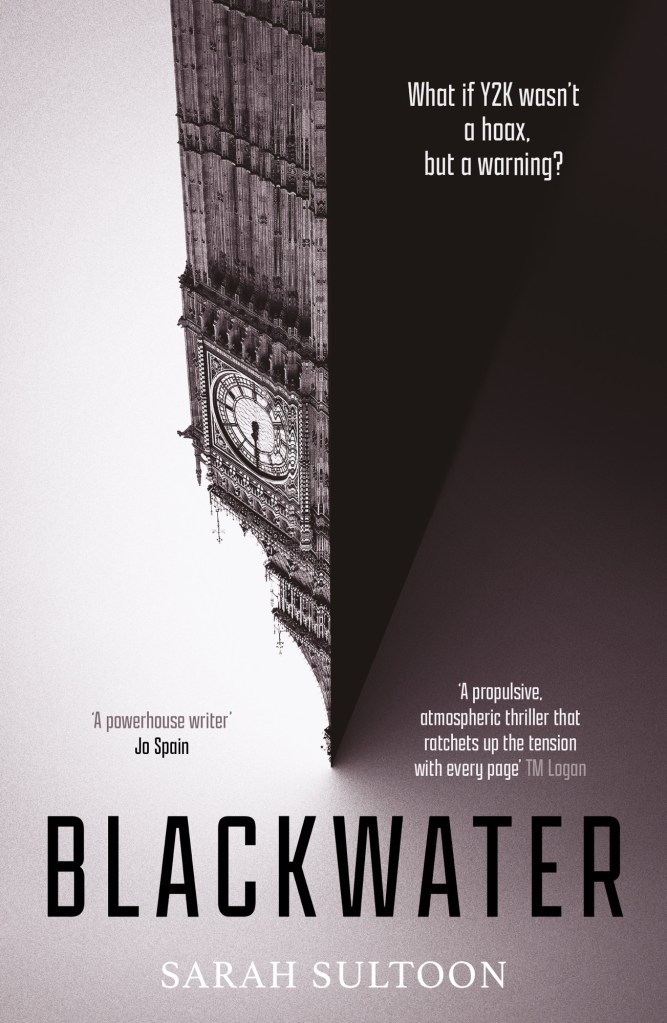
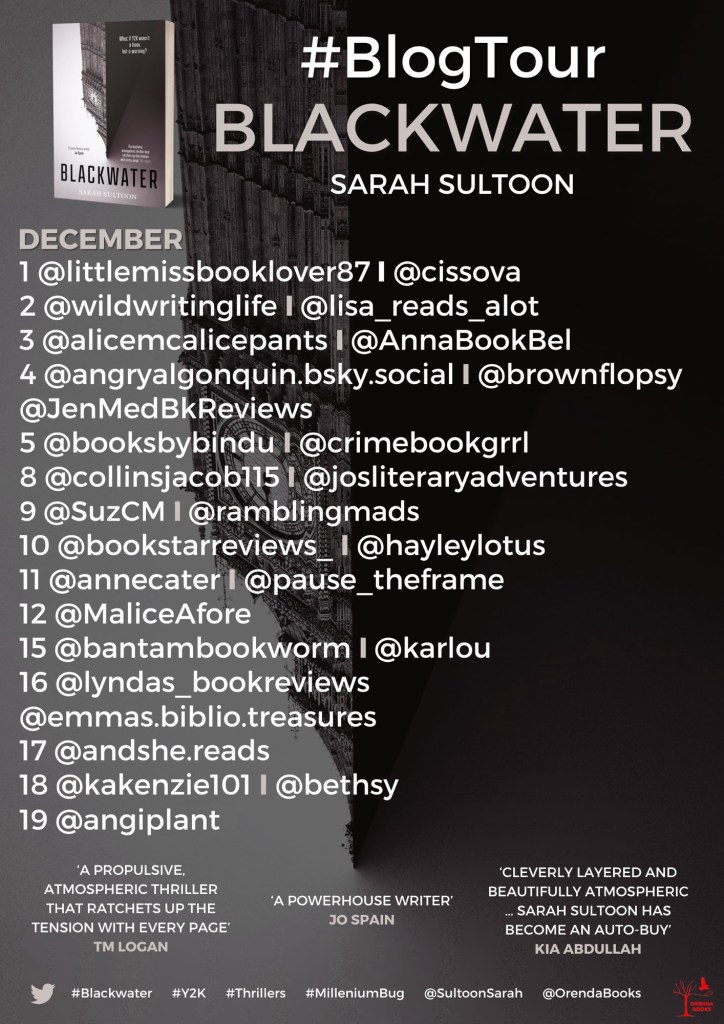
Blackwater by Sarah Sultoon 

As the clock ticks towards the millennium – and the threat of a potentially new apocalyptic reality – Jonny Murphy is sent to investigate the discovery of a child’s body on a deserted swamp island, fifty miles from London. What he finds is more than just a tragedy, it’s a warning. Something big is coming … Can Jonny stop it? Should he?

London, Christmas 1999. The world is on edge. With the new millennium just days away, fears of the Millennium Bug are spiralling – warnings of computer failures, market crashes, even global catastrophe. But fifty miles east, on the frozen Blackwater Island, a different kind of mystery unfolds. A child’s body is discovered on the bracken, untouched by footprints, with no sign of how he died. And no one has come forward to claim him.

At the International Tribune, reporter Jonny Murphy senses something is off. Police are appealing for relatives, not suspects. An anonymous call led officers to the scene, but no one knows who made it. While the world fixates on a digital apocalypse, Jonny sees the real disaster unfolding closer to home. With just twenty-hour hours before the century turns, he heads to Blackwater – driven by curiosity, desperation, and the sting of rejection from his colleague Paloma.

But Blackwater has secrets buried deep in the frozen ground. More victims – some dead, others still paying for past sins. And when Paloma catches up to him, they stumble onto something far bigger than either of them imagined. Something that could change everything. The millennium is coming. The clock is ticking. Can Jonny stop it? Should he?

I went into this novel quite late, so I was incredibly pleased to find that this is definitely a gripping, read in one sitting type of thriller. This is Sarah Sultoon’s third novel featuring investigative journalist Jonny Murphy, but could very easily be read as a standalone. For people like me, old enough to be an adult at the time of the possible ‘millennium bug’, I remember the panic and the predictions that planes would fall out of the sky, banking systems would collapse and the apocalypse would begin. I remember the money spent trying to mitigate its potential effects but like the British seem to do, we gathered with friends and family anyway and set off fireworks in the freezing cold and precisely nothing happened. It feels like an innocent time now, when we think that 9/11 came only 18 months later, followed by going to war in Afghanistan and Iraq and then years of austerity followed by a pandemic. It’s certainly been turbulent ever since. My dad was convinced that the bug was a made up bogeyman, allowing technology companies and their shareholders to clean up by proposing to ‘fix’ something that didn’t exist. Maybe he was right. We don’t call him Fox Mulder for nothing.

Here Sarah Sultoon has created a fast paced thriller that plays out in the days before Millennium Eve. The timing gives us a countdown, but believe me this story creates its own tension. The setting of Blackwater Island is familiar but alien at the same time. Situated in an inlet only 50 miles from London and with a direct route by boat into the Channel and the Thames this place is hiding in plain site. Beyond the last village, the terrain feels like the eerie marshlands at the beginning of Charles Dickens’s David Copperfield. The mist is so thick someone could be standing next to you and the black, viscous mud has the feel of quicksand. It sucks all explorers into its depths and is enough to put anyone off reaching the island itself. As if that wasn’t enough, the author brings elements of folk horror to the narrative as Jonny is warned off by very unfriendly and odd locals. The only place to stay is an old inn in the village, but the landlady isn’t very welcoming. She warns him that the only resident of Blackwater is Inka who is depicted in a framed picture behind the bar and on graffiti near the island:  

“it’s apparently a picture of a ghost that’s been haunting Blackwater since the Dark Ages. Our landlady told me some mad story about a mythical Icelandic warrior named Inka with a diamond-tipped spear and a mermaid’s tail.” 

Jonny is canny enough to know when he’s being warned away from something and it only sets his investigative skills tingling. On the other hand, actual protection for the crime scene is very thin on the ground. He meets the only police officer in the area and she feels like she’s been dumped in the backwaters of Essex with no support or back up. The facts are that the body of a boy was found on the island with no visible cause of death, but the weirdest part is that he was dressed like an extra from Oliver! His Victorian urchin clothing is so incongruous, but could mean anything from local amateur dramatics to time travel. It’s once Jonny manages to get on the island that answers start to come and it was nothing I’d considered. 

Jonny is a rather fascinating character. He’s absolutely determined to track down his story and has defensive walls a mile high where friendship and romance are concerned. Yet he does have empathy and tries to take the honourable route where possible. He clearly has feelings for photographer Paloma, but has been determined not to pursue them, not wanting to inflict himself on someone else. What does he know about himself that makes him hesitate? Will the story always come first? The scariest part of the whole story is that it’s believable and the afterword really does show that sometimes, what feels far fetched, is only the beginning. Taking in biological experimentation and weaponry, black ops, government conspiracies and the price paid by the locals caught up in it, it’s the writing and the very real atmosphere at the time that makes this a believable story. Jonny’s mission becomes unbearably tense as he has to make it to the centre of London with the city’s ’River of Fire’ fireworks display under threat. Thousands are gathered to hear Big Ben strike midnight and the start of a new century. Jonny fears they may be the target, but there’s also the press area where Paloma is hoping to catch the display on camera, no matter his reservations he’s determined to save her. Events and emotions build and I was half expecting a huge explosion, but Sarah Sultoon is more subtle than that and the fear here is insidious. It warns us not to trust those in authority, to question and investigate everything – an instinct that in real life seems to have been lost since the pandemic. Jonny is a brilliant hero because he has that instinct still and a moral compass that guides his work, something that’s a rare combination. This is incredibly tense, gripping and packed full of action with the added nostalgia of millennium memories. 

Out now from Orenda Books

Meet the Author

Sarah Sultoon is a novelist and journalist, whose prior work as an international news executive at CNN has taken her all over the world, from the seats of power in both Westminster and Washington to the frontlines of Iraq and Afghanistan. She has extensive experience in conflict zones, winning three Peabody awards for her work on the war in Syria, an Emmy for her contribution to the coverage of Europe’s migrant crisis in 2015, and a number of Royal Television Society gongs. As passionate about fiction as nonfiction, she recently completed a Masters of Studies in Creative Writing at the University of Cambridge, adding to an undergraduate degree in languages, chosen mainly so she could spend time itinerantly travelling the world. She likes running, Indian food, cocktails, playing sport with her children and throwing a ball for her dog, order dependent on when the cocktails are consumed.