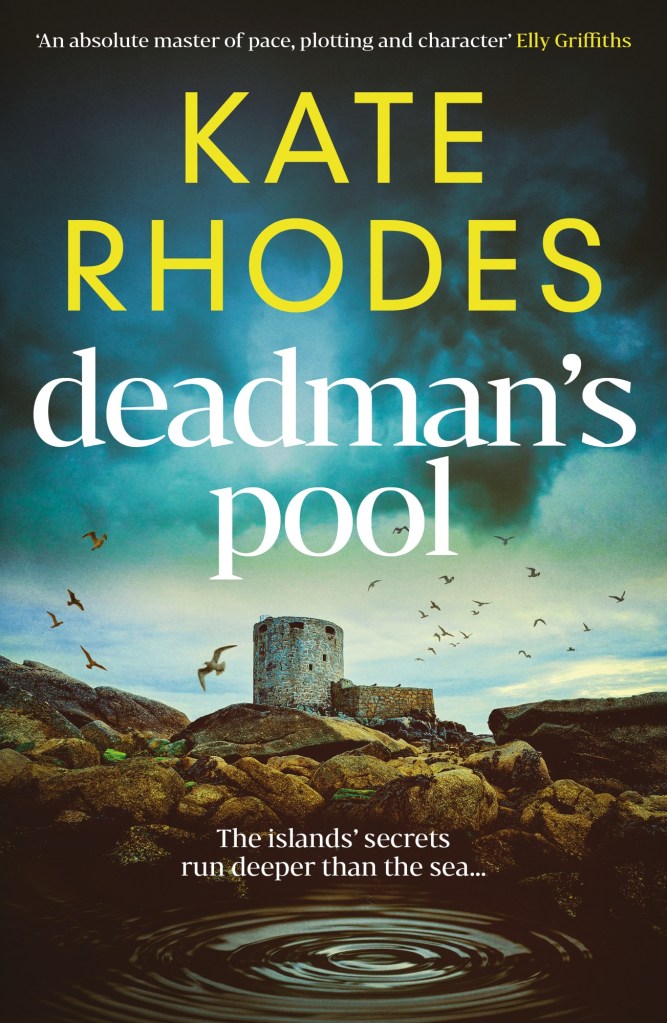
Winter storms lash the Isles of Scilly, when DI Ben Kitto ferries the islands’ priest to St Helen’s. Father Michael intends to live as a pilgrim in the ruins of an ancient church on the uninhabited island, but an ugly secret is buried among the rocks. Digging frantically in the sand, Ben’s dog, Shadow, unearths the emaciated and ruined remains of a young girl. The discovery chills Ben to the core. The victim is Vietnamese, with no clear link to the community – and her killer made sure that no one found her easily. The storm intensifies as the investigation gathers pace. Soon Scilly is cut off by bad weather, with no help available from the mainland. Ben is certain the killer is hiding in plain sight. He’s worried they are waiting to kill again – and at unimaginable cost.
When this blog tour request came through, I was intrigued by the blurb and the feel of the Scilly Isles as a backdrop for a murder investigation. Then I realised it was the eighth book in the Ben Kitto series, although the first in its new home at Orenda Books and it’s a perfect match. I was worried about whether I would be lost without all that back story. Thankfully I wasn’t lost at all. I was drawn in immediately by the opening chapter as Ben took Father Michael to St Helen’s, an uninhabited island that’s always been seen as the spiritual centre of the Scilly Isles. Father Michael uses one of my favourite phrases for places that feel holy and haunted at the same time:
‘Christians call these places “thin”. The gap between us and the spiritual world is narrower here than any shrine I know, even Lourdes. It was hallowed ground for centuries.’ ‘It still feels haunted.’ The sky overhead is boiling with clouds.’
I love the idea of thin places, that ghosts are not necessarily trying to haunt you, they’re just going about their business. In fact you’re probably as much of a fright for them as they are for you. It’s just that the veil between us and them has worn so thin we’ve become visible to each other. The author keeps this metaphor throughout the story and it soon becomes clear that the actual world also has its veils. We meet Mai, a girl trapped somewhere, unseen by those gardening only a small pane of glass away because they’re not looking down. There’s the gap between what the teenagers and the adults see; the rumour in school that there’s a network of well known adults trafficking children is dismissed as a conspiracy theory early on. But these young people lead a different lifestyle to the adults, they’re around in the dead of night travelling by boat to the uninhabited islands either to party or be where they can’t be seen. There are signs of a camp fire and drinks cans just inches from the body Ben and Father Michael discover, only a small layer of earth between the living and the dead. This mystical feel does extend to the body of the child, wrapped in what looks like a prayer shawl with jade charms left inside. There’s a sense of contradiction here, between the care taken to bury the body and the huge hole where the skull has been smashed. The atmosphere created by the author along with the description of the body make it one of the most horrifying I’ve read, emphasising that this is a human being clearly emaciated and treated with extreme violence. There’s also a loneliness to her final resting place, cut off from those living on the islands but also buried in a soil that isn’t her own.
‘I crouch down to study the victim’s face more closely. There’s nothing inside the eye sockets except blackened hollows, but her exposed jaw catches my attention. Most of her teeth are intact, but several are blackened by decay. It’s unusual these days, when most kids obsess over their teeth, bleaching them to a perfect white.’
These are established characters but I felt that I knew them very quickly. Ben comes across as a gentle giant, huge in stature but easily affected by the cases he investigates. He comments that his wife Nina who works as a counsellor, has a way of detaching from the terrible things she hears at work while he doesn’t. Becoming a father hasn’t helped, especially when cases involve children like this one. When a baby is then left on the steps of the police station Ben is horrified. Their pathologist thinks the dead girl has Vietnamese heritage, if the baby is the same they have a monster on their hands and he has to face the fact that it is one of his neighbours. Until they know he has to make sure that there are no teenage girls who could have been concealing a pregnancy. It’s particularly distressing for Ben’s lifelong friend Zoe who has tried everything to become a mum, but I loved his sensitivity with her and the way he talked to the teenage girls he has to question. I loved how Nina’s violin playing allows him a meditation, sifting through the images of the day in his head and finding enough solace to sleep.
“I can still feel the girl’s cold weight in my hands, when we lifted her from the sand, and see her blue-white skin. I have to find the monster who put her there, or she’ll be in my head forever. When I open my eyes again, Nina is returning her violin to its case, and it’s time we slept, before Noah wakes us again at dawn.”
We know someone is being kept prisoner because there are short narratives between Ben’s chapters told by a young girl called Mai. She lives in one room with constant fear of the door opening and her captor coming in. These are distressing scenes and really add to the urgency of finding this man. My nerves were shredded by one of Mai’s narratives where she’s been trying to break the rotten frame of a tiny window, high up in the room. It doesn’t give her much light because all she can see are the weeds and grasses of an unkempt garden, but one day as she’s working away on loosening the frame she sees the feet of someone cutting a lawn and she desperately wants them to notice her. The knowledge that she’s so close to this stranger but living in an entirely different world really got my heart racing. I was simply begging them to look down. The more we get to know her, the more Ben’s desperate search feels. There are potential suspects, particularly a musician who lives in an isolated position on the coast with a house that looks out to St Mary’s and a telescope trained on the horizon. He definitely has an odd manner but Ben needs much more than that to go on. The author pitched this quiet start to the investigation beautifully, it’s definitely not cozy but there’s a sense of waiting, the calm before the storm. It then kicks up a notch as the forensic examiner, Gannick, finds red carpet fibres and results on the baby’s DNA point to a young Vietnamese girl who’s fostered by a family on Bryher. Suddenly Ben has something to go on and he can’t move quickly enough. He sets the uniformed officers out to check households for red carpet and he sets out to the school to talk to the girl who is related to the abandoned baby. Now he’s sure that his suspect is an island resident, it’s just a race against time to find someone with a red carpet but also a cellar or storage area where someone could be kept and never seen.
One of my favourite characters was Gannick, the grumpy and brusque forensics specialist. Ben is privileged to have her company at home, where Nina seems to melt the icy facade in just a few minutes. There are some lovely moments where Ben just observes and appreciates her careful work and how she does everything to ensure she gets the evidence needed to lock this murderer away for a long time. He tells us she has severe and chronic back pain and he describes her using her crutches to swing across the terrain of St. Mary’s missing nothing. He knows she’s in considerable pain and as a woman with a similar disability I loved having a disabled character who isn’t instantly likeable or some sort of superhero. She’s just quietly getting on with her job the best way she can. There’s no redemptive character arc here and I loved that her disability and her grumpy attitude remain. Yet Ben does confide in her that he’s worried, that the closer they come to the offender the more danger his victim is in. Gannick acknowledges that ‘this one’s a psycho’ but they will definitely get him. As we come closer to the truth, the weather mirrors Ben’s turmoil:
“The outside world is comfortless, though. When I pull back the curtain, breakers are lashing the shore. Seabirds are returning to Bryher in flocks, scattered by the breeze. It feels like we’re at the mercy of some savage force that’s trying to tear these islands apart.”
This is a fantastic crime novel, acknowledging both the savagery of someone who will traffic young women and keep them captive, but also the wildness and daily difficulty of living on these islands in the Atlantic. When a storm blows in people are cut off, there’s no way to travel between the islands and everything has to stop. Nina worries that as he’s older Noah won’t know what it’s like to be able to meet friends in town and to visit a cinema together. On the other hand he’ll have experiences other teenagers won’t like making a fire and cooking on the beach, camping on uninhabited islands and learning to drive a speedboat. I could see what Ben finds so special about this place and while there are many experiences he’ll only have rarely, there are others that some people don’t have in a lifetime. Yet the case does taint his idea that the islands are a safe place, to have had a crime that’s so serious happen right under his nose has left him feeling unsure and more suspicious of his fellow islanders. It’s going to be fascinating to see where things go from here for Ben Kitto. In fact I’m so fascinated that I’ve bought all the previous novels in the series to take on holiday with me and have a binge read. I’ve fallen in love with this unusual and wild backdrop but also with this giant of a man who carries the weight of the crimes he investigates with him.
Meet the Author

Kate Rhodes is an acclaimed crime novelist and an award-winning poet, selected for Val McDermid’s New Blood panel at Theakston Old Peculier Crime Writing Festival for her debut, Crossbones Yard. She has been nominated twice for the prestigious CWA Dagger in the Library award, and is one of the founders of the Killer Women writing group. She lives in Cambridge with her husband, the writer and film-maker Dave Pescod, and visited the Scilly Isles every year as a child, which gave her the idea for the critically acclaimed Isles of Scilly Mysteries series.

 The Lotus Readers