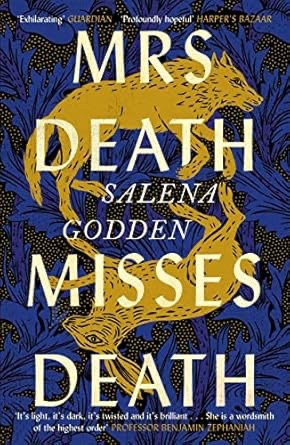
Wow! I loved this book! It’s been sitting on my shelf for a while. I’d bought it instinctively but hadn’t got round to reading it yet and our new local book club gave me the chance. The club is a brilliant combo of meeting other bookish people, talking about books and eating pudding. It’s like my fantasy night out. I found the book incredibly lyrical and philosophical and totally blew my mind. It also made me take a long hard look at myself. It’s hard to explain the story, except to say that it’s a journey. I am a total sucker for books that address the reader directly and here we’re addressed by Death herself. Yes, I did say ‘her’. She explains herself like this:
‘The greatest trick man played was making you believe I was a man […] Surely only she who bears it, she who gave you life, can be she who has the power to take it. The one is she. And only she who is invisible can do the work of Death. And there is no human more invisible, more readily talked over, ignored and easy to walk past than a woman, a poor, old black woman.”
She weaves another narrative through Death’s monologues and that’s the story of Wolf. He is charmed by an old antique desk he sees through a shop window, not realising when he buys it that it belonged to Death. He is drawn to writing and feels this desk might unlock his discipline and creativity. As he writes, Death perches on the edge of the desk and talks to him. They met when he was very small, during the fire that killed his mother. Between this story, Death delivers monologues on modern life: our ridiculous preoccupations, the way our lives are moulded by society and those terrible events that are an indictment on us and our world. The description of the fire that kills Wolf’s mother is surely based on Grenfell. There are multiple deaths and the residents have been campaigning to be heard for some time, claiming that the tower block was a death trap. I read this as the enquiry was in the news and the injustice resonated so strongly. The lives lost were cheap. The issues in the block were never addressed because those in power don’t listen to the poor, the downtrodden, or the immigrants. They were unwanted in an area that was becoming gentrified and no one seems accountable. There were no alarms and no sprinklers and the fact that Wolf survived us a miracle. This brush with Death connects them both, a deep sense of injustice and grief. I found Death’s monologues wise and started to think of her voice as that of the author coming into the fictional world. Her description of grief felt right:
“It’s like having a stone in your centre; time smooths the edges like a pebble in a river, but it’s always there – a stone is a stone”.
We’re given a glimpse of Wolf’s ancestry through the prism of death. Wolf’s mother is the latest in a long line of violent and terrible deaths: hanging, gunshot, fire, drowning. Does this ancestral history mark Wolf out as Death’s obvious companion?
Mrs Death’s monologues on society are brilliant, whether it’s child abusing celebrities using their money, fame and even religion to disguise their misdeeds or social media moguls allowing spurious and fake news stories to mislead us about what is real. I loved her take on sexism and misogyny, starting off with our perceived surprise that she’s a woman. The misogyny begins at the beginning of time, with Eve and the garden of Eden. Women in creation myths and legends are always the trickster. They’re the person who draws men towards their deaths, like the Sirens. There’s Eve, Medusa, Kalima – all are the architect of man’s misfortune. She lists the crones, witches, hags and wicked stepmothers of fairy tales. We sound incredibly powerful in those terms, but women only lead people to their deaths and don’t have the power to end life, despite having the power to give birth to it. Perhaps it’s that power to create life that scares men so much. If you listen to right wing politicians, we’ve excused and accepted way too much in the name of tolerance. Yet, women are still openly viewed in these terms, think about Trump’s running mate J.B. Vance and his dig at childless, cat ladies. Being a slave to her womb is the only thing that makes a woman natural or fulfilled.
‘It is exhausting how much space men want and how much credit and control man wants for mankind”.
There were parts of Death’s monologues that made me take a look at myself and particularly how I consume. Even publishing comes under her scrutiny as she talks about the stories chosen for publication. It’s not necessarily the stories that are most creative, but those that sell. She posits a story about the struggles of poor people, the literary equivalent of a Ken Loach film. She wonders about whether it would sell without a hook? Vampires are popular these days aren’t they? Let’s set it in Sheffield. It’s like I, Daniel Blake but with vampires. That will sell. The Christmas monologue really hit home, because I’d spent three days moaning that my usual place for Christmas wrapping paper had changed their website and it wasn’t working properly. It was designed for America and had stopped recognising some UK post codes and I was fuming. They were going to sell out before I got mine. Talk about first world problems.
“It’s not a proper Christmas without the deep fried pork-whip nutmeg balls. Quick! Shop! Consume!”
We all have our favourite Christmas foods, but Christmas will still happen without them. We will still have those we love round us. Yet every year I drag myself to Sainsbury’s because I just have to get my supply of Ecclefechan tarts. While it’s good to have our own traditions and things that make our Christmas, wouldn’t it be okay if the wrapping paper didn’t match the tree? It made me thoroughly ashamed of myself.
What I found most profound was Death’s ideas around ageing and changing. Humans are not meant to stand still. We change constantly. At those times when I’m worrying about how I look and my weight, which has increased considerably over the last few years while I’ve been unwell. I tell myself that this is the best I’m ever going to look. When I look back to pictures from twenty years ago I realise how pretty I looked, but I have to remember that in twenty years I’ll be seventy years old and I’ll probably do the same. I need to stop feeling inadequate. Stop the self- criticism. As Mrs Death says, it’s the love that matters. Even though our outsides change, inside you’re still you. Even when I’m old and wrinkled in my nursing home, with others doing the washing and caring, deep inside I’m still me. I can visit a lifetime of memories and imaginary palaces in my mind that have always been there. That never leaves. It reminded of some work I did in a nursing home. I planned it for two reasons. I wanted to talk residents through their memories and help them make a memory box. I also wanted to created a collage for each resident to put outside their rooms so that carers could see it and hopefully realise that the residents are people. They’re not just empty bodies to be serviced, because once they had busy, full lives just like their carers do. It makes a massive change to the standard of care because they can now relate to residents and talk to them, instead of over them. I loved doing it because it changed how carers related to the residents.
I loved how the book changed as I came towards the end. The prose starts to break up and poetry starts to take hold, firstly in- between longer prose sections but then longer verses. The prose becomes shorter, more statements than sentences. It’s like the descent into madness or dementia. Meaning becomes more difficult to decipher with only brief moments of lucidity. Wolf stays at a writing retreat and he seems to lose time. There are periods of unconsciousness. He wanders and rambles. It’s still beautifully lyrical but more instinctive. It comes from the soul.
Ultimately this book won’t be for everyone but those that do like it, will love it. I came away feeling uplifted. I didn’t expect a book about death to be so life-affirming. Wolf realises that time is a man made form of control. It’s something man created to place structure on life. Without time how could we create ‘work’, regulated to certain hours of the day and measured in units for which we are paid. Time is control. He examines the words we use, such as ‘time of death’. Death seems overwhelmingly final, so much so that we might avoid thinking (or reading) about it. There’s only one time of death, but we do have the time of life every single day. It’s down to the way we look As Mrs Death says ‘it’s all in the phrasing’.
Meet the Author

Salena Godden FRSL is an award-winning author, poet and broadcaster of Jamaican-mixed heritage based in London. In 2021 Canongate published her highly acclaimed debut novel ‘Mrs Death Misses Death’. It won The Indie Book Award for fiction and The Peoples Book Prize and was also shortlisted for The British Book Awards and The Gordon Burn Prize.
Salena Godden’s work has been widely anthologised and broadcast on BBC radio and TV and film. Her essay ‘Shade’ was published in award-wining anthology ‘The Good Immigrant’ (Unbound, 2016). She has had several volumes of poetry published including ‘Under The Pier’ (Nasty Little Press, 2011) ‘Fishing in the Aftermath: Poems 1994-2014’ (Burning Eye Books, 2014) ‘Pessimism is for Lightweights – 13 Pieces of Courage and Resistance’ (Rough Trade Books, 2018) and also the childhood memoir ‘Springfield Road’ (Unbound, 2014). Her self-produced poetry album ‘LIVEwire’ (Nymphs and Thugs, 2016) was shortlisted for The Ted Hughes Prize. The Royal Society of Literature inducted Godden as a fellow FRSL in 2022. She is also a patron of Hastings Book Festival and an Honorary Fellow of West Dean, Sussex.
A new hardback edition of ‘Pessimism is for Lightweights – 30 Pieces of Courage and Resistance’ was published in February 2023 by Rough Trade Books, featuring revised and new material, an introduction by John Higgs and an Old English translation of the title poem by Emily Cotman. The poem ‘Pessimism is for Lightweights’ is on permanent display at The Peoples History Museum, Manchester.
Salena Godden is currently working on three new books for Canongate: Literary childhood memoir ‘Springfield Road – A Poets Childhood Revisited’ and full poetry collection ‘With Love, Grief and Fury’ will be published together in May 2024. Plus an eagerly anticipated 2nd novel set in the ‘Mrs Death Misses Death’ universe will be published by Canongate in spring 2025.

 The Lotus Readers