Posted in Netgalley

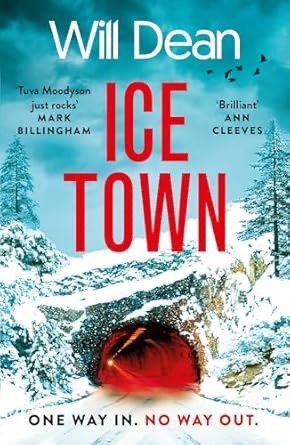
Ice Town by Will Dean

I’m convinced that I’m fated to never meet Will Dean. Despite booking to meet him twice this year both COVID and MS relapses have had ridiculously accurate timing and I didn’t manage either event. It’s so frustrating because I really am such a Tuva fangirl. I really enjoyed this trip back into her world, even if at times it was tense, threatening and claustrophobic. Will’s intrepid reporter is enticed to a town further north than Gavrik because her instinct is telling her there’s a story. Dubbed ‘Ice Town’ it’s a minor ski resort with only one upscale and very empty hotel. Stuck in its mid-century heyday it is now losing out to the bigger resorts and the hotel must be on its knees. Tuva can only access the town via a tunnel through a mountain. Traffic queues at the tunnel mouth as drivers are alternately let through. It then closes at night leaving residents cut off from the outside world. Tuva has been drawn by a missing person’s report, a teenager called Peter has disappeared. Nothing unusual in that, but Peter is deaf and Tuva is imagining how isolated he must feel. She worries that his hearing aid batteries have run out of battery life. She imagines him stuck somewhere in the dark, in freezing temperatures and not even able to hear the search teams shouting his name. Tuva packs up her Hilux and heads north hoping to find out more about Peter and maybe help the search. She’s heading for the only B & B in town, but when she gets there it’s clear they should have dropped the second B – something Tuva points out with her usual tact! It’s actuality two bedrooms in the back of the a sunbed shop with very thin walls, but Tuva does not need luxury and expenses are scrutinised carefully by her boss Lena. As she starts to acclimatise she starts to realise that, if possible, this is a quirkier town than Gavrik. She’s also without the long-standing relationship she usually has with the police. Can she find Peter without their help? Without her usual support system to call on, might she find herself in danger? 

She rounds out that Peter lived with his grandmother and seems quite isolated in then community. Kids at school thought he was weird and girls mention that he made them uneasy, always staring at their mouths. Tuva is quick to point out that this isn’t sexual, he’s just trying to lip read. The church seems to be the gathering point for the community, with the Deacon organising the search parties. Instead of the police, once the tunnel is closed at night, the residents are protected by the Wolverines, a local biker gang. Tuva meets one of them at the only watering hole in town and finds out he’s actually a poet, an unexpected hobby for a huge mountain of a man dressed in leather. Tuva has managed to shack up next to the only other outside journalist, a girl called Astrid who has the other room beyond the sun beds. Tuva feels an urge to find Peter quickly and when a body is found near the tunnel she fears the worst. When news comes through that the body isn’t Peter, the search is based on two possibilities: either Peter and another resident have gone missing at around the same time and died from exposure, or Peter is in hiding, because he is the killer. This change from victim to possible perpetrator worries Tuva, she knows how disorientating it is to have no hearing out in the wilderness. She also worries that if the police do catch sight of him he won’t be able to hear their commands and they’ll shoot him. She asks the police chief to remind her officers that Peter can’t hear them. 

It’s not long before Tuva is plunged into disorientating situations herself, in one scene when she’s staying at the resort hotel her isolated lobby falls into darkness and she can’t find the right bedroom door. For a moment she’s terrified and knocks a picture off the wall in her panic. It made me very jumpy because it seemed targeted because she’d been placed in such a remote part of the building. When waking up one night after a dream she feels around the bedside table and can’t find her hearing aids or her phone. As she feels her way around the unfamiliar room, I had the uncanny sense that she might be being watched. Anyone could be lurking in the dark. Who has moved her stuff and is someone in the dark watching her panic? That definitely had my heart racing. Then she finds them on the desk, remembering she’d had one too many at the pub and must have left them in the wrong place. Another scene that kept me glued to the book was when she took the ski lift down to the town and for some reason the power goes out. She hears what she thinks is a shot and the overhead light goes out. Now she’s just swinging silently in the dark and in the cold. She knows it doesn’t take long for frostbite to set in and she tries to protect her face. She is so vulnerable at this moment and I was scared for her. I felt like someone was playing with her, like a cat does with a mouse. I had to finish this scene before I could get up and do anything else. 

Will writes the quirkiest characters and here there are a few. There’s Ingvar who comes across like a college professor and lives halfway down the slope with his dogs. Could he have tampered with the ski lift, after all he might seem respectable now but he has served a sentence for murder. The poet bouncer is another surprise, especially when Tuva unexpectedly wakes up in his house. There’s a pod-caster who is becoming quite well known, but his listeners don’t know that he keeps the slopes smooth by day and keeps large numbers rabbits in his basement for food. Once it becomes clear that they have a spree killer on their hands, the odds are a lot more serious. Could Tuva end up being a target due to her snooping around the town and asking too many questions? Maybe Peter’s position as an outsider has created resentment and a desire for revenge? For some reason Tuva doesn’t think he’s the killer, although he still hasn’t been found and bodies are starting to pile up. The claustrophobic feeling of the town isn’t helped when the killer’s methods become known. They disarm people with bear spray, several times more powerful than ordinary pepper spray which is banned in Sweden. Other items they use are military grade so could this be someone who served in the army? The victims are asphyxiated with a tourniquet used on the battle field that has a clever gadget attached. It can be turned to create the necessary pressure, even if you can only use one hand? It’s an unusual piece of kit and Tuva wonders whether the killer is a medic or has used one on the battlefield. Or is it the ability to adjust the pressure that’s key? To allow a few breaths then cut the victim off again, playing God. 

I enjoyed the realisations Tuva has about her own life. She recognises that Lena and Tammy have kept her on track since her partner Noora died. To the extent of making sure she’s eating and getting some sleep. Despite losing her mum she certainly has some substitutes. I loved how Will lets thoughts of Noora just wander across her mind from time to time, sometimes happy memories and sometimes deeply sad ones. I’m glad that she gets to hear Nora’s heart beat from time to time. There is a strange coincidence that may have a huge impact on her personal life going forward. The tense few chapters that bring us to the finale are so confusing! My suspicion was running back and forth constantly and the clues come thick and fast here. I really didn’t know who to believe. We’re on tenterhooks and I remember thinking why does Tuva put herself and us through this? The ending coming in time for the Santa Lucia festival was beautifully done and those of us who’ve been reading since the beginning and love the weirder members of the Gavrik community will love a little cameo towards the end. When will someone pick this up for TV or a film series? It’s a fabulous franchise and it just gets stronger all the time. 

Out on 7th November from Point Blank.

Meet the Author

Will Dean grew up in the East Midlands, living in nine different villages before the age of eighteen. After studying law at the LSE, and working many varied jobs in London, he settled in rural Sweden with his wife. He built a wooden house in a boggy forest clearing and it’s from this base that he compulsively reads and writes.
Posted in Netgalley

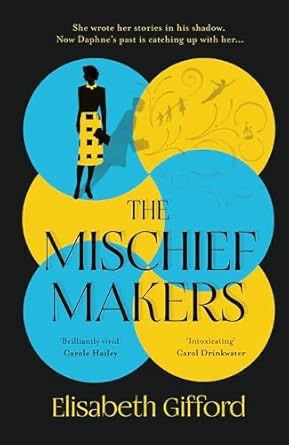
The Mischief Makers by Elizabeth Gifford


The Mischief Makers tells the story of author J.M Barrie’s relationship with the du Maurier family, including their daughter Daphne. I had a vague idea there was a connection between he two but hadn’t realised what the connection actually was. The film Finding Neverland always makes me cry, especially where the boy’s mother dies and makes her way into heaven/ Neverland. I knew that all the brothers were adopted by J.M.Barrie but I’d not realised that the boys were Daphne Du Maurier’s cousins. Their mother Sylvia was Gerald du Maurier’s sister, so my first thought was why weren’t the boys adopted by their own family? The author tells the story from Daphne’s perspective from her childhood all the way to middle-age. It’s a psychological study in a lot of ways, because Gifford really takes us into Daphne’s inner world as her life unfolds. Daphne herself filters the world through her psychological readings of Jung and Adler. We move back and forth in time as she examines incidents from her childhood with the benefit of experience and new discoveries she makes. We gain insight into her character and her process as an author, which was wonderful for me because I’m a huge fan of her work. 

Daphne grows up in a very complicated situation where she has a very attentive father and a cold, distant mother. This is something she examines closely later o with her adult knowledge of what’s appropriate and her father’s philandering ways with young actresses he starred with in theatre productions. The boys and J.M. Barrie are constant presence too, particularly in the nursery where Daphne would be waiting for the writer to weave stories. She is an imaginative child and Barrie teaches her to use her imagination, conjuring her ‘shadow self’ very like his most famous creation, Peter Pan. Tomboy Daphne is his real life principle boy and their play gives her space to sword fight, climb and take to the high seas in a way that’s frowned upon for girls in her class. There’s a fluidity to Daphne, in terms of both her gender and sexuality. In adulthood her pirate side becomes the bold, beautiful and sexually adventurous Rebecca de Winter. This was a character I’d always associated with Jane Eyre’s Bertha Mason – the original madwoman in the attic. Similarly, the second Mrs de Winter also represents Daphne but the quiet side that’s rarely seen in London. This is the side that craves time alone in Cornwall where she dresses in men’s tweeds and romps through the countryside or goes out sailing from their home in Fowey. As I was reading about this side of her character I was reminded of the young Mrs de Winter’s tweed skirts and her new sister-in-law’s observation that she couldn’t give a fig what she looks like. Fowey is where she goes to be herself, o hunker down with her children and husband Tommy. It’s where she writes and is most at home. 

I was very interested in the methods Barrie used to visualise the scenes from his books and plays. It also unlocks the imagination of his young charges, as the boys act out certain scenes such as hanging certain characters in the woods. With Daphne he has an almost hypnotic way of getting her to imagine an island rising from the lake. Could his techniques, which could be seen as hypnotism, have caused Daphne constant sense of being split. What effect did Uncle Jim’s imagination and techniques have on the boys in his care? Daphne remembers Michael being plagued by night terrors about drowning and a stubborn aversion to learning to swim. Are they all too imaginative? It’s clear that mental illness has run in the family, but is this an innate problem or unintentionally learned behaviour? 

I loved how Daphne comes across as a very new type of woman, especially in her own society and class. She epitomises the ‘flapper spirit’ but her progression goes much further than the drinking and dancing of the Bright Young Things. She’s different from previous generations of women in her very own way. She wants to write, to live alone in Cornwall and earn her own money. She has never fancied the idea of a husband and children, and has chafed against all the rules of being a young lady set by a mother she refers to as ‘Edwardian’. We get what she means in one sentence – the generation gap is huge. There’s also her fluid sexuality , something that I’ve always suspected as an undercurrent in her most famous novel Rebecca. Mrs Danver’s obsession with her mistress, telling her new mistress about Rebecca’s lustrous hair and showing her the sheer lace of her nightdress. When Daphne visits New York for a plagiarism case about the novel she meets Ellen, the wife of her publisher. She is immediately struck by her hostess’s resemblance to the character both in looks and her ability to look after a guest and put them at their ease. Daphne is overwhelmed by feeling and interprets it as desire, but I could see the second Mrs de Winter gazing out at Rebecca wishing she could be like her. Wouldn’t life be easier if she was this smart, perfect hostess and Tommy’s trophy wife? Although, Tommy largely accepts his rather less organised and talented wife.

Elizabeth Gifford brought Daphne to life for me and having visited the du Maurier home at Ferryside and Menabilly, I could easily imagine her there.  It was fascinating to take a trawl through her upbringing and how she ended up down in Cornwall writing. There is also this brilliant sinister edge to the story, with odd psychosexual tension and the questions around J.M. Barrie’s motives in adopting the du Maurier boys. Despite her mother’s wishes, her parents are generous enough to let her live down in Fowey as a young woman. Through her own journals we can see that she is troubled, constantly torn between the self she wants to be and the self she feels she should be. This is the gap between Rebecca and the second Mrs de Winter who is young, inexperienced and not equipped to run a great household in the same way as her predecessor. She questions herself constantly when the truth is that much like Maxim de Winter, her husband loves her for all the qualities she sees as faults. I thoroughly enjoyed this novel, that filled in the gaps in my knowledge about a brilliant writer and the psychological place her work came from. 

Meet The Author

Elisabeth Gifford studied French literature and world religions at Leeds University. She has an MA in Creative Writing from Royal Holloway College. She is married with three adult children and lives in Kingston upon Thames.

Posted in Personal Purchase

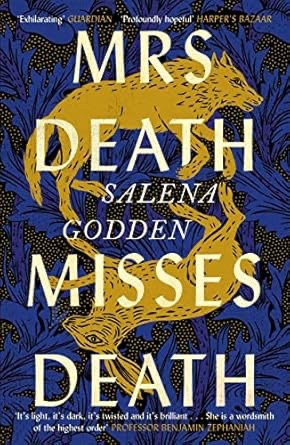
Mrs Death Misses Death by Salena Godden

Wow! I loved this book! It’s been sitting on my shelf for a while. I’d bought it instinctively but hadn’t got round to reading it yet and our new local book club gave me the chance. The club is a brilliant combo of meeting other bookish people, talking about books and eating pudding. It’s like my fantasy night out. I found the book incredibly lyrical and philosophical and totally blew my mind. It also made me take a long hard look at myself. It’s hard to explain the story, except to say that it’s a journey. I am a total sucker for books that address the reader directly and here we’re addressed by Death herself. Yes, I did say ‘her’. She explains herself like this: 

‘The greatest trick man played was making you believe I was a man […] Surely only she who bears it, she who gave you life, can be she who has the power to take it. The one is she. And only she who is invisible can do the work of Death. And there is no human more invisible, more readily talked over, ignored and easy to walk past than a woman, a poor, old black woman.”

She weaves another narrative through Death’s monologues and that’s the story of Wolf. He is charmed by an old antique desk he sees through a shop window, not realising when he buys it that it belonged to Death. He is drawn to writing and feels this desk might unlock his discipline and creativity. As he writes, Death perches on the edge of the desk and talks to him. They met when he was very small, during the fire that killed his mother. Between this story, Death delivers monologues on modern life: our ridiculous preoccupations, the way our lives are moulded by society and those terrible events that are an indictment on us and our world. The description of the fire that kills Wolf’s mother is surely based on Grenfell. There are multiple deaths and the residents have been campaigning to be heard for some time, claiming that the tower block was a death trap. I read this as the enquiry was in the news and the injustice resonated so strongly. The lives lost were cheap. The issues in the block were never addressed because those in power don’t listen to the poor, the downtrodden, or the immigrants. They were unwanted in an area that was becoming gentrified and no one seems accountable. There were no alarms and no sprinklers and the fact that Wolf survived us a miracle. This brush with Death connects them both, a deep sense of injustice and grief. I found Death’s monologues wise and started to think of her voice as that of the author coming into the fictional world. Her description of grief felt right: 

“It’s like having a stone in your centre;  time smooths the edges like a pebble in a river, but it’s always there – a stone is a stone”. 

We’re given a glimpse of Wolf’s ancestry through the prism of death. Wolf’s mother is the latest in a long line of violent and terrible deaths: hanging, gunshot, fire, drowning. Does this ancestral history mark Wolf out as Death’s obvious companion? 

Mrs Death’s monologues on society are brilliant, whether it’s child abusing celebrities using their money, fame and even religion to disguise their misdeeds or social media moguls allowing spurious and fake news stories to mislead us about what is real. I loved her take on sexism and misogyny, starting off with our perceived surprise that she’s a woman. The misogyny begins at the beginning of time, with Eve and the garden of Eden. Women in creation myths and legends are always the trickster. They’re the person who draws men towards their deaths, like the Sirens. There’s Eve, Medusa, Kalima – all are the architect of man’s misfortune. She lists the crones, witches, hags and wicked stepmothers of fairy tales. We sound incredibly powerful in those terms, but women only lead people to their deaths and don’t have the power to end life, despite having the power to give birth to it. Perhaps it’s that power to create life that scares men so much. If you listen to right wing politicians, we’ve excused and accepted way too much in the name of tolerance. Yet, women are still openly viewed in these terms, think about Trump’s running mate J.B. Vance and his dig at childless, cat ladies. Being a slave to her womb is the only thing that makes a woman natural or fulfilled. 

‘It is exhausting how much space men want and how much credit and control man wants for mankind”. 

There were parts of Death’s monologues that made me take a look at myself and particularly how I consume. Even publishing comes under her scrutiny as she talks about the stories chosen for publication. It’s not necessarily the stories that are most creative, but those that sell. She posits a story about the struggles of poor people, the literary equivalent of a Ken Loach film. She wonders about whether it would sell without a hook? Vampires are popular these days aren’t they? Let’s set it in Sheffield. It’s like I, Daniel Blake but with vampires. That will sell. The Christmas monologue really hit home, because I’d spent three days moaning that my usual place for Christmas wrapping paper had changed their website and it wasn’t working properly. It was designed for America and had stopped recognising some UK post codes and I was fuming. They were going to sell out before I got mine. Talk about first world problems. 

“It’s not a proper Christmas without the deep fried pork-whip nutmeg balls. Quick! Shop! Consume!” 

We all have our favourite Christmas foods, but Christmas will still happen without them. We will still have those we love round us. Yet every year I drag myself to Sainsbury’s because I just have to get my supply of Ecclefechan tarts. While it’s good to have our own traditions and things that make our Christmas, wouldn’t it be okay if the wrapping paper didn’t match the tree? It made me thoroughly ashamed of myself.

What I found most profound was Death’s ideas around ageing and changing. Humans are not meant to stand still. We change constantly. At those times when I’m worrying about how I look and my weight, which has increased considerably over the last few years while I’ve been unwell. I tell myself that this is the best I’m ever going to look. When I look back to pictures from twenty years ago I realise how pretty I looked,  but I have to remember that in twenty years I’ll be seventy years old and I’ll probably do the same. I need to stop feeling inadequate. Stop the self- criticism. As Mrs Death says, it’s the love that matters. Even though our outsides change, inside you’re still you. Even when I’m old and wrinkled in my nursing home, with others doing the washing and caring, deep inside I’m still me. I can visit a lifetime of memories and imaginary palaces in my mind that have always been there. That never leaves. It reminded of some work I did in a nursing home. I planned it for two reasons. I wanted to talk residents through their memories and help them make a memory box. I also wanted to created a collage for each resident to put outside their rooms so that carers could see it and hopefully realise that the residents are people. They’re not just empty bodies to be serviced, because once they had busy, full lives just like their carers do. It makes a massive change to the standard of care because they can now relate to residents and talk to them, instead of over them. I loved doing it because it changed how carers related to the residents.

I loved how the book changed as I came towards the end. The prose starts to break up and poetry starts to take hold, firstly in- between longer prose sections but then longer verses. The prose becomes shorter, more statements than sentences. It’s like the descent into madness or dementia. Meaning becomes more difficult to decipher with only brief moments of lucidity. Wolf stays at a writing retreat and he seems to lose time. There are periods of unconsciousness. He wanders and rambles. It’s still beautifully lyrical but more instinctive. It comes from the soul. 

Ultimately this book won’t be for everyone but those that do like it, will love it. I came away feeling uplifted. I didn’t expect a book about death to be so life-affirming. Wolf realises that time is a man made form of control. It’s something man created to place structure on life. Without time how could we create ‘work’, regulated to certain hours of the day and measured in units for which we are paid. Time is control. He examines the words we use, such as ‘time of death’. Death seems overwhelmingly final, so much so that we might avoid thinking (or reading) about it. There’s only one time of death, but we do have the time of life every single day. It’s down to the way we look As Mrs Death says ‘it’s all in the phrasing’. 

Meet the Author


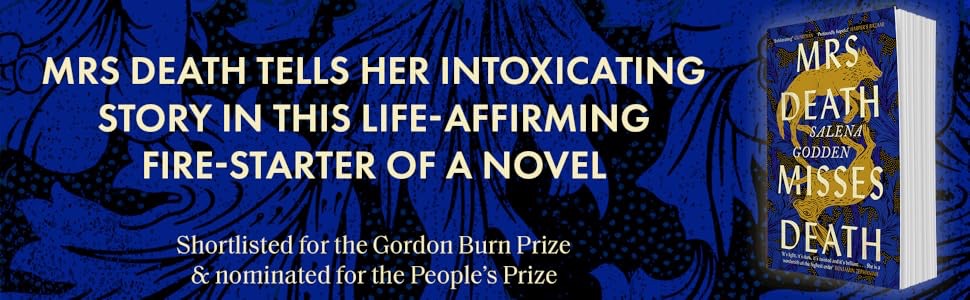
Salena Godden FRSL is an award-winning author, poet and broadcaster of Jamaican-mixed heritage based in London. In 2021 Canongate published her highly acclaimed debut novel ‘Mrs Death Misses Death’. It won The Indie Book Award for fiction and The Peoples Book Prize and was also shortlisted for The British Book Awards and The Gordon Burn Prize. 

Salena Godden’s work has been widely anthologised and broadcast on BBC radio and TV and film. Her essay ‘Shade’ was published in award-wining anthology ‘The Good Immigrant’ (Unbound, 2016). She has had several volumes of poetry published including ‘Under The Pier’ (Nasty Little Press, 2011) ‘Fishing in the Aftermath: Poems 1994-2014’ (Burning Eye Books, 2014) ‘Pessimism is for Lightweights – 13 Pieces of Courage and Resistance’ (Rough Trade Books, 2018) and also the childhood memoir ‘Springfield Road’ (Unbound, 2014). Her self-produced poetry album ‘LIVEwire’ (Nymphs and Thugs, 2016) was shortlisted for The Ted Hughes Prize. The Royal Society of Literature inducted Godden as a fellow FRSL in 2022. She is also a patron of Hastings Book Festival and an Honorary Fellow of West Dean, Sussex.

A new hardback edition of ‘Pessimism is for Lightweights – 30 Pieces of Courage and Resistance’ was published in February 2023 by Rough Trade Books, featuring revised and new material, an introduction by John Higgs and an Old English translation of the title poem by Emily Cotman. The poem ‘Pessimism is for Lightweights’ is on permanent display at The Peoples History Museum, Manchester. 

Salena Godden is currently working on three new books for Canongate: Literary childhood memoir ‘Springfield Road – A Poets Childhood Revisited’ and full poetry collection ‘With Love, Grief and Fury’ will be published together in May 2024. Plus an eagerly anticipated 2nd novel set in the ‘Mrs Death Misses Death’ universe will be published by Canongate in spring 2025.