Posted in Netgalley

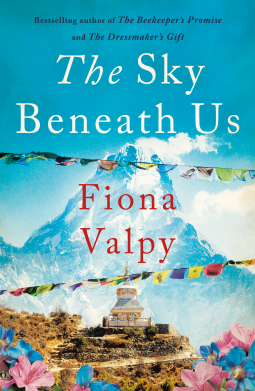
The Sky Beneath Us by Fiona Valpy 

Fiona Valpy is a newish author to me, someone that I’ve come across while blogging and I always request her books on NetGalley. I know I’m going to get a read that’s focused on women, their history and characters going through an experience that changes their outlook on life. I love the psychology behind these stories and this new novel was no exception, taking our main character through her family history to explore her identity and her direction now she’s in middle life. In two timelines we meet Violet Mackenzie- Grant and her great niece Daisy almost a century later. In 1927, Violet is leaving the family estate to focus on a new and exciting career path for women. Having watched her sister settle into the role of wife, Violet wants her life to be different and enrols at The Edinburgh School of Gardening for Women. Manual labour isn’t really what her family had in mind for her daughter, but Violet is so excited especially when she gets the chance to use her drawing skills to sketch plant specimens for the Edinburgh Botanical Gardens. She is thrilled to see the amazing plants being brought back from expeditions all over the world. Little does she know that this work will inspire a journey of her own; the trek of a lifetime to Kathmandu and beyond. In 2020, her great niece Violet Loverack has always dreamed of retracing Violet’s steps ever since she discovered her journals at the family home in Scotland. Her plant hunting exploits inspired Daisy’s own career as a landscape gardener, but from her tiny flat in London, Kathmandu has always seemed a long way away. Now divorced and with her last daughter leaving home for university, she’s made the decision to go on the trip of a lifetime. As she arrives in Nepal, ready for her trek into the Himalaya, fate has a different plan in store for her in the shape of the COVID pandemic. It prevents her mother joining her on the trip and soon after her arrival, the country is shut down leaving her stuck mid-way to the village Violet mentions with her two Sherpas. She must now undertake her journey alone with her guides, hoping for shelter at the same village. As she starts to piece together all the parts of Violet’s story she uncovers long held family secrets, can they inspire Daisy to find her own path forward and build a new life for herself? 

I was so inspired by this story, especially the adaptability and courage of these women. It gave me the travel bug too and I booked a little trip to Venice half way through! Violet is an incredible character, brave and perhaps a touch naïve at first. She doesn’t want to be restricted by what her family and society expect for her, but isn’t quite prepared by how strong their beliefs and rigid class structure is. Even going away to study us a massive step away from that path of marriage and children her parents were hoping for and manual labour for a woman of Violet’s class is possibly unheard of. There’s an openness and freedom to how she thinks that’s partly being young, part never challenging the status quo before and partly her own restless spirit. Things changed rapidly after WW1 for both women and the rigid class structure of the Edwardians. There’s a definite generational gap between those who remember those early years of the early Twentieth Century and those born after the war. Men were more scarce and that applied particularly to women of Violet’s social standing. There were more spinsters at that time, but the war also had an effect on class. It’s a change watchers of Downton Abbey saw between the dowager Duchess played by Maggie Smith and her granddaughter Sybil, who elopes with the young chauffeur. The family also struggled to keep the estate financially viable and many aristocratic families at this time had to give up their stately homes or married American heiresses who were only to keen to gain a British title in return for fixing the stately home’s roof or paying the multiple death duties. Young people of the 1920’s were the flappers and bright young things of the ‘Roaring Twenties’. Violet’s parents seem relatively relaxed about her studying, but probably assume Violet will give it all up when the right man comes along. In finding him, I’m not sure Violet understood how restricted her choices actually were. 

When Violet meets Callum Gillespie at the botanic gardens it’s a meeting of minds as well as hearts. Both love gardens and are inspired by the intrepid plant hunters who travel all over the world to bring back the specimens that Violet is sketching. They are experimenting by cultivating seeds and cuttings to see which plants grow well in the Scottish climate. Violet’s home is situated where the Gulf Stream brings milder temperatures and along with it”s mountainous countryside it could be the perfect site to cultivate plants coming from Nepal. Violet has fallen in love with the stunning Himalayan poppy, it’s sky blue petals and orange centre jumps out from the page and she’d love to grow it back home. Callum is going on the next expedition to Nepal, but first Violet takes him to meet her parents. It’s fair to say she’s stunned by their reaction. They insist that there’s no future in their relationship. He’s so far beneath them in class, that they couldn’t possible give their blessing to the relationship. Violet must break off their relationship. Determined to be with Callum, they both leave and spend the night in a nearby bothy together, cementing their union before a trip to Callum’s parents where they expect a better reception . Sadly things are equally awkward. Callum’s mother is uncomfortable when Violet tries to help out with tea. They are more used to working for people of Violet’s class, and to Callum’s embarrassment they act more like servants than family. They tell Callum he should look for a wife from his own class because this will never work and he could ruin Violet’s chances of a more suitable marriage. As Callum leaves for Nepal the pair are downcast and worry for their future. They continue to write to each other over the weeks and Violet becomes ever more sure that he is her soulmate. Surprise news makes Violet realise she wants to be with him, wherever he is and with the help of her sister she sets off to Nepal where life changing events await her. 
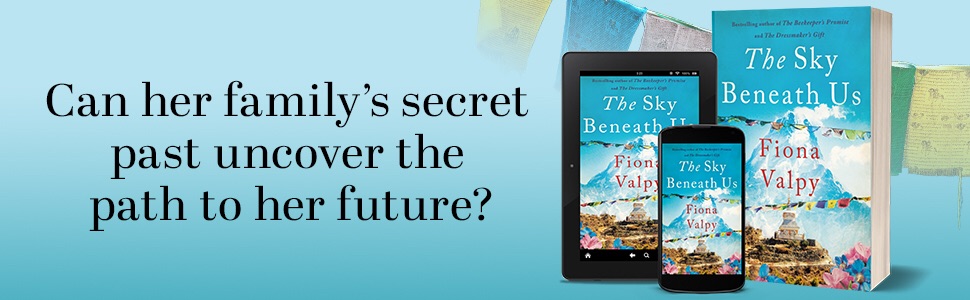
Years later Daisy is setting out on the same journey. She’s recently been very uncertain about the direction of her life now she’s no longer a wife or a full-time Mum. I loved following her journey, taking Violet’s steps into the Himalaya and at such an extraordinary time too. While the landscape itself is unchanged, more and more tourists have made their own attempts to conquer Everest. Previously, the Nepalese people thought it disrespectful to the mountain goddess to climb her, but since then both the Tibetan and Nepalese governments have allowed tourism in the area. Of course this has opened up the small communities to the rest of the world and allowed communication links to and from the area. It was fascinating to read about the effects of tourism on the people and the delicate eco-system around them. Sherpas are now employed to to tackled the most dangerous aspects of climbing Everest. They know the mountain, the weather and the best paths to take. Some are employed to create paths of ladders across the glaciers and many lives are lost, depriving families of their fathers and the income. It was clever to set Daisy’s journey in the pandemic because she gets to see the valley where Violet lived without tourists. The place feels untouched and even more remote as tourists have rushed home and the villages are locked down. So Daisy gets to experience the trek very much like Violet did, it’s quiet, there’s nobody on the same path and when she reaches the village she’s so surprised to a warm welcome. She’ll have to quarantine of course, but she has a family here with so many cousins she’s lost count. She also has access to the rest of Violet’s journals and will be able to read what remains of her life story. Just as these people did for Violet when she arrived a century ago, they now take Daisy in and look after her, 

I loved the equality of the village and I’m sure this is what Violet enjoyed too. There’s no class structure and seemingly no judgement either. She was taken in and as soon as a house becomes available it is cleaned and given to her for as long as she needs it. They don’t find industrious and hard working women an anomaly. This is somewhere Violet can settle and now Daisy can meet Violet’s descendants. Their societal structure is based on community and sharing. No one is without, but equally no one has ownership either. I loved how Daisy is inspired by the villagers and their generosity. It sparks a fire in her for community garden, partly to put something back into this wonderful place, a replacement for what years of visitors have taken. She also thinks it could work back home in Scotland, sharing some of the land that’s been her privileged birthright with the community. She inspires her daughters to improve the estate with an organic gardening project and more ethical values. The settings in the novel are incredible, equally beautiful but it’s hard not to be in awe of the incredible landscapes Daisy uncovers on each day’s trek. The valley between the mountains has its own climate and a unique combination of plants. I was blown away by the author’s description of the flower meadow which I pictured as a living rainbow of roses, rhododendrons and climbers. Of course there are also those vivid blue poppies and yes, I have already sourced some seeds. The idea of being above the clouds was incredible, almost as if it’s a magical, heavenly place. 

Of course there are some darker moments. COVID hits the family hard, just as typhoid hit Violet’s plans a hundred years earlier. The trek is challenging as Daisy struggles with the altitude and the stamina required to reach the village, in fact she’s stunned by how sure footed and physically fit the older members of the community are. This was heartbreaking in parts but also incredibly uplifting. It left me thinking I could start to tick off those bucket list items and fulfil those dreams I had for my life but set aside when I first became ill. Daisy’s Sherpa has a great way of combatting her fears and anxieties about completing the trek. He tells her to keep taking small steps, one in front of the other and I think this is great advice for any overwhelming task and life in general. You only fail if you give up. 

 Out 10th September from Lake Union Publishing.

Meet the Author
Fiona is an acclaimed number 1 bestselling author, whose books have been translated into more than thirty different languages worldwide.

She draws inspiration from the stories of strong women, especially during the years of World War II. Her meticulous historical research enriches her writing with an evocative sense of time and place.

She spent seven years living in France, having moved there from the UK in 2007, before returning to live in Scotland. Her love for both of these countries, their people and their histories, has found its way into the books she’s written. Fiona says, “To be the first to hear about my NEW releases, please visit my website at http://www.fionavalpy.com and subscribe to the mailing list. I promise not to share your e-mail and I’ll only contact you when there’s news about my books.”
 

Posted in Squad Pod

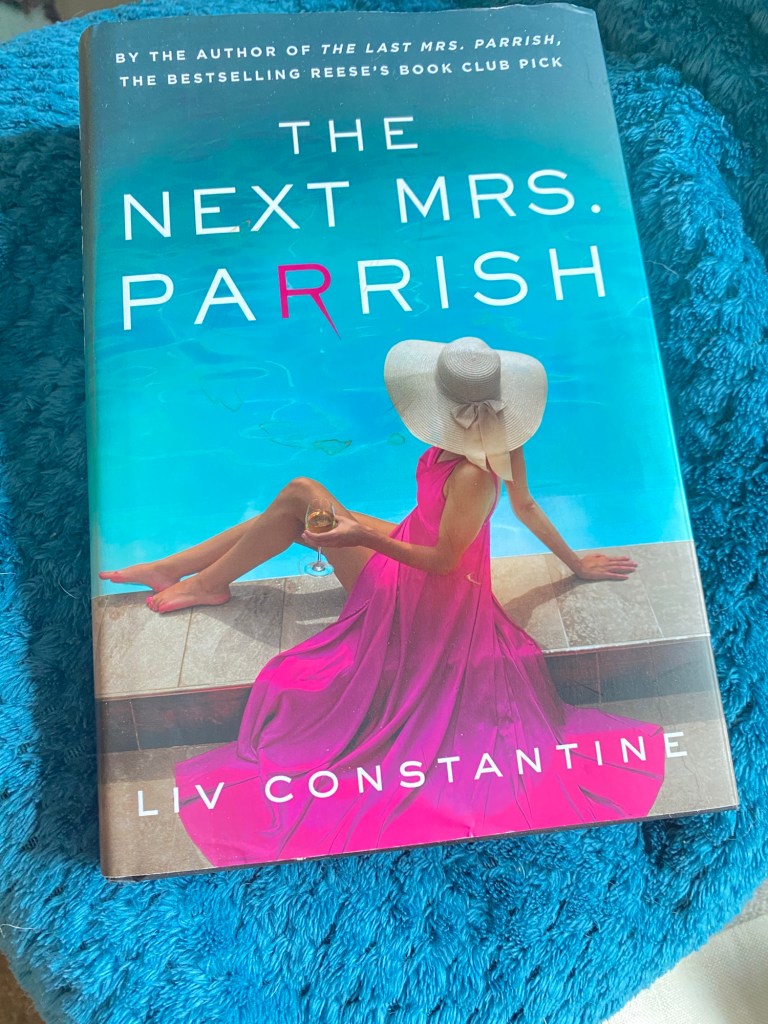
The Next Mrs Parrish by Liv Constantine 

Amber Parrish has worked her way up from being invisible nobody Lana Crump, to prominent socialite over a number of years. There have been many bumps along the way but now she’s made it. Even her husband Jackson’s current status hasn’t stopped her reigning supreme over the Bishop’s Harbour community on the Long Island Sound. Jackson is coming to the end of a prison sentence for tax evasion, but with a month or so left to serve Amber is fast running out of money. Daphne, the first Mrs Parrish, left Bishop’s Harbour after her divorce from Jackson and swore she would never return. She believed that he would never change. His abuse was psychological, physical and emotional, but she has tried to keep the truth of her marriage secret from her girls until they’re older. When she sees daughter Tallulah struggling and desperate to see her father, Daphne relents and agrees to spend the summer in Bishop’s Harbour. For as long as Jackson agrees to her boundaries and rules. Jackson proclaims he is a changed man and agrees to family therapy, but Daphne is on her guard, unsure whether a man like him can ever change. Daisy Anne lives in Texas with husband Mason and their children and enjoys a very close relationship with her in-laws, especially her mother-in-law Birdie. Even so, Daisy Anne feels the loss of her father very deeply, especially since she suspects foul play. After her mother’s death he jumped into an ill-advised relationship with a younger woman and was killed while they were elk hunting. The death was ruled an accident, because his wife claimed she’d mistaken movement up ahead for an elk, but Daisy Anne knows it was murder. When this woman walks into an exhibition for Daisy Anne’s White Orchid jewellery company in New York, she is furious and has her thrown out. The incident hardens her resolve to bring this woman to justice. Amber, Daphne and Daisy Anne’s lives become interlinked, in a dangerous game with complicated motives of revenge, justice and greed.  

This is one of those books where it’s hard to like any of the characters, instead it’s driven by it’s complicated and thrilling plot of deceit and betrayal. I found myself mentally berating some characters and hating others with a passion, but still I felt compelled to keep reading. I’ll admit this was mainly because I wanted to see some people get their comeuppance. I did a lot of internal screaming if I thought one of the women was doing something stupid. My husband will tell you it wasn’t all silent screaming, because I honestly wanted to give others a swift slap. I had sympathy for Daphne, especially when learning the extent of the abuse she suffered while married. I desperately wanted to intervene and tell her not to return to Bishop’s Harbour ever. I could understand her concern about her daughters, but when the abuse was so extensive and he showed signs of starting to control their children it has to be non-negotiable. I would have had to draw a line. Instead of allowing him access to the family, she needed to have a very hard, but honest conversation with her eldest daughter. Once they knew the truth, she needed to work on blocking his access and maybe relocating. Daphne came across as wary one moment then far too trusting the next. When she made the decision to stay close to Jackson for the summer and he stepped over her first boundary, I was screaming at her to get back on a plane. I probably had a huge reaction to this storyline because I have been through psychological abuse and I had to set hard boundaries after leaving. It was great to see the author use this subject in one of her novels and portraying it so accurately, because she shows how pervasive and relentless coercive control is. She covers all the red flags too, showing the initial love bombing – something that’s really off the scale with a man as wealthy as Jackson Parrish. Then she shows him slowly ramping up the control, starting with what Daphne wears and weighs. It isn’t clear if he continues this pattern with current wife Amber, but she’s quite the operator herself having used every trick in the book to end up in such a wealthy position as the second Mrs Parrish. 

As Jackson comes out of prison, their relationship deteriorates over Amber’s solution to their short term cash flow problems. Seemingly having no jealousy or feelings for her husband, Amber agrees to help with his plan to get Daphne and the girls back. Only if she gets the right terms of divorce of course – the guarantee of this standard of living for life. She aims to get her own back on someone from the past, someone who got in the way of her social climbing and humiliated her. She’s determined to buy into their business, setting up a dummy company to buy the controlling share and ruin it from the inside. She is utterly ruthless and there’s a definite pleasure in knowing that she got one over on Jackson but it’s hard to empathise with her, especially when she knows Jackson plans for Daphne. Meanwhile, Daisy Anne continues to be suspicious of the woman who married her father. His sudden death left Daisy Anne without either parent and although she’s since had a family of her own, she’s missed out on that grounding and support we get from our parents. She starts looking into his death in more detail, searching out CCTV and witnesses to the shooting ‘accident’. She also puts out feelers to find out where his widow came from, someone with her father’s interests of fly fishing and shooting would probably have lived on a large estate or been known in their social circle. She can feel in her bones there was a scam involved and she’s not going to let it go. You’re not quite sure how these women overlap at first, as the author ekes out the revelations and takes us on a rollercoaster of twists and turns. Often books have twists just for the sake of it but this was a belter and totally unexpected. I devoured the last few chapters, desperate to get the ending I wanted; finally I could find out how these women link together and watch certain characters get their just desserts. This is the perfect summer read with a great combination of serious issues, the beautiful Long Island beach backdrop and those delicious glimpses into the lives (and wardrobes) of the wealthy women who live there. Definitely one for your suitcase if you’re popping off for some late summer sun.

Meet the Author

Liv Constantine is the pen name of sisters Lynne Constantine and Valerie Constantine. Lynne and Valerie are New York Times and international bestselling authors with over two million copies sold worldwide. Their books have been translated into 29 languages, are available in 34 countries, and are in development for both television and film. Their novels have been praised by The Washington Post, USA Today, The Sunday Times, People Magazine, and Good Morning America, among many others. Their debut novel, THE LAST MRS. PARRISH, is a Reese Witherspoon Book Club selection.

Posted in Orenda

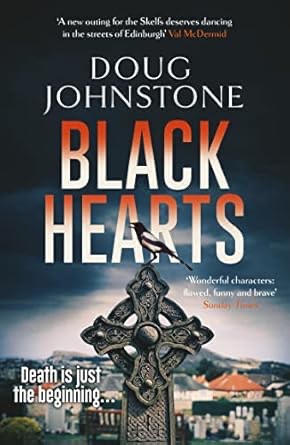
Black Hearts by Doug Johnstone

As all subscribers and Twitter followers must know by now, I am a huge fan of The Skelf series. I’m a Skelfaholic and it’s become a strange cycle of waiting for the next book to be published, devouring it overnight then longing for the next one. It’s even worse this time because I have it on good authority that this might be the penultimate book in the series. So one more book and no more Skelfing! I’m going to be like a weasel with a sore head when I have to go cold turkey. It has been wonderful to be back in Edinburgh with this family: part private investigators, part undertakers and all round incredible women. For those who haven’t met them yet, the Skelfs are three generations of one family. Grandmother Dorothy is in her seventies, but is still active in both the investigative and the funeral parts of the business. In her spare time she still drums like a badass and has a lover almost twenty years her junior. Daughter Jenny is back home, living above the business and struggling with memories of psychopath ex- husband Craig. She’s drowning her pain with alcohol and sex. Jenny’s daughter Hannah is now a PhD student, working in the astrophysics department, but still finding time to help out. She’s now married to Indy, feeling settled and starting to move past what happened to her father. The women are brought some unusual cases, both for funerals and PI work. A gentleman approaches Dorothy after his wife’s funeral, to ask if they can help him with a nighttime visitor. He believes his wife’s spirit is punishing him and he has the bruises to prove it. Hannah is approached by Laura, a young woman who claims to know her, but Hannah has no recollection of her. When Laura starts to turn up wherever Hannah goes, she suspects mental health problems. She stops being harmless the closer she gets to the family, especially when Hannah drops into the funeral parlour and finds Laura talking to Indy. Laura wants them to do her mother’s funeral, but Hannah thinks it’s unwise. How can she let this fragile girl down gently? 

Aside from their cases Johnstone picks up those storylines that weave throughout the novels. In the main we are drawn back to Craig, Jenny’s ex-husband and Hannah’s father, who is still haunting the family. Jenny is most visibly affected by her interactions with Craig’s family, most notably his sister, who seems to have inherited his ability to manipulate and turn to violence to get what she wants. Will Craig ever leave them alone and will Jenny be able to tread the line between her own pain as his ex and Hannah’s pain as his daughter. Both tend to overlook the grief that Dorothy still feels at the loss of her own husband Jim, complicated now by her relationship with police detective Thomas. Indy’s grief is also overlooked a lot, especially since she’s just gone through disinterring her parents in order to give them the cremation in line with their faith. Hannah and Jenny bring the drama and it’s Jenny I was particularly worried about. She’s getting messy, day drinking and embarking on a highly controversial sexual relationship with the wrong person. She never wakes up feeling better, but in the moment she has to drown out the constant pictures in her head. This is PTSD and she’s in danger of drawing others into her drama, especially Archie who works for the funeral business. Can she rein in her behaviour? Even professional help seems doomed to failure at this point. 

Aside from these incredible women, and the lovely Indy of course, the things I most love about these books is Doug Johnstone’s love for Edinburgh and the way he weaves incredible ideas, philosophy and physics into his novels. I’ve not been to Edinburgh since I was in my twenties, but the way he describes the city makes me want to go back. He doesn’t sugar coat the place either, there’s good and bad here, but as a whole it’s a poem to a place that’s in his soul. Dorothy muses on her home town a lot in this novel and considering she was born in America, this place is her heart’s homeland. She ponders on the people this city produces, including her husband and child, the history, the architecture almost as if she’s taking stock. She concludes that she’s a person who always looks forward to where life’s going, but grief is like the tide and there’s no telling when those waves will wash ashore again. Jenny tends to frequent the less salubrious areas of the city. She’s stuck. Her past has quite literally washed ashore and the problem with losing someone is you’re not the only one grieving and everyone grieves differently. She’s not mourning Craig as he truly was. She’s grieving the loss of all that hope; the hope they both had for the future on their wedding day and when Hannah was born. Similarly Craig’s mum and sister aren’t missing the Craig who committed all those terrible crimes. Violet misses the little boy she had and the life she wanted for him and his sister misses her baby brother. Hannah seems to be the person most resigned to the loss of her father. She always seems older than she is and with Indy alongside her she has the support she needs. There’s so much wisdom in these two young women, honed from a combination of Indy’s spirituality, years of working with grieving families and Hannah’s physics knowledge, especially where it tries to explain the universe. The supermassive black holes that are thought to be at the heart of every galaxy are mysterious. We know that they have a huge power that acts like a magnet, drawing in items from across the universe. 

I loved the element of Japanese spirituality and having read Messina’s novel The Phonebox at the Edge of the World, I loved the concept of the wind phone. I’ve always thought that a good way of letting go of the past, especially when you’re struggling emotionally, is to make a physical gesture or step in the direction you want to go. That might mean taking off a wedding ring when you’re getting divorced, or moving house where it’s full of old memories. I found talking to my late husband in my head a bit strange and it only made me miss him more. So I wrote to him in my journal instead. To have a phonebox dedicated to speaking with those who have died seems a very effective way of keeping them in the present with you, but in a controlled and deliberate way. Samuel Beckett said: 

“Memories are killing. So you must not think of certain things, of those that are dear to you, or rather you must think of them, for if you don’t there is the danger of finding them, in your mind, little by little.” 

Each of the Skelf women have their own grief to bear, a black hole at the centre of their heart. Each must find their own way to remember a little, to prevent becoming overwhelmed by their memories. Only by reconciling this, can they live in the present moment and make plans for their altered future. 

Meet the Author

Doug Johnstone is the author of fifteen novels, most recently The Space Between Us (2023). Several of his books have been bestsellers, The Big Chill (2020) was longlisted for the Theakston Crime Novel of the Year, while A Dark Matter (2020), Breakers (2019) and The Jump (2015) were all shortlisted for the McIlvanney Prize for Scottish Crime Novel of the Year. He’s taught creative writing and been writer in residence at various institutions over the last two decades including festivals, libraries, universities, schools, prisons and a funeral directors.

Doug is a Royal Literary Fund Consultant Fellow and works as a mentor and manuscript assessor for many organisations, including The Literary Consultancy, Scottish Book Trust and New Writing North. He’s been an arts journalist for over twenty years and has also written many short stories and screenplays. He is a songwriter and musician with six albums and three EPs released, and plays drums for the Fun Lovin’ Crime Writers, a band of crime writers. He’s also co-founder of the Scotland Writers Football Club.

Posted in Orenda

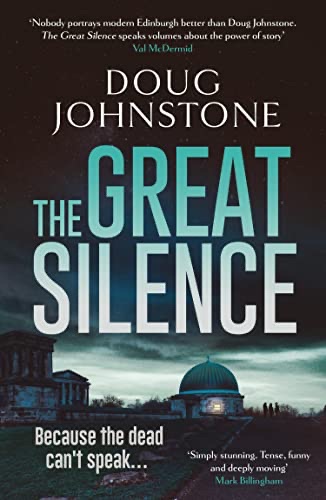
The Great Silence by Doug Johnstone

I have already created two new hashtags for this third novel in the Skelf family series. The first was #bookbereavement, because when I finished it I wanted to turn straight back to the first page and start again. The second was #Skelfaholic and I am a fully paid up member. It is agreed that if this series ends (please no!) then we Skelfaholics will be holding a wake by drinking whiskey in a funeral home, followed by star-gazing at the observatory. It’s hard to put across how much I love the Skelf women, their cases, the way they conduct their funeral business with such dignity, and their investigation business with more balls than most men. I read this book almost as soon as I received it, and I’ve been sitting on it excitedly ever since, desperately trying not to say anything until the blog tour. Now I can happily say Doug Johnstone has done it again. This is a fantastic read. 

For those who are new to the series, the Skelf women are three generations living under the same roof: Dorothy the grandmother, Jenny the mother, and Hannah the granddaughter. They ‘live above the shop’; their businesses being a strange mix of funeral directors and private investigators. Oh and Dorothy is a music teacher too, so there are often teenagers wandering in and out and playing the drums. In fact there are often waifs and strays under the Skelf’s roof. Hannah’s girlfriend Indy was one of their waifs, brought into the fold when her parents died and the Skelf’s organised their funeral. She now looks after the funeral business with the same calm and dignity she brings to Hannah’s life. Einstein the dog arrived when a police chase ended with a van crashing nose first into one of their graves, during the funeral. The dog was in the van and with his owner dead, he became part of the household and a companion of Schrodinger, the cat. Jenny mainly works on the private investigation side, but has a lot of her time taken up by her ex and Hannah’s father, Craig who escaped prison and is now closer than they think. Finally, there’s Hannah, starting her PhD with the astrophysics department and pondering the question of why other life in the universe has never tried to contact us – the ‘Great Silence’ of the title. 

The book begins with a strange event. Dorothy takes Einstein for a walk in the park and he fetches a human foot, even more strange is that it appears to be embalmed. This embroils Dorothy in a very unusual case that could be deadly. Jenny is dealing with the aftermath of her ex-husband’s actions in the last book, she’s still healing emotionally and potentially regretting the end of her relationship with painter, Liam. She misses him, and wonders if perhaps they could rekindle something. Then the other daughter of her ex-husband disappears and Jenny wonders if her life will ever be free of this man, as she joins forces with the other woman in his life to find her daughter. Finally, Hannah is facing massive changes in her academic and personal life. In a sense she’s being pulled between past and future. Her graduation becomes a double celebration when Indy proposes, but then she’s pulled into the past when their flat is broken into and someone makes it clear they still want to be part of her life. Her academic supervisor asks her if she’ll look into one of the central questions of astrophysics, if there is extraterrestrial life, why haven’t they replied to our messages? José has had a reply, but doesn’t know where it’s come from. Is it really from another life form or is someone playing game with him? 

There’s so much packed into this novel, but Doug Johnstone never loses a thread. Each storyline is given equal time and care. As I was reading the novel and writing this review, my husband saw my search history on my iPad and looked confused. I had tabs open for SETI (an institute set up to search for possible extraterrestrial life), the embalming process, numbers of big cats kept in domestic homes in the U.K, and Hindu funeral rites. Yes, the author does go to all these different places in the novel, not to mention the Italian gigolo and elderly lady, and they all interweave harmoniously.  I love the unexpected situations they find themselves in, such as Indy and Hannah taking a walk in the park and encountering a black panther. I also love how these women throw off expectations and be themselves. Dorothy is an elderly lady, but she goes to clubs when one of her students is playing a gig, and has a healthy sex life with her long time friend and police contact, Thomas. She’s investigating the ‘foot’ incident, which becomes more urgent once another foot turns up belonging to someone different. She’s also investigating the panther incident and visits experts keeping wildcats at their homes. In between she’s supporting Abi, now living with the Skelfs, who gets a huge shock when a man claiming to be her birth father shows up. 

Jenny has to face her ex- husband and there is a sense that this might be their final showdown. They had originally thought he’d be far away in another country, but with huge estates covering thousands of acres in Scotland, it’s not inconceivable that he’s been hiding close by all along. The strength of both Hannah and Jenny in facing him again, is amazing.  They’re scared – so much so that Hannah and Indy move back in to the family home – but know that the only way to stop this man ruling their lives is to find him and have him locked away again. I felt for Jenny, who had just turned a corner emotionally and was considering her life moving forward, and whether she wanted to remain alone. She’s also investigating on behalf of a brother and sister who are concerned their elderly mother is being misled by an Italian playboy. As usual Jenny is professional with her investigation, but uneasy about her clients and their motives. Meanwhile, behind all these fireworks, the kind and loyal Indy is having a crisis about her grandparents. They are traditional, but to Hannah’s surprise they want to fly over from India for their wedding. They don’t mind their granddaughter marrying a woman it seems, but they do have a huge request relating to the death of Indy’s parents. Leading to some very hard choices for Indy, who I’m especially fond of.  

Doug Johnstone is so many things at once: a gritty crime writer; a poet; a philosopher; a lover of the city where he bases this series; and an incredible writer of women. Johnstone writes real women, women who are intelligent, ballsy and true to themselves which is why I love them so much. One philosophical idea that stood out to me was ‘sonder’. It’s a word I’ve become aware of because it’s the title of my work in progress – where there are people in a difficult situation desperately trying to understand each other. Sonder is the sense I often get in a very busy train station when I look around at all the people and realise that every one of them has a complex and unique life just like mine. It’s the name of a cafe that Hannah visits near the university campus and as she sits there after her graduation, with Indy, Jenny and Dorothy she realises something. These three women come into people’s lives at a terrible moment, but have the ability to treat each person’s grief as if it was the most important thing to them. It reminded me of bringing a client into my counselling room, creating a safe space where, for an hour, the most important thing in the room is this person and whatever they bring to talk about. I think this is possibly why I feel such a strong kinship with these women. Jenny will take a drink with a homeless person and pass the time of day and Dorothy will connect with a young person fifty years her junior and make them feel welcome. I hope a little of the Skelfs rubs off on all of us. There was something about this book that felt like a finale, but I’m hoping against hope there’s more to come from these characters who I love. I’ll miss them, till next time. 

Meet the Author

Doug Johnstone is the author of fifteen novels, most recently The Space Between Us (2023). Several of his books have been bestsellers, The Big Chill (2020) was longlisted for the Theakston Crime Novel of the Year, while A Dark Matter (2020), Breakers (2019) and The Jump (2015) were all shortlisted for the McIlvanney Prize for Scottish Crime Novel of the Year. He’s taught creative writing and been writer in residence at various institutions over the last two decades including festivals, libraries, universities, schools, prisons and a funeral directors.

Doug is a Royal Literary Fund Consultant Fellow and works as a mentor and manuscript assessor for many organisations, including The Literary Consultancy, Scottish Book Trust and New Writing North. He’s been an arts journalist for over twenty years and has also written many short stories and screenplays. He is a songwriter and musician with six albums and three EPs released, and plays drums for the Fun Lovin’ Crime Writers, a band of crime writers. He’s also co-founder of the Scotland Writers Football Club.

Posted in Netgalley

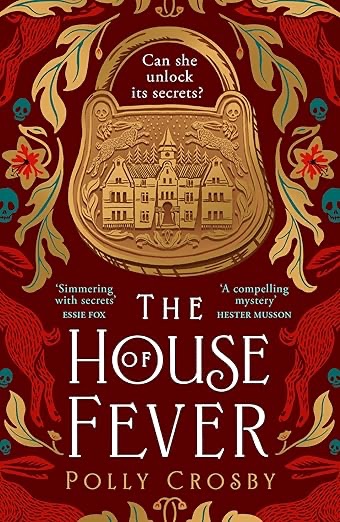
House of Fever by Polly Crosby

On a trip abroad with her mother, Agnes Templeton meets a handsome young doctor called Christian Fairhaven. He seems completely besotted with her and a romance soon develops. Surely his swift proposal can only mean one thing,it must be love or this a relationship of convenience? Dr Fairhaven needs a wife and a stepmother for his daughter Isobel, while Agnes needs an expert in tuberculosis for to look after her mother who is now dying from the disease. Christian is researching a new cure, something he’s working on at the institute he runs called Hedoné. He lives in a cottage alongside the institute, which is split into an infirmary for very unwell patients and ‘spa’ type accommodation for TB patients who can benefit from the fresher air and rest that the institute provides. When Agnes arrives she finds that not everything is as she imagined. The guests are more glamorous and wealthy than she expected, with their part of the building adjoined by a swimming pool, beautiful grounds and many places for parties. Their access to alcohol and gourmet food gives the place a feel of a luxury hotel. Agnes’s mother is taken into isolation, to be monitored closely and have a period of quarantine. Agnes is allowed to visit her mother’s room as she seems to be immune to TB having nursed both her father and mother through the disease without succumbing herself. As she adjusts to the contrasts of lavish dinners and the sound of partying with the very authoritarian Matron and strict quarantine restrictions, Agnes starts to notice things. Isobel seems to flit around largely unmonitored and doesn’t live with them in the cottage. The beautiful actress Juno Harrington holds court here and seems to have unfettered access to Christian, even in his office. There’s nothing Agnes can put her finger on, but she feels uneasy. She senses there are secrets at Hedoné and perhaps in her marriage too. 

The book is largely narrated by Agnes, with small chapters every so often that seem to be narrated by a child. Through this we see the institute in two different ways; Agnes’s conflicting and unexpected impressions alongside those of a person who knows this place inside out and has explored every nook and cranny. I was very interested in the hare motif that repeats itself throughout the book as a symbol for the institute. It’s the keyring on which matron keeps her keys as well as the keys to the cottage, it’s on the signage and repeats throughout the building. I’m very interested in hares as a mystical symbol and a spirit animal, ever since my father found a leveret on the farm and let a four year old me touch it’s silky fur. For me it’s a symbol of huge leaps I have taken in life, some of which paid off and others that didn’t – something you have to accept if you are one of life’s ‘jump in with both feet’ people. I wondered if it had been chosen as a symbol of renewal, recovery and potentially the cure that Christian thinks he may be on the verge of discovering. However, it’s also a fertility symbol, having possible implications for his expectations of Agnes and their marriage. Agnes has jumped in to this marriage with a very short courtship away from the institute that dominates her husband’s life. There is a lot to learn about each other and where Agnes saw a competent and successful doctor, able to run an institute and bring up his daughter alone, the real picture is more complex. Isobel seems to be brought up by whoever is available, but spends a huge amount of time alone. Agnes wants to be a mother to her, but doesn’t want to impose and change what’s clearly a familiar routine. She hadn’t expected formal dinners with a new dress magically appearing each time. Who is choosing them? Christian courts investors for the institute, all drawn in by his claim of a cure. It starts to feel like the 

man she met and married was something of an illusion, incidentally that’s one of the risks of taking ‘hare leaps’. 

I thought the author cleverly placed doubts in the reader’s mind very slowly and strategically. I was immediately alert to a couple of characters: Juno Harrington who seems to run the social aspects of the institute and Matron, who at first gives off Mrs Danvers vibes and reprimands Agnes if she isn’t following the rules. I could see red flags popping up with Christian, who is clearly not as financially successful as the institute might suggest and the revelation that it is Juno Harrington’s family who are the largest investors answers one or two questions. Being very fond of fashion, I didn’t like the fact someone was choosing Agnes’s clothes, always placing just one new dress in her room as her only option for the evening. It showed a element of control that had my senses pinging straight away. Christian’s strange obsession with her colouring and complexion seemed odd too, constantly referring to her as his ‘English Rose’. When she finally sees a picture of Isobel’s mother, Agnes finds herself eerily similar. He’s also very quick to ask whether she could be pregnant. Agnes has been learning to enjoy their love-making and finds herself actively looking forward to it in their honeymoon period. Is his attention to her genuine or purely based on the potential outcome of having a child? He’s also very cagey about his claims of a potential cure and if the graveyard Agnes finds in the woods is a measure of his competence, it clearly isn’t working. 

I wasn’t surprised when the idea of eugenics started to come up, especially considering the period the book is set. It started as a theory in the late 19th Century and was the catalyst for horrific crimes against people deemed genetically inferior. In the USA it was used as the justification for sterilising huge numbers of Native American and young African-American women, especially those living in poverty in the southern states. In the UK it became a way of herding out those who were degenerate, linking criminality to certain facial features. Obviously, the Holocaust was the single biggest crime against humanity based in eugenicist theory. Hitler’s obsession with creating an Aryan master race, was used as a justification for mass murder of those he deemed as ‘life, unworthy of life’. This was mainly those of the Jewish faith, but also included Roma people, Catholics and people with disabilities. His program of sterilising those with disabilities and removing disabled children from their families started in the early 1930’s. In this novel, eugenics are linked to the institute and possibly Agnes’s particular traits – her immunity to tuberculosis and her English Rose colouring. I was becoming worried that the graveyard where Christian’s first wife is buried, alongside so many of his patients, might be the result of experimentation or simply weeding out those too far advanced for him to cure. I loved how these ideas unfolded. We only see what Agnes does so we might suspect, but we 

only discover the truth as she does which brings an immediacy to the revelations. 

I loved Agnes’s burgeoning relationship with Isobel who felt to me like an abandoned little soul, wandering the grounds and all the secret spaces within the institute, trying to to help sick people where she could and spending time at her mother’s grave. Christian seems to have no plan for her and doesn’t even discuss what his parenting strategy is, probably because he doesn’t have one. He leaves Agnes to get on with it and she does well, simply assuring Isobel that she is there for her and showing a willingness to share the memories she has of her mother and their life together. I think Agnes shows her more love than anyone else. Juno Harrington seems very interested in her but treats her almost as a little pet. I thought Sippy was interesting too, a nightclub singer and the institute’s only black patient. She is valued for her entertainment potential and her voice is incredible, but I didn’t feel she was included as part of the creative and bohemian crowd. She could be on display but not one of them, and I had the sense she was quite lonely day to day. Her friendship with Agnes is based on a real understanding and connection between the women. She’s also enough of a friend to warn Agnes that everything here is not as it seems. As the closing chapters began, secrets unravelled and the tension really did build. I loved how these women helped each other and how the most help came from a totally unexpected source. It is a timely reminder that people can surprise you, especially the ones you are most afraid of. One of the most interesting things for me was the subversion of the Romantic trope of the beautiful, frail and young artist wasting away from consumption. This quote from Byron sums it up beautifully: 

‘I look pale. I should like to die of a consumption’. ‘Why?’ asked his [Byron’s] guest. ‘Because the ladies would all say, Look at that poor Byron, how interesting he looks in dying.’

The pale complexion, the fatigue and the ‘rosy’ cheeks of advanced TB were a Romantic staple in fiction, whereas the truth of dying from this disease was different according to gender, race and most particularly, social status. The reality is often saved in literature for those in dire poverty and terrible living conditions. This excerpt from Liberty Hall gives a more accurate picture of the disease: 

‘Her body was bent forward on her knees; the joints of this body so thin, that it was almost deformed, were swelled and red and painful. She laboured and coughed for her breath; each time that she breathed she coughed up blood …’ 

Despite this, TB was a Romantic fashion and the figure of the beautiful, young woman slowly giving her soul up to God was a staple of 19th Century literature – just think of Dora in David Copperfield or Beth in Little Women. I felt like these two contrasting views of TB were embodied by the two types of patient; the free, bohemian and intellectual party-going patients and those locked down in the basement, having a very different experience of the same disease. The visible parts of Hedoné are based on the Romantic ideal and the illusory cure, while the locked and hidden parts contain secrets and patients whose outlook is at best poor and with only matron to tend to them in their final hours. One is an ideal and one is the truth, rather like Agnes’s expectations of her marriage and the strange reality. As the real horror starts to unfold, I was desperate for Agnes to escape and I was desperate for that she not leave Isobel behind, because a definite bond between them. Polly nails the historical background to her story and really emphasises the fate of women between two world wars. Agnes is of a social status where earning a living as a nightclub singer like Sippy or an actress like Juno isn’t possible. In fact she seems in that liminal space where becoming a governess or nurse like matron might be her only working options. I wanted her to be free though, to explore her authentic self and make the life she wants. I wasn’t sure, right up to the final chapters, what her fate would be. This is an entertaining and interesting novel from an author who understands the nuances of relationships and always creates fascinating characters within the most unusual settings. 

Meet the Author

Polly Crosby grew up on the Suffolk coast, and now lives with her husband and son in the heart of Norfolk.

Polly writes gothic historical mysteries for adults. Her first novel for young adults – This Tale is Forbidden – a dystopian fractured fairytale with hints of the Brother’s Grimm and The Handmaid’s Tale, came out in January with Scholastic.

In 2018, Polly won Curtis Brown Creative’s Yesterday Scholarship, which enabled her to finish her debut novel, The Illustrated Child.

Later the same year, she was awarded runner-up in the Bridport Prize’s Peggy Chapman Andrews Award for a First Novel. Polly received the Annabel Abbs Creative Writing Scholarship at the University of East Anglia.

Polly can be found on Twitter, Instagram & Tiktok as @WriterPolly

Posted in Random Things Tours

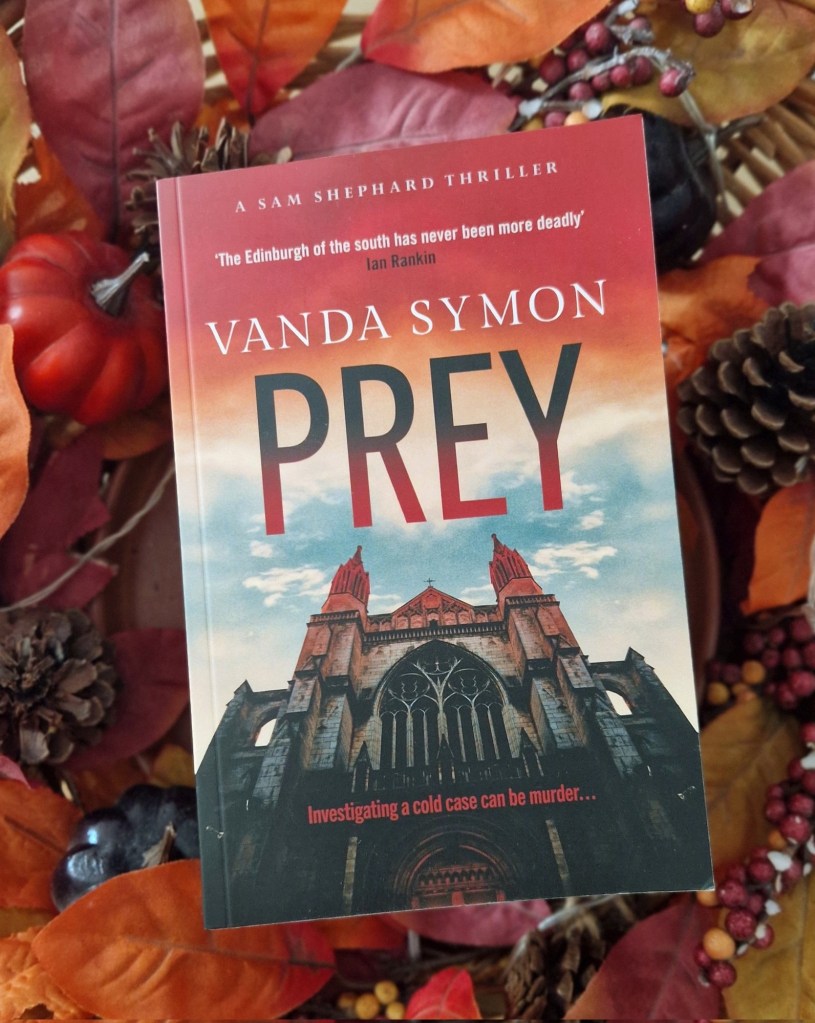
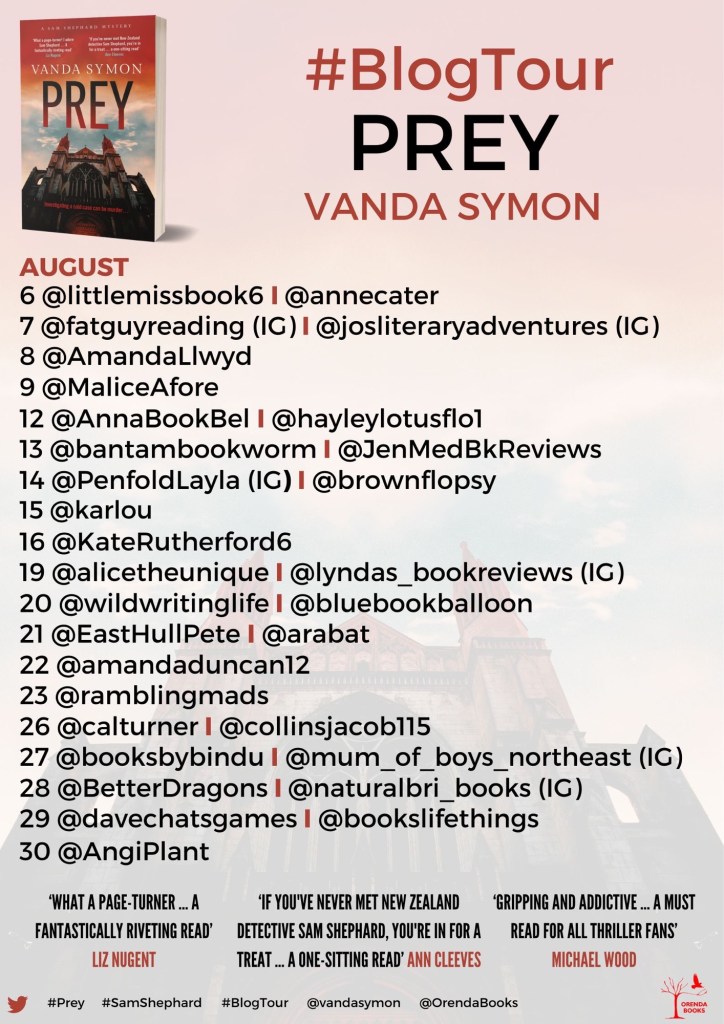
Prey by Vanda Symon 

Sam Shephard is on the verge of returning to work after maternity leave and the traumatic circumstances around Amelia’s birth. In order to make the transition as easy as possible, Paul is staying home with Amelia for the first week Sam returns. As is predictable, her boss DI Johns isn’t the most welcoming and gives her a cold case – the murder of Rev. Mark Freeman outside his own church. There’s one potential issue, Mark Freeman was the father of DI Johns wife Felicity. Felicity’s mother has been diagnosed with cancer and the boss would like her to go to her grave knowing who killer her husband. My first thought was that this had the potential to blow up in his face: he’d be all over her progress, creating conflict of interest for Sam that would be exploited if a case ever went to court. He was also being his typical sensitive self by ensuring that his mother-in-law would spend her final months reliving the most terrible experience of her life. Rev. Freeman was found at the bottom of the stone stairs leading up to the church entrance. He had been stabbed in the stomach by a small knife, but that wasn’t the cause of death. His subsequent fall down the steps broke his neck, immediately cutting off his ability to breathe. Horrifically he was found by his son Callum, who had ventured back out into the pouring rain when his father hadn’t returned home after the service. Yet we know at least one other person witnessed the killing, because the book begins with their anonymous account of the murder. The boss has essentially handed Sam a poisoned chalice and she fears one of two outcomes – she won’t be able to solve the case, so will be held responsible for disappointing his wife and her mother or she will solve it, making the previous investigation seem incompetent and potentially tearing his family apart in the process. If we as readers know one thing, it’s that Sam will not rest until the case is solved. 

I loved the happy family life Sam and Paul have created with baby Amelia. Their relationship feels like a real long-term partnership with the added bonus that Paul is also a detective. They understand that it’s hard for either of them to switch off when they’re working a case, so can happily bounce ideas and theories off each other in the evening. The addition of Amelia to their relationship is something they’ve taken in their stride. It isn’t always easy. There’s a return to work poonami that had me laughing; how do you shit in your own hair? There’s also an afternoon where each thinks the other is picking her up from childcare, but other than this they’re coping well. The author brings home to us the difficulties of being a working mum. Sam misses Amelia and has to call home to check in and hear what they’re doing. There’s also the issue of expressing milk at work, the family room is at her disposal but it feels awkward and isn’t as private as it could be. It doesn’t take long to get used to her new routine though and she’s soon busy using the time to go through interview notes and test out different scenarios. Paul is incredibly supportive, totally backing Sam up in her eventual decision to swap to bottle-feeding. Of course her mother has plenty to say, but she’s besotted with her granddaughter so that helps ease tensions. This is a case that brings up a lot of personal feelings and memories for Sam, because she too was brought up in a church environment and talking to Callum and Felicity, Mark Freeman’s children, brings up some memories of her own that it might be time to disclose. 

“What I hadn’t factored in, though, was the emotional toll it took. The wrench of being away from Amelia when I loved every second of being in her company. The regret about going back to work and putting her into childcare, which felt like paying for someone else to bring up my child. And the guilt over the immense sense of relief I felt at getting away from her and from the relentless demands and responsibility of looking after a baby.”

The Freeman children and their mother are first on the list of people Sam needs to re-interview, but as she suspected, keeping her boss away from her case is difficult. He blows up over the fact she’s interviewed his wife without his knowledge and express permission. He wants all access to the family to come through him, but Sam stands her ground. If his fingerprints are all over this case it doesn’t matter what she finds out. The case would be thrown out of court, a fate even worse than failing to find the killer. I loved how Sam stuck to her guns though and called him out in front of the whole team. He has to stay away from the case and trust her. If he keeps a stranglehold on who she can talk to and what avenue her investigation takes, he will ultimately be responsible for it’s failure. The Freeman family seem lovely, but as Sam knows that’s no indicator of innocence. Sam has had a church upbringing, something I have in common with her, so we know better than anyone that sometimes people hide within a congregation. Their Christianity is a mask, a mask that seems to confer an unquestioning trust on them.  Most people Sam talks to see the Reverend as a saint, but Sam isn’t taken in and knows she just has to ask the right people. Luckily, she has two potential witnesses: Aaron Scott was an operative in an Organised Crime Group and he certainly appears ferocious with his size and his Māori tattoos, then there’s Mel Smythe, former youth leader and now a drunk living in a hostel. What Aaron tells her blows the Freeman’s timeline totally off kilter and gives her a glimpse into an angrier and self-righteous Mark Freeman. Mel was well-known for being a bit of a rebel, mainly because she was gay yet she was still a youth leader. I found myself wondering whether the church was quite progressive after all. Despite her heavy involvement at the church during the time of the murder, she was soon caught up in the aftermath. She also brings throws new light on the case, but only twenty-four hours later she’s dead. Stabbed in the stomach in her lonely and bleak hostel room. 

The author brings up something about church people that I was very aware of as a Christian teenager. They can seem welcoming, hospitable, even saint-like but if you breach one of their most important rules you can meet a completely different side to that person. While they might preach forgiveness, there are certain things they hold true and they are immovable. Aaron certainly places a new spin on the Reverend, with whom he’d had a great friendship. What he overheard that night showed that when faced with a challenge to his Christian values he wasn’t so great at forgiving. Mel Smyth backs up his story with a revelation of her own, a problem that was brought to her perhaps because she was different and lived outside the traditional Christian view of relationships. These new statements show that the original investigation missed so many leads or simply didn’t follow them up. That it took the saintliness of the Reverend and others around him at face value, perhaps because he was a figure of authority in the community. It’s also leading her towards conclusion that the boss isn’t going to like. As the rest of the team, including Paul, take on the Mel Smyth case Sam feels more supported. She knows that Paul and Shortie have her back and trust her methods to get results. I loved how the author gave us more on the relationship between Sam and her mother too, especially now she has a grandchild to dote on. It’s clear to see in any conversation with her mother where Sam’s self-doubt and over-thinking come from. Trying to please a critical parent is a self-defeating task and even here when talking about the Reverend Freeman case, her mother shows a total belief in the church and it’s figures of authority that’s probably hard for us to fathom in this day and age. Yet it gives us some indication of why the original case had been conducted in the way it was and how powerful church figures were several decades ago. 

At the end of the case I felt so sad, that belief in the church and it’s rules were often put before the well-being and love of family and the real and flawed people who make up a congregation. I felt it because I lived it, being a teenager in an evangelical church was no picnic and I got out as soon as I could. I regularly see other waifs and strays who are no longer in the church and thankfully we get a lot of humour and relief or closure from each other. We can say ‘that was a bit mad wasn’t it?’ and hear confirmation that yes, it was utterly bonkers. I was so incredibly proud of Sam to know she was ready to talk to her mother about what happened during those years. It’s common that having your own child triggers feelings about your childhood and how you were parented, especially where there are unresolved issues. It’s no coincidence that in this novel she’s ready to take on the boss and the past, perhaps not just because of Amelia but because of the family unit she’s building with Paul. That was the feeling I took away from this novel overall, it’s main theme is family whether that’s a nuclear family in its most traditional sense, a work family that grows in professions like policing, or a church family. It also gave me a reminder that in all of these relationships, it’s communication and honesty that are the most important facets. If those two things are broken or over-shadowed by authority, a web of secrets and lies are woven that can prove very difficult to unravel. I love Sam, she’s a no bullshit character and at this moment when I am still struggling with my health and keeping up, she gave me some healthy reminders that it’s ok to let things slide a little. This was another great novel in this series, Sam is a character I’d love to go for a drink with and seeing her stand up to her boss was a real highlight! 

“I suspected I’d get bored and frustrated with a life of domestic bliss. I certainly wasn’t cut out to be a domestic goddess. Six months of maternity leave had driven that home. Fortunately for me, I wasn’t aware of anyone dying from a lack of vacuuming, bed-making and not managing to get out of their PJs all day.”

Out in August 2024 from Orenda Books

Meet the Author

Vanda Symon is a crime writer from Dunedin, New Zealand, and the President of the New Zealand Society of Authors Te Puni Kaituhi o Aotearoa. The Sam Shephard series, which includes Overkill, The Ringmaster, Containment, Bound and Expectant, hit number one on the New Zealand bestseller list, and has also been shortlisted for the Ngaio Marsh Award. Overkill was shortlisted for the CWA John Creasey (New Blood) Dagger and Bound and Expectant have been nominated for USA Barry Awards. All five books have been digital bestsellers, and are in production for the screen. She is also the author of the standalone thriller Faceless, and lives in Dunedin with her family.

Posted in Orenda

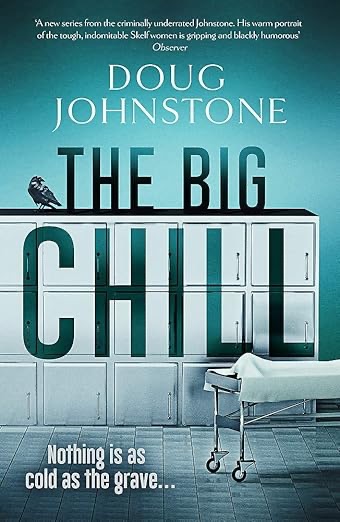
The Big Chill by Doug Johnstone

First posted on publication and being shared as part of #SkelfSummer.

How have I come this far in my reading life without reading Doug Johnstone? The Skelfs are the family I didn’t even know I was missing. To prepare for reading the second novel in Johnstone’s Skelf series, I made the decision to read the first novel entitled A Dark Matter. I couldn’t have imagined this incredible group of women, but now I feel like I know them personally. Set within the city of Edinburgh, this is a family of undertakers and private investigators. Just to set up the kind of family they are, the author places their residence and place of work at No 0 – somewhere that doesn’t exist. Grandmother Dorothy is a Californian lured to Edinburgh after falling in love with Jimmy Skelf who has passed away at the beginning of book one. Dorothy works in the funeral business with employee Archie, but also takes on PI duties and in her spare time teaches spunky young girls to play the drums. Mum Jenny is at a loose end so comes into the family business after her father dies. She jumps into the PI business with both feet, which is how she seems to do most things. Granddaughter Hannah is studying physics at Edinburgh University and lives with her girlfriend Indy. She has a good relationship with her parents and her grandmother. The first book concerns the disappearance of Hannah’s uni friend Mel and the shock when her killer is revealed is seismic, hitting all the Skelf family hard. 

The beginning of The Big Chill reads like the explosive ending of most books. In a scene as comical as it is tragic, Dorothy and Archie are overseeing a routine funeral at the cemetery when sirens start moving closer and drowning out the service. The guests and undertakers stare aghast as a van driven at high speed forces its way through the cemetery gates followed by the police. As the van careers towards them, mourners start to scatter and Dorothy narrowly misses being ploughed into ground, as the van speeds straight into the grave nose first. Dorothy clambers in to check on the driver and finds he has died instantaneously from a head injury. However, what does survive is a scruffy Collie dog she names Einstein to sit alongside Schroedinger the cat. She immediately offers the Skelfs’ services for the man she names Jimmy X but she would like to find a little more out about him before she conducts his funeral. So, Dorothy sets out, with Einstein in tow, to find out how Jimmy X ended up living in a van that literally ‘ended up’ in an open grave. 

Of course, this is only one of the mysteries the women are investigating. Hannah makes friends with an elderly physics professor at university when he asks if she’ll help with a memorial for Mel. Not long after they are performing dual duties for him too, when he dies suddenly and unexpectedly. Hannah can’t accept his death and even if it is just a displacement activity, begins to look into his personal life for answers. Dorothy is overstretched with cases when one of her drumming students doesn’t turn up for practice. This is so unusual because Abi loves to drum and has never missed a lesson. When she visits Abi’s home she is told that she was unwell, but Dorothy senses an undercurrent in the air and eventually finds our that Abi has run away. In order to find her, 70 year old Dorothy will have to start thinking like a 14 year old girl, which isn’t easy when the back ache doesn’t go away as quickly as it used to. The scars of her assault in the previous novel are not just mental. 

Hanging over them all is the trial of Mel’s killer, known intimately to the Skelf women and still keeping a hold over them where he can. Not only did he kill the pregnant Mel but when found out he attacked Jenny. He stabbed her in the stomach and beat Dorothy too. He has found a psychiatrist to claim he was incapacitated by mental illness at the time of the original killing. Even worse he lures Jenny to visit him, then presses charges when she assaults him. In the aftermath, Hannah is drowning. She’s well supported by Indy, but can’t sleep, feels anxious and when under pressure has panic attacks and passes out. It may take a seismic change to shake her from personalising all these difficult life experiences and thinking she is the only victim. She is having counselling, but there’s so much to unpick and she is in danger of ignoring the one person who helps her most. The women usually gather at the end of the day in the kitchen and catch each other up on the days events, but when even that ritual starts to fall apart Dorothy knows her family are stretched to breaking point. Yet, everyone has to heal in their own time and in their own way. She is wondering whether there is life after Jimmy, and whether her long held friendship and working relationship with a certain Swedish police officer, could become more? 

These women are great characters. They’re tough, but still vulnerable. Full of quirky detail and boundless energy. They are also wonderfully good at picking up ‘waifs and strays’. They try not to judge people. I loved Jenny, trekking round homeless shelters and approaching groups in the street, but stopping to pass the time of day or joining them in beer. As someone who is also very good at collecting people, I know how much it widens horizons, teaches us about our own preconceptions and sometimes brings unexpected but wonderful friends. Their arms and their home are open. I found myself thinking a lot about the wonderfully patient and wise Indy, who comes into contact with the Skelfs as a teenager organising her parents funeral after a car accident. She is always quietly working in the background: cooking mouthwatering curries when Hannah hasn’t eaten; taking the reins at funerals when private investigating takes over; listening to bereaved family and respecting the person who died with so much attention to detail. There are such hidden depths here and I found myself hoping that’s explored more in later novels. 

I loved the Edinburgh backdrop. In fact it becomes a character in its own right from the touristy areas, to the student quarter, to the areas that missed regeneration, this is such a varied and richly atmospheric city. I don’t know it well but I feel this has taken me under that tourist facade to find something more interesting. We also see such a variety of people from those on the streets to those who in academia or in private education. Death is a great leveller though and these people are often side by side once they reach Skelf’s undertakers. We also see that these extremes can all be found in one person; there isn’t a ‘type’ that becomes homeless or commits a murder. I also find the way Hannah makes sense of her world through science really interesting. She muses on quantum suicide and whether we, like Schroedinger’s Cat, can be alive and dead at the same time. People often think that science is anathema to concepts like faith, hope and a belief in God. However, there is beauty and wonder in everything Hannah knows about space. 

What I take away most from this book is the way the author writes with bluntness, but also kindness, acceptance and wonder about the human condition and the strange galaxy we call home. Hannah muses on the end of the universe with her counsellor: 

‘stars will stop forming, the sun will wink out, the solar system will collapse. Then in the black-hole era galaxies disband, all proton matter decays, supermassive black holes swallow everything, then they’ll evaporate too, all the energy and matter in the cosmos gone […] it’s called the big chill’. 

Hannah comments that it’s not such a bad way to go, but her counsellor reminds her that it’s a long way into the future. Dorothy has the same thoughts as her mind is flooded with images of everything they’ve experienced. She has felt the cold, icy creep of death: 

‘death so close that she could feel its breath on her neck, could smell it every day when she woke, could feel its icy touch spreading from her mind to her limbs’. 

So she sits behind her drums, plays the Black Parade album by My Chemical Romance, and starts to tap out a rhythm until she can feel the music within her, warming her veins and bursting to life. While we’re here we have to find a way to keep living. 

Shared as part of #SkelfSummer

Meet the Author

Doug Johnstone is the author of fifteen novels, most recently The Space Between Us (2023). Several of his books have been bestsellers, The Big Chill (2020) was longlisted for the Theakston Crime Novel of the Year, while A Dark Matter (2020), Breakers (2019) and The Jump (2015) were all shortlisted for the McIlvanney Prize for Scottish Crime Novel of the Year. He’s taught creative writing and been writer in residence at various institutions over the last two decades including festivals, libraries, universities, schools, prisons and a funeral directors.

Doug is a Royal Literary Fund Consultant Fellow and works as a mentor and manuscript assessor for many organisations, including The Literary Consultancy, Scottish Book Trust and New Writing North. He’s been an arts journalist for over twenty years and has also written many short stories and screenplays. He is a songwriter and musician with six albums and three EPs released, and plays drums for the Fun Lovin’ Crime Writers, a band of crime writers. He’s also co-founder of the Scotland Writers Football Club.

Posted in Squad Pod Collective

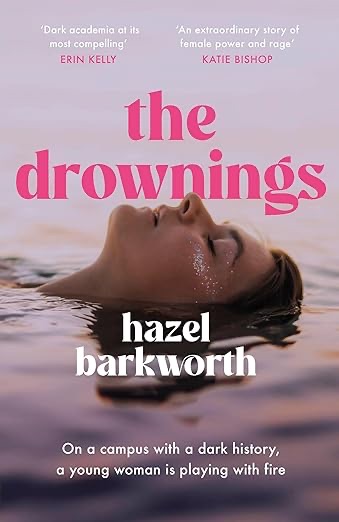
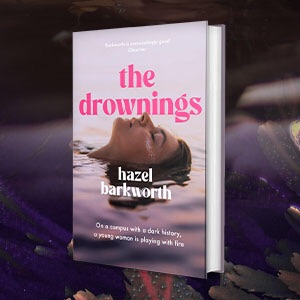
The Drownings by Hazel Barkworth

This is a fascinating read from Hazel Barkworth, capturing so much about the times we’re in while also exploring themes of identity, obsession, use of social media and modern day witch-hunts. Serena was born to swim. Her body is honed by years of training to be the best. When she thinks about her body, she imagines it sleek and pointed like an arrow shooting through the water. Her trainer Nico thinks she can go as far as the Olympics and within the family her winning streak makes her the centre of attention. Then one day it all goes wrong, because despite her training, focus and visualising the win, she loses. She can’t fathom why or what went wrong, but to add to her shock she then slips in the changing area and damages her knee. Now she’s on crutches and cannot swim at all. She knows she will not be ready to meet the next Olympics and the disappointment is crushing. Even worse, within her family, attention shifts to her cousin Zara. Zara has always had issues with her body image, but started an Instagram account promoting body positivity. Her curated Insta in shades of peach, teal and gold, is gathering momentum. She is blossoming in her success and has enough followers for companies to start sending her free products in the hope she might promote them. Just as Zara is making peace with her body and finding success, Serena has no idea who she is. With most of her time previously taken up with diet, exercise, warm-ups and time-splits, she doesn’t recognise herself. Her body only had one purpose and now it’s let her down. How can she be Serena, when the Serena she knew doesn’t even exist any more?

Serena decides to take up a place at university, at Leysham Hall, where her cousin already has a place. Here they both fall under the spell of their feminist lecturer in history, Jane. Serena meets her entirely by accident when walking the grounds one night. She sees a young woman poised by the edge of the river, that rushes downstream at this point of the campus. There have been warnings about this stretch of water, young women going missing and discussions about lighting the area always come to nothing. When the girl disappears, Serena rushes forward to help her. There is no hesitation when she realises the girl isn’t a strong swimmer and is in serious trouble. She leaps in and then Jane appears, just in time to help Serena bring the girl up to the surface and out. She doesn’t notice much about her that night, but she does end up in Jane’s history tutorial group and from that point on she feels drawn to the academic. It’s not a sexual attraction, she doesn’t want to be with her, it’s more that she wants to be like her. She loves the unfussy but stylish way that Jane dresses. She admires the knowledge and passion she has about her subject. Totally at odds with her dress sense, Jane’s tutorial room is a riot of colour turning the functional and boring space into something cozy and colourful. There are so many mementoes of places she’s been, feminist posters, colourful rugs and cushions. Mostly, I felt Serena is drawn to the fact that Jane seems so entirely sure of who she is.

A few of my reads this year have touched on a couple of very specific themes and when I thought about why, I could see that this is a product of the times we’re in. There’s the theme of witches and the witch hunting of the 17th Century which grew rife due to the obsession of James I /James VI of Scotland. The second was the influence and power gained by becoming part of all-male, elite, private school gangs like the Bullingdon Club, a club in which David Cameron, Boris Johnson and George Osborne were all members. The club carried out ‘pranks’ such as trashing the restaurant they met in and simply fixing the problem with family money. They burned ten and twenty pound notes in front of homeless people. I also believe this club may have been the source of the Infamous David Cameron and pig story. At Serena’s college it’s the Carnforth Club, named after their school founder they are robed from head to foot to keep their identities secret. As far as witches go, the words witch-hunt are being co-opted by men in powerful positions who don’t like it when their actions have consequences. We have seen it in the aftermath of the #MeToo movement, where men who are finally facing courts of law after years of abuse and sexual assault allegations, are claiming they are victims. The most recent is Russel Brand who has used his YouTube channel to protest his innocence, but has the tried to rehabilitate himself by becoming ‘born again’ and hiding within the Trump family, of all places. These and other men like Prince Andrew. Kevin Spacey, Jeffrey Epstein and Harvey Weinstein have all used the excuse that the media want to take them down. However, it’s not a witch-hunt when you’re one of the most privileged demographics of the world. If you’re moaning about witch-hunts you must genuinely be a victim and since most of these men are always punching down, I think we’re being gaslit.

The original witch-hunts were brutal and targeted mainly women. Jane tells them that witch trials took place where they now study and in fact, the place where Serena had jumped in to rescue a student was where witches were ducked. After a brutal interrogation that included torture, coercion and violation, suspected witches were taken to a river and ‘ducked’. If they drowned they were innocent but if they lived they were declared a witch and burned alive. Jane places this within a feminist framework. We know that ‘witches’ were usually women who lived alone, earned their own living from medical and herbal knowledge, often helped deliver babies in their area and helped other women. By offering advice on things like fertility, preventing pregnancy and helping girls in trouble, local ‘wise women’ gave the women around them some control and autonomy when it came to their own bodies. A woman like his is a threat to men and to the teachings of the established church. No wonder James I worked to the edict from Exodus ‘ thou shalt not suffer a witch to live’. Working as a counsellor and in chronic pain management for years I often realise I have quite a few friends who might come under suspicion from the witch finders.

Both Serena and Zara are dazzled by Jane, Serena has even wondered if Jane and Zara may be attracted to each other. Using Zara’s quite considerable social media platform, they encourage young women in the college to speak out about any sexist and misogynistic treatment they’ve suffered there, particularly if linked to the Carnforth Club. They are soon inundated with messages alleging everything from online abuse to sexual assault. Their anger comes to a head one night at a rally where both Zara and Jane will speak to any of the students who will turn up. Round a campfire they start to share their stories, with the evening rounded off with a call to arms. They must campaign for change. At the crucial moment, Zara is expecting the megaphone to be passed over, but instead Jane chooses to hand it to Serena. Fired up by the atmosphere Serena dives in and starts to rally the women and she is inspired. The night ends as Serena starts to lead a ritualistic dance and before she knows it she’s the leader, whipping up the women into a frenzy as they take off their clothes and follow her. Next day Serena is a little bemused at what happened, but it felt right at the time and she went with it. Even as she goes to sleep, someone is sharing a photograph of her naked and marching in the light from the campfire. It’s sent to the whole college. In the aftermath, Jane wants them to keep up the momentum and break into the hall, where a portrait of the college founder and instigator of the Carnforth Club has pride of place. While most of the group are happy to break in and cause mischief, Jane is considering something much darker and more dangerous. Will everyone go along with her plan? Since the rally, Serena has noticed that Zara is not herself. She seems to have lost some of her audience and her confidence seems to be following. Now that Serena is finding herself, it seems that Zara is losing herself.

The tension really builds here as the author takes us into final third of this thriller and I was fascinated to see how it turned out. I felt for Serena who seems to have found confidence and a sense of what kind of woman she wants to be, but is it real? She struck me as one of those children who’ve been pushed into specialising too early in life with no back-up plan. In all those dark, early mornings at the pool and the times she had to say no to social occasions to train, there’s someone who isn’t allowed to explore who she is and what she enjoys. Her time is so limited and she doesn’t form any meaningful friendships either. How do we know what we love in life if we’ve never tried anything else? She also has a very distant relationship with her own body that’s merely an athletic instrument. She’s used to ignoring aches and pains, divorcing her mind from how far she’s pushing her growing body and never seeing her it as a source of pleasure. Then suddenly she’s surplus to requirements and has no other plan. Placed into the chaos of fresher’s week and meeting so many different and strong characters must be bewildering. When people ask about herself, who is she? She struck me as a borderline personality, who takes on the issues and characteristics of whoever she’s with. She’s vulnerable, used to obeying authority figures and having them control everything down to her food. Zara seems equally fragile though, growing up in the shadow of a cousin who might go to the Olympics is not easy. She’s so proud of her influencer award and in a way, her Insta has been as much about her own validation and acceptance of her body, as it has about inspiring others. Once her star begins to fade, Zara’s confidence plummets and she becomes desperate to make her mark. The author shows us how fragile today’s young women can be with misogyny seemingly rife and the added pressure of a global audience on social media. I wasn’t sure how far either of these girls might go to impress their tutor and display who they are. That’s if this is who they are? This was a brilliant contemporary thriller that asks serious questions about how the authentic self forms within this confusing and dangerous world.

Published 1st August by Review.

Meet the Author

Hazel grew up in Stirlingshire and North Yorkshire before studying English at Oxford. She then moved to London where she spent her days working as a cultural consultant, and her nights dancing in a pop band at glam rock clubs. Hazel is a graduate of both the Oxford University MSt in Creative Writing and the Curtis Brown Creative Novel-Writing course. She now works in Oxford, where she lives with her partner. Heatstroke was her first novel and The Drownings is her second.

Posted in Paperback Publication

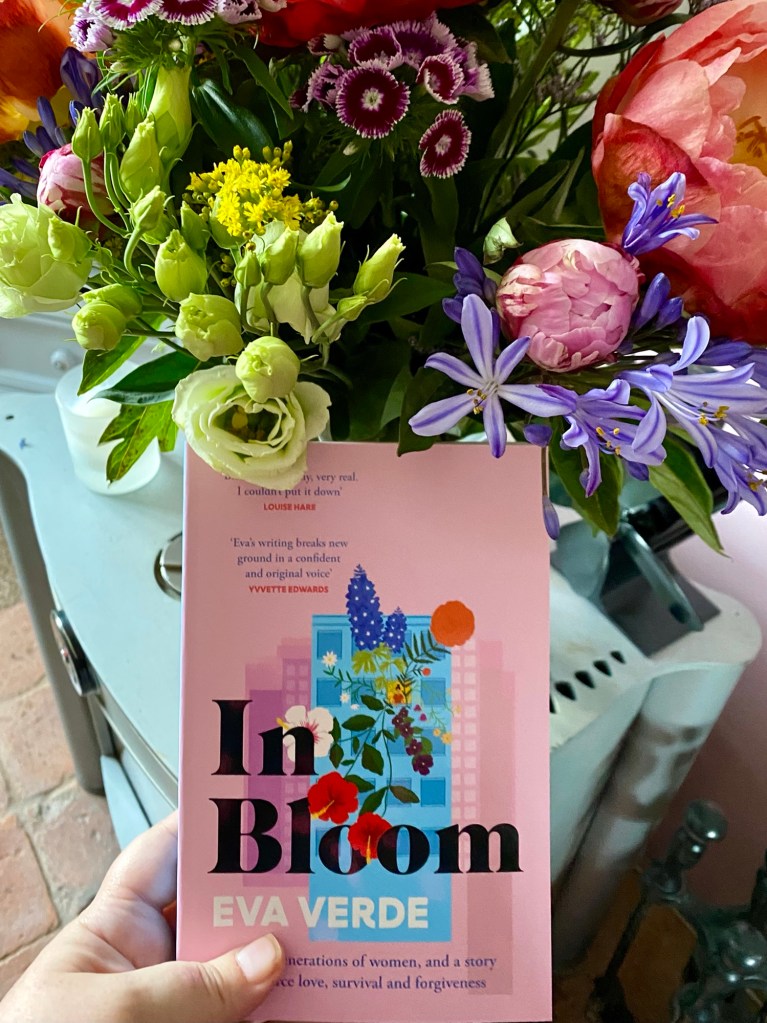
In Bloom by Eve Verde

‘This is my family story. From all I’ve sown together, through all I couldn’t ask. I want to be the bud who makes it.’

In Bloom tells of strength, survival, forgiveness, resilience and determination, and the fierce love and unbreakable bonds between mothers and daughters.

Ever since Sol’s untimely death left her pregnant and alone at twenty-two, Delph’s kept herself small as a form of self-protection. Now, over a decade later, she lives with their daughter Roche and her new partner Itsy, a kind and protective cabbie, on the fourteenth floor of Esplanade Point on the Essex coast.

But Delph’s protective bubble bursts when Roche moves in with her estranged nan, Moon. Feeling on the outside of the bond between her fierce-yet-flaky tarot-reading mother and volatile martial-arts-champion daughter, Delph begins questioning her own freedom. And when Roche’s snooping into her grandmother’s past unearths a familial line of downtrodden women; a worrying pattern emerges. Has keeping small and safe truly been Delph’s choice all these years…?

I’m hosting the paperback blog tour for this wonderful book today and it’s lost none of its charm and power since I read it last year. I don’t believe in trigger warnings, despite their intended purpose to flag up material that may ‘trigger’ difficult emotions in the reader, I feel that they might stop someone experiencing a connection with a text. It might well be a trigger, but that doesn’t always have to mean it’s a negative one. It might be a trigger that starts a healing process. If anyone should have avoided this book it was me, because I was Delphine. I lost the love of my life in my early thirties and then sleepwalked into a coercive and damaging relationship. Yes, it was a hard read at times, but it wasn’t a remotely negative experience. Moon, Delphine and Roche are three generations of a family. Each woman has her own issues, but they all stem from one place. Right back at the beginning.

As the book opens Roche can no longer live with her mother and Itsy, the man she’s been living with for most of Roche’s life. So she decamps to her grandmother Moon’s house. Roche can’t stand Itsy, he dislikes her and wishes she wasn’t there. In fact what he wants is Delphine all to himself, it’s easier to control someone who’s isolated. Delphine has had a glazed over look ever since he arrived in her life and she doesn’t seem like her mum anymore. Delphine has done everything she can to keep Itsy happy. She’s changed how she dressed, made herself less beautiful, stayed at home and stopped going out with friends. Every day she makes herself smaller to make more space for him and Roche can’t watch it anymore. However, things are changing slowly. Delphine has a job she enjoys at B & Q, new connections with her colleagues and today she has made a choice. Delphine is pregnant and she knows deep down in her soul that ‘the thought of more years, more life, tied to him’ is more than she can bear. She goes quietly on her own for an abortion, the quietest but most powerful act of rebellion she can make. Then comes her opportunity, Itsy receives a phone call from Jamaica to tell him his mother is dying. He must jump straight on a flight, so Delphine lets him go alone, knowing that now she has several weeks to herself. She doesn’t stop Roche from moving out and accepts this as her time to heal, time to be the parent that so often Roche has to be for her. However, this isn’t the only recovery needed in the three generations of this family thanks to the actions of men.

I felt at first that I was slowly piecing together the story of a client. Being a person- centred therapist means letting the client choose what they want to talk about. I would use my counselling skills to tease out that story and ask questions where it needs to be clarified or where I might only be getting one perspective. Here the story has it’s own pace and each woman narrates her own section. We flit back and forth, also delving into the past here and there and it’s like doing a jigsaw puzzle but only being handed one piece at a time, then another from a different angle. It takes some time to perceive the whole and that was definitely the case here. Only we the reader can see where they all are in relation to one another. The reality of being a woman in today’s world is explored fully, there is no doubt that these women’s lives would have been immeasurably better had they not encountered men. It takes Roche to articulate this properly with the words and wisdom of her generation.

“Roche knows, remembers, how her life changed at around the time she started secondary, and her bubble of invisibility popped. How, despite the school uniform screaming otherwise, she very suddenly became the inhabitant of a woman’s body, complete with a depressing self-awareness that this was now Roche’s life until one day men deemed her invisible again. In fairness, it’s not her contemporaries who usually do the perving – no, it’s men, grown–ass men who have always done the bulk of the wolf–whistling, the innuendoes and basic compliments that they expect her to ‘smile, love’ and be grateful for.”

As a middle aged woman I now know the power of that invisibility and how, in many ways, it’s a blessing.

I love how carefully the author drew the threads between generations, those behaviours that create a pattern of intergenerational trauma. There are moments in her journey where Delph needs her daughter by her side, but she recognises that it’s a selfish need. Delphi’s lived experience stops her; “is not for a child to fix the parent. Nor is Roche the ointment to Delph’s current troubles”. Then we go back into her mother Moon’s early years, when her grandmother is in hospital, suffering from mental ill health. Her name was still Joy back then and her job is to dispense sunshine to a women who can’t even remember her name. ‘Come on,’ Ma says, in a giddy-up way. ‘You know how happy your little face always makes her.’ This a learned behaviour, people pleasing and exactly what Delph is trying to avoid for her own daughter, three generations later. By sitting with her own pain, Delph is avoiding instilling that behaviour in her own daughter, she’s actively breaking the cycle. Yes, there are traumatic moments in these women’s lives, Moon’s story being particularly harrowing, but we can also see the women’s determination to change. It’s that change and what it means for Roche that brings such an uplifting feeling to the book. For me it’s Delph’s struggle that touched me deeply. The loss of Sol, who’d been there her entire life, is devastating. So moving out of Itsy’s orbit and the mental paralysis she’s been living with means opening up her emotions. That’s all of the emotions including her grief, but it’s a process that needs to happen so that Roche can talk about her father openly and in a joyful way. I found myself more engrossed in the later stages of the book as I had to see whether these women could heal together. This is beautifully written and manages to be funny, moving and hopeful.

Posted in Squad Pod Collective

The Final Act of Juliette Willoughby by Ellery Lloyd

Having just read about female surrealist artists in The Paris Muse by Louise Treager I was so ready for this story about the art world, women painters and a mystery surrounding British artist Juliette Willoughby. The writers tell their story across three timelines. In 1938, Juliette Willoughby is living and painting alongside her lover Oskar in Paris. A British heiress, she left her family and their money behind for a life as an artist who is best known for her painting ‘Self-Portait as Sphinx’, thought to be lost in a studio fire where she also lost her life. We meet our main characters Caroline and Patrick at Cambridge in 1991, where they are both studying art history and specialise in the Surrealists. They are sent to the same dissertation supervisor and while researching come across something sinister about Juliette’s death. Their investigations may expose terrible secrets about the Willoughby family, who are acquaintances of both students and aristocrats who don’t want their family history out in the open. Our final timeline is present day Dubai where Patrick is an art dealer and lives with his wife. Caroline is now an academic and expert on Surrealism, especially Juliette Willoughby so when a new Self-Portrait as Sphinx is uncovered he asks her to fly to Dubai and authenticate the painting. A sale is on the cards and Patrick needs to know if this painting is a second version by the artist and potentially worth millions. He plans a night for collectors to view the painting and offer sealed bids, but the night ends with Patrick in a cell accused of murdering one of his closest friends – the last surviving member of the Willoughby. There are now three suspicious deaths linked to this painting, but can Caroline unlock the mystery before Patrick is charged with a crime he didn’t commit?

I have a real interest in art history and the lives of artists, probably formed when I studied Victorian art history as part of my literature degree. My particular interests are the Pre-Raphaelites, the Arts and Crafts movement, Klimt and Frida Khalo, so it was brilliant to learn more about the Surrealists who are outside of my experience. My only understanding is that the artists may be representing the contents of their subconscious rather than the conscious. I can be a little bit scathing of some modern art, having my teenage years in the 1990s we were in the world of the YBAs – such as Damien Hurst and Tracey Emin. I have been to gallery openings where I could only conclude that other people had an ability to see something I couldn’t or that everyone was affected by a dose of the Emperor’s New Clothes – too scared to say anything negative they just nodded along and agreed it was good. I will never grasp why people spend a fortune on paintings that are nothing more than a red square on a beige background. As you can imagine, I drove my artist friend crazy when we visited the Guggenheim in NYC. I understand a piece that hits you in the emotions or a true passion to own and look at something incredibly beautiful every day, but it seems that more often than not investors pay millions for something that will sit in a storage unit. I thought I might find the art world in the book pretentious, but I could understand Caroline’s deep fascination with Juliette. There’s something about a female artist, often overshadowed by the man she lives with, that brings out the feminist in me. From Dora Maar whose photography and painting was eclipsed by Picasso to authors like Zelda Fitzgerald, thought to have contributed greatly to F. Scott Fitzgerald’s writing, there’s an urge to uncover their talent and put them in their historical context. This is the passion of Caroline, but Patrick is definitely complicit in trying to solve the mysteries the this particular painting found at a party in the Willoughby mansion.

This story has all the ingredients of a good old-fashioned mystery with the archetypal eccentric aristocratic family at it’s centre. Juliette’s father is an Egyptologist who never got over the death of her younger sister Lucy who drowned in the lake. Juliette is aware that she can never measure up to the baby of the family, who never reached her teenage years or tested her family. After her death, her father built a pyramid shaped sarcophagus on the island in the middle of the lake. Close to Lucy’s death, a maid disappeared from the house and then Juliette’s cat went missing too. Keeping the Egyptian theme was the club the Willoughby men formed at university, which had several similarities to the Bullingdon club. It was like an American college fraternity with it’s own initiation tests, pranks and hazing rituals. All members wear a signet ring with an Egyptian hieroglyph. Patrick was friends with both Harry and Freddie Willoughby, but the brother’ enmity for each other ran deep. At the party attended by Caroline and Patrick, Freddie disappeared after falling from some scaffolding during an argument with his brother. The amount of blood left behind would indicate a severe head injury but he is nowhere to be found, much to the distress of his girlfriend Athenia. It’s this same night when Caroline finds Juliette’s masterpiece and her diary. On impulse she takes the painting, wraps it carefully and places it in the boot of Patrick’s MG. What can she do with it from here and will the Willoughby’s know that it’s gone? Patrick suggests it’s placed in a small country sale where it’s value will go under the radar and they should be able to legitimately buy it, yet the unthinkable happens and the painting soars above when they can afford. Caroline still has the diary though and through it we can hear about her life with Oskar and the inspiration for the painting. She brings 1930s Paris alive for us a d provides clues to the symbolism of her Sphinx painting.

Finally, these sections are interspersed with the present day where Patrick has asked Caroline to come to Dubai. This is all the more tense because she is his ex-wife and Patrick has remarried. He wants her in Paris to answer questions that potential investors might ask. How can she know this piece is by the same artist as the 1930’s painting and is it from the same time period? There are differences in the smaller narrative parts of the painting in the background, why would the artist change them? Soon the presence of the painting brings other people from the past into Dubai, including Freddie’s girlfriend from the 1990’s Athenia. She is advising one investor who wants to remain nameless and as they all gather to make their bids in just one night it becomes clear that Patrick and Caroline’s reputations hang in the balance. However, it’s Patrick who finds himself in a cell, losing his standing, his financial future, his liberty and possibly even his marriage. What could have gone so wrong? This is such a complex mystery and as we get closer to unravelling some of the secrets, the tension starts to build. It definitely grips you and keeps the pressure on. I loved the history unravelled through Juliette’s diary and her take on what it’s like to live and work alongside another artist. There’s a certain point where I found myself reaching for the book in my downtime more than putting on the TV or radio. It’s a real skill to build tension like these authors do, slowly but surely sucking you in. You will find that you want the answers as much as Caroline and Patrick do. I also thought there were more tangled questions than they could ever resolve, but keep going. It’s definitely worth it and there are no loose ends left untied. I found myself focused on Juliette, Caroline and Patrick more than any other characters. Others are definitely hard to like – especially those with the hint of the Bullingdon Club in their pasts and a sense of elitist entitlement in their characters. These are people who will commit any sort of crime to keep their status and the respectability of their family. I found this attitude strangely believable in the recent political climate where lies and cover-ups seem to be the norm. I was amazed how well it was all tied-up and how the author used distraction and first person narrative to make sure we only read what they wanted us to. The novel moves effortlessly from writer to writer and I wouldn’t have known it was a writing team. They are masters at letting us into some secrets while shielding others until later on, right up until the last few pages.

Out now from Pan MacMillan

Meet the Authors

Ellery Lloyd is the pseudonym for New York Times bestselling husband-and-wife writing team Collette Lyons and Paul Vlitos.

Collette is a journalist and editor, the former content director of Elle (UK) and editorial director at Soho House. She has written for The Guardian, The Telegraph, and the Sunday Times.

Paul is the author of two previous novels, Welcome to the Working Week and Every Day is Like Sunday. He is the program director for Professor of Creative Writing at the University of Greenwich.