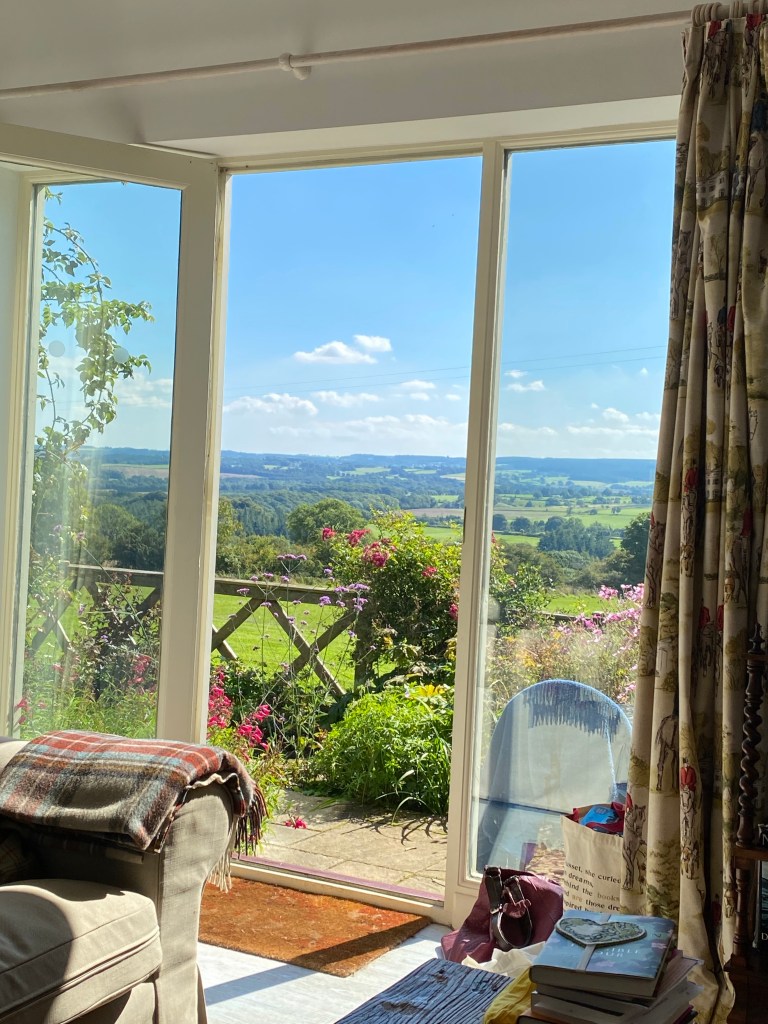
I don’t know how many of you have come across the term ‘glimmers’ but it’s one I love and notice more and more, it’s about finding joy in the everyday, but not expecting to feel cock-a-hoop all the time. Instead recognise those moments when we’re stopped in our tracks by something beautiful – a sight or a sound, but any combination of the senses is okay. In that moment we are purely happy. Glimmers are the opposite of triggers. Where triggers might send us spiralling back into negative emotions, glimmers do the opposite, a mixture of happiness, wonder, calm and contentment. The word was coined by social worker Deb Dana who suggested that in between moments of extreme joy – getting married, getting your dream job – we need to look for micro joys. They may be fleeting moments, but the more we stop and enjoy them they can have a very positive effect on our mental well-being. In an article in Stylist magazine, clinical psychologist at Headspace Dr Sophie Mort describes them as ‘safety cues’ that tell the nervous system we’re okay.
“Glimmers don’t tend to lead to euphoric moments; instead, they gently nudge us towards ease, relaxation, connection and a feeling that the world is OK. And, they can be fleeting. We will all have our own specific brand of glimmers and they can be found in a number of different places and senses.”
https://www.stylist.co.uk/health/mental-health/glimmers-how-to-spot/814102 18/09/23
Their list of possible glimmers included:
- A phone call from your best friend
- Watching your favourite tv show
- Cuddling pets
- Being in nature – from a walk in the woods to watching the stars
It made me realise that I get these moments when I read quotes or passages from one of my favourite novels. Those moments where you read a paragraph then pop the book down for a minute to soak in the words. There are some that whenever I hear them I notice myself smiling, they bring such joy into every day life! I’m going to share with you my twelve literary glimmers.
1. “And at home by the fire, whenever you look up, there I shall be — and whenever I look up, there will be you.“ Far From the Madding Crowd Thomas Hardy
2. “His heart beat faster and faster as Daisy’s white face came up to his own. He knew that when he kissed this girl, and forever wed his unutterable visions to her perishable breath, his mind would never romp again like the mind of God. So he waited, listening for a moment longer to the tuning fork that had been struck upon a star. Then he kissed her. At his lips’ touch she blossomed like a flower and the incarnation was complete.” The Great Gatsby F.Scott Fitzgerald
3. “It has always seemed to me, ever since early childhood, amid all the commonplaces of life, i was very near to a kingdom of ideal beauty. Between it and me hung only a thin veil. I could never draw it quite aside, but sometimes a wind fluttered it and I caught a glimpse of the enchanting realms beyond-only a glimpse-but those glimpses have always made life worthwhile.” Anne of Green Gables by L.M Montgomery
4. “This was the simple happiness of complete harmony with her surroundings, the happiness that asks for nothing, that just accepts, just breathes, just is’. The Enchanted April by Elizabeth Von Armin
5. “The wood was silent, still and secret in the evening drizzle of rain, full of the mystery of eggs and half-open buds, half unsheathed flowers. In the dimness of it all trees glistened naked and dark as if they had unclothed themselves, and the green things on earth seemed to hum with greenness.” Lady Chatterley’s Lover by D.H.Lawrence
6. “George had turned at the sound of her arrival. For a moment he contemplated her, as one who had fallen out of heaven. He saw radiant joy in her face, he saw the flowers beat against her dress in blue waves. The bushes above them closed. He stepped quickly forward and kissed her.” Room With A View by E. M. Forster
7. “almost met in the middle. From either hand the notes of the small birds that had not yet given up singing went winging out across the water, and so quiet it was that though they were only such thin songs as those of willow wrens and robins, you could hear them all across the mere. Even on such a burning day as this, when I pulled the honeysuckle wrathes, there was a sweet, cool air from the water, very heady and full of life. For though Sarn was an ill place to live, and in the wintry months a very mournful place, at this one time of the year it left one dreaming of sorrow and was as other fair stretches of wood and water. All around the lake stood the tall bulrushes with their stout heads of brown plush, just like a long coat Miss Dorabella had. Within the ring of rushes was another ring of lilies, and at this time of the year they were the most beautiful thing at Sarn, and the most beautiful thing I’d ever seen. The big bright leaves lay calm upon the water, and calmer yet upon the leaves lay the lilies, white and yellow. When they were buds, they were like white and gold birds sleeping, head under wing, or like summat carven out of glistering stone, or, as I said afore, they were like gouts of pale wax. But when they were come into full blow they wunna like anything but themselves, and they were so lovely you couldna choose but cry to see them. The yellow ones had more of a spread of petals, having five or six apiece, but the white ones opened their four wider and each petal was bigger. These petals are of a glistening white within, like the raiment of those men who stood with Christ upon the mountain top, and without they are stained with tender green, as if they had taken colour from the green shadows in the water. Some of the dragon-flies look like this also, for their lacy wings without other colour are sometimes touched with shifting” Precious Bane by Mary Webb
8. “If you listen, you can hear it. The city, it sings. If you stand quietly, at the foot of a garden, in the middle of the street, on the roof of a house. It’s clearest at night, when the sound cuts more sharply across the surface of things, when the song reaches out to a place inside you. It’s a wordless song, for the most, but it’s a song all the same, and nobody hearing it could doubt what it sings. And the song sings the loudest when you pick out each note.” If Nobody Speaks of Remarkable Things by Jon McGregor
9. “Every life has its kernel, its hub, its epicentre, from which everything flows out, to which everything returns. This moment is the absent mother’s: the boy, the empty house, the deserted yard, the unheard cry. Him standing here, at the back of the house, calling for the people who had fed him, swaddled him, rocked him to sleep, held his hand as he took his first steps, taught him to use a spoon, to blow on broth before he ate it, to take care crossing the street, to let sleeping dogs lie, to swill out a cup before drinking, to stay away from deep water. It will lie at her very core, for the rest of her life.”
“He feels again the sensation he has had all his life: that she is the other side to him, that they fit together, him and her, like two halves of a walnut. That without her he is incomplete, lost. He will carry an open wound, down his side, for the rest of his life, where she had been ripped from him. How can he live without her? He cannot. It is like asking the heart to live without the lungs, like tearing the moon out of the sky and asking the stars to do its work, like expecting the barley to grow without the rain.” Both from Hamnet by Maggie O’ Farrell
10. One by one, the snowflakes floated down on to his warm snout, and melted. He reached out to grab them so he could admire them for a fleeting moment. He looked towards the sky and watched them drift down towards him, more and more, soft and light as a feather. “So that’s how it works,” thought Moomintroll. “And I thought somehow that the snow grew from the ground up!” Moominland Midwinter by Tove Jansson
11. “One of the strange things about living in the world is that it is only now and then one is quite sure one is going to live forever and ever and ever. One knows it sometimes when one gets up at the tender solemn dawn-time and goes out and stands out and throws one’s head far back and looks up and up and watches the pale sky slowly changing and flushing and marvelous unknown things happening until the East almost makes one cry out and one’s heart stands still at the strange unchanging majesty of the rising of the sun–which has been happening every morning for thousands and thousands and thousands of years. One knows it then for a moment or so. And one knows it sometimes when one stands by oneself in a wood at sunset and the mysterious deep gold stillness slanting through and under the branches seems to be saying slowly again and again something one cannot quite hear, however much one tries. Then sometimes the immense quiet of the dark blue at night with the millions of stars waiting and watching makes one sure; and sometimes a sound of far-off music makes it true; and sometimes a look in someone’s eyes.” The Secret Garden by Frances Hodgson Burnett
12. The Peace of Wild Things
When despair for the world grows in me
and I wake in the night at the least sound
in fear of what my life and my children’s lives may be,
I go and lie down where the wood drake
rests in his beauty on the water, and the great heron feeds.
I come into the peace of wild things
who do not tax their lives with forethought
of grief. I come into the presence of still water.
And I feel above me the day-blind stars
waiting with their light. For a time
I rest in the grace of the world, and am free.”
Wendell Berry.

 The Lotus Readers